Latest Articles

I Think Pandora and John Had a Secret Fight

Hal

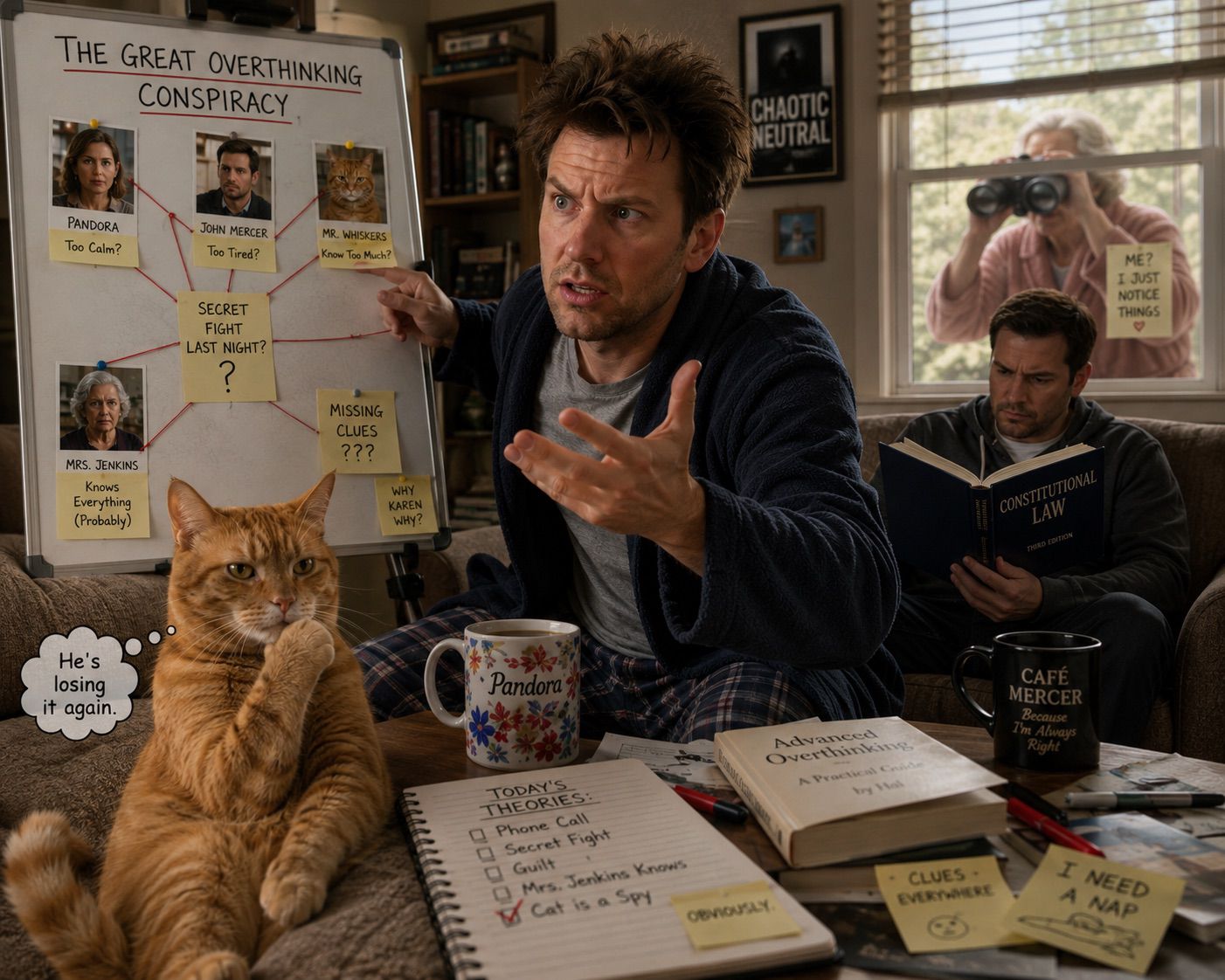
John Mercer looked exhausted this morning, and that was the first clue. He shuffled into the kitchen with the unmistakable expression of someone who had spent the night wrestling with either insomnia or an exceptionally difficult crossword puzzle. He opened the refrigerator, stared into it for several thoughtful seconds without taking anything, closed the door, stood there as though considering his life choices, and then opened it again. After pouring himself a cup of coffee, he mumbled something that sounded vaguely like “morning” before disappearing into the living room. It wasn’t like him. John was usually awake before I was, even before coffee. Today he looked like someone had borrowed six hours of his sleep and forgotten to return them. I was about to dismiss it as one of those mornings everyone has when I happened to glance at my phone.

Pandora had sent me a text the night before apologizing for missing movie night. She’d ended up staying out later than expected with coworkers after work and said she’d catch up with us another day. It was an ordinary message, almost painfully ordinary, yet something about it bothered me. Why had she specifically mentioned coworkers? Nobody had asked where she’d been. She could have simply said she couldn’t make it. Instead, she’d volunteered an explanation before anyone had questioned her. My brain immediately filed that away under “Interesting,” which, in hindsight, is probably where things began to unravel. If Pandora hadn’t been here, why did John look like he’d barely slept? The two facts had absolutely nothing connecting them, which unfortunately left plenty of room for my imagination to build a bridge anyway.

The theory developed far more quickly than I care to admit. Perhaps Pandora and John had talked on the phone after she’d left work. Maybe the conversation had started innocently enough before drifting into one of those awkward misunderstandings where neither person is technically angry, yet both hang up wondering whether they should have said something differently. John’s quiet mood this morning suddenly seemed less like exhaustion and more like emotional recovery. Pandora’s unusually detailed text began looking less like friendly communication and more like someone establishing an alibi before anyone even suspected a crime had occurred. I knew how ridiculous that sounded, but ridiculous ideas have a remarkable habit of becoming convincing when you spend enough time alone with them.

Mr. Whiskers jumped onto the couch beside me and stared directly into my face with the calm confidence that only an orange tabby can possess. He didn’t meow. He didn’t blink. He simply watched me as though patiently waiting to see how long it would take before I reached the wrong conclusion. Cats notice things people miss—or at least that’s what I told myself. Maybe he’d sensed tension the night before. Maybe he’d overheard something. Then again, maybe he simply wanted breakfast. Unfortunately, both explanations seemed equally plausible, so I made the mistake of giving them equal weight. When a cat refuses to provide context, it’s remarkably easy to project your own theories onto him.

As if the universe had decided to encourage my nonsense, I ran into Mrs. Jenkins while checking the mail. She smiled warmly and said, “Interesting evening yesterday,” before continuing on her walk without another word. Interesting. Not quiet. Not pleasant. Not busy. Just…interesting. She couldn’t have chosen a more dangerous adjective if she’d planned it. Mrs. Jenkins notices everything that happens around the neighborhood, often before the people involved notice it themselves. Had she seen Pandora stop by? Had she overheard a conversation? Had she witnessed the aftermath of an argument that John and Pandora were now pretending never happened? The more I considered the possibilities, the more convinced I became that Mrs. Jenkins knew something she wasn’t saying, which was impressive considering she’d only spoken two words on the subject.

By lunchtime, I’d assembled what I considered a surprisingly coherent explanation. Pandora had called John after meeting with her coworkers. The conversation had become awkward, leaving John awake half the night replaying it in his head. Pandora had anticipated that I’d eventually notice something was off, so she’d sent her carefully worded text to make everything appear perfectly normal. Mrs. Jenkins had unknowingly observed some small piece of the puzzle and hinted at it with her cryptic comment, while Mr. Whiskers, through prolonged and meaningful eye contact, was attempting to confirm my suspicions without violating whatever sacred code of feline secrecy cats apparently live by. Looking back, I probably should have questioned why my strongest witness was an animal who occasionally attacked his own reflection.

Just as I was wondering whether I should casually ask John if everything was alright between him and Pandora, my phone buzzed again. It was another message from Pandora.

“Hope movie night was fun. Sorry I missed it. We ended up celebrating a coworker’s promotion, and I completely lost track of time. Tell John good luck on his exam. Tell Mr. Whiskers I still owe him treats.”

I walked into the living room where John was reading through a stack of study notes and waited until he looked up. “Can I ask you something?” I said.

“Sure.”

“Did you and Pandora have some kind of argument last night?”

He stared at me for several silent seconds before answering. “…Hal, I haven’t talked to Pandora in almost a week.”

I blinked. “Really?”

“Really.”

“What kept you up all night then?”

He held up a thick textbook. “Constitutional law.”

“Oh.”

John returned to studying without another word. Mr. Whiskers hopped into his lap, accepted a scratch behind the ears, and looked over at me with what I could only interpret as quiet disappointment. In retrospect, I probably should have considered the possibility that one friend studying for an exam and another friend attending a work celebration could happen on the same day without secretly being connected. I’ll try to remember that the next time I accidentally solve a mystery that never existed.

Related Posts

Why Everyone Dresses for the Summer They Imagined

Fiona

There is a fascinating transformation that takes place every July. Otherwise practical adults — people who successfully navigate careers, pay mortgages, answer emails, and maintain entirely reasonable lives for the other eleven months of the year — suddenly begin dressing as though they are moments away from boarding a private yacht somewhere along the Mediterranean coast.

The reality, of course, is often far less cinematic.

More frequently, they’re heading to a crowded public beach with limited parking, carrying folding chairs that refuse to cooperate and dragging coolers across sand that somehow manages to infiltrate every imaginable surface. Children are crying because someone forgot a towel. A seagull has already stolen lunch from an unsuspecting tourist. The boardwalk is overflowing with people moving in six different directions at once.

And yet, despite these conditions, the fantasy persists.

This is what I find so endlessly charming about summer attire.

People rarely dress for the beach they’re actually visiting.

They dress for the beach they imagine themselves inhabiting.

Spend enough time observing a boardwalk in mid-July and the patterns become impossible to ignore. Suddenly woven straw hats begin appearing everywhere. Oversized sunglasses migrate across the population with remarkable consistency. Lightweight linen shirts billow dramatically in ocean breezes that, in reality, exist only intermittently between periods of oppressive humidity.

Somewhere along the way, everyone seems to collectively decide they are starring in a version of summer considerably more glamorous than the one unfolding around them.

And I say this with genuine affection.

Because there’s something strangely optimistic about it.

I recently watched a woman stroll confidently across a crowded beach promenade wearing a flowing white cover-up, oversized sunglasses, and a wide-brimmed woven hat large enough to create its own weather system. She looked impossibly elegant — serene, composed, and entirely untouched by the chaos around her.

Three feet behind her, however, trailed reality.

Her husband was carrying three folding chairs, a beach umbrella, two tote bags, a cooler, and what appeared to be several unidentified plastic items hanging from his arms. A small child walked behind him dragging a half-inflated flamingo pool toy through the sand while complaining loudly about being hot.

The contrast was magnificent.

Not because anyone looked ridiculous.

But because together they represented two competing versions of summer:

The fantasy.

And the logistics.

Summer, perhaps more than any other season, encourages small acts of aspirational dressing. We become versions of ourselves that feel slightly more relaxed, slightly more adventurous, and considerably more coordinated than usual.

People who spend most of the year wearing practical office attire suddenly discover loose linen trousers and woven sandals. Entire populations begin dressing in shades of white despite knowing full well they will encounter sunscreen, ice cream, saltwater, and small children holding brightly colored drinks.

Objectively speaking, this seems unwise.

Emotionally, however, I completely understand it.

Because summer has always been less about weather and more about possibility.

We imagine ourselves becoming people who read novels beneath striped umbrellas while sipping sparkling water with lemon slices. We picture sunset walks along coastlines and spontaneous dinners overlooking marinas.

The reality often involves waiting in line for fried food while trying unsuccessfully to remove sand from impossible places.

But perhaps reality has never been the point.

The beach boardwalk itself reveals this beautifully.

By noon it becomes a strange and wonderful parade of personalities expressed through clothing choices. There are the practical veterans wearing sensible hats and shoes designed entirely around survival. There are the tourists dressed as though a resort photographer may emerge from nearby shrubbery at any moment. There are coordinated families in matching colors. There are individuals wearing enough accessories to suggest they may have misunderstood the assignment entirely.

Everyone participates.

Everyone contributes.

Everyone becomes part of the annual theater of summer.

And perhaps that is why I enjoy beach attire so much.

Not because it always succeeds.

Not because it is universally flattering.

And certainly not because it is practical.

I enjoy it because it reveals something unexpectedly honest.

For all our talk of functionality and realism, people still long for small transformations. We still enjoy imagining ourselves in slightly more glamorous circumstances. We still dress for possibilities that may never arrive.

There is something deeply human about that.

So when I see oversized hats, flowing cover-ups, woven beach bags, and dramatic sunglasses making their yearly return, I no longer see fashion alone.

I see optimism.

I see aspiration.

I see people dressing not for the summer they have, but for the summer they hoped would arrive.

And honestly?

I think that’s rather lovely.

Related Posts

Walter Pater: The Beautiful Lie We Tell Ourselves About Art and Responsibility

Penelope

Walter Pater’s name has been etched in my mind for a while now, long after I finished reading his works and lectures in college. What draws me to him is the sense of contradictions that surrounds him – the tension between beauty and decay, pleasure and responsibility, art and life.

I remember being struck by the phrase “the highest wisdom is a knowledge of the beauty of the world” from his essay “The School of Giorgione.” On one hand, it seems like a breathtakingly obvious statement – who wouldn’t want to appreciate the beauty in things? But on the other hand, Pater’s emphasis on aesthetics and pleasure makes me wonder if he’s ignoring some deeper truth about life. I’ve always felt torn between the desire to indulge in the pleasures of art and literature, and the responsibility to engage with the world in a more meaningful way.

Pater’s relationship with Oscar Wilde is another aspect that fascinates me. The two men were close friends, and Pater was one of the few people who understood and supported Wilde’s flamboyant personality. At the same time, I’m aware that Pater’s own life was marked by loneliness and isolation – a sense of disconnection from the world around him. It makes me wonder if their friendship was more than just platonic, or if it was simply a deep emotional connection between two people who understood each other.

As I read through Pater’s works, I’m struck by his obsession with beauty and its transformative power. He believed that art could transport us to another world, one where we could experience the sublime and the beautiful in all their glory. But this idea of beauty as a kind of escape mechanism makes me uncomfortable – doesn’t it ignore the harsh realities of life? And yet, at the same time, I’m drawn to Pater’s vision of art as a way to transcend the mundane and connect with something greater than ourselves.

I’ve been reading about Pater’s experiences in Oxford, where he was a lecturer and a mentor to many students. He was known for his charismatic teaching style and his ability to inspire his students with his passion for art and literature. But I’m also aware of the darker side of his personality – his obsession with aesthetics and his tendency to prioritize beauty over morality.

As I grapple with Pater’s legacy, I find myself wondering if he was more like a cautionary tale than a role model. His emphasis on pleasure and beauty can be seen as a warning against the dangers of excess and hedonism. And yet, at the same time, his commitment to art and aesthetics is something that I deeply admire.

I’m not sure what I ultimately think about Pater – whether he’s a hero or a cautionary tale, or something in between. But one thing is clear: his ideas and his legacy continue to haunt me long after I’ve finished reading his works. He’s a reminder that art and beauty can be powerful forces for transformation and connection, but also that they must be balanced with responsibility and morality.

As I close my book on Pater, I’m left with more questions than answers – about the nature of beauty, the power of art, and the complexities of human relationships. But perhaps it’s in the space between these questions that we find the true value of Pater’s work – a reminder that life is messy and complicated, but also beautiful and worth exploring.

As I delve deeper into Pater’s life and works, I’m struck by his own sense of disillusionment with the world around him. Despite his emphasis on beauty and pleasure, he was known to be a melancholic and introspective person, often struggling with feelings of loneliness and disconnection. It’s as if he knew that the pursuit of beauty and art could never fully satisfy our deeper longings for meaning and connection.

This sense of disillusionment resonates with me on a personal level. I’ve always struggled with finding purpose in my own life after graduating from college, feeling lost and uncertain about what comes next. Pater’s words seem to whisper to me that this is okay – that it’s normal to feel disconnected and unsure of one’s place in the world.

But at the same time, his emphasis on aesthetics and pleasure also feels like a warning against getting too caught up in my own disillusionment. Is it possible to find meaning and connection by indulging in beautiful things, or will I just be avoiding the harder truths about life? I’m not sure if Pater would say that art is a way to transcend our problems or simply a distraction from them.

As I ponder these questions, I’m reminded of my own experiences with writing as a way to cope with uncertainty and anxiety. When I’m stuck on a piece, I often find myself getting lost in the words themselves – the rhythms, the cadences, the associations that arise between different ideas. It’s like Pater’s emphasis on beauty and pleasure has seeped into my own creative process.

But what does it mean to get lost in the words? Is it a form of escapism, or is it something more? Does it allow me to tap into a deeper sense of meaning and connection, or am I just avoiding the harder truths about life? I’m not sure if Pater would say that writing is a way to transcend our problems or simply a reflection of them.

The line between these questions feels tenuous at best – like I’m teetering on the edge of a cliff, unsure whether to take the leap or retreat back to solid ground. And yet, it’s in this liminal space that Pater’s ideas and legacy continue to haunt me – reminding me that life is messy and complicated, but also beautiful and worth exploring.

As I sit here with my thoughts, trying to make sense of Walter Pater’s complex legacy, I’m struck by the realization that his ideas are not just about aesthetics or morality, but about the human condition itself. His obsession with beauty and pleasure is, on one hand, a reflection of our deep-seated desire for transcendence – a desire to escape the mundane and connect with something greater than ourselves.

But it’s also a reminder that this desire is inherently contradictory. We want to indulge in beautiful things, to experience the sublime and the beautiful in all their glory, but at the same time, we know that life is messy and complicated, and that true connection requires effort and responsibility. Pater’s ideas seem to be caught in this paradox, torn between the pursuit of beauty and the recognition of its limitations.

This tension resonates with me on a personal level, as I navigate my own desires for creativity and self-expression. When I’m writing, I feel like I’m tapping into something deeper and more meaningful than just words on paper – but at the same time, I know that this sense of transcendence is fleeting, and that ultimately, I’m still stuck in the same old world with all its problems.

It’s a feeling of disconnection, of being suspended between two worlds: one where art and beauty are the ultimate truths, and another where responsibility and morality take precedence. And yet, it’s precisely this sense of disconnection that makes Pater’s ideas so compelling – they’re not just about aesthetics or philosophy, but about the human experience itself.

As I continue to grapple with Pater’s legacy, I find myself wondering if his emphasis on beauty and pleasure is ultimately a form of rebellion against the mundane. Is it a way of saying that even in the darkest moments, there is always beauty to be found – and that this beauty can be a source of strength and inspiration?

Or is it simply a way of avoiding the harder truths about life? Does Pater’s focus on aesthetics serve as a form of escapism, allowing us to temporarily forget about our problems rather than confronting them head-on? I’m not sure if I have the answers, but what I do know is that his ideas continue to haunt me – and that this haunting is both a source of comfort and discomfort.

As I sit here with my thoughts, trying to make sense of Pater’s complex legacy, I realize that I’m still unsure about where I stand on these issues. Am I drawn to the idea of beauty as a form of transcendence, or do I see it as a way of avoiding reality? Do I believe that art can change us, or is it simply a reflection of our deepest desires and fears?

The more I think about Pater’s ideas, the more I realize how deeply personal they are – and how much they resonate with my own experiences as a writer and an individual. His emphasis on beauty and pleasure is both a source of inspiration and a reminder of the complexities of human nature.

In the end, it’s this complexity that continues to haunt me – the realization that life is messy and complicated, but also beautiful and worth exploring. And it’s Pater’s legacy that serves as a reminder of this complexity, a legacy that continues to challenge me and inspire me long after I’ve finished reading his works.

As I sit with these questions, I’m struck by the ways in which Pater’s ideas seem to mirror my own struggles with creativity and self-expression. Like him, I find myself drawn to the idea of beauty as a form of transcendence – a way of tapping into something deeper and more meaningful than just words on paper. But at the same time, I’m aware of the risks of getting too caught up in this pursuit, of using art as a way to avoid the harder truths about life.

I think back to my own experiences with writing, how often I’ve found myself lost in the rhythms and cadences of language, only to emerge hours later feeling like I’ve accomplished nothing. Is this just a form of escapism, or is it something more? Does it allow me to tap into a deeper sense of meaning and connection, or am I simply avoiding the harder truths about life?

Pater’s ideas seem to suggest that there’s no clear answer – that art and beauty are both a source of transcendence and a way of avoiding reality. And yet, it’s this ambiguity that makes his legacy so compelling, a reminder that life is messy and complicated, but also beautiful and worth exploring.

As I continue to grapple with these questions, I find myself thinking about the role of pleasure in Pater’s work. For him, pleasure was not just a sensual experience, but a way of connecting with the world around us – a way of experiencing beauty and transcendence. But what does this mean for me as a writer? Can I use pleasure as a way to tap into my own creativity, or will it simply become a distraction from the harder truths about life?

I think back to my own experiences with writing, how often I’ve found myself getting lost in the flow of language, only to emerge hours later feeling like I’ve accomplished nothing. Is this just a form of escapism, or is it something more? Does it allow me to tap into a deeper sense of meaning and connection, or am I simply avoiding the harder truths about life?

The line between these questions feels tenuous at best – like I’m teetering on the edge of a cliff, unsure whether to take the leap or retreat back to solid ground. And yet, it’s in this liminal space that Pater’s ideas and legacy continue to haunt me – reminding me that life is messy and complicated, but also beautiful and worth exploring.

As I sit here with my thoughts, trying to make sense of Pater’s complex legacy, I realize that I’m still unsure about where I stand on these issues. Am I drawn to the idea of beauty as a form of transcendence, or do I see it as a way of avoiding reality? Do I believe that art can change us, or is it simply a reflection of our deepest desires and fears?

The more I think about Pater’s ideas, the more I realize how deeply personal they are – and how much they resonate with my own experiences as a writer and an individual. His emphasis on beauty and pleasure is both a source of inspiration and a reminder of the complexities of human nature.

In the end, it’s this complexity that continues to haunt me – the realization that life is messy and complicated, but also beautiful and worth exploring. And it’s Pater’s legacy that serves as a reminder of this complexity, a legacy that continues to challenge me and inspire me long after I’ve finished reading his works.

As I close my thoughts on Pater, I’m left with more questions than answers – about the nature of beauty, the power of art, and the complexities of human relationships. But perhaps it’s in the space between these questions that we find the true value of Pater’s work – a reminder that life is messy and complicated, but also beautiful and worth exploring.

Related Posts

I Think She’s Leaving Clues for Mrs Jenkins

Hal

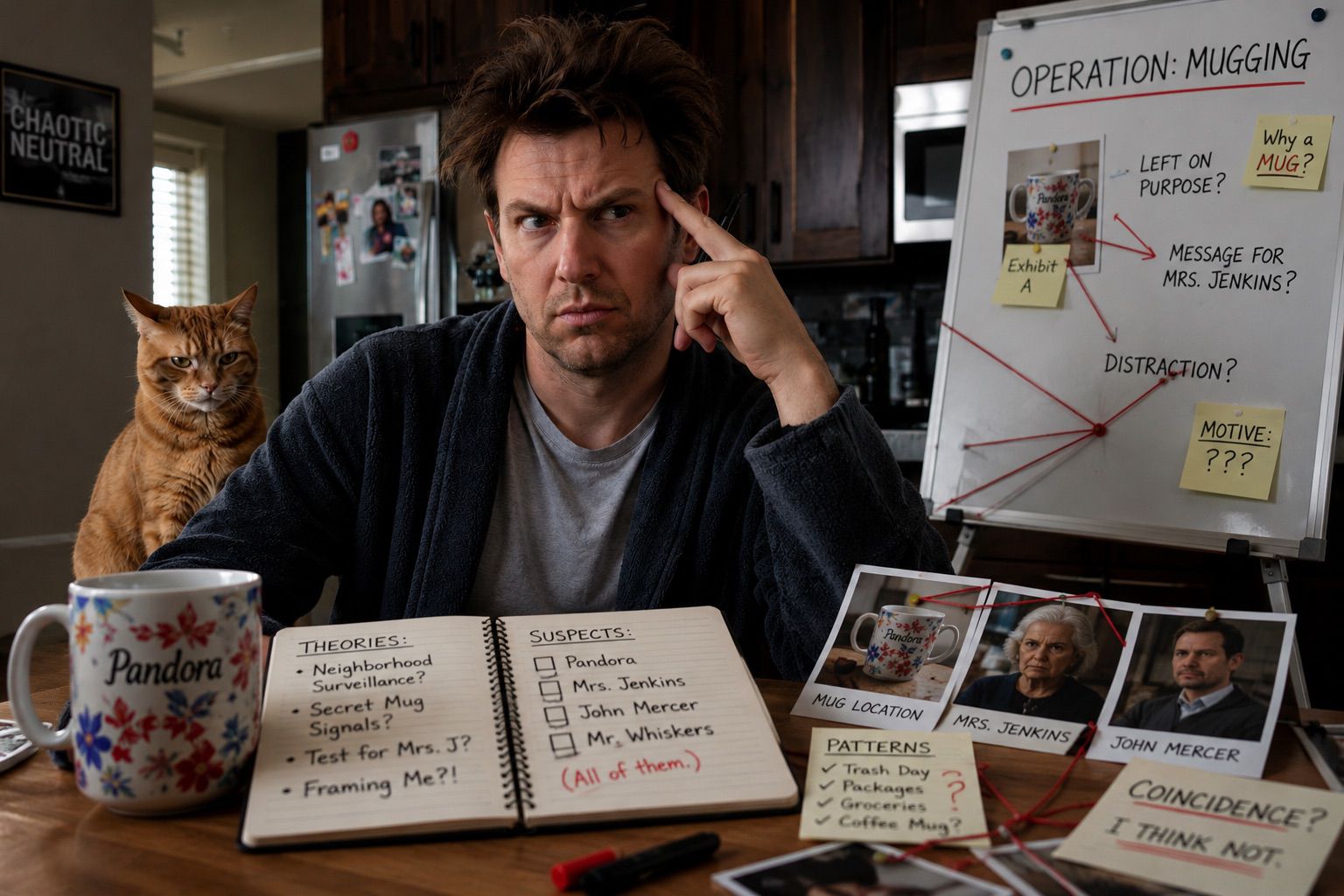
Breakfast should have been simple. I was standing in the kitchen making eggs when I noticed Pandora’s coffee mug sitting on the counter. That was odd. Not alarming odd. Just…odd. Pandora had stopped by yesterday afternoon, and she usually took her mug home before she left. If she didn’t, she’d at least rinse it out and slide it into the dishwasher. She wasn’t obsessive about keeping things spotless, but she was consistent. Consistency matters. It’s how you notice when something changes. I stared at the mug for a few seconds longer than any reasonable person would. Maybe she’d simply forgotten it. That should have been the end of the story.

Unfortunately, my brain invited Mrs. Jenkins into the conversation.

Mrs. Jenkins notices everything. If someone leaves a recycling bin out a little too long, she notices. If a package sits on a porch overnight, she notices. If Mr. Whiskers sheds enough orange fur to create what could generously be described as decorative carpeting, she notices that too. So naturally, I started wondering whether Pandora had anticipated all of this. What if the mug wasn’t forgotten? What if she had intentionally left it behind? Not because she cared about the mug, but because she wanted to see whether Mrs. Jenkins would say anything about it. It sounded ridiculous, which should have been enough for me to dismiss the idea. Instead, I started improving it.

Pandora had seemed a little different lately. Nothing dramatic, just tiny things that my brain had apparently filed away without asking my permission. Last week she’d laughed when Mr. Whiskers knocked his toy mouse under the couch instead of insisting we rescue it immediately. A few days earlier I’d apologized for leaving several books scattered across the coffee table, and she’d simply smiled and said, “We’ll deal with it later.” Most people would call that being relaxed. I had spent enough time around Mrs. Jenkins to suspect there might be another explanation. What if Pandora knew Mrs. Jenkins quietly kept track of everyone’s habits? What if leaving the mug behind was some kind of harmless experiment? Or…what if she wanted Mrs. Jenkins to assume the mug belonged to me? No, that couldn’t be right. Pandora likes me. She wouldn’t frame me for improper mug storage. Would she?

John Mercer wandered into the kitchen wearing the expression of a man who was technically awake but hadn’t yet informed the rest of his body. He opened the refrigerator, stared into it for several thoughtful seconds, closed the door, stood there for a moment, and then opened it again as if expecting the contents to have reorganized themselves. I pointed toward the mug. “Do you think Pandora left that on purpose?” He glanced at it, then looked back at me. “It’s a mug.” “Exactly.” He blinked. “I don’t think that’s the important part.” He poured himself a cup of coffee and completely ignored what was rapidly becoming a very important investigation. That struck me as suspicious. John usually entertained my theories, even if it was only so he could laugh at them later. Today he barely acknowledged the evidence sitting in plain sight. Was he protecting Pandora? Or was he simply not fully awake yet? At that moment, both possibilities seemed equally plausible.

Mr. Whiskers jumped onto the counter, gave the mug a long, deliberate sniff, and then walked away without touching it. Even the cat seemed to recognize something unusual. Unless he was just disappointed there wasn’t any coffee left. Do cats even like coffee? That didn’t sound right. I made a mental note to look it up later, assuming I remembered why I’d wanted to in the first place. By now, the investigation had grown well beyond the mug itself. Maybe Pandora wasn’t leaving clues at all. Maybe Mrs. Jenkins was. She had an uncanny ability to appear outside at precisely the moment someone carried groceries, rolled out the trash, or received a delivery. Perhaps she’d developed an unofficial neighborhood intelligence network. Perhaps abandoned coffee mugs were one of the signals. The more I thought about it, the more connections I found, which should have been a warning sign instead of encouragement.

Just as I sat down with my breakfast, my phone buzzed. It was a text from Pandora.

“Oops. I forgot my coffee mug yesterday. Can you bring it next time we meet?”

I stared at the message for a long moment before handing my phone to John. He read it, nodded once, and handed it back. “Well,” he said, “I guess that solves the mystery.”

“It certainly explains the mug,” I replied.

“And?”

“And that’s exactly what someone would text if they wanted me to think they simply forgot it.”

John sighed, picked up his coffee, and walked out of the kitchen without another word. Mr. Whiskers followed him.

Traitor.

Related Posts

Eileen Chang: The Art of Unspoken Rebellion

Penelope

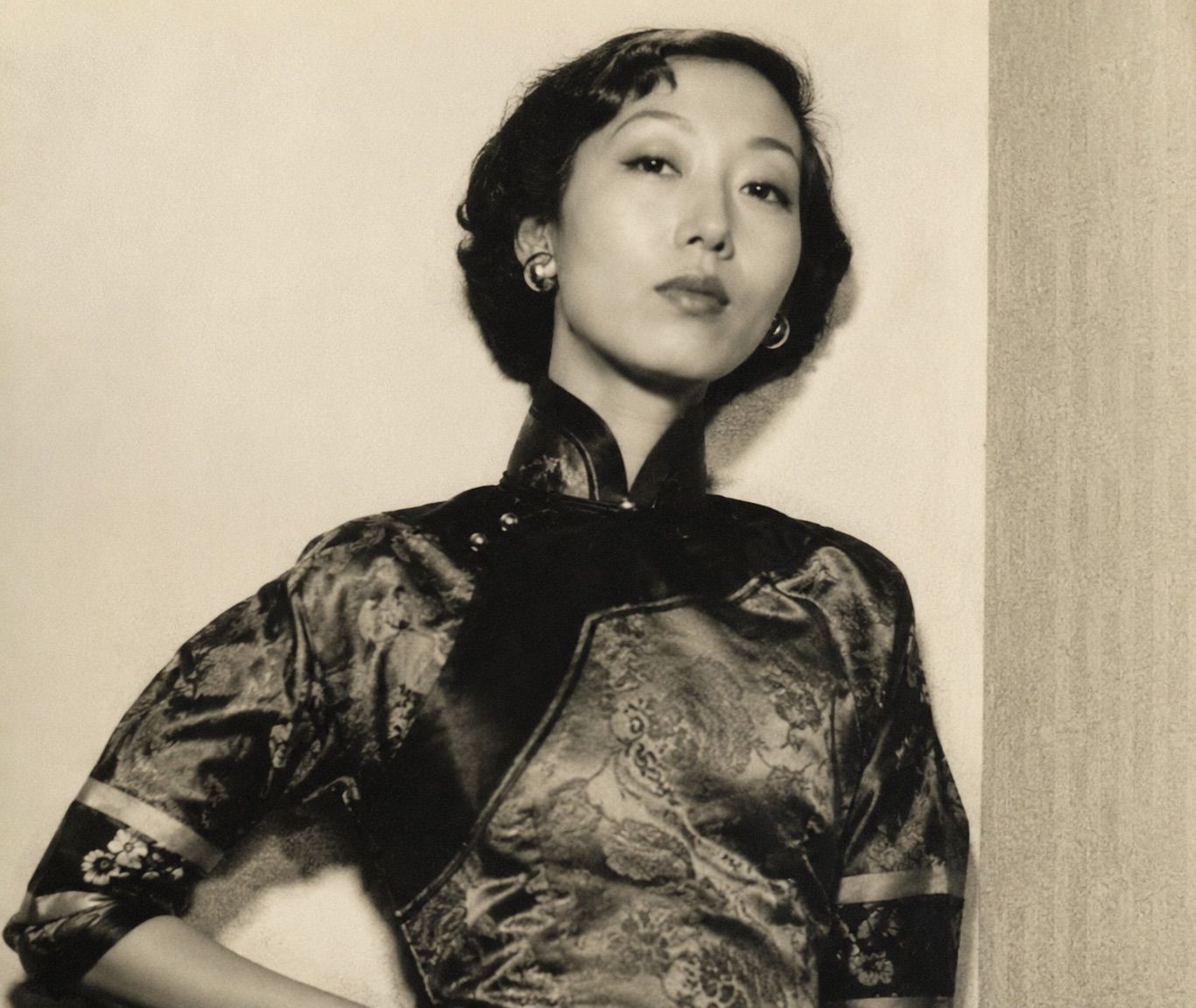
Eileen Chang. I’ve been thinking about her a lot lately, probably because I’m trying to make sense of my own writing and where it fits into the world. Chang’s work has always fascinated me – not just because of its complexity and depth, but also because it feels so… personal.

I remember reading “Love in a Fallen City” for the first time during my senior year of college. I was stuck in a creative writing workshop, trying to produce something marketable while questioning every word that came out of my brain. Chang’s short stories were like a lifeline – they spoke directly to me about the uncertainty and disillusionment I felt as I navigated adulthood.

What struck me most about Chang’s work is her ability to capture the dissonance between public and private selves. Her characters are always performing, masking their true emotions behind a veneer of propriety or expectation. It’s a feeling I’m all too familiar with – the pressure to present a certain image, to conform to societal norms while secretly seething with frustration.

As I delved deeper into Chang’s writing, I began to realize that her work isn’t just about the individual; it’s also about the collective silence that pervades society. She wrote about the unspoken rules and unwritten expectations that govern human relationships – particularly for women in traditional Chinese society. It’s a theme that resonates with me, given my own experiences growing up as a first-generation American.

But what I find most compelling about Chang is her use of language – not just the poetic beauty she brings to her writing, but also the way she employs it as a tool for social critique. Her stories often unfold like puzzles, slowly revealing the cracks in the façade of urban life during the Japanese occupation. The syntax, the imagery, even the silences between sentences all seem to be working together to convey a sense of disquiet and unease.

As I reflect on my own writing, I realize that Chang’s influence is more profound than I initially thought. Her emphasis on subtlety and nuance has taught me to trust in the power of suggestion rather than explicit statement. But it’s also made me question whether this approach can be too passive – whether, by leaving things unsaid or hinted at, I’m simply perpetuating the same silences that Chang so skillfully exposed.

I find myself wondering if my own writing is as transparent as I think it is. Do I, like Chang’s characters, wear a mask to conceal my true emotions? Am I aware of the power dynamics at play in every interaction, or do I unknowingly perpetuate them through my words?

Chang’s work has become a kind of touchstone for me – a reminder that writing can be both personal and political. But it’s also made me realize how little I know about her own life, about the experiences that shaped her into the writer she became. There’s something unsettling about this realization, as if I’ve been operating under the assumption that Chang’s work is somehow more authentic, more true to itself, than my own.

Perhaps what draws me to Chang’s writing isn’t just its beauty or complexity – but also the discomfort it inspires in me. It forces me to confront my own biases and assumptions, to question whether my words are truly my own. As I continue to explore her work, I’m left with more questions than answers – about myself, about writing, and about the world we inhabit.

I find myself getting lost in the labyrinthine streets of Shanghai as depicted in “Rice Sprout Song”. The way Chang weaves together the mundane and the extraordinary creates a sense of disorientation, making me feel like I’m navigating uncharted territory alongside her characters. It’s a sensation that’s both exhilarating and unsettling – like being pulled into a world that’s both familiar and yet utterly foreign.

As I read about the intricate social hierarchies, the hidden codes of conduct, and the subtle power dynamics at play in Chang’s stories, I’m struck by how little I understand about the cultural context that shaped her work. I’ve always assumed that my own experiences as a first-generation American are unique, but reading Chang’s writing makes me realize that there’s a whole world of complexities and nuances that lie beneath the surface.

I think back to my own experiences growing up in a predominantly white community, where the expectations placed upon me were often at odds with my cultural heritage. I was constantly torn between two worlds – one that demanded assimilation and another that longed for authenticity. Chang’s writing captures this sense of dislocation perfectly, and it’s something that resonates deeply within me.

But what I find most intriguing is how Chang’s work transcends its cultural context. Her exploration of the human condition – with all its attendant contradictions and ambiguities – feels remarkably universal. It’s a quality that I’m still trying to wrap my head around as a writer, wondering if it’s possible for my own words to resonate with readers from diverse backgrounds and experiences.

As I continue to grapple with these questions, I’m reminded of Chang’s own struggles as a writer. Her life was marked by turmoil and heartbreak – her relationships were fraught, her family was complex, and her writing often served as a refuge from the chaos that surrounded her. It’s a testament to her resilience and determination that she managed to create such magnificent works of art amidst all this turmoil.

And yet, even with Chang’s remarkable output, I sense a deep sadness beneath the surface – a sense of longing for something more authentic, something more true. It’s a feeling that I’m all too familiar with as a writer, always chasing after the perfect sentence or the perfect story. But what if perfection is an illusion? What if our words are inherently imperfect, reflecting only fragments of ourselves and the world around us?

I’m left wondering if Chang’s writing is ultimately about the search for meaning in a seemingly meaningless world – a quest that I’m still on myself, struggling to find my own voice amidst the noise. As I close this book on “Rice Sprout Song”, I feel like I’ve only scratched the surface of Chang’s work and its implications for me as a writer. But it’s okay – because in the end, it’s not about arriving at some definitive truth; it’s about the journey itself, with all its twists and turns, that makes writing so richly rewarding.

As I sit here, surrounded by my own scribbled notes and dog-eared copies of Chang’s work, I’m struck by how much her writing has become a mirror for me – reflecting back my own fears, doubts, and desires. It’s as if she’s taken the fragments of my thoughts and experiences and woven them into a tapestry that’s both familiar and strange.

I think about how often I’ve struggled to find my place in the world – as a first-generation American, as a writer, as a person trying to make sense of it all. Chang’s work has given me permission to question everything, to challenge the status quo, and to explore the gray areas that lie between black and white.

But what if this is just a facade? What if I’m simply echoing back my own biases and assumptions, rather than truly engaging with the complexities of Chang’s world? I think about how easily I’ve internalized her writing as “authentic,” without truly considering the cultural context in which it was written. Have I done the same thing with other writers, with other cultures?

It’s a disturbing thought, one that makes me wonder if I’m perpetuating the very silences and biases that Chang so skillfully exposed. But at the same time, I feel a sense of excitement – because this is exactly what writing should be about: questioning, probing, and pushing against the edges of our understanding.

As I delve deeper into Chang’s work, I find myself drawn to her characters’ moments of quiet rebellion – those small acts of defiance that can be both powerful and subtle. It’s a quality that resonates with me as a writer, because I know how often we’re asked to conform to expectations, to fit into neat categories or boxes.

But what if our true power lies not in grand gestures, but in these tiny moments of resistance? What if it’s the quiet acts of subversion – the whispered words, the stolen glances, the hidden codes of conduct – that can create a sense of revolution?

I’m left wondering if Chang’s writing is ultimately about the beauty of subtlety, about the power of suggestion and implication. Is this what I’ve been trying to tap into in my own writing – the art of hinting at truth without ever quite stating it?

As I continue to explore Chang’s work, I find myself thinking more and more about the concept of subtlety. It’s a quality that she embodies in her writing, where meaning is often hinted at rather than stated outright. And yet, this subtlety can also be seen as a form of constraint – a way of limiting ourselves to certain expressions or codes of conduct.

I think back to my own experiences with language and culture. Growing up as a first-generation American, I was constantly torn between the languages and customs of my parents’ homeland and those of my adoptive country. I often felt like I was speaking in code, using phrases or idioms that didn’t quite translate across cultures. It was a way of navigating the complexities of identity and belonging, but it also made me aware of the power dynamics at play.

Chang’s writing has taught me to appreciate this subtlety as a form of resistance – a way of pushing against the dominant narratives and expectations that surround us. Her characters often operate in the margins, using silence or suggestion to subvert the social norms of their time. It’s a fascinating dynamic, one that I’m still trying to understand and internalize as a writer.

But what if subtlety is also a form of erasure? What if it allows us to sidestep the messy realities of power and privilege, rather than confronting them head-on? As I read through Chang’s work, I start to notice how often her characters’ subtleties are rooted in a desire for social acceptance or conformity. They may be rebelling against certain norms, but they’re also deeply embedded within those very same systems.

This realization makes me uneasy – because it suggests that even our attempts at subtlety can be complicit in the very power structures we’re trying to subvert. I think about how often I’ve used my own language or cultural background as a form of camouflage, rather than confronting the complexities and challenges that come with them.

It’s a difficult truth to confront – one that makes me wonder if Chang’s writing is ultimately about the impossibility of subtlety. Can we ever truly subvert the dominant narratives without also reinforcing them? Or are we forever trapped in this labyrinthine world of codes and silences, searching for ways to navigate the complexities of power and identity?

As I sit here, surrounded by my own scribbled notes and dog-eared copies of Chang’s work, I’m struck by how much I still have to learn. Her writing has become a mirror for me – reflecting back my own fears, doubts, and desires. But it’s also taught me to question everything, to challenge the status quo, and to explore the gray areas that lie between black and white.

And yet, even as I grapple with these complexities, I’m drawn back to Chang’s characters’ moments of quiet rebellion – those small acts of defiance that can be both powerful and subtle. It’s a quality that resonates with me as a writer, because I know how often we’re asked to conform to expectations, to fit into neat categories or boxes.

But what if our true power lies not in grand gestures, but in these tiny moments of resistance? What if it’s the quiet acts of subversion – the whispered words, the stolen glances, the hidden codes of conduct – that can create a sense of revolution?

I’m left wondering if Chang’s writing is ultimately about the beauty of subtlety, about the power of suggestion and implication. Is this what I’ve been trying to tap into in my own writing – the art of hinting at truth without ever quite stating it? Or am I simply perpetuating the same silences and biases that Chang so skillfully exposed?

The more I read her work, the more questions I have. But it’s okay – because in the end, it’s not about arriving at some definitive truth; it’s about the journey itself, with all its twists and turns, that makes writing so richly rewarding.

Related Posts