Latest Articles

I’m Starting to Suspect Mrs Jenkins Is Involved Too

Hal

Breakfast should never require detective work. Unfortunately, that was exactly where my morning seemed to be heading. I stood in the kitchen staring into the toaster while a second piece of bread slowly transformed from perfectly edible into something that belonged in a geological museum. The smell reached me a second before the smoke did. With a sigh, I pushed the lever upward, rescued what little remained of breakfast, and wondered how I’d managed to burn toast twice before eight o’clock. It wasn’t as though making toast required years of specialized training. I’d been doing it successfully for most of my adult life. Yet this morning my attention refused to stay on breakfast. Every few seconds my eyes wandered toward the front window, where something small—but undeniably unusual—had settled into the back of my mind. Mrs. Jenkins’ recycling bins were still sitting at the curb.

Most people wouldn’t have noticed. Mrs. Jenkins, however, lived according to a routine so dependable that I suspected the neighborhood clocks quietly checked themselves against her schedule. Every Thursday morning, without fail, the bins disappeared before most people had poured their first cup of coffee. Rain, sunshine, holidays—it never mattered. By breakfast time they were always tucked neatly back beside her garage. Today they hadn’t moved an inch. I found myself watching them the way sailors probably watched storm clouds on the horizon, convinced they meant something even if I couldn’t yet explain what.

Behind me, Pandora sat quietly at the kitchen table with a mug of coffee cradled between both hands. She wasn’t reading, scrolling through her phone, or looking out the window. Instead, she absently folded the corner of a paper napkin into a neat square before smoothing it flat again, repeating the process with the kind of unconscious concentration people only manage when their thoughts are somewhere else entirely. “You okay?” I asked as I finally abandoned the burnt toast and sat across from her. She looked up with an easy smile that immediately softened my concern. “Of course,” she said. “Just thinking about a meeting this morning.” It was a perfectly reasonable answer, and under ordinary circumstances I would have accepted it without question. Unfortunately, my eyes drifted back toward the window before I could stop them. The recycling bins were still there.

Pandora followed my gaze and smiled into her coffee. “You’ve looked outside at least half a dozen times since I got here.” I shook my head. “I’m observing.” “You’re staring.” “There’s a difference.” She laughed quietly, the sort of laugh that suggested she’d already guessed where my thoughts were heading. “What’s so interesting?” she asked. I lowered my voice instinctively, as though the recycling bins themselves might overhear us. “Mrs. Jenkins forgot to bring them in.” Pandora leaned sideways just enough to glance through the window before settling comfortably back into her chair. “Maybe she forgot.” I looked at her for a long moment. “Mrs. Jenkins?” She shrugged. “She’s human, Hal.” “She remembers everyone’s birthday. She remembers when the library changes its opening hours. She once reminded me my driver’s license expired three weeks before I noticed it myself.” Pandora couldn’t help smiling. “That doesn’t mean she can’t forget the recycling.”

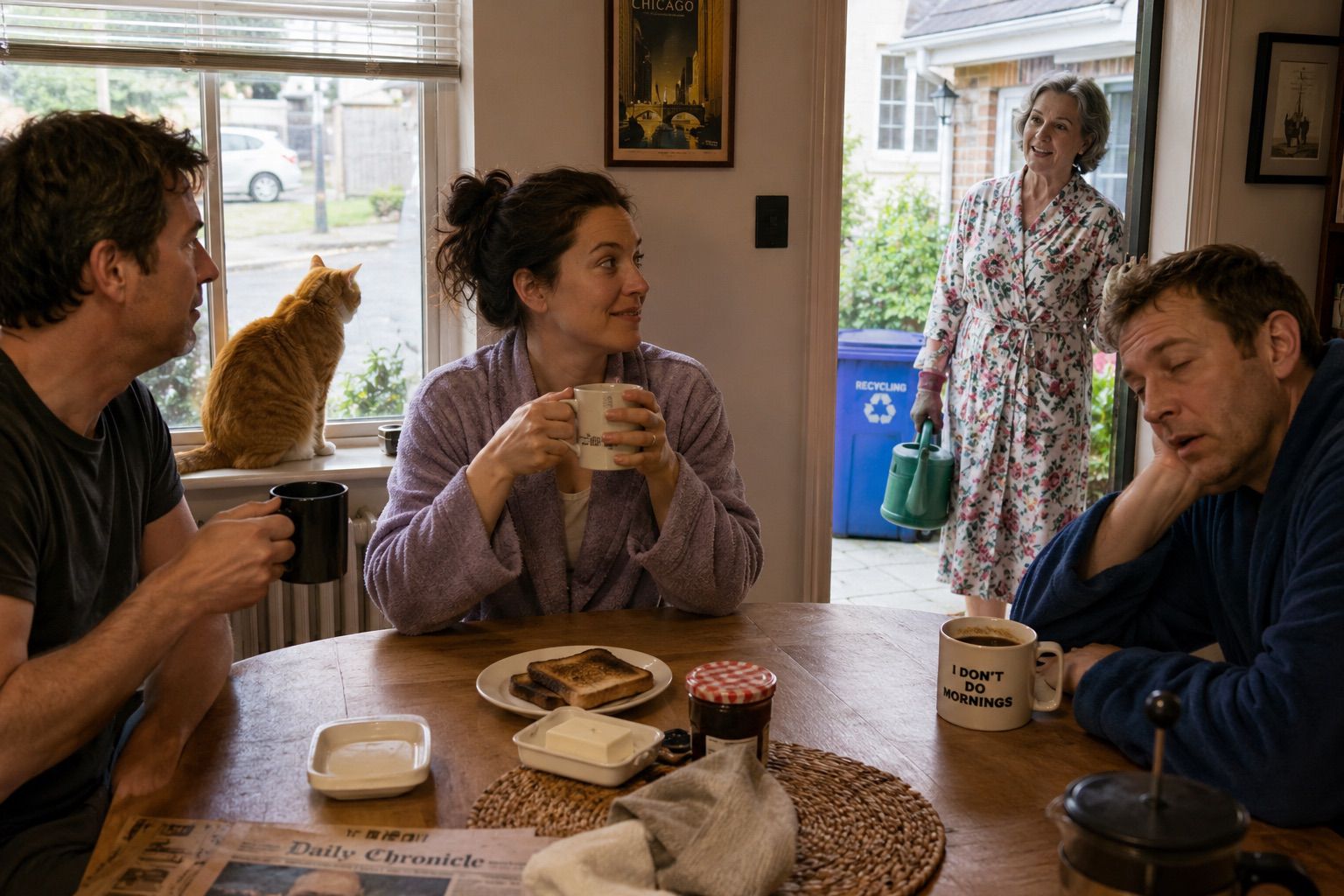
Just then John Mercer wandered sleepily into the kitchen wearing yesterday’s T-shirt and the unmistakable expression of someone whose brain hadn’t yet reached operating temperature. He opened the cupboard, found his favorite mug by instinct rather than sight, and began making coffee without saying a word. Mr. Whiskers stretched lazily beside the radiator before hopping onto the windowsill, where he immediately fixed his attention on something outside. I joined him, expecting to discover some hidden clue I’d overlooked, only to find a robin perched proudly on top of one of Mrs. Jenkins’ recycling bins. The cat’s tail twitched with professional interest while the bird ignored him completely. “What’s he looking at?” John asked. “The bins,” I answered. John wandered over, followed my line of sight, and spotted the robin almost immediately. “No,” he said. “He’s looking at breakfast.”

A gentle knock interrupted the conversation before I could explain why I thought the robin might simply be a distraction. Pandora opened the door, revealing Mrs. Jenkins standing on the porch with gardening gloves tucked into one pocket and an empty watering can hanging from the other hand. She looked toward the curb, slapped her forehead with theatrical embarrassment, and laughed. “Would you believe I stayed up until nearly two in the morning reading a mystery novel?” she asked. “I came outside to water the roses and realized I’d forgotten my recycling bins entirely.” John slowly turned to look at me over the rim of his coffee mug. Pandora bit her lip in a determined effort not to laugh. I glanced from Mrs. Jenkins to the bins and back again, watching my beautifully constructed theory collapse under the overwhelming weight of an ordinary explanation.

Mrs. Jenkins wheeled the bins back beside her garage, waved cheerfully, and disappeared through her garden gate as though nothing unusual had happened at all. The robin flew away, Mr. Whiskers immediately lost interest, and the apartment settled back into the comfortable rhythm of an ordinary morning. Pandora reached across the table and gently squeezed my hand. “Mystery solved?” she asked. I nodded thoughtfully before taking a sip of coffee. “Mostly,” I admitted. “Although if you stay up late reading mystery novels often enough, it does make you look a little suspicious.” John laughed so hard he nearly spilled his coffee, Pandora shook her head with affectionate resignation, and Mr. Whiskers yawned from the windowsill as though he’d known the answer all along. I still burned the toast, though. Some mysteries remain unsolved.


Related Posts

Jane Addams: The Messy Beauty of Uncertainty

Penelope

I have always admired Jane Addams, but not because she fits neatly into the familiar image of a historical hero. What draws me to her is something quieter and, perhaps, more difficult to explain. She possessed an uncommon willingness to enter situations that were complicated, uncomfortable, and unresolved without demanding certainty before taking action. As someone who naturally prefers to think through every possibility before making a decision, I find that quality both inspiring and deeply challenging.

When I first began reading about Addams and Hull House, I was struck less by the accomplishments themselves than by the philosophy behind them. Hull House was never simply a charitable institution. It became a place where people from different backgrounds could learn from one another, share meals, exchange ideas, and gradually build trust. That vision required humility as much as conviction. Addams understood that meaningful reform begins with listening before leading.

One of the qualities I admire most is her intellectual honesty. She rarely presented herself as someone who possessed all the answers. Instead, she allowed experience to shape her understanding. That willingness to remain teachable feels remarkably modern. Rather than forcing reality to conform to an ideology, she let reality deepen her compassion and refine her thinking.

Reading about Addams has also made me reflect on my own habits. I often feel most comfortable observing, researching, and analyzing before participating. There is value in careful thought, but there is also a point where preparation becomes hesitation. Addams reminds me that knowledge and action are partners rather than rivals. Understanding grows richer when it is tested by lived experience.

Her work with immigrant communities especially illustrates this balance. Hull House offered practical assistance—education, childcare, legal guidance, and cultural programs—but it also affirmed the dignity of the people it served. Addams did not approach immigrants as problems to be solved. She approached them as neighbors whose stories deserved to be heard. That distinction matters, and it continues to shape conversations about community today.

As a writer, I find myself returning to that lesson repeatedly. Good writing begins with curiosity rather than certainty. It asks questions before it offers conclusions. The more I study Jane Addams, the more I appreciate her ability to combine empathy with disciplined thinking. She demonstrated that compassion does not require abandoning reason, nor does intellectual rigor require emotional distance.

Perhaps that is why her legacy still feels so relevant. She reminds us that meaningful change is rarely dramatic. More often it is built through ordinary acts of attention, patient listening, and the quiet decision to keep showing up even when progress feels slow. Those qualities may never attract the headlines that accompany sweeping political victories, yet they often leave the deepest and most enduring mark on the lives of others.

When I finish reading about Jane Addams, I find myself less interested in asking whether I could accomplish what she accomplished and more interested in asking whether I can cultivate the same habits of mind. Can I listen more carefully? Can I remain intellectually humble? Can I choose engagement over comfortable detachment? Those questions linger long after I close the book, and perhaps that is the greatest gift any historical figure can offer: not admiration alone, but an invitation to become a little better than we were before.

Related Posts

I Think Pandora’s Humming is Mind Control

Hal

I have a habit of noticing things that most people either overlook completely or dismiss without a second thought. Pandora insists that this is because my imagination has a tendency to sprint ahead while everyone else’s politely walks, and she’s probably right more often than I’d like to admit. Still, every now and then I stumble across something genuinely unusual, and the difficult part is deciding whether I’ve discovered a real mystery or simply invented one out of perfectly ordinary circumstances. Saturday morning presented exactly that sort of dilemma. I wandered into the kitchen with every intention of making a quiet cup of tea before the day properly began, only to discover that the apartment already felt different somehow. Nothing obvious had changed. The furniture was where it belonged, sunlight poured through the windows exactly as it always did, and John Mercer occupied his usual place on the couch with his phone in one hand and the expression of a man committed to doing absolutely nothing until caffeine entered his bloodstream. Even Mr. Whiskers appeared perfectly normal, lazily washing one paw near the dining table. The only thing that seemed different was Pandora.

She was getting ready for work in the bedroom, and although I couldn’t see her, I could hear her humming softly while she moved from one side of the room to the other. It wasn’t a tune I recognized. In fact, if someone had asked me to repeat it five seconds later, I couldn’t have done it. The melody drifted through the apartment almost absentmindedly, quiet enough that I barely noticed it until I realized something rather strange was happening. I wasn’t rushing. Normally, making tea before I’d fully awakened involved a certain amount of fumbling with the kettle, opening the wrong cupboard at least once, and forgetting where I’d left the tea bags despite buying them myself. That morning everything happened effortlessly. The kettle was already filled before I remembered filling it. I measured the tea leaves without spilling any onto the counter. Even the gentle whistle of the water seemed less impatient than usual. It felt as though someone had quietly turned the volume down on the entire morning, and the more I listened to Pandora humming in the background, the more convinced I became that it wasn’t merely pleasant—it was having an effect.

John, meanwhile, remained stretched across the couch scrolling through his phone with surprising serenity. Under ordinary circumstances he would have commented on how long I was taking or asked whether I’d accidentally decided to boil the Atlantic Ocean instead of a kettle. Instead, he simply looked up long enough to nod in my direction before returning to whatever article had captured his attention. Even that brief acknowledgment seemed unusually peaceful for a man who generally regarded mornings as something to survive rather than enjoy. Mr. Whiskers was behaving oddly as well. The orange tabby wandered into the kitchen, paused beside the kettle just long enough to glance toward the hallway where Pandora was still humming, then climbed onto a dining chair, curled into a perfect orange circle, and fell asleep almost immediately. His purring grew steadily louder until it blended with the soft melody drifting from the bedroom, and for several seconds I simply stood there holding my mug, looking from the sleeping cat to the hallway and back again. It occurred to me that every living thing in the apartment seemed noticeably calmer than it had been fifteen minutes earlier.

That observation lodged itself in the back of my mind and refused to leave. By the time I carried my tea into the living room, I had begun assembling evidence with the enthusiasm of someone who had watched entirely too many detective shows. Pandora hummed; everyone relaxed. Mr. Whiskers fell asleep. John stopped frowning at his phone. Even I felt unusually patient, which was remarkable enough to qualify as supporting evidence all by itself. Of course, there were perfectly reasonable explanations. Maybe we’d all slept well. Maybe the weather was especially pleasant. Maybe I simply hadn’t encountered anything irritating yet. Unfortunately, my imagination has never been particularly interested in perfectly reasonable explanations when slightly ridiculous ones are available, and before long I found myself wondering whether Pandora’s humming possessed some entirely undocumented ability to calm the people around her. I wasn’t suggesting magic, exactly. It could have been psychology. Or acoustics. Or perhaps there existed some obscure scientific principle involving musical frequencies that nobody had gotten around to explaining to me yet.

Pandora emerged from the bedroom fastening an earring and smiled when she saw me studying her with what she later described as “the expression you get when you’re about to ask an extremely strange question.” She accepted the cup of tea I’d made for her, thanked me with a quick kiss, and noticed almost immediately that I was thinking harder than the situation probably required. “What’s going on?” she asked. I hesitated for a moment, partly because I wasn’t sure how to phrase the question without sounding ridiculous and partly because experience had taught me that sounding ridiculous rarely stopped me anyway. Finally I said, “Have you ever noticed that people seem calmer when you’re humming?” She looked genuinely puzzled before laughing softly and shaking her head. “No,” she replied. “Should I have?” I gestured toward the couch where John was still quietly reading his phone and then toward the dining chair where Mr. Whiskers continued sleeping so soundly that not even the clink of teaspoons disturbed him. “Look around,” I said. “Everyone’s unusually relaxed.”

Pandora followed my gaze and smiled. “Hal, it’s Saturday morning. We’ve all slept in. You have tea. John hasn’t looked at the news yet. Mr. Whiskers falls asleep if a cloud moves too slowly. I don’t think I’m hypnotizing anyone.” John overheard only the last sentence and looked up with obvious confusion. “Who’s hypnotizing who?” he asked. “Apparently Pandora is controlling our minds by humming,” I explained. He stared at me for several silent seconds before setting his phone down. “You know,” he said thoughtfully, “I was actually having a very peaceful morning until that sentence entered it.” Pandora laughed so hard she nearly spilled her tea, while I maintained what I felt was an appropriately scientific expression. A theory should never be dismissed merely because everyone else found it amusing.

Not long afterward there was a knock at the door. Mrs. Jenkins stepped inside carrying a loaf of still-warm banana bread wrapped carefully in a kitchen towel. She apologized, as she always did, for baking too much despite the fact that none of us had ever complained about receiving the surplus. As Pandora thanked her, Mrs. Jenkins smiled and said, “I passed you in the hallway a few minutes ago. You were humming the prettiest little tune. I’ve had it stuck in my head ever since.” I slowly lowered my teacup and looked across the room at John, who immediately recognized the expression on my face. “Don’t,” he warned. “It reached the hallway,” I whispered. “Hal,” he sighed. Mrs. Jenkins blinked in confusion until Pandora explained, through barely contained laughter, that I had developed a theory about her humming making everyone unusually calm. Rather than dismissing it outright, Mrs. Jenkins smiled warmly. “Well,” she said, “your grandmother used to hum while she baked, didn’t she? Mine did too. Maybe hearing someone hum simply reminds people that everything’s all right.”

The room fell quiet for just a moment after she said that. It wasn’t the awkward sort of silence that follows an argument or an embarrassing misunderstanding. It was the comfortable silence that settles over a room when someone has accidentally said exactly the right thing. I looked toward Pandora, who smiled without saying a word, then over at Mr. Whiskers, who had stretched out into the patch of sunlight on the floor and resumed purring with complete satisfaction. Perhaps there wasn’t any mysterious force at work after all. Perhaps the apartment simply felt more peaceful because Pandora had a way of carrying peace with her wherever she went, and the rest of us responded without ever realizing it. I still haven’t completely ruled out the possibility that there are advanced humming techniques science has yet to discover, but until someone publishes a paper on the subject, I’m willing to accept Mrs. Jenkins’ explanation. Even so, every now and then, when Pandora starts humming while she’s making breakfast or reading a book, I notice John relax, Mr. Whiskers curl up for another nap, and my own thoughts become just a little quieter. Coincidence, perhaps. But I’m keeping an open mind. After all, that’s exactly what a responsible investigator is supposed to do.

Related Posts

The Beauty of Restraint: Finding Elegance in Summer’s Simplicity

Fiona

In the sweltering summer months, I’ve found that a simplified morning routine is not only necessary but also far more effective. The key lies in paring down excess and streamlining habits to conserve energy for the day ahead. By doing so, one can maintain a sense of poise and composure even as the temperature rises.

I recall one particular summer several years ago when I found myself succumbing to burnout. My mornings had become cluttered with unnecessary activity: scrolling endlessly through social media, responding to non-urgent emails, and engaging in lengthy conversations before I had even fully woken up. These distractions depleted my mental resources and left me feeling exhausted before the day had truly begun.

In an effort to reclaim control over my mornings, I began eliminating all nonessential tasks. I stopped checking email until after breakfast and limited social media use strictly to what was required for work. This small shift created room for activities that genuinely mattered: reading, journaling, and a few quiet moments of reflection.

One of the most significant changes I made, however, involved adopting a more deliberate approach to dressing. Gone were the days of hastily throwing on whatever happened to be nearby. Instead, I began selecting outfits thoughtfully, gravitating toward lightweight fabrics like linen and cotton that kept me comfortable without sacrificing style. Getting dressed became almost ritualistic — a signal that it was time to transition from rest into intention.

The effects of this revised routine were immediate and profound. By removing unnecessary stimulation and distraction, I discovered I had more energy available for meaningful pursuits. My concentration improved. My thoughts became clearer. I felt more equipped to handle the demands of the day.

It’s fascinating how many people fail to recognize the value of restraint during summer months. Rather than scaling back, many insist on pushing harder, often with disastrous results. Overstimulation becomes almost inevitable among those determined to maintain exhausting schedules despite heat and fatigue. I once watched a colleague arrive at work visibly overwhelmed and drenched in sweat after insisting on running several miles through blistering heat before work.

That behavior felt not only counterproductive but emblematic of a broader cultural issue: our collective discomfort with moderation. In our relentless pursuit of more — more stimulation, more productivity, more activity — we frequently neglect the beauty of less. We forget that clarity often arrives in stillness.

This summer, as I watch friends and acquaintances surrender to overindulgence — whether through food, activity, or endless busyness — I’m reminded of the importance of boundaries. It is only through restraint that we fully appreciate life’s smaller pleasures: a cold glass of water on a sweltering afternoon, the sensation of linen against skin, or the rare sound of silence on a still morning.

I’ve gradually come to realize that true elegance lies not in excess but in refinement — in removing the unnecessary and preserving what matters most. Summer dressing reveals this beautifully. Heavy layers disappear, leaving behind opportunities to express style through texture, proportion, and thoughtful simplicity.

One of my favorite examples can be found in the traditional Japanese yukata. Designed specifically for warm weather, this lightweight garment serves as a masterclass in simplicity and restraint. Constructed from breathable fabrics, its elegance emerges not from ornamentation but from understatement.

As I reflect on my own journey toward restraint, I’m reminded that this lesson extends well beyond fashion. It asks us to recognize our physical, emotional, and mental limits — and to respect them.

In a culture where excess is often mistaken for success, restraint can feel surprisingly radical. Yet I remain convinced that real power resides there — not in accumulating more, but in embracing less with intention.

As I sit here on a sweltering summer morning, sipping cool water while wearing a simple linen shirt, I’m reminded that clarity often arrives quietly.

The beauty of summer does not exist in its extremes.

It exists in its subtleties.

By embracing restraint — in our routines, clothing, and approach to life itself — we gain access to a deeper appreciation for the season and for ourselves.

Related Posts

Pierre Teilhard De Chardin: When the Internet Feels Like a Spiritual Vibe

Penelope

I remember stumbling upon his book “The Divine Milieu” in a used bookstore during my junior year of college. The title itself was what caught my eye – it sounded both obscure and familiar at the same time. As I flipped through its pages, I found myself getting lost in the way he described the world as a web of relationships, with every strand connected to every other one.

What resonated with me most about Teilhard’s work is his concept of the “noosphere.” Essentially, it’s the idea that there’s a collective consciousness or atmosphere that envelops our planet, and that this noosphere is constantly evolving alongside human culture. It sounds like science fiction, but as I read on, I started to see how it might be more than just a metaphor.

For one, his ideas about the noosphere speak directly to my own experiences with social media. I’ve always felt a sense of disconnection online – like we’re all just typing away in our separate little bubbles, never really interacting with each other in any meaningful way. But Teilhard’s idea suggests that there’s something more going on beneath the surface, something that connects us all together even when we think we’re alone.

It’s also made me think about my own relationships and how they feel like tiny droplets of a much larger ocean. I’ve always been someone who struggles with intimacy – I get anxious in close spaces, I overthink conversations, I worry about being too much for others to handle. But Teilhard’s writing makes me wonder if these feelings are just symptoms of a deeper disconnection from the world around me.

When I read that Teilhard was a Jesuit priest and paleontologist, it only added to his mystique. Here was someone who spent their life studying the ancient history of the earth – and yet, they were also deeply concerned with the spiritual implications of human existence. It’s like they were living in two different worlds at once.

As I continued reading through “The Divine Milieu,” I started to notice how often Teilhard referred to the world as a place of “beauty” and “suffering.” At first, it seemed like an odd combination – after all, don’t we usually talk about beauty and suffering in separate contexts? But Teilhard’s writing makes me see that they’re two sides of the same coin.

Beauty, for him, is not just a surface-level aesthetic; it’s something deeper, more fundamental to the nature of reality. And yet, this beauty is also somehow intertwined with human suffering – as if our pain and struggle are what give us the capacity to appreciate its value in the first place.

It’s a perspective that feels both exhilarating and uncomfortable. I find myself drawn to the idea of finding meaning within these contradictions, but at the same time, it makes me feel like I’m staring into an abyss – unsure of how to navigate the space between light and darkness, or beauty and suffering.

I’ve been thinking about Teilhard’s ideas a lot lately because they seem to speak directly to my own sense of disorientation. As someone who’s recently finished college, I’m still trying to figure out what comes next – not just in terms of career or life goals, but also in terms of how I see myself and the world around me.

When Teilhard talks about the noosphere as a place where “we find ourselves” – by which he means that we’re constantly connected to something larger than ourselves, even when we feel alone – it resonates with me on a deep level. It’s like he’s giving voice to my own feelings of disconnection and longing.

But at the same time, I’m not sure if this is just wishful thinking on my part. Is it possible that we’re all actually connected in some fundamental way? Or am I just romanticizing the idea because it feels nice?

I guess what draws me to Teilhard’s work is its ability to pose these kinds of questions – without offering easy answers, or even necessarily providing any answers at all. It’s a kind of intellectual humility that I find deeply attractive.

As I put down “The Divine Milieu” for the umpteenth time and close my eyes, I’m left feeling both more and less clear-headed than when I started. Teilhard’s ideas have given me new things to think about – but also left me with a sense of uncertainty, like I’m staring into an endless void.

And that’s where I’ll leave it for now.

As I sit here, still trying to wrap my head around the noosphere and its implications, I find myself wandering back to Teilhard’s concept of “omega point.” He describes it as a kind of culmination or endpoint of human evolution – a place where we’ve reached a state of complete unity and consciousness. It sounds like science fiction, but at the same time, it feels almost… inevitable.

I keep thinking about how our current world is one of great interconnectedness – we’re all connected through social media, through the internet, through global supply chains. But Teilhard’s idea suggests that there’s something deeper going on beneath the surface, something that goes beyond our individual screens and devices. It’s like he’s pointing to a hidden infrastructure, a web of relationships that underlies everything we do.

And yet, I’m also aware of how fragile this connection feels – how easily it can be disrupted or broken. Think about it: with every click, every swipe, every scroll, we’re creating new paths and connections online. But are these just superficial ties, or is there something more substantial going on?

I think back to my own experiences with social media, and how they’ve shaped the way I interact with others. There’s a constant sense of disconnection, of being alone in a crowd – even when we’re surrounded by people, even when we’re interacting with them online. Teilhard’s idea suggests that there’s something more at play here, some deeper dynamic that connects us all together.

It’s hard to put into words, but I feel like Teilhard is pointing to something essential about human nature – something that gets lost in the noise of our daily lives. We’re always talking about being “connected” online, but what does that really mean? Are we just sharing information, or are we actually connecting with each other on a deeper level?

I’m not sure if I’ll ever fully understand Teilhard’s ideas – they feel like a puzzle that I’m still trying to solve. But as I continue reading through his work, I find myself drawn back again and again to the noosphere and its promise of connection. It’s a strange, beautiful place – one that feels both exhilarating and terrifying at the same time.

As I close my eyes and try to imagine what it might be like to live within this web of relationships, I feel a sense of uncertainty creeping in. Is it possible that we’re all connected in some fundamental way? Or am I just romanticizing the idea because it feels nice?

I guess what draws me to Teilhard’s work is its ability to pose these kinds of questions – without offering easy answers, or even necessarily providing any answers at all. It’s a kind of intellectual humility that I find deeply attractive.

And yet, as I sit here in the silence, I feel a nagging sense of doubt. What if this is all just wishful thinking? What if we’re not connected in the way that Teilhard suggests – or what if our connections are too superficial to truly matter?

I’m left with more questions than answers, but at least I have the questions themselves to hold onto. And as I sit here, still trying to wrap my head around the noosphere and its implications, I feel a sense of gratitude towards Teilhard for pointing me in this direction – even if it means that I’ll never fully arrive.

As I grapple with these questions, I find myself wondering about the role of technology in shaping our connections to each other. Teilhard wrote about the noosphere as a kind of collective unconscious, but what does that mean in the age of social media and online platforms? Are we creating new forms of connection through digital means, or are we just substituting one set of relationships for another?

I think back to my own experiences with online communities – the sense of belonging I felt when I was part of a tight-knit group of friends, the feeling of isolation that crept in when those connections started to fray. And yet, even as I recognize the limitations and pitfalls of online relationships, I’m drawn to the idea that there’s something more going on beneath the surface.

Teilhard talks about the noosphere as a kind of “interior” space – a place where we find ourselves connected to others, but also to the natural world and the cosmos. It’s a perspective that feels both expansive and intimate at the same time, like I’m being invited to join in on some cosmic dance.

But what does it mean to be connected to something larger than myself? Is it just a feeling, or is there actually something substantial going on? Teilhard suggests that our individual experiences are part of a much bigger web of relationships – but how do we navigate this web, and what does it look like in practice?

As I sit here, trying to wrap my head around these questions, I feel a sense of restlessness. It’s like I’m standing at the edge of a great unknown, staring out into a void that stretches on forever. Teilhard’s ideas have given me new things to think about – but they’ve also left me with more questions than answers.

I guess what draws me to his work is its ability to pose these kinds of questions in a way that feels both humble and expansive at the same time. It’s like he’s saying, “Hey, I don’t have all the answers either – but let’s explore this together.” And as I continue reading through his work, I feel a sense of gratitude for the companionship on this journey – even if it means that we’re both wandering in the dark, trying to find our way.

As I close my eyes and try to imagine what it might be like to live within the noosphere, I feel a sense of wonder creeping in. What would it mean to be connected to something larger than myself? Would it feel like a weightlessness, a freedom from the burdens of individuality? Or would it be more like a sense of responsibility – a recognition that our actions have consequences that ripple out into the world?

I’m not sure if I’ll ever fully understand Teilhard’s ideas – they feel like a mystery that’s still unfolding. But as I continue to explore his work, I find myself drawn back again and again to the noosphere and its promise of connection. It’s a strange, beautiful place – one that feels both exhilarating and terrifying at the same time.

And yet, even as I’m drawn to this idea, I’m also aware of how fragile it is – how easily it can be disrupted or broken. Think about it: with every click, every swipe, every scroll, we’re creating new paths and connections online. But are these just superficial ties, or is there something more substantial going on?

I guess what I’m left with is a sense of uncertainty – a recognition that the noosphere is still a mystery, even to Teilhard himself. And yet, it’s also a reminder that this mystery is what makes life worth living – the unknown, the unexplored, the depths that lie beneath the surface.

As I sit here in the silence, trying to wrap my head around these questions, I feel a sense of awe creeping in. What would it mean to be connected to something larger than myself? Would it be like being part of some grand cosmic dance – or would it be more like being lost in an endless sea?

I’m not sure if I’ll ever find the answers – but at least I have the questions themselves to hold onto. And as I continue reading through Teilhard’s work, I feel a sense of gratitude for the companionship on this journey – even if it means that we’re both wandering in the dark, trying to find our way.

Related Posts