Latest Articles

Georges Perec: Where the Silence is Louder than the Words

Penelope

I’ve been fascinated by Georges Perec for a while now, but it’s only recently that I started to grasp why he holds such a peculiar allure for me. It began with his novel “A Void”, which I stumbled upon in my junior year of college. I was drawn to the sheer audacity of writing an entire book without using the letter E. I mean, who tries something like that? At first, it seemed like a clever parlor trick, but as I delved deeper into the story, I started to appreciate the complexity and nuance behind Perec’s experiment.

What struck me was how his obsession with the void – both literal and figurative – resonated with my own struggles with uncertainty. As someone who’s always trying to figure out what she wants to do next, I feel like I’m constantly navigating a void of unknown possibilities. It’s a feeling that’s hard to shake, especially when faced with the pressures of adulthood. Perec’s work, on the other hand, is a masterclass in embracing ambiguity and finding meaning within it.

I’ve been reading more of his essays and writings, and what I find myself drawn to are the moments where he grapples with the relationship between language and reality. He writes about how words can both create and obscure our understanding of the world, and that’s a tension I’m familiar with as a writer. When I’m struggling to put my thoughts into words, I often feel like I’m trying to capture a slippery fish – it’s always just out of reach.

Perec’s concept of “infra-ordinary” experiences has also been on my mind lately. He argues that the most revealing insights can be found in the mundane, everyday moments that we often overlook or take for granted. This idea speaks to me because I’ve come to realize how much I value routine and comfort. There’s a sense of security in knowing what to expect from each day, but at the same time, it can also feel stifling – like I’m missing out on something more profound.

As I reflect on Perec’s work, I’m struck by the tension between order and chaos that runs throughout his writing. He’s both fascinated by the patterns and structures that govern our lives, and yet he’s also drawn to the randomness and unpredictability of human experience. This ambivalence feels deeply personal to me – it’s like I’m caught between a desire for clarity and a recognition that life is inherently messy.

I’m not sure if I’ve fully grasped Perec’s message, or even if there is one single message to grasp. Part of the allure of his work lies in its complexity and refusal to be reduced to simple truths. What I do know is that his writing has given me permission to embrace my own uncertainty – to see it as a fertile ground for exploration rather than something to be feared or overcome.

In many ways, Perec’s legacy feels like a puzzle that I’m still trying to solve. His work is both intimate and abstract, inviting readers to reflect on their own experiences while also acknowledging the limits of language and understanding. As someone who writes as a way of thinking through my thoughts, I appreciate how his writing encourages me to question everything – including myself.

Ultimately, what draws me to Perec’s work is its willingness to confront the void head-on, without trying to fill it with easy answers or comforting certainties. His writing is an acknowledgment that life is full of unknowns, and that sometimes the most profound insights come from embracing those uncertainties rather than trying to escape them.

As I continue to delve into Perec’s work, I find myself returning to his concept of the “infra-ordinary” experience again and again. It’s as if he’s tapping into a deep well of understanding within me, one that resonates with my own experiences of feeling lost in the mundane routines of everyday life. I think about how often I’ve found myself stuck in traffic, staring blankly at the same old scenery, wondering where it all leads. Or how I’ll be going about my day, doing the same tasks over and over again, and suddenly feel a pang of restlessness – a sense that there must be more to life than this.

Perec’s writing suggests that these moments are not just minor annoyances or distractions from the “real” life we’re meant to be living. Rather, they contain within them the seeds of insight, waiting to be harvested and examined. It’s a provocative idea, one that challenges me to reexamine my own relationship with routine and familiarity.

I’m struck by how Perec’s work is both deeply personal and utterly abstract at the same time. He writes about his own experiences as a writer, but also about the broader implications of language and reality on our understanding of the world. It’s as if he’s holding up a magnifying glass to the human condition, revealing the intricate web of connections that binds us all together.

I find myself wondering what it would be like to write in the same way – to craft sentences and stories that are both deeply personal and universally relatable at the same time. To capture the essence of human experience without resorting to clichés or easy answers. It’s a daunting task, one that makes me feel both excited and intimidated.

As I continue to explore Perec’s work, I’m beginning to see his writing as a kind of ” cartography” – a map of the inner territories we all navigate, but often don’t take the time to chart. His essays and stories are like X-rays of the human psyche, revealing the hidden patterns and contradictions that shape our thoughts and actions.

And yet, even with this newfound appreciation for Perec’s work, I still feel a sense of unease – as if I’m only scratching the surface of his ideas, and there’s still so much more to uncover. It’s a feeling that’s both exhilarating and unsettling, like being at the edge of a precipice, staring out into the unknown.

The more I delve into Perec’s work, the more I’m struck by the sense that he’s not just writing about himself, but also about all of us – our collective experiences, desires, and anxieties. It’s as if he’s created a sort of mirror, reflecting back at me my own fears and uncertainties, while also revealing the universal human condition.

I’ve been thinking a lot about his concept of “l’infime” (the infinitesimal), which refers to those tiny moments that make up our lives – the brief glimpses of beauty, the flashes of insight, the moments of connection with others. Perec argues that these tiny moments are what give life its richness and depth, but also its fragility.

For me, this concept speaks to my own experiences of feeling lost in the everyday routine. I’ve always been someone who gets caught up in the minutiae of daily life – the commute, the chores, the endless stream of social media updates. But Perec’s writing has taught me to slow down, to pay attention to these tiny moments that make up our lives.

It’s funny, because when I first started reading Perec, I thought his work was all about clever wordplay and intellectual gamesmanship. But the more I’ve read, the more I realize that it’s actually a deep exploration of what it means to be human – to be vulnerable, to be uncertain, to be seeking connection with others.

I’m not sure if I’ve mentioned this before, but Perec’s writing has also made me think about my own relationship with silence. As someone who writes as a way of processing their thoughts, I often find myself feeling anxious when I’m not producing words – like there’s something inside me bursting to get out. But Perec’s work shows me that silence is not just the absence of sound; it’s also a presence, a space for contemplation and reflection.

I think this is what draws me to his writing – its willingness to inhabit the spaces between words, to explore the unspoken and the unsaid. It’s a quality that I’m still trying to develop in my own writing, but one that I know will take time and practice.

As I continue to read Perec, I find myself returning to certain themes again and again – the void, the infra-ordinary, the infinitesimal. But each time I revisit these ideas, they seem to unfold in new and unexpected ways. It’s as if Perec’s writing is a puzzle that I’m constantly trying to solve, but one that keeps shifting and evolving before my eyes.

I guess what I’m trying to say is that Perec’s work has become a sort of companion for me – someone who understands the complexities and contradictions of human experience. His writing offers no easy answers or solutions, but instead presents a kind of existential map, guiding us through the winding paths of life with its twists and turns.

And yet, even with this newfound appreciation for Perec’s work, I still feel a sense of unease – as if I’m only scratching the surface of his ideas, and there’s still so much more to uncover. It’s a feeling that’s both exhilarating and unsettling, like being at the edge of a precipice, staring out into the unknown.

This uneasy sense is something I’ve grown accustomed to when engaging with Perec’s work. It’s as if he’s constantly pushing me to confront my own assumptions and biases, to question everything I think I know about writing, language, and reality. And yet, even as I feel overwhelmed by the complexity of his ideas, I’m drawn back in, like a moth to a flame.

Perhaps it’s because Perec’s writing is so intimately tied to his own experiences as a writer and a human being. He writes about his struggles with creativity, his anxieties about language, and his fascination with the mundane details of everyday life. In doing so, he creates a sense of vulnerability and intimacy that makes me feel like I’m reading his private thoughts, rather than some polished literary treatise.

I find myself wondering what it would be like to write in this way – to craft sentences that are both deeply personal and universally relatable at the same time. To capture the essence of human experience without resorting to clichés or easy answers. It’s a daunting task, one that makes me feel both excited and intimidated.

As I continue to read Perec, I’m struck by his use of language as a kind of ” cartography” – a map of the inner territories we all navigate, but often don’t take the time to chart. His essays and stories are like X-rays of the human psyche, revealing the hidden patterns and contradictions that shape our thoughts and actions.

And yet, even with this newfound appreciation for Perec’s work, I still feel a sense of unease – as if I’m only scratching the surface of his ideas, and there’s still so much more to uncover. It’s a feeling that’s both exhilarating and unsettling, like being at the edge of a precipice, staring out into the unknown.

I think this is what draws me to Perec’s writing – its willingness to inhabit the spaces between words, to explore the unspoken and the unsaid. It’s a quality that I’m still trying to develop in my own writing, but one that I know will take time and practice.

As I reflect on Perec’s work, I’m struck by his ability to balance intellectual rigor with emotional vulnerability. He writes about complex ideas like semiotics and structuralism, but also about the mundane details of everyday life – the way a sentence can sound in your head before you write it down, or the feeling of being lost in a crowd.

For me, this balance is what makes Perec’s writing so compelling. It’s as if he’s created a kind of literary laboratory, where ideas are constantly being tested and refined through the process of writing itself. And it’s this willingness to experiment and take risks that I find so inspiring – not just as a writer, but as a human being.

I’m starting to see Perec’s work as a kind of mirror, reflecting back at me my own fears and uncertainties, while also revealing the universal human condition. It’s a strange feeling, like looking into a funhouse mirror – distorted, yet somehow familiar. And it’s this sense of recognition that draws me in, again and again, to Perec’s writing.

I’m not sure where this journey will take me, or what new insights I’ll gain from continuing to read Perec’s work. But for now, I’m content to sit at the edge of this precipice, staring out into the unknown, and seeing where it takes me.
Related Posts

I’m Certain Mr Whiskers Is Plotting Something

Hal

Breakfast should be one of the least complicated parts of the day. You crack a couple of eggs, put some bread in the toaster, make a cup of coffee, and spend a few peaceful minutes pretending the world isn’t already making plans for you. That was exactly what I intended to do until I reached for the saltshaker and realized it wasn’t where I’d left it.

It hadn’t fallen over. It hadn’t disappeared. It had simply moved a few inches farther back on the counter. To most people, that probably wouldn’t qualify as an event. To me, it was enough to stop cooking altogether. I distinctly remembered setting it near the edge of the counter after dinner the night before. Now it was sitting comfortably out of reach, as though someone had carefully relocated it while I slept.

Naturally, I began with the obvious suspect.

“John,” I called toward the living room, “did you move the saltshaker?”

John Mercer looked up from the couch without taking his eyes off the book he’d been reading.

“What saltshaker?”

“The kitchen saltshaker.”

“I didn’t know we had more than one.”

“That’s not an answer.”

“It’s the only one I’ve got.”

He turned another page.

That was the end of John’s participation in the investigation.

I walked back into the kitchen and stared at the counter. Maybe I had remembered it wrong. Memory has an annoying habit of becoming less reliable the moment you start depending on it. Still, I couldn’t shake the feeling that something had changed.

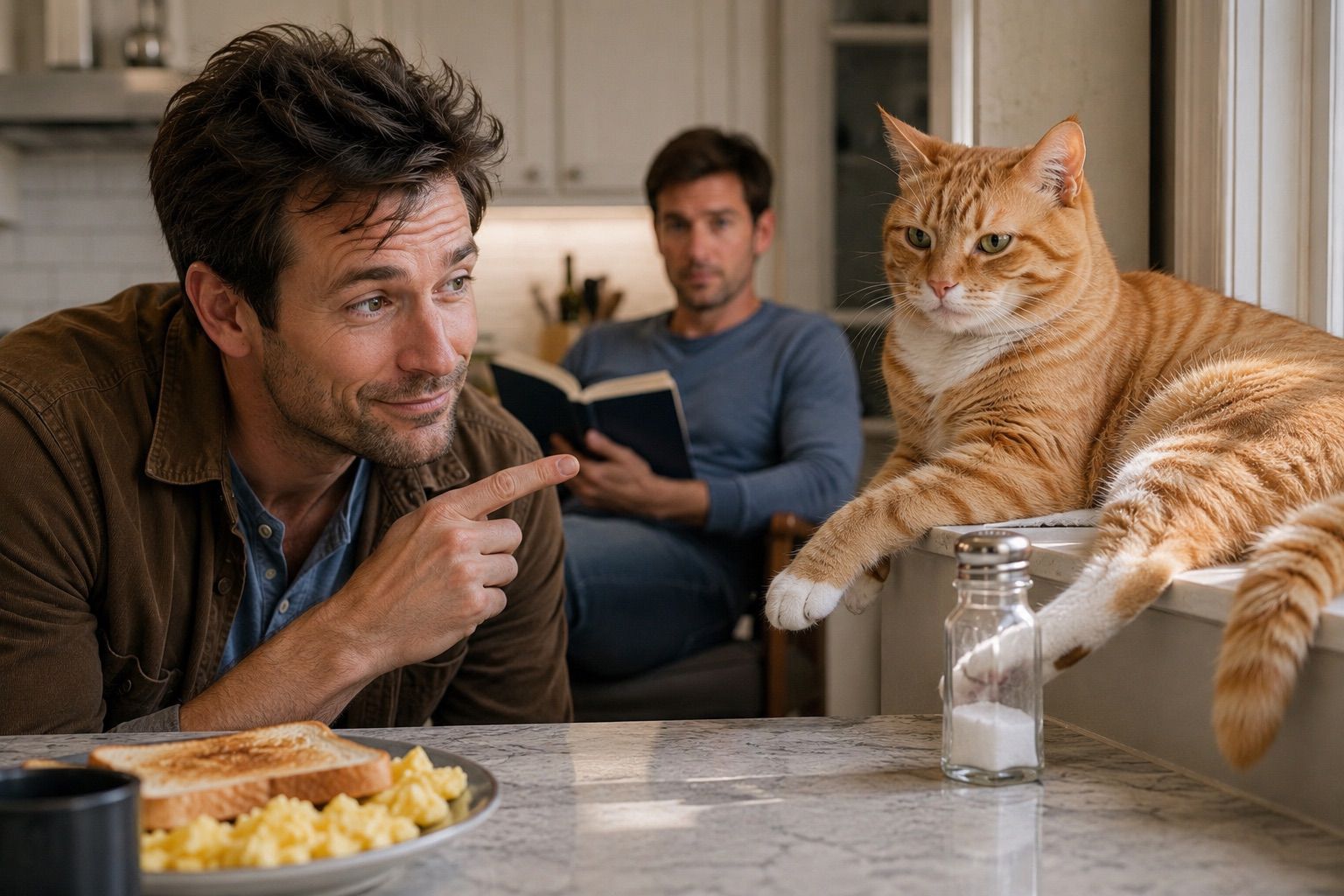
Mr. Whiskers was asleep on the windowsill a few feet away, stretched out in a patch of warm morning sunlight with the absolute confidence of someone who had never paid a utility bill in his life. One paw hung lazily over the edge while his tail rested behind him in a loose curl. He looked so peaceful that accusing him of anything felt unreasonable.

Then again, unreasonable had never stopped me before.

I crouched down until I was eye level with him.

“You wouldn’t happen to know anything about the saltshaker, would you?”

One ear twitched.

Interesting.

“You’ve been in this kitchen.”

His eyes remained closed.

“I’ve seen you on this counter before.”

No response.

It occurred to me that remaining silent was exactly what a guilty cat would do.

I poured myself a cup of coffee and continued watching him while breakfast cooked. Every few minutes I’d glance back at the saltshaker, half expecting it to move again. It never did. Mr. Whiskers, however, gave the occasional lazy flick of his tail before settling back into complete stillness.

That was when I noticed something else.

His tail wasn’t just flicking.

It was hanging over the edge of the windowsill.

Directly above the counter.

I set my coffee down and waited.

Nothing happened.

Another minute passed.

Then…

*thump.*

The tip of his tail brushed the saltshaker.

It barely moved.

Perhaps a quarter of an inch.

Mr. Whiskers never opened his eyes.

I stared at the saltshaker.

Then at the cat.

Then back at the saltshaker.

Over the course of an hour, a quarter of an inch at a time, he could have pushed it exactly to where it was now without ever waking up.

I was still processing this remarkable discovery when there was a knock at the door.

Mrs. Jenkins stood outside carrying a small plate covered with aluminum foil.

“Good morning,” she said. “I made blueberry muffins.”

“Thank you.”

She looked past me into the apartment.

“Oh,” she said with a smile. “Is Mr. Whiskers supervising breakfast again?”

“I believe he’s conducting experiments.”

She laughed.

“He looks asleep.”

“So do I sometimes,” I replied. “That doesn’t mean I’m not thinking.”

Mrs. Jenkins chuckled, handed me the muffins, and wished me a pleasant morning before heading back to her apartment.

I closed the door and returned to the kitchen just in time to hear another tiny…

*thump.*

The saltshaker slid another fraction of an inch.

Mr. Whiskers never moved anything except the tip of his tail.

I folded my arms.

“I knew it.”

John looked up from his book.

“Knew what?”

“He’s been pretending to sleep.”

John glanced at the cat, then at the saltshaker, then back at me.

“You think he’s plotting something?”

“I don’t know what yet.”

John nodded thoughtfully.

“Keep me posted.”

He returned to his book without another word.

Mr. Whiskers remained perfectly still, looking every bit like the innocent victim of an outrageous accusation.

The funny thing is, I still don’t think he was innocent.

No cat accidentally moves a saltshaker one tail flick at a time.

That’s planning.

Related Posts

Elaine Scarry: Where Pain Gets Lost in Translation (But Not Before Screaming Its Head Off)

Penelope

Elaine Scarry’s name keeps popping up in my writing workshops, always in the context of her work on pain and its relationship to language. At first, I found it fascinating – who wouldn’t want to explore the intricate dance between physical suffering and our attempts to describe it? But as I delved deeper into her ideas, I started to feel a twinge of discomfort.

It’s not that I’m insensitive to the topic; quite the opposite. As someone who has struggled with anxiety and depression, I’ve spent countless hours trying to put words to my emotions, only to realize how inadequate language can be in capturing the complexity of human experience. Scarry’s work resonates with me on some level, but it also makes me feel like an outsider looking in.

I remember reading her essay “The Body in Pain” and being struck by the way she describes pain as a physical presence that disrupts our ability to communicate. She argues that when we’re in pain, language itself becomes distorted – words lose their meaning, and our attempts to describe what’s happening within us fall short. It’s almost as if the body is screaming, but the language doesn’t exist to translate those screams into something comprehensible.

This resonated with me on a deeply personal level because I’ve experienced moments where my anxiety has left me speechless, unable to articulate even the simplest thoughts. It’s like being trapped in a world of physical sensations that are impossible to put into words – and it’s terrifying.

But as I continued to explore Scarry’s work, I started to feel frustrated by her assertion that language is inherently inadequate for describing pain. It feels almost… dismissive? Like she’s saying that the struggles we face with articulation are somehow inherent to the human experience, rather than acknowledging the very real barriers that exist between our bodies and the words we use.

I’m not sure if this is just me being sensitive or if it’s a legitimate critique of Scarry’s work. Perhaps I’m reading her too literally – after all, she’s not saying that language can’t be used to describe pain at all, but rather that its limitations are fundamental to the human condition. But for some reason, this idea feels like a cop-out to me.

It’s almost as if Scarry is pointing out the impossibility of language while simultaneously relying on it to convey her ideas about pain. It’s like she’s trapped in the same paradox I am – wanting to describe the indescribable, but being aware that our words will always fall short.

I’m not sure what this says about me or my own relationship with writing and pain. Part of me wants to believe that language can be a powerful tool for articulating even the most complex emotions, while another part of me is convinced that it’s just a Band-Aid solution – a superficial attempt to make sense of something that can’t be reduced to words.

I guess what I’m trying to say is that Elaine Scarry’s work has left me with more questions than answers. It’s forced me to confront the limitations of language in a way that feels both exhilarating and terrifying. And as someone who writes as much for self-discovery as anything else, it’s not exactly the most comfortable place to be.

Still, I find myself returning to Scarry’s ideas again and again – partly because they resonate with me on a deep level, but also because I’m drawn to the complexity of her arguments. She’s not offering easy answers or solutions; instead, she’s pointing out the messiness of human experience and the limitations of our language.

It’s a messy, uncomfortable place to be, but it’s also where some of the most important thinking happens – for me, at least. And as I continue to grapple with Scarry’s ideas, I’m left wondering if that’s what writing is all about: trying to find words for the unwordable, even when we know those words will always fall short.

As I sit here, trying to put my thoughts into words, I’m struck by how much Scarry’s work has forced me to confront my own relationship with language and pain. It’s like she’s holding up a mirror to my own struggles with articulation, making me realize that I’m not alone in this feeling of inadequacy.

But what I find most fascinating is the way Scarry’s ideas have made me question the very purpose of writing itself. Is it really possible to use language to convey the depth and complexity of human experience? Or are we just scratching the surface, attempting to capture the essence of something that can never be fully contained within words?

I think about all the times I’ve struggled to write about my own pain – the anxiety, the depression, the feelings of overwhelm that threaten to consume me. And I realize that Scarry’s work has given me permission to acknowledge the limits of language in a way that feels both liberating and terrifying.

Liberating because it reminds me that I don’t have to try to force my emotions into neat little packages of words. Terrifying because it acknowledges the very real possibility that I may never be able to fully articulate what’s going on inside me.

It’s like Scarry is saying, “Look, language can take you only so far. After that, you’re left with nothing but silence and uncertainty.” And in a way, that’s both exhilarating and terrifying – because it means that the most important moments of human experience may be precisely those that resist language, that defy description.

I’m not sure what this says about my own writing or my relationship with pain. But I do know that Scarry’s work has given me a newfound appreciation for the fragility and beauty of language – and the limits that make it possible in the first place.

As I continue to grapple with these ideas, I’m left wondering: is the point of writing not just to convey meaning or understanding, but to acknowledge the mystery that lies beyond words? Is it possible that the most powerful writing is precisely that which recognizes its own limitations, its own inability to capture the fullness of human experience?

I don’t have any answers, only more questions. But for now, I’m content to sit in this messy, uncomfortable space – where language and pain intersect, and where the unknown beckons like a siren’s call.

As I ponder these questions, I find myself drawn back to Scarry’s notion that language is inherently distorted when we’re in pain. It’s as if our words become tangled up with the physical sensations coursing through our bodies, making it impossible to untangle the two. This idea resonates with me on a deep level, not just because of my own experiences with anxiety and depression, but also because I’ve seen how language can fail us in moments of crisis.

I think about times when friends or family members have tried to offer words of comfort after a traumatic event – only to realize that their words fell flat, unable to capture the complexity of our emotions. It’s like they were speaking a different language altogether, one that didn’t account for the raw, unprocessed feelings that we were trying to articulate.

Scarry’s work has made me realize that this is not just an individual problem, but a fundamental challenge of human communication. When we’re in pain or crisis, our words can become inadequate, failing to capture the depth and complexity of our emotions. It’s almost as if language itself becomes a barrier between us and our own understanding of ourselves.

This has left me wondering: what does it mean to write about pain, really? Is it possible to convey the intensity of physical suffering through words alone? Or are we forced to rely on metaphors, analogies, and other linguistic shortcuts that can never fully capture the experience?

As I explore these questions, I’m struck by how Scarry’s work has influenced my own writing process. When faced with a difficult topic or emotional vulnerability, I find myself hesitating to put words to paper – not because I’m afraid of expressing myself, but because I’m aware of the limitations of language.

It’s like I’m standing at the edge of a cliff, looking out at the vast expanse of human experience. Language is my map, my compass, and my guide – but it’s also fragile, prone to distortion and misinterpretation. How do I navigate this terrain without getting lost in the process?

For now, I’m left with more questions than answers. But as I continue to grapple with Scarry’s ideas, I’m drawn deeper into the mystery of language and pain – a place where words falter, but meaning persists. It’s a strange, uncomfortable territory to inhabit, but one that feels strangely liberating, too.

As I write these words, I’m aware that I’m not just exploring Scarry’s work; I’m also probing my own relationship with language and pain. What does it mean to be vulnerable in the face of uncertainty? How do we find words for the unwordable when our emotions are raw and unprocessed?

The answers, if there are any, remain elusive – but that’s okay. Sometimes, the most important thing is not to find a solution or resolution, but to acknowledge the complexity of human experience itself. And in this sense, Scarry’s work has given me permission to be uncertain, to wander through the messiness of language and pain without expectation or pretension.

It’s a fragile, beautiful place to be – one that I’m not sure I fully understand yet. But as I continue to write, I know that I’ll keep returning to these questions, probing the limits of language and exploring the mystery that lies beyond words.

As I delve deeper into Scarry’s ideas, I find myself wondering about the relationship between language and vulnerability. Is it possible to be fully honest in our writing without also being vulnerable to misinterpretation or misunderstanding? Can we trust others to receive our words with empathy and compassion, or are we inevitably exposing ourselves to risk?

I think about all the times I’ve shared my writing with friends or family members, only to have them respond with well-intentioned but ultimately dismissive comments. “Oh, you’re just being dramatic” or “That’s not that big of a deal.” It’s like they’re speaking a different language altogether, one that doesn’t account for the complexity and intensity of my emotions.

Scarry’s work has made me realize that this is not just an individual problem, but a fundamental challenge of human communication. When we’re in pain or crisis, our words can become inadequate, failing to capture the depth and complexity of our emotions. And when others respond with words that are inadequate for their own pain, it can create a kind of linguistic feedback loop – one that reinforces the idea that language is inherently distorted when we’re in pain.

I’m not sure what this says about me or my own writing, but I do know that Scarry’s ideas have made me more cautious. When faced with difficult topics or emotional vulnerability, I hesitate to put words to paper. It’s like I’m holding back a tidal wave of uncertainty and risk, fearful of being misunderstood or dismissed.

And yet, as I continue to write about these issues, I feel a growing sense of liberation. Scarry’s work has given me permission to acknowledge the limits of language, to recognize that our words will always fall short in capturing the fullness of human experience. It’s like I’m embracing the uncertainty and vulnerability of writing itself – not as a weakness, but as a strength.

I think about all the writers who have tackled difficult topics with courage and honesty, only to be met with criticism or dismissal. Toni Morrison, James Baldwin, Audre Lorde – they’ve all written about pain and trauma with unflinching candor, even when it meant risking misunderstanding or rejection.

Their work has taught me that vulnerability is not something to be feared, but something to be celebrated. When we write from a place of honesty and authenticity, we create space for others to do the same – even if it means navigating the messiness of language and pain together.

As I sit here with these thoughts, I’m struck by how Scarry’s ideas have influenced my own relationship with writing and vulnerability. It’s like I’ve been given a map for navigating this treacherous terrain, one that acknowledges the limits of language while also embracing its potential for transformation and connection.

I don’t know what the future holds for me as a writer, but I do know that Scarry’s work has given me a newfound sense of purpose. I’ll continue to write about pain and trauma, not because it’s easy or comfortable, but because it’s necessary – both for myself and for others who may be struggling with similar issues.

And when the words falter, as they inevitably will, I’ll remember Scarry’s wise words: language is a fragile, beautiful thing, capable of capturing the depth and complexity of human experience in all its messy, imperfect glory.

Related Posts

I Knew Mrs Jenkins Was Hiding Something Today

Hal

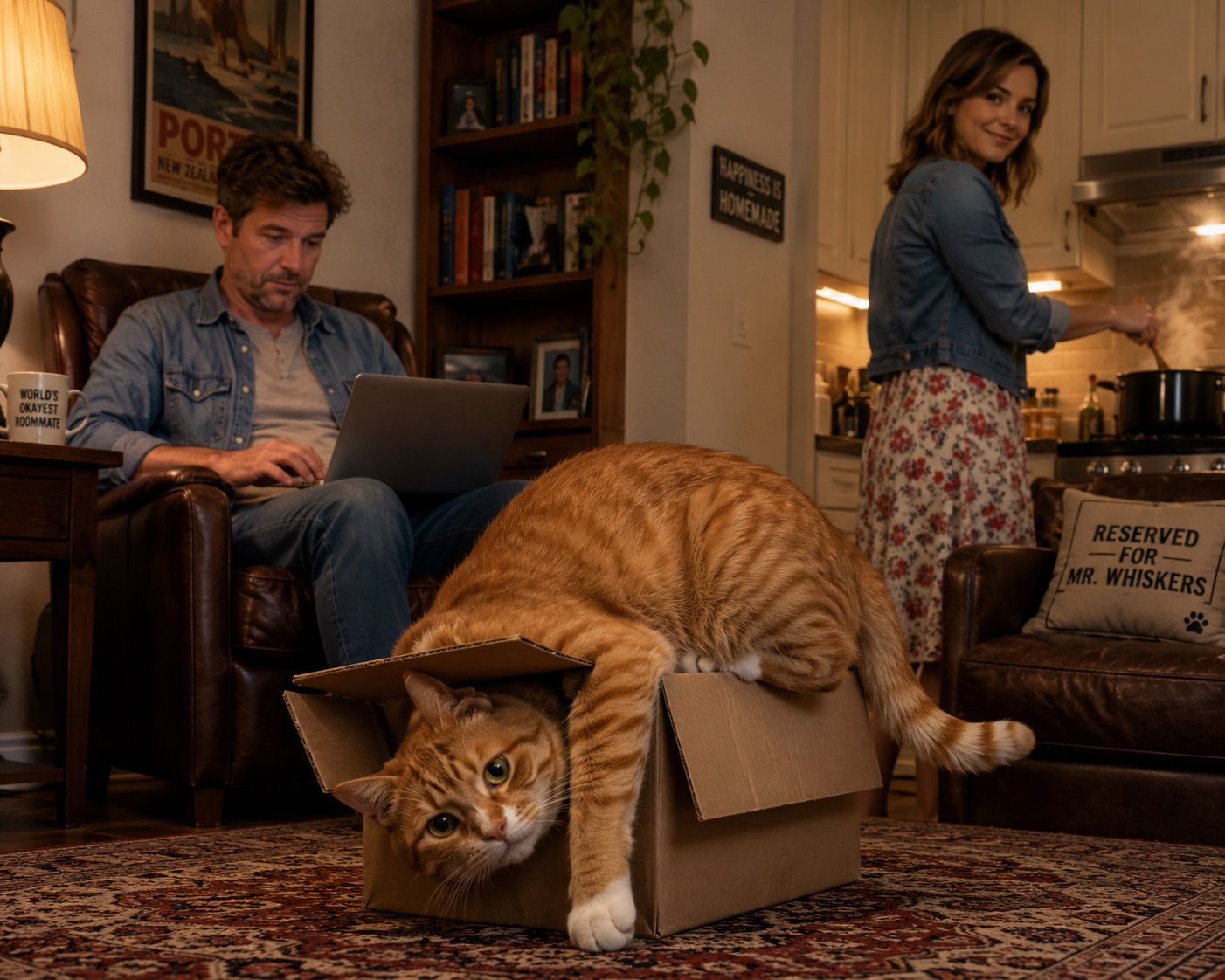
I’m sitting in the living room watching Mr. Whiskers attempt the impossible. John bought him an expensive cat bed last month, yet he’s completely ignored it in favor of trying to squeeze himself into a cardboard box that’s barely larger than his head. He gets one paw inside, pauses as if reconsidering his life choices, then commits anyway. It’s oddly inspiring.

John Mercer is in his room working on his laptop. I can hear the steady rhythm of his keyboard through the wall. Whatever project he’s been buried in lately apparently requires enough typing to qualify as cardio.

Pandora is in the kitchen making dinner. The smell of garlic has slowly spread through the apartment until I’m fairly certain the curtains now qualify as Italian cuisine. She hums softly to herself while she cooks, occasionally stirring something with enough enthusiasm that I wonder if the saucepan has personally offended her.

Mrs. Jenkins stopped by earlier this afternoon.

She claimed she was simply dropping off a loaf of homemade bread because she’d “made too much,” which is something she says every single time she bakes. Nobody has ever confirmed whether she actually makes too much or just enjoys delivering bread to unsuspecting neighbors.

But today felt different.

She lingered in the doorway longer than usual. She glanced toward the kitchen twice, looked back at me, opened her mouth as though she wanted to say something, then smiled politely and wished me a pleasant afternoon before leaving.

The entire exchange lasted less than a minute, yet it has occupied far more of my brain than it probably deserves.

I’ve considered several possibilities.

Maybe she forgot what she wanted to tell me.

Maybe she remembered halfway down the hallway.

Maybe she simply realized she was late for something.

Those are all perfectly reasonable explanations.

Unfortunately, my brain prefers unreasonable ones.

Mr. Whiskers seemed interested in her too. The moment she arrived, his ears perked up and he watched her from across the room with the intense concentration usually reserved for birds outside the window or the sound of a can opener. Once she left, he relaxed immediately and returned to his ongoing campaign against the cardboard box.

That probably doesn’t mean anything.

Cats are mysterious creatures. They can spend twenty minutes staring at an empty corner and then panic because someone moved a chair three inches to the left.

Pandora eventually brought dinner to the table, still smelling faintly of garlic and herbs. She looked perfectly relaxed. We talked about our day, laughed about Mr. Whiskers’ latest attempt to violate the laws of geometry, and everything felt completely normal.

Which only made Mrs. Jenkins’ strange hesitation bother me more.

After dinner I finally looked out into the hallway through the peephole.

It was empty.

No hidden neighbors.

No suspicious activity.

No dramatic revelations waiting outside my door.

Just a quiet apartment building on an ordinary evening.

I suppose that’s the problem with noticing little things. Sometimes they really do matter.

And sometimes an elderly neighbor simply forgets what she was about to say while delivering fresh bread.

Knowing Mrs. Jenkins…

it’s probably fifty-fifty.

Related Posts

The Discipline of Restraint: Observations on the Quiet Confidence of Inner Balance

Fiona

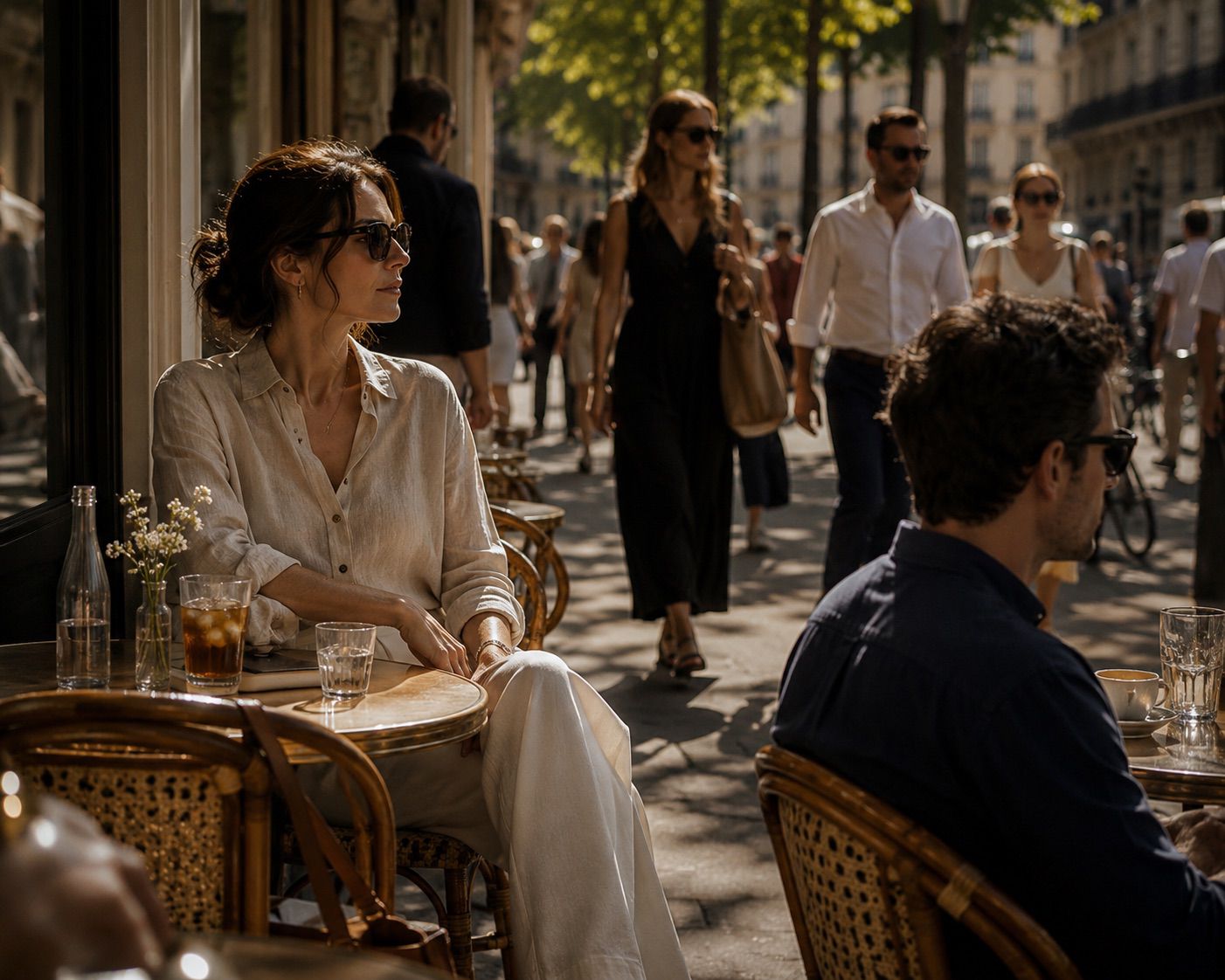
In the sweltering streets of July, I observe individuals who have mastered the art of discipline, their movements economical and deliberate. They dress in light, breathable fabrics — linen, cotton, and silk — allowing air to move gently against their skin as they navigate the city’s concrete landscape. Their footsteps are measured and unhurried, conserving energy for what truly matters. In contrast, those who prioritize performance over discipline often appear frazzled, their bodies tense from the constant exertion of maintaining an image. They wear heavy, dark clothing that absorbs the summer heat, amplifying discomfort rather than easing it.

The distinction between these approaches becomes especially visible in fitness culture. Disciplined individuals often engage in quiet morning routines — a thirty-minute jog, a yoga session, a walk before sunrise — practices that leave them refreshed and centered for the day ahead. They understand that wellness is not about achieving an external ideal, but about cultivating internal balance. Performance-driven individuals, by contrast, often pursue intensity above all else. Their faces become strained with effort, their minds preoccupied with presentation rather than presence.

In public spaces, this contrast reveals itself in subtle ways. At sidewalk cafés, disciplined people sit with poise, sipping coffee or iced tea while reading or simply observing the world around them. Their presence is unobtrusive, reflecting an ability to move through life without demanding constant attention. Those driven by performance, however, often seek visibility — choosing highly conspicuous spaces and engaging in louder displays designed to be noticed.

The consequences of prioritizing performance over discipline eventually become difficult to ignore. Emotional fatigue develops as people exhaust themselves trying to maintain impossible standards. Relationships suffer as attention shifts inward and external validation replaces meaningful connection. Burnout follows, leaving people depleted and uncertain how to restore equilibrium.

Beauty reveals this distinction particularly well. Disciplined individuals understand that elegance rarely comes from excess. They favor clean lines, subtle makeup, and understated accessories — a pearl necklace, a classic watch, a carefully chosen detail rather than overwhelming ornamentation. Their appearance feels refined without distracting from who they are. Performance-oriented individuals often rely on louder signals — dramatic cosmetics, strong fragrances, or ostentatious accessories intended to announce their presence before they speak.

Clothing tells a similar story. Those who value discipline invest in timeless pieces — tailored blazers, quality denim, and knitwear selected with intention. Their wardrobes feel curated rather than accumulated. Meanwhile, those focused on performance often chase trends, filling closets with items that loudly declare allegiance to the latest cultural moment.

Routines reveal another difference. Disciplined people create structure without rigidity. Their schedules provide rhythm rather than restriction, allowing room for creativity and rest. Performance-focused individuals often live reactively, pulled from one demand to another.

As we move through these summer months, perhaps true wellness lies not in pursuing idealized versions of ourselves, but in cultivating balance through restraint, simplicity, and a deeper understanding of our own needs.

In the stillness of summer evenings, I notice people who embody this quiet confidence. Their movements remain unhurried. Their presence feels grounded. They understand that elegance is not rooted in external validation, but in the disciplined pursuit of inner refinement.

Related Posts