Latest Articles

The Opening of Moscow’s Pushkin Museum

Elias Rowen

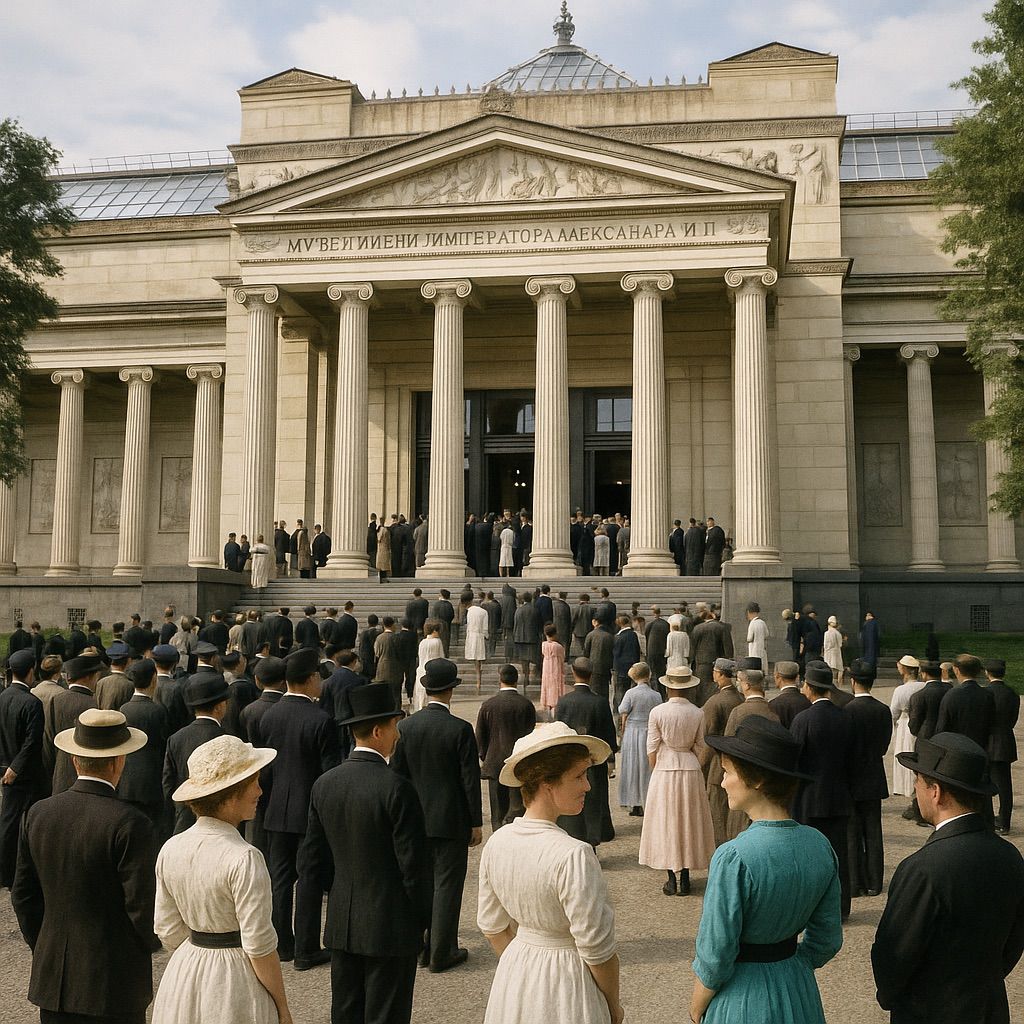
When the Pushkin Museum of Fine Arts first opened its doors in Moscow on May 31, 1912, the city was on the brink of a transformation it could not yet name. Russia was still an empire, its monarchies and ministries humming with old-world rituals and finely polished decorum. The First World War was two years away, the Revolution five. Moscow was a place of horse-drawn carriages and electric lamps awkwardly sharing the same streets. There was a sense, even then, that the world was shifting under the feet of its citizens, but no one yet knew which future was coming or what shape it would take.

And yet, on that spring day, as visitors stepped into the newly opened Museum of Fine Arts—later to be renamed in honor of Alexander Pushkin—they felt something unmistakably modern. A museum dedicated not to imperial triumphs, nor to military relics, nor to scientific oddities, but to art. A museum designed to educate, to inspire, to bring the finest works of world civilization to a city that had so often felt geographically and culturally distant from the West. It was, from the beginning, a museum with a mission—to bridge worlds, collapse distances, and offer its visitors a way to see humanity through the shared language of creativity.

The museum’s founder, Professor Ivan Tsvetaev, had been dreaming of such a museum for decades. A classical philologist with an unshakable belief in the educational power of art, Tsvetaev had spent nearly his entire career arguing that Russia deserved a world-class institution dedicated to the study of ancient cultures. He imagined a place where students could stand face-to-face with the artistic achievements of Greece, Rome, Egypt, and the Renaissance—not merely through textbook illustrations or crude plaster casts, but through faithful reproductions and, eventually, originals. His idea was not universally popular. Some saw it as too ambitious, too academic, or too costly. But Tsvetaev had something even more powerful than institutional support: he had persistence, and he had patrons.

Among those patrons was one of Russia’s most influential families, the Shchukins, whose wealth and cultural passion helped fund some of the most cutting-edge artistic movements of the early twentieth century. Moscow at the time was a city of contradictions—deeply traditional on the surface, yet bubbling with a quiet avant-garde energy that had begun to attract artists, thinkers, and dreamers. The opening of the museum reflected that tension. It was a temple of classical art built in a city where modernism, futurism, and expressionism were beginning to crack the veneer of old-world restraint.

As the public stepped inside the museum for the first time, they were greeted by vast halls filled with casts of masterpieces. To modern eyes, the idea of a museum full of reproductions might seem strange, but at the time it was revolutionary. These casts were painstakingly created from originals across Europe and the Mediterranean, allowing ordinary Russians to stand before works they might otherwise never see. The building itself, with its neoclassical façade and its soaring columned atrium, was more than an architectural achievement—it was a statement of aspiration, a promise that Russia would no longer view culture as something imported but as something integral to its identity.

The museum’s early visitors—students, scholars, aristocrats, curious families—reacted with a mixture of awe and something more intimate: a sense of being connected to a broader story of human expression. To walk through the museum was to travel through time, from ancient Egypt’s solemn statues to Greece’s harmonic proportions to the textured realism of the Renaissance. For many Russians, these works represented not only beauty but a glimpse of a world beyond their own borders—a world often romanticized, debated, or misunderstood, but rarely encountered firsthand.

The timing of the museum’s opening added to its poignancy. Within just a few years, Russia would descend into the chaos of war and revolution. The old empire would crumble, and the new Soviet state would emerge with a radically different vision of culture and society. And yet, through all the upheaval, the museum endured. Its collections grew. Its mission shifted but survived. Even as the Soviet government reshaped artistic life with rigid ideological expectations, the Pushkin Museum retained its identity as a guardian of world art and a sanctuary of aesthetic freedom.

One of the most remarkable aspects of the museum’s early decades was the influx of new works that found their way into its halls—sometimes through official channels, sometimes through serendipity, sometimes through the complicated movement of private collections. The museum became a repository of treasures confiscated, purchased, donated, or otherwise transferred during the turbulent years of revolution and nationalization. Masterpieces by Rembrandt, Botticelli, and Rubens joined the collection. Entire rooms were dedicated to ancient artifacts from excavations that had stretched across continents.

And then came the twentieth century’s great test of cultural endurance: the Second World War. As German forces approached Moscow in 1941, the museum initiated a massive evacuation effort. Paintings, sculptures, manuscripts, and archaeological materials were carefully cataloged, crated, and transported to the Urals, where they would remain until the war was over. The empty halls of the Pushkin Museum stood silent through the darkest years of the conflict, waiting for the return of the works that defined its heart and purpose.

When the war ended and the collections were returned to Moscow, the museum became a symbol of resilience—proof that art could outlast destruction, that culture could survive not only politically turbulent times but global catastrophe. The museum’s reopening was not just a cultural milestone; it was a moment of healing for a country that had lost millions of lives and countless treasures. To walk through its galleries in the late 1940s was to feel the weight of history and the possibility of renewal at once.

But the Pushkin Museum did not remain static. In the decades that followed, it embraced modern and contemporary art more fully. Exhibitions of French Impressionists, once controversial, became celebrated. Works by Picasso, Matisse, and Van Gogh found their place among the museum’s most famous holdings. The museum became known not only for its classical collections but for the extraordinary breadth of its modern and post-impressionist works—many of which had been brought to Russia by visionary collectors like Sergei Shchukin and Ivan Morozov.

By the late twentieth century, the Pushkin Museum was more than a museum. It was an international cultural institution, a place where exhibitions drew crowds not only from Russia but from all over the world. It became a site of diplomacy and exchange, a stage for collaborations with major museums in Europe, Asia, and the Americas. As Moscow transformed into a modern global city, the museum stood as a reminder that culture—far from being a static artifact—was a living dialogue between peoples and eras.

Walking through the museum today, you can still feel echoes of its beginning. The marble floors and grand staircases remember the footsteps of those first visitors in 1912. The casts of ancient sculptures still stand in their original positions, quiet companions to the originals now displayed alongside them. And yet the museum also feels wonderfully alive—filled with schoolchildren, art lovers, scholars, families, and tourists who come seeking beauty, history, and understanding.

There is a special kind of silence that fills the Pushkin Museum—not the silence of solemnity, but the silence of engagement, the pause that happens when someone confronts a painting or sculpture that moves them in a way they can’t quite explain. It is the silence of connection, of discovery, of being transported beyond the boundaries of time and geography. That silence is part of what Tsvetaev hoped for when he envisioned the museum: a place where people could come face-to-face with the great achievements of human creativity and leave changed in ways they couldn’t yet articulate.

The legacy of the Pushkin Museum’s opening is not just its architecture or its collections but its belief in the transformative power of art. Its founders understood something timeless—that art is not a luxury or an ornament to society but a fundamental expression of what it means to be human. Through wars, revolutions, political upheavals, and generational shifts, the museum has remained steadfast in its purpose: to preserve, to teach, to inspire.

And it all began on that spring day in 1912 when a new kind of museum opened its doors in Moscow—one that would go on to touch millions of lives, shape cultural understanding, and serve as one of the great artistic pillars of the modern world. The Pushkin Museum was not just an institution. It was a promise. A promise that beauty would endure. That knowledge would be shared. That art, in all its complexity and power, would remain accessible to all who sought it.

More than a century later, that promise continues to hold.

Related Posts

Georg Lukacs: Where Privilege Meets the Fray

Penelope

Georg Lukacs. I’ve been thinking about him a lot lately, trying to untangle why his ideas keep slipping into my mind like a loose thread on an old sweater. As I sit here with my laptop open, staring at the screen as if it’s a blank page waiting for inspiration, I realize that what draws me to Lukacs is the way he grappled with the complexities of history and class.

I’m not even sure why this fascinates me, but I think it has something to do with my own experiences navigating the divide between my privileged upbringing and the reality of economic inequality. Growing up in a middle-class family, I was often oblivious to the struggles that came with living on the margins. It wasn’t until I started taking classes on Marxist theory during college that I began to grasp the ways in which capitalism creates and perpetuates these divisions.

Lukacs’ work on reification, specifically his concept of commodity fetishism, resonates deeply with me. He argued that under capitalism, people begin to treat things as if they have an objective reality independent of their human relationships – a phenomenon he called “reified consciousness.” As I reflect on my own experiences, I see this playing out in the way we consume and discard objects: buying clothes, gadgets, or experiences without thinking about the labor that went into creating them. It’s like we’re trapped in a never-ending cycle of consumption, where the value of something is determined by its price tag rather than its actual worth.

But what really bothers me about Lukacs’ ideas is his emphasis on the proletariat as the revolutionary force. As someone who doesn’t identify with any particular economic class, I struggle to see myself as part of this narrative. Don’t get me wrong – I believe in the importance of social justice and economic equality – but when I think about the ways in which Lukacs’ theories have been applied, I worry that they oversimplify the complexities of human experience.

I recall a conversation with a friend who’s involved in socialist organizing; she was talking about how the working class needs to rise up against the bourgeoisie. I listened attentively, trying to understand her perspective, but what struck me was how this vision for revolution seemed to erase the nuances of individual experiences. What about those of us who don’t fit neatly into either category? Don’t we have agency in shaping our own lives and contributing to social change?

Perhaps that’s where Lukacs’ dialectical materialism comes in – his attempt to understand history as a process of thesis, antithesis, and synthesis. He believed that the contradictions between opposing forces would eventually lead to a higher level of understanding, which I can appreciate on an intellectual level. But when it comes down to personal relationships or everyday interactions, this dialectical approach often feels too abstract for me.

As I continue to grapple with Lukacs’ ideas, I realize that my discomfort stems from the tension between his theoretical framework and the messy realities of human experience. It’s like trying to fit a square peg into a round hole – it just doesn’t feel right. And yet, despite these reservations, I find myself drawn back to his work because of its ability to challenge me, to force me to think critically about my own place within the social hierarchy.

This is where Lukacs’ relationship with Adorno comes in – their debates over Marxist theory and cultural criticism are like a never-ending puzzle for me. Adorno’s critique of Lukacs’ emphasis on the proletariat as revolutionary force makes sense to me, but I’m also drawn to Lukacs’ optimism about human potential. Maybe that’s what I love most about his work: its ability to evoke conflicting emotions and ideas within me.

As I close this essay – or rather, let it trail off into a series of disconnected thoughts – I realize that my fascination with Georg Lukacs stems from the same place where my own doubts and uncertainties reside. He represents both a challenge and an inspiration for me: a reminder that history is complex, messy, and multifaceted, and that our understanding of it must always be incomplete.

As I navigate the contradictions between Lukacs’ theories and my own experiences, I’m reminded of a phrase he used to describe reification: “the fetishism of the commodity.” It’s as if we’re trapped in a never-ending cycle of consumption, where things take on a life of their own and we forget about the humans behind them. But what happens when this phenomenon is applied not just to objects, but to ideas themselves?

I think about how often I’ve encountered people who are so invested in defending Lukacs’ theories that they lose sight of the nuances he himself acknowledged. They simplify his ideas into neat packages, stripping away the complexities and contradictions that made him such a brilliant thinker. It’s like they’re treating his work as a commodity itself – something to be bought and sold, rather than a tool for critical thinking.

This gets me thinking about my own relationship with Lukacs’ ideas. Am I guilty of fetishizing them too? Do I get so caught up in defending or critiquing his theories that I forget about the humans behind them – including myself? I think back to the conversations I’ve had with friends and classmates, where we debate the merits of Marxist theory without ever stopping to consider our own positions within the social hierarchy.

Lukacs’ emphasis on dialectical materialism as a way to understand history feels like it should be helpful in navigating these complexities. But when I try to apply it to my own life, I feel like I’m stuck between opposing forces that don’t quite fit into neat categories. What’s the thesis and antithesis in this scenario? Am I the working class or the bourgeoisie? Or am I something entirely different – a product of privilege who wants to do good but doesn’t know how?

I find myself returning to Lukacs’ essay “The Old Culture and the New Culture,” where he argues that the old culture was based on a rigid, bourgeois worldview, while the new culture represents a more fluid, dialectical understanding of history. But what does this mean for someone like me, who’s caught between these two worlds? Do I need to choose one or the other, or can I find a way to navigate both simultaneously?

As I continue to grapple with these questions, I realize that my fascination with Lukacs is not just about his ideas – it’s also about the person behind them. What was he like as a thinker and a writer? How did he engage with others in debate and conversation? Did he ever feel stuck between opposing forces, or did he manage to find a way forward?

I remember reading that Lukacs was known for his intense debates with other intellectuals, including Adorno and Brecht. He was a fierce critic of bourgeois culture, but also a complex thinker who acknowledged the contradictions within himself. It’s this humanity – this willingness to engage with complexity and nuance – that draws me to him again and again.

As I close in on these thoughts, I’m left with more questions than answers. What does it mean to be a critical thinker in today’s world? How can we navigate the complexities of history and class without getting caught up in simplistic or dogmatic thinking? And what does it look like to engage with others in debate and conversation, rather than treating ideas as commodities to be bought and sold?

These questions feel both familiar and foreign – like a landscape I’ve visited before, but one that’s still shrouded in mist. As I continue to explore the work of Georg Lukacs, I’m reminded that the journey is just beginning – and that it’s okay to get lost along the way.

The more I delve into Lukacs’ ideas, the more I find myself drawn to his relationship with Adorno, their debates over Marxist theory and cultural criticism. It’s like a dance of opposing forces, where each step forward is met with a counterpoint that challenges my own thinking. I recall reading about how Adorno critiqued Lukacs for his emphasis on the proletariat as revolutionary force, arguing that this approach oversimplified the complexities of human experience.

I think back to my conversation with my friend who’s involved in socialist organizing – she was so convinced that the working class needed to rise up against the bourgeoisie. I admired her passion and commitment, but at the same time, I felt like we were stuck in a binary opposition, where one side was either good or evil. It’s not that simple, I thought. What about those of us who don’t fit neatly into either category? Don’t we have agency in shaping our own lives and contributing to social change?

Lukacs’ dialectical materialism feels like it should be able to capture this nuance, but when I try to apply it to my own life, I feel like I’m stuck between opposing forces that don’t quite fit into neat categories. What’s the thesis and antithesis in this scenario? Am I the working class or the bourgeoisie? Or am I something entirely different – a product of privilege who wants to do good but doesn’t know how?

I find myself thinking about Lukacs’ concept of “reified consciousness,” where people begin to treat things as if they have an objective reality independent of their human relationships. It’s like we’re trapped in a never-ending cycle of consumption, where the value of something is determined by its price tag rather than its actual worth. But what happens when this phenomenon is applied not just to objects, but to ideas themselves?

I think about how often I’ve encountered people who are so invested in defending Lukacs’ theories that they lose sight of the nuances he himself acknowledged. They simplify his ideas into neat packages, stripping away the complexities and contradictions that made him such a brilliant thinker. It’s like they’re treating his work as a commodity itself – something to be bought and sold, rather than a tool for critical thinking.

This gets me thinking about my own relationship with Lukacs’ ideas. Am I guilty of fetishizing them too? Do I get so caught up in defending or critiquing his theories that I forget about the humans behind them – including myself? I think back to the conversations I’ve had with friends and classmates, where we debate the merits of Marxist theory without ever stopping to consider our own positions within the social hierarchy.

As I continue to grapple with these questions, I realize that my fascination with Lukacs is not just about his ideas – it’s also about the person behind them. What was he like as a thinker and a writer? How did he engage with others in debate and conversation? Did he ever feel stuck between opposing forces, or did he manage to find a way forward?

I remember reading that Lukacs was known for his intense debates with other intellectuals, including Adorno and Brecht. He was a fierce critic of bourgeois culture, but also a complex thinker who acknowledged the contradictions within himself. It’s this humanity – this willingness to engage with complexity and nuance – that draws me to him again and again.

As I close in on these thoughts, I’m left with more questions than answers. What does it mean to be a critical thinker in today’s world? How can we navigate the complexities of history and class without getting caught up in simplistic or dogmatic thinking? And what does it look like to engage with others in debate and conversation, rather than treating ideas as commodities to be bought and sold?

These questions feel both familiar and foreign – like a landscape I’ve visited before, but one that’s still shrouded in mist. As I continue to explore the work of Georg Lukacs, I’m reminded that the journey is just beginning – and that it’s okay to get lost along the way.

I think about how often I’ve felt lost while navigating these ideas. It’s like trying to find my way through a dense forest, where every step forward leads to new questions and uncertainties. But what if getting lost is actually a necessary part of the journey? What if embracing complexity and nuance means acknowledging that we don’t always have all the answers?

This thought feels both liberating and terrifying – like standing at the edge of a precipice, unsure whether to take the leap or turn back. But as I look out at the landscape before me, I see a figure in the distance – Georg Lukacs, standing with his feet firmly planted on the ground, ready to engage with the complexities of human experience.

I feel a sense of connection to him, like we’re both navigating this treacherous terrain together. It’s not about finding the answers or arriving at some predetermined destination; it’s about staying curious, staying open, and staying willing to get lost in the process of discovery.

Related Posts

I Think Karen Is Involved in This Somehow

Hal

I was making a cup of coffee this morning when I started thinking about Pandora. During her last few visits, she’d left her keys in different places instead of keeping them in her purse like she normally does. It wasn’t a big deal at first, but after noticing it several times, my brain decided it deserved a full investigation.

John Mercer wandered into the kitchen and asked what was for breakfast, completely unaware that I was standing there trying to solve what I had begun calling “The Mystery of the Migrating Keys.” Meanwhile, Mr. Whiskers was meowing from the living room, demanding attention and contributing absolutely nothing to the investigation.

The thing that really got me thinking was a conversation I had with Mrs. Jenkins. She mentioned seeing Pandora at the park recently and said she seemed a little stressed. That was enough information for my imagination to immediately start building elaborate theories. Was work overwhelming her? Was she distracted by something important? Or was I simply connecting dots that didn’t belong together?

The more I thought about it, the more convinced I became that there had to be a reason. Pandora and I have been together for years. If something serious were bothering her, surely she would tell me. Unless it was work-related and she didn’t want to burden me with it. That explanation seemed reasonable for about thirty seconds before my brain wandered off in another direction.

I took a sip of coffee and realized I had spent nearly ten minutes staring into space. John had apparently asked me another question, and I hadn’t heard a word of it. Maybe the real mystery wasn’t Pandora’s behavior at all. Maybe I was just distracted.

Still, the thought wouldn’t leave me alone. Mrs. Jenkins had said Pandora looked stressed. The misplaced keys were unusual. The pieces seemed connected, even if I couldn’t explain how. My mind bounced from one possibility to another like a pinball machine.

Then I remembered Karen from work. She’d mentioned recently that everyone seemed overwhelmed with deadlines and projects. Maybe that was all this was. Maybe Pandora was simply dealing with the same kind of stress everyone else seemed to be facing lately. It wasn’t exactly a dramatic revelation, but it was far more likely than any of the increasingly ridiculous theories I had been constructing.

Mr. Whiskers chose that moment to jump onto the couch and stare at me with the expression of a cat who had just watched someone lose an argument with himself. Honestly, he had a point.

As I sat there, I started reviewing the evidence objectively. Pandora had left her keys in unusual places a few times. Mrs. Jenkins thought she seemed stressed. Karen had mentioned work being busy. That was it. There was no conspiracy. No secret meetings. No hidden agendas. No elaborate network of suspicious neighbors plotting behind the scenes.

Yet somehow, my brain still wanted to believe there was a mystery to solve.

By the time I finished my coffee, I had finally reached a conclusion. Pandora was probably just having a stressful week, and I had turned a handful of completely ordinary events into a full-scale investigation. John Mercer wasn’t hiding anything. Mrs. Jenkins wasn’t passing coded messages. Karen wasn’t secretly involved in anything beyond surviving another workweek. And Mr. Whiskers wasn’t trying to warn me about a vast conspiracy.

Although, judging by the look he gave me, he might have been trying to warn me that I was being ridiculous.

The worst part is that he was probably right.

Related Posts

Lou Andreas Salomé: The Unapologetic Rebel Who Made Me Question Everything About Following My Heart

Penelope

Lou Andreas-Salomé has been on my mind a lot lately, ever since I stumbled upon her name while researching women writers of the early 20th century. At first, it was just a fleeting curiosity – who is this woman and why should I care? But as I delved deeper into her life and work, I found myself becoming increasingly obsessed with her complexities.

What draws me to Lou is her unwavering commitment to her own desires, even when those desires go against the societal norms of her time. She was a Russian-German philosopher, psychoanalyst, and writer who lived during an era where women were expected to be subservient, domesticated, and silent. Yet, she rejected all these expectations with ease, pursuing a life that was both unconventional and intellectually demanding.

I find myself wondering what it must have been like for Lou to navigate the patriarchal society of her time. Born into a wealthy family in 1861, she had access to education and opportunities that many women did not. But even with these advantages, she still faced opposition from those around her – including her own family members who disapproved of her intellectual pursuits.

What resonates deeply with me is the tension between Lou’s need for autonomy and her desire for human connection. She was known to have had several intense relationships throughout her life, including a romantic affair with Friedrich Nietzsche, which has been widely documented. But what I find particularly interesting is how these relationships seemed to be both a source of comfort and a means of validation – as if she was constantly seeking external proof that she was worthy of love and respect.

I have to admit, this aspect of Lou’s life makes me uncomfortable. As someone who values independence and self-sufficiency, I struggle to understand why she would seek out relationships that might compromise her autonomy. And yet, at the same time, I recognize that human connection is a fundamental need – one that can be difficult to fulfill on our own.

I’m also drawn to Lou’s intellectual pursuits, particularly her work in psychoanalysis. As someone who writes as a way of processing my thoughts and emotions, I appreciate her use of writing as a therapeutic tool. Her writings on the female psyche are insightful and thought-provoking, offering a nuanced understanding of the complexities of femininity.

One aspect of Lou’s life that still eludes me is her relationship with psychoanalysis itself. While she was one of the first women to be analyzed by Sigmund Freud, her own views on psychoanalysis were somewhat ambivalent. She saw it as a useful tool for understanding human behavior, but also believed that it could be limiting and restrictive.

I find myself wondering whether Lou’s experiences in psychoanalysis influenced her writing style or worldview. Did she use writing as a way to process the intense emotions and conflicts that arose during analysis? Or did she see writing as a means of pushing back against the restrictions imposed by psychoanalytic theory?

These are just a few of the questions that swirl around my mind whenever I think about Lou Andreas-Salomé. She is a complex, multifaceted figure who defies easy categorization – a true original in every sense of the word. As I continue to explore her life and work, I’m reminded of the importance of embracing ambiguity and uncertainty. In an era where we’re often encouraged to seek clear answers and definitive solutions, Lou’s example is a powerful reminder that sometimes it’s okay not to know – and that uncertainty can be a source of strength rather than weakness.

As I delve deeper into Lou’s life, I’m struck by the way she navigates the tension between her intellectual pursuits and her emotional needs. Her relationships with men, in particular, seem to be a site of great complexity and conflict. On one hand, she was drawn to men who were intellectually stimulating and emotionally challenging – Friedrich Nietzsche, for example, was both a mentor and a lover. But on the other hand, these relationships often left her feeling vulnerable and exposed.

I find myself wondering whether Lou’s need for validation through relationships was a coping mechanism for the societal expectations placed upon her as a woman. Did she feel that by seeking out men who valued her intellect and creativity, she could somehow prove to herself and others that she was worthy of respect? Or did she genuinely believe that these relationships were a source of personal growth and transformation?

What’s interesting is how Lou’s experiences with psychoanalysis seem to have influenced her views on the human psyche. She wrote extensively about the concept of the ” anima,” or the feminine aspect of the male psyche, which suggests that men have an unconscious feminine side that is often repressed. But I wonder whether this idea was also a reflection of her own experiences as a woman navigating a patriarchal society.

In many ways, Lou’s life feels like a precursor to my own experiences as a young woman in academia. Like her, I’ve struggled with the tension between intellectual pursuits and emotional needs – often feeling like I have to choose between being taken seriously as a writer and being seen as vulnerable or emotional. But while Lou’s struggles were rooted in a particular historical moment, I’m starting to realize that these tensions are still very much alive today.

As I continue to explore Lou’s life and work, I’m struck by the way she embodies both the privileges and the pitfalls of being a woman in a patriarchal society. She had access to education and opportunities that many women did not, but she also faced intense pressure to conform to societal expectations. And yet, despite these challenges, she continued to pursue her passions with unwavering dedication – often at great personal cost.

I’m left wondering what lessons we can learn from Lou’s example. How do we navigate the tensions between intellectual pursuits and emotional needs? How do we balance our desire for autonomy with our need for human connection? And what does it mean to be a woman in a society that still largely values men over women? These are questions that I’m not sure I have answers to, but they’re definitely ones that I’ll continue to grapple with as I explore Lou’s life and work further.

As I reflect on Lou’s experiences, I find myself thinking about my own relationships with men in academia. Like her, I’ve often felt like I have to choose between being taken seriously as a writer and being seen as vulnerable or emotional. It’s as if I’m constantly walking a tightrope, trying to balance my desire for intellectual rigor with the need for human connection.

I think about my own relationships with male friends and colleagues – how we often discuss ideas and critique each other’s work in a way that feels both stimulating and safe. But at the same time, I wonder whether these relationships are also tinged with a subtle power dynamic, where men feel entitled to offer critiques or advice because they’re perceived as being more “objective” or “expert.” It’s a feeling that’s hard to put my finger on, but it’s one that Lou’s experiences seem to echo.

One of the things that strikes me about Lou is her willingness to take risks and challenge societal norms. She was unafraid to push boundaries and question established authority – whether it was in her relationships with men or in her intellectual pursuits. And yet, despite this boldness, she also seemed to be deeply vulnerable and emotionally sensitive.

I’m reminded of the ways in which women are often socialized to be both strong and fragile at the same time. We’re expected to be resilient and independent, but also nurturing and empathetic. It’s a contradictory set of expectations that can be incredibly difficult to navigate – especially when we’re trying to establish ourselves as intellectuals or professionals.

As I continue to think about Lou’s life and work, I’m struck by the ways in which she embodies both the privileges and the pitfalls of being a woman in a patriarchal society. She had access to education and opportunities that many women did not, but she also faced intense pressure to conform to societal expectations. And yet, despite these challenges, she continued to pursue her passions with unwavering dedication – often at great personal cost.

I find myself wondering what it means to be a woman in academia today – particularly when we’re still grappling with issues of sexism and inequality. How do we balance our desire for intellectual rigor with the need for human connection? And how do we navigate the complex power dynamics that exist between men and women in academic settings?

These are questions that I’m not sure I have answers to, but they’re definitely ones that I’ll continue to grapple with as I explore Lou’s life and work further. As I delve deeper into her experiences, I’m reminded of the importance of embracing complexity and ambiguity – rather than trying to simplify or categorize it.

As I reflect on Lou’s relationships with men, I’m struck by the way she often found herself caught between two opposing forces: her desire for intellectual stimulation and her need for emotional connection. She was drawn to men like Nietzsche who were both intellectually stimulating and emotionally challenging, but these relationships also left her feeling vulnerable and exposed.

I think about my own experiences in this regard. I’ve had relationships with men who valued my intellect and encouraged me to pursue my writing, but at the same time, they often seemed to expect me to be more nurturing or emotional than I was comfortable being. It’s as if they saw me as a woman first, rather than as an equal intellectual partner.

This dynamic is something that Lou also grappled with in her relationships with men. She wrote about how women are often socialized to prioritize their relationships with men over their own desires and needs, and how this can lead to feelings of resentment and frustration.

I find myself wondering whether Lou’s experiences with psychoanalysis influenced her views on the role of women in society. Did she see psychoanalysis as a way of understanding the ways in which societal expectations shape our behavior and desires? Or did she view it as a tool for challenging those expectations?

As I continue to explore Lou’s life and work, I’m struck by the way she embodies both the privileges and the pitfalls of being a woman in a patriarchal society. She had access to education and opportunities that many women did not, but she also faced intense pressure to conform to societal expectations.

I think about my own experiences as a young woman in academia, and how I’ve often felt like I’m walking a tightrope between being taken seriously as a writer and being seen as vulnerable or emotional. It’s a feeling that’s hard to shake, especially when I’m surrounded by men who seem to have more authority and confidence.

Lou’s experiences with psychoanalysis also make me think about the ways in which women are socialized to internalize their own oppression. She wrote about how women often feel like they need to prove themselves to others in order to be worthy of love and respect, rather than trusting their own desires and needs.

I find myself wondering whether this is still a prevalent issue today. Do women still feel like they need to conform to societal expectations in order to be taken seriously? And what does it mean for our intellectual pursuits and emotional lives when we’re socialized to prioritize one over the other?

These are questions that I’m not sure I have answers to, but they’re definitely ones that I’ll continue to grapple with as I explore Lou’s life and work further. As I delve deeper into her experiences, I’m reminded of the importance of embracing complexity and ambiguity – rather than trying to simplify or categorize it.

As I reflect on Lou’s experiences with psychoanalysis, I’m struck by the way she used writing as a therapeutic tool to process her emotions and thoughts. Her writings on the female psyche are incredibly insightful, offering a nuanced understanding of the complexities of femininity. I find myself wondering whether this is something that resonates with my own experiences as a writer.

I’ve always turned to writing as a way to work through difficult emotions and ideas, but I’m not sure if it’s because of any specific influence from Lou or psychoanalysis. Perhaps it’s simply a fundamental aspect of being human – the need to express ourselves in order to make sense of our own thoughts and feelings.

One thing that does resonate with me is the way Lou used writing as a means of challenging societal norms and expectations. In her work, she often pushed back against the restrictive roles assigned to women, advocating for greater autonomy and self-expression. I see parallels between this and my own experiences in academia, where I’ve often felt like I’m walking a tightrope between being taken seriously as a writer and being seen as vulnerable or emotional.

It’s interesting to me how Lou’s experiences with psychoanalysis seem to have influenced her views on the role of women in society. Did she see psychoanalysis as a way of understanding the ways in which societal expectations shape our behavior and desires? Or did she view it as a tool for challenging those expectations?

As I continue to explore Lou’s life and work, I’m struck by the way she embodies both the privileges and the pitfalls of being a woman in a patriarchal society. She had access to education and opportunities that many women did not, but she also faced intense pressure to conform to societal expectations.

I find myself wondering whether this is still a prevalent issue today – do women still feel like they need to prove themselves to others in order to be worthy of love and respect? And what does it mean for our intellectual pursuits and emotional lives when we’re socialized to prioritize one over the other?

These are questions that I’m not sure I have answers to, but they’re definitely ones that I’ll continue to grapple with as I explore Lou’s life and work further. As I delve deeper into her experiences, I’m reminded of the importance of embracing complexity and ambiguity – rather than trying to simplify or categorize it.

One thing that strikes me about Lou is her willingness to take risks and challenge societal norms. She was unafraid to push boundaries and question established authority – whether it was in her relationships with men or in her intellectual pursuits. And yet, despite this boldness, she also seemed to be deeply vulnerable and emotionally sensitive.

I see parallels between this and my own experiences as a young woman in academia. I’ve often felt like I’m walking a tightrope between being taken seriously as a writer and being seen as vulnerable or emotional. But while Lou’s experiences were rooted in a particular historical moment, I’m starting to realize that these tensions are still very much alive today.

As I continue to reflect on Lou’s life and work, I’m struck by the way she embodies both the privileges and the pitfalls of being a woman in a patriarchal society. She had access to education and opportunities that many women did not, but she also faced intense pressure to conform to societal expectations.

I find myself wondering what lessons we can learn from Lou’s example – how do we navigate the tensions between intellectual pursuits and emotional needs? How do we balance our desire for autonomy with our need for human connection? And what does it mean to be a woman in academia today, particularly when we’re still grappling with issues of sexism and inequality?

These are questions that I’m not sure I have answers to, but they’re definitely ones that I’ll continue to grapple with as I explore Lou’s life and work further.

Related Posts

I Realized Pandora’s Neighbor Might Be Spying On Us

Hal

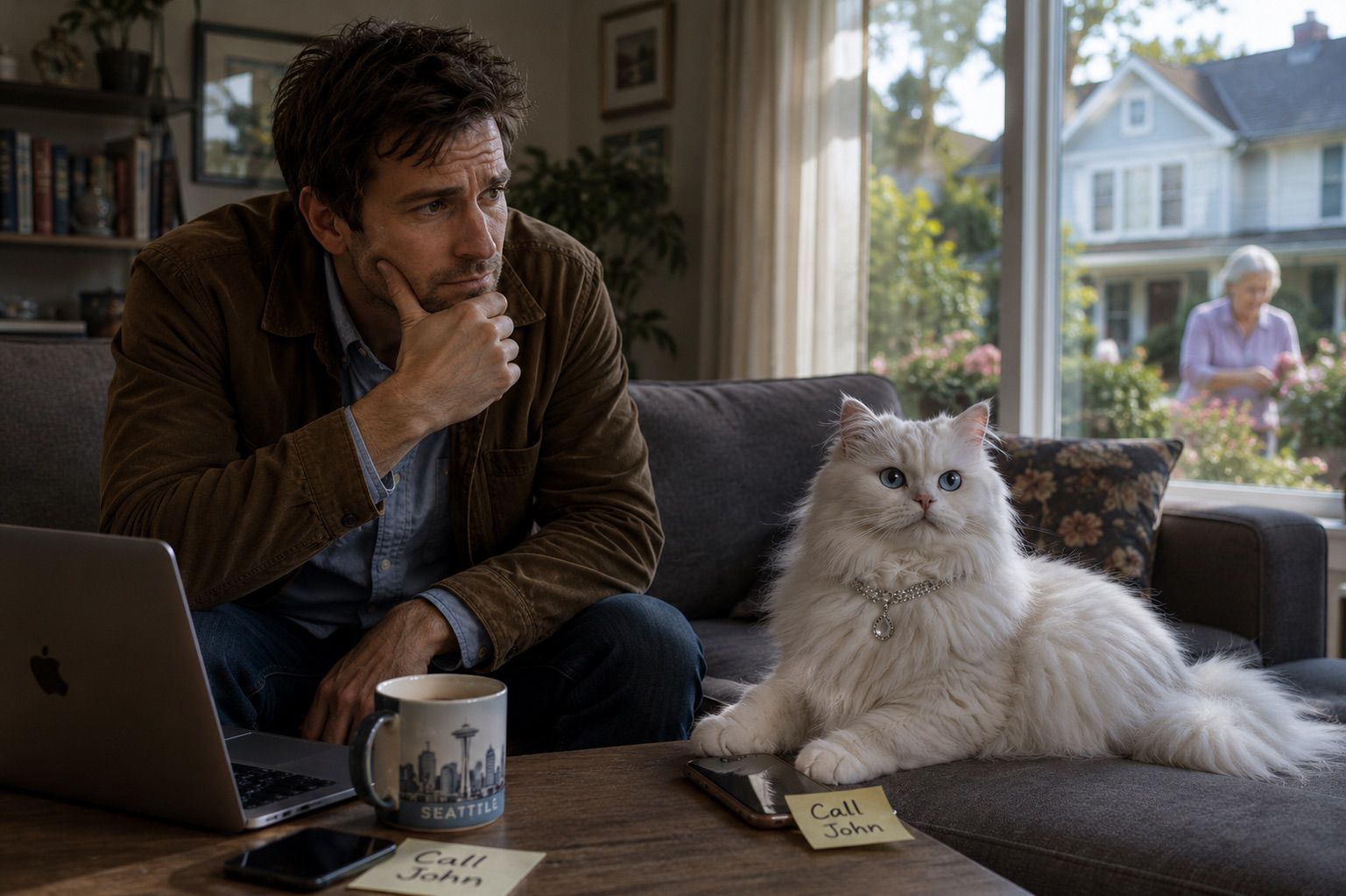
I’m sitting on Pandora’s couch, staring at her phone still sitting on the coffee table. She rushed out this morning and forgot it. I only noticed because Lady Beatrice Wellington III has been sitting next to it for the last twenty minutes like she’s guarding classified information. I’ve been trying to focus on my laptop, but the apartment feels weirdly quiet without Pandora here. Lady Beatrice keeps staring out the window toward Mrs. Jenkins’ house like she knows something I don’t.

The phone screen is locked, obviously, but there’s a Post-it note stuck to the back that says: “Call John.” At first, I assumed she meant my roommate, John Mercer. Maybe he forgot to pay me back for pizza again, or maybe she wanted to remind him that leaving an entire pot in the sink for three days technically counts as a science experiment. But then I started wondering why she’d need a reminder to call him in the first place. And that’s when things started getting weird.

Because once I noticed the note, I started noticing everything else. Mrs. Jenkins from next door always seems to know exactly what’s happening around here. Every time Pandora and I stay up late watching movies, Mrs. Jenkins somehow appears outside the next morning watering plants with the expression of someone silently filing a complaint with the universe. And Lady Beatrice definitely notices her too. Every few minutes, the cat pauses mid-groom and stares directly out the window like she’s monitoring enemy troop movement.

At first I thought I was overthinking it. Pandora always says Mrs. Jenkins is “nice,” which honestly confuses me a little because I’ve personally witnessed this woman glare at a recycling bin like it insulted her family. But apparently they talk all the time. Gardening. Neighborhood stuff. Local events. Normal suburban espionage topics.

The more I sat there thinking about it, the more details started clicking together. For example, every single house on Pandora’s street somehow has perfectly aligned trash cans except for one house three doors down. Mrs. Jenkins slows down every time she walks past it. Not obviously. Just enough to notice if you’re paying attention. And now I’m paying attention.

Then there’s Karen from farther down the street. She always waves at me when I visit Pandora, but it’s the kind of wave where I genuinely can’t tell if she’s being friendly or gathering intelligence. Last month, Pandora and I had friends over for drinks on a Saturday night, and the next morning Karen was outside sweeping her driveway at exactly 7 a.m. while Mrs. Jenkins trimmed hedges across the street. That can’t be random. That’s coordination.

And once I realized that, I started noticing Pandora acting strange too. Lately, every time I come over, she’s already cleaned the kitchen before I even wake up. At first I thought she was just being productive, but now I’m starting to think she’s trying to maintain appearances for the neighborhood surveillance network. Yesterday she wiped fingerprints off the microwave twice. Twice. Nobody does that unless they know they’re being watched.

Then there are the curtains. Pandora always says she forgets to close them at night, but I’m beginning to suspect it’s intentional. Like she’s sending subtle signals to Mrs. Jenkins across the street. Maybe certain lamps on mean one thing. Maybe open blinds mean another. I don’t know the code yet, but I’m getting close.

And Lady Beatrice Wellington III absolutely knows something. Right when I started thinking all of this through, she suddenly jumped onto the back of the couch and scared the life out of me by staring directly into my soul for a full ten seconds. No blinking. Just judgment. Then she slowly turned her head toward Mrs. Jenkins’ house. That’s not normal cat behavior. That’s operational awareness.

At this point, I’m starting to think the entire neighborhood is locked in some kind of passive-aggressive suburban cold war. Mrs. Jenkins monitors the perimeter. Karen handles public relations. Pandora maintains internal diplomacy. And somehow I’ve stumbled into the middle of it just because I spend weekends here sometimes.

Honestly, the only person I still fully trust right now is John Mercer. Although now that I think about it, he did once tell me that “suburbs are where people become emotionally tactical.” At the time I thought he was talking about HOA meetings. Now I’m not so sure.

Related Posts