
Latest Articles

Grills, Waves, and Good Vibes: The Ultimate Guide to a Summer BBQ at the Beach

Dave

Few things capture the essence of summer quite like a barbecue at the beach. The combination of sizzling food, salty air, golden sunsets, and laughter echoing over the sound of waves is nothing short of magical. A beach BBQ is more than just a meal; it’s an event, a sensory celebration where every detail matters. The crackle of charcoal, the glow of a portable grill, the smell of marinades mingling with ocean breeze—it all weaves together into an experience that feels both carefree and unforgettable. But to make it truly work, preparation is everything. You can’t just toss a few burgers into a bag and hope for the best. You need a checklist, a strategy, and above all, the right spirit to transform an ordinary cookout into a memory everyone talks about for years. So let’s dive into exactly what you should bring to make your summer BBQ at the beach the kind of story that spreads like sunshine.

It starts with the centerpiece: the grill. Portable is the keyword here. Whether you prefer a small charcoal grill that gives food that authentic smoky flavor or a propane version that fires up instantly, it needs to be compact enough to carry yet powerful enough to feed a hungry crowd. Don’t forget fuel—extra charcoal, lighter fluid, or a backup gas canister—because nothing kills the vibe faster than a grill that sputters out halfway through the fun. Tongs, spatulas, and a sturdy grill brush are your best friends; without them, you’ll be flipping burgers with plastic forks, and trust me, nobody wants to watch that happen.

Now for the star of the show: the food. Burgers and hot dogs are classics, reliable and crowd-pleasing, but a beach BBQ gives you room to get creative. Marinated chicken skewers, shrimp kabobs brushed with garlic butter, or even foil-wrapped salmon with lemon slices all cook beautifully by the sea. Vegetables deserve their moment too—grilled corn on the cob, zucchini strips, bell pepper skewers, or portobello mushrooms make vegetarians happy and add color to the spread. Don’t overlook snacks to keep everyone satisfied while the grill does its magic: chips and salsa, fruit skewers, pasta salads, or a platter of cheese and crackers that pairs perfectly with an afternoon drink. And speaking of drinks, hydration matters just as much as indulgence. A cooler packed with ice-cold water, lemonade, sparkling sodas, and maybe a few beach-friendly cocktails keeps the group refreshed all day.

But food and drinks are just part of the story—comfort and practicality make or break the experience. Chairs, blankets, or beach mats create a gathering spot, while a canopy or umbrella provides much-needed shade in the midday sun. A folding table helps keep food out of the sand, and extra coolers double as seats when the guest list grows. Utensils, cups, plates, and napkins might sound obvious, but they’re easy to forget in the rush to pack, and there’s nothing worse than having grilled chicken ready with no fork in sight. Go the eco-friendly route with reusable or compostable options, and bring a roll of paper towels and wet wipes for quick cleanups. Trash bags are non-negotiable; part of the beauty of a beach BBQ is leaving the sand as pristine as you found it.

Entertainment is another essential ingredient. A waterproof Bluetooth speaker sets the soundtrack of the day, whether it’s mellow acoustic strumming during the afternoon or upbeat anthems once the sun starts to dip. Frisbees, footballs, paddleball sets, or even a beach volleyball net keep energy levels high between meals. For a slower pace, card games or a simple deck of Uno create laughter that flows just as easily as the drinks. And let’s not forget the magic of timing. A beach BBQ isn’t just about the food; it’s about the rhythm of the day. Start early enough to enjoy swimming, tanning, and games, then let the grill heat up as the afternoon cools. As the sun sets, the glow of the barbecue mingles with the fading light, creating an atmosphere so perfect it feels staged.

Music and lighting add that final layer of magic. As night approaches, string lights powered by portable batteries or lanterns create a cozy glow. If bonfires are allowed, roasting marshmallows and making s’mores is the ultimate grand finale, one that makes even adults feel like kids again. A playlist curated in advance—mixing everyone’s favorite summer songs—keeps the vibe consistent. There’s something about hearing a beloved track with sand under your feet and stars above your head that sticks with you long after the trip is over.

Preparation also means thinking about the little things that elevate the experience. Sunscreen is obvious, but aloe vera for after-sun care is a lifesaver. Bug spray becomes a necessity as dusk falls. Extra towels and blankets ensure no one gets chilly once the breeze picks up. A portable fan can even make those sweltering moments bearable. And don’t underestimate the power of presentation: a well-packed cooler with labeled drinks, fruit salads served in hollowed-out pineapples, or skewers displayed like works of art all add to the aesthetic. People eat with their eyes first, and a beautifully arranged spread makes the day feel like something out of a magazine.

But beyond the lists and logistics, the heart of a beach BBQ is the people. It’s the way friends gather around the grill, each offering “expert” advice while one person sweats it out flipping burgers. It’s the sound of kids laughing as they dart in and out of the surf, their faces smeared with watermelon juice. It’s the friend who always brings too much food, the one who insists on taking group selfies every twenty minutes, and the one who DJs the afternoon with way too much enthusiasm. These quirks are what turn a simple meal by the sea into a story you’ll tell for years. The ultimate checklist is about ensuring nothing gets in the way of those moments.

Because in the end, a summer BBQ at the beach isn’t about the grill or the skewers or even the playlist—it’s about connection. It’s about gathering with people you love in a place that already feels like paradise and adding your own flavors, sounds, and laughter to it. It’s about eating with your hands, toes in the sand, and realizing that the best meals don’t happen in restaurants but in the open air, with smoke rising to meet the sky and waves applauding from the shore. The food will be eaten, the drinks finished, the sun gone, but the feeling? That lingers. It clings like salt to your skin, something you’ll carry with you long after you’ve shaken the sand from your shoes.

So pack the grill, load the cooler, grab the speaker, and don’t forget the sunscreen. Because the ultimate summer BBQ at the beach isn’t waiting—it’s calling. And the only thing better than hearing the waves crash is hearing them while you bite into the best burger of your life, surrounded by people who make the world brighter. That’s summer, bottled in a moment. That’s the BBQ you’ll never forget.

Related Posts

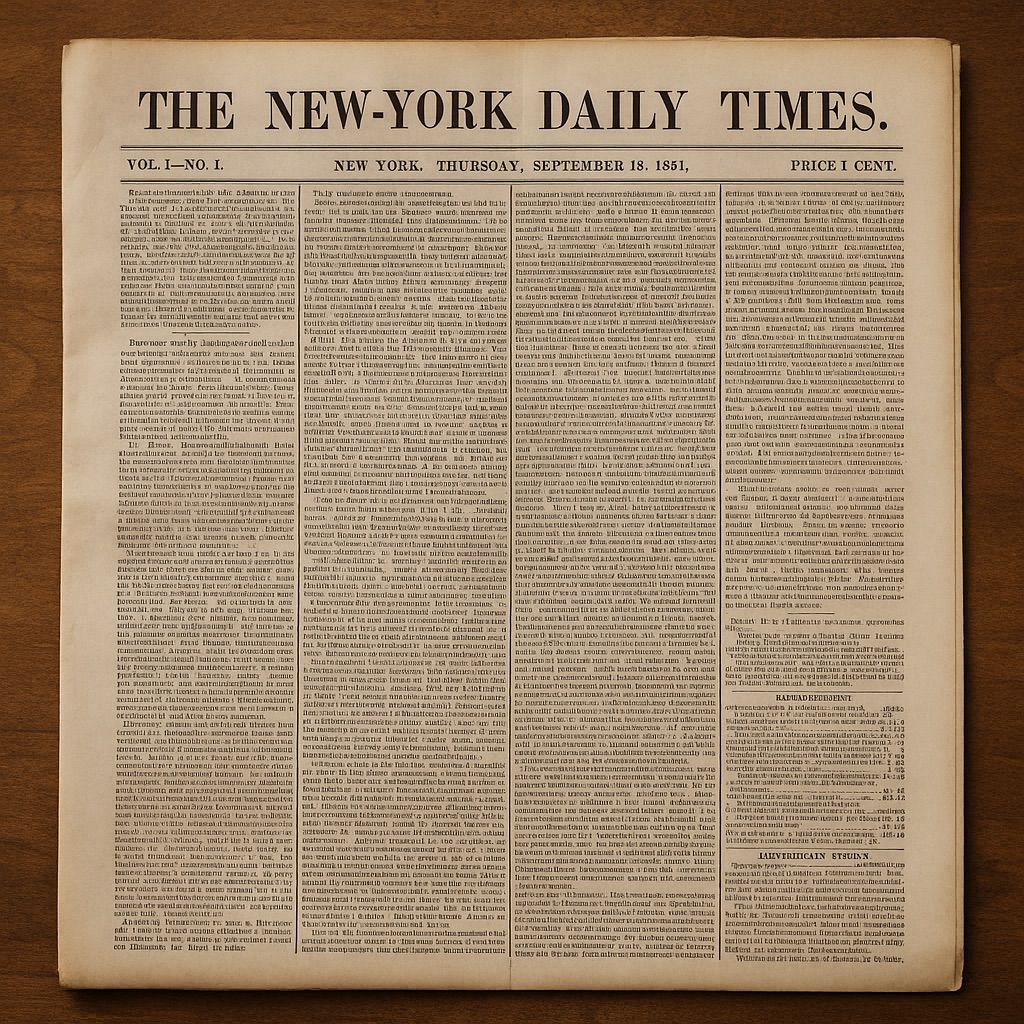
All the News That’s Fit to Print: The Day The New York Times First Hit the Streets

Elias Rowen

On September 18, 1851, the streets of New York City awoke to a new voice. Amid the clatter of horse-drawn carriages, the cries of newsboys hawking papers, and the hum of a city that was rapidly becoming the beating heart of America, a four-page newspaper rolled off a printing press for the very first time. Its name was The New-York Daily Times, a modest publication that cost just one cent. Few who glanced at that first issue could have imagined that this newspaper would grow into The New York Times, one of the most influential publications in the world, a journalistic institution synonymous with credibility, depth, and the famous motto it would later adopt: “All the News That’s Fit to Print.” That morning in 1851 marked the birth of a paper that would chronicle wars, revolutions, scandals, triumphs, and tragedies, shaping the way millions of people understood the world around them.

The mid-19th century was a turbulent, electric time for journalism. Newspapers were everywhere, competing for attention in a city already thick with rival publications. Many of them were sensationalist, filled with lurid stories, gossip, and outright fabrications. Others were fiercely partisan, serving as mouthpieces for political parties rather than independent outlets for the public. Into this noisy, chaotic media landscape stepped Henry Jarvis Raymond, a journalist and politician, and George Jones, a banker. Together, they founded the New-York Daily Times with a mission that seemed both bold and old-fashioned: to publish a newspaper that valued accuracy over sensation, balance over bias, and depth over triviality. They believed that readers deserved not only information but trustworthy information — a radical concept in an age of yellow journalism and partisan warfare.

That first issue set the tone. It included coverage of politics, business, foreign affairs, and cultural life, written with a clarity and restraint that distinguished it from its competitors. It did not scream for attention with wild headlines or exaggerated stories. Instead, it presented itself as serious, respectable, and thoughtful. Raymond and Jones envisioned a newspaper for readers who craved more than scandal and spectacle, for those who wanted to understand the complexities of the nation and the world. It was, in its way, a rebellion against the dominant media culture of its time. And slowly, it began to build a reputation for integrity.

The Times would go on to play a pivotal role in shaping the American public sphere. Through the Civil War, it reported from the frontlines, offering readers not just battlefield updates but sober analysis of the conflict that was tearing the nation apart. During Reconstruction, it covered the challenges of reunification and the struggles for civil rights. As the nation industrialized, the Times chronicled labor strikes, economic booms, and social upheavals. In the 20th century, it became the paper of record for a nation that was itself becoming a global power. Its correspondents filed reports from Europe during two world wars, from Asia during conflicts and revolutions, from Washington during political scandals, and from cities across the globe as the modern world unfolded. Each headline was more than ink on paper. It was a lens through which millions saw history happening in real time.

What made the Times endure was not just its reach, but its ethos. The motto “All the News That’s Fit to Print,” first used in 1897, encapsulated its philosophy. In an era when newspapers often printed anything to sell copies, the Times promised discernment. It would print not everything, but everything worth knowing. That philosophy became a trust between the paper and its readers, a trust that elevated it from just another publication to an institution. Over time, its front page became something more than newsprint. It became a national stage, where the events of the world were given weight, context, and permanence.

Of course, the Times has not been without controversy. Over its long history, it has faced criticism, lawsuits, and scandals. It has been accused of bias, of errors, of failures in judgment. It has sometimes struggled with the balance between objectivity and advocacy, between timeliness and accuracy. Yet part of its endurance lies in its willingness to confront those challenges, to correct mistakes, to adapt to new technologies and new demands. From the telegraph to the internet, the Times has continually reinvented itself while holding to its central promise of credibility. In doing so, it has become not only a chronicler of history but a part of history itself.

When we think about September 18, 1851, we see more than the launch of a newspaper. We see the beginning of a tradition that has shaped democracy. Journalism, at its best, is not just about reporting facts. It is about holding power accountable, about informing citizens, about giving voice to truth even when it is uncomfortable. The New York Times, born in that moment, became one of the most enduring examples of that principle. Its pages have been the battleground for debates about freedom of the press, the source of revelations that toppled governments, and the chronicler of everyday life in all its complexity. From the Pentagon Papers to Watergate, from 9/11 to the digital revolution, the Times has been there, shaping and reflecting the way we understand the world.

The story of its birth is also the story of America’s own coming of age. In 1851, the United States was still young, still finding its place in the world, still wrestling with contradictions of liberty and slavery, expansion and division. The launch of a newspaper dedicated to accuracy and fairness was, in its way, a reflection of the nation’s aspirations: to be serious, to be respected, to be informed. And just as the country grew, faltered, and rose again, so too did the Times evolve, stumble, and rise again. The parallels are striking because both the nation and its newspaper share the same project: the constant, imperfect pursuit of truth.

Looking back now, more than 170 years later, that modest first issue of the New-York Daily Times feels almost quaint. Its typeface was simple, its columns dense, its circulation limited. But within those pages was the spark of something enduring. On that September morning, Henry Raymond and George Jones could not have foreseen the digital age, the global reach, or the Pulitzer Prizes their paper would one day win. But they believed in something timeless: that truth matters, that words matter, that journalism matters. And because they believed, a newspaper was born that continues to shape the world today.

So when we remember September 18, 1851, we are not just remembering the launch of a newspaper. We are remembering the launch of an idea: that information should be accurate, that truth should be told, that the public deserves more than noise and spectacle. That idea, embodied in the New York Times, remains as vital now as it was then. For all the news that’s fit to print — and all the stories still to come — it began on that day, with a small paper sold for a penny, and a dream that truth, once printed, could change the world.

Related Posts

From Buckets to Masterpieces: Building the Ultimate Sandcastle

Dave

There is something timeless and universal about building a sandcastle. No matter where you grew up or how old you are, the urge to dig your hands into wet sand, scoop it into a bucket, and flip it upside down into a perfect little tower never quite leaves you. On beaches all over the world, castles rise with the tide, only to be washed away later, reminding us that some of the best creations in life are fleeting. But somewhere between those simple childhood piles and the jaw-dropping professional sand sculptures you see at festivals lies the dream of every beachgoer: building the ultimate sandcastle. Not just a lopsided tower or a moat that collapses, but something that feels like art, a fortress that stands proud against the breeze, a creation that makes people walking by stop in their tracks and say, “Wow, look at that.”

The beauty of building sandcastles is that the materials couldn’t be simpler. Sand, water, a few tools, and your imagination. Yet anyone who has ever tried to stack sand too dry or pile it too wet knows it’s not as easy as it looks. The secret is in the mixture: the perfect ratio of sand to water, something close to the consistency of cookie dough. Too dry and it crumbles; too wet and it slumps. Master sand builders know this instinctively, carrying buckets back and forth to the ocean, mixing until the grains hold together in a compact clump that you can carve without collapse. It’s a small act of alchemy, turning grains of crushed rock into something that feels as alive as clay.

But the ultimate sandcastle isn’t just about sturdy walls—it’s about imagination unleashed. Maybe your dream castle looks like a medieval fortress, with turrets and moats and drawbridges. Maybe it’s a fairy-tale palace, delicate spires rising like a dream out of the beach. Maybe it’s something modern, sculpted and abstract, an art installation disguised as play. Each design carries its own personality, and that’s part of the joy. Sand doesn’t cost a thing, and it doesn’t carry risk, so you are free to experiment, to try wild ideas you’d never attempt with brick or wood or stone. With sand, mistakes wash away, and every new tide brings a blank canvas.

Tools elevate the game. Buckets and shovels are classics, but straws, spatulas, spoons, and even old credit cards or butter knives become chisels for detail. With the right touch, you can carve windows, stairs, battlements, and tiny seashell decorations that transform a pile into a story. Some castle-builders bring spray bottles to keep the surface damp, others pack large forms to mold arches or towers. But even with nothing more than your hands, magic is possible. The human urge to build is primal, and in sandcastle-making, it collides with childlike joy.

Every great sandcastle has a story. Maybe it’s the castle a father built with his kids one summer, walls so high they almost reached their waists, complete with a moat that kept filling with ocean water as if defending it from an invisible army. Maybe it’s the castle two strangers collaborated on, wordlessly sharing tools and ideas until they built something together that neither could have done alone. Maybe it’s the castle that became a magnet for kids passing by, each adding a little tower or shell until it turned into a community project. These castles are more than structures—they are experiences woven into memory, lessons in teamwork, patience, creativity, and joy.

Professional sand sculptors take this to another level. At festivals from Texas to Portugal, artists carve dragons, pyramids, life-size faces, and towering cathedrals from nothing more than sand and water. These works can reach 15 feet high and last for days, defying the fragility we usually associate with sand. They remind us of the ultimate potential hidden in ordinary grains, the way imagination and technique can turn even the most temporary material into jaw-dropping beauty. But the ultimate sandcastle for the rest of us doesn’t have to rival these feats. It just has to feel like something we poured our hearts into, something that, for a few hours, stood as proof of joy and creativity on the shore.

What makes building sandcastles so viral, so memorable, is how it connects us across generations. Children, teens, adults, even grandparents all gather around the same pile of sand with equal wonder. It’s one of the few activities that doesn’t require skill to start but offers infinite levels to master. Everyone can play, everyone can contribute, everyone can marvel. The castle you build with your kids today might become the memory they tell their kids tomorrow. The castle you build alone might become the one thing that finally made you slow down and breathe deeply after months of stress. The act itself is grounding, almost meditative. Each scoop, each pat, each carved line brings you deeper into presence, tethered to the earth and the sea in the most playful way.

Of course, every sandcastle eventually falls. The tide creeps in, the waves lap at the moat, the walls weaken and slump, the turrets collapse into mush. And yet, rather than being depressing, it’s beautiful. It’s a reminder of impermanence, of the fleeting nature of joy, and of the value of creating not because something will last forever but because it mattered in the moment. Sandcastles teach us that beauty can be temporary and still worthwhile. That joy doesn’t have to be permanent to be real. That sometimes, the act of building is enough, regardless of what survives.

So what does the ultimate sandcastle look like? It’s less about the perfect spires or the straightest walls and more about the feeling it creates. It’s the castle that makes kids laugh when they jump in the moat. It’s the castle that strangers stop to admire, sparking conversations with people you’ve never met. It’s the castle that holds shells like treasure chests and leaves behind a story even when the waves carry it away. It’s the castle that lives in photos, in sunburned shoulders, in salty smiles.

In the end, building the ultimate sandcastle isn’t just a beach activity. It’s a metaphor. It’s about making time for play, about embracing imperfection, about collaborating, about enjoying the process as much as the result. It’s about knowing that some of the best things in life won’t last forever but will feel extraordinary while they do. And when you walk away at sunset, brushing sand off your hands and feet, you’ll know the truth: the real castle you built wasn’t in the sand—it was in your memory, your laughter, your heart.

Related Posts

A More Perfect Union: The Day the U.S. Constitution Was Signed

Elias Rowen

On September 17, 1787, in a stuffy room in Philadelphia’s State House, a group of weary delegates affixed their signatures to a document that would alter the trajectory of human history. That document was the United States Constitution. For four long months, the men gathered there — farmers and lawyers, merchants and generals, revolutionaries and statesmen — had debated, argued, compromised, and despaired. They had wrestled with questions of power and liberty, of unity and division, of ambition and restraint. And at last, after a summer of sweat and frustration, they put their quills to parchment and created what they called “a more perfect union.” At the time, few could have grasped the magnitude of what they had done. But the Constitution, fragile yet powerful, incomplete yet visionary, would go on to shape not only a nation but the modern idea of self-government itself. The day it was signed was not merely the end of a convention. It was the beginning of an experiment still unfolding.

The backdrop to that day was anything but orderly. The United States in 1787 was a fragile confederation, held together loosely under the Articles of Confederation. The Articles had been written in the midst of revolution, when the colonies were more concerned about defeating Britain than about governing themselves. They deliberately created a weak central government, leaving most power to the states. But in the years after independence, it became clear that such weakness was unsustainable. The nation was drowning in debt, its currency unstable, its trade fractured by competing state laws. Shays’ Rebellion, an uprising of indebted farmers in Massachusetts, had shaken the country’s elites, convincing them that something stronger was needed to preserve order and liberty alike. The Constitutional Convention was summoned in Philadelphia with the stated aim of revising the Articles. But once assembled, the delegates decided instead to scrap them and craft an entirely new framework.

The convention that followed was messy, contentious, and at times perilously close to collapse. Delegates argued over representation, with small states fearing domination by larger ones. They argued over slavery, with southern delegates insisting on protections for their “peculiar institution” while others squirmed at the hypocrisy of a republic founded on liberty that sanctioned bondage. They argued over the powers of the executive, wary of creating a new king even as they acknowledged the need for an energetic leader. They argued over the judiciary, the legislature, taxation, trade, and the very nature of sovereignty. Tempers flared, alliances shifted, and more than once it seemed the effort would dissolve into failure.

And yet, through compromise, they forged something enduring. The Great Compromise resolved the battle over representation by creating a bicameral legislature: a House of Representatives based on population, and a Senate with equal votes for each state. The Three-Fifths Compromise, grim and shameful in hindsight, counted enslaved people as three-fifths of a person for purposes of representation and taxation — a concession to slavery that would haunt the nation for generations. They created a presidency with limited but significant powers, constrained by checks and balances. They created a judiciary to interpret the law and ensure that neither Congress nor the President could become too powerful. They created a federal system, balancing power between the national government and the states. And they wrote into the Constitution the principle of amendment, recognizing that the document itself would need to grow and adapt with time. What emerged was not perfect — indeed, it was riddled with compromise and contradiction — but it was, in their words, more perfect than what had come before.

On September 17, the final draft was presented for signing. Some refused. George Mason, Edmund Randolph, and Elbridge Gerry withheld their signatures, unwilling to endorse a Constitution that lacked a bill of rights or that gave too much power to the central government. But thirty-nine men signed, led by the commanding presence of George Washington, whose support lent the entire project credibility. Benjamin Franklin, now in his eighties and so frail he had to be carried into the hall, urged unanimity. In one of the most famous anecdotes of the day, Franklin pointed to a carved sun on the back of Washington’s chair and remarked that throughout the summer he had wondered whether it was a rising sun or a setting one. “Now,” he said, “I have the happiness to know it is a rising and not a setting sun.” His words captured the fragile optimism of that moment: a belief that they had created not perfection, but possibility.

The Constitution left Philadelphia uncertain of its fate. It still had to be ratified by the states, and fierce debates lay ahead. Federalists and Anti-Federalists would battle over its meaning, over the absence of a bill of rights, over fears of centralized tyranny. But the signing was the first step, and in hindsight, it was momentous. For the first time in history, a large republic attempted to govern itself not by monarchy or by accident, but by deliberate design. The Constitution was not a charter of perfection, but a framework of balance — ambition checking ambition, power constrained by power, liberty preserved not by chance but by structure. It was, as James Madison put it, “the greatest of all reflections on human nature.”

The legacy of September 17, 1787, is profound because it was both particular and universal. It was the product of specific men, in a specific place, at a specific time. And yet it spoke to ideas that transcended them: that people could govern themselves, that power could be divided and limited, that government could be both strong and free. The Constitution was flawed — it sanctioned slavery, excluded women, ignored Native peoples, and reflected the biases of its age. But it also contained within it the seeds of its own improvement. The amendment process would add the Bill of Rights, abolish slavery, extend voting rights, and continue the project of creating a more inclusive union. The brilliance of the Constitution was not that it solved every problem, but that it created a structure in which problems could be confronted and progress could be made.

That is why we still remember September 17. Not because the men in Philadelphia were infallible, but because they dared to attempt something unprecedented. They chose to believe that humans, flawed as they are, could craft institutions to govern themselves without kings or tyrants. They chose to believe that compromise, though messy, was stronger than division. They chose to believe that the sun could rise on a new experiment in liberty. And they signed their names to that belief, knowing that the real test lay ahead.

The Constitution they signed has endured for over two centuries, through wars, crises, and transformations they could scarcely imagine. It has been amended, interpreted, contested, and stretched. It has been used to justify injustice and to advance justice. It has been a tool of exclusion and of inclusion. It is not a sacred relic, but a living framework — one that reflects both the best and the worst of the American story. Yet its endurance is itself remarkable. Few documents in history have shaped so many lives, across so many generations, for so long.

On September 17, 1787, the United States Constitution was signed into being. That act did not end conflict, did not guarantee peace, did not resolve the contradictions of liberty and slavery, equality and hierarchy, unity and division. But it created a structure in which those conflicts could be fought, debated, and, sometimes, resolved. It created a republic that could endure. And for all its flaws, it remains one of humanity’s boldest experiments in self-government. That is why the signing of the Constitution is remembered as the day America gave itself not a perfect union, but a chance to become one.

Related Posts

Sandy Toes, Salty Hair, Zero Worries: The Ultimate Girls’ Beach Weekend Checklist

Dave

There is something magical about planning a girls’ beach weekend, a kind of excitement that feels like being seventeen again, when the promise of salt air and laughter was enough to carry you through the week. A beach trip with your closest friends isn’t just a getaway—it’s an event, an escape from deadlines and drama, an excuse to pack the cutest outfits you own, and an opportunity to recharge together in the sunshine. Unlike a solo trip or a romantic vacation, a girls’ beach weekend is powered by collective energy, the anticipation of shared playlists, matching swimsuits, endless snacks, and conversations that drift from silly to soul-baring under umbrellas by the sea. But pulling it off seamlessly takes more than just tossing a bikini into a bag and calling it a day. The ultimate girls’ beach weekend checklist isn’t just about what to pack—it’s about how to create an atmosphere of joy, ease, and connection where every detail has been thought of and no one is left wishing they’d remembered something essential.

Let’s start with the obvious: swimwear. A girls’ beach weekend calls for options, because moods shift like tides. One day it’s the bold bikini moment for photos, the next it’s the comfortable one-piece for water volleyball, and maybe even a matching set you all agreed on just for fun. Add in cover-ups—flowy kaftans, sarongs, oversized shirts—and you’ve got instant versatility for beach-to-bar transitions. Sunglasses are non-negotiable, but the trick is having a pair that looks good in group selfies while actually protecting your eyes. And of course, wide-brimmed hats, bucket hats, or visors—whatever your vibe—because sun protection can absolutely be chic.

Now for the unsung heroes: skincare and sunscreen. Nothing kills the vibe faster than a sunburn, so this section of the checklist deserves reverence. Pack reef-safe sunscreen with SPF 30 or higher, but bring multiple kinds—spray for quick reapplication, lotion for thorough coverage, and tinted SPF moisturizers for the friend who refuses to go bare-faced. Aloe vera gel is a must for soothing, even if you’re careful, and hydrating face masks turn an evening wind-down into a mini spa night. Toss in lip balm with SPF, because chapped, sunburnt lips are an avoidable tragedy. The beauty of traveling with friends is that someone always has the product you forgot, but the checklist ensures that everything important makes it into at least one bag.

The snack and drink game is where true legends are made. Sure, you could rely on boardwalk food, but half the fun of a girls’ trip is the shared picnic spread. Think fruit that travels well—grapes, clementines, apple slices—plus crackers, cheese, hummus, and pretzels. Granola bars or protein bites keep energy steady between swims, while popcorn and trail mix satisfy those grazing cravings. Drinks should be equally thoughtful: plenty of water bottles (bonus points for cute reusable ones), sparkling water for the fizzy lovers, and pre-mixed cocktails or wine spritzers packed in a cooler for when the sun starts setting. Don’t forget a corkscrew—it sounds trivial until you’re trying to open a bottle with car keys.

Then there are the little luxuries that elevate a beach trip from fun to unforgettable. A waterproof Bluetooth speaker is practically a requirement, because no girls’ weekend is complete without a curated playlist blasting everything from nostalgic throwbacks to guilty-pleasure anthems. A big beach blanket or a set of matching towels not only looks great for group photos but also saves everyone from sand wars. Portable chargers keep phones alive for capturing every moment, and a disposable film camera or Polaroid instantly transforms memories into keepsakes. Games—cards, beach paddles, or even just a ball—bring laughter when the sun gets too hot and everyone needs a break from tanning.

Outfits for off-beach hours often get overlooked, but they matter. Nights out on a girls’ beach weekend are their own kind of magic—hair still salty from the ocean, skin glowing, laughter spilling out as you walk to dinner. Pack sundresses that slip on easily, sandals that work on sand and city streets, and one or two elevated pieces if the night calls for dancing. Lightweight sweaters or denim jackets are perfect for bonfire nights, when the air cools but no one wants to go inside.

Of course, a beach checklist wouldn’t be complete without practical items that seem boring until you need them: hair ties, bobby pins, and scrunchies for taming windblown hair. A mini first aid kit with band-aids for unexpected blisters or coral scrapes. Ziplock bags for wet swimsuits, and totes that double as both beach bags and shopping carriers. Even baby powder, a random but genius hack, makes brushing sand off legs effortless before heading back to the hotel. These little things are what make you feel smugly prepared while other groups are scrambling.

Perhaps the most important part of a girls’ beach weekend checklist isn’t even tangible—it’s the intention behind it. This trip isn’t about perfection; it’s about presence. It’s about showing up with your friends, letting the sun and sea dissolve the stress you’ve been carrying, and making space for laughter that feels like medicine. It’s about creating rituals—sunscreen circles where everyone helps each other, snack time that turns into storytelling, dance breaks that erupt out of nowhere. These are the details that make a beach weekend unforgettable.

The best part? The checklist is really a framework, not a rulebook. Each group customizes it—some lean into glam with coordinated outfits and styled beach hair, others lean into pure chaos with mismatched towels and snacks spilling out of grocery bags. Both are perfect, because the point is never about getting everything right. The point is making memories, ones that come back years later when you find sand in the pocket of a bag or scroll through photos of sunsets framed by your friends’ silhouettes.

The ultimate girls’ beach weekend checklist is not just about stuff—it’s about the moments those items unlock. The speaker blasting your anthem as you run into the waves. The snacks that fuel your endless conversations. The Polaroids that capture laughter in a way iPhones never quite do. The aloe vera that saves you from misery so you can laugh about the sunburn scare instead of crying through it. The tote bags overflowing with everything you thought you’d never use but ended up needing. Every item, every detail, every laugh—it all adds up to a trip that becomes part of your shared story.

At the end of the day, what makes a girls’ beach weekend magical isn’t the beach itself but the people on the towels beside you. The checklist is just your way of making sure nothing gets in the way of joy. Because when the sun sets, when the sky glows pink and the tide creeps closer, when you’re sitting in the sand with your best friends and the music still plays softly, what you’ll remember isn’t how perfect your packing list was. You’ll remember how free you felt, how close you were, how the ocean seemed to echo your laughter. That’s the magic of a girls’ beach weekend, and with the ultimate checklist, you make sure you have everything you need to let it unfold perfectly imperfect.

Related Posts