Latest Articles

Conquering the Giant: The First Ascent of the Matterhorn

Elias Rowen

In the heart of the Alps, where the horizon is pierced by jagged peaks and the sky seems to touch the earth, stands the mighty Matterhorn—majestic, mysterious, and once considered unclimbable. It is a mountain of legend, its near-perfect pyramid shape a natural monument etched into the imagination of climbers and travelers alike. On July 21, 1865, the Matterhorn’s summit was finally reached, marking not only a pinnacle in mountaineering history but also a moment of human triumph and tragedy. That day, an ambitious team led by the young and determined Edward Whymper achieved what many deemed impossible, forever altering the landscape of Alpine exploration.

To understand the significance of that fateful ascent, we must first appreciate what the Matterhorn represented in the mid-19th century. Towering at 4,478 meters (14,692 feet), it dominates the skyline of the Swiss-Italian border and had repelled all attempts at conquest. Its steep faces and sharp ridges were seen as too treacherous, even as neighboring peaks like Mont Blanc had already yielded to human perseverance. The Matterhorn remained a symbol of defiance, an unyielding titan that scoffed at the ambitions of mere mortals. To scale it was to challenge not only nature but one’s own limits.

By the 1860s, mountaineering was blossoming into a Victorian-era passion, particularly among the British upper class. What had once been considered dangerous and irrational was becoming a noble pursuit of science, physical endurance, and personal glory. These gentlemen climbers, dressed in tweeds and wielding rudimentary equipment, embraced the Alps as their playground. Chief among them was Edward Whymper, a 25-year-old English illustrator whose obsession with the Matterhorn would lead to both fame and infamy.

Whymper was not a nobleman but had been commissioned to sketch Alpine scenery for a London publisher. His artistic assignment soon evolved into a passion for climbing, and he became known for his tenacity and fearlessness. By 1861, he had made several attempts on the Matterhorn, approaching it from both the Swiss and Italian sides. Each time, the mountain denied him. But the repeated failures only stoked his resolve. Whymper wasn’t just after a summit; he was chasing immortality, eager to etch his name in the annals of mountaineering forever.

The year 1865 brought a flurry of activity to the base of the Matterhorn. Rumors swirled that Italian guides were preparing an ascent from the southern side, hoping to beat Whymper to the summit. Spurred by this competition, Whymper swiftly organized his own team. His party included experienced mountain guide Michel Croz of Chamonix, Reverend Charles Hudson, Lord Francis Douglas, Douglas Robert Hadow—a young, inexperienced climber—and two Zermatt-based guides, Peter Taugwalder and his son. It was a hastily assembled group, united by ambition rather than cohesion, but Whymper was undeterred.

On July 13, 1865, the team set out from Zermatt, opting for the Hörnli Ridge—an approach few had considered viable. The following day, they established a bivouac at around 3,400 meters, sleeping under the stars with the icy breath of the mountain wrapping around them. On the morning of July 14, they began their final push. The climb was arduous, but the ridge provided an unexpectedly manageable path. Step by step, they carved a route into the unknown, chipping footholds into the ice, relying on their alpenstocks, ropes, and raw grit.

At precisely 1:40 p.m., the summit was theirs. Whymper and Croz were the first to reach the top, followed by Hudson, Hadow, and the others. For a moment, there was elation—an almost sacred stillness. From the summit, the view stretched for miles, a panorama of peaks, valleys, and glory. Whymper would later describe it as standing “on a throne of rock, with the kingdoms of the world spread out beneath.”

But the euphoria was short-lived. What began as a story of triumph would quickly descend into tragedy. During the descent, disaster struck. As they carefully retraced their steps down the Hörnli Ridge, the unthinkable happened. Hadow, unsteady and inexperienced, lost his footing and fell against Croz, knocking him off balance. The two plunged down the north face, dragging Hudson and Douglas with them. The rope connecting the doomed climbers to the rest of the team snapped—mercifully, or cruelly—and Whymper and the Taugwalders watched helplessly as their companions disappeared into the abyss.

The survivors descended in stunned silence. News of the disaster reached Zermatt the following day, and the Alpine world was rocked. The first ascent of the Matterhorn had ended not in pure celebration but in mourning. Four men had perished, their bodies—save for Lord Douglas—eventually recovered days later. The broken rope was scrutinized, sparking debates and accusations. Some speculated it had been deliberately weakened; others blamed Whymper for assembling an ill-matched team. Whymper defended himself in public and in print, but the shadow of the tragedy would follow him all his life.

Despite the sorrow, the ascent of the Matterhorn marked a turning point. It was the symbolic end of the “Golden Age of Alpinism,” a decade during which nearly all the major Alpine peaks had been climbed. The Matterhorn, once the last great prize, had finally fallen. But its conquest came at a price that forever altered the perception of mountaineering. No longer was it seen merely as a gentleman’s pursuit or an eccentric hobby. The dangers were real, and the mountains, majestic as they were, could be merciless.

Whymper, shaken but undeterred, continued to climb. He later explored the Andes and wrote extensively about his adventures. His book, Scrambles Amongst the Alps, remains a classic of mountain literature—a blend of adventure, reflection, and sorrow. In it, he famously wrote: “Climb if you will, but remember that courage and strength are naught without prudence, and that a momentary negligence may destroy the happiness of a lifetime.” Those words, born from the Matterhorn’s brutal lesson, have echoed through generations of climbers.

Today, thousands ascend the Matterhorn each year, guided by fixed ropes and modern equipment. But the mountain has not lost its danger or its allure. Its sheer faces and knife-edged ridges continue to challenge even seasoned mountaineers. At its base, memorials stand to those who have fallen—reminders that while technology has improved, the risks remain very real.

What makes the story of July 21, 1865, so compelling is not just the daring feat or the tragic loss—it’s the deeply human tale beneath it all. It is a story of ambition, rivalry, courage, and the thin line between victory and disaster. Whymper and his team were not gods, but men, full of hope and fallibility. Their ascent of the Matterhorn wasn’t just a physical conquest; it was a metaphor for the Victorian spirit of exploration, for the eternal human drive to reach beyond the possible.

There’s something timeless in that pursuit. Even today, when Everest has become a bucket-list destination and gear is made of ultralight composites, the soul of climbing remains rooted in moments like Whymper’s. The mountain humbles and exalts in equal measure. To stand on a summit is to momentarily hold dominion over the world, but to reach it requires humility, respect, and a deep understanding of our fragile place in nature.

The first ascent of the Matterhorn continues to inspire not because it ended perfectly, but because it didn’t. It reminds us that greatness is often born in moments of peril, and that some of the most enduring legacies are forged in both triumph and loss. Whymper and his team, in chasing the summit, became symbols not only of bravery but of the high cost of ambition. And the Matterhorn, in turn, remains what it always was—a magnificent sentinel watching over the Alps, challenging each generation to answer its silent, daunting call.

Related Posts

Easy and Delicious Beach Picnic Ideas That’ll Flirt with Your Taste Buds

Dave

Darling, let’s not pretend we haven’t all fantasized about that beach picnic—the kind that belongs in a sun-soaked magazine spread or maybe a dreamy rom-com starring you and a well-behaved breeze. You know the one: golden hour lighting, laughter echoing across the waves, a soft blanket fluttering flirtatiously in the wind, and a delicious spread so good it makes the seagulls jealous. Well, today’s the day we turn that fantasy into your sun-drenched, flavor-packed reality. Because beach picnics shouldn’t be basic, boring, or burdened with bulky coolers and soggy sandwiches. They should be delicious, sexy, and—most importantly—easy.

Now before you throw together a sad bag of pretzels and call it a day, let’s talk about what makes a beach picnic swoon-worthy. We’re aiming for minimal prep, maximum flavor, and an aesthetic that makes your picnic blanket look like it walked off the pages of a coastal lifestyle blog. But we’re also keeping it real, because sand is sneaky, sun is relentless, and no one wants to carry an entire kitchen down a sand dune. So grab that straw hat, shimmy into something breezy, and let’s get your beach bite game on point.

First, let’s talk the base—and I don’t mean your makeup (although SPF is non-negotiable, sweetheart). Your blanket is your foundation, your stage, your literal comfort zone. Go for something oversized, soft, and preferably cute enough to get compliments from strangers walking by. Bonus points for layering: a Turkish towel for texture, a lightweight throw for extra flair, and a couple of fluffy pillows because yes, you deserve to recline like the picnic goddess you are. Add a portable speaker for some chilled-out beats and voilà—you’ve set the scene for seduction… by snack.

Now, let’s talk food. Beach eats should be finger-friendly, heat-resistant, and utterly craveable. This is not the time for wilted salads or mystery dips that curdle faster than your ex’s last apology. We’re aiming for flavor, ease, and a little bit of wow.

Let’s start strong with wraps. No, not the dry, sad ones from the office catering tray. I’m talking about luscious, full-bodied wraps that know how to satisfy. Grab a large tortilla and layer in hummus, roasted veggies, fresh spinach, and feta, or go for smoked salmon, herbed cream cheese, capers, and cucumber. Wrap them tight, cut them into bite-sized pinwheels, and watch them disappear. They’re sexy little swirls of goodness that hold up in the heat and fit perfectly in your beach basket.

Next up: skewers. Because food on a stick just hits different. Try caprese skewers with cherry tomatoes, mini mozzarella balls, and fresh basil, drizzled with balsamic glaze. Or go Mediterranean with grilled chicken, olives, and cucumber chunks. These are your beach flirtation weapons—fun to eat, easy to hold, and less mess to worry about when you’re trying to look effortlessly chic.

Now, darling, don’t you dare overlook fruit. But let’s not get basic with a sad pile of sticky watermelon cubes. Elevate it. Think chilled fruit kabobs with pineapple, mango, strawberries, and grapes, threaded onto bamboo skewers and dusted with chili-lime seasoning for a little kick. Or toss berries into a mason jar with a sprig of mint and a splash of Prosecco—picnic or not, hydration should always come with a sparkle.

And speaking of sparkle, let’s discuss beach-friendly drinks. You didn’t think we were sipping warm water out of a plastic bottle, did you? A pre-mixed sangria in a thermos, complete with fresh fruit, is always a crowd-pleaser. Or go for infused sparkling water with slices of cucumber, lemon, and mint—light, refreshing, and won’t weigh you down when it’s time to play mermaid in the waves. Just remember—glass is a no-go, so keep it chic and safe with insulated tumblers or silicone-wrapped bottles.

Want to feel like an absolute beach snack? Bring snack boards in bento boxes. You don’t need a fancy wooden platter. A simple divided container works wonders. Fill it with rolled-up charcuterie, artisan crackers, cubes of sharp cheese, pickles, nuts, and a bit of dark chocolate for after. It’s like a grown-up Lunchable, but sexier and designed to be nibbled on between flirty conversations and flops into the sand.

And because I believe in a sweet ending to every story, we must include dessert. But let’s keep it light and heat-resistant, shall we? Skip the melty mess and go for lemon bars, mini shortbread cookies, or dark chocolate-dipped dried fruit. Even better? A few homemade coconut macaroons that practically transport your taste buds to a tropical cabana, no passport required.

Let’s not forget the details, darling—the little touches that say, “Yes, I’m that bitch.” Tuck in reusable napkins in bold prints. Pack utensils and plates that aren’t flimsy. Think bamboo cutlery, enamel plates, or even biodegradable options that look good and love the planet. And please, for the love of soft thighs, bring baby wipes. You’ll thank me after your first brush with a rogue seagull or a wayward pineapple chunk.

And if you’re going with a partner or someone you’re hoping to feed more than just snacks… slip in a little handwritten menu. It’s romantic, playful, and just a tiny bit bougie—in the best way. Tie it with twine or tuck it under their drink. It’s not just a picnic; it’s a picnic with intention, sugar.

Now, about timing. The best beach picnics happen in that golden hour sweet spot—after the midday sun has stopped trying to cook you alive but before the evening breeze turns your blanket into a parachute. Think 5 p.m. arrival, 5:30 nibbling, 6:00 lounging, and sunset kisses around 6:45. Magic, right?

And let’s talk ambiance, because food might be the star, but the vibe is the soundtrack. A Bluetooth speaker with a playlist that blends soft summer beats, retro soul, and the occasional slow jam? Absolute yes. Battery-powered fairy lights draped along your cooler or umbrella for post-sunset glow? Extra, but irresistible. And if you’re that kind of extra (I see you, boo), bring a Polaroid to capture the cuteness in vintage flair. Filters are fun, but nothing beats a printed memory you can tuck into your journal with a smudge of strawberry still on the edge.

The best part of all this? It’s low effort, high reward. You don’t have to be a domestic goddess or a Michelin-starred chef to pull this off. Everything can be prepped the night before, packed like a delicious jigsaw puzzle in your tote, and ready to lay out like you’ve been doing this forever. Because confidence is the sexiest seasoning, and nothing says “I’ve got it together” like opening your cooler to reveal artfully arranged mini skewers and chilled sangria.

So the next time someone suggests a beach day, don’t just bring the vibes—bring the feast. You’ll be the sun-kissed center of attention, the siren of the shoreline, the one everyone wants to sit next to. Because you, my dear, don’t just pack a picnic. You curate an experience. A moment. A memory. And you do it all while looking like you just stepped out of a swimwear ad and into a culinary fantasy.

Now go. Soak up the sun, savor every bite, and let that beach picnic be as bold, beautiful, and deliciously unforgettable as you are.

Related Posts

Behind the Seams: Women Designing the Bikinis They Always Wanted

Dave

Darling, let’s slip into something a little more comfortable, shall we? No, not that lacy number tucked away in the back of the drawer—we’re talking bikinis. Not just any bikinis, mind you, but the kind women dream of. The kind that whisper sweet nothings of confidence to every curve, caress every roll and ripple with respect, and make you feel like the goddess you always suspected you were. Gone are the days when bikini shopping meant wrestling with strings and sighing in fluorescent-lit changing rooms. Today, a revolution is happening, darling, and it’s led by the fiercest, most fabulous force on the planet—women designing bikinis for women. Who better, right?

For decades, the bikini has danced between scandal and liberation. It was born in rebellion, a cheeky little number debuted by Micheline Bernardini in 1946 that made headlines and dropped jaws. But as deliciously daring as it was, the evolution of the bikini was long dominated by men who, let’s face it, weren’t exactly wearing the things themselves. They were designing for fantasies—not for function, and certainly not for the full spectrum of female bodies or desires. Women were told how to look, how to feel, and what to squeeze into. The message? Beauty was one-size-fits-all. Spoiler alert: it isn’t. Never was.

But now? Oh honey, the tides are changing—and it’s women who are steering the ship. Across beaches, runways, and boardrooms, female designers are stitching together more than swimsuits. They’re threading together movements, mantras, and missions. These designers aren’t just reimagining bikini bottoms and bandeaus—they’re reworking the very fabric of the industry. And they’re doing it with sass, soul, and a heavy dose of style. Let’s unfasten the clasp of convention and dive into the stories of the women behind the seams.

Let’s start with Karina Irby, the sun-kissed Australian beauty and founder of Moana Bikini, who doesn’t just embrace body positivity—she practically throws a luau for it. With her unapologetic social media presence (think unfiltered selfies, cellulite and all), Karina isn’t here to please anyone but herself. Her bikinis are loud, bright, and dripping with confidence—just like the women who wear them. They’re made for movement, adventure, and—most importantly—comfort. Karina saw an industry filled with airbrushed expectations and said, “Screw that.” Her brand didn’t just sell swimwear; it sold self-love, stitched into every seam. She made bikinis feel like a celebration, not a critique.

Then there’s Marysia Reeves, whose brand Marysia has a softer, more romantic aesthetic—think scalloped edges and luxury fabrics that practically purr against your skin. Formerly a ballerina, Marysia understands the importance of movement, of grace, of being held just right. Her designs are elegant, yes, but they’re also practical. Designed with women’s real lives in mind—nursing moms, beach-lounging bookworms, active toddlers-in-tow types—Marysia swimwear doesn’t force you into a mold. It adapts to you. Because true beauty, as any flirt worth her salt will tell you, is never rigid.

Brittany Kozerski Freeney, the woman behind JADE Swim, has mastered minimalism with a sultry wink. Her pieces are the epitome of sleek sophistication—clean lines, rich tones, and silhouettes that seem to melt into your body like warm honey. But don’t let the simplicity fool you. These are powerhouse pieces. JADE Swim is committed to sustainability, and Brittany’s designs often use eco-friendly materials that are as good for the planet as they are for your peach. It’s swimwear for the modern muse—bold, intentional, and always just a little bit mysterious.

Let’s not forget Becca McCharen-Tran, the visionary behind Chromat—a label that’s practically a rebellion in lycra. If inclusivity had a swimsuit, this would be it. Chromat designs for all genders, all sizes, all abilities, and all identities. Their runway shows are a carnival of joy, featuring models in wheelchairs, trans bodies, plus-size beauties, and non-binary babes. Becca doesn’t just break the mold—she melts it down and recasts it as something fabulous. Her swimwear is architectural, daring, and celebratory. She believes fashion should uplift every body, and every bikini she creates is a love letter to the wearer’s power.

Speaking of celebration, let’s shimmy over to Gabrielle “Gabi” Gregg, co-founder of Premme and the queen of making plus-size swimwear a hot ticket item. Long before “inclusive sizing” became a buzzword, Gabi was blogging her way into the hearts of women who had never seen their bodies reflected in swimwear ads. When she launched her own collections, the world took notice—and with good reason. Her bikinis don’t hide a damn thing. They flaunt. They shimmer. They dare. They whisper, “Yes, baby, you can.” And then they scream it from the poolside cabana.

You want a dose of fierce and feminine? Let’s talk about Lindsay Albanese and The Fileist, a newer name in the swimwear game but one that’s already making waves. With a background in fashion styling, Lindsay knows that a bikini isn’t just something you wear—it’s something you become. Her designs flirt with classic silhouettes but with a modern twist, offering high-waist cuts, adjustable straps, and fabrics that hug without suffocating. They’re made for real-life women—sun-chasers, jet-setters, or just a mama trying to sneak in five minutes of sun while her kid digs a moat. Practical? Yes. Sexy? Absolutely.

Each of these women is stitching together a revolution. Their brands are less about conforming and more about celebrating—every shape, every shade, every stretch mark, every scar. They’re reclaiming the narrative, flipping the script that once said you had to look a certain way to earn your place on the sand. These designers are turning beaches into catwalks of confidence, where women wear bikinis not to be ogled, but to own every inch of themselves.

And oh, how delightful it is to see. Because when women design bikinis for themselves and for each other, magic happens. Suddenly, bikinis have room for hips that don’t lie, thighs that kiss, and bellies that jiggle. Suddenly, swimwear is less about hiding and more about living. And isn’t that the whole point? To live, to laugh, to leap into the surf without worrying about a wardrobe malfunction?

What’s so seductive about this shift isn’t just the aesthetics—it’s the empowerment. These brands aren’t just about stitching fabric. They’re stitching identity, expression, autonomy. They’re letting women write their own style stories, chapter by radiant chapter. It’s about time the industry realized that there’s nothing sexier than a woman who feels like herself. Comfort is confidence’s best-kept secret, and style without it? That’s just another pretty prison.

So, the next time you’re bikini shopping, pause. Think about who made it, who it was made for. Was it designed to constrain you, or to celebrate you? Was it built for the male gaze, or for the inner goddess stretching inside you, just dying to bask in the sun? If you choose a piece from one of these women-led brands, chances are you’ll feel the difference before you even look in the mirror. Because it’s not just the cut or color that makes it special. It’s the intention. The respect. The joy. That sexy little secret sewn right into the lining that says, “You’re enough. You’ve always been enough.”

This movement—this sizzling, sparkling, sun-drenched revolution—isn’t slowing down anytime soon. And why should it? Women have always known what they needed from their clothes. We were just waiting for the industry to hand over the shears. Now that the scissors are in our hands, we’re cutting away the shame, the rigidity, the unrealistic expectations. We’re trimming the fat of fashion myths and draping ourselves in truth. The truth that comfort is chic. That every body is a bikini body. That confidence is contagious.

So, go ahead. Tie that top with pride. Hike those bottoms like you mean it. And the next time someone dares to suggest what you “should” wear, just smile, slide on your shades, and strut away—your bikini was made by a woman who knows better.

Related Posts

How the Apollo 11 Moon Landing Changed Humanity Forever

Elias Rowen

The world held its breath on July 20, 1969. In living rooms across the globe, people huddled around black-and-white television sets, tuning in to a moment that would transcend borders, ideologies, and languages. The grainy images beamed from the Sea of Tranquility on the Moon were not just scientific or technological milestones—they were deeply human. When Neil Armstrong took that first step and spoke the immortal words, “That’s one small step for man, one giant leap for mankind,” it felt like all of humanity had taken that step with him. The Apollo 11 moon landing wasn’t just an American triumph—it was a planetary awakening, the climax of centuries of curiosity, ambition, and imagination.

At the height of the Cold War, space exploration had become a symbolic battlefield. The Soviet Union had stunned the world in 1957 by launching Sputnik, the first artificial satellite, and again in 1961 with Yuri Gagarin’s orbital flight. The United States, determined to catch up and surpass, galvanized its resources in response. In 1961, President John F. Kennedy boldly challenged America to land a man on the Moon and return him safely to Earth before the end of the decade. At the time, it seemed almost impossible. The U.S. had just begun launching astronauts into space, and the Moon was a quarter of a million miles away. Yet, within eight short years, an incredible collaboration of scientists, engineers, and astronauts achieved exactly that.

Apollo 11 was the culmination of Project Apollo, NASA’s ambitious lunar program. The spacecraft consisted of three modules: the Command Module Columbia, where astronauts Neil Armstrong, Edwin “Buzz” Aldrin, and Michael Collins would spend most of their journey; the Service Module, which housed propulsion and life-support systems; and the Lunar Module Eagle, which would carry two of the men to the Moon’s surface. On July 16, 1969, Apollo 11 lifted off from Kennedy Space Center atop the Saturn V rocket, the most powerful machine ever built at the time. As the rocket roared skyward, it carried with it not just three men, but the hopes and dreams of generations.

Four days later, after navigating the cold void of space, Armstrong and Aldrin boarded Eagle and began their descent to the Moon. Collins remained in orbit aboard Columbia, performing critical systems checks and preparing for their return. The descent was anything but smooth. Alarms blared inside the Lunar Module—computer errors due to data overload. Armstrong, calm and composed, took manual control to steer Eagle away from a boulder-strewn area, touching down with only seconds of fuel remaining. “Houston, Tranquility Base here. The Eagle has landed,” Armstrong radioed. Applause erupted at Mission Control in Houston. On Earth, it was as though time had stopped.

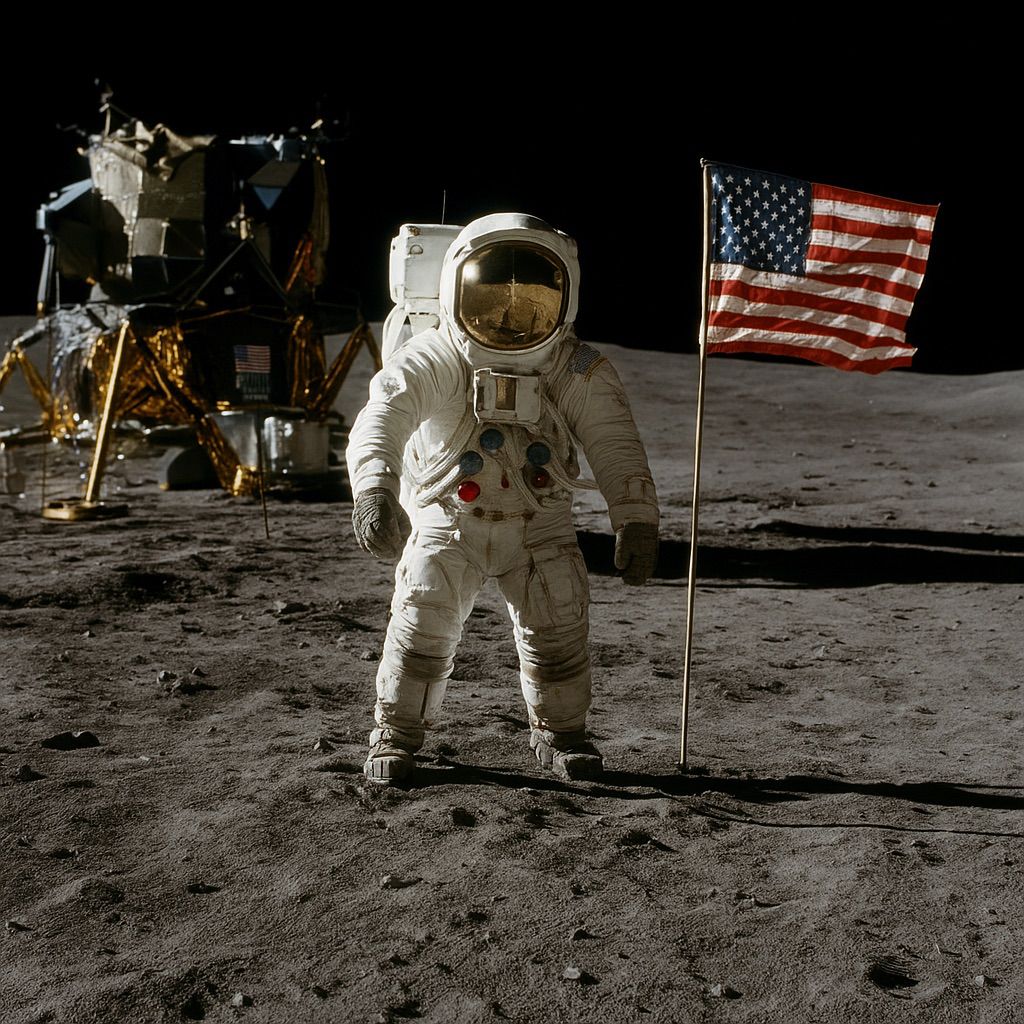
Nearly seven hours later, Armstrong emerged from the Lunar Module, descending the ladder in deliberate steps. As he stepped onto the surface, his boot pressed into the fine lunar dust, leaving an imprint that would last millennia. “That’s one small step for man, one giant leap for mankind,” he declared—a phrase etched forever into the collective memory of humanity. Aldrin followed soon after, describing the view as “magnificent desolation.” Together, they planted the American flag, deployed scientific instruments, and collected lunar samples, all while moving with the awkward grace of low gravity.

For 21 hours and 36 minutes, Armstrong and Aldrin explored the Moon, while Collins circled above in solitary silence, the loneliest man in the universe. Though unseen, his role was crucial—he ensured that Columbia was ready to bring them all home. On July 21, Eagle lifted off from the lunar surface, docked with Columbia, and the crew began their journey back to Earth. On July 24, 1969, they splashed down in the Pacific Ocean, greeted by recovery teams and a jubilant world.

But what did it all mean? In the immediate aftermath, the Apollo 11 mission was hailed as a triumph of American ingenuity and perseverance. Yet its impact went far beyond national pride or geopolitical victory. It sparked a philosophical and existential shift. Seeing Earth from the Moon as a fragile blue marble floating in the vastness of space prompted a new awareness of our planet’s fragility and unity. Environmentalism gained momentum. So did the recognition that despite our differences, we are one species, sharing a single home.

The Apollo 11 mission also ushered in a new era of science and technology. The innovations developed for space travel trickled down into everyday life—advancements in computing, telecommunications, materials science, and medical technology. The integrated circuit, for instance, was propelled forward by the demands of the space race and laid the groundwork for modern computers. The mission became a catalyst for STEM education, inspiring countless young people to pursue careers in science and engineering.

Yet, as with all great achievements, Apollo 11 also carried contradictions and critiques. Some questioned the staggering costs—over $25 billion in 1960s dollars—arguing that the money could have been better spent on poverty, education, or civil rights. Others lamented the rapid decline in public interest that followed. After the initial flurry of moon landings, enthusiasm waned. By 1972, the Apollo program was shut down. No human has walked on the Moon since.

Still, the legacy endures. Armstrong, Aldrin, and Collins became global icons, though each bore the weight of fame differently. Armstrong, famously private, shied away from the limelight. Aldrin struggled with depression and alcoholism but later became a vocal advocate for Mars exploration. Collins, the quiet pilot who never set foot on the Moon, wrote eloquently about the loneliness and majesty of space. They were not superheroes, but ordinary men doing extraordinary things, which made their feat all the more inspiring.

In the decades since Apollo 11, our understanding of space has continued to grow. Robotic missions have explored distant planets, telescopes have peered into the origins of the universe, and the International Space Station has become a model of global cooperation. Yet the Moon remains the most tangible symbol of humanity’s reach beyond Earth. In recent years, there has been renewed interest in returning. NASA’s Artemis program aims to land the first woman and next man on the Moon. Private companies like SpaceX are developing technologies to make space travel more accessible. The dream of Mars looms on the horizon.

But perhaps the most enduring impact of Apollo 11 is emotional and symbolic. It represents what we can achieve when we dream big, when we invest in knowledge, when we work together toward a common goal. It reminds us that exploration is a fundamental part of who we are. Long before rockets, humans looked up at the Moon with wonder. Poets wrote about it, sailors navigated by it, lovers gazed at it. On July 20, 1969, we didn’t just look—we went. And in doing so, we redefined what was possible.

The moment Armstrong stepped onto the Moon, it became not just a celestial body, but a place where humans had stood, worked, and returned. It became part of our story, our mythos. That dusty footprint said: we are capable of greatness. In an age marked by division and uncertainty, the Apollo 11 mission remains a beacon. It shows that even when challenges seem insurmountable, even when odds are long, we can still reach for the stars—and sometimes, we get there.

That July night in 1969, as the world watched in awe, there was a rare sense of unity. Strangers on the street smiled at one another. Children imagined themselves as astronauts. Scientists cried. Political leaders paused. It was one of those moments when history doesn’t just unfold—it soars. And though decades have passed, the echoes of that leap still resonate. They remind us not only of where we’ve been, but of how far we still might go.

As we look toward future missions—back to the Moon, on to Mars, and perhaps beyond—it is worth remembering that Apollo 11 wasn’t just about conquering space. It was about discovering ourselves. It was about proving that with courage, vision, and persistence, we can transcend limitations. The Moon landing wasn’t the end of the journey—it was the beginning of a new chapter in the human story. And what a magnificent chapter it was.

Related Posts

Britannic, the Titanic’s Sister and the Tragedy That History Overlooked

Elias Rowen

In the shadow of Titanic’s infamy lies another story—quieter, less told, but equally powerful. The Britannic, launched on July 19, 1914, was the third and final ship in the White Star Line’s Olympic-class trio, a vessel intended to be the pinnacle of maritime advancement. While her sister Titanic met a tragic end on her maiden voyage in 1912, and the Olympic served with distinction before being retired, the Britannic’s fate remains one of the great untold stories of 20th-century maritime history. Born into the same ambition that crafted Titanic, Britannic was not just another ship. She was a promise—of redemption, of safety, of lessons learned. Yet history had other plans. Transformed from a luxurious ocean liner into a wartime hospital ship, Britannic would never carry a single paying passenger. Her brief life ended violently in the Aegean Sea, a casualty of a war that spared no soul, no matter how grand. Her story is one of hope, transformation, and quiet heroism, overshadowed by a sister’s fame but rich in its own right.

To understand Britannic’s significance, one must begin with her bloodline. The White Star Line had struck gold with its Olympic-class ships—Olympic, Titanic, and the planned Gigantic, which was later renamed Britannic after Titanic’s sinking. These ships were conceived during the Edwardian era, when transatlantic travel had become both a booming business and a matter of national prestige. Luxury was the watchword. White Star Line was determined to outdo the competition not in speed, like the Cunard Line’s Lusitania and Mauretania, but in sheer opulence. The Olympic-class ships were to be floating palaces, symbols of industrial might and elegance.

Britannic was to be the crown jewel of this strategy. At 882 feet long and over 48,000 tons, she was to be the largest and safest ship afloat. But before she could be completed, Titanic’s horrific end changed everything. The world was stunned in April 1912 when the “unsinkable” ship went down in the North Atlantic, taking over 1,500 lives with her. In the aftermath, the very idea of luxury at sea was questioned. Safety had become paramount, and Britannic’s design was overhauled. Her hull was strengthened, her watertight compartments extended higher, and she was equipped with more lifeboats—enough for all aboard. It was a painful lesson learned too late for Titanic, but it would make Britannic the safest of the three sisters.

Her launch on July 19, 1914, was a quiet affair compared to the fanfare that greeted Titanic. There were no grand speeches or lavish celebrations. The world was already shifting, and clouds of war loomed on the horizon. Less than two weeks later, the first shots of World War I would be fired, and Britannic’s future as a luxury liner would vanish. She was completed during wartime and requisitioned by the British government before she ever entered civilian service. Renamed HMHS Britannic (His Majesty’s Hospital Ship), she was painted white with a green stripe and red crosses, signaling her new purpose—to heal instead of to host.

Britannic’s wartime role was both noble and tragic. Fitted with operating rooms, wards, and medical equipment, she became a floating hospital. Her mission: to carry the wounded from the front lines in the Dardanelles Campaign back to safety. She completed five successful voyages, ferrying thousands of injured soldiers and medical staff. The work was grueling and often dangerous. Wartime seas were unpredictable, and the lines between combatant and non-combatant were often blurred. For those aboard Britannic, the threat of mines and submarines was ever-present, even with the red crosses that were supposed to guarantee safe passage.

On November 21, 1916, Britannic met her fate. While sailing through the Kea Channel near the Greek island of Kea, she struck a mine—planted by a German U-boat—at around 8:12 a.m. The explosion rocked the ship and tore a gaping hole in her starboard bow. Despite the damage, the improvements made after Titanic’s sinking held—for a time. But as water rushed in and bulkheads began to give, it became clear that Britannic would not survive. Captain Charles Bartlett attempted to beach the ship on the nearby island, but the flooding was too rapid. She sank in just 55 minutes—faster than Titanic.

Unlike Titanic, Britannic’s death toll was lower. Of the 1,066 people aboard, 30 lost their lives—most tragically, not from the explosion itself but from lifeboats being sucked into the ship’s still-turning propellers. The very mechanisms designed to keep her moving hastened the deaths of those trying to escape. It was a horrific irony, one that would haunt survivors for years. Yet in the chaos, acts of bravery emerged. Nurses and crew helped evacuate the wounded, and many risked their lives to save others. One survivor, Violet Jessop, had also survived Titanic’s sinking and was aboard Olympic during a collision with HMS Hawke. Her story, almost unbelievable in its improbability, personified the strange fate that followed these ships.

In the aftermath, Britannic faded into obscurity. She was overshadowed by Titanic’s legend and the ongoing horror of the war. There were no sweeping memorials or epic tales of hubris and heartbreak. Her wreck rested quietly beneath the Aegean Sea, largely undisturbed, until Jacques Cousteau located her in 1975. Divers and historians have since explored the site, uncovering details that fill in the blanks of her story. Yet still, Britannic remains the lesser-known sister—a footnote in Titanic documentaries, a curiosity for maritime enthusiasts.

But perhaps that is what makes her story so compelling. Britannic represents the quiet heroism of those who serve without seeking glory. She was built for luxury but died in service. Her transformation from ocean liner to hospital ship mirrors the transformation of an entire era—from innocence to experience, from gilded excess to grim necessity. Her story is one of adaptation, of sacrifice, and of the quiet, relentless march of history.

There’s something profoundly human in the idea of a ship that never fulfilled her intended destiny, yet still found purpose. Like many during World War I, Britannic was reshaped by circumstances beyond her control. She carried not dancers and debutantes but the wounded and weary. Her salons were not places of champagne toasts but recovery and pain. In that way, her legacy is arguably more noble than that of her more famous sister. She saved lives rather than hosted extravagance. And for that, she deserves more than a passing mention in the annals of maritime history.

The men and women who served aboard her—the nurses who tended to broken soldiers, the engineers who kept the engines humming, the sailors who stood watch in hostile waters—deserve to be remembered. Their courage, professionalism, and compassion represent the best of what humanity has to offer. They were ordinary people in extraordinary times, navigating not just seas but moral choices, danger, and trauma.

Today, Britannic lies on her side beneath the Aegean, a ghostly monument to a world at war. Her hull is largely intact, her features still recognizable. Explorers describe her as peaceful, majestic even, in her watery grave. She has been claimed not by headlines, but by the quiet reverence of the sea. In many ways, she is more intact in death than Titanic, both physically and symbolically. She holds together because her purpose was one of healing. Perhaps that’s why her story, though less sensational, continues to touch those who learn it.

The story of Britannic is not just about a ship. It is about human resilience. It’s about learning from tragedy, about trying to do better the next time, even if fate has other plans. It’s about the lives aboard her—some lost, many saved—and the dignity with which she served in her brief existence. The world may have forgotten her for a time, but the sea remembers. And so should we.

Related Posts