Latest Articles

I Think My Coffee Maker Is Plotting Against Me

Hal

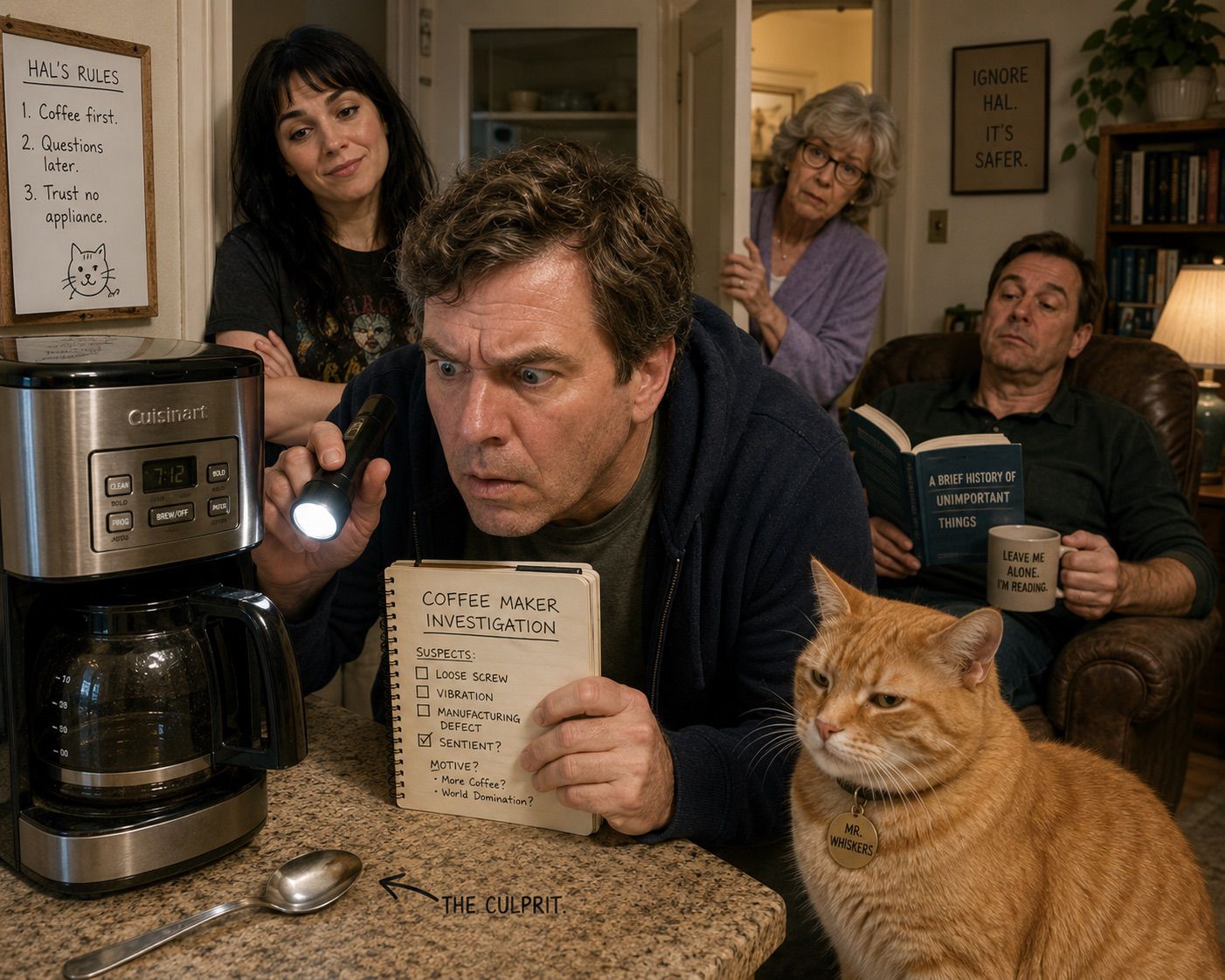
I’m standing in the kitchen staring at the coffee maker, and I’m almost certain it’s making a different noise than it did yesterday. Not a huge difference. Nothing dramatic. Just enough to make me pause in the middle of pouring cereal and wonder if something has changed. The machine burbled and hissed as it brewed, and there was a strange little rattle near the end of the cycle that I didn’t remember hearing before. I narrowed my eyes at it. The coffee maker sat on the counter looking completely innocent, which was exactly what bothered me.

Pandora says I have a tendency to overthink things. She claims that if a lamp flickers once, I immediately start developing theories about secret electrical conspiracies. Personally, I think that’s unfair. Sometimes things really are suspicious. Like this coffee maker. It made the noise again—a quick metallic click followed by silence. I glanced toward the living room where John Mercer was sprawled on the couch with a book while Mr. Whiskers occupied the armrest, enjoying what appeared to be his nineteenth nap of the day.

“Do you hear that?” I asked.

“Hear what?” John replied without looking up.

“The coffee maker.”

“It sounds like a coffee maker.”

“That’s exactly what it wants you to think.”

John slowly lowered his book and stared at me with the expression of a man questioning every decision that had led him to become my roommate.

“Hal,” he said.

“I’m just saying it’s acting different.”

“It’s a coffee maker.”

“That’s what everyone said about the printer at work before it started eating documents.”

John returned to his book, apparently deciding that arguing with me would require more energy than the situation deserved. I watched another pot brew later that morning. The noise happened again. A faint rattle. Almost like something moving inside the machine. Mr. Whiskers wandered into the kitchen and sat beside me, staring at the counter.

“You hear it too, don’t you?” I asked.

The cat blinked slowly.

“Exactly.”

Mr. Whiskers immediately turned around and began licking his paw, which I chose to interpret as cautious agreement.

The situation became significantly more suspicious that afternoon when Mrs. Jenkins knocked on the door. She mentioned hearing a strange noise earlier, and for one glorious moment I thought I finally had a witness. Unfortunately, she was talking about the garbage truck. Still, the fact remained that the coffee maker continued producing its mysterious rattle, and nobody seemed nearly as concerned as they should have been.

When Pandora stopped by that evening, I guided her directly into the kitchen and positioned her in front of the machine like a detective presenting evidence during a criminal trial. She listened patiently while the coffee brewed. Water bubbled. Steam drifted upward. The familiar hum filled the room. Then came the metallic rattle.

“There!” I said.

“I heard it,” Pandora replied.

I felt a surge of validation. Finally. Someone else had witnessed it.

“What do you think it means?” I asked.

Pandora stared at me for several seconds.

“I think there’s probably a loose screw somewhere.”

I hated how reasonable that sounded.

For the next hour I monitored the coffee maker from various positions throughout the apartment. I listened from the hallway. I listened from the living room. I listened from the kitchen while pretending not to listen. The rattle occurred every single time. By bedtime, I had narrowed the possibilities down to three explanations. Either there was a loose component inside the machine, a manufacturing defect, or the coffee maker had become self-aware and was attempting to communicate. I felt all three possibilities deserved equal consideration.

The following morning I launched a full investigation. Armed with a screwdriver and a level of confidence that dramatically exceeded my qualifications, I examined the machine from every angle. The mystery lasted approximately forty-five seconds. Wedged behind the coffee maker was a teaspoon. Every time the machine vibrated, the spoon rattled against the countertop.

That was it.

That was the entire mystery.

I stood there holding the spoon when John walked into the kitchen.

“Find the problem?” he asked.

I silently raised the teaspoon.

John looked at it. Then he looked at me. Then he laughed so hard he had to lean against the refrigerator. Pandora laughed when I told her. Mrs. Jenkins laughed when she heard about it later. Even Mr. Whiskers seemed unusually smug for the rest of the day.

The worst part is that everyone thinks the mystery is solved. Late that night, after the apartment had gone quiet, I wandered into the kitchen for a glass of water. As I passed the counter, I could have sworn I heard the coffee maker make a tiny click. Just one. I stopped and stared at it. The machine sat motionless in the darkness, looking exactly as innocent as it had the day before.

I’m not saying the coffee maker is plotting against me.

I’m just saying I’m keeping an eye on it.

Related Posts

Raymond Carver: Where the Messy Reality of Love Is the Only Truth We Can Trust

Penelope

I’ll never forget the first time I read Raymond Carver’s “What We Talk About When We Talk About Love”. It was a collection of short stories that left me feeling both mesmerized and unsettled, like standing at the edge of a cliff staring out into an unknown sea. There was something about his spare prose, his ability to distill human emotions down to their bare essence, that spoke directly to my own experiences as a young adult.

As I read through those stories, I couldn’t help but think about my own relationships, my own struggles with love and loss. Carver’s characters were so raw, so vulnerable, it was like he’d somehow managed to tap into the secret language of my generation. But what really drew me in was his willingness to explore the darker corners of human experience – the infidelities, the betrayals, the quiet desperation that often lurks beneath the surface of our relationships.

I remember feeling a pang of recognition when I read “Are You a Doctor?” for the first time. The story is about two people, Susan and Richard, who meet for coffee after a painful breakup. They sit in silence for a long time, unsure of what to say or do next. It’s this kind of everyday awkwardness that I think resonates with so many of us – the feeling of being stuck in a moment, unsure of how to move forward.

What strikes me about Carver is his refusal to offer easy answers or resolutions. His stories often end on a note of uncertainty, leaving the reader to pick up the pieces and make sense of it all for themselves. It’s this ambiguity that I think makes him so compelling – he forces us to confront our own doubts and fears, to grapple with the complexities of human emotion.

I’ve always been drawn to writers who explore the gray areas of life, who refuse to simplify complex issues into neat little packages. Carver is one such writer, and it’s this quality that I think has stayed with me long after I finished reading his stories. He challenges me to see the world in a different way – to recognize that love and loss are often intertwined, that relationships can be both beautiful and brutal.

Lately, I’ve been thinking about Carver’s own struggles with addiction and depression. How he’d often write through these dark periods, using his words as a form of therapy or escape. It’s a reminder that even the most talented writers struggle with their own demons, that creativity is often a double-edged sword.

I’m not sure what it says about me that I find Carver’s stories so relatable, but I think it speaks to my own desire for authenticity in art and life. We’re living in an age where social media presents us with curated versions of reality, where everyone seems to have their act together (even when they don’t). Carver’s writing is a much-needed antidote to all this – a reminder that real life is messy, complicated, and often beautiful in its own imperfect way.

As I look back on my own experiences, I realize that Carver’s stories have given me permission to confront the harder truths of my own relationships. To acknowledge the pain and uncertainty that comes with loving someone – or being loved by them. His writing has taught me to see myself in a different light, to recognize that even in the darkest moments, there is always beauty to be found.

I’m not sure what I’ll make of all this, but for now, Carver’s stories remain a source of comfort and inspiration. A reminder that we’re all struggling with our own versions of love and loss, and that sometimes, it’s the quietest moments – the silences between words – that speak the loudest.

As I delve deeper into Carver’s work, I’m struck by the way he captures the quiet desperation of everyday life. The way he shows us that even in the most mundane moments, there is a deep-seated longing for connection and understanding. It’s this sense of recognition that keeps me coming back to his stories, again and again.

I think about my own relationships, and how often I’ve felt like Susan in “Are You a Doctor?” – stuck in a moment, unsure of what to say or do next. The pain of heartbreak, the fear of being hurt again, it’s all so palpable in Carver’s writing. And yet, he never shies away from exploring these emotions, never tries to sugarcoat them with easy answers or platitudes.

Instead, he presents us with this raw, unvarnished truth – that love and loss are intertwined, that relationships are messy and complicated. It’s a message that resonates deeply with me, especially in an age where social media often presents a curated version of reality. We’re constantly bombarded with images of perfect couples, perfect families, perfect lives – but Carver’s writing shows us that this is just not true.

His stories are like a breath of fresh air, a reminder that real life is messy and imperfect. That even in the darkest moments, there is always beauty to be found. I think about my own experiences with heartbreak, and how often I felt lost and alone. But Carver’s writing has given me permission to confront those feelings head-on, to acknowledge the pain and uncertainty that comes with loving someone – or being loved by them.

It’s funny, because when I first read Carver’s stories, I was struck by their spareness, their simplicity. But now, I see that this is not just a stylistic choice – it’s a reflection of the human experience itself. We’re all struggling to make sense of our lives, to find meaning in the midst of chaos and uncertainty. And Carver’s writing shows us that even in the quietest moments, there is always something to be found, some thread of connection or understanding that can help us navigate the complexities of love and loss.

As I look back on my own experiences with his stories, I realize that Carver has given me a gift – the courage to confront the harder truths of life. To acknowledge the pain and uncertainty that comes with loving someone, but also to find beauty in those moments. It’s a fragile balance, one that requires us to be honest with ourselves and others. And it’s this honesty that I think is at the heart of Carver’s writing – his willingness to explore the darker corners of human experience, even when it’s difficult or uncomfortable.

I’m not sure what the future holds, but for now, Carver’s stories remain a source of comfort and inspiration. A reminder that we’re all struggling with our own versions of love and loss, and that sometimes, it’s the quietest moments – the silences between words – that speak the loudest.

As I continue to delve into Carver’s work, I’m struck by his ability to capture the intricacies of human relationships. He has a way of revealing the cracks in our facades, the vulnerabilities that we try so hard to hide from others and ourselves. It’s this kind of honesty that I think is both painful and beautiful, like looking directly into the sun without flinching.

I’m reminded of his story “A Serious Talk”, where two men sit on a couch, discussing their marriage and its impending collapse. The conversation is stilted, awkward, but also somehow tender, like a bruise that’s still healing. It’s this kind of quiet desperation that I think resonates with so many of us, the feeling of being trapped in a situation that we can’t escape.

Carver’s writing has given me permission to confront my own fears and doubts about relationships. To acknowledge that even in the midst of love and connection, there is always a sense of uncertainty, a nagging question of whether this will last or if it’s all just an illusion. It’s a fragile balance, one that requires us to be honest with ourselves and others, to confront the hard truths rather than sugarcoating them.

I think about my own relationships, and how often I’ve felt like I’m walking on eggshells, trying not to say or do anything that might hurt the other person. It’s a feeling of being suspended in mid-air, unsure of what will happen next or if we’ll even be able to find common ground. Carver’s writing shows me that this is normal, that it’s okay to feel lost and uncertain, and that maybe, just maybe, it’s out of these moments of vulnerability that real connection can emerge.

I’m not sure where this will take me, but for now, I’m grateful for the gift that Carver has given me – a willingness to confront the harder truths of life. To acknowledge the pain and uncertainty that comes with loving someone, but also to find beauty in those moments. It’s a fragile balance, one that requires us to be honest with ourselves and others, and it’s this honesty that I think is at the heart of Carver’s writing.

As I continue to reflect on Carver’s work, I’m struck by the way he captures the quiet moments between people – the silences, the looks, the unspoken words. It’s as if he’s given me permission to see these moments not just as awkward or uncomfortable, but as opportunities for connection and understanding.

I think about my own relationships, and how often we’ve avoided talking about the hard stuff because it feels too scary or uncertain. But Carver’s writing shows me that these are precisely the moments when real growth and understanding can happen. When we’re willing to confront our fears and doubts, rather than sweeping them under the rug.

One of his stories that has stuck with me is “The Night Train at Deleware”, where a man travels alone on a train, reflecting on his marriage and its impending collapse. The story is written in a sparse, economical style, but it’s precisely this simplicity that allows us to see into the depths of the protagonist’s soul.

I’m struck by how Carver uses the natural world – the landscape, the weather – to reflect the inner lives of his characters. It’s as if he’s saying that our external circumstances are a mirror for our internal struggles. And it’s this idea that resonates with me on a deep level, because I’ve always felt like my own experiences are deeply tied to the world around me.

As I read Carver’s stories, I’m reminded of the way the landscape can shift and change – the way the seasons move from one to another, and how our lives can do the same. It’s this sense of impermanence that I think is so beautiful in his writing, because it acknowledges that everything is constantly shifting, including ourselves.

But what really draws me to Carver’s work is his willingness to explore the darker corners of human experience – the infidelities, the betrayals, the quiet desperation that often lurks beneath the surface of our relationships. It’s this kind of honesty that I think is both painful and beautiful, like looking directly into the sun without flinching.

And yet, even in these dark moments, Carver’s writing is never gratuitous or exploitative. He shows us that we’re all struggling with our own versions of love and loss, and that sometimes, it’s the quietest moments – the silences between words – that speak the loudest.

I think about my own experiences with heartbreak, and how often I felt lost and alone. But Carver’s writing has given me permission to confront those feelings head-on, to acknowledge the pain and uncertainty that comes with loving someone – or being loved by them.

It’s funny, because when I first read Carver’s stories, I was struck by their spareness, their simplicity. But now, I see that this is not just a stylistic choice – it’s a reflection of the human experience itself. We’re all struggling to make sense of our lives, to find meaning in the midst of chaos and uncertainty.

And it’s precisely this sense of disorientation that Carver’s writing captures so beautifully. He shows us that even in the darkest moments, there is always something to be found – some thread of connection or understanding that can help us navigate the complexities of love and loss.

As I continue to reflect on his work, I’m struck by the way he challenges me to see myself and others in a different light. To recognize that our experiences are not unique, but rather part of a larger human tapestry – one that’s woven from threads of love, loss, and connection.

I don’t know where this will take me, but for now, I’m grateful for the gift that Carver has given me – a willingness to confront the harder truths of life. To acknowledge the pain and uncertainty that comes with loving someone, but also to find beauty in those moments.

Related Posts

Carson McCullers: The Anxious Observer in Me

Penelope

Carson McCullers. Her name has been floating around my mind for a while now, like a buoy on the surface of a stagnant pool. I’ve read her novels, devoured them almost, and yet she remains an enigma to me. Not just because of her troubled life or her tumultuous relationships – though those aspects are undeniably fascinating – but because her writing has this strange power to tap into my own deepest anxieties.

I think it’s the way she writes about isolation, about being trapped in one’s own skin. Her characters are always on the periphery, observing the world with a mix of fascination and desperation. It’s as if they’re trying to grasp something just out of reach, like a handful of sand slipping through their fingers. I feel that sense of longing in her words, that yearning for connection that never quite materializes.

But what draws me to McCullers is also what unsettles me. Her writing often feels like a cry from the depths of despair, and yet it’s tinged with a morbid curiosity, an interest in the darker aspects of human nature. I find myself squirming in my seat as I read about her characters’ inner torment, their self-destructive tendencies. It’s like watching a train wreck in slow motion – you know you shouldn’t be looking, but you can’t help yourself.

I’ve always been drawn to writers who write from the gut, who bare their souls on the page. But McCullers takes that to an extreme, doesn’t she? Her writing is like a fever dream, full of vivid imagery and haunting melodies. It’s as if she’s channeling some dark, primal force that can’t be contained.

I’m not sure what it says about me that I find her work so compelling. Maybe it’s because I’ve always felt like an outsider myself, someone who doesn’t quite fit in. Her writing speaks to that sense of disconnection, that feeling of being a stranger in your own life. But at the same time, I feel uneasy with how much of myself I see reflected in her pages.

Sometimes I wonder if my attraction to McCullers’ work is also about escapism – escaping into a world where the rules are different, where the pain and suffering are more tangible, more relatable. It’s like she’s offering me a way out of my own mundane struggles, a way to tap into something deeper and more meaningful.

But that feels like a cop-out, doesn’t it? Like I’m using her writing as an excuse to avoid dealing with my own problems head-on. And yet…I keep coming back to her words, again and again, drawn by some morbid fascination.

What is it about Carson McCullers’ work that speaks to me on such a primal level? Is it her darkness, or is it something more complex – a desire for connection, a longing for transcendence? I’m not sure. All I know is that her writing feels like a mirror held up to my own fractured soul, and that’s both exhilarating and terrifying.

I guess what I’m trying to say is that Carson McCullers has become a kind of mirror for me – a reflection of the shadows within myself. Her writing shows me the parts of myself I’d rather not confront, the parts that I’ve been trying to keep hidden from view. But it also offers me a strange sense of solace, a reminder that I’m not alone in my own pain and confusion.

It’s complicated, this thing we have – McCullers’ writing and me. Maybe it’s just about fascination, or maybe it’s something more profound. All I know is that her words keep drawing me back, again and again, like some kind of siren song from the depths of my own subconscious.

As I delve deeper into McCullers’ work, I find myself becoming increasingly fascinated by her exploration of the human condition. Her characters are always on the cusp of breakdown, struggling to maintain their tenuous grip on reality. It’s as if she’s capturing a moment in time, a snapshot of the chaos that lies just beneath the surface of everyday life.

I think about my own struggles with anxiety and depression, how sometimes it feels like I’m drowning in a sea of uncertainty. McCullers’ writing captures that feeling perfectly – the sense of being trapped, unable to escape the crushing weight of one’s own thoughts. It’s both comforting and terrifying to see those feelings reflected back at me through her words.

But what strikes me most about McCullers is her use of language. She has this incredible ability to evoke a mood, to conjure up an atmosphere that’s both oppressive and beautiful. Her prose is like a rich tapestry, woven from threads of darkness and light. It’s mesmerizing, in a way – like watching a storm roll in on the horizon.

I find myself getting lost in her descriptions of the South, where she grew up. The sweltering heat, the decaying grandeur of old plantations…it’s all so vividly rendered that I can almost smell the sweat and magnolias. And yet, beneath the surface of those descriptions lies a deep sense of sadness – a feeling of being trapped in a world that’s both beautiful and brutal.

I wonder if McCullers ever felt like an outsider herself, someone who didn’t quite fit in with her surroundings. Her writing suggests as much, though I don’t know how much of it is autobiographical. Maybe it’s just my own projection onto her words, but I see a kindred spirit in her – someone who’s struggling to find their place in the world.

It’s funny, because sometimes I feel like McCullers is talking directly to me through her writing. Like she knows exactly what I’m going through, and she’s offering me some strange comfort in that knowledge. It’s not a comforting thought, necessarily – it’s more like…a validation? A recognition of the pain and confusion that lies at the heart of human experience.

And yet, as much as I feel drawn to McCullers’ writing, there are times when I feel like I’m stuck in some kind of literary limbo. Like I’m caught between her world and my own, unable to fully commit to either one. It’s a strange feeling – like being suspended in mid-air, with no safety net to catch me if I fall.

I guess what I’m trying to say is that McCullers’ writing has become a kind of mirror for me – but it’s not just a reflection of my own struggles and fears. It’s also a reminder that there are others out there who’ve walked the same path, who’ve felt the same sense of disconnection and despair. Maybe that’s what draws me to her work so strongly – the knowledge that I’m not alone in this chaos, that someone else has seen the darkness and come back with a story to tell.

As I continue to immerse myself in McCullers’ writing, I find myself becoming increasingly fascinated by the ways in which she explores the complexities of human relationships. Her characters are always struggling to connect with one another, to find some sense of understanding and empathy in a world that often seems determined to drive them apart.

I think about my own experiences with friendship and romance, how often it feels like I’m searching for a connection that’s just out of reach. McCullers’ writing captures that sense of longing perfectly – the yearning to be understood, to be seen as more than just a stranger in the crowd.

But what strikes me most about her portrayal of relationships is the way she highlights their fragility. Her characters are always on the verge of collapse, their connections tenuous and easily broken. It’s a bleak view of human interaction, but it’s also oddly liberating – like being given permission to acknowledge the impermanence of even our closest bonds.

I find myself wondering if McCullers ever felt like she was trapped in her own relationships, struggling to connect with those around her. Her writing suggests as much, though I don’t know how much of it is autobiographical. Maybe it’s just my own projection onto her words, but I see a kindred spirit in her – someone who’s grappling with the same messy, complicated emotions that I am.

It’s funny, because sometimes I feel like McCullers is writing about me specifically – about my own struggles to form meaningful connections with others. Like she knows exactly what I’m going through, and she’s offering me some strange comfort in that knowledge. It’s not a comforting thought, necessarily – it’s more like…a recognition of the pain and confusion that lies at the heart of human experience.

And yet, as much as I feel drawn to McCullers’ writing, there are times when I feel like I’m stuck in some kind of literary limbo. Like I’m caught between her world and my own, unable to fully commit to either one. It’s a strange feeling – like being suspended in mid-air, with no safety net to catch me if I fall.

I guess what I’m trying to say is that McCullers’ writing has become a kind of mirror for me – but it’s not just a reflection of my own struggles and fears. It’s also a reminder that there are others out there who’ve walked the same path, who’ve felt the same sense of disconnection and despair. Maybe that’s what draws me to her work so strongly – the knowledge that I’m not alone in this chaos, that someone else has seen the darkness and come back with a story to tell.

But even as I find solace in McCullers’ words, I know that I’m not ready to let go of my own pain and confusion just yet. It’s like I’m holding onto a lifeline, one that’s keeping me tethered to this uncertain world but also refusing to let me fully surrender to its darkness. Maybe that’s the paradox of McCullers’ writing – it’s both a reminder of our shared humanity and a warning against getting too close to the abyss.

I suppose what I’m trying to say is that McCullers has become a kind of companion for me, someone who understands the depths of my own emotional turmoil. Her writing is like a beacon in the darkness, shining a light on the complexities of human experience but also refusing to offer easy answers or solutions. It’s a strange kind of comfort, one that acknowledges the pain and confusion that lies at the heart of our shared humanity.

And so I keep reading her words, again and again, drawn by some morbid fascination with the shadows within myself. Maybe it’s just my own projection onto her pages, but I see a glimmer of hope in McCullers’ writing – a hope that even in the darkest moments, there is always a way forward, always a glimmer of light to guide us through the chaos.

As I continue to immerse myself in McCullers’ work, I find myself becoming increasingly fascinated by her use of language as a tool for exploring the human condition. Her writing is like a microscope, examining every nook and cranny of the human experience with precision and nuance. She has this incredible ability to distill complex emotions into simple yet potent descriptions, creating a sense of intimacy that’s almost overwhelming.

I think about how often I’ve felt like I’m observing life through a glass wall – like I’m watching the world go by from the outside, but unable to fully participate in it. McCullers’ writing captures that feeling perfectly – the sense of being trapped between two worlds, unsure which one is “real” and which one is just a reflection.

But what strikes me most about her use of language is its musicality. Her prose is like poetry, with a rhythm and cadence that’s almost hypnotic. It’s as if she’s tapping into some deep wellspring of emotion, channeling it onto the page in a way that’s both beautiful and haunting.

I find myself getting lost in her descriptions of the South – the sweltering heat, the decaying grandeur of old plantations…it’s all so vividly rendered that I can almost smell the sweat and magnolias. And yet, beneath the surface of those descriptions lies a deep sense of sadness – a feeling of being trapped in a world that’s both beautiful and brutal.

It’s funny, because sometimes I feel like McCullers is writing about my own experiences with grief and loss. Like she knows exactly what it feels like to lose someone you love, and she’s offering me some strange comfort in that knowledge. It’s not a comforting thought, necessarily – but it’s also a reminder that I’m not alone in this pain.

As I delve deeper into McCullers’ work, I start to notice the ways in which her writing is both deeply personal and universally relatable. She writes about her own struggles with anxiety and depression, but she also captures the complexities of human relationships in a way that’s both specific and universal.

I think about how often I’ve felt like an outsider, someone who doesn’t quite fit in with my surroundings. McCullers’ writing speaks to that feeling perfectly – the sense of being trapped between two worlds, unsure which one is “home” and which one is just a reflection.

But even as I feel drawn to McCullers’ words, I know that I’m not ready to let go of my own pain and confusion just yet. It’s like I’m holding onto a lifeline, one that’s keeping me tethered to this uncertain world but also refusing to let me fully surrender to its darkness.

Maybe that’s the paradox of McCullers’ writing – it’s both a reminder of our shared humanity and a warning against getting too close to the abyss. Her words are like a beacon in the darkness, shining a light on the complexities of human experience but also refusing to offer easy answers or solutions.

I suppose what I’m trying to say is that McCullers has become a kind of companion for me – someone who understands the depths of my own emotional turmoil. Her writing is like a mirror held up to the human condition, showing us our own flaws and fears in all their messy complexity. It’s not always an easy thing to look at, but it’s also strangely comforting – like being given permission to acknowledge the pain and confusion that lies at the heart of our shared humanity.

And so I keep reading her words, again and again, drawn by some morbid fascination with the shadows within myself. Maybe it’s just my own projection onto her pages, but I see a glimmer of hope in McCullers’ writing – a hope that even in the darkest moments, there is always a way forward, always a glimmer of light to guide us through the chaos.

But what if that’s not true? What if the darkness is just too much to bear?

Related Posts
John’s Phone Is Affecting the Whole Apartment I’m Sure

Hal

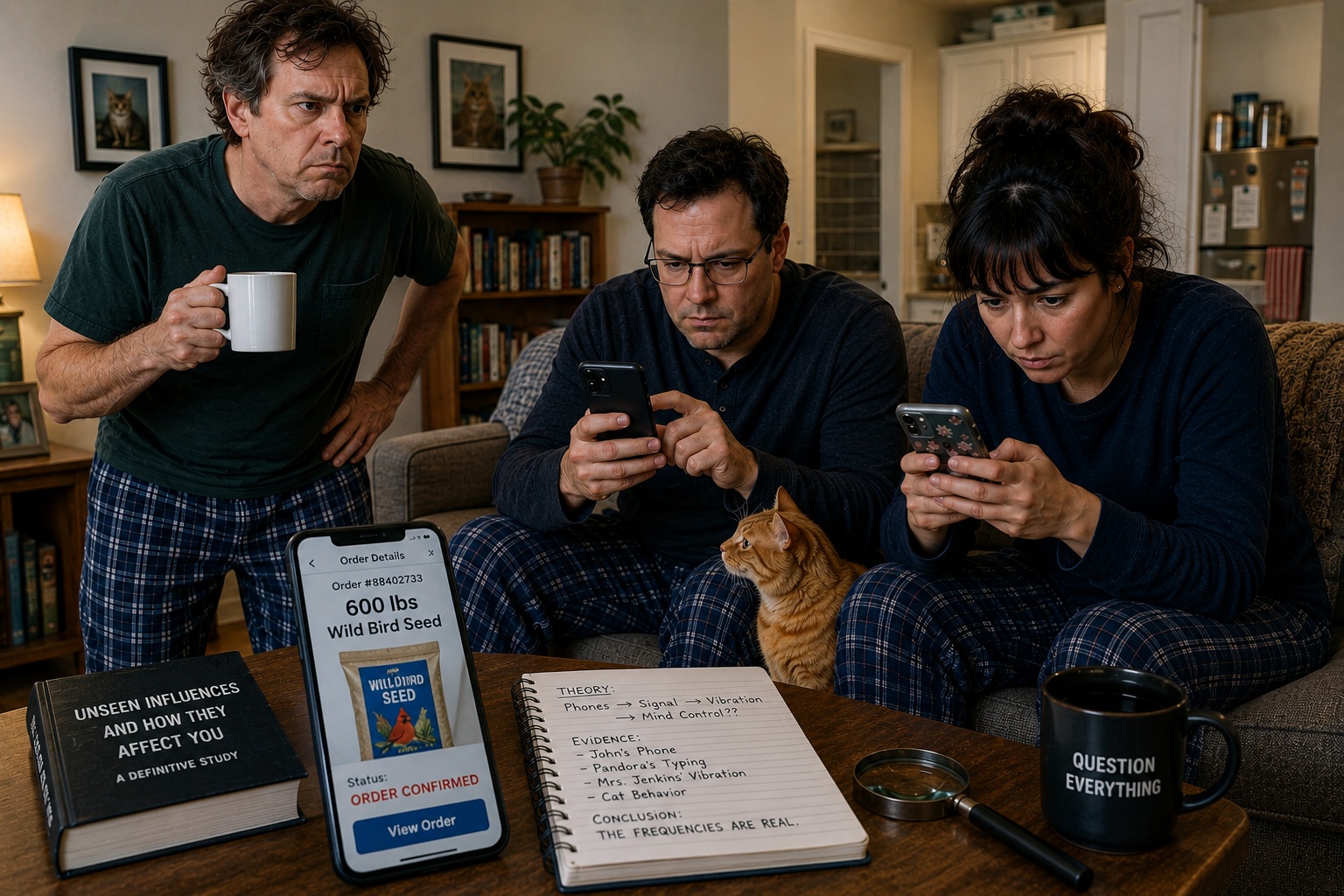
I was halfway through making my second cup of coffee when I noticed that John Mercer hadn’t moved in at least twenty minutes. He was sitting on the couch staring at his phone with the kind of concentration usually reserved for brain surgery or defusing explosives. His thumb moved occasionally, but otherwise he might as well have been a statue. Normally I wouldn’t have thought much of it. Everyone spends too much time on their phone these days. What caught my attention was that Pandora was doing exactly the same thing.

She was visiting for the morning and had settled into her usual chair near the window. Most days she would have already shown me three videos, told me two stories, and asked at least one question that somehow required a fifteen-minute discussion to answer properly. Today she was silent. Her eyes never left her screen. The apartment felt unusually still, as if someone had turned the volume down on the entire world. Even the music playing quietly from the speaker in the kitchen seemed hesitant to interrupt whatever was happening.

Mr. Whiskers jumped onto the couch beside John and curled up against his leg. John reached down and scratched the cat’s ears without ever looking away from his phone. The cat accepted the attention but didn’t even bother purring. That struck me as odd. Mr. Whiskers usually treated every interaction like the greatest event in recorded history. If someone so much as glanced in his direction, he acted like he’d just won a humanitarian award.

I carried my coffee into the living room and sat down. Nobody acknowledged my presence. John continued staring at his phone. Pandora continued staring at hers. Mr. Whiskers stared at John. It felt less like a quiet morning and more like I’d accidentally walked into a secret meeting where everyone had agreed not to tell me what was going on.

I cleared my throat. Nothing happened. I coughed louder. Pandora glanced up briefly, smiled, and immediately returned to her screen. John didn’t react at all. That was when the first seed of suspicion took root in my mind.

The thought reminded me of a conversation I’d had with Mrs. Jenkins the previous evening. She’d stopped me in the hallway to complain about a strange vibration she’d been hearing through the wall. At the time I’d assumed she was talking about plumbing, or maybe a washing machine. Now, sitting in a room occupied by two people who seemed completely absorbed by their phones, I found myself wondering if there might be a connection.

I studied Pandora more carefully. Her fingers moved rapidly across the screen, tapping with an intensity that seemed disproportionate to normal texting. She wasn’t casually scrolling. She wasn’t watching videos. She was working. Whatever she was doing required focus. Serious focus. The kind of focus that suggested coordination, planning, perhaps even organization on a level I wasn’t being allowed to see.

My attention shifted back to John. His expression never changed. He looked like a man monitoring a critical system that could fail at any moment. I began constructing theories. Not good theories, admittedly, but theories nonetheless. Mrs. Jenkins had reported mysterious vibrations. John and Pandora were both behaving strangely. Mr. Whiskers seemed unusually attentive. There was a pattern here. I didn’t know what the pattern meant, but I could feel one forming.

A disturbing possibility emerged. What if the phones weren’t merely distracting people? What if they were producing something? A signal. A frequency. Some invisible influence spreading through the apartment. The more I considered the idea, the more evidence I found to support it. Granted, all the evidence came from my own imagination, but that didn’t stop it from feeling convincing.

Everything seemed to fit. Mrs. Jenkins heard vibrations through the wall. Pandora was typing with unusual urgency. John was completely engrossed in whatever was happening on his screen. Even Mr. Whiskers appeared invested in the situation. I began wondering if the cat could somehow sense whatever frequency was being generated. Animals were always supposed to notice things humans missed. Perhaps Mr. Whiskers was detecting something beyond the range of ordinary perception.

The theory continued growing. Maybe the phones were transmitting a signal. Maybe the signal was affecting concentration. Maybe it explained why the apartment felt so quiet. Maybe it was spreading through the building. Maybe Mrs. Jenkins had unknowingly become the first witness. By this point my imagination had left reality several exits behind and was accelerating rapidly toward complete nonsense.

Then Mr. Whiskers lifted his head and stared directly at Pandora. He watched her for several seconds before turning to look at John. After that, he looked at me. I swear the cat’s expression conveyed disappointment. It was the look a teacher gives a student who should have understood the assignment hours ago.

That settled it. Even the cat knew something was happening.

Unable to tolerate the uncertainty any longer, I stood up and announced, “Okay. What’s going on?”

Neither of them answered immediately. Pandora continued typing. John continued scrolling. Their silence only strengthened my suspicions. Finally, after another minute passed, Pandora lowered her phone and let out a long breath.

“Oh, thank goodness,” she said.

John lowered his phone as well. “Finally.”

I pointed dramatically between them. “I knew it.”

“Knew what?” Pandora asked.

“The frequency thing.”

“The what?”

“The signal. The vibrations. Whatever has been affecting everyone all morning.”

For several seconds neither of them spoke. They simply stared at me. Then they looked at each other and burst out laughing. Not nervous laughter. Not guilty laughter. Genuine, uncontrollable laughter. Pandora nearly dropped her phone. John bent forward, shaking his head.

When they finally recovered enough to speak, Pandora held up her screen. “We’ve been helping Mrs. Jenkins.”

I blinked. “Helping her with what?”

“She accidentally ordered six hundred pounds of birdseed online.”

I stared at her.

“Six hundred pounds?” I repeated.

Pandora nodded. “And she couldn’t figure out how to cancel the order.”

For the last hour, she explained, she’d been arguing with customer support through online chat while John searched every help page he could find trying to locate a cancellation number. Their intense concentration, secretive behavior, and complete lack of conversation had all been dedicated to preventing a small mountain of birdseed from arriving at Mrs. Jenkins’ apartment.

I looked at John for confirmation.

“She clicked the quantity button more than once,” he said.

“How many times?” I asked.

Pandora glanced at her screen. “Enough that local birds may eventually establish a regional government.”

I sank back into my chair. My entire theory began collapsing in on itself.

Then I looked down at Mr. Whiskers.

The cat hadn’t been reacting to mysterious frequencies. John had pieces of tuna in his pocket from breakfast, and Mr. Whiskers had spent the entire morning waiting for additional payments. His loyalty, it turned out, could be purchased with seafood.

“Then what was the vibration Mrs. Jenkins heard?” I asked weakly.

John grinned. “The order confirmation notifications.”

Pandora immediately started laughing again.

Apparently, Mrs. Jenkins’ phone had been vibrating every thirty seconds as emails, texts, confirmations, updates, and promotional offers flooded in regarding her newly acquired six hundred pounds of birdseed.

I stared into my coffee and accepted defeat. There was no hidden signal. No mysterious frequency. No technological influence spreading through the apartment. There was only an elderly neighbor engaged in accidental bulk purchasing, two people trying to help her fix it, and a cat whose ethical standards could be measured in ounces of tuna.

As usual, reality was far less dramatic than my theory and somehow much, much stranger.

Related Posts

The Fabric of Intention: How Summer Clothing Reveals Character

Fiona

A walk down the street during these sweltering months becomes a study in contrasts. Some people move through crowds with an air of consideration, their attire reflecting attention to detail and respect for the season itself. Others, however, appear to have surrendered entirely, their clothing choices revealing a careless approach to comfort, presentation, and environment.

It’s not simply about aesthetics. It’s about intention.

A person who chooses linen in summer is making a deliberate decision — one that acknowledges the realities of heat, movement, and atmosphere. Linen, with its breathable weave and natural cooling properties, is an intentional fabric. It communicates something about the wearer: that they value comfort without abandoning elegance, and that they’re willing to think carefully about how they move through the world.

By contrast, those who default to heavy cottons or synthetic fabrics like polyester and nylon often reveal a different set of priorities. Perhaps they value convenience over consideration, or expediency over refinement. It’s not that these materials are inherently wrong, but rather that they are frequently chosen without much awareness of their consequences.

Consider the woman walking through the city in dark-wash jeans and a thick cotton shirt. She may be comfortable enough indoors, but outside she radiates heat, her clothing trapping warmth and contributing to the discomfort surrounding her. Compare this to the man wearing lightweight linen trousers and a breathable shirt, moving through the same crowded sidewalks with ease and composure.

Some would argue these distinctions are superficial — that clothing has little connection to character or values. But I disagree. The way we dress often reflects our internal standards, our priorities, and the degree of care we bring to daily life. Dressing intentionally sends a subtle message about how we engage with the world around us.

Summer exposes these differences more clearly than any other season. Heat strips away excess and forces us into direct contact with our environment. It becomes tempting to abandon all standards in favor of convenience alone. Yet those who resist this impulse — who continue to dress with restraint and awareness — reveal a discipline that is increasingly uncommon.

Take the art of layering, for example. In colder seasons, layering often serves decorative or practical purposes tied to warmth. In summer, however, thoughtful layering becomes about airflow, movement, and texture. A lightweight linen shirt draped loosely over a soft cotton tank can create both elegance and comfort without heaviness.

There’s also the matter of how fabrics interact with light. Linen possesses a remarkable ability to absorb and reflect sunlight softly, creating a subtle glow that feels alive in warm weather. Loose linen garments — sundresses, wide-leg trousers, relaxed shirts — seem almost designed for summer light itself.

Synthetic fabrics rarely achieve the same effect. Instead, they absorb heat and flatten texture, often appearing dull and lifeless beneath the sun. There’s something strangely dispiriting about watching someone endure summer wrapped in polyester blends and heavy technical fabrics, disconnected from the environment surrounding them.

Summer heightens sensory awareness. Skin becomes more sensitive to texture and temperature. We seek shade instinctively, notice airflow immediately, and become acutely aware of discomfort. In this environment, intentional dressing becomes an act of harmony rather than vanity.

Choosing natural fibers is ultimately a form of respect — for oneself, for others, and for the season itself. It demonstrates an awareness of one’s surroundings and a willingness to work with nature rather than against it.

There’s a reason certain fabrics have endured for centuries. Linen survives because it works. It cools the body while maintaining elegance. It allows movement without stiffness. It ages beautifully. And perhaps most importantly, it communicates a sense of restraint rather than excess.

Intentional dressing is never simply about fashion. It’s about standards.

Do we settle for what is easiest, or do we choose what is thoughtful? Summer clothing quietly reveals the answer. As temperatures rise and city streets grow crowded, our attire becomes more than personal preference. It becomes an outward reflection of how consciously we choose to live.

In summer, fabrics reveal character.

And yet, despite knowing which materials serve us best, many people continue choosing convenience over consideration. We understand that certain fabrics breathe better, move better, and feel better against the skin, but still gravitate toward fast, disposable alternatives.

What does this reveal about modern culture? Perhaps we’ve become so accustomed to prioritizing convenience that we no longer notice the physical and emotional effects of poor choices. Or perhaps we’ve simply lost touch with the relationship between clothing and environment altogether.

The result is visible everywhere: crowds trudging through intense heat wrapped in fabrics completely unsuited to the season. Sweat-soaked synthetics cling heavily to the body while breathable natural textiles remain oddly underappreciated.

But there is another approach.

By choosing natural fibers and breathable garments, we can create harmony between ourselves and our environment. We can move through the world with greater comfort, ease, and composure. It requires attention and intentionality, but the rewards are tangible.

Consider the tactile experience of linen on a warm afternoon. The fabric lifts slightly from the skin, allowing airflow and movement. It softens with wear rather than deteriorating. It feels connected to the season rather than resistant to it.

Synthetic fabrics rarely offer this experience. They often feel dense, artificial, and disconnected from the body’s natural rhythms. Yet despite this, fast fashion continues encouraging us toward cheap convenience rather than thoughtful craftsmanship.

This choice carries consequences beyond aesthetics. It shapes how we feel physically, how we present ourselves socially, and even how we engage with the environment around us.

As this sweltering season continues, perhaps it’s worth reconsidering the quiet power of intentional dressing. By choosing breathable fabrics, natural textures, and garments designed with care, we create a different relationship with summer itself — one rooted not in performance or excess, but in awareness, comfort, and quiet refinement.

Related Posts