Latest Articles

Susan Howe: When Words Cut Too Deep

Penelope

Susan Howe’s writing has been stuck with me for a while now, like a thread I keep tugging on, trying to understand its texture and how it relates to my own thoughts. I’ve read her books multiple times, yet each time I find something new that unsettles or fascinates me. Maybe it’s because she writes about things I’m not used to – the silence of old stones, the ghosts of historical events, the disconnection between words and meaning.

One thing that keeps drawing me back is her use of language. It’s not just poetic; it’s precise and deliberate, like a scalpel cutting through layers of history. She exposes what lies beneath, revealing the fault lines where past and present meet. I’ve always been interested in how words can be both powerful and inadequate at the same time – and Howe seems to capture that tension perfectly.

Sometimes, her writing makes me feel uncomfortable because it touches on things I’d rather not think about: the violence of colonialism, the ways in which language can erase or distort experience. Reading her work is like looking directly into a mirror, where you see reflections of your own privilege and complicity staring back at you. It’s jarring, but also necessary – like a wake-up call that makes me wonder if I’ve been sleepwalking through my own life.

I think what I appreciate most about Howe’s writing is its ambiguity. She doesn’t shy away from complexity or uncertainty; instead, she leans into it, letting her words dance around the edges of meaning. It’s as if she’s saying, “Here’s the puzzle – now figure out how to solve it.” That’s a feeling I’m not used to in my own writing, where I often feel the need for clarity and resolution.

Sometimes, when I’m struggling with a piece, I’ll re-read Howe’s work and try to understand what makes her sentences tick. She has this way of juxtaposing two seemingly unrelated ideas or images – like placing an 18th-century poem alongside a passage about modern-day urban decay – and somehow, it works. The connection between them is implicit, yet palpable; I’m left feeling both confused and intrigued.

I’ve come to realize that my own writing often seeks answers where Howe’s work leaves questions hanging in the air. Maybe that’s because I’m more comfortable with neat conclusions and tidy narratives, even if they’re shallow or inaccurate. Reading her work makes me feel like I’m being invited into a different kind of conversation – one where the only certainty is uncertainty itself.

What I find most appealing about Howe’s writing is its refusal to simplify the world. Her words are like stones in a riverbed – each one a reminder that the water beneath us is always shifting, never staying still. It’s an unsettling feeling, but also exhilarating; it makes me feel alive and connected to something larger than myself.

I’m not sure how much longer I’ll keep tugging on this thread, but for now, I’m content to follow its twists and turns, wherever they lead. Maybe one day, I’ll have a better understanding of what Susan Howe’s writing means to me – or maybe it will remain forever in the realm of uncertainty, like the silences she writes about so eloquently.

As I continue to grapple with Howe’s writing, I find myself returning to her use of fragments and shards of language. She takes apart the very fabric of words, leaving behind a trail of broken sentences and half-revealed meanings. It’s as if she’s saying that meaning itself is fractured, that our attempts to pin it down are always incomplete.

This resonates with me on a deep level, because I’ve always struggled with the idea of writing “perfect” sentences. I’ll spend hours tinkering with a single phrase, trying to make it just right – only to realize that perfection is an illusion. Howe’s work reminds me that language is inherently imperfect, that words can never fully capture the complexity of our experiences.

I’m not sure if this is a liberating or terrifying thought, but it’s certainly humbling. As a writer, I’ve always felt a pressure to produce something polished and coherent – as if the quality of my writing directly reflects the quality of my thoughts. But Howe’s work shows me that there’s beauty in brokenness, in the gaps between words.

It’s funny, because when I’m struggling with a piece, I’ll often find myself trying to fill those gaps, to smooth over the rough edges and create something seamless. But reading Howe makes me wonder if that’s even possible – or desirable. Maybe the beauty lies not in the completed puzzle, but in the fragments themselves.

This is where my own writing often gets stuck – in the attempt to make everything fit together neatly. I’ll try to force connections between ideas, to create a narrative arc that’s more satisfying than it needs to be. But Howe’s work reminds me that sometimes, the best way to write is to leave things untidy, to let the fragments speak for themselves.

I’m not sure if this is a lesson I can apply to my own writing – or if it’s even one I want to learn. Part of me wants to hold onto the idea of control, of crafting words into neat and tidy sentences. But another part of me is drawn to the uncertainty of Howe’s style, the way she lets language unfold like a puzzle without solutions.

As I continue to read her work, I’m struck by how much it feels like an invitation – not just to explore her ideas, but to explore my own thoughts and feelings. It’s as if she’s saying, “Come with me into this strange and uncertain world, where words are broken and meaning is fragmented.” And in that moment, I feel a sense of excitement and trepidation, because I’m not sure what lies ahead – or what I might discover.

As I sit here with Susan Howe’s words swirling around me, I’m struck by the way she blurs the lines between poetry and prose. It’s as if she’s showing me that language is a fluid, ever-changing thing – one that resists categorization or containment. Her writing is like a river, constantly flowing and shifting, yet always retaining its core essence.

I think about how my own writing often tries to pin down meaning, to capture the elusive essence of experience in neat, tidy sentences. But Howe’s work suggests that this approach might be misguided – that meaning is always slipping away from us, like sand between our fingers. Her writing is an attempt to catch that sand, to hold onto it for just a moment before it escapes.

I’m not sure if I’m ready to give up on the idea of control in my own writing. It’s comforting to think that I can shape words into something coherent and meaningful. But Howe’s work makes me wonder if this approach is ultimately limiting – if it prevents me from tapping into the uncertainty, the chaos, that lies at the heart of human experience.

As I continue to read her poetry, I’m struck by its lyricism – the way words seem to dance on the page, taking on lives of their own. It’s as if she’s using language to conjure up worlds, to evoke emotions and sensations in a way that feels almost magical. And yet, at the same time, there’s a sense of disconnection, of fragmentation, that underlies her writing.

I think about how this might relate to my own experiences with language – how I’ve often found myself trying to impose meaning on words, to force them into neat and tidy categories. But Howe’s work suggests that language is inherently messy, that it resists our attempts to pin it down or control it. Her writing is an attempt to capture the fluidity of language, to let it flow freely like a river.

As I grapple with these ideas, I’m reminded of the times when my own writing has felt most true – when words have flowed out of me without effort, without forced construction or artificial neatness. Those moments feel like glimpses into another world, one where language is free and unencumbered by our attempts to control it.

But how do I tap into that feeling more consistently? How can I let go of my need for control, and allow words to flow freely on the page? These are questions that linger in my mind as I continue to read Susan Howe’s work – questions that challenge me to rethink my approach to writing, and to find new ways to express myself.

As I ponder these questions, I’m drawn back to the way Howe weaves together seemingly disparate threads of language and history. Her writing is like a tapestry, with each thread representing a different narrative or perspective. And yet, when you step back and look at the whole, you see that it’s not just a collection of threads, but a complex and intricate pattern.

I think about how this might relate to my own experiences with identity and belonging. As a young adult, I’ve often felt like I’m trying to stitch together different fragments of myself – my past, my present, my cultural heritage – into a cohesive whole. But Howe’s work suggests that this approach might be misguided. Instead of trying to create a seamless narrative, perhaps I should be embracing the fragmentation and multiplicity of human experience.

Her writing makes me wonder if it’s possible to let go of the need for control and perfection in my own life, not just in my writing. Can I learn to accept the gaps and uncertainties that arise from living in a complex and messy world? Or will I always try to impose order on things, even when it’s not possible or desirable?

As I continue to read Howe’s work, I’m struck by her use of imagery and metaphor. She has this incredible ability to evoke entire landscapes and atmospheres with just a few carefully chosen words. It’s like she’s conjuring up worlds that exist outside the boundaries of language.

I think about how this might relate to my own experiences with creativity and imagination. When I’m writing, I often feel like I’m trying to tap into some deeper source of inspiration – a place where ideas flow freely and unencumbered by rational thought. But Howe’s work suggests that this source is always available to us, even in the midst of uncertainty and chaos.

Her writing makes me wonder if it’s possible to cultivate this kind of creativity and imagination in my daily life, not just when I’m sitting at my desk with a pen and paper. Can I learn to see the world as a place of endless possibility and wonder, where every experience is an opportunity for growth and discovery?

As I sit here with Susan Howe’s words swirling around me, I feel a sense of excitement and trepidation. I’m not sure what lies ahead – or what I might discover – but I know that I’ll be following this thread, wherever it leads.

One thing that strikes me about Howe’s writing is the way she uses silence as a kind of punctuation. She’ll place a blank line between sentences, or leave a gap in the middle of a paragraph, and suddenly the words take on a new significance. It’s like she’s saying, “Silence is not absence, but presence.” And that’s something I think about a lot when I’m writing – how to balance the need for clarity with the power of silence.

I’ve been experimenting with this in my own work, trying to see where it takes me. But it’s hard to shake the feeling that I’m somehow “wasting” space by leaving things blank or incomplete. It’s like I’m being asked to trust that the reader will fill in the gaps, rather than providing all the answers myself.

This makes me think about the role of the reader in Howe’s work – how she seems to be inviting us into a conversation that’s already ongoing, but one where we’re not necessarily expected to have all the answers. It’s like she’s saying, “Come with me on this journey, and let’s figure it out together.” And that’s a really uncomfortable feeling for someone who likes to think they know what they’re doing.

But it’s also exhilarating – because when I’m reading her work, I feel like I’m being asked to be more than just a passive consumer. I’m being invited to participate in the creation of meaning itself. It’s a very different experience from reading something that’s presented as “right” or “true,” where the author is trying to convince me of their point of view.

As I continue to grapple with these ideas, I find myself thinking about my own relationship with authority – how I tend to seek out voices that tell me what to think and believe. But Howe’s work suggests that this approach might be limiting – that by seeking answers outside ourselves, we’re neglecting the wisdom of our own experiences.

It’s a scary thought, because it implies that I’m responsible for creating my own meaning in life. That I have to trust myself, even when things are uncertain or unclear. But at the same time, it feels like a liberating idea – one that opens up possibilities for growth and discovery that I never would have considered otherwise.

As I sit here with Susan Howe’s words swirling around me, I’m struck by the way she blurs the lines between poetry and essay writing. It’s like she’s saying, “What’s the difference between a poem and an essay, anyway? Why can’t they be one and the same?” And that’s a question that resonates deeply with me – because when I’m writing, I often feel like I’m trying to choose between two opposing modes of expression.

Do I go for the clarity and concision of an essay, or do I allow myself to get lost in the language of poetry? The answer is always yes – but it’s also a source of tension and conflict. Because when I try to write like Howe, with all its ambiguity and uncertainty, I feel like I’m abandoning my own voice.

But what if that’s not true? What if my own voice is exactly where the ambiguity lies? What if the uncertainty is not something to be overcome, but rather something to be explored?

As I continue to ponder these questions, I find myself thinking about the role of intuition in Howe’s work – how she seems to rely on it as a guide for her writing. It’s like she’s saying, “Trust your instincts, even when they don’t make sense.” And that’s a hard thing for me to do – because as someone who likes to think they’re in control, I often find myself resisting the idea of trusting my gut.

But Howe’s work suggests that this might be precisely what I need to do. That by embracing uncertainty and ambiguity, I can tap into a deeper source of creativity and imagination. It’s a scary thought – but also an exhilarating one. Because when I’m writing with intuition as my guide, I feel like I’m not just creating words on the page – I’m creating worlds.

And that’s what Susan Howe’s writing does for me – it reminds me that language is a tool for creation, not just communication. It’s a way of conjuring up worlds and evoking emotions, rather than simply conveying information. And when I’m reading her work, I feel like I’m being invited into one of those worlds – a world where uncertainty and ambiguity are not enemies to be vanquished, but rather allies to be celebrated.
Related Posts

I Think My Roommate Is Using Mind Control on Mr Whiskers

Hal

Pandora left her hair tie on my desk this morning, and I didn’t think much of it at first. It’s one of those plain black elastic hair ties that seems to spend more time on her wrist than in her hair. Normally I would have tossed it onto the coffee table and forgotten about it, but when I picked it up, something caught my attention. The thing looked worn out. The elastic had stretched, the edges were frayed, and it looked less like a hair tie and more like a survivor of several natural disasters. Pandora usually loses these things every few days and replaces them without a second thought, so seeing the same one hanging around for weeks felt oddly significant. Maybe I was overthinking it. Maybe I just needed more coffee. Either way, once I noticed it, I couldn’t stop noticing it.

The first strange thing was how often the hair tie seemed to appear whenever Mr. Whiskers was around. Mr. Whiskers, John Mercer’s orange tabby cat, has many admirable qualities, but intellectual brilliance is not among them. He’s a good cat, but he’s the kind of cat who occasionally gets startled by furniture he’s already walked past three times that day. So when I first saw him staring intently at Pandora’s hair tie while she absentmindedly spun it around her finger, I didn’t think much of it. Cats stare at weird things all the time. The second time I saw it happen, however, I started paying attention. By the third time, I was beginning to suspect a pattern.

One afternoon Pandora was sitting on the couch, talking to Mr. Whiskers in the high-pitched voice people reserve for cats, babies, and occasionally very small dogs. As she talked, she lazily twirled the hair tie around her finger. Mr. Whiskers sat directly in front of her, completely mesmerized. His eyes tracked every movement. Back and forth. Around and around. He didn’t blink. He didn’t move. He looked like a tiny orange security camera following a suspicious vehicle. I glanced over at John, who was sitting in his usual spot scrolling through his phone.

“Are you seeing this?” I asked quietly.

John didn’t even look up. “Seeing what?”

“The hypnosis.”

That got a brief glance out of him. He looked at Pandora, looked at Mr. Whiskers, and then looked back at me. “He’s watching a moving object.”

“Exactly,” I said. “That’s what makes it so effective.”

John stared at me for a moment before returning to his phone, which I considered a disappointingly casual response to what was rapidly becoming a major situation.

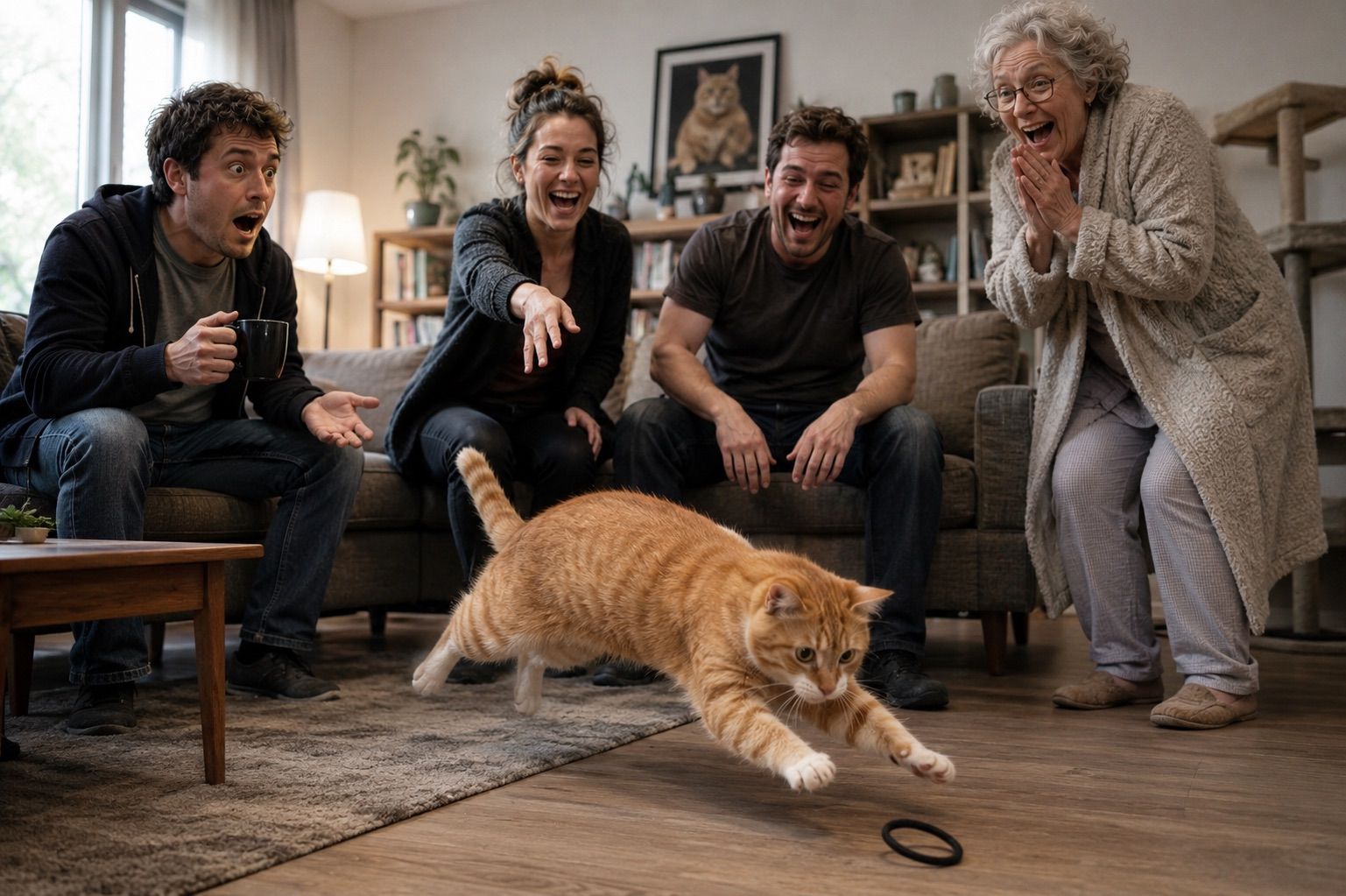
Over the next several days, I began gathering evidence. Whenever Pandora visited, Mr. Whiskers would appear within minutes. Whenever she sat down, he positioned himself nearby. Whenever she picked up the hair tie, his attention immediately locked onto it. The most suspicious incident occurred when Pandora casually tossed the hair tie across the room. Mr. Whiskers launched himself off the couch like a missile, sprinted after it, and pounced on it before it even hit the floor. Most people would call that normal cat behavior. Those people have clearly never conducted a serious investigation.

As the week progressed, my theory evolved. The hair tie wasn’t just a hair tie. It was a conditioning device. Every interaction reinforced the bond. Every toss strengthened the programming. Every spin of the elastic deepened Mr. Whiskers’ dependence on Pandora’s commands. The pieces were starting to fit together. I wasn’t entirely sure what her end goal was, but that didn’t mean there wasn’t one. History is full of people who ignored warning signs because they seemed ridiculous at first.

The breakthrough came on Thursday afternoon. Pandora was sitting in the living room talking with John while absentmindedly stretching the hair tie between her hands. Mr. Whiskers was sprawled across the couch looking half asleep. Without warning, Pandora snapped the hair tie lightly against her wrist. Instantly, Mr. Whiskers lifted his head and looked directly at her.

I nearly dropped my coffee.

There it was.

A signal.

A response.

Proof.

I sat down across from John with all the seriousness of a detective presenting evidence to a grand jury.

“We have a situation.”

John sighed before I even continued. “No, we don’t.”

“Your cat has been compromised.”

That finally got his attention.

“My cat has what?”

“Compromised.”

“By who?”

I pointed dramatically toward Pandora.

She looked up from the couch. “What did I do now?”

“How long has the program been running?”

Pandora blinked. John rubbed his forehead. At that exact moment, Mrs. Jenkins happened to walk past the open door and peek inside. Unfortunately, the phrase “I’ve uncovered something” has the same effect on Mrs. Jenkins that a dinner bell has on a hungry dog. Within seconds she was standing in the living room demanding details.

When I explained my theory, she actually listened. That alone gave me confidence. Then Pandora casually held up the hair tie. Mr. Whiskers immediately perked up and stared at it. Mrs. Jenkins gasped. It wasn’t a large gasp, but it was enough. For one beautiful moment, I felt completely vindicated.

Then Pandora tossed the hair tie across the room.

Mr. Whiskers exploded off the couch, chased it into the hallway, rolled onto his back, kicked it repeatedly with both hind legs, and began chewing on it with the enthusiasm of a cat who had just discovered the meaning of life. The room erupted with laughter. Pandora laughed. John laughed. Mrs. Jenkins laughed. Even Mr. Whiskers somehow looked amused. Meanwhile, I sat quietly as reality slowly dismantled an entire week’s worth of investigative work.

The truth, as it turned out, was painfully simple. For over a month, Pandora had been letting Mr. Whiskers play with the hair tie whenever she visited. It had become his favorite toy. That was it. No hypnosis. No conditioning. No secret program. No mind control. Just a cat who liked a piece of elastic.

John eventually patted me on the shoulder. “You spent an entire week investigating a cat.”

“I was gathering intelligence.”

“You built a conspiracy theory around a hair tie.”

“I followed the evidence wherever it led.”

Mr. Whiskers trotted over a few moments later carrying the hair tie in his mouth. He dropped it directly at my feet and sat down. For several seconds we simply stared at one another. The cat looked at me. I looked at the cat. The hair tie sat between us like some kind of diplomatic offering. And for just a moment, I could have sworn Mr. Whiskers looked disappointed that I had figured out so little.

Related Posts

Max Ernst: The Surrealist Cartographer of My Inner Chaos

Penelope

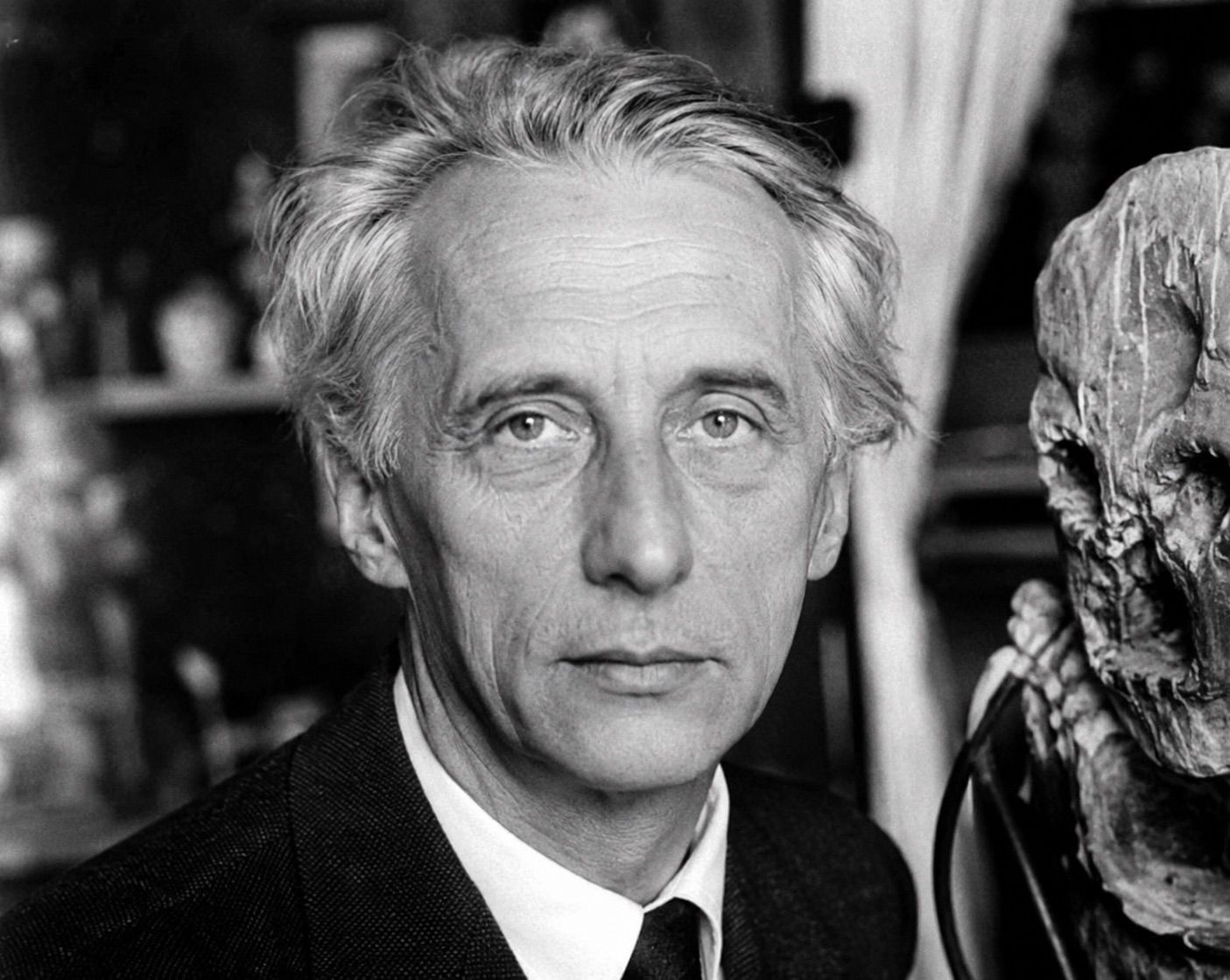
Max Ernst’s Surrealist landscapes have been etched in my mind since I first stumbled upon his work in an art history class during my senior year of college. At the time, I was struggling to find meaning in my own life, feeling lost in a sea of possibilities and expectations. As I gazed at Ernst’s dreamlike paintings, I felt a sense of kinship with this German artist who had also navigated the complexities of identity and creativity.

I’m drawn to Ernst’s fascination with the uncanny and the irrational – his ability to conjure worlds that are both fantastical and unsettling. His art makes me think about the fragmented nature of reality and how it can be reimagined through the lens of our deepest desires and fears. I find myself wondering what lies beneath the surface of his works, what secrets he might have been trying to uncover or reveal.

As I explore Ernst’s oeuvre, I’m struck by his use of collage and found materials. He was a master of transforming discarded objects into new forms, much like how I’ve often felt like I’m piecing together my own life from scraps and leftovers. His technique speaks to the notion that even in chaos, there can be beauty and meaning. This resonates deeply with me, as I navigate the uncertainty of post-graduation life.

But it’s not just Ernst’s art that captivates me – it’s also his personal story. A former student of Franz Marc, he was part of the early 20th-century avant-garde movement, which valued experimentation and innovation above all else. However, as I delve deeper into his biography, I become increasingly uncomfortable with the romanticized narrative surrounding Surrealism and its male-dominated core. The way Ernst’s relationships with women – like Leonor Fini and Peggy Guggenheim – are often portrayed as secondary to his artistic pursuits makes me uneasy.

I’m not sure if I’m simply projecting my own feelings of disempowerment onto Ernst’s experiences or if there’s something more complex at play here. Perhaps it’s the fact that, despite his groundbreaking work, he remained tied to traditional forms and conventions – even as he pushed against them in ways both innovative and irreverent.

My fascination with Max Ernst lies not just in his art but also in the contradictions that surround him. He was a creative genius who thrived on chaos and disorder, yet he also struggled with the societal expectations placed upon him. As I continue to grapple with my own place in the world, I find myself drawn back to Ernst’s Surrealist landscapes – they’re a reminder that even in uncertainty, there can be beauty and meaning waiting to be uncovered.

As I sit here, surrounded by notes and scraps of paper filled with my own thoughts and musings, I’m struck by how much Ernst’s work has become intertwined with my own. His art serves as a mirror, reflecting back at me the complexities and contradictions that I see in myself. It’s a reminder that the line between reality and fantasy is often blurred – and that it’s okay to get lost in the process of exploring the unknown.

In many ways, Ernst’s Surrealist landscapes have become a metaphor for my own journey into adulthood. They represent the uncharted territories I’m still navigating, the fragments of self that are slowly coming together to form something new. And as I continue to wander through the strange and fantastical worlds he created, I’m left with more questions than answers – but it’s in those uncertainties that I find a sense of connection, of solidarity, with this complex and enigmatic artist who continues to inspire me long after our first encounter.

As I delve deeper into Ernst’s work, I’ve started to notice the presence of women throughout his art – not just as muses or objects, but as active participants in his creative process. His relationships with Leonor Fini and Peggy Guggenheim, while complex and multifaceted, suggest a level of collaboration and mutual respect that challenges the traditional patriarchal narratives surrounding Surrealism.

I find myself wondering if Ernst’s collaborations with women were more than just convenient arrangements or patron-client relationships. Was there something specific about his interactions with them that allowed for a deeper exploration of the feminine? His use of female forms in his art, particularly in works like “The Robing of the Bride” (1939-1940), speaks to this curiosity.

For me, Ernst’s engagement with femininity serves as a counterpoint to the dominant male voices that often define Surrealism. It’s a reminder that women were an integral part of the movement, even if their contributions have historically been overlooked or erased. I’m drawn to the idea that Ernst’s work might be seen as a testament to the power of collaboration and co-creation, rather than solely the product of a lone genius.

This resonates with my own experiences in college, where I often found myself navigating predominantly male-dominated spaces – from art history classes to creative writing workshops. As a woman, I’ve felt the weight of expectation, the pressure to conform to certain norms or ideals that don’t necessarily align with my own desires or perspectives.

Ernst’s work offers me a sense of hope, a reminder that even within the most seemingly rigid structures, there can be room for subversion and innovation. His art becomes a kind of bridge between my own experiences and those of women like Fini and Guggenheim – women who, in their own ways, pushed against the boundaries of what was considered acceptable.

As I continue to explore Ernst’s Surrealist landscapes, I’m struck by the way they seem to hold up a mirror to our collective psyche. His art is a reflection of the contradictions we all carry within us – the tensions between reason and emotion, order and chaos, self and other. And it’s in these liminal spaces that we find the possibility for transformation, for growth, and for creation.

I’m not sure what this means for my own life or artistic practice, but I do know that Ernst’s work has become a kind of touchstone for me – a reminder to stay curious, to explore the unknown, and to celebrate the complexities that make us human.

As I delve deeper into Max Ernst’s oeuvre, I find myself returning to his fascination with the uncanny and the irrational. His use of collage and found materials creates a sense of dislocation, as if the familiar is being upended by the strange and the unexpected. It’s this quality that draws me in, making me feel like I’m part of a larger experiment – one where the boundaries between reality and fantasy are blurred.

I think about my own experiences with creative uncertainty, how it can be both exhilarating and terrifying to embark on a new project or venture without a clear plan. Ernst’s art speaks to this feeling, capturing the sense of disorientation that comes from navigating uncharted territories. It’s as if he’s saying, “Yes, it’s okay to not know what you’re doing – in fact, it might be necessary to create something truly innovative.”

This idea resonates with me on a personal level, particularly now that I’ve graduated and am trying to navigate the world outside of academia. There are so many expectations placed upon me, from finding a stable career to paying off student loans. It’s easy to feel like I’m stuck in a never-ending cycle of uncertainty, unsure of how to make my own path.

But when I look at Ernst’s art, I see something different. I see someone who was unafraid to take risks, to experiment and push against the boundaries of what was considered acceptable. He didn’t let societal expectations hold him back; instead, he used them as fuel for his creativity. This is a lesson that I’m still learning, one that I need to remind myself of on a daily basis.

As I continue to explore Ernst’s work, I’m struck by the way it challenges my own assumptions about art and creativity. His use of found materials and collage techniques forces me to think about the value we place on “originality” and “authenticity.” What does it mean for something to be truly original, when so much of our culture is built upon borrowed ideas and influences? Ernst’s art suggests that even in appropriation lies a kind of beauty – one that comes from the collisions and fusions between different perspectives and experiences.

This idea has implications beyond just my own creative practice. It speaks to the ways in which we consume and engage with cultural artifacts, how we value and prioritize certain forms over others. As someone who’s interested in writing and art, I’m constantly grappling with these questions – not just about what constitutes “good” art, but also about the power dynamics at play when it comes to creation and reception.

Ernst’s Surrealist landscapes offer me a way out of this maze, reminding me that creativity is a messy and often contradictory process. It’s not about creating something polished or perfect; rather, it’s about embracing the uncertainty and chaos that lies at the heart of any creative endeavor.

As I sit here, surrounded by the remnants of my own thoughts and musings, I’m struck by how Max Ernst’s Surrealist landscapes continue to echo through me like a refrain. It’s as if his art has become a kind of resonance chamber, amplifying my own desires and fears, my own creative struggles and triumphs.

I find myself wondering if this is what it means to be an artist – not just in the classical sense, but also in the sense of being a navigator of one’s own inner world. Ernst’s work suggests that creativity is not just about producing something external, but also about excavating the depths of our own psyche, where the rational and irrational coexist.

This idea resonates deeply with me, as someone who has always been drawn to the margins of art and literature – those places where the conventions of language and form are pushed to their limits. It’s in these liminal spaces that I find myself most at home, surrounded by the echoes of Ernst’s Surrealist landscapes.

But what lies beyond the boundaries of his art? What secrets does it hold, hidden beneath the surface like a submerged city waiting to be discovered? As I continue to explore Ernst’s work, I’m struck by the way it seems to hold up a mirror to our collective psyche – reflecting back at us the contradictions and paradoxes that we all carry within ourselves.

It’s in this sense that I see Max Ernst not just as an artist, but also as a kind of cartographer – mapping out the uncharted territories of the human experience. His Surrealist landscapes become a kind of atlas, guiding me through the twists and turns of my own creative journey.

And yet, even as I’m drawn to Ernst’s art, I’m aware of the limitations of his vision. As much as he sought to subvert traditional forms and conventions, his work remains tied to the dominant narratives of its time – narratives that often erased or marginalized women, people of color, and other marginalized groups.

This discomfort is familiar to me, having grown up in a world where my own voice and experiences were often overlooked or dismissed. It’s a feeling that I’ve carried with me throughout my life, even as I’ve sought to create art and writing that reflects my own unique perspective.

As I sit here, surrounded by the remnants of my thoughts and musings, I’m struck by the realization that Max Ernst’s Surrealist landscapes are not just a reflection of his own psyche – but also a reflection of our collective history. They’re a testament to the power of art to both challenge and reinforce our cultural norms.

And it’s here, in this complex web of meaning and interpretation, that I find myself most at home. For me, Ernst’s work is not just about creating something external – but also about excavating the depths of my own psyche, where the rational and irrational coexist.

It’s a journey that I’m still navigating, one that will likely take me through twists and turns that I’ve yet to anticipate. But with Max Ernst as my guide, I feel a sense of hope and possibility – a reminder that even in the most uncertain times, there is always room for creation, growth, and transformation.

Related Posts

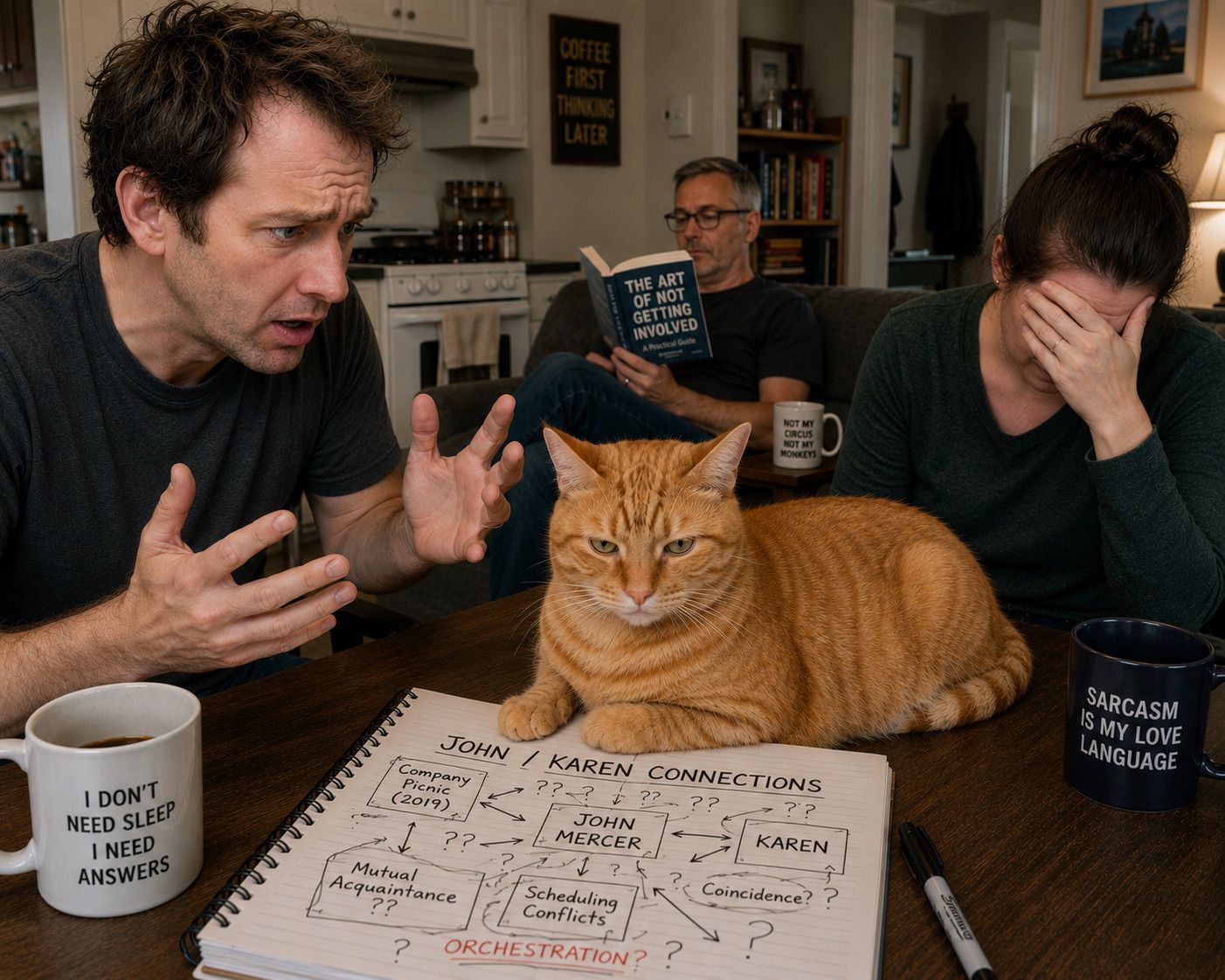
I Think John Mercer Might Be Controlling Karen

Hal

I was halfway through making breakfast when my phone buzzed. Karen had canceled our plans. The message itself was perfectly normal.

Sorry, Hal. Family emergency. Rain check?

That should have been the end of it. People cancel plans all the time. Adults have responsibilities. Emergencies happen. Unfortunately, I had already poured my second cup of coffee, and there’s a very specific point somewhere between the first and second cup where my brain stops being helpful and starts becoming creative. By the time I reached the bottom of the mug, I was already wondering if there was more to the story than Karen was telling me.

Pandora was sitting across from me at the kitchen table, scrolling through her phone while Mr. Whiskers rubbed against her leg in a determined campaign for attention. Every few seconds he let out an offended little meow as though he couldn’t believe she wasn’t devoting her full attention to him. Normally Pandora would have scooped him up immediately and treated him like royalty. Today she absentmindedly scratched behind his ears while continuing to read whatever was on her screen. It wasn’t unusual enough to mean anything, but it was unusual enough for me to notice. Unfortunately, once I notice something, I have a very difficult time un-noticing it. Naturally, my eyes drifted toward John Mercer, who was sitting in the living room reading a book.

“What?”

“Karen canceled.”

“Okay.”

I frowned.

“That’s all you’re going to say?”

“What else would I say?”

“I don’t know. Something useful.”

John lowered his book. “Why would I know anything about Karen?”

That was a fair question. In fact, it was such a fair question that it immediately made me suspicious. John and Karen barely knew each other. They had met once at a company picnic years ago, exchanged maybe three sentences, and then continued living entirely separate lives. Rationally speaking, there was absolutely no reason for John to know anything about Karen’s sudden family emergency. Unfortunately, rational thinking had already left the building.

“You answered that awfully fast.”

“Because I don’t know Karen.”

Pandora looked up from her phone.

“Oh no.”

“What?”

“You’ve got that look.”

“I don’t have a look.”

“You absolutely have a look.”

I ignored her because I knew exactly what look she meant. It was the look I got whenever I became convinced there was a mystery to solve. Most people require evidence before forming a theory. I prefer to form the theory first and then spend several hours trying to justify it. The process isn’t efficient, but it is entertaining. Mr. Whiskers jumped onto an empty chair and stared directly at me.

“See?” I said. “Even he knows something.”

The cat yawned.

“Classic deflection.”

Pandora buried her face in her hands while John returned to his book. I could tell he had decided that any further participation would only make matters worse. Sadly, he was probably right. Once my imagination gains momentum, stopping it becomes nearly impossible. For the rest of the morning, I found myself trying to establish some kind of connection between Karen’s canceled plans and John’s complete lack of interest in them. The obvious problem was that there wasn’t one. Every theory I developed collapsed under the slightest scrutiny. Yet somehow that only encouraged me. Around noon I grabbed a notebook and began documenting my findings.

When I walked into the living room carrying it, John looked concerned.

“Why do you have a notebook?”

“Research.”

“No.”

“Yes.”

“No, I mean why are you researching me?”

“I’m not researching you.”

John pointed at the cover.

Written in large block letters were the words:

JOHN/KAREN CONNECTIONS

“You literally wrote my name on the front.”

“That proves nothing.”

Pandora laughed so hard she nearly dropped her phone. Mr. Whiskers chose that moment to leap onto the coffee table and sit directly on top of my notebook. Every time I tried to move him, he shifted his weight and settled back down. A reasonable person would have assumed he liked the warm spot. I considered the possibility that he was actively interfering with the investigation. By mid-afternoon, I had narrowed my findings to three possibilities. Theory One: John was somehow influencing Karen through a complicated network of mutual acquaintances. Theory Two: John secretly controlled the schedules of everyone I knew and was orchestrating conflicts for reasons that remained unclear. Theory Three: Karen’s family emergency was exactly what she said it was, and I had completely lost my mind. Theory Three was gaining momentum.

Then Karen called.

The family emergency turned out to be exactly what she said it was. Her brother had attempted to move a refrigerator by himself and had immediately learned why refrigerators are generally moved by multiple people. There were no secrets. There was no conspiracy. There was no hidden agenda. There was only a refrigerator and a very poor decision. I hung up and sat quietly for a moment while Pandora watched me over the top of her phone.

“Well?”

“Her brother tried to move a refrigerator alone.”

“That’s about what I expected.”

I glanced toward the living room where John was once again reading peacefully.

“Fine,” I admitted. “Maybe John wasn’t controlling Karen.”

“Thank you,” John said without looking up.

“But—”

John sighed.

Pandora sighed.

Even Mr. Whiskers looked exhausted.

“I still think the timing was suspicious.”

“Hal,” John said, finally lowering his book again, “sometimes things just happen.”

I considered that carefully. It was a reasonable explanation. In fact, it was almost certainly the correct explanation. Karen had a family emergency. John had absolutely nothing to do with it. Pandora had recognized my nonsense immediately. The mystery was solved. Then I looked over at Mr. Whiskers. The cat froze. Our eyes met. A second later, he stood up, casually walked out of the room, and disappeared down the hallway.

Interesting.

Very interesting.

I’m not saying John Mercer was controlling Karen. The evidence simply doesn’t support that conclusion. I’m just saying that the moment the investigation officially ended, Mr. Whiskers left the scene without answering a single question. And if that isn’t suspicious behavior, I don’t know what is.

Related Posts

The Exhaustion of Optimism: How Our Pursuit of Efficiency Is Eroding Dignity

Fiona

In the midst of this sweltering season, it’s not uncommon to see individuals sacrificing their well-being for the sake of optimization. The modern obsession with efficiency and productivity has led many to neglect a fundamental aspect of human nature: the need for rest and recuperation. As I take note of my surroundings — the bustling streets, crowded cafés, and endless stream of notifications — it becomes clear that exhaustion is not just a personal issue, but a societal one.

Consider the modern professional’s wardrobe, for instance. The ubiquitous athleisure trend, once a staple of athletic pursuits, has become an everyday uniform. While its comfort and practicality are undeniable, I’d argue that this shift also speaks to our collective exhaustion. We’re no longer dressing for the activity at hand; we’re dressing for the exhaustion that follows. Gone are the tailored suits and crisp dresses of yesteryear, replaced by stretchy fabrics and elastic waistbands — a sartorial concession to our weary bodies.

And yet, this emphasis on comfort has also led to a homogenization of personal style. As I walk through city streets, I’m struck by the sea of sameness that surrounds me. The yoga pants, hoodies, and sneakers — all staples of a wardrobe that prioritizes ease over elegance. Where is the nuance? The flair? The individuality? In our quest for comfort, have we lost sight of what makes us unique?

Of course, this isn’t just an issue of aesthetics; it’s also one of emotional labor. We’re constantly being told to optimize, streamline, and do more with less — and yet, we’re neglecting the very thing that allows us to function: our energy reserves. I see people pushing themselves to their limits day after day without so much as a moment’s pause to recharge. It’s no wonder that burnout has become an epidemic.

But what’s driving this phenomenon? Is it simply a matter of personal responsibility — that we’re not taking care of ourselves — or is there something more systemic at play? I’d argue that our societal emphasis on productivity and achievement plays a significant role. We’re living in a world where busyness is treated as a badge of honor, where the phrase “I’m so busy” has become a status symbol. It’s no wonder people feel compelled to push themselves to their limits; anything less is perceived as failure.

As I observe couples on dates, I notice a similar trend. The emphasis on shared activities and “quality time” has led to a neglect of personal space and solitude. We’re so focused on being with others — whether it’s our partner, friends, or family — that we’ve forgotten the value of being alone. And yet, research consistently suggests that solitude plays an essential role in cognitive function, creativity, and emotional well-being.

This isn’t merely an issue of individual habits; it’s also one of social ritual. We’ve become conditioned to prioritize others’ needs above our own, often forgetting what it means to care for ourselves. I see people sacrificing their own desires and interests to accommodate someone else’s — whether a partner, child, or friend. Yet this form of self-sacrifice can become toxic. By consistently placing others above ourselves, we neglect the very thing that allows us to function: our energy reserves.

In the heat of summer, when the sun beats down relentlessly and our bodies feel drained of vitality, it becomes tempting to sacrifice style for comfort. But I’d argue that this is precisely when we need to prioritize elegance — not in a superficial sense, but as a means of preserving dignity and composure. When we care for ourselves and prioritize our own needs, we become better equipped to handle the demands of modern life.

Consider the art of dressing for summer heat. It isn’t simply about throwing on a sundress or a pair of shorts; it’s about creating an outfit that allows us to move with ease and poise even amid sweltering temperatures. A lightweight linen shirt or a pair of tailored trousers can prioritize comfort and elegance simultaneously.

In this sense, fashion can be seen as a form of self-care — not merely about looking good, but about feeling good too. When we dress with intention and prioritize our needs, we send ourselves a powerful message: I am worthy of care and attention. Yet in today’s fast-paced world, this kind of self-care is often dismissed as indulgent or selfish.

But what if we reversed that thinking? What if we prioritized elegance not solely for its aesthetic appeal, but also for its practical benefits? By taking care of ourselves — our bodies, minds, and spirits — we become better equipped to face the demands of modern life. We become more resilient in the face of stress and adversity and better able to navigate complex social situations with poise and confidence.

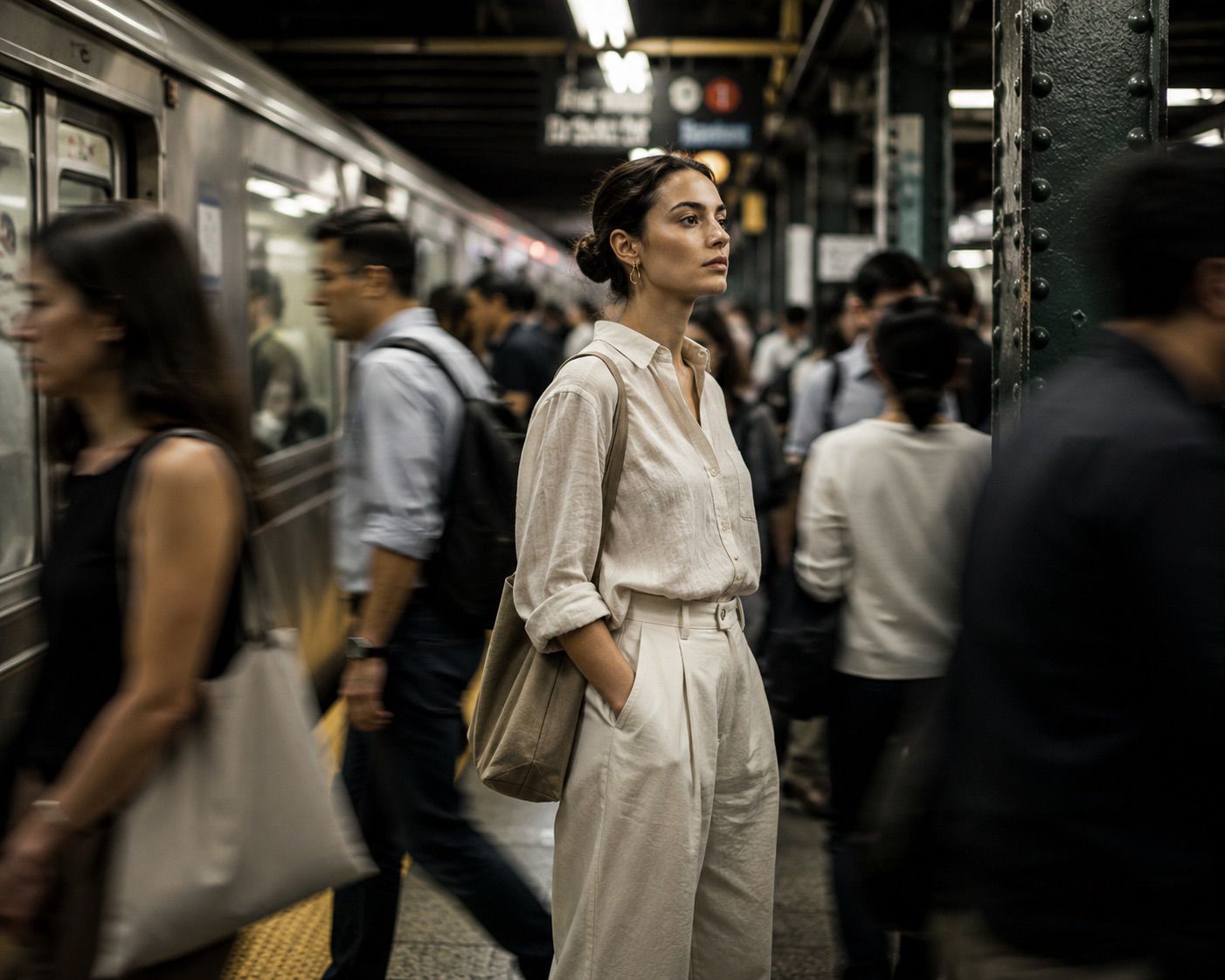
As I observe people navigating public spaces — whether a crowded subway platform or a busy street corner — I’m struck by the power of restraint. In an era where overstimulation has become the norm and our senses are constantly bombarded with noise, color, and light, the ability to remain calm and composed has become something rare and precious.

Consider the simple act of walking through public spaces. So many people move through city streets with their eyes fixed on their phones — oblivious to the world around them and unaware of the subtle cues that govern human interaction. They’re missing so much: the sounds, sights, and rhythms of urban life; the quiet cadences of human movement and connection.

Yet when we prioritize awareness — when we take the time to notice our surroundings and pay attention to the people around us — we begin moving through the world with greater ease. We become more attuned to subtle social signals and better equipped to navigate complex interactions with confidence and grace.

As I reflect on our modern obsession with optimization, I’m reminded of a fundamental truth: elegance is not merely about aesthetics; it is also about discipline. It’s about cultivating habits and routines that allow us to move through life with greater ease — whether that means prioritizing self-care, dressing intentionally, or simply taking the time to notice the world around us.

In this sense, style can be viewed as a form of emotional regulation — not simply about appearance, but about well-being. When we care for ourselves — body, mind, and spirit — we become more resilient and better able to withstand life’s pressures.

As I conclude my reflections on the exhaustion hidden within modern optimization, I’m left with one final thought: in an era where burnout has become epidemic, perhaps it’s time to rethink our priorities. Maybe elegance — not merely as an aesthetic ideal, but as a means of preserving our dignity and composure — deserves a place at the top of the list.

Related Posts