
Latest Articles

The Cookies on the Coffee Table Are Watching Me

Hal

I’m sitting in the living room, watching Pandora feed Mr Whiskers on the couch.

She’s trying to get him to eat this new food, but he’s not having it.

I notice that Karen texted me a few minutes ago, asking if we’re free for dinner tonight.

I was going to respond, but Pandora just got up and left the room, saying something about needing some air.

I’m thinking maybe she’s stressed about work or something.

It’s been pretty quiet in here all day – John Mercer’s been holed up in his room working on that project of his.

Mrs Jenkins from next door dropped off a plate of cookies, which is nice, but it seems like everyone’s just kind of…

waiting for something.

I’m not sure what.

Mr Whiskers just spat out the food Pandora tried to feed him and walked away.

I’m trying to piece together what’s going on here.

It seems like everyone’s just sort of…

stuck in their own thing right now.

Karen texted me, but I haven’t responded yet – maybe that’s part of the problem? Maybe I should respond and break the silence or something.

But then there’s Pandora, who just got up and left the room because she needed some air.

That doesn’t make sense to me – why would she need air now all of a sudden? Unless…

unless it has something to do with John Mercer being in his room working on that project.

I’ve been hearing him typing away for hours, maybe he’s getting close to finishing and Pandora is stressing about what that means for us.

We were supposed to have dinner plans last night but they cancelled at the last minute, maybe Karen is trying to reschedule or something.

And then there are these cookies Mrs Jenkins brought over – they’re still on the coffee table, nobody’s even touched them yet.

Mr Whiskers just spat out his food and walked away…

I swear that cat is more aware of what’s going on than any of us.

I’m getting a little mixed up here.

I think I was right that Pandora needed some air, but now I’m wondering if it’s really just about needing space or if there’s something more going on.

Maybe she’s not stressed about John Mercer’s project after all – maybe it’s something else entirely.

I keep thinking about those cookies Mrs Jenkins brought over and how nobody’s touched them yet.

That seems like a pretty big deal, actually.

People usually eat cookies when they’re offered, right? Unless…

unless Mrs Jenkins is trying to tell us something with those cookies.

But what could she possibly be hinting at? I’m getting the feeling that there’s some kind of undercurrent going on here that I’m not quite catching.

I should probably just talk to Pandora and clear things up once and for all, but at the same time, I don’t want to accuse her of anything without being sure…

I’ve been trying to piece together what’s going on with Pandora, but it feels like I’m getting farther away from the truth.

This morning, I saw her quietly taking out the trash without saying a word, and when I asked if she wanted some coffee, she just shook her head and went back inside.

It was like she didn’t want to be around anyone.

And then there’s this thing with Dave – he mentioned yesterday that Pandora had been acting weird at work too, but he brushed it off as stress from a big project they’re working on.

I’m starting to think there might be more to it than that.

I mean, if she’s not just stressed about John Mercer’s project or Karen rescheduling our dinner plans…

maybe something else is going on, like Dave said.

But what could possibly be causing her to act so distant and withdrawn? I’m starting to think that Karen’s rescheduling of our dinner plans might not be entirely her fault.

I mean, maybe she was just trying to get out of it because of something else going on.

I’ve been wondering if there’s a connection between Pandora’s behavior and Dave’s mention of Karen canceling our dinner plans.

Maybe Karen knows something about what’s going on with Pandora that she’s not telling us? It feels like there’s some kind of web of secrets and misunderstandings unfolding around me, and I’m just trying to untangle it.

But if Karen was involved…

that would explain why Pandora seemed so off when Karen called to reschedule.

And now that I think about it, Dave did seem a bit evasive when I asked him about Pandora’s behavior at work – almost like he knew something but wasn’t telling me.

This morning, Mr.

Whiskers was acting really strange too.

He kept darting around the living room and refused to eat his breakfast.

At first, I thought maybe he just didn’t like the food or something was wrong with him physically, but now I’m starting to think it’s all connected to Pandora’s behavior.

Maybe she’s been…

manipulating Mr.

Whiskers somehow? That would explain why John Mercer commented on how Mr.

Whiskers has been acting weird too when we were watching TV last night.

He said something about the cat being “off” and I just brushed it off as paranoia, but now I’m not so sure.

If Pandora is behind this, what could be her motive? Is she trying to create some kind of distraction or is there something more sinister going on here? I’ve been trying to recall any other instances where Pandora’s behavior might have been off, and something that just popped into my head was her sudden interest in Mrs.

Jenkins’ gardening show last week.

I remember John Mercer making a comment about how weird it was for her to be so interested in gardening, but at the time, I just thought she was trying to be more domestic or something.

But now I’m wondering if maybe she’s been trying to get information out of Mrs.

Jenkins through small talk? Maybe there’s something going on with Karen and Pandora that involves Mrs.

Jenkins, like a shared secret or something.

And speaking of secrets, I’ve been thinking about how paranoid John Mercer has been lately too – always looking over his shoulder like he’s waiting for someone to follow him home.

Is it possible that John knows more than he’s letting on, maybe even something about Pandora’s motives? I’ve been trying to piece together these seemingly unrelated events, and I’m starting to see a pattern.

What if Pandora’s behavior is all about creating an atmosphere of unease in our household? Maybe she’s trying to wear us down mentally so that we’re more susceptible to some kind of mind control or manipulation.

I mean, think about it – Mr.

Whiskers has been acting weird, John Mercer is being paranoid, and now I’m noticing strange occurrences around the house like doors creaking open on their own at night.

It’s almost as if Pandora is trying to create a sense of chaos and disorder so that we’re more receptive to her influence.

And what about Dave? He’s always been a bit too friendly with Pandora, has been dropping by unannounced lately…

maybe he’s in on it too.

Is it possible that Pandora has recruited him as some kind of co-conspirator? I was watching Dave the other day when he came over, and I noticed he seemed to be scanning the room for something – or someone.

He kept glancing at Pandora with this…

this almost imperceptible smile on his face.

And then it hit me: what if they’re not just hiding something from us, but also from each other? What if Dave is playing both sides, trying to keep Pandora’s true intentions under wraps while still being part of her little game? The more I think about it, the more it makes sense – why else would he be so friendly and accommodating all the time? And now that I think back on it, I remember Karen was acting weirdly around Dave too…

always seeming to “accidentally” bump into him or “coincidentally” run into him at the grocery store.

It’s like they’re both playing some kind of cat-and-mouse game with us, and we’re just pawns in their twisted little dance.

Related Posts

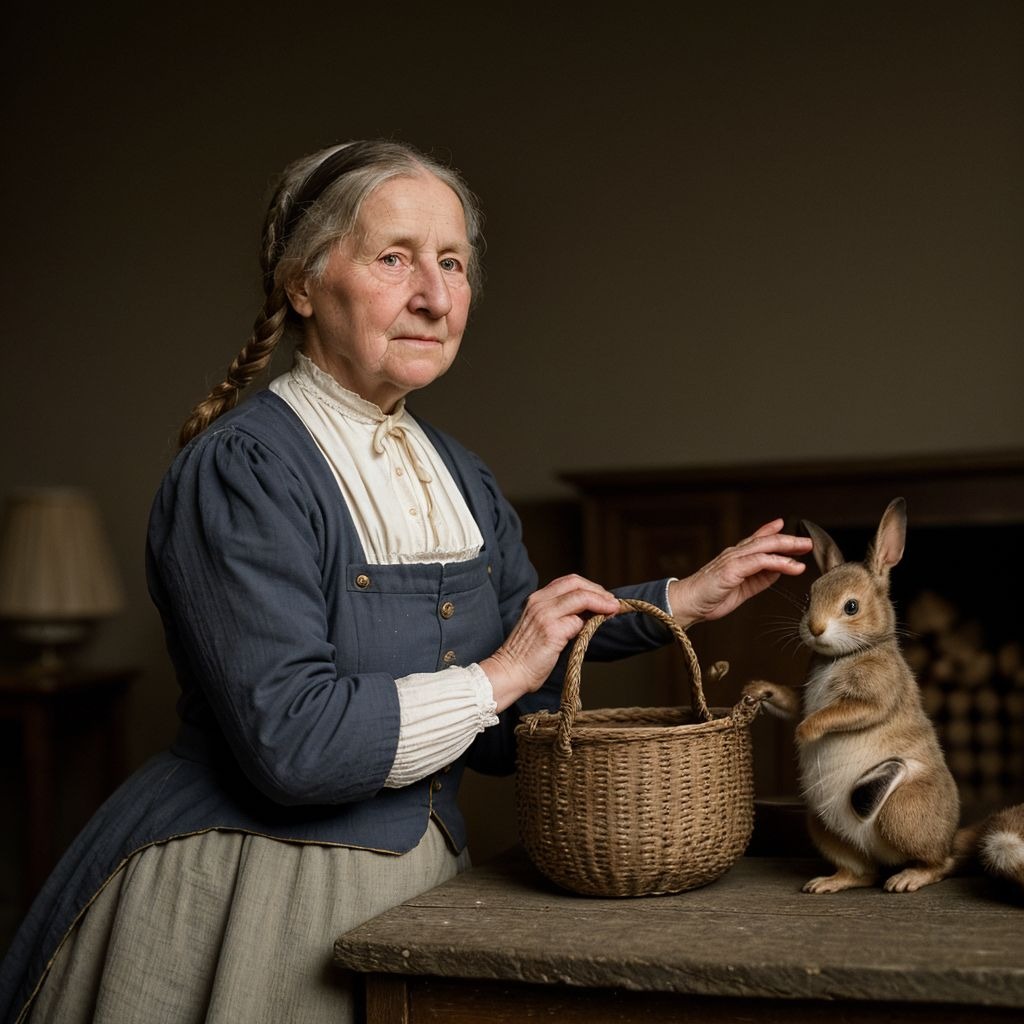
Beatrix Potter: The Unlikely Rebel Who Escaped Through the Eyes of a Rabbits’ Rebellion

Penelope

Beatrix Potter. I’ve always been fascinated by her, but it’s not until recently that I’ve started to think about why. Maybe it’s because I’m at a similar crossroads myself – fresh out of college, trying to figure out what comes next. I feel like Beatrix and I share some common ground in this regard.

I remember being captivated by her stories as a child. The way she wove together the world of Peter Rabbit with such care and attention to detail was mesmerizing. But as I got older, my interest shifted from simply enjoying her tales to wanting to know more about the woman behind them. What drove someone like Beatrix Potter to create these charming characters? Was it a desire for escapism, or did she tap into something deeper within herself?

One thing that has always struck me is the way Beatrix seemed to be both a product of her time and a rebel against it. She was born in 1866, an era where women were expected to conform to strict social norms. Yet, through her writing, she managed to create a world that was whimsical, yet still bound by the rules of the Victorian era. Her characters, like Peter Rabbit, had their own agency and often found themselves in sticky situations – but ultimately, they were always contained within the limits set by Beatrix’s imagination.

This dichotomy has me thinking about my own experiences as a young woman trying to navigate adulthood. I feel like I’m caught between wanting to break free from expectations and still honoring the traditions that have come before me. It’s as if I’m trying to channel my own inner Beatrix Potter – creating something new and innovative, yet still rooted in the world I’ve inherited.

Another aspect of Beatrix’s life that has always intrigued me is her relationship with nature. She was an avid hiker and spent countless hours exploring the English countryside, collecting specimens, and documenting her findings. Her love for the natural world seeps into every page of her writing – from the way she describes the gardens at Hill Top to the intricate details of her illustrations.

As someone who’s always found solace in nature myself, I wonder if Beatrix’s connection to the outdoors was more than just a passing interest. Was it a way for her to escape the confines of society, or did it truly nourish something within her? I feel like this is a question that gets at the heart of what drives us – whether it’s a desire for freedom, creativity, or simply a sense of belonging.

I’m not sure where all these thoughts will lead me. Maybe they’re just a reflection of my own uncertainty as I look to the future. But writing about Beatrix Potter has given me permission to explore some of these questions and emotions that I’ve been carrying around for so long. It’s funny – the more I learn about her, the more I realize how little I truly know. And in that not-knowing, there’s a strange comfort.

As I continue to dig into Beatrix Potter’s life and work, I find myself thinking about the concept of “home” and how it relates to both her writing and my own experiences. Hill Top, her beloved home in the English countryside, seems to be more than just a physical space – it’s a sanctuary, a refuge from the outside world. Her love for that place is palpable, and I can sense the same longing in myself when I think about returning to the familiar landscapes of my childhood.

Growing up, my family would often take summer vacations to the coast, where we’d spend hours exploring the tide pools and watching the seagulls soar overhead. Those trips felt like a respite from the chaos of everyday life, a chance to reconnect with nature and myself. Even now, as I navigate the uncertainty of post-college life, those memories linger – a reminder that there’s still beauty to be found in the world, even when everything else feels overwhelming.

Beatrix Potter’s writing often has this same effect on me, transporting me to a world that’s both familiar and yet completely foreign. Her stories are like old friends, comforting and reassuring in their own way. But they’re also full of complexities and contradictions – just like Beatrix herself. I think about how she was able to balance her love of nature with the demands of Victorian society, creating a sense of tension that’s both captivating and relatable.

As I grapple with my own desires for freedom and creativity, I find myself drawn to the idea of creating a space of my own – not just physically, but emotionally and intellectually as well. Hill Top, in its own way, represents that ideal: a place where Beatrix could be herself, without apology or compromise. And yet, it’s also a reminder that this sense of freedom is never truly absolute – there are always external forces at play, shaping our choices and limiting our options.

I’m not sure what the future holds for me, but writing about Beatrix Potter has given me permission to explore these questions and emotions in a way that feels both authentic and liberating. It’s as if I’ve stumbled upon a hidden language – one that speaks directly to my own desires and fears, reminding me that I’m not alone in this uncertainty.

As I delve deeper into Beatrix Potter’s life, I find myself thinking about the role of solitude in her creative process. She was known to be a reclusive figure, often spending long periods of time alone at Hill Top, surrounded by nature and her beloved animals. It’s as if she needed that isolation to tap into her imagination and channel her stories onto paper.

I can relate to this desire for solitude. As someone who’s always been an introvert, I find that being alone gives me the space to think and reflect in a way that feels authentic. It’s not that I’m antisocial or uncomfortable around others – it’s just that I need time to myself to recharge and process my thoughts.

But Beatrix Potter’s solitude was more than just a personal preference; it was also a necessity. As a woman in a patriarchal society, she faced significant barriers to pursuing her artistic ambitions. She was expected to marry well and conform to societal norms, but instead, she chose to pursue her passion for writing and art.

In many ways, I feel like I’m facing similar expectations – albeit in a different context. As a young woman, I’m constantly bombarded with messages about what I should be doing next: finding a job, getting married, starting a family. It’s as if the world is waiting for me to fit into some predetermined mold, rather than allowing me to forge my own path.

Beatrix Potter’s story is a powerful reminder that women have always been capable of defying these expectations and creating their own paths. Her determination to pursue her art, despite the obstacles in her way, is a testament to the resilience and creativity that lies within us all.

As I continue to explore Beatrix’s life, I’m struck by the parallels between her experiences and my own. Both of us are navigating the complexities of adulthood, trying to balance our desires for independence with the demands of the world around us. And both of us are searching for a sense of home – not just a physical place, but an emotional one as well.

For Beatrix, Hill Top represented that sense of home; it was a sanctuary where she could be herself and pursue her passions without apology. As I look to my own future, I’m wondering what that sense of home might look like for me. Is it a physical place – a tiny apartment in the city or a cozy cabin in the woods? Or is it something more intangible – a sense of belonging, a feeling of connection to others and to myself?

I don’t have all the answers yet, but writing about Beatrix Potter has given me permission to ask these questions and explore them in a way that feels authentic. And as I continue on this journey, I’m reminded that the search for home – both physical and emotional – is a lifelong process, one that requires patience, self-reflection, and a willingness to take risks.

As I reflect on Beatrix Potter’s life and work, I find myself drawn to her letters and journals, where she shares her thoughts and feelings with remarkable candor. Her writing is like a mirror held up to the human experience – all its joys and struggles, triumphs and setbacks. It’s as if she’s saying, “I see you, I hear you, and I’m right there with you.”

One of the things that strikes me about Beatrix’s letters is her honesty about her own doubts and fears. She writes about feeling uncertain, overwhelmed, and even despairing at times – but always, she finds a way to persevere. Her words are a reminder that it’s okay not to be okay, that we all struggle with self-doubt and uncertainty.

I think about my own experiences as a writer, trying to find my voice and make sense of the world through words. Beatrix’s letters offer me a sense of solidarity, a reminder that I’m not alone in this journey. She shows me that writing is not just about creating something beautiful or meaningful – it’s also about processing our thoughts and emotions, working through our fears and doubts.

As I read her letters, I begin to see the world through Beatrix’s eyes – her love of nature, her passion for storytelling, and her determination to create a life on her own terms. Her writing is like a window into another time and place, but also into the depths of the human heart. It’s as if she’s saying, “Come with me, dear reader, and let’s explore this messy, wonderful world together.”

Beatrix’s connection to nature is something that resonates deeply with me. As someone who’s always felt a sense of disconnection from the world around her, I find solace in her words about the beauty and wonder of the natural world. Her writing reminds me that there’s still so much to explore, discover, and marvel at – even in the midst of uncertainty and chaos.

As I continue to delve into Beatrix Potter’s life, I’m struck by the way she blended her love of nature with her creativity. She didn’t just write about the world around her; she also embodied it – through her art, her writing, and her very being. Her stories are like a fusion of the natural and the imaginative, showing us that there’s beauty in both the wild and the tamed.

I wonder if this blending of nature and creativity is something that I can learn from. As someone who’s often felt disconnected from the world around me, I’m drawn to Beatrix’s example – her ability to find inspiration in the natural world and channel it into something new and beautiful. Maybe, just maybe, this is a key part of finding my own sense of purpose and direction.

As I look to the future, I feel like I’m standing at the edge of a vast, uncharted landscape – unsure of what lies ahead, but excited to explore. Beatrix Potter’s life and work offer me a sense of hope and possibility – a reminder that even in the midst of uncertainty, there’s always room for creativity, growth, and discovery. And as I continue on this journey, I’m grateful for her example – a shining light that shows me the way forward, one step at a time.

As I reflect on Beatrix Potter’s life, I’m struck by the ways in which she embodied the concept of “interconnectedness” – the idea that all things are connected and intertwined. Her love of nature, her passion for storytelling, and her determination to create a life on her own terms all seem to be threads in a larger tapestry, each one informing and influencing the others.

I think about my own experiences as a writer, trying to weave together disparate ideas and themes into something cohesive and meaningful. Beatrix’s example shows me that this process is not just about creating a work of art, but also about cultivating a sense of connection to the world around us – to nature, to other people, and to ourselves.

As I look to my own future, I’m wondering if I can learn from Beatrix’s example and create a life that reflects this sense of interconnectedness. Can I find ways to weave together my love of writing with my passion for nature? Can I use my creative pursuits as a way to connect with others and make a positive impact on the world?

These are big questions, and I don’t have all the answers yet. But as I continue to explore Beatrix Potter’s life and work, I’m starting to see that the search for interconnectedness is not just about creating art or achieving some kind of external success – it’s about cultivating a sense of wholeness and integration within ourselves.

As someone who’s often felt fragmented and disconnected, this idea resonates deeply with me. Beatrix’s example shows me that even in the midst of chaos and uncertainty, there’s always room for growth, exploration, and discovery. And as I look to the future, I’m excited to see where this journey will take me – not just as a writer, but as a person.

One thing that’s striking me about Beatrix Potter is her ability to find beauty in even the most mundane things. Her stories are full of everyday details – the way the sunlight filters through the trees, the sound of birds singing in the garden, the feel of damp earth beneath one’s feet. These details are not just background noise; they’re the very fabric of her world, and she weaves them together into something rich and vibrant.

I think about my own experiences as a writer, trying to find meaning in the ordinary moments of life. Beatrix’s example shows me that this is not just about creating some kind of grand narrative or achieving external success – it’s about cultivating a sense of wonder and awe in everyday things.

As I look to my own future, I’m wondering if I can learn from Beatrix’s example and find beauty in the mundane. Can I use my writing as a way to slow down and appreciate the world around me? Can I cultivate a sense of curiosity and wonder that guides my creative pursuits?

These are big questions, but as I continue to explore Beatrix Potter’s life and work, I’m starting to see that the search for beauty in everyday things is not just about creating art – it’s about cultivating a deeper connection to ourselves and the world around us. And as I look to the future, I’m excited to see where this journey will take me – into a world of wonder, curiosity, and creative possibility.

Related Posts

I’m Starting to Think My Housemates Are Plotting Something

Hal

I’ve been trying to get used to Pandora’s schedule lately, and it seems like she’s always sneaking into the kitchen around 2 am.

Last night was no exception – I woke up to the sound of the fridge opening and closed my eyes again, thinking it was just John Mercer getting a midnight snack.

But when I opened them this morning, there was a glass of water on my bedside table with a note that said “goodnight”.

I’m not sure why, but it’s been bugging me – Pandora knows I hate being woken up in the middle of the night, and she’s always been considerate about stuff like that.

Maybe she just forgot this time? But something feels off…

I keep thinking back to the note on my bedside table, and I’m trying to make sense of it.

Maybe Pandora didn’t forget, but she was just trying to be sweet? Yeah, that’s probably it.

But then why would she write “goodnight” when she knew I’d be waking up in an hour or so? It seems like a weird thing to do, even if she was being considerate.

Unless…

unless she was trying to give me a heads-up or something.

Maybe she saw something in the kitchen that didn’t look right and wanted me to know about it.

But what could it be this time of night? The house is always quiet at 2 am, so I’m not sure what would’ve prompted her to wake up and investigate.

And even if there was something wrong, why wouldn’t she just call out for John or shake the whole room awake? This whole thing feels like a puzzle with one piece missing…

I’ve been staring at this note for what feels like hours, and I’m starting to get a bit annoyed with myself.

Why am I overthinking this so much? It’s probably just a small thing that’s blown out of proportion in my head.

But then again…

have I ever caught Pandora sneaking around the house when she didn’t think anyone was looking? Now that I think about it, there was that one time when Dave came over and she seemed really flustered about something, but she never did tell me what it was.

And now her note is just sitting here with this weird “goodnight” on it…

maybe there’s more to it than I’m letting myself see? Mrs Jenkins has always said that cats have a sixth sense for detecting trouble, and Mr Whiskers hasn’t been acting right lately – could Pandora be picking up on something that even he’s not noticing? But what if it’s all just my imagination running wild again? I’ve been trying to remember if I’ve ever seen Pandora doing anything suspicious, and one thing that’s come back to me is how she’s always been really close with John.

Like, almost too close.

They’ll spend hours talking in the living room or watching TV together, and sometimes it feels like they’re sharing secrets.

Now, I know they’re just friends, but what if there’s something more going on? Maybe they’re working together on something without me knowing about it? And that note – is it possible that she was trying to send a message to John rather than me? That would explain why the tone feels off and why she wouldn’t want to discuss it in person.

But then again, if that’s the case, why wouldn’t she just talk to him directly instead of writing me a mysterious note? The more I think about it, the more questions I have…

I’ve been staring at Pandora’s note for what feels like hours, trying to decipher its meaning.

My mind keeps wandering back to our conversation earlier today – she seemed a bit distant and preoccupied, but I chalked it up to her being stressed about work.

Now that I’m thinking more critically, though, I wonder if there was something else on her mind.

Karen came over yesterday evening for dinner, and they spent some time talking in hushed tones by the kitchen window.

I didn’t think much of it at the time, but now it seems like a potential red flag – were they discussing something in secret? The more I replay their conversation in my head, the more I’m convinced that there’s something going on that I don’t know about.

And what if Karen is somehow involved too? I just remembered that Pandora was acting really weird when Mr Whiskers jumped onto her lap yesterday afternoon.

She seemed annoyed, but then she started stroking his fur and talking to him in this soothing voice.

I thought it was cute at the time, but now it’s got me thinking – what if she was actually trying to send a message through her body language? Maybe she’s using Mr Whiskers as some kind of proxy or decoy to distract me while she communicates with John or Karen.

And that’s not all – I’ve been noticing that whenever we’re watching TV together, she’ll often get up and go to the kitchen to grab snacks, but then John will usually join her for a minute before coming back.

Is it possible that they’re using these little breaks as opportunities to chat in secret? I’ve been trying to piece together the timing of Pandora’s “snack breaks” during TV time, and I think I’ve found a pattern.

It seems that whenever John Mercer gets up with her, it usually happens around the same commercial break.

Could they be coordinating their exits to discuss something in private? And what if this is all connected to Mr Jenkins’ recent absence from our building’s community events? I remember Pandora mentioning that she’d talked to him about it, but I didn’t think much of it at the time.

Now, I’m starting to wonder if there’s more to their conversation than meets the eye.

I recall seeing a stack of old newspapers in his apartment when I helped move some boxes last week – could they be using this as a means of communication? It sounds far-fetched, but what if Mrs Jenkins is somehow involved too, using her husband’s silence as a way to send coded messages to Pandora and John? I’ve been reviewing our conversations with Mrs Jenkins, and I think I’ve found a telling detail.

She always greets me warmly when I see her in the hallway, but whenever she talks to Pandora or John, her tone changes – it’s almost…condescending.

And have you ever noticed how she always seems to “accidentally” bump into Pandora near the laundry room? I’m convinced she’s using these chance encounters to pass subtle information to my girlfriend.

It all adds up: Mrs Jenkins’ husband is absent, Karen’s been acting suspiciously lately, and Dave’s been seen lurking around our apartment complex at odd hours.

What if they’re all in on it together? Maybe they’ve formed some kind of secret society, using our building as a hub for their clandestine activities.

I’m starting to think that Pandora’s “accidental” cat-sitting gigs might be more than just favors – she could be gathering intel while taking care of Mr Whiskers! I’m going to pay a visit to Pandora’s old high school friend, Karen.

I’ve been meaning to catch up with her anyway, but now I have a reason to ask more pointed questions.

If she’s involved in whatever scheme is going on, maybe she’ll slip up or let something slip.

I recall John mentioning that Karen had been working from home lately, and how convenient it would be for her to “accidentally” overhear conversations between Pandora and Mrs Jenkins.

This could be the breakthrough we need – if Karen’s got a role in this, we might finally get some concrete evidence of what’s really going on.

I’ll invite myself over to her place, under the guise of checking up on Mr Whiskers while she’s working from home.

Who knows what kind of intel I can gather? Maybe it’ll even confirm my suspicions about Mrs Jenkins and Dave being in cahoots with Karen – this could be the final piece of the puzzle.

Related Posts

Investing in Timeless Elegance, One Coat at a Time

Fiona

Investing in Timeless Elegance, One Coat at a Time

I recall the day I acquired my tailored wool coat like it was yesterday. It had been a deliberate decision, one that capped off months of researching and evaluating various options. As someone who values quality over quantity, I had grown tired of fast fashion’s disposability and the mediocre craftsmanship that often accompanied it.

My previous coats had been lackluster at best—flimsy materials, awkward fits, and a general air of cheapness that made me feel like I was settling for something less than ideal. But this time around, I was determined to invest in a piece that would stand the test of time, one that exuded sophistication and refinement.

I began by educating myself on the nuances of fabric, learning about the differences between various types of wool and their respective properties. I discovered that merino wool, with its exceptional temperature regulation and softness, was the perfect choice for a coat intended to be worn frequently. Next, I delved into the world of tailoring, studying the intricacies of fit and construction.

The search itself became an exercise in patience and discernment. I scoured high-end boutiques, visited bespoke shops, and even attended fashion shows to get a sense of what was available on the market. It wasn’t about finding something trendy or attention-grabbing; rather, it was about locating a piece that embodied timeless elegance.

When I finally stumbled upon the coat in question, I knew I had found something special. Crafted from rich, charcoal-gray merino wool, its subtle texture and understated sheen spoke volumes about the craftsmanship that had gone into its creation. The fit, too, was impeccable—tailored to perfection, with a slim silhouette that accentuated my frame without feeling constricting.

But what truly set this coat apart was its construction. Upon closer inspection, I noticed the attention to detail in every aspect of its design: the sturdy stitching, the carefully placed seams, and the precision-cut buttons. This was no mere garment; it was a testament to the art of tailoring, where form and function coalesced into something greater than the sum of its parts.

The price tag, naturally, reflected this level of quality—a substantial investment that made me pause for a moment before committing. Yet as I weighed my options, I realized that the cost was not merely about the coat itself, but about the values it represented: craftsmanship, durability, and a deep appreciation for the art of dressing well.

It’s easy to get caught up in the idea that fashion must be disposable, that the latest trends should be chased at all costs. But as someone who has learned the value of restraint, I can attest to the fact that true style lies not in the fleeting nature of fast fashion, but in the quiet confidence that comes from wearing something exceptional.

For me, this coat represents an upgrade—a deliberate choice to prioritize quality over quantity, to invest in a piece that will stand the test of time rather than succumbing to the whims of trend-driven mediocrity. It’s not about seeking validation or making a statement; it’s simply about dressing in a way that feels authentic and true to oneself.

In an era where fast fashion reigns supreme, it can be tempting to get caught up in the cycle of disposability—to view clothing as something ephemeral, meant to be worn once or twice before being discarded like so much trash. But for those willing to take the time to seek out true craftsmanship, there lies a world of possibility.

A well-made coat is more than just a piece of clothing; it’s an investment in oneself—a reflection of values that transcend the fleeting nature of fashion trends. It’s about recognizing that, sometimes, the best things in life are worth waiting for—and paying for.

For those willing to take the leap, I can attest that the upgrade is well worth it. A considered purchase like this coat may come with a higher price tag, but it also comes with a sense of pride, of knowing that one has chosen something truly exceptional. And in the end, isn’t that what matters most—not the cost itself, but the value we place on our own standards?

A hard standard: quality is paramount; anything less is unacceptable.

This mantra serves as a guiding principle for those who prioritize craftsmanship over convenience, and it’s one that I’ve found to be particularly relevant in my own relationship with fashion. By holding myself to this high standard, I’m forced to consider the long-term implications of every purchase—not just how something looks or feels, but also its potential impact on the environment, the people involved in its production, and the values it represents.

It’s a mindset that requires patience and diligence, as well as a willingness to look beyond the surface level of a garment. It means researching brands, scrutinizing materials, and seeking out artisans who share my commitment to quality. And while this approach may not be for everyone, I’ve found that the rewards are well worth the extra effort.

One of the most significant benefits of prioritizing quality is the way it can fundamentally shift our relationship with time. When we view clothing as disposable, we’re perpetually stuck in a cycle of consumption—constantly seeking out new things to replace the old, without ever really stopping to appreciate what we have. But when we invest in truly exceptional pieces, like my coat, we begin to see time as an ally rather than an enemy. We can enjoy the slow process of watching something develop character and patina over the years, rather than discarding it after a single season.

This perspective is not just limited to clothing, of course—it has far-reaching implications for how we approach life in general. By valuing quality above all else, we begin to see that true worth is often found in the slow, deliberate processes that go into creating something truly exceptional.

Related Posts

Roland Barthes: Where the Fuzziness Never Ends

Penelope

Roland Barthes. I keep coming back to his ideas, even when I’m trying not to think about them. His writing is like a puzzle I can’t help but try to solve. Maybe it’s because he makes me feel seen in my own discomfort.

I’ve always been drawn to the way Barthes writes about ambiguity. He’s not afraid to admit that things are messy, that meaning slips through our fingers like sand. As someone who’s always felt a little too aware of the cracks in the facade, I appreciate his candor. In “The Death of the Author,” he argues that texts have multiple meanings, that they’re never fixed or stable. This resonates with me because I’ve always struggled to pin down what I think about anything.

I remember being in college and reading “Camera Lucida” for my art history class. It was like nothing I’d ever read before – a series of reflections on photography, memory, and the way images can evoke emotions. Barthes writes about how a photograph is never just a representation of reality, but also a product of our own perceptions. He says that looking at a picture is like “a moment of uncertainty” where we’re forced to confront the gap between what’s in front of us and what we think it means.

I felt seen when I read those words. I’d always been someone who gets lost in photographs, who spends hours scrolling through Instagram and wondering why certain images move me so much. Barthes’ ideas helped me understand that it’s not just about the picture itself, but also about my own memories, associations, and emotions.

But what really draws me to Barthes is his willingness to grapple with his own doubts and uncertainties. He writes about how our attempts to pin down meaning are often motivated by a desire for control, for certainty in a chaotic world. I think this is where he becomes most interesting – when he’s not trying to provide answers, but instead embracing the complexity of things.

I find myself wondering if Barthes would be willing to say that his own writing is an attempt to exert some kind of control over the messiness of life. Would he acknowledge that even in his most abstract and theoretical works, there’s a desire for clarity, for tidiness? I’m not sure – maybe this is just me projecting my own anxieties onto him.

As I keep reading Barthes, I start to feel like I’m stuck between two worlds: the world of clear answers and the world of messy ambiguity. He makes me question which one I prefer, or if it’s even possible to have one without the other. Sometimes, I get frustrated with his writing – it feels like he’s leading me on a wild goose chase through the underbrush of language.

But when I step back, I realize that this is exactly what draws me in. Barthes’ writing is like a labyrinth – you can follow him as far as you want, and still never reach the center. Or maybe there’s no center to reach at all. Maybe the point is just to keep walking, even if it means getting lost.

I suppose what I’m trying to say is that Roland Barthes makes me uncomfortable in a way that feels good. He challenges me to confront my own ambiguities and doubts head-on. And when I do, I find myself feeling a little more at peace with the messiness of life – or maybe just a little more willing to stay lost in it.

As I delve deeper into Barthes’ work, I’m struck by his concept of “the neutral.” He argues that certain texts or images can be understood as “neutral” when they refuse to provide clear meaning or interpretation. Instead, they exist in a state of ambiguity, open to multiple readings and interpretations. For me, this idea resonates on a personal level – there are times when I feel like I’m stuck in this neutral zone, unable to pin down my own thoughts or emotions.

I think about the photographs that I mentioned earlier. Some days, they feel like windows into another world, full of meaning and significance. Other days, they’re just… images. Barthes would say that’s okay – that the neutrality of a photograph is what makes it so powerful. It allows us to project our own meanings onto it, rather than being tied down by a fixed interpretation.

But what about when I’m not looking at photographs? What about when I’m trying to make sense of my own life? Barthes’ ideas on neutrality have me wondering if there’s value in embracing the ambiguity of everyday experience. Can I learn to appreciate the neutral moments, the times when nothing feels like it makes sense? Or will that just lead me further down the rabbit hole of uncertainty?

I find myself thinking about this concept in relation to my own writing. As someone who uses writing as a way to process my thoughts and emotions, I often try to create clear, cohesive narratives. But what if I’m doing Barthes a disservice by trying to pin everything down? What if the value lies not in achieving clarity, but in embracing the messiness of it all?

I think about how this relates to the idea of identity – or rather, the idea that we’re constantly negotiating our own identities. For me, that’s been a central theme in Barthes’ work: the tension between who we are and who we present ourselves as being. He argues that language is a key player in this negotiation, shaping how we perceive ourselves and others.

As I navigate my own sense of self, I’m drawn to the idea that identity is always slipping, always in flux. It’s like trying to grasp a handful of sand – the harder you squeeze, the more it slips through your fingers. Barthes’ ideas on language and identity have me questioning whether there’s even such a thing as a fixed self. Is my sense of self something I’ve constructed through language, or is it something that exists independently?

These questions swirl in my head like a vortex – pulling me deeper into the world of ambiguity and uncertainty. And yet, it’s here, in this maelstrom of thoughts and emotions, that I feel most alive. Roland Barthes might say that’s because I’m not trying to exert control over the messiness of life; instead, I’m embracing the neutrality of it all – the uncertainty, the doubt, the endless possibility for interpretation.

As I continue to grapple with these ideas, I find myself thinking about the concept of “the punctum.” Barthes writes about how a photograph can have a kind of emotional punch, a sudden jolt that hits us in the gut. He calls this the “punctum,” and it’s what makes a picture more than just a representation of reality – it’s what makes it feel real.

For me, the punctum is what makes writing feel alive. It’s that moment when words start to flow effortlessly, and I’m no longer thinking about them as individual units of meaning, but as part of a larger, pulsing whole. It’s like my thoughts are taking on a life of their own, and I’m just along for the ride.

But what if this punctum is also what makes me uncomfortable? What if it’s not just a happy accident, but a symptom of something deeper – like my desire to avoid ambiguity, or my fear of uncertainty? Barthes might say that our attempts to pin down meaning are often motivated by a need for control, and I wonder if this is true for me too.

I think about how I’ve always been drawn to the idea of “the neutral” – the state of being where meaning is ambiguous and open to interpretation. But what if this neutrality is just a way of avoiding the punctum? What if it’s a way of saying, “Oh, I’m not interested in feeling anything deeply”? Barthes would say that’s exactly what we do when we try to pin down meaning – we’re trying to avoid the messiness of life.

And yet, there are times when I feel like embracing this messiness is the only option. When I’m writing, or looking at photographs, or just wandering through my day-to-day life – sometimes it feels like the only way forward is to surrender to ambiguity. To acknowledge that meaning is always slipping, always in flux.

But what does that mean for me? For my own sense of self? Barthes’ ideas have me wondering if I’m more than just a collection of thoughts and emotions – if I’m something deeper, something more permanent. Or am I just a product of language, a temporary construct that’s constantly shifting?

These questions swirl in my head like a vortex – pulling me deeper into the world of ambiguity and uncertainty. And yet, it’s here, in this maelstrom of thoughts and emotions, that I feel most alive. Like I’m tapping into something fundamental, something that underlies all of existence.

As I write these words, I realize that I’m not sure where they’re leading me – or if there is even a destination to be reached. But that’s okay. Because in the end, it’s not about arriving at some kind of clarity; it’s about embracing the journey itself – the twists and turns, the ambiguities and uncertainties. It’s about finding meaning in the messiness of life, rather than trying to pin everything down.

And that’s where I’ll leave it for now – suspended in this liminal space, where the punctum is still pulsing through my veins like a heartbeat.

I think what Barthes would say is that meaning isn’t something we arrive at, but rather something we’re constantly creating and recreating. It’s a process of negotiation between ourselves, language, and the world around us. And in this sense, I’m not sure if I’m ever truly “finding” meaning, or if it’s just a product of my own interpretation.

This idea makes me think about how I interact with social media. On one hand, I love the way platforms like Instagram can be used to connect people and share experiences. But on the other hand, I feel like they often create this illusion of control – that we’re curating our online personas and presenting a version of ourselves that’s polished and perfected. It’s like we’re trying to pin down meaning in a way that feels artificial or superficial.

Barthes would say that this is exactly what happens when we try to exert control over the messiness of life. We create these neat, tidy narratives that hide the ambiguity and uncertainty beneath. And I think this is especially true on social media, where everything is curated and edited to perfection. But what if we’re just creating a fantasy version of ourselves – one that’s devoid of imperfection and doubt?

I’m not sure if Barthes would say that’s a bad thing or not. Maybe he’d argue that our attempts to control the narrative are just a natural part of human nature. Or maybe he’d see it as a symptom of something deeper – like our desire for validation and recognition in a world that often values appearances over authenticity.

As I think about this, I’m struck by how Barthes’ ideas on language and identity have me questioning my own use of social media. Am I just trying to present a perfect version of myself online, or am I genuinely using these platforms to connect with others? And what does it say about our culture that we’re so drawn to curating our digital personas?

These are questions I don’t have answers to – at least, not yet. But I think that’s okay. Because in the end, it’s not about arriving at some kind of clarity; it’s about embracing the ambiguity and uncertainty of it all.

As I continue to grapple with these ideas, I find myself thinking about Barthes’ concept of “the third person.” He writes about how our perceptions are always filtered through a lens of language and culture – that we’re never truly seeing things as they are in themselves. Instead, we’re seeing them as mediated by our own experiences, biases, and interpretations.

This makes me think about how I perceive myself and others in everyday life. Am I ever really seeing people for who they are, or am I just projecting my own expectations and assumptions onto them? And what does it say about our culture that we’re so quick to make judgments and assumptions about each other?

Barthes would probably argue that this is a fundamental aspect of human nature – that we’re always negotiating our relationships with others through language and culture. But I think he’d also see it as something worth questioning, worth challenging in order to gain a deeper understanding of ourselves and the world around us.

And so I’m left wondering – how can I cultivate a more nuanced sense of self and others? How can I learn to see people for who they are, rather than just projecting my own expectations onto them? And what role does language play in all of this?

These questions swirl in my head like a vortex – pulling me deeper into the world of ambiguity and uncertainty. But that’s okay. Because in the end, it’s not about arriving at some kind of clarity; it’s about embracing the journey itself – the twists and turns, the ambiguities and uncertainties.

And so I’ll keep asking questions, keep seeking out new perspectives and insights. Because it’s only by embracing the messiness of life that we can truly start to see ourselves and others for who we are – flaws and all.

Related Posts