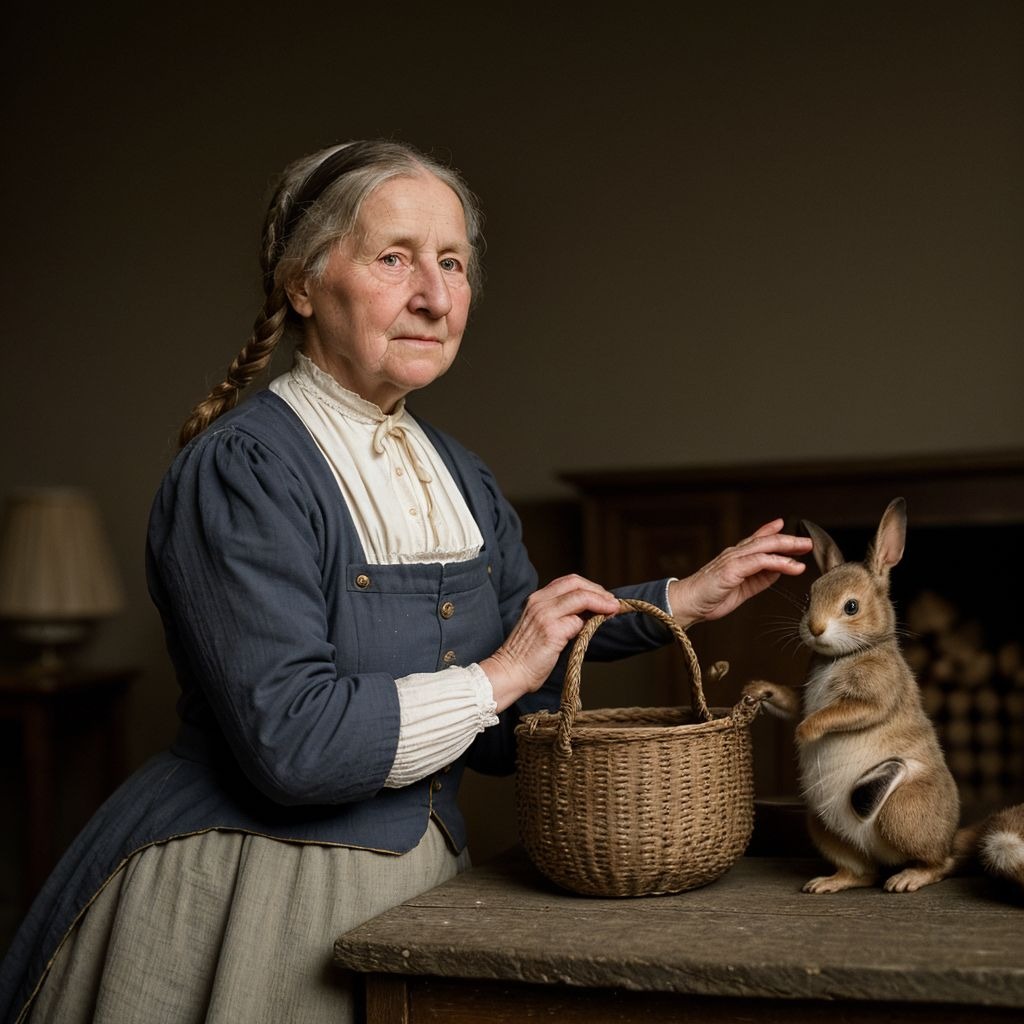
Beatrix Potter. I’ve always been fascinated by her, but it’s not until recently that I’ve started to think about why. Maybe it’s because I’m at a similar crossroads myself – fresh out of college, trying to figure out what comes next. I feel like Beatrix and I share some common ground in this regard.
I remember being captivated by her stories as a child. The way she wove together the world of Peter Rabbit with such care and attention to detail was mesmerizing. But as I got older, my interest shifted from simply enjoying her tales to wanting to know more about the woman behind them. What drove someone like Beatrix Potter to create these charming characters? Was it a desire for escapism, or did she tap into something deeper within herself?
One thing that has always struck me is the way Beatrix seemed to be both a product of her time and a rebel against it. She was born in 1866, an era where women were expected to conform to strict social norms. Yet, through her writing, she managed to create a world that was whimsical, yet still bound by the rules of the Victorian era. Her characters, like Peter Rabbit, had their own agency and often found themselves in sticky situations – but ultimately, they were always contained within the limits set by Beatrix’s imagination.
This dichotomy has me thinking about my own experiences as a young woman trying to navigate adulthood. I feel like I’m caught between wanting to break free from expectations and still honoring the traditions that have come before me. It’s as if I’m trying to channel my own inner Beatrix Potter – creating something new and innovative, yet still rooted in the world I’ve inherited.
Another aspect of Beatrix’s life that has always intrigued me is her relationship with nature. She was an avid hiker and spent countless hours exploring the English countryside, collecting specimens, and documenting her findings. Her love for the natural world seeps into every page of her writing – from the way she describes the gardens at Hill Top to the intricate details of her illustrations.
As someone who’s always found solace in nature myself, I wonder if Beatrix’s connection to the outdoors was more than just a passing interest. Was it a way for her to escape the confines of society, or did it truly nourish something within her? I feel like this is a question that gets at the heart of what drives us – whether it’s a desire for freedom, creativity, or simply a sense of belonging.
I’m not sure where all these thoughts will lead me. Maybe they’re just a reflection of my own uncertainty as I look to the future. But writing about Beatrix Potter has given me permission to explore some of these questions and emotions that I’ve been carrying around for so long. It’s funny – the more I learn about her, the more I realize how little I truly know. And in that not-knowing, there’s a strange comfort.
As I continue to dig into Beatrix Potter’s life and work, I find myself thinking about the concept of “home” and how it relates to both her writing and my own experiences. Hill Top, her beloved home in the English countryside, seems to be more than just a physical space – it’s a sanctuary, a refuge from the outside world. Her love for that place is palpable, and I can sense the same longing in myself when I think about returning to the familiar landscapes of my childhood.
Growing up, my family would often take summer vacations to the coast, where we’d spend hours exploring the tide pools and watching the seagulls soar overhead. Those trips felt like a respite from the chaos of everyday life, a chance to reconnect with nature and myself. Even now, as I navigate the uncertainty of post-college life, those memories linger – a reminder that there’s still beauty to be found in the world, even when everything else feels overwhelming.
Beatrix Potter’s writing often has this same effect on me, transporting me to a world that’s both familiar and yet completely foreign. Her stories are like old friends, comforting and reassuring in their own way. But they’re also full of complexities and contradictions – just like Beatrix herself. I think about how she was able to balance her love of nature with the demands of Victorian society, creating a sense of tension that’s both captivating and relatable.
As I grapple with my own desires for freedom and creativity, I find myself drawn to the idea of creating a space of my own – not just physically, but emotionally and intellectually as well. Hill Top, in its own way, represents that ideal: a place where Beatrix could be herself, without apology or compromise. And yet, it’s also a reminder that this sense of freedom is never truly absolute – there are always external forces at play, shaping our choices and limiting our options.
I’m not sure what the future holds for me, but writing about Beatrix Potter has given me permission to explore these questions and emotions in a way that feels both authentic and liberating. It’s as if I’ve stumbled upon a hidden language – one that speaks directly to my own desires and fears, reminding me that I’m not alone in this uncertainty.
As I delve deeper into Beatrix Potter’s life, I find myself thinking about the role of solitude in her creative process. She was known to be a reclusive figure, often spending long periods of time alone at Hill Top, surrounded by nature and her beloved animals. It’s as if she needed that isolation to tap into her imagination and channel her stories onto paper.
I can relate to this desire for solitude. As someone who’s always been an introvert, I find that being alone gives me the space to think and reflect in a way that feels authentic. It’s not that I’m antisocial or uncomfortable around others – it’s just that I need time to myself to recharge and process my thoughts.
But Beatrix Potter’s solitude was more than just a personal preference; it was also a necessity. As a woman in a patriarchal society, she faced significant barriers to pursuing her artistic ambitions. She was expected to marry well and conform to societal norms, but instead, she chose to pursue her passion for writing and art.
In many ways, I feel like I’m facing similar expectations – albeit in a different context. As a young woman, I’m constantly bombarded with messages about what I should be doing next: finding a job, getting married, starting a family. It’s as if the world is waiting for me to fit into some predetermined mold, rather than allowing me to forge my own path.
Beatrix Potter’s story is a powerful reminder that women have always been capable of defying these expectations and creating their own paths. Her determination to pursue her art, despite the obstacles in her way, is a testament to the resilience and creativity that lies within us all.
As I continue to explore Beatrix’s life, I’m struck by the parallels between her experiences and my own. Both of us are navigating the complexities of adulthood, trying to balance our desires for independence with the demands of the world around us. And both of us are searching for a sense of home – not just a physical place, but an emotional one as well.
For Beatrix, Hill Top represented that sense of home; it was a sanctuary where she could be herself and pursue her passions without apology. As I look to my own future, I’m wondering what that sense of home might look like for me. Is it a physical place – a tiny apartment in the city or a cozy cabin in the woods? Or is it something more intangible – a sense of belonging, a feeling of connection to others and to myself?
I don’t have all the answers yet, but writing about Beatrix Potter has given me permission to ask these questions and explore them in a way that feels authentic. And as I continue on this journey, I’m reminded that the search for home – both physical and emotional – is a lifelong process, one that requires patience, self-reflection, and a willingness to take risks.
As I reflect on Beatrix Potter’s life and work, I find myself drawn to her letters and journals, where she shares her thoughts and feelings with remarkable candor. Her writing is like a mirror held up to the human experience – all its joys and struggles, triumphs and setbacks. It’s as if she’s saying, “I see you, I hear you, and I’m right there with you.”
One of the things that strikes me about Beatrix’s letters is her honesty about her own doubts and fears. She writes about feeling uncertain, overwhelmed, and even despairing at times – but always, she finds a way to persevere. Her words are a reminder that it’s okay not to be okay, that we all struggle with self-doubt and uncertainty.
I think about my own experiences as a writer, trying to find my voice and make sense of the world through words. Beatrix’s letters offer me a sense of solidarity, a reminder that I’m not alone in this journey. She shows me that writing is not just about creating something beautiful or meaningful – it’s also about processing our thoughts and emotions, working through our fears and doubts.
As I read her letters, I begin to see the world through Beatrix’s eyes – her love of nature, her passion for storytelling, and her determination to create a life on her own terms. Her writing is like a window into another time and place, but also into the depths of the human heart. It’s as if she’s saying, “Come with me, dear reader, and let’s explore this messy, wonderful world together.”
Beatrix’s connection to nature is something that resonates deeply with me. As someone who’s always felt a sense of disconnection from the world around her, I find solace in her words about the beauty and wonder of the natural world. Her writing reminds me that there’s still so much to explore, discover, and marvel at – even in the midst of uncertainty and chaos.
As I continue to delve into Beatrix Potter’s life, I’m struck by the way she blended her love of nature with her creativity. She didn’t just write about the world around her; she also embodied it – through her art, her writing, and her very being. Her stories are like a fusion of the natural and the imaginative, showing us that there’s beauty in both the wild and the tamed.
I wonder if this blending of nature and creativity is something that I can learn from. As someone who’s often felt disconnected from the world around me, I’m drawn to Beatrix’s example – her ability to find inspiration in the natural world and channel it into something new and beautiful. Maybe, just maybe, this is a key part of finding my own sense of purpose and direction.
As I look to the future, I feel like I’m standing at the edge of a vast, uncharted landscape – unsure of what lies ahead, but excited to explore. Beatrix Potter’s life and work offer me a sense of hope and possibility – a reminder that even in the midst of uncertainty, there’s always room for creativity, growth, and discovery. And as I continue on this journey, I’m grateful for her example – a shining light that shows me the way forward, one step at a time.
As I reflect on Beatrix Potter’s life, I’m struck by the ways in which she embodied the concept of “interconnectedness” – the idea that all things are connected and intertwined. Her love of nature, her passion for storytelling, and her determination to create a life on her own terms all seem to be threads in a larger tapestry, each one informing and influencing the others.
I think about my own experiences as a writer, trying to weave together disparate ideas and themes into something cohesive and meaningful. Beatrix’s example shows me that this process is not just about creating a work of art, but also about cultivating a sense of connection to the world around us – to nature, to other people, and to ourselves.
As I look to my own future, I’m wondering if I can learn from Beatrix’s example and create a life that reflects this sense of interconnectedness. Can I find ways to weave together my love of writing with my passion for nature? Can I use my creative pursuits as a way to connect with others and make a positive impact on the world?
These are big questions, and I don’t have all the answers yet. But as I continue to explore Beatrix Potter’s life and work, I’m starting to see that the search for interconnectedness is not just about creating art or achieving some kind of external success – it’s about cultivating a sense of wholeness and integration within ourselves.
As someone who’s often felt fragmented and disconnected, this idea resonates deeply with me. Beatrix’s example shows me that even in the midst of chaos and uncertainty, there’s always room for growth, exploration, and discovery. And as I look to the future, I’m excited to see where this journey will take me – not just as a writer, but as a person.
One thing that’s striking me about Beatrix Potter is her ability to find beauty in even the most mundane things. Her stories are full of everyday details – the way the sunlight filters through the trees, the sound of birds singing in the garden, the feel of damp earth beneath one’s feet. These details are not just background noise; they’re the very fabric of her world, and she weaves them together into something rich and vibrant.
I think about my own experiences as a writer, trying to find meaning in the ordinary moments of life. Beatrix’s example shows me that this is not just about creating some kind of grand narrative or achieving external success – it’s about cultivating a sense of wonder and awe in everyday things.
As I look to my own future, I’m wondering if I can learn from Beatrix’s example and find beauty in the mundane. Can I use my writing as a way to slow down and appreciate the world around me? Can I cultivate a sense of curiosity and wonder that guides my creative pursuits?
These are big questions, but as I continue to explore Beatrix Potter’s life and work, I’m starting to see that the search for beauty in everyday things is not just about creating art – it’s about cultivating a deeper connection to ourselves and the world around us. And as I look to the future, I’m excited to see where this journey will take me – into a world of wonder, curiosity, and creative possibility.