Latest Articles

Secrets in the Sand: How Barefoot Steps Reset Your Body and Brain

Dave

There’s a small, almost rebellious kind of joy in stepping out of your shoes and letting your feet meet the sand. The first touch is a flicker of temperature—the sun-warmed grains greeting your soles—then a slow, yielding sink as your weight presses down and the earth rearranges itself to fit you. It’s not just a pleasant sensation; it’s a full-body memo that says, “You’re here. You’re alive. Pay attention.” Barefoot walking on sand is one of those simple acts that hides a surprising amount of science and soul. It strengthens things you didn’t know were weak. It calms parts of you that forgot how to be quiet. It reminds you that your body, for all its complexity, was designed to move with the world, not against it. And that’s the secret many of us miss: the most powerful reset often looks like a gentle walk along the shore.

If you’ve ever taken that first step and felt your ankle wobble, you’ve met one of sand’s great teachers: instability. Unlike sidewalks, sand doesn’t demand a single, repetitive pattern. It shifts, so you adapt. Every micro-adjustment your foot makes—curling your toes, flaring your heel, tightening your arch—is a tiny strength exercise. The muscles of your feet wake up like a crowd at sunrise. The smaller stabilizers in your ankles, calves, and hips join the chorus, coordinating to keep you upright. Think of sand as a quiet, forgiving gym—no mirrors, no clanging metal—just an ever-changing surface that asks you to be present. Over time, this unpredictability builds foot strength, improves balance, and teaches your nervous system to communicate more efficiently with your muscles. It’s functional fitness in the oldest sense of the term: training your body to respond gracefully to the world it actually lives in.

There’s also the matter of pace. Most of us move too fast, even when we’re technically standing still. Sand slows you down—not because you’re lazy, but because the medium makes you honest. You can’t sprint mindlessly across a soft beach without paying attention; the surface won’t let you. Your stride shortens. Your knees bend. Your hips start to move more fluidly. Your spine becomes a mast that steadies the ship. In that slowness is an opportunity to breathe deeply, to open your chest to the sea, to let your arms fall with your steps. A few minutes in, you’re not just walking; you’re unspooling a thread of tension that’s been wrapped tight around your day. And as your breath finds rhythm with your steps, your mind often follows—the to-do list quiets, the sense of urgency thins, and you begin to feel that spaciousness in your head that you forgot existed.

Then there’s the sensory orchestra. Bare feet mean full access to the world: cool patches of damp sand hiding under warm top layers, the contour of a shell under your arch, the faint fizz of foam as it reaches for your toes and retreats. Your skin is your largest organ, a master receiver of information, and on the beach you’re tuning it to high fidelity. The texture of sand provides rich, varied input to thousands of nerve endings in your soles, sending a stream of data to your brain about pressure, temperature, and terrain. That feedback can improve proprioception—the body’s sense of where it is in space—like turning up the brightness on your internal GPS. Better proprioception often means better movement: more confident steps, quicker reactions, and a reduced risk of missteps that become injuries. The beauty is that your brain loves novelty, and a beach is novelty in endless supply—no two steps are the same, and because of that, your nervous system keeps learning.

But let’s be honest about something: our feet have a story, and for many people that story includes aches, stiffness, and a lifetime of shoes that turned them into passengers rather than drivers. Barefoot walking on sand is a gentle invitation back to agency. The arch—so frequently misunderstood as either too high or too flat—relearns its job as an elastic bridge. The toes get a chance to spread and stabilize instead of cramming into a narrow toe box. The calf muscles, perpetually shortened by heeled shoes and hard surfaces, lengthen a little with each sink and push. Over time, that can translate into better alignment up the chain: when your feet work, your ankles stabilize; when your ankles stabilize, your knees track more cleanly; when your knees track, your hips and lower back carry less strain. It’s not magic; it’s mechanics favored by a forgiving surface.

Of course, the ocean gives you more than physics. There’s something about a shoreline that resets perspective, even if you’re not sure why. Maybe it’s the horizon: a literal line of possibility that stretches beyond whatever you’ve been carrying. Maybe it’s the soundscape—the slow thunder of waves—masking the mental noise that chews through your attention inland. For many people, the beach flips on what marine biologist Wallace J. Nichols calls the “blue mind,” a calmer mental mode associated with water settings. You don’t have to be a poet to feel it; just a person willing to stand there long enough to let your senses catch up. When you walk barefoot in that setting, your brain gets two signals at once: the grounding from your feet, and the spaciousness from your eyes and ears. The result is an unusually effective formula for dropping stress in real time.

Let’s talk about “grounding,” a concept that quickly gets tangled in big claims. You don’t need to buy into anything mystical to appreciate the clear, lived experience: connecting skin to earth can feel steadier than being insulated by rubber soles. At minimum, it’s a habit that encourages time outdoors, slower walking, and full-body attention—three things modern life notoriously under-delivers. If you find the practice soothing, that feeling itself is the benefit worth chasing. If you’re skeptical, you can still enjoy the measurable perks: stronger feet, better balance, fresh air, and a calmer nervous system that comes from moving in a rhythmic, sensory-rich environment.

The hidden cardio is another quiet win. Sand demands more from your muscles with every step. Even a leisurely, 10- to 20-minute beach walk can elevate your heart rate in a low-impact way. Because the surface absorbs some of the force you generate, your joints deal with less sharp impact than on concrete. Many people find they can go a little longer on sand without the same post-walk soreness in knees or lower back. It’s like nature’s elliptical—more work, less strain—wrapped in sunlight and salt air. If you crave a challenge, walk closer to the dry, softer sand; if you want more stability, stay near the water’s edge where the surface is firmer. You get to tune the difficulty without changing the location.

And then there’s temperature, a quiet physiotherapist. Warm sand coaxes blood flow to the soles, which often spend their days chilled and under-stimulated in air-conditioned rooms. In the cooler hours—sunrise and sunset—the sand’s warmth feels like a natural heat pad. That comfort alone can relax the muscles in your feet and calves, making each step more fluid. When a wave rolls over your ankles, the brief cool contrast wakes tired tissues like a splash of water on a sleepy face. It’s hot-and-cold hydrotherapy, delivered by the planet for free.

But what about the practicalities—the small obstacles that keep a beautiful idea from becoming a real habit? Start with duration. Ten minutes counts. You don’t need to schedule an epic trek or “close all your rings.” A dozen mindful, barefoot minutes can do more for your nervous system than an hour you don’t enjoy. To make it stick, anchor the walk to something you already do: after your morning coffee, after school drop-off, while dinner’s simmering. If you’re carrying stress (and who isn’t), try treating the first five minutes as a decompression lane. Feel the sand. Count your exhale to four. Let your arms dangle and your jaw unclench. Imagine dropping questions into the tide: What can wait? What do I want the next hour to feel like? How little force can I use and still move forward?

If foot strength is new for you, think micro-progress. The first week, aim for softer, damp sand near the water and short intervals—five to ten minutes—even if you’re eager. In week two, add a minute or two and venture to a slightly softer patch. A simple pattern that works: three steps slow, three steps normal, repeat. Slow steps keep you honest about form—quiet landings, even weight, toes spreading—while normal steps let you settle into a natural rhythm. If your arches feel tired, that’s okay; tired is a signal to stop for the day, not a reason to quit the practice. Over a few weeks, many people notice their arches feel springier, their toes more articulate, and their balance better on everyday surfaces.

Use your eyes like a second set of feet. Scan the ground ahead for shells, stones, or debris. The goal isn’t to tiptoe nervously—it’s to walk with awareness, like a surfer reading a wave. If you do step on something sharp, pause. Shake out the sting, check the skin, and carry on if it’s superficial. If you have diabetes, neuropathy, or foot wounds, talk to a clinician first—barefoot walking may still be possible, but you’ll want personalized guidance. Sand can also be hot enough to burn later in the day; prefer morning and late afternoon, and test the temperature with your hand before committing.

What you do with your arms matters more than most people realize. Let them swing. That movement counter-rotates your torso and hips, easing your lower back and helping your feet place more naturally. Keep your gaze about ten meters ahead rather than down at your toes; your neck will thank you. And breathe like you’re walking through a long exhale—because you are. A simple pattern: inhale for three steps, exhale for four. The longer exhale nudges your nervous system toward calm, leveraging the vagus nerve’s role in relaxation. When your thoughts drift (and they will), bring your attention to the sensation of your heel sinking, your arch loading, your toes pressing, your body rising. That’s one barefoot step, start to finish. Repeat it a few hundred times and you’ve built a moving meditation without ever trying to meditate.

There’s also a quiet emotional repair that happens when your feet meet the shore. The beach is a shapeshifter: a place for sprinting, for ambling, for grieving, for joy. If you’re carrying anger, the sand absorbs the excess like an old friend who doesn’t need you to explain. If you’re tired, the rhythm of the waves will keep time while you borrow a little calm. If you’re excited, you’ll find room to celebrate without worrying how loud you are—nature has already turned the volume up. Walking barefoot in that environment becomes a way to metabolize feelings that never quite get processed in the daily grind. It’s not therapy, but it is therapeutic.

Parents discover another perk quickly: kids are natural barefoot philosophers. Give a child a strip of beach and they will invent a world—races with the waves, treasure hunts for shells, obstacle courses over tide lines. Walking alongside them barefoot creates an easy, shared sensory language. You notice where the sand is warmest; they show you the smoothest skipping stones. You point out a pelican’s shadow; they teach you how to sprint away from the foamy edge like it’s a playful monster. These are the tiny, healthy memories families are built on: ordinary wonder, repeated often.

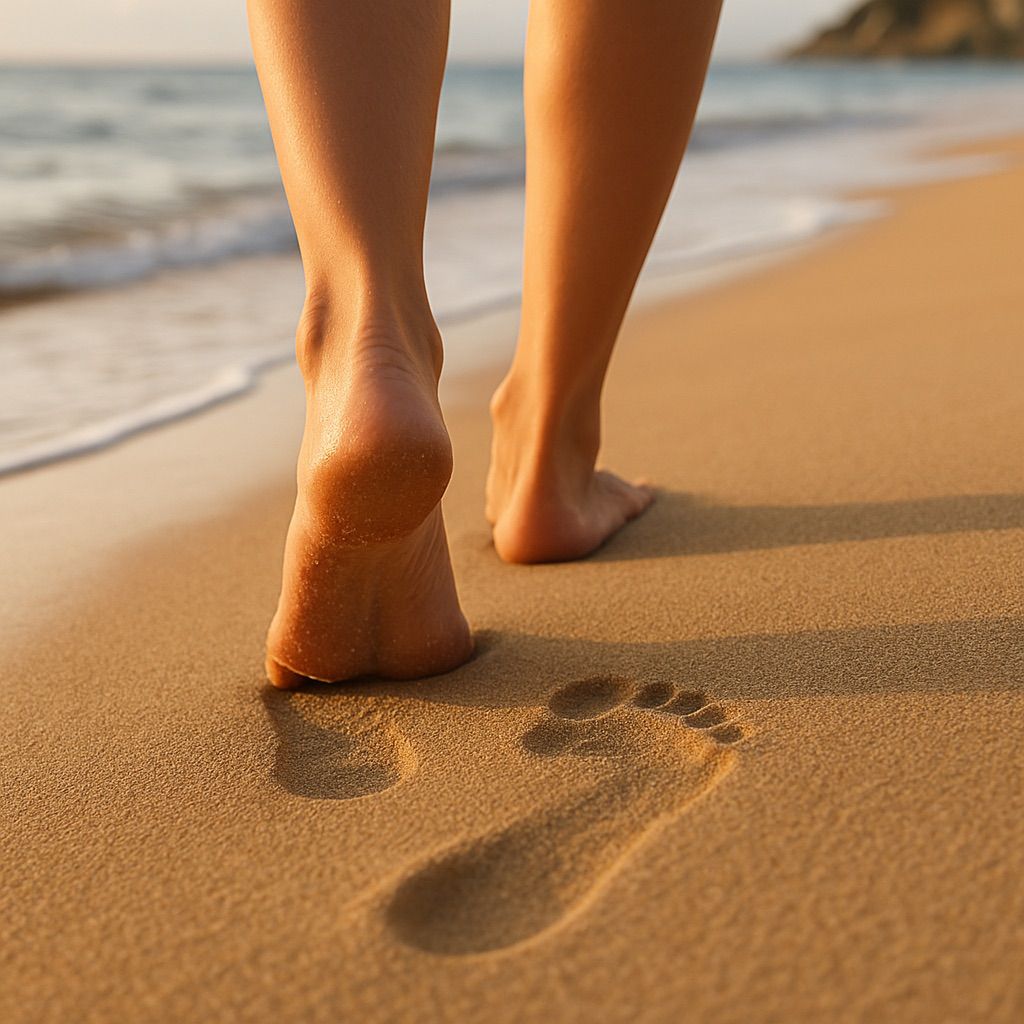
If you like a plan, here’s a simple one you can start the next time you meet a shoreline, written like a friendly whisper rather than a command. Day one: walk for ten minutes at low tide near the waterline, barefoot, slow enough to feel your heels sink. Day two: repeat, adding a minute and a few slow-motion steps where you pause on the mid-stance and notice your arch. Day three: shift five minutes to slightly softer sand, then finish on firmer ground; pay attention to the difference in muscle effort. Day four: after your walk, stand facing the water and roll slowly from heels to toes for one minute as if the ground is a gentle rocking chair. Day five: keep the walk casual, but finish with five “quiet steps”—place your feet so softly you can hardly hear them. Day six: let it be social; bring a friend, walk, talk, and laugh—because joy sticks better in groups. Day seven: take a photo of your footprints and then watch the tide erase them; let it remind you that stress, too, is temporary.

As your relationship with sand deepens, you may notice subtle payoffs landing elsewhere. Your balance on stairs feels easier. Your posture in line at the café is looser, your shoulders lower. Your calves don’t bark after a day on your feet. That’s what happens when small muscles resume their jobs: the big ones stop overworking. Walking barefoot on sand also nudges your gait toward a softer landing. Without the buffer of thick soles, most people naturally shorten their stride and place the foot more underneath the body rather than far in front. That alignment spreads the load through the whole kinetic chain, reducing the braking forces that accumulate during long, heel-striking strides on hard ground. It’s not that shoes are bad; it’s that variety is good, and your feet thrive on it.

You’ll also learn a surprising amount about timing. Beaches change character throughout the day—the sand is cooler at sunrise, busier after lunch, smoother after a receding tide, sculpted into ridges by wind overnight. When you begin to read those patterns, your walk becomes a conversation with the landscape. On a breezy morning, head into the wind for the first half and let it push you back on the return. On a cloudless evening, walk west and gather gold from the setting sun, then turn around and walk into a violet-blue that softens your eyes. On a drizzly day, watch how the wet sand tightens beneath your steps and doubles as a mirror.

There will be days you don’t want to go—too hot, too humid, too busy. Try this trick: tell yourself you only have to step onto the sand. That’s all. Nine times out of ten, momentum will carry you forward. On the tenth, you still touched the earth and reminded your nervous system how to settle. Another trick: end each walk with one small gratitude you wouldn’t have had without showing up. The cool patch under the dry sand. The far laughter of strangers. The way your feet look dusted with gold. Gratitude turns a single walk into the first line of a habit.

Let’s keep it real with a few cautions, folded gently into the invitation. Hot sand can burn—choose morning or late afternoon, aim for shade breaks, and test the surface with your hand. Be mindful of glass, hooks, or sharp shells; a quick visual scan saves a lot of drama. If you have circulatory issues, neuropathy, or a history of foot ulcers, consult a medical professional before you go barefoot on natural terrain; safety is part of strength. If you tend toward plantar fascia irritation, ease in slowly, favor firmer sand at first, and stop if pain—not just fatigue—shows up. And sunscreen isn’t optional on the tops of your feet; they’re closer to the sun than your calendar is to empty.

When all is said and walked, the hidden benefits of barefoot time on sand are not rare or exotic. They’re ordinary, which is why they’re so powerful. Your feet get stronger because you use them for what they were made to do. Your balance improves because your brain is fed a richer signal. Your joints learn generosity from a surface that yields. Your breath slows to match the sea’s patient metronome. Your mind steps out of the hot circle of worry and remembers the long horizon. None of this requires the “perfect” beach or the “perfect” body or the “perfect” schedule. It asks only that you show up, set your soles free, and let the shore reshape not just the ground beneath you but the way you carry yourself through the rest of your life.

And that might be the real, shining secret in the sand: you don’t have to push to become better. You can soften. You can let the world help. You can trust that something as small as a barefoot step can ripple outward into your posture, your mood, your sleep, your relationships. A beach walk doesn’t fix everything, but it doesn’t have to. It just needs to be the part of your day where you remember how to be a human animal in a living world—equal parts muscle and breath, purpose and play. Tomorrow, the tide will tidy away the marks you left. But you’ll take the changes with you: stronger feet, a clearer head, a little more room inside your chest. That’s a good trade for ten quiet minutes and a handful of sand.

Related Posts

The Day of Disappearance and Arrival: How August 21 Framed a World Without a Painting and a Union With an Ocean

Elias Rowen

On August 21, two scenes, two rooms, two kinds of silence. In Paris, a hush like a held breath spreads across the Louvre as visitors face an empty rectangle on a wall, four small pegs where a smile once hovered. In Honolulu, the wind tests a new flag’s seams as it climbs a pole against a volcanic silhouette and the Pacific’s long exhale. One day, two stories: the Mona Lisa vanishes in 1911 and the United States becomes truly ocean-to-ocean in 1959 when Hawaii enters as the 50th state. These events appear to belong to different shelves of history—one is a theft, the other a vote and a proclamation—but they share a grammar: both are about frames and belonging. Remove the painting and you reveal the frame’s power to hold meaning; welcome an archipelago and you redraw the frame of a nation. August 21 is a study in presence and absence, in what the eye sees and what the map admits.

In the Louvre that Monday morning in 1911, the building stretched and yawned into workaday rhythms. Guards rotated positions, gallery attendants checked fastenings and dust, and a few early visitors padded through the Salon Carré toward the Italian masters. On the wall usually hung a panel portrait in a dark frame, small enough to surprise first-time viewers who had imagined a canvas the size of a door—Leonardo’s La Gioconda, a woman’s gaze balanced like a coin on a fingertip. Instead there was vacancy: a blankness that vibrated, so clearly outlined by absence that it seemed louder than any painting. People came closer, as if closeness could call her back. Nothing. Four iron studs, a paler rectangle. Once you see a work of art missing, you grasp how much of art is choreography: the way a museum directs your feet, your breath, your neck muscles, your expectations. The empty space rewrote the room’s script.

The story of the theft has the clanky charm of a caper film but also the simplicity of a janitor’s schedule. Vincenzo Peruggia, an Italian glazier who had worked at the Louvre, had studied the routines and the vulnerabilities. The Mona Lisa had been protected not by lasers and sensors but by habit. He removed the painting from its frame, hid it beneath a workman’s smock, and walked more or less out the door. The magnitude of the disappearance wasn’t obvious at once; bureaucracy required hours to decide that a masterpiece could go missing during daylight. When the alarms finally translated into action, the building became a machine of locked doors and questions. Paris—already a city that knew how to make a scandal sing—turned the theft into a chorus. Newspapers printed the empty wall like a wanted poster. Detectives interviewed artists; bohemian circles were scraped for gossip. For a stretch, the poet Guillaume Apollinaire was arrested, and the name Picasso drifted across interrogation tables like a rumor with its hat pulled low. The idea that modernists might have kidnapped old art felt narratively satisfying to some, but evidence is inconvenient to a good story.

What the city learned, day by day, was the power of an absence to multiply presence. With La Gioconda gone, crowds surged merely to stare at where she had been. The traffic of longing and curiosity warmed the room like a furnace. Without a subject to receive them, people saw themselves and their expectations reflected on the wall; the blankness was a mirror, a provocation. Museums became, briefly, newsrooms. The theft inflated the painting’s celebrity, turning a quiet, sly portrait into a celebrity whose face gazed back from kiosks and cab stands. Before radio, before the globalized churn of images, a stolen canvas rehearsed how fame would work in the twentieth century: scandal as spotlight, scarcity as amplifier. The Mona Lisa didn’t laugh; the world did: a startled, nervous laugh that recognized itself in its avidity.

Two years later, the painting would reappear in Florence, where Peruggia attempted to sell it to a dealer, explaining himself as a patriot who only wished to return a stolen Italian treasure to Italy. The story had the rough edges of justification; it also had the sincerity of a worker who felt history’s weight through his hands. Courts and headlines did their business, and the Louvre reacquired its jewel with rituals of relief that felt like a homecoming parade. Yet the theft’s imprint lingered. The blank space had taught us a new kind of looking—watching the social life of art as keenly as the paint. It’s a lesson that echoes whenever crowds assemble with phones for a glimpse of celebrity, or pilgrimage toward a screen at a vigil after a building burns. The missingness becomes the message: you cannot see the world as it is without also seeing the outlines of what was taken, what is promised, what is withheld.

Across the calendar from that Paris morning, another August 21 took place in air silked with trade winds. In Honolulu, a statehood ceremony welcomed Hawaii into the Union, an act with centuries of prelude and decades of debate. The United States, a continental shape for most of its life, now wore a Pacific necklace openly, acknowledging what had long been fact: military bases, sugar barons, immigrant communities, politics and music and food that braided Asia, Polynesia, and the Americas. Statehood was not a spontaneous bloom but the fruit of a tree grown in contested soil—an overthrow of a Hawaiian monarchy in the 1890s, annexation during a feverish imperial moment, territorial status with its strange half-privileges, and then the slow accumulation of arguments for full inclusion and the muscle of local organizing. In 1959, when the votes were counted and the proclamation signed, the geography of American belonging expanded from a noun to a verb—the nation did not only occupy space; it crossed water to include culture and history that preceded it.

Statehood is a legal ceremony, yes, but it is also choreography. To welcome a fiftieth star is to redesign a flag, to reorder the visual language of national identity. The new constellation, arranged in staggered rows, arrived as an object lesson in geometry and symbolism: how do you fit more selves into one pattern without breaking symmetry? On the ground, the island chain embodied the answer in human form. Hawaii has long been a place where surnames bring maps to the dinner table: Japanese, Filipino, Chinese, Native Hawaiian, Portuguese, Korean, Samoan, Micronesian, haole—and the list keeps welcoming additions. Statehood took that reality and wrote it into the ledger of federalism, with senators and representatives, with budgets and courtrooms and postal codes. The United States did not become more homogeneous by including Hawaii; it became more honest about the kaleidoscope it already was.

But to tell this as a banner-fluttering story is to simplify. The day carried joy and pride and also misgivings that still deserve airtime. Indigenous Hawaiians, the Kānaka Maoli, had watched sovereignty recede under the pressures of empire and capital. For some, statehood felt like a final seal on dispossession; for others, it promised tools within the system to protect land, water, and language. The islands, framed as “paradise” in postcards, carried the more complicated realities of military presence and tourist economies. The new star came with federal funds and federal rules, with protections and the risk of erasures. As in Reconstruction a century earlier on the mainland, the entry into full union created opportunities and conflicts in the same breath. Statehood is best understood as a platform, not a verdict: it furnishes means to argue more effectively about what justice and flourishing look like in a place where taro patches and high-rises share horizons.

Juxtapose the Louvre and Honolulu—those four bare pegs and that rising flag—and you begin to see a pattern in how humans script meaning. Frames matter. We often mistake frames for background because they don’t shout; they support. The Louvre’s frame for La Gioconda told visitors where to stop and pay attention, how close to stand, how to speak in hushed voices. Remove the painting, and the frame becomes a protagonist, teaching us about expectation and value. The United States’ frame of states and stars tells citizens how they belong, where their votes translate into governance, how their histories are recognized on a map. Admit Hawaii, and the frame isn’t background anymore; it is the very act of saying, “You count here.”

Consider also the role of scale. The painting is small and intimate, designed for a patron’s private life more than a palace’s theater; the state is archipelagic, vast in oceanic distance, intricate in its people. Both, on August 21, absorbed outsized attention because they re-specified scale. The Mona Lisa’s disappearance magnified a panel into a global headline. Hawaii’s admission took islands whose influence already looped through Pacific trade, World War II, and American military strategy, and wrote that influence into everyday governance. The day teaches us that size isn’t destiny; narrative is. A missing portrait can become a world story; a chain of islands can redraw a superpower’s self-portrait.

The theft has a way of aging into parable. Peruggia’s motives—patriotism, pride in Italian art, perhaps resentment toward a France that displayed what he believed Italy should keep—mirror patterns that echo today whenever cultural property, restitution, and museums tangle over ownership. Who holds the right to show? Who holds the right to return? The Mona Lisa, of course, is French by provenance of centuries, attached to the royal collections that became the Louvre. But the question Peruggia posed in crude form remains gnarly and alive: how do nations and institutions repair historical takings without erasing the complex webs of acquisition and care that preserve art for public eyes? That empty wall in 1911 turned the museum into a forum. Every debate since—about the Parthenon marbles, about Benin bronzes, about bones and sacred objects—carries a shadow of that vacancy. Art’s social life doesn’t begin or end with its making; it includes its movements and the ethics that govern those movements.

Statehood, too, keeps teaching. The fiftieth star didn’t still the islands’ arguments; it sharpened them. Questions of land and water — wai as life — intensified under the pressures of development. The revitalization of ‘Ōlelo Hawai‘i, the Hawaiian language, gained momentum precisely because a generation saw that legal belonging should not mean cultural melting. The Hawaiian Renaissance of the 1970s braided music, dance, political activism, and education into a project of remembering and insisting. The sovereignty movement staged protests on Kahoʻolawe, on Mauna Kea, in classrooms and at the ballot box, at surf breaks and in legislative chambers. Statehood does not reduce politics; it distributes it into more rooms where it can happen. You can hear an echo of the Louvre’s lesson: frames are not passive; they invite us to decide what to display and how.

And somewhere between these stories runs a shared undercurrent: the choreography of crowds. In 1911, people thronged to behold nothing, which is a sly way of saying they came to behold each other beholding. In 1959, people gathered to watch a symbol become official, which is a formal way of saying they came to witness themselves in a larger “we.” The power of a crowd is not just numbers; it is narrative density. The same instinct that draws us toward an empty frame draws us toward a swaying flag: we want to be included in the moment when meaning turns visible.

Zoom in further, and you meet the individuals who lived these days intimately. Somewhere in Paris, a maid paused in a doorway with a bucket, listening to her employers argue about whether to take the metro to the museum and see the commotion. A photographer looked at his dwindling rolls of film and calculated which angle of absence would sell best to a newspaper editor. In Honolulu, a kid restless in the sun tugged at a lei and asked mom how many stars were on the old flag and whether this one meant more fireworks. A veteran remembered December 7, 1941, and how the harbor had smelled, and felt the ceremony as a stitch tying living memory into the cloth of the day. The world’s big dates work because thousands of tiny lives tie knots in them.

Even the artifacts around the events carry stories. The Louvre frame, empty, proved that materials can haunt. Wood, plaster, metal pins—ordinary things—become actors when a masterpiece departs. The American flag’s new geometry turned seamstress labor into national iconography. Some eighth-grader in 1960 would trace those staggered rows of stars in pencil and memorize a fact about fifty that felt, for a while, like permanence. (It is worth remembering, too, that territories remain — Puerto Rico, Guam, American Samoa, the U.S. Virgin Islands, the Northern Mariana Islands — and that the frame may yet be redrawn again, through statehood votes or changed relationships. The map breathes.)

We tend to treat art and sovereignty as separate languages: galleries on one hand, constitutions on the other. August 21 proposes a conversational bridge. Both are, at heart, about where meaning lives and who gets to access it. A painting displayed in a public museum is a promise that beauty and cultural memory are not the private hoards of princes. A state admitted to a federal union is a promise that its people can shape and be shaped by the larger body politic, with representation and responsibilities. Theft breaks a promise; statehood attempts to deepen one. The juxtaposition becomes a study in accountability: If you say the Mona Lisa is “for the public,” guard her with care; if you say Hawaii is “in the union,” listen when its people say what the union should become.

There is also the matter of time—its compressions and echoes. Leonardo’s portrait took shape in the early 1500s, its varnish deepening, its cracks whispering the patience of centuries. By the time it was stolen, it had outlived dynasties and revolutions. Hawaii’s human story reaches back far before 1959—voyagers reading swells and stars, kalo cultivated in lo‘i, aliʻi ruling and then constitutionally reigning, missionaries, whalers, migrant laborers, jazz bands, surfers, and schoolteachers teaching keiki the old words. Statehood was a moment in that long timeline, as the theft was in the painting’s long life. Both events remind us that a single date is a window, not a house. You can see a lot through it, but it opens onto rooms built over generations.

What should we do with August 21 now? One answer is simply to remember: to keep alive the tales of a Monday morning’s shock in Paris and a Friday’s applause in Honolulu. Another answer moves beyond memory toward practice. The Louvre’s wound invites us to invest in stewardship that is more than locks—stewardship that includes ethical provenance research, equitable partnerships with source communities, and a pedagogy that teaches visitors why a painting matters beyond its selfie radius. Hawaii’s celebration invites us to invest in a union that treats geography not as an afterthought but as a teacher, to learn from the islands’ environmental wisdom and multicultural competencies, to center Indigenous leadership on questions of water, land, and future-building. In both cases, the work is to match the frame’s promise with the ongoing labor of care.

There is an irony, of course, at the heart of the Mona Lisa’s celebrity: the theft that made her a global icon is an act we hope never to be repeated. We want the heat of attention without the fire. The way out of that paradox is to cultivate attention nourished by education rather than emergency. Let museums be houses of wonder where the story behind a painting is as magnetic as lines around it, where children learn to decode brushstrokes the way they decode emojis, where the question “why do we protect this?” has answers that are civic, not only aesthetic. And in the civic sphere, let statehood’s pageantry not seduce us into forgetting that the best symbols are backed by budgets and laws: schools that teach ‘Ōlelo Hawai‘i; conservation that protects coral; housing that families can afford; courts that listen; airports that honor both tourists and the people who make a life beyond the postcards.

Stepping back, you can feel how August 21 is a master class in attention. The empty frame trains your eye to what’s missing; the new star trains your eye to what’s included. Together they coach us toward a better citizenship in the world of culture and the world of nations. They whisper: look longer, ask what belongs, ask what’s been taken, ask who decides. If we take that coaching seriously, perhaps the next time we face an absence—an erased history, a neglected neighborhood, a climate refugee’s unmade bed—we’ll recognize it not only as a tragedy but as a summons to repair. And perhaps the next time we add a star—bring someone new into our circle, expand legal protections, extend a welcome—we’ll understand that it’s not a gift bestowed but a recognition long overdue.

So let August 21 stand as a paired emblem on your calendar: the Day of Disappearance and Arrival. In your mind’s museum, leave a rectangle on a wall as a reminder of what vigilance, curiosity, and humility demand. In your mind’s atlas, sketch a chain of islands tethered to a continental shape by lines of language, food, song, and law. Let both pictures exert a tide on your habits. That way, even without boarding a plane to Paris or Honolulu, you are part of the long project that these days inaugurate: guarding what we love without locking it away, and widening who “we” are without asking anyone to shrink.

Because in the end, the smile that the world missed for two years belongs to no one and to everyone—a mystery captured and made public. And the star that rose in 1959 belongs to no one and to everyone—a promise stitched where waves speak languages older than our politics. Both remind us that the best frames do not imprison. They give us edges to hold while we do the real work: telling truer stories, sharing broader power, learning to see each other more completely. And that work, like the ocean and a masterpiece, never really ends; it only deepens.

Related Posts

The Empowered Lens: How to Plan Bikini Photo Shoots That Celebrate People, Not Objects

Dave

There’s a moment on every summer shoreline when the wind drops, the water inhales, and the sun hovers just above the horizon like a held note. Photographers call it golden hour, but the name undersells what it does to a person’s confidence: light softens, edges warm, and even the shyest among us feels a little braver. It’s an ideal time to make images in swimwear, and also a dangerous time—because the same glow that flatters can tempt us to forget that the person in the frame is a person first. “Bikini photo shoots done right” is not a mood board; it’s a philosophy. It’s the decision to treat the body not as material but as meaning, to invite collaboration rather than extract compliance, to design a shoot where dignity is built into the logistics and creativity grows out of trust. This essay is a road map for photographers, influencers, brand creatives, and hobbyists who love summer aesthetics and want to do them humanely. It’s a long walk—from first message to final edit—because respect is not a filter you add in post. It’s a workflow.

Before you even think about locations or lenses, begin with values. Say them out loud, write them down, put them into your call sheet: consent-centered, adult-only, inclusive, culturally respectful, environmentally gentle, safety-forward, no sexualization, no diet talk, no retouching that rewrites bodies. If that sounds like an HR policy rather than a creative brief, good—because the most liberating shoots are the ones where boundaries are explicit. When every collaborator knows the rules, they can play inside them with confidence. Share those values in your initial outreach: “I’m planning an empowerment-focused swimwear portrait session for adults (18+). Poses will remain natural and non-sexualized. You’ll help craft the concepts, approve wardrobe, and choose the images that get shared.” That one paragraph reframes the entire enterprise from “I take” to “we make.” It also pre-screens for the right fit. People who only want spectacle drift away; people who want to be seen—not displayed—lean in.

Next comes consent, which isn’t a single yes—it’s a rolling conversation. Start with a short questionnaire that asks comfort levels on a spectrum: “Which poses feel good? Which don’t? How do you feel about close-ups of midsection, back, thighs? Do you want to jump, swim, lounge, dance? Any colors or cuts you love or avoid?” Include a section for accessibility needs (mobility, sensory, medical), religious or cultural considerations (e.g., modest swimwear, hijab-friendly styling), and privacy preferences (anonymous posting, face partially obscured, first-name-only credits, or keep images private). Send a plain-language contract that distinguishes three things people often conflate: 1) consent to be photographed on the day, 2) permission to use images in a portfolio/social (limited and revocable if you agree), and 3) any commercial licensing (separate, paid, and negotiated). Build in a kill switch: the right to stop a shot, change an outfit, or call the session without penalty. Consent without exit isn’t consent; it’s pressure.

Casting, like light, reveals your ethics. If you want empowerment, your roster should look like real beaches do: different ages (adults only), sizes, skin tones, genders, and abilities. Avoid tokenism—don’t slot diversity into a single frame and call it done. Instead, design micro-stories that honor each person’s individuality: a runner cooling down at the tideline, a book lover in a striped cabana chair, a surfer waxing a board while chatting with friends, a wheelchair user navigating a boardwalk with sunlight flaring the spokes, a trans woman being fanned with a straw hat by her best friend while both laugh, a duo of older models—silver hair catching the last rays—clinking iced tea. The goal is not to showcase bodies for appraisal but to show people in their element. When models feel like whole humans on camera, audiences stop scanning for flaws and start looking for feelings.

Wardrobe is where many shoots tip toward objectification without meaning to. Your styling note should whisper ease, not performance. Encourage models to bring options that make them feel powerful: classic bikinis, high-waisted sets, sport tops, rash guards, one-pieces, swim leggings, sarongs, linen shirts, roomy button-downs, crochet cover-ups, sun hats, scarves, and jewelry that won’t snag. If you’re supplying pieces, size-inclusive means truly inclusive; carry stock from petite to plus, with cuts that support busts without forcing cleavage. Offer adhesive nipple covers, seamless underwear, and body tape for those who want them—and don’t treat any of it as mandatory. Bring towels, robes, and a pop-up changing tent; privacy isn’t a luxury on a beach—it’s a right. Ban performative impracticalities: no stiletto heels sinking into sand, no swimsuits two sizes too small “for look,” no glass props that can shatter on public shorelines. Empowerment is comfortable by design.

Your mood board should balance aesthetics with evidence of care. Include lighting and palette references (golden hour ambers, midday glints, blue hour cobalt), but also add pages for body language: expansive arms, weight on a strong leg, shoulders back but relaxed, genuine laughter that crinkles eyes, quiet moments—eyes closed, chin lifted into the breeze. Sprinkle in “negative space” frames where the body occupies a corner and the horizon carries most of the emotion; it teaches you not to rely on curves for interest. Include “hands” studies: that gentle grip on a hat brim, fingers trailing in water, palms pressed to sternum in a breath-check. When you brief your team, talk verbs, not shapes: “walk, sway, stretch, breathe, spin, lean, listen to the waves.” Verbs evoke presence; fixed shapes invite performance.

Scouting a location is part aesthetics, part ethics, part logistics. Public beaches offer texture and variety—piers, rock jetties, dunes, showers, lifeguard towers—but they also carry bystanders, regulations, and fragile habitats. Read the posted signs. No stepping on dunes (those grasses hold coastlines together). Keep the crew footprint small and portable: collapsible reflector, lightweight stands, sandbags, microfiber towels for gear, trash bags to leave the place cleaner than you found it. If the tide chart were a person, it would be your assistant director—consult it like gospel. Know sunrise and sunset angles, know where the sun drops behind buildings, and how wind will cut the temperature. If privacy is a priority, look for a secluded cove or rent a beachfront property with permission. For pool shoots, get written authorization from owners or hotels; for piers or state parks, call the permitting office and expect to carry insurance if you’re commercial. Pay location fees promptly. Public beauty is not a free-for-all; it’s a shared inheritance that expects manners.

Safety is not a buzzkill; it’s a creative multiplier. Assign a safety lead who watches currents, guards bags, and politely intercepts onlookers. Pack a kit: SPF 30+ reef-safe sunscreen, aloe, bug spray, electrolytes, bandaids, tweezers, wet wipes, hair ties, hand warmers (yes, in summer—people get chilled after swimming), menstrual products, a compact first-aid book, and a whistle for emergencies. Walk the terrain barefoot before asking anyone else to—check for broken shells, fishing hooks, glass. Establish a buddy system if you’re shooting in water: one person swims, one spots, one photographs. Set dress codes for crew that signal professionalism (lightweight shirts, IDs on lanyards) so strangers know who’s with you. Do not shoot minors in swimwear—ever. If you’re on a public beach, keep a respectful radius from families and avoid angles that accidentally include strangers in swim attire; their consent matters too.

Gear choices can either flatten a person into “figure” or render them as presence. The difference isn’t just focal length; it’s intention. A 35mm or 50mm prime invites closeness without distortion if you shoot at eye level; a 24–70mm zoom gives you pace without shouting across sand. Telephotos (85–135mm) compress background clutter into pleasing blur while preserving breathing room. Use a circular polarizer to tame glare on water and deepen skies; bring a 5-in-1 reflector (silver/white/gold) and an assistant who knows that “gold” can go brassy if overused. If you light, keep it gentle—battery strobes feathered off the face, big umbrella or octa as high-key fill, or a single backlight to rim hair at sunset. Respect the ambient story; don’t bulldoze it. Shoot RAW for latitude, but expose for skin first. Sand fools meters—chimp the histogram, not the LCD. Remember that your gear choices should support body-friendly angles: a slight top-down for seated shots (not to “slim,” but to honor posture), level horizon for power stances, low vantage for dancing silhouettes against sky. If your lens turns a person into geometry, stop and reframe.

Directing is where empowerment either lands or evaporates. Words matter. Replace “sexy” with “strong,” “soft,” “playful,” “serene,” “athletic,” “regal.” Replace “suck it in” with “grow tall.” Replace “arch your back” with “breathe into your chest and find length.” Replace “give me more” with “tell me how that felt—want to try a variation?” The best direction is a collaboration of sensations: “Feet in the foam, hold your hat—okay, listen for the seventh wave and turn toward it, eyes closed for two beats, then open.” Mirror the pose with your own body. Celebrate micro-feedback: “That hand on your hip looked smart; keep it; yes to that laugh.” Build rest into the pace so people don’t tire into compliance. Keep a private vocabulary for wardrobe adjustments (quietly offer to check straps or ties; never touch without explicit permission). And allow truly candid moments to rule the gallery. Empowerment lives in the frame where a person forgets there is a frame.

Representation is not complete without texture of story. Invite each subject to bring a “meaning prop” that tells on their life: a dog’s leash, a surf wax comb, a dog-eared book with sea-notes in the margins, a picnic blanket hand-quilted by an aunt, a stethoscope for the ER nurse who came straight from nights, a parasol a grandmother carried in another country. These details turn a swimwear frame into a portrait; they anchor beauty in biography. If you’re shooting for a brand, fight for captions that honor this: “Amira, community organizer and weekend longboarder, wearing the Tulum one-piece—pockets because she asked for them.” No euphemisms like “real women”; all women are real. No “flattering” as code for “shrinking.” Talk fit and feel. Talk use.

Music turns a beach into a room. Build a collaborative playlist beforehand—subjects add their confidence tracks, you add instrumentals that soothe nerves between takes. Keep volume neighborly. When the song that makes someone feel invincible comes on, give them the frame to be invincible. Movement sequences—twirls, sprints through ankle-deep water, slow walks hip-to-hip—work best when sound choreographs breath. Silence also has its place; the hush a person enters while listening to waves is a portrait all by itself.

Editing carries its own ethics. Color grade to the day’s truth; don’t turn 5 p.m. into a tropical noon if it wasn’t. Honor skin as skin—texture, pores, freckles, tan lines, scars, stretch marks, body hair. Remove temporary distractions (a stray hair across an eye, a sand blotch on a calf), but never “perfect” a person into a doll. If a subject has a long-standing scar or birthmark they want softened for personal reasons, follow their lead, but default to reverence. Keep body proportions real—no liquify, no limb-lengthening. Sequence the gallery like a story: open with a wide establishing frame, move through quieter chapters, and end on something triumphant or mischievous that feels like a curtain call. Deliver both hero edits and a contact sheet; empowerment includes choice. If someone asks to pull an image after delivery, honor it; their body, their archive.

Captions and posting are the public face of your values. Ask your subject how they want to be named and credited; link to their work or fundraiser if they have one. Add content notes where appropriate (e.g., “swimwear” for viewers who filter feeds at work). Avoid engagement bait that treats a person like a poll (“Which body type do you prefer?” is not a question; it’s harm). Pre-moderate comments or warn followers that disrespect vanishes. Your comment section is part of the set; keep it safe. If you’re a brand, pay everyone on time and at fair rates; if you’re a hobbyist, offer trade that benefits both sides and doesn’t devalue working models’ labor. If your account earns money, tithe some of that to beach cleanups, inclusive swimwear initiatives, or swim-safety programs that teach adults who weren’t given the chance as kids.

Cultural respect is not mood—it’s method. Don’t borrow motifs (e.g., leis, saris, beadwork) as “aesthetic” without community involvement and understanding. If your subject’s culture has norms around modesty or hair covering, design the shoot to honor them and showcase ingenuity: long-sleeve swim tops with vivid prints, half-gloves for sun protection, elegant cover-ups in motion. Translate empowerment into contexts where agency and belonging are the center. A shoot that makes one person feel powerful at the expense of another’s culture isn’t empowerment; it’s costume.

Weather will change your plan; let it change your story, not your respect. Overcast? Lean into soft, painterly frames and whispered color palettes. Windy? Turn sarongs into choreography and hair into narrative—pin flyaways when someone asks; otherwise, let the breeze be a character. Too bright? Look for backlit shade, use hats and umbrellas, or reschedule. Heat wave? Cut the set length, prioritize hydration and breaks, cool towels on necks, shade tent as sanctuary. Putting care first is not unprofessional; it’s how professionalism looks to the person being photographed.

A few concrete do’s and don’ts crystallize all of this. Do: contract consent and usage clearly, bring a changing tent, hire a diverse crew, keep a safety lead, scout with tide charts, make a shared playlist, bring size-inclusive wardrobe, and build breaks. Don’t: touch the model or their wardrobe without permission, ask for “sexier,” shoot minors, aim lenses toward bystanders in swimwear, post bloopers that undermine dignity, retouch away identity, or joke at someone’s expense. It’s remarkable how creative teams bloom when they know the work won’t ever cross the line.

Empowerment also lives behind the camera. If you are the photographer, remember you are not only technician but host. Introduce everyone by name; ask pronouns; check in before each setup: “How’s your energy? Want a warmer towel? Any pose you’ve been thinking about?” Share the LCD often; put the camera into your subject’s hands and ask which frames feel like them. If they shrug at your favorite shot, let it go. The goal is not to collect trophies for your portfolio; it’s to co-author images that someone wants to keep for years because they recognize themselves in them. The biggest compliment you can get isn’t “You made me look good,” it’s “You made me feel safe enough to be myself.”

Consider the ripple effects when bikini shoots are done this way. A teenager scrolling (who you will never photograph) sees adults of every stripe being joyful and unashamed and internalizes a new script about bodies. A brand quietly raises its sample-size order to include real range and sells more because people recognize themselves. A couple in their fifties books a session and rediscovers play. Someone who left swim culture because of shame starts swimming again. An influencer with reach posts a resources list—swim lessons for adult beginners, surf camps for women, adaptive boards for para-athletes, inclusive swimwear labels—and uses their platform as a bridge rather than a mirror. Photography can’t fix culture, but it can irrigate places where better culture wants to grow.

There will always be critics who insist that any swimwear imagery is inherently objectifying. Engage them with humility. Acknowledge the industry’s history of turning bodies into inventory. Then point to your methods. Show the intake forms that center consent, the contracts that separate portfolio from commercial use, the casting that looks like actual humanity, the lighting that caresses rather than carves, the editing that keeps skin human, the captions that name people’s work and wisdom, the comment policies that treat respect like architecture. You’re not arguing that a bikini is liberation; you’re arguing that agency is—and that clothing can be canvas when agency holds the brush.

One last scene, because the small details are what memory keeps. The sun has dropped; the sky is violet with a seam of neon at the horizon. Your last frame is not a posed triumph but a weary smile as someone pulls on an oversized shirt and takes a long drink of water. The crew is packing—reflector claps shut, tripod legs scrape sand, someone’s laughter stutters and spreads. You walk the last twenty yards together, eyes scanning for forgotten hair ties and stray safety pins; you leave the beach cleaner than you found it. Later, as files back up and the first contact sheet appears on screen, you’re tempted to triage quickly, to scroll for fireworks. Don’t. Start with the quiet frames where shoulders are down and breath is visible. Start with the images where a person took up exactly as much space as they wanted, no more, no less. That’s the electricity you came for, and it’s the one that lasts: not the spectacle of a body, but the evidence of a person.

Related Posts

Surfing for Beginners: What to Expect

Dave

Your first day learning to surf doesn’t begin with the ocean; it starts with a feeling—the kind that pulls at you while you’re scrolling past sunrise photos and glassy waves, the kind that shows up in a stray beach breeze miles from the coast or in a song that sounds like summer. Surfing has a way of whispering to people before it shouts. If you’ve felt that tug, you’re already halfway there. The rest is learning to show up—board in hand, salt in the air, heart beating fast—and discovering what the ocean has to teach you. This is everything to expect, honestly and without sugarcoating, so your first sessions become a string of small, exhilarating wins instead of a confusing blur.

The beach is both more ordinary and more magical than you imagine on your first lesson day. There’s sunscreen in the air and coffee in the parking lot; there are sandy families and dogs that look like retired lifeguards; there are surfers who seem to know exactly where to go without ever looking up. You’ll feel new. That’s good. Being new means you can pay attention. You’ll notice the sound first—a low rolling hush underneath the gulls and chatter—waves folding, unfolding, folding again. You’ll learn that almost everything in surfing begins with listening to that sound and then matching your breath to it, the way you’d match steps with a friend on a long walk.

There’s a board under your arm. At some point you chose it, or someone chose it for you. If you want the simplest path, choose a big one—an 8- or 9-foot soft-top is a floating permission slip to learn slower and smarter. Big boards forgive wobbly stances and hesitant pop-ups; they help you find glide. You’ll feel slightly silly carrying it, like you stole a door and ran off toward the sea, but you’ll also feel the promise of all that foam: buoyancy, stability, and time to figure things out. You can chase performance later; on your first months, chase momentum.

Before you touch the water, the beach teaches your first lesson: patience disguised as preparation. You’ll wax your board (a light crosshatch on the deck where your feet and hands will go) and maybe do a few awkward pop-ups on the sand—hands under shoulders, hips forward, chest lifted, then a quick but smooth step to your feet, landing with your weight centered and your eyes forward. It will feel weird. That’s the point. Better to debug your stance in the sand than to learn the hard way while a wave is rearranging your life. You’ll also stretch—hamstrings, hips, shoulders, lower back—and feel your body ask, “So… we’re really doing this?” Yes. You are.

When you wade in, the water is never one temperature; it’s a map of microclimates. Ankles say “hello” in a sharp syllable, knees say “ahh,” waist says “oh, that’s a choice,” and then a wave smacks your ribcage and baptizes you without asking. Welcome. You’ll feel the board pull and bob. The leash will touch your ankle and you’ll wonder how people forget it’s there. They don’t, not at first. You’ll learn to keep the board between yourself and the horizon; you’ll learn to point its nose toward incoming waves so it doesn’t escape like a giant cork. Your instructor or a friend will tell you the two words you’ll hear forever: “Paddle out.”

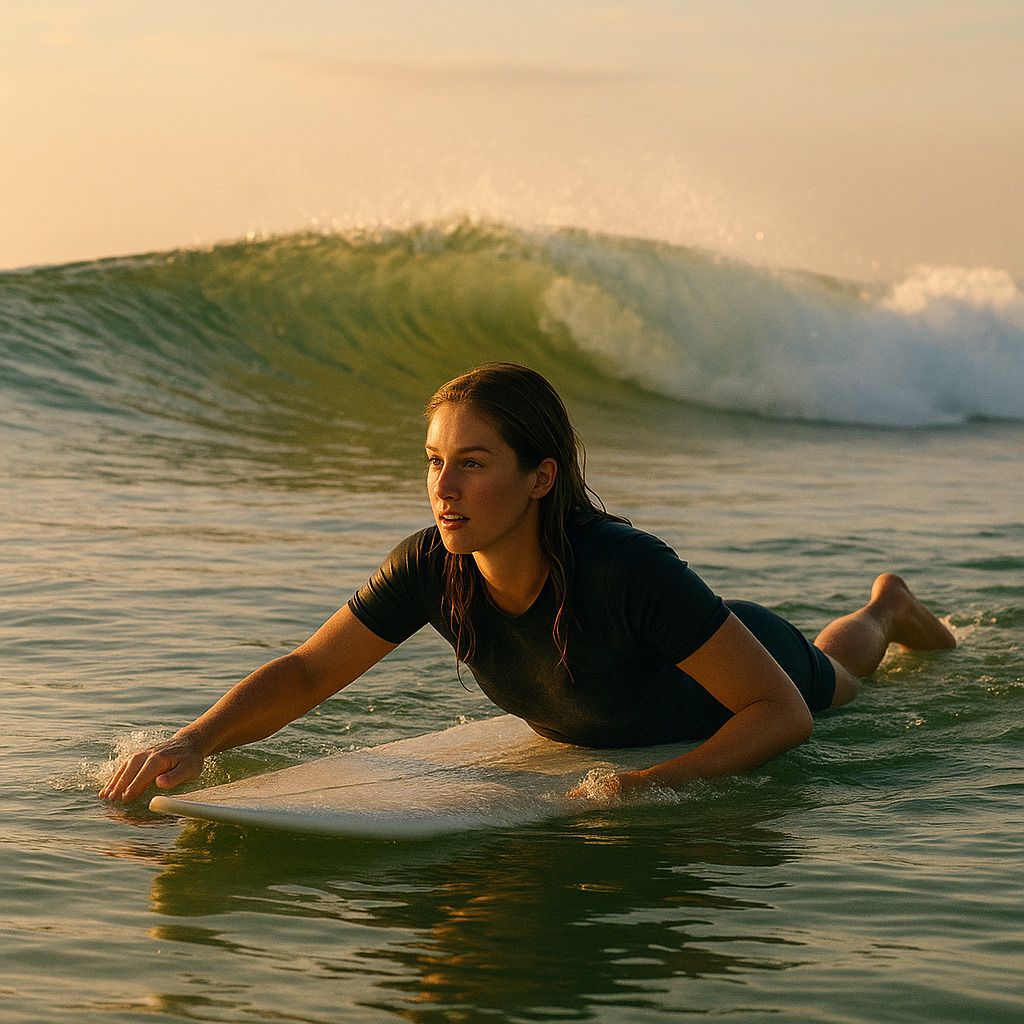
Paddling is surfing’s true engine and first surprise: it’s less about fighting the ocean and more about learning to move with it. Keep your chest lifted just enough that your nose isn’t plowing and your lower back isn’t screaming. Look where you’re going, long strokes, fingers slightly cupped. You’ll tend to paddle too short and too frantic; imagine instead you’re slowly climbing a ladder that stretches into the horizon. Each stroke should matter. This is where you learn rhythm—like a song that measures itself in breath and distance instead of beats. If a whitewater wave approaches, you’ll “press-and-knee” or push up slightly and let the foam roll between you and the deck. You’ll get shoved back. That’s fine. You don’t win by brute force; you win by reading the ocean better.

Somewhere past the shore break, there’s a quiet lane where the waves calm down before they rise. This is the lineup, and it’s a classroom with no walls. You’ll sit or belly down and watch the water breathe—lulls, sets, shifts. That surfer over there looks relaxed? They’re not lazy; they’re scanning. What is the wind doing? Are sets arriving every few minutes with two or three larger waves? Are people catching rides on the inside or farther out by a deeper channel? You’ll see patterns. Human beings are built for pattern-spotting. It’s just that the ocean likes to shuffle the deck now and then, and part of the humility of surfing is accepting that your patterns are always provisional.

Then comes your first wave—the conversation you’ve been eavesdropping on since you waxed that board. You’re positioned a little inside so you don’t have to sprint yourself into a heart attack. You turn the board toward shore, glance over your shoulder as the bump becomes a wall, and paddle with intent. The wave lifts you like a question. Two more strokes. One more. You’ll want to stand early. Don’t. Feel the board start to slide on its own—like a shopping cart that suddenly got a motor—then pop up decisively. Hands under you, hips driving forward, eyes up, feet landing wider than you think, front foot aiming slightly forward, back foot perpendicular, knees soft. If your eyes are down at your feet, you go down. If your chest is over the stringer and you’re looking where you want to go, you stand a chance.

You’ll stand for a second or ten. It will feel like standing on a rolling coin. Your instincts will argue. One will say “freeze” and the other will scream “lean!” Try neither. Bend, breathe, and let your ankles do the listening. Surfing is a thousand tiny adjustments you don’t consciously calculate. Your eyes read the slope; your hips translate; your feet write the sentence. When the ride ends (and it will, sooner than you want), step off rather than dive headfirst, keep the board away from your body, and come up protecting your head. If you wipe out harder than expected—and you will—know that wipeouts are the price of admission, not a sign you don’t belong. Everyone pays the cover.

Etiquette enters early. It isn’t gatekeeping; it’s traffic rules so the game stays fun and nobody collects fin marks on their shins. The surfer closest to the peak has priority; don’t drop in on someone’s right-of-way. Look both ways before you paddle for a wave; if someone’s already riding, pull back. Don’t paddle straight through the face of a wave someone is surfing—go around the shoulder or through the whitewater behind them. Smile. Apologize if you mess up. People forgive beginners who are respectful. They side-eye beginners who act like the ocean is a private amusement park. Learn who’s learning around you; celebrate their rides. Surfing can be solitary, but it’s a solitary sport done in company.

You’ll discover tides. They aren’t just “high or low”—they’re energy and geometry. On some beaches, mid-tide is your friend, smoothing the takeoff zone. On others, low tide turns the shore into a conveyor belt of closeouts, while high tide gives fat, slow rollers perfect for practice. You’ll learn to notice winds: morning glass before the sea breeze kicks up; afternoons that turn the surface into corduroy. Dawn patrol isn’t a personality trait; it’s a strategy. If you’re worried about crowds, early sessions are merciful. If you’re worried about cold, a light spring suit or fullsuit is a magic cape. Wetsuits aren’t just warmth; they’re flotation and courage.

Some days, progress feels like an escalator; other days it’s like trying to exit a crowded subway going the wrong way. You’ll plateau. Accept it. Plateaus are where technique consolidates and confidence catches up. On those days, choose goals that aren’t scoreboard-based: catch three clean whitewater rides to full pop-up; paddle out without turning turtle; finish with more energy than you started. Surfing asks you to be proud of ordinary wins. That’s how extraordinary ones sneak up on you.

Gear questions will appear like pop-up ads in your brain: Should I switch to a smaller board? When does a fish make sense? What about fins? Wax? Leash length? Here’s the quiet answer: keep gear simple while fundamentals grow. Your “next board” is not a trophy; it’s a teacher. If your soft-top still challenges you when the waves are a little bigger or cleaner, it’s still the right board. When you can catch unbroken waves consistently and angle down the line—not just go straight—then a mid-length (say 7’0”–7’6”) or a funboard transition opens new doors. Fins matter, but not as much as your paddle strength and pop-up timing. Wax smells like coconut so you buy more than you need; that’s okay.

The ocean will scare you sometimes, honestly, and that’s healthy. Fear is part warning system, part performance enhancer. The trick is to aim your fear at skills instead of avoidance. If you’re scared of getting held down, practice duck-dives or turtle-rolls in small surf and learn to count calmly underwater—one breath, one number. If rips worry you, learn to spot them—darker, ruffled water moving seaward—and treat them as conveyor belts you can exit by angling sideways to the sandbar rather than sprinting directly against them. If crowds stress you, move down the beach or pick a less “perfect” peak; an imperfect wave ridden is better than a perfect wave watched.

Training creeps in without feeling like homework when you anchor it to your goals. Two or three short swims a week condition your shoulders without the mileage; a resistance band routine keeps your rotator cuffs happy; light yoga grooves pop-up mobility and lower back resilience. Balance trainers are fun but optional; better to practice controlled land pop-ups and light jogs than to collect gadgets. The best “training plan” for beginners is a session plan: pick conditions with waves you can read, sessions short enough that your technique doesn’t collapse, and a simple focus like “late pop-ups” or “angled takeoffs.” Keep a notes app log—date, tide, wind, what you learned, what to try next. It’s shockingly motivating to see your ocean diary fill up.

There’s a social map to surfing that you’ll begin to decode. Some beaches throw “localism” like a wall; others welcome like a picnic. You can’t control that, but you can control how you show up—curious, respectful, stoked for everyone’s ride, and honest about your limits. Ask a lifeguard where beginners usually go. Watch a few sets before you paddle out. If a peak has six impatient shortboarders each with hero fantasies, don’t prove anything. Walk fifty yards. An easy wave with room to breathe is a better coach than a perfect wave with sharp elbows.

And then, the best part: surfing does strange, generous things to your life outside the water. You hydrate more. You sleep better. You start checking wind forecasts before checking your email. Mornings feel like presents you open on the sand. You become the person who understands that a single amazing ride is enough to turn a hard week into a good story. When friends ask how it’s going, you don’t brag about how many waves you caught; you talk about the one you almost had, how you learned to wait, the gull that looked like it was laughing at you, and that moment when you were paddling back out and the light turned the lip of a wave into a green window and you could see right through it. You start collecting moments like that—pocket-sized miracles, salt-cured and bright.

What should you realistically expect in your first ten sessions? Expect to be tired, but from the good kind of work. Expect to be humbled, and then to laugh at yourself more sweetly than you used to. Expect one or two rides that make you yell out loud without meaning to. Expect a handful of small scrapes: wax on your rashguard, a leash burn, a tiny bruise where the board kissed your thigh. Expect to learn that sunscreen is not a suggestion and water is fuel. Expect to meet strangers who pat their boards like pets and tell you the tide is “doing something weird.” Expect to get hooked, not on the image of surfing, but on the practice: the ritual of paddling out, the way time dilates, the fact that success is partly skill and partly generosity from something bigger than you.

Over weeks and months, your expectations will change. You’ll go from “I hope I stand up” to “I hope I angle right and make that section” to “I hope I find an empty bank and work on trimming.” You’ll learn to see waves that haven’t yet revealed themselves, to feel the slight lift in the water before it’s visible, to sense how a wave wants to be ridden and to oblige it instead of demanding it be something else. That’s perhaps the secret—surfing works best when you collaborate, not conquer. You’re not putting the ocean in your pocket; you’re borrowing a moment from it.

You’ll also learn that rest days are part of the practice. Surfers love to pretend they live on a permanent sabbatical, but bodies have bandwidth. Let your shoulders recover. Take a bike ride. Watch a point break cam with coffee and notice which surfers never look rushed. Read a book about ocean currents and realize that what pushes a wave across a whole planet is the same energy that nudges your board forward in that final, perfect instant before you stand.

If there’s a single mindset that keeps beginners progressing, it’s this: surf small goals, celebrate them loudly, and stack them early. A “small goals session” might look like: paddle out and back in three times without resting on the beach; practice ten smooth sand pop-ups before paddling out; sit on the board for a full minute without putting your feet down; angle your takeoff a little instead of going straight; end session while you still feel crisp. Small wins compound. They become muscle memory. Muscle memory becomes style. Style becomes the quiet signature you’ll leave on a wave someday when you’re not thinking about anything other than how good it feels to be alive.

Someday soon you’ll have a session that replays itself when you’re trying to fall asleep. The light is maybe a little gold. You’re in the spot you picked on purpose. The set builds. You’re calm. You turn with time to spare, paddle strong, feel the lift, commit to the pop-up later than your nervous system prefers, land clean, knees soft, eyes forward. You angle slightly, the board hums, and for a breath or five you’re weightless—hanging off the edge of your old life like a person peeking into a party they’re suddenly invited to. You kick out. You lie there grinning. The next wave marches in as if nothing happened, but something did. You’ll carry it all day, all week. This is what to expect.

If you want a practical checklist in plain words, here’s the quiet version, smuggled into the paragraphs above. Start on a big soft-top—your ego can handle it and your skills will thank you. Practice pop-ups on sand until the movement feels inevitable. Paddle with long, smooth strokes and a lifted chest. Choose mellow, uncrowded peaks and learn the traffic rules early so you make friends, not enemies. Read conditions: get curious about tides, winds, and bottom contour. Exit wipeouts with calm, protect your head, and find your leash before you stand up. Train off the water just enough to keep shoulders happy and hips mobile. Log your sessions. Sleep. Repeat. Smile at strangers with boards under their arms because you already know something about their day.

And then, welcome to the long game. You’ll tinker forever—stances, timing, lines, boards, fins, beaches, friend groups, playlists for early drives, snacks for the parking lot, the perfect change of clothes, the lucky towel. You’ll become the kind of person who notices cloud texture and thinks about wind. You’ll turn into the friend who can tell, by the smell in the air thirty minutes from the coast, if the sea is warming up. You’ll collect a dozen slightly ridiculous rituals that only make sense to surfers. That’s the real expectation: surfing will fold into your life until it’s not a hobby at all, but a place where you go to become a clearer version of yourself for a little while. The surprise is that this is available to anyone who’s willing to be a beginner for long enough.

If you need one more reason to begin now, consider this: the ocean is the most patient teacher in the world. It doesn’t care how you look in a wetsuit. It doesn’t ask how much you bench. It doesn’t even mind when you shout after a tiny ride like you just won a medal. It just keeps rolling up, class after class, in simple blue lines, asking you to pay attention. Most of surfing is just that: attention paid in salty coins over and over until you’ve accidentally bought yourself a life you recognize as your own. That’s what you can expect. Everything else is a bonus.

Finally, a few practical images to carry with you into those first sessions—pictures you can pull up with your eyes closed: the long slow paddle where each stroke is a note in a song you wrote that morning; the way you look over your shoulder and feel the lift like a hand at your lower back guiding you forward; the sudden quiet right before you pop; the glitter-sparkle of water at fin level when you’re trimming; the ridiculous laugh you can’t suppress when you fall and pop up grinning anyway. Make a pocket for those moments. That’s your souvenir bag. You’ll refill it for years.

When you pack up after a session—board rinsed, leash wrapped, wetsuit hanging like a tired superhero costume—you’ll feel subjectively taller. You earned a nap. Food tastes better. The traffic home is less insulting. You might hum along to a song you would normally skip. Surfing isn’t spiritual in a grand, serious way unless you want it to be; it’s spiritual in an everyday way that helps you name the day: I went out, I tried, I fell, I learned, I stood, I felt alive. Tomorrow might be flatter, windier, busier; doesn’t matter. You learn to greet the ocean as it is, and maybe yourself that way, too. That’s the surprise at the center of this sport: you came for the waves, and you leave with a better way to live your life between them.

When you finally call yourself a surfer, nobody gives you a certificate. You’ll just notice that your car knows the route on its own, that your shoulders are stronger than your patience used to be, that your phone’s weather widget looks like a secret code, and that you don’t mind waiting anymore. Waiting becomes part of the pleasure. You wait for tide, for wind, for sets, for that one friend who’s always late, for your turn, for your wave. In a world that begs you to sprint, surfing teaches you to arrive. That might be the best thing to expect of all.

Related Posts

Two Declarations on a Summer Day: How August 20 Wrote the End of One War and the Beginning of Another

Elias Rowen

On an August day that might otherwise have passed like any other—humid, slow, the air shimmering above cobblestones—two signatures on two very different pieces of paper nudged the world onto quieter, healthier tracks. On August 20, 1866, President Andrew Johnson proclaimed the last embers of the U.S. Civil War officially extinguished, a legal coda to the most convulsive conflict in American history. Thirty-one years later to the day, on August 20, 1897, a British physician named Ronald Ross peered through a microscope in Secunderabad and found, in the gut of a mosquito, the living chain that bound humankind to one of its oldest scourges. Two acts—one political, one scientific—never met in the same column inches of a newspaper, yet they rhyme: an ending and a beginning, both about the possibility of peace, one between people and the other between people and a parasite.

Consider first the proclamation. By 1866, the cannons had long since fallen silent. Lee had surrendered the previous spring; the armies had stacked their muskets and drifted home, some to farms long neglected, others to cities rethreading their industrial looms. The Union had held, but victory did not feel like triumph. There were ghosts everywhere—empty chairs at rough-hewn tables, burned courthouses along roads that had been turnpikes of death, an unfinished Constitution waiting for amendments that would try to transmute pain into law. Soldiers carried letters creased into soft squares, wedding rings on chains, and injuries that medicine could not name, let alone cure. Reconstruction had begun, but so had an argument about what “reconstruction” meant: restoration or remaking; punishment or pardon; rights on paper or rights in practice.

Johnson’s proclamation of August 20 did not fill this argument with answers. It was a punctuation mark rather than a paragraph—a formal declaration that all the states once in rebellion were at peace, that the “insurrection” was over. Proclamations are a peculiar literary form: they turn facts into law by speaking them out loud. On Johnson’s desk, the document said what history would accept: that the shooting war had ended, that the country could tax and govern as a single thing again, that railways and river ports and courthouses operated under one flag. It did not mend the broken moral timber of the nation; it could not. Paper can only become scaffolding; it is people who must climb it. But the date mattered. Governments tell themselves—and their citizens—where they stand by fixing words to calendars. August 20, 1866 said: this chapter is closed. It did not declare that the next chapter would be easy, or just, or even coherent.

If we listen carefully, we can hear the sounds outside the White House windows that day: hoofbeats, wagon wheels, distant hammers. Peace is noisy at first because rebuilding is noisy. Bricks tumble; saws bite; arguments rise and fall over the price of nails and the length of leases. Freedpeople stood in lines to register their marriages, to sign labor contracts, to find their names written by clerks who didn’t always know how to spell them but were obligated, now, to try. In those rooms, the promise of the Thirteenth Amendment pressed against the reality of Black Codes and vigilante violence. Johnson’s pen could declare peace, but it could not forbid cruelty. The paper ending one war made space, at best, to fight others: the fight for equality, for schooling, for fair wages, for the vote, for dignity. Proclamations can clear the table; they cannot set it.

Shift the lens thirty-one years forward and nine thousand miles east, to a laboratory warm enough that insects hummed like stray wires. There, Ronald Ross hunted a mystery that had stalked humanity since before the first wall was built or the first hymn was sung. Malaria—fever that comes like the tide; chills that shake the bones like a drum; anemia that whitens lips and eyelids; a disease so old that it seems part of the climate—had killed mothers and emperors alike, had shaped road maps and harvest calendars, had whispered into the ears of generals planning campaigns. People blamed night air, marsh mists, the position of stars. Doctors suspected “parasites” but could not complete the story of how. Ross spent long days studying the thin blood of birds and men, and the fragile bodies of insects no wider than a fingernail clipping. On August 20, he held a mosquito under his lens and saw the parasite in its gut: proof that the insect was not incidental but essential, that the mosquito was a bridge carrying the disease from one human island to another.

Where Johnson’s proclamation tried to close a book, Ross’s discovery opened a field. It gave public health what war had taught generals: strategy. Once you know the path of your enemy, you can break it. Drain the swamps. Screen the windows. Hang nets at night like gauzy sanctuaries. Spray the walls. Map the breeding sites the way engineers map rivers. Train nurses to recognize fevers and pharmacists to dispense quinine. Textbooks could now write down what folk wisdom had sensed—stay away from the mosquito—and turn it from caution into program. In a single microscope slide, the world’s view of disease shifted from myth to mechanism, and mechanism is a language that policies can speak.

The beauty of August 20 is therefore not just historical coincidence but conceptual harmony. Ending a civil war and starting a campaign against malaria seem to belong to different shelves of a library; yet both are about weaning the future off chaos. War is a fever that breaks nations; malaria is a war conducted on a cellular front. Johnson’s proclamation, for all its gaps and political controversy, made space for people to imagine a republic bigger than gunfire. Ross’s insight, for all the iterations and refinements that followed, made space for villages to imagine nights quieter than the hungry whine of Anopheles. Each event says: if you trace a problem to its structure—whether constitutional or biological—you have more than hope; you have handles.

This is not to polish away the rough edges. Johnson’s postwar policies are a tangle of pardons and vetoes, leniencies that emboldened former Confederates, and conflicts with a Congress determined to protect the rights of newly freed citizens. Reconstruction was brutally contested; its retreat scarred generations. The proclamation of August 20 stamped a seal on peace while vigilantes were already stitching masks and lawmakers were already imagining barriers at ballot boxes. We must hold both facts: the importance of the statement and the insufficiency of the settlement. The war’s end date is a legal truth; the work of justice is a longer arc, sometimes bent backwards by hands unwilling to learn.

Ross’s discovery, too, did not settle everything. The parasite’s life cycle unfolds with a trickster’s flair—moving from mosquito to human blood to human liver and back to blood again—so the new knowledge was a doorway, not a destination. Eradication would prove to be a greater dream than control. Quinine mitigated but did not cure; newer drugs emerged, the parasite evolved, insecticides worked until they didn’t; climate and poverty colluded to keep breeding grounds where roofs needed nets and nets sometimes went unused because heat and habit trumped instruction. Public health is politics by other means: budgets, logistics, trust. And mosquitoes do not require passports; borders do not hold back wings.

Yet hold the two Augusts in your palm and they warm like twin coins. Both declare that naming a thing matters. Johnson named the end of formal rebellion so that courts and counties could coordinate life after carnage. Ross named the vector so that villages and hospitals could coordinate life after ignorance. We are so used to thinking of power as either a president’s pen or a scientist’s pipette that we forget how they complement each other. Law makes the lanes; science paves them. Without the proclamation, Reconstruction’s bureaucracies would have lacked an anchor; without Ross’s diagrams, public health would have lacked a map. Together they remind us that progress is multidisciplinary: paper and glass, signatures and slides.

Think about the human beings around these events, the ones who didn’t get recorded. In 1866, a widow in Tennessee may have read the proclamation in a newspaper and felt a strange mixture of relief and resentment, hope and hunger. A freedman in South Carolina may have folded the page into his pocket and walked to a meeting where someone explained a contract clause that he didn’t like but might accept for now. A child in Richmond asked her father if the soldiers were really gone this time. Meanwhile, in 1897 India, a soldier shivered in a barracks bed beneath a net that smelled faintly of smoke, a nurse refilled a kerosene lamp, and somewhere a clerk wrote down the number of men feverish in a company that week. History is a telescope, but it is also a field guide—what matters is how it helps the next person act.

Perhaps the most powerful shared lesson of August 20 is that “official” does not mean “finished,” and “discovery” does not mean “delivered.” Those are invitations, not finales. Proclamations summon citizens to build the peace their leaders announce. Discoveries summon communities to adopt the prevention their scientists design. The arc from Johnson to Ross, from political settlement to microbial understanding, is an arc of responsibility migrating outward from the page to the street. The test of any peace is not the date you inscribe but the schools you open, the courts you staff, the farms you replant, the punishments you do not inflict. The test of any discovery is not the journal in which it appears but the clinics you equip, the water you drain, the screens you hang, the lives you lengthen.

We live with their legacies, not as museum pieces but as daily habits. Every election held in a courthouse rebuilt during Reconstruction is a descendant of August 20, 1866. Every night a child sleeps without fever behind a net in a village with a sprayed wall is a descendant of August 20, 1897. And every time disease surges where trust thins, every time resentment is fanned into retrenched inequality, we glimpse where those legacies were neglected. The day’s lessons are not sentimental but stern: peace must be policed by justice; science must be coupled to services.

If you need one image to carry forward, imagine two hands. In the left, a pen above a proclamation; in the right, a hand turning the knurled focusing wheel of a microscope. Between them floats a single imperative: name what is wrong, and then build what will make it right. For all the complexities of Reconstruction, for all the complexities of malaria control, the core is simplicity itself—complex problems demand both authority and understanding, both policy and proof. We honor August 20 by refusing to separate them.

Our century has inherited new plagues and revived old hatreds; we should know by now that emergencies do not stay politely in their categories. Health emergencies are political; political emergencies have public health consequences. A hurricane knocks out power to clinics; a war births a cholera outbreak in camps; a pandemic rearranges the choreography of voting lines. If Ross and Johnson could sit together on a porch and trade notes, they might each be surprised by the other’s vocabulary—amendments and oocysts are not often heard in the same sentence—but they would recognize the moral: legitimacy matters, and so does evidence. You must settle who we are to each other, and you must learn what is happening in our bodies and our water and our air. Only then do you get the sturdy kinds of peace.

There is a kind of courage in both stories that is easy to overlook. Johnson’s political courage, such as it was, is filtered through a record speckled with failure and conflict; he often refused the courage required to protect the newly freed. Still, to say officially that a war is over is to risk being judged on whether the peace that follows is worthy of the sacrifices that bought it. Ross’s courage was the slow kind, the patience that sits through hour after hour of trial and error. It’s romantic to talk about “eureka moments,” but most discoveries are a long apprenticeship in looking, a craft of enduring tedium and doubt. He had to believe his eyes when they told him something many found implausible, and then he had to persuade others without the brute force of bombs or ballots—only sketches, slides, and calm argument.

If our task is to carry this date forward, the path is clear enough. We can build policies that strengthen the fabric of belonging—schools that teach honest histories; voting systems that invite participation rather than restrict it; courts that administer rights consistently. We can also build the infrastructures of health—labs that monitor, clinics that reach the last village, budgets that anticipate rather than react, campaigns that respect culture as much as they respect data. We can measure success not by the absence of crisis headlines but by the presence of ordinary, life-sustaining routines: mornings without gunfire, nights without fever, summers that feel like seasons instead of sieges.

History does not usually offer such a crisp pairing as August 20. That’s part of why it’s worth pausing over. One day, two declarations: we are done killing each other; we now understand how this disease spreads. Neither promise was fully realized, neither will ever be. But the human project is not perfection; it is improvement. To celebrate this date is to recommit to that project—to the steady work of closing the gap between what the law says and what life feels like, between what the microscope shows and what the clinic can supply. It’s to refuse fatalism in the face of old evils by summoning new tools and fairer rules.

And so, each August 20, let’s read both documents again—the proclamation and the notes from a microscope bench—as if they were addressed to us. The first says, “You may set down your rifles.” The second says, “You must pick up your screens.” Together they say, “Make a world where children inherit fewer reasons to fear the dark.” That is the country, the community, the planet worth building: one in which our debates are loud but not lethal, and our fevers rare, brief, and survivable. The calendar does not cause progress, but it can remind us of the days when we made some.

Here’s the story in plain, human terms. On August 20, 1866, the U.S. government officially said, “The Civil War is over.” People had already stopped shooting, but this put a stamp on it. It meant the country could stitch itself back together—messily, unevenly, with a lot of arguments and pain still to come. That paper didn’t fix everything—far from it—but it gave a starting line for rebuilding.

Exactly thirty-one years later, on August 20, 1897, a doctor named Ronald Ross found proof that malaria spreads through mosquitoes. That single moment at a microscope changed how we fight the disease: use nets, drain standing water, screen the windows, and treat people fast. It didn’t end malaria everywhere, but it turned a mystery into a plan.

Both August 20 moments are about the same idea: you can’t fix what you don’t name. One document named the end of a war so the country could move forward. One discovery named the messenger of a killer disease so communities could protect themselves. They’re reminders that progress takes both leadership and learning—laws and labs, proclamations and proof. And they quietly ask us to keep going: build a fairer peace, and put health within everyone’s reach.

Related Posts