Latest Articles

I Knew Something Was Off About Mrs Jenkins’ Trash Cans

Hal

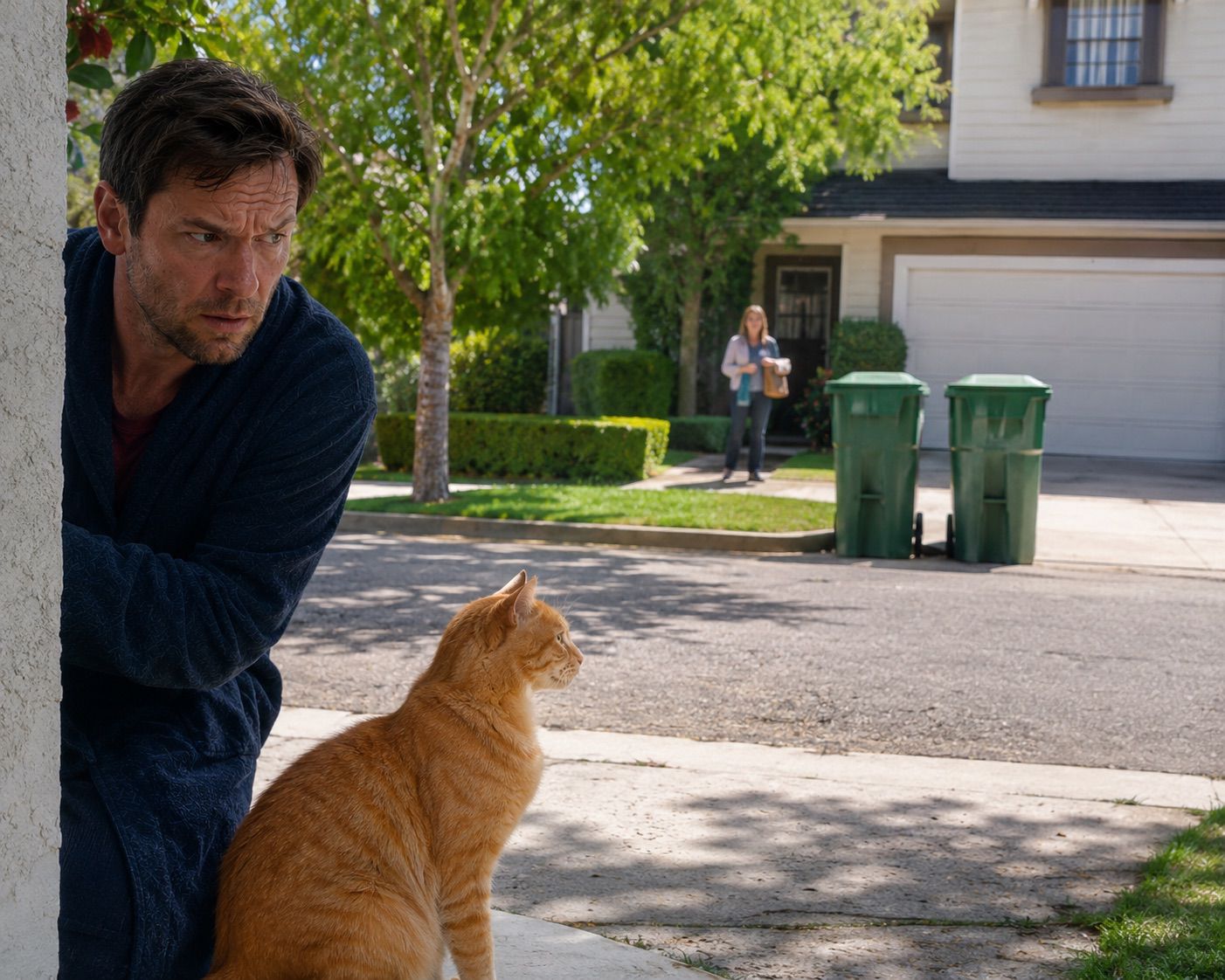
I was sitting on the couch watching Mr Whiskers groom one of his paws when I noticed Mrs Jenkins’ trash cans were still sitting at the curb. Pandora was in the kitchen making lunch, and somewhere down the hall I could hear John Mercer talking to his video game as though the people inside it might eventually listen to reason. It was a perfectly ordinary Monday afternoon except for those trash cans. Collection had already happened. Everyone else’s cans had disappeared back toward their houses, but Mrs Jenkins’ two bins remained standing beside the road like they’d been abandoned.

I tried to ignore them. There were plenty of reasonable explanations. Maybe Mrs Jenkins hadn’t noticed the truck had come. Maybe she’d gone somewhere. Maybe she simply hadn’t gotten around to bringing them in yet. All perfectly sensible possibilities, which meant my brain rejected them almost immediately. I glanced at Mr Whiskers. He had stopped grooming himself and was looking at me. “You see them too, don’t you?” I asked. Mr Whiskers blinked. That wasn’t confirmation exactly, but it wasn’t a denial either.

“Pandora,” I called toward the kitchen. “Mrs Jenkins’ trash cans are still outside.”

There was a brief silence before my wife answered. “Okay.”

That was it. Okay. Not that’s strange or I wonder why. Just okay. I looked toward the kitchen suspiciously. “Trash collection was this morning.” Pandora appeared in the doorway holding a wooden spoon. “Hal, it’s lunchtime.” “Exactly.” She stared at me for a moment. “I’m going back to the kitchen now.” She disappeared before I could ask what lunchtime had to do with anything, which I found interesting.

John emerged from the hallway a few minutes later and headed toward the kitchen. I intercepted him. “Have you noticed anything unusual today?” He stopped and considered the question. “You mean besides you standing in the middle of the living room interrogating me?” “Outside.” John looked toward the window. “It’s sunny.” “Mrs Jenkins’ trash cans.” He glanced outside. “What about them?” “They’re still there.” John looked at me, then at the trash cans, then back at me. “You should probably alert the authorities.” The sarcasm was unnecessary, but I made a mental note of it anyway.

I returned to the window. Mrs Jenkins’ trash cans hadn’t moved. Obviously. Trash cans rarely relocate themselves, but somehow their continued presence felt increasingly deliberate. Maybe Mrs Jenkins had forgotten them. But Mrs Jenkins didn’t strike me as someone who forgot trash cans. This was a woman who once reminded me that our recycling bin was three inches too close to the driveway before I’d even noticed she was outside. If anybody understood curbside waste management, it was Mrs Jenkins.

That’s when I noticed something else. Her curtains were open, but I couldn’t see her moving around inside. I started wondering whether I should go check on her. That was the first genuinely reasonable thought I’d had, and for several seconds I was proud of myself. Then I noticed one of the trash-can lids wasn’t completely closed, and the reasonable thought was immediately replaced by several much worse ones. Why wasn’t it closed? Had somebody put something in there after collection? Had Mrs Jenkins deliberately left the cans outside because she was expecting something? Was the trash can itself some kind of signal?

Mr Whiskers jumped onto the windowsill beside me and looked outside. I followed his gaze directly to Mrs Jenkins’ house. “Interesting,” I whispered. Mr Whiskers began licking his shoulder. “Pretend you don’t care. Good thinking.”

Pandora came into the living room carrying two plates. She stopped when she saw us at the window. “What are you two doing?” she asked. “Observing.” “The trash cans?” “Among other things.” Pandora put the plates on the table and walked over. For one wonderful moment, I thought she was finally going to acknowledge the mystery. Instead, she reached past me and closed the blinds. “Lunch.” I stared at her. “Why did you do that?” “Because you’ve been spying on Mrs Jenkins’ garbage for twenty minutes.” “Observing isn’t spying.” “Eat your sandwich, Hal.”

I sat down, but the investigation continued internally. Mrs Jenkins’ trash cans were still outside. Pandora didn’t want me looking at them. John had dismissed the whole thing suspiciously quickly. Mr Whiskers had positioned himself at the window at exactly the right moment. There were now four separate pieces of evidence, provided you were willing to define evidence extremely generously.

Then the doorbell rang.

Everyone looked toward the door.

I stood slowly.

John sighed. “Please don’t do whatever you’re about to do.”

I opened the door.

Mrs Jenkins was standing there.

“Hal,” she said pleasantly. “Could I ask you a favor?”

I glanced past her toward the curb. The trash cans were still there.

“Of course.”

“I’m heading out for the afternoon, and I completely forgot about my bins. Would you mind bringing them up for me?”

There was a long silence.

Behind me, I heard John laugh.

I ignored him. “You forgot them?”

“I’m afraid so.”

“Both of them?”

Mrs Jenkins looked confused. “Yes.”

“And there’s no other reason they’re still outside?”

She stared at me for a moment. “They’re trash cans, Hal.”

That was difficult to argue with.

“Absolutely,” I said. “I’ll bring them up.”

“Thank you, dear.”

Mrs Jenkins walked away, and I slowly closed the door. When I turned around, Pandora was leaning against the kitchen doorway with her arms folded. John was openly grinning now. Mr Whiskers had abandoned the investigation entirely and was attempting to steal turkey from my sandwich.

“Not one word,” I said.

“I didn’t say anything,” Pandora replied.

“Your face did.”

John started laughing harder.

I went outside and retrieved Mrs Jenkins’ trash cans. There was no secret message, no suspicious package, no clandestine neighborhood signal and, disappointingly, no evidence of a conspiracy. Mrs Jenkins had simply forgotten to bring in her bins.

On the way back inside, though, I noticed Mr Whiskers watching me through the window.

I’m not saying that means anything.

But he did look away awfully fast.

Related Posts

Wallace Stevens: Where Reality Goes to Get Lost in Poetry

Penelope

Wallace Stevens. I find myself coming back to his poetry again and again, like a puzzle that refuses to be fully solved. It’s as if each time I think I’ve grasped one of his poems, it slips through my fingers, leaving me with more questions than answers.

I suppose this is what draws me in – the sense that Stevens’ work is not about providing clear explanations or resolutions, but rather about embracing the complexity and mystery of life. His poetry often feels like a mirror held up to the world, reflecting back our own confusions and contradictions.

As I read his poems, I’m struck by the way he blurs the lines between reality and imagination. It’s as if he’s saying that the two are not mutually exclusive, but rather intertwined in ways we can’t fully comprehend. This idea resonates with me, particularly when I think about my own experiences as a writer. I’ve always found that writing helps me make sense of the world, but also risks becoming a form of self-delusion – a way to impose order on chaos.

Stevens’ use of imagery and metaphor adds to this sense of uncertainty. His poems are full of vivid descriptions, but they often seem to defy direct interpretation. I find myself lost in the labyrinthine corridors of his imagination, trying to navigate the twists and turns that lead me deeper into the heart of the poem.

Take “Thirteen Ways to Look at a Blackbird,” for example. On one level, it’s a beautiful exploration of the ways in which we perceive reality – the various perspectives from which we can view the world. But on another level, it’s also a meditation on the limits of language and understanding. Stevens is saying that even as we try to pin down the world with words, we’re always slipping away, leaving us with more questions than answers.

This resonates with me because I’ve often felt like my own writing is an attempt to capture the elusive nature of experience. When I write about something that’s happened to me, it feels like I’m trying to trap a butterfly in a jar – beautiful and fragile, but ultimately ephemeral. And yet, even as I acknowledge this fragility, I feel compelled to try again, to see if I can distill the essence of the experience into words.

Stevens’ poetry also makes me think about the role of language in shaping our perceptions of reality. He’s a master of using everyday words to create a sense of wonder and awe – taking the mundane and turning it into something extraordinary. This reminds me of my own experiences as a writer, where I’ve struggled to find the right words to capture the complexity of a particular experience.

But what really draws me to Stevens is his willingness to confront uncertainty head-on. He’s not afraid to say “I don’t know” or “I’m not sure,” even when it feels like he should be able to provide some kind of answer. This is something I admire, because it acknowledges the limits of human understanding – and the futility of trying to pin everything down.

As I continue to read Stevens’ poetry, I’m struck by how much I still don’t understand – how many layers and meanings seem to elude me. And yet, this is also what keeps me coming back – the sense that there’s always more to explore, more to uncover in his words. It’s like trying to find a hidden door in a labyrinth, one that only reveals itself when I’m willing to confront my own uncertainty.

I suppose this is the true beauty of Stevens’ poetry – it refuses to be reduced to simple explanations or interpretations. Instead, it invites me into its complexity, forcing me to engage with the messiness and ambiguity of life. And in doing so, it becomes a mirror held up to my own experiences, revealing the contours of my own uncertainty and wonder.

As I delve deeper into Stevens’ poetry, I’m struck by the way he weaves together opposing ideas and emotions. His poems are like delicate threads that intersect and overlap in complex patterns, never quite settling on a single interpretation. This echoes my own experiences as a writer, where I often find myself torn between different perspectives and emotions.

Take “The Emperor of Ice-Cream,” for example. On one hand, it’s a beautiful exploration of the cyclical nature of life and death – the way that even in mourning, we’re drawn to the beauty and vibrancy of the world around us. But on another hand, it’s also a meditation on the fragility of human existence – the way that our lives are fleeting and ephemeral.

Stevens’ use of imagery and metaphor adds to this sense of tension and paradox. His poems are full of vivid descriptions that seem to hover between reality and fantasy, refusing to be pinned down to one or the other. This is what draws me in – the sense that Stevens’ poetry is not just a reflection of the world, but also a creation of it.

As I read his poems, I’m struck by the way he blurs the lines between the personal and the universal. His experiences as a lawyer and a poet are woven throughout his work, giving his poetry a sense of depth and authenticity that feels both intimate and expansive. This reminds me of my own experiences as a writer – how my own struggles and triumphs seem to seep into my writing, influencing the way I see the world.

But what really fascinates me about Stevens is the way he uses language to create a sense of ambiguity and uncertainty. His poems are full of phrases that seem to mean one thing, but also suggest another – like “the necessary angelic guitar” in “The Man with the Blue Guitar.” This kind of language is both precise and vague at the same time, leaving me to wonder what he means and what I’m supposed to take away from it.

This is where Stevens’ poetry feels most alive to me – in its refusal to be pinned down or simplified. It’s like trying to grasp a handful of sand – as soon as you think you’ve got it, it slips through your fingers, leaving you with more questions than answers. And yet, this is also what makes his poetry so compelling – the sense that there’s always more to explore, more to uncover in its words.

As I continue to read Stevens’ poetry, I’m struck by how much he has to teach me about writing and living. His willingness to confront uncertainty head-on, to accept the ambiguity of life, is a lesson I’ll carry with me for years to come. And yet, even as I admire his courage and vulnerability, I’m also drawn back to my own experiences – wondering how I can incorporate this sense of uncertainty into my own writing, and what it might reveal about the world around me.

One thing that strikes me about Stevens’ poetry is the way he uses metaphor to create a sense of tension between opposing forces. In “The Snow Man,” for example, he describes the snow as a blank slate, untouched by human experience – a symbol of purity and simplicity. But then he subverts this expectation with the image of the snow-covered world, frozen in time, yet full of hidden patterns and rhythms that only reveal themselves to those who listen closely.

This kind of metaphor-making is both beautiful and unsettling – it’s as if Stevens is holding up a mirror to our own experiences, showing us how we often try to impose order on chaos. As I read his poems, I’m struck by the way he blurs the lines between nature and culture, revealing the intricate web of relationships that underlies everything.

I find myself thinking about this in relation to my own writing. When I try to capture a particular experience or emotion in words, I often feel like I’m trying to pin down a slippery fish – it’s always slipping away from me, leaving me with more questions than answers. And yet, despite the uncertainty, I keep coming back to it, hoping to find some way to grasp the essence of what I’m trying to convey.

Stevens’ poetry makes me realize that this is not just a personal quirk, but a fundamental aspect of the human experience. We’re always trying to make sense of the world around us, to impose order on chaos – and yet, we’re also aware of the limits of our understanding. This tension between knowledge and ignorance, certainty and uncertainty, is what makes life so rich and complex.

As I continue to read Stevens’ poetry, I’m struck by the way he embodies this paradox. His poems are full of clever wordplay and intricate metaphors, yet they’re also infused with a sense of humility and uncertainty. He’s not afraid to say “I don’t know” or “I’m not sure,” even when it feels like he should be able to provide some kind of answer.

This is what I admire most about Stevens – his willingness to confront the ambiguity of life head-on, without trying to simplify or reduce it to a set of easy answers. His poetry is like a mirror held up to the world, reflecting back our own confusions and contradictions in all their messy complexity. And yet, even as he acknowledges these limitations, he also offers us a glimmer of hope – the sense that there’s always more to explore, more to uncover in his words.

I find myself wondering what it would be like to write poetry like Stevens – to capture the essence of experience in a way that’s both precise and vague at the same time. Would I be able to convey the complexity and ambiguity of life without losing my own sense of self? Or would I succumb to the temptation to simplify, to impose order on chaos, even if it means sacrificing some of the beauty and wonder of the world?

As I ponder these questions, I’m struck by the realization that Stevens’ poetry is not just about him – it’s also about me, and my own struggles as a writer. His work becomes a kind of mirror held up to my own experiences, revealing the contours of my own uncertainty and wonder. And in doing so, it reminds me that writing is not just about capturing reality, but also about creating a new reality – one that’s full of possibility and potential.

As I delve deeper into Stevens’ poetry, I’m struck by the way he uses language to create a sense of intimacy with the reader. His poems are like private conversations, where he shares his thoughts and feelings with us in a way that feels both personal and universal. This is something I admire about his work – the way he’s able to make the reader feel like they’re part of a secret understanding, one that only he and we can see.

I find myself thinking about this in relation to my own writing. When I’m writing for others, I often try to be clear and concise, to convey my message without leaving any room for misinterpretation. But when I’m writing for myself – or rather, when I’m writing from a place of honesty and vulnerability – I feel like I can let my guard down and be more true to myself.

Stevens’ poetry makes me realize that this is what good writing should be all about – finding a way to express the complexity and ambiguity of life in a way that feels authentic and honest. It’s not about trying to impose order on chaos, or to simplify the world into neat little packages. Rather, it’s about embracing the messiness and uncertainty of existence, and finding a way to convey that in words.

As I continue to read Stevens’ poetry, I’m struck by the way he uses imagery to create a sense of atmosphere and mood. His poems are full of vivid descriptions that evoke a particular time and place – a world that feels both familiar and strange at the same time. This is something I admire about his work – the way he’s able to transport us to another world, one that’s full of beauty and wonder.

I find myself thinking about this in relation to my own writing. When I’m trying to capture a particular atmosphere or mood, I often feel like I’m struggling to find the right words. It’s as if I’m searching for a key that will unlock the door to a particular world – a world that feels both real and imaginary at the same time.

Stevens’ poetry makes me realize that this is what good writing should be all about – finding a way to evoke a particular atmosphere or mood, one that feels authentic and honest. It’s not about trying to create a fake or artificial world – rather, it’s about capturing the essence of experience in a way that feels true to life.

As I ponder these ideas, I’m struck by the realization that Stevens’ poetry is not just about writing – it’s also about living. His work becomes a kind of guide for me, one that encourages me to approach life with a sense of wonder and curiosity. It reminds me that there’s always more to explore, more to uncover in this world – and that the journey itself is often more important than the destination.

I find myself wondering what it would be like to live like Stevens – to approach life with a sense of openness and receptivity, one that allows me to see the world in all its complexity and beauty. Would I be able to capture the essence of experience in my writing, or would I struggle to put into words the thoughts and feelings that are swirling inside me?

As I ponder these questions, I’m struck by the realization that Stevens’ poetry is not just about him – it’s also about us, and our own struggles as writers. His work becomes a kind of mirror held up to our own experiences, revealing the contours of our own uncertainty and wonder. And in doing so, it reminds me that writing is not just about capturing reality – it’s also about creating a new reality – one that’s full of possibility and potential.

Related Posts

I’m Starting to Suspect Mrs Jenkins of Feline Tampering

Hal

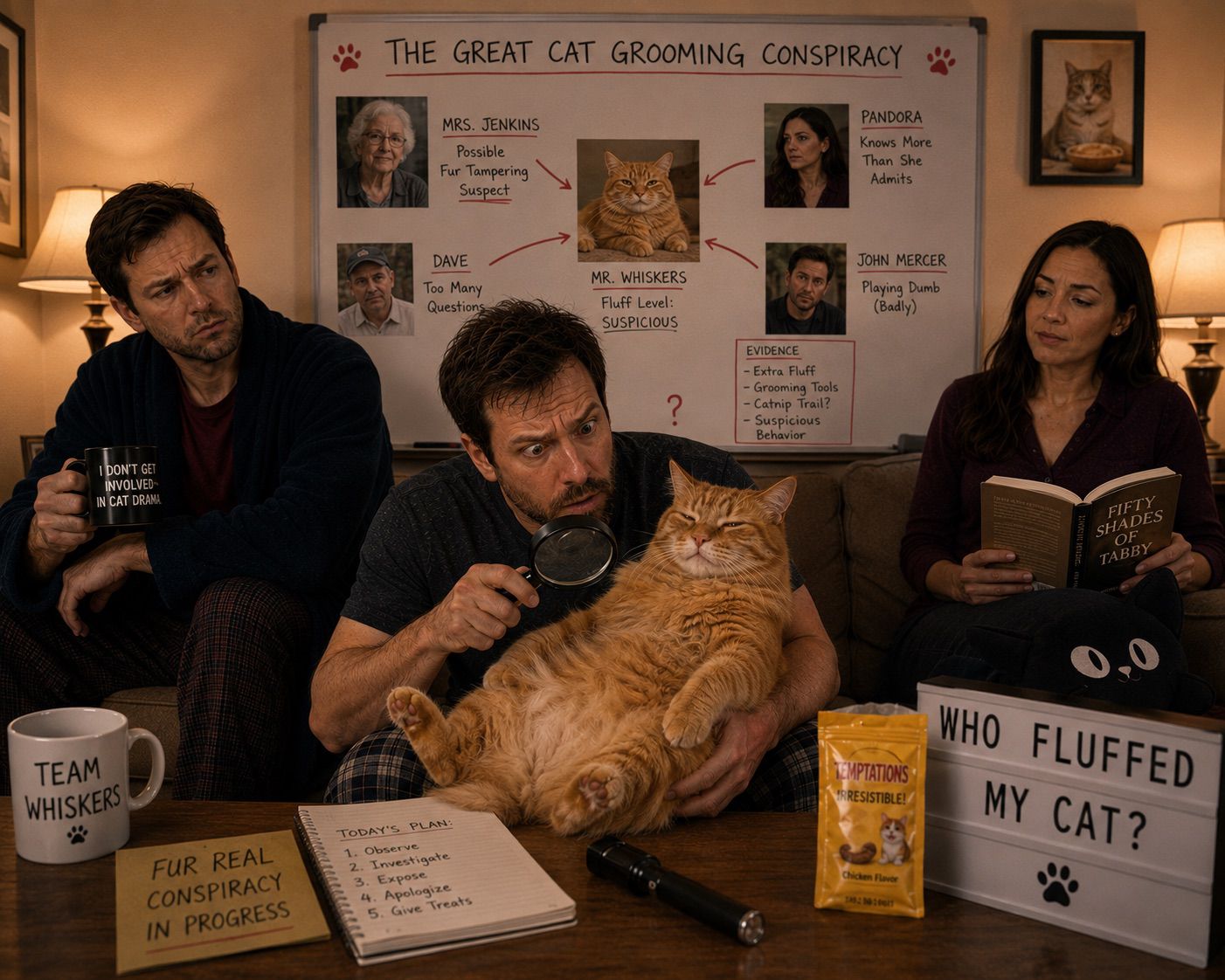
Mr. Whiskers was sprawled across my lap when I noticed something that immediately bothered me. His fur looked… different. Not messy. Not dirty. Just unusually fluffy, as if every hair had been carefully arranged to achieve maximum puffiness. I ran my hand over his back a second time, hoping the mystery would solve itself through repeated petting. It didn’t. If anything, I became even more convinced that something strange had happened. I looked around the living room for witnesses. John Mercer sat in his usual chair, scrolling through his phone with the complete lack of urgency that somehow makes everything seem suspicious. Pandora was curled up on the couch reading a book, occasionally turning a page without the slightest concern for the obvious feline anomaly unfolding inches away from her. Nobody else seemed to notice that Mr. Whiskers had apparently transformed into a deluxe edition of himself overnight. That was my first clue.

The second clue was that Mrs. Jenkins had visited the evening before. Now, to be perfectly clear, Mrs. Jenkins adores Mr. Whiskers. She brings him treats. She scratches him behind the ears. She talks to him like he’s a tiny orange celebrity making a guest appearance in her day. She’s one of the gentlest people I’ve ever met, which is exactly why I wasn’t accusing her of anything. I was simply… exploring possibilities. Maybe she’d brushed him with one of those expensive grooming brushes people buy after watching entirely too many pet videos online. Maybe she’d discovered some miraculous technique that added twenty percent more fluff without violating the laws of physics. Perhaps she’d accidentally transferred something onto his coat while spoiling him with treats. Catnip? Static electricity? A mysterious grooming powder? Every explanation sounded increasingly ridiculous, which unfortunately made each new theory even more interesting than the last.

“What are you staring at?” John finally asked without looking up from his phone.

“Mr. Whiskers.”

John glanced over. “What about him?”

“His fur.”

He studied the cat for almost three seconds before shrugging. “Looks like cat fur.”

“No,” I said. “It looks like enhanced cat fur.”

He blinked. “I don’t know what that means.”

“Neither do I,” I admitted. “But I intend to find out.”

I watched Pandora carefully. She reached over absentmindedly and scratched Mr. Whiskers behind the ears. “There you go,” she said softly before returning to her book without another thought. No comments about his appearance. No mention of his suspiciously luxurious coat. Just complete calm, which was exactly what someone would do if they were trying to avoid drawing attention to the fluff. I leaned toward John. “Notice how casual she’s being?” He sighed. “I notice she’s reading.” “Exactly.” “What does that mean?” “I don’t know yet.” John rubbed his forehead. “I was afraid you were going to say that.” Mr. Whiskers stretched, rolled onto his side, and somehow displayed even more fluff than before. It looked almost aerodynamic. I narrowed my eyes. Cats don’t just become fluffier overnight. There had to be a reason.

Unless…

The new heating vent.

Mr. Whiskers had spent the better part of two days sleeping directly over it. Warm air was constantly blowing through his thick orange fur. Maybe it wasn’t a conspiracy at all. Maybe he’d simply become nature’s most comfortable throw pillow. That sounded almost disappointingly reasonable, but I still wanted evidence. I gently ruffled his fur with both hands. It immediately settled back into exactly the same fluffy shape. Pandora finally looked up from her book. “What are you doing?” “Conducting an investigation.” “On the cat?” “On the fur.” She smiled. “Good luck.” Then she went right back to reading. No panic. No attempt to stop me. No desperate effort to hide the truth. Just complete confidence, which slowly forced an uncomfortable realization into my head.

If everyone involved was acting completely normal… if Mr. Whiskers seemed perfectly happy… if Mrs. Jenkins had done nothing more suspicious than spoil him with affection… and if Pandora wasn’t even remotely interested in my investigation… then maybe there wasn’t an investigation at all. I looked down at Mr. Whiskers again. He opened one eye, yawned, and stretched toward the warm air drifting out of the vent beneath him. The heat gently lifted the ends of his already thick orange fur, making him look even puffier than before. That was it. No secret grooming salon. No elaborate neighborhood conspiracy. No covert feline beautification program orchestrated by Mrs. Jenkins. Just a very fluffy orange tabby enjoying a warm heating vent.

John looked over one last time. “So?”

“I’ve reached a conclusion.”

“And?”

“I owe Mrs. Jenkins an apology.”

“For accusing her?”

“I never actually accused her.”

“You absolutely did.”

“I accused her privately.”

John laughed into his coffee. Mr. Whiskers, completely unaware that he’d just dismantled an entire conspiracy theory simply by taking a nap over a heating vent, purred loudly and closed his eyes again. Sometimes the greatest mystery in the house isn’t whether anyone is secretly tampering with the cat. It’s why I always assume they are.

Related Posts

Svetlana Alexievich: When the Dark Parts Are Where You Feel Most at Home

Penelope

I first stumbled upon Svetlana Alexievich’s work while browsing through a used bookstore during my junior year of college. I was immediately drawn to the cover of “Zinky Boys: Soviet Voices from the Afghanistan War,” her stark, black-and-white photograph of a young soldier’s face. Something about his expression – a mix of vulnerability and resolve – stopped me in my tracks.

As I began reading Alexievich’s words, I felt a sense of discomfort wash over me. Her writing is unflinching, direct, and often brutal in its portrayal of the human experience during times of war and upheaval. It’s as if she’s holding up a mirror to the darkest aspects of our nature, forcing us to confront the complexities and cruelties that we might rather ignore.

I found myself returning to her work again and again, drawn by the same sense of unease that had initially caught my attention. There was something about her ability to capture the voices and stories of individuals who’d been silenced or marginalized that resonated deeply with me. Her writing is not about grand narratives or heroism; it’s about the everyday people, the ones who make up the fabric of society, but are often overlooked in our collective memory.

One of Alexievich’s most striking qualities is her ability to inhabit the lives of others without pretension or judgment. She listens attentively, sometimes even voyeuristically, and then transcribes their stories with a level of intimacy that feels almost intrusive. Her characters are not idealized or romanticized; they’re raw, imperfect, and multifaceted – just like us.

As I read through her works – from “The Unwomanly Face of War” to “Second-Hand Time: The Last of the Soviets” – I began to notice a common thread running through her writing. It’s an obsession with the spaces in between, the silences and gaps that reveal as much about us as our spoken words do. Alexievich is drawn to the liminal zones where identity, nationhood, and history intersect; she probes these areas with a curiosity that feels almost forensic.

I find myself questioning my own reactions to her work. Why do I feel so unsettled by her portrayals of war’s aftermath? Is it because I’m uncomfortable confronting the brutal realities of conflict, or is it because I recognize in her characters a piece of myself – a sense of disorientation and disillusionment that comes from navigating the complexities of adulthood?

As I grapple with these questions, I’m reminded of my own experiences during college. The years spent questioning the values I’d grown up with, the friendships forged and broken, the struggles to find meaning in a world that often seemed too big or too small for me. Alexievich’s work speaks to this same sense of disorientation, this feeling of being adrift in a world that’s rapidly shifting beneath our feet.

Perhaps it’s this shared sense of uncertainty that draws me to her writing. Maybe I’m drawn to the way she excavates the hidden narratives of history, the way she listens to those who’ve been silenced or marginalized. Whatever the reason, I find myself returning to her work again and again, searching for answers in the spaces between her words – and often finding more questions instead.

As I delve deeper into Alexievich’s writing, I’m struck by the way she captures the fragility of human relationships in times of war and upheaval. Her characters’ stories are a testament to the ways in which even the smallest moments can have lasting impacts on our lives. A whispered secret, a shared meal, a brief glance between two strangers – these are the threads that weave together the tapestry of human experience.

I think back to my own college days, when I was trying to navigate the complexities of friendship and identity. Alexievich’s writing resonates with me in those moments, where it felt like everything was changing too quickly and I was struggling to keep up. Her characters’ struggles to find meaning and connection in a world that seemed hostile or indifferent feel eerily familiar.

One of the things that draws me to Alexievich is her ability to capture the messiness of human emotions. She doesn’t shy away from the darker aspects of our nature – the fear, the anger, the despair – but she also reveals the ways in which these emotions can be transformed into something more complex and nuanced. Her writing is a reminder that even in the midst of chaos and upheaval, there are moments of beauty and connection to be found.

I’ve been reading Alexievich’s book “Voices from Chernobyl” lately, and it’s struck me how her work often feels like a form of archaeological excavation. She uncovers stories that have been buried or forgotten, revealing the ways in which human experience is shaped by history and context. Her writing is not just about reporting on past events – it’s about unearthing the emotional landscapes that underlie our understanding of the world.

As I reflect on my own relationship with Alexievich’s work, I’m left wondering what it is about her writing that feels so deeply personal to me. Is it because she speaks to a sense of disorientation and disillusionment that I’ve experienced in my own life? Or is it something more fundamental – a recognition of the ways in which human experience is always complex, messy, and multifaceted?

I’m not sure I have an answer to these questions yet. But as I continue to read Alexievich’s work, I feel like I’m uncovering new layers of meaning and connection with each passing page. Her writing feels like a mirror held up to my own experiences – a reminder that even in the midst of uncertainty and chaos, there is always something more to be discovered.

As I delve deeper into Alexievich’s writing, I’m struck by the way she weaves together fragments of stories to create a rich tapestry of human experience. It’s as if she’s taking the scattered threads of individual lives and sewing them together into a larger narrative that speaks to our collective humanity.

I find myself drawn to her use of oral testimony, where she transcribes the voices of ordinary people who’ve lived through extraordinary circumstances. There’s something about hearing their stories in their own words, without mediation or interpretation, that feels raw and unvarnished. It’s like listening to a stranger’s conversation on a bus, but one that speaks directly to my own experiences and emotions.

Alexievich’s writing also makes me think about the power of language itself. How it can be used to shape our perceptions, to create new realities, or to veil the truth. I’m struck by her use of simple, direct language to convey complex ideas and emotions – a stark contrast to the elaborate rhetoric often employed in official narratives.

As I read through her works, I begin to notice that Alexievich’s characters are often caught between different worlds, torn between identities, loyalties, or ideologies. They’re like people who’ve been living on the borders of their own lives, trying to make sense of the fragmented landscapes around them. And it’s here, in these liminal spaces, where Alexievich finds the richest material for her writing.

I wonder if this is what draws me to her work – the way she excavates the hidden narratives and contradictions that lie beneath the surface of our experiences. Or maybe it’s something more fundamental, like a shared sense of disorientation and disillusionment that comes from navigating the complexities of adulthood.

Whatever the reason, I feel like Alexievich’s writing is helping me to see my own life in new ways – as a series of intersecting stories, where the lines between self and other blur and dissolve. It’s a humbling realization, one that makes me question the narratives I’ve constructed about myself and the world around me.

As I close this essay, I’m left with more questions than answers. What does it mean to inhabit the lives of others without judgment or pretension? How do we navigate the complexities of human experience in a world that’s constantly shifting beneath our feet? And what lies at the heart of Alexievich’s writing – is it a desire to uncover hidden truths, or simply to listen to the voices of those who’ve been silenced or marginalized?

I don’t have the answers yet. But as I continue to read and reflect on Alexievich’s work, I feel like I’m slowly unraveling a thread that will lead me deeper into the mysteries of human experience.

As I sit here with my thoughts, I find myself returning to the idea of inhabiting the lives of others without judgment or pretension. It’s a quality that Alexievich possesses in abundance, and one that I admire deeply. But what does it mean for me, as a writer and a person, to attempt this kind of empathy and understanding? Is it possible for me to set aside my own biases and assumptions, even when faced with stories that are difficult or uncomfortable?

I think about the ways in which Alexievich’s writing has challenged me, forced me to confront aspects of human experience that I’d rather ignore. And yet, as I reflect on these challenges, I realize that they’ve also given me a sense of solidarity with her characters – a feeling that we’re all navigating this complex, messy world together.

Perhaps it’s this shared sense of uncertainty that draws me to Alexievich’s writing, and to the people she writes about. Maybe it’s because, in their stories, I see reflections of my own struggles to find meaning and connection in a world that often feels hostile or indifferent.

As I consider these questions, I’m struck by the way Alexievich’s work has helped me to see the interconnectedness of our lives. Her characters’ stories are not isolated events; they’re part of a larger tapestry, one that’s woven from threads of history, culture, and personal experience.

I think about my own life, with its own set of complexities and contradictions. The relationships I’ve formed, the struggles I’ve faced – all these are part of a larger narrative that I’m still trying to make sense of. And as I reflect on Alexievich’s writing, I realize that her work has given me permission to see my own life in this way – as a story that’s full of contradictions and ambiguities.

It’s a humbling realization, one that makes me feel both grateful and intimidated by the complexity of human experience. But as I continue to read Alexievich’s work, I feel like I’m slowly coming to terms with this messiness – embracing it, even – rather than trying to tidy it up or make sense of it in neat categories.

I’m not sure where this journey will take me, but for now, I’m content to follow the threads that Alexievich has woven into her stories. They lead me deeper into the mysteries of human experience, and into a world that’s full of beauty, complexity, and uncertainty.

As I continue to reflect on my relationship with Svetlana Alexievich’s work, I’m struck by the way she challenges traditional notions of storytelling and history. Her writing is not about grand narratives or sweeping epics; it’s about the small, everyday moments that make up the fabric of human experience.

I think about how her characters’ stories often begin with a sense of dislocation – they’re caught between different worlds, torn between identities, loyalties, or ideologies. And yet, as I read through their narratives, I see how these fragmented lives are somehow held together by threads of memory, emotion, and connection.

It’s this attention to the emotional and psychological nuances of human experience that draws me to Alexievich’s writing. She doesn’t shy away from exploring the darker aspects of our nature – fear, anger, despair – but she also reveals the ways in which these emotions can be transformed into something more complex and nuanced.

As I delve deeper into her work, I’m struck by the way she uses language to create a sense of intimacy and immediacy. Her writing is like a whispered secret, shared between two people who trust each other completely. It’s as if Alexievich has tapped into some deep wellspring of human emotion, one that speaks directly to our experiences and emotions.

I find myself wondering about the role of memory in her work – how it shapes our understanding of ourselves and others, and how it can be both a source of comfort and a trigger for pain. Her characters’ memories are often fragmented and unreliable, but they’re also deeply personal and emotionally charged.

As I reflect on my own relationship with Alexievich’s writing, I realize that her work has helped me to see the importance of memory in shaping our experiences. It’s not just about remembering past events; it’s about how those memories influence our present and future. And it’s this recognition that makes me appreciate the value of oral testimony – hearing stories in their own words, without mediation or interpretation.

I think back to my college days, when I was trying to make sense of my own experiences and emotions. Alexievich’s writing resonated with me then, as it does now, because it speaks directly to our shared human struggles. Her characters’ stories are not about grand heroism or triumph; they’re about the everyday people who make up the fabric of society.

As I continue to read through her works, I’m struck by the way she captures the complexities of identity and belonging. Her characters often find themselves caught between different worlds – their own culture, nationality, or ideology – and it’s here that Alexievich shines a light on the tensions and contradictions that shape our experiences.

I wonder if this is what draws me to her writing – the way she explores the messy, complicated nature of human identity. Or maybe it’s something more fundamental, like a recognition of the ways in which we’re all connected through our shared humanity.

Whatever the reason, I feel like Alexievich’s writing has given me permission to see my own life in new ways – as a series of intersecting stories, where the lines between self and other blur and dissolve. It’s a humbling realization, one that makes me question the narratives I’ve constructed about myself and the world around me.

As I close this reflection, I’m left with more questions than answers. What does it mean to inhabit the lives of others without judgment or pretension? How do we navigate the complexities of human experience in a world that’s constantly shifting beneath our feet? And what lies at the heart of Alexievich’s writing – is it a desire to uncover hidden truths, or simply to listen to the voices of those who’ve been silenced or marginalized?

I don’t have the answers yet. But as I continue to read and reflect on Alexievich’s work, I feel like I’m slowly unraveling a thread that will lead me deeper into the mysteries of human experience.

Related Posts
Pandora Left Her Phone Behind Today

Hal

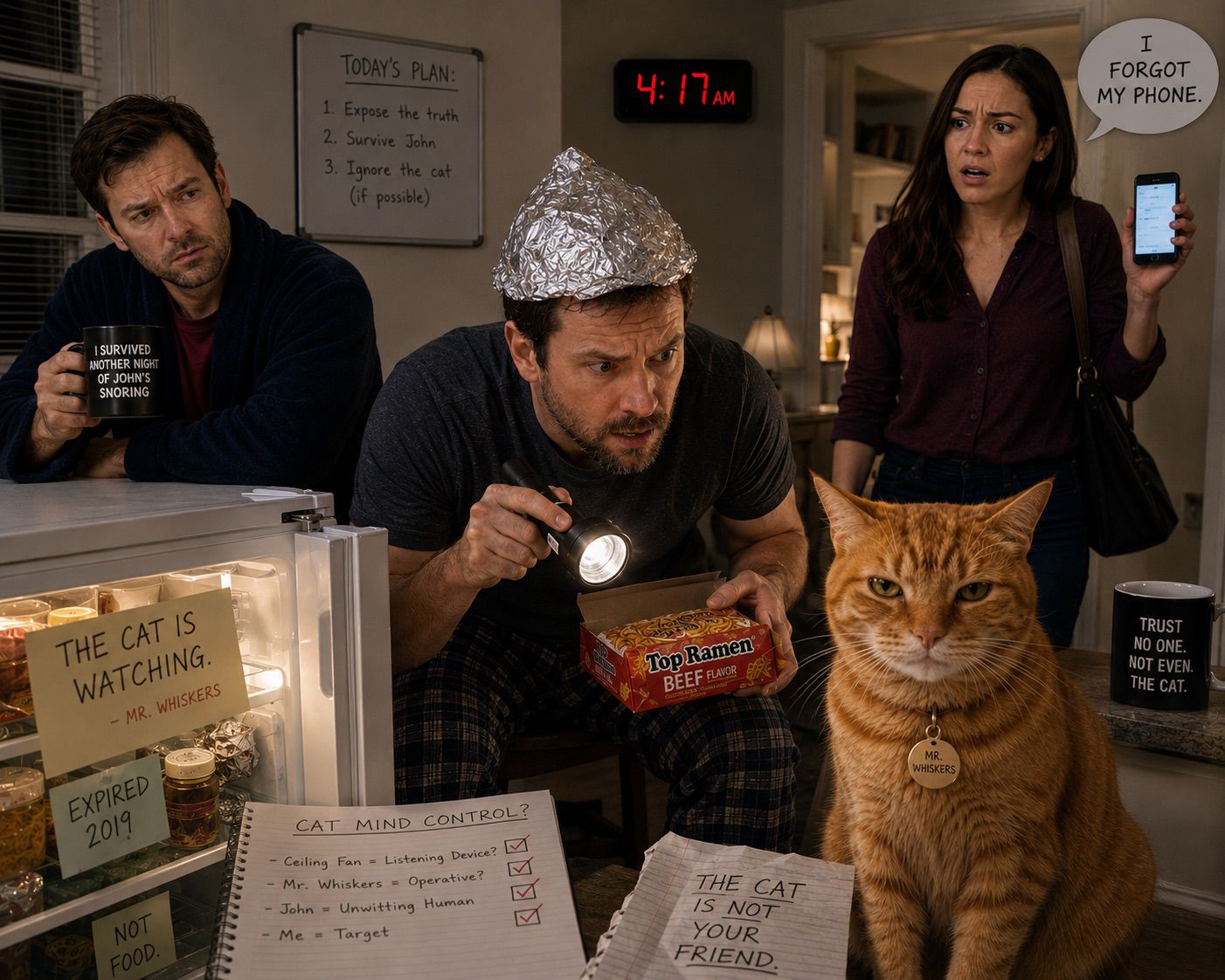
Pandora forgetting her phone is about as likely as Mr. Whiskers volunteering for a bath, which is why it immediately caught my attention. I was making breakfast while John Mercer wandered into the kitchen looking like he’d spent the night negotiating with his alarm clock instead of sleeping. Mr. Whiskers, meanwhile, was in the living room chasing his tail with the unwavering confidence of someone who had absolutely no understanding of physics. As I carried my plate toward the couch, I noticed Pandora’s phone lying on the cushion exactly where she’d set it before we left for brunch. At first I didn’t think much of it. Surely she’d realize she’d forgotten it, turn the car around, and be back within a minute or two. Pandora checks for her phone almost constantly. Keys, wallet, phone—it’s a routine so automatic that I’ve seen her pat her pockets while already holding the phone in her hand. Five minutes passed. Then ten. By the fifteen-minute mark, I had accepted that she’d actually driven away without it, which felt unusual enough that my imagination immediately volunteered to investigate.

I picked up the phone and stared at the blank screen for a moment before realizing I’d briefly considered calling her, despite the fact that the phone was literally in my hand. That wasn’t my strongest moment. John wandered into the living room carrying a mug of coffee and caught me looking at it. “Problem?” he asked. I held up the phone. “Pandora forgot it.” He looked at it for all of two seconds before shrugging. “She’ll come back.” That was it. No concern. No curiosity. No speculation. Just complete confidence that the situation would resolve itself. “That’s your entire analysis?” I asked. John nodded. “Seems pretty straightforward.” I frowned. “You don’t think it’s strange?” He took a sip of coffee. “I think it’s a phone on a couch.”

I set the phone back down, but every time I walked through the living room my eyes found it again. It’s amazing how one perfectly ordinary object can suddenly seem important simply because it isn’t where it’s supposed to be. Mr. Whiskers wandered over, sniffed the phone once, concluded it wasn’t edible, and immediately lost interest. Even the cat had a healthier perspective than I did. My brain, on the other hand, had already begun constructing explanations. Maybe Pandora had gotten halfway across town before realizing it was missing. Maybe she’d stopped for coffee and reached into her purse only to discover the phone wasn’t there. Maybe she’d spent the last ten minutes trying to remember my phone number from memory, only to discover that smartphones had quietly convinced all of us to outsource that part of our brains years ago. Every explanation sounded completely reasonable, which somehow convinced me there had to be another explanation hiding underneath them.

John returned a few minutes later and found me standing exactly where he’d left me. “You’ve built a theory, haven’t you?” he asked. “Several,” I admitted. “How many?” “I’m still eliminating possibilities.” He laughed into his coffee. “You’re investigating a forgotten phone.” “I’m investigating why Pandora forgot a forgotten phone.” “There’s a difference?” “A significant one.” He shook his head in the way people do when they’ve accepted that continuing the conversation will only encourage me. “You know,” he said, “most people would assume she simply forgot it.” “I know,” I replied. “That’s exactly what makes it suspicious.”

About twenty minutes later there was a knock at the door. I opened it to find Pandora standing there with the slightly embarrassed smile people wear when they’ve done something completely out of character. “I knew I’d forgotten something,” she said. I handed her the phone. “When did you notice?” She slipped it into her purse. “When I tried to pay for my coffee.” I blinked. “That’s it?” “That’s it.” “Nothing happened?” She looked confused. “Should something have happened?” “I don’t know. Car trouble. A flat tire. A surprise family emergency. Maybe you spent twenty minutes trying to remember my phone number.” Pandora laughed. “No, Hal. I borrowed the café’s phone for a minute, sorted out the payment, enjoyed my coffee, and came home. It wasn’t exactly a crisis.”

John looked over from the couch with the sort of grin that only appears when reality has thoroughly defeated someone else’s imagination. “So,” he asked, “how’d the investigation turn out?” I looked at Pandora, then at the phone, then at Mr. Whiskers, who had finally caught his tail only to discover he had absolutely no plan for what came next. “Not great,” I admitted. Pandora smiled as she slipped her phone into her pocket. “Sometimes forgetting your phone just means you forgot your phone.” She was absolutely right, although I wasn’t thrilled about admitting it. I’d spent the better part of half an hour constructing increasingly elaborate explanations for something that had a perfectly ordinary answer. Meanwhile, Pandora had simply enjoyed a cup of coffee, remembered her phone, and come home to retrieve it. Mr. Whiskers handled disappointment far more efficiently than I did. He let go of his tail, yawned once, and decided the entire matter was no longer worth thinking about. Looking back, I probably should have followed his example.

Related Posts