Latest Articles

Pandora Left Her Phone Behind Today

Hal

Pandora forgetting her phone is about as likely as Mr. Whiskers volunteering for a bath, which is why it immediately caught my attention. I was making breakfast while John Mercer wandered into the kitchen looking like he’d spent the night negotiating with his alarm clock instead of sleeping. Mr. Whiskers, meanwhile, was in the living room chasing his tail with the unwavering confidence of someone who had absolutely no understanding of physics. As I carried my plate toward the couch, I noticed Pandora’s phone lying on the cushion exactly where she’d set it before we left for brunch. At first I didn’t think much of it. Surely she’d realize she’d forgotten it, turn the car around, and be back within a minute or two. Pandora checks for her phone almost constantly. Keys, wallet, phone—it’s a routine so automatic that I’ve seen her pat her pockets while already holding the phone in her hand. Five minutes passed. Then ten. By the fifteen-minute mark, I had accepted that she’d actually driven away without it, which felt unusual enough that my imagination immediately volunteered to investigate.

I picked up the phone and stared at the blank screen for a moment before realizing I’d briefly considered calling her, despite the fact that the phone was literally in my hand. That wasn’t my strongest moment. John wandered into the living room carrying a mug of coffee and caught me looking at it. “Problem?” he asked. I held up the phone. “Pandora forgot it.” He looked at it for all of two seconds before shrugging. “She’ll come back.” That was it. No concern. No curiosity. No speculation. Just complete confidence that the situation would resolve itself. “That’s your entire analysis?” I asked. John nodded. “Seems pretty straightforward.” I frowned. “You don’t think it’s strange?” He took a sip of coffee. “I think it’s a phone on a couch.”

I set the phone back down, but every time I walked through the living room my eyes found it again. It’s amazing how one perfectly ordinary object can suddenly seem important simply because it isn’t where it’s supposed to be. Mr. Whiskers wandered over, sniffed the phone once, concluded it wasn’t edible, and immediately lost interest. Even the cat had a healthier perspective than I did. My brain, on the other hand, had already begun constructing explanations. Maybe Pandora had gotten halfway across town before realizing it was missing. Maybe she’d stopped for coffee and reached into her purse only to discover the phone wasn’t there. Maybe she’d spent the last ten minutes trying to remember my phone number from memory, only to discover that smartphones had quietly convinced all of us to outsource that part of our brains years ago. Every explanation sounded completely reasonable, which somehow convinced me there had to be another explanation hiding underneath them.

John returned a few minutes later and found me standing exactly where he’d left me. “You’ve built a theory, haven’t you?” he asked. “Several,” I admitted. “How many?” “I’m still eliminating possibilities.” He laughed into his coffee. “You’re investigating a forgotten phone.” “I’m investigating why Pandora forgot a forgotten phone.” “There’s a difference?” “A significant one.” He shook his head in the way people do when they’ve accepted that continuing the conversation will only encourage me. “You know,” he said, “most people would assume she simply forgot it.” “I know,” I replied. “That’s exactly what makes it suspicious.”

About twenty minutes later there was a knock at the door. I opened it to find Pandora standing there with the slightly embarrassed smile people wear when they’ve done something completely out of character. “I knew I’d forgotten something,” she said. I handed her the phone. “When did you notice?” She slipped it into her purse. “When I tried to pay for my coffee.” I blinked. “That’s it?” “That’s it.” “Nothing happened?” She looked confused. “Should something have happened?” “I don’t know. Car trouble. A flat tire. A surprise family emergency. Maybe you spent twenty minutes trying to remember my phone number.” Pandora laughed. “No, Hal. I borrowed the café’s phone for a minute, sorted out the payment, enjoyed my coffee, and came home. It wasn’t exactly a crisis.”

John looked over from the couch with the sort of grin that only appears when reality has thoroughly defeated someone else’s imagination. “So,” he asked, “how’d the investigation turn out?” I looked at Pandora, then at the phone, then at Mr. Whiskers, who had finally caught his tail only to discover he had absolutely no plan for what came next. “Not great,” I admitted. Pandora smiled as she slipped her phone into her pocket. “Sometimes forgetting your phone just means you forgot your phone.” She was absolutely right, although I wasn’t thrilled about admitting it. I’d spent the better part of half an hour constructing increasingly elaborate explanations for something that had a perfectly ordinary answer. Meanwhile, Pandora had simply enjoyed a cup of coffee, remembered her phone, and come home to retrieve it. Mr. Whiskers handled disappointment far more efficiently than I did. He let go of his tail, yawned once, and decided the entire matter was no longer worth thinking about. Looking back, I probably should have followed his example.

Related Posts

Erich Auerbach: The Puzzle That Refuses to Unravel (Even Though It Should Have By Now)

Penelope

I’ve been reading Erich Auerbach’s work for a few weeks now, and I’m still trying to wrap my head around his ideas about literature and history. What keeps drawing me back is the way he talks about how texts can be both deeply personal and universally relevant at the same time. It sounds like a simple concept, but the more I read him, the more it feels like a puzzle that refuses to fit neatly together.

I remember taking a course on medieval literature during my senior year of college, and we spent weeks dissecting Auerbach’s book “Mimesis.” At the time, his arguments about how ancient Greek and Roman texts differed from their medieval counterparts seemed dry and academic. I was more interested in the actual stories themselves – Homer, Virgil, Dante – than in the theoretical framework surrounding them.

But something about Auerbach’s writing stuck with me long after the course ended. Maybe it was the way he wove together seemingly disparate threads of history, literature, and philosophy to create a rich tapestry that I couldn’t look away from. Or maybe it was his willingness to confront the complexity and messiness of human experience head-on.

As I’ve continued reading Auerbach’s work, I find myself coming back to one particular idea: the concept of “figural interpretation.” For those who might not know (like me until recently), figural interpretation is a way of reading texts that looks for underlying patterns and connections between seemingly unrelated events or characters. It’s like trying to find the hidden geometry beneath the surface of a piece of art – you start to see relationships and correspondences where none were apparent before.

What I love about Auerbach’s take on figural interpretation is how he acknowledges its power to reveal deeper truths, but also warns against over-interpreting or forcing connections that aren’t really there. It’s like trying to solve a difficult puzzle: you might get close, but the more you fiddle with it, the more likely you are to break the pieces instead of putting them together.

This resonates with me on a personal level because I’ve always been someone who gets lost in their own thoughts and connections. As a writer, I’m drawn to the act of linking seemingly disparate ideas or experiences into a coherent narrative – but Auerbach’s warnings about the dangers of over-interpretation make me wonder if I’m just creating elaborate fantasies instead of genuinely understanding the world.

Auerbach’s writing also makes me think about my own relationship with history. As someone who came of age during a tumultuous time in the world, I’ve always felt like I’m living in a perpetual state of “then vs. now.” It’s hard to see how the past and present are connected, except through the lens of hindsight – but Auerbach’s work suggests that there might be more continuity than I think.

I remember being fascinated by his book on Don Quixote during college, where he talks about how Cervantes’ character embodies both the ideals of chivalry and the disillusionment with it. It was like seeing a shadowy reflection of my own generation’s struggles with identity and purpose – we’re constantly trying to reconcile our idealism with the harsh realities of the world.

As I continue reading Auerbach, I’m struck by how little I really understand about his life or context. What was he like as a person? How did his experiences shape his writing? Did he ever worry that his ideas were too abstract or inaccessible?

But maybe that’s the point – Auerbach’s work is more about the questions themselves than any definitive answers. His ideas are like a series of cryptic clues, waiting to be deciphered by readers who are willing to take the risk of getting lost in the labyrinth of human experience.

I’m not sure where this exploration will lead me, or what conclusions I’ll come to – but for now, Auerbach’s work feels like a puzzle that I want to keep trying to solve. It’s messy and uncomfortable at times, but it’s also exhilarating to see how one person can capture the complexity of human existence in all its messy glory.

As I delve deeper into Auerbach’s writing, I’m struck by the way he navigates the tension between universality and particularity. On one hand, his ideas about figural interpretation suggest that there are underlying patterns and connections that transcend time and place. But on the other hand, he’s always aware of the unique historical and cultural context in which a text was written – and how that context shapes our understanding of it.

This tension resonates with me as a writer because I often struggle to balance my desire for universality with my awareness of the specific experiences and perspectives that shape my own writing. Do I try to craft stories that are universally relatable, or do I focus on capturing the nuances of my own life and times?

Auerbach’s work suggests that these aren’t mutually exclusive goals – but rather, they’re intertwined aspects of a larger whole. By acknowledging both the universal and particular elements in a text, we can create something that feels both deeply personal and universally relevant.

I’m reminded of a project I worked on during college, where I tried to write a short story about identity and belonging in a multicultural community. At the time, I felt like I was struggling to reconcile my own experiences with those of others – and how could I possibly capture the complexity of that feeling in words?

But reading Auerbach’s work has made me see this struggle as a strength, rather than a weakness. By embracing the messiness and uncertainty of human experience, we can create something that feels authentic and true to our own lives.

As I continue to explore Auerbach’s ideas, I’m also struck by his emphasis on the importance of close reading – of paying attention to the smallest details in a text, rather than just skimming the surface. For me as a writer, this is a crucial reminder that writing isn’t just about conveying big ideas or messages – but about capturing the subtleties and nuances of human experience.

I think back to my own writing process, where I often get caught up in trying to convey some grand truth or message. But what if instead I focused on the small, everyday moments that make life worth living? What if I wrote about the way sunlight filters through a window, or the sound of raindrops on the roof?

Auerbach’s work suggests that these small moments are precisely where we can find the deeper truths and connections that make human experience so rich and complex. And it’s this idea that keeps drawing me back to his writing – the promise that even in the most mundane details, there lies a world of meaning and wonder waiting to be uncovered.

As I delve deeper into Auerbach’s work, I’m struck by the way he writes about the importance of paying attention to the margins of texts – not just the central plots or themes, but the peripheral characters, events, and details that often get overlooked. For me as a writer, this is a powerful reminder that even the smallest, seemingly insignificant moments can hold immense significance.

I think back to my own writing process, where I often find myself getting caught up in trying to convey some grand narrative or message. But what if instead I focused on the small, everyday moments that make life worth living? What if I wrote about the way a character’s eyes crinkle at the corners when they smile, or the sound of their voice as they whisper a secret?

Auerbach’s emphasis on close reading has me rethinking my approach to writing. Rather than trying to tackle big themes or ideas, perhaps I should focus on capturing the subtleties and nuances of human experience. The way a character interacts with their environment, the way they speak to others – these are the details that can reveal so much about who they are, what they value, and how they navigate the world.

As I continue reading Auerbach’s work, I’m also struck by his use of metaphor and analogy. He writes about texts as if they were living, breathing organisms, with their own rhythms and patterns. This resonates deeply with me as a writer, because I’ve always been drawn to metaphors and analogies as a way of capturing the complexity of human experience.

But what I love most about Auerbach’s writing is the way he acknowledges that interpretation is always subjective, always influenced by our own experiences and perspectives. He writes about how texts can be read in multiple ways, depending on who is reading them and why. This makes me realize that my own writing is never objective or definitive – it’s always a reflection of my own biases and assumptions.

And yet, despite this subjectivity, Auerbach’s work suggests that there are still universal truths to be uncovered. That even though our experiences may differ, we share a common humanity that transcends time and place. This idea both comforts and unsettles me – it’s a reminder that I’m not alone in my struggles or doubts, but also that I have a responsibility to listen to others, to consider their perspectives, and to strive for understanding.

As I finish reading Auerbach’s latest book, I feel like I’ve only scratched the surface of his ideas. There are still so many questions swirling in my mind – about the nature of interpretation, the power of metaphor, and the role of subjectivity in writing. But what I do know is that Auerbach’s work has left an indelible mark on me as a writer, and that I’ll continue to return to his ideas again and again, seeking guidance and inspiration for my own creative journey.

As I close the book on Auerbach’s latest writing, I’m struck by the sense of loss that washes over me. It’s as if I’ve been holding onto a lifeline, and now it’s slipped through my fingers. But even as I grieve the end of this particular journey with his work, I know that the ideas and insights he’s shared will stay with me for a long time to come.

One thing that continues to resonate with me is Auerbach’s emphasis on the importance of literary criticism being grounded in a deep understanding of historical context. He writes about how texts are always embedded within their own specific moment in time, and how this context shapes our interpretation of them. This makes me think about my own writing process, and how often I’ve tried to create stories that feel universally relatable without fully considering the historical and cultural context in which they’re set.

Auerbach’s work suggests that this kind of contextual awareness is crucial for creating fiction that feels authentic and true to life. But it also raises questions for me about the role of authorial intent versus reader interpretation. If a writer creates a text that is deeply rooted in its own time and place, how much responsibility do they have to ensure that readers understand and appreciate this context? And conversely, how much agency do readers have to interpret texts in their own way, even if it means disagreeing with the author’s original intentions?

These questions swirl in my mind as I think about Auerbach’s own writing style. His essays are often dense and complex, requiring close reading and attention to detail to fully appreciate his ideas. And yet, he’s also willing to take risks and explore difficult topics, even if it means venturing into uncertain territory.

This willingness to experiment and push boundaries is something that I admire about Auerbach’s writing, but it also makes me feel a little uncomfortable. As a writer myself, I’ve always struggled with the desire to create work that feels both accessible and authentic at the same time. Do I prioritize clarity and simplicity over depth and complexity? Or do I take the risk of creating something that might be misunderstood or misinterpreted?

As I ponder these questions, I’m reminded of Auerbach’s own words about the importance of being willing to get lost in the labyrinth of human experience. He writes about how this willingness is essential for creating fiction that feels true and meaningful, but it also requires a certain level of courage and vulnerability.

This is something that resonates deeply with me as a writer, because I’ve always struggled with feeling like I’m exposing myself too much on the page. What if my readers don’t understand or relate to what I’m trying to convey? What if they misinterpret my intentions or feel uncomfortable with certain themes or ideas?

But Auerbach’s work suggests that these are precisely the kinds of risks we need to take in order to create truly compelling fiction. By being willing to get lost in the complexities and uncertainties of human experience, we can create stories that feel authentic and true to life – even if they’re not always easy to understand or relate to.

As I finish writing this essay, I’m left with a sense of awe and gratitude for Auerbach’s work. His ideas have challenged me, comforted me, and inspired me in ways that few other writers have. And yet, as I look back on our time together in these pages, I realize that the most important thing he’s taught me is not any particular theory or concept – but rather a sense of humility and curiosity.

Auerbach’s work reminds me that there’s always more to learn, more to discover, and more to explore. And it’s this sense of wonder and awe that I hope to carry with me as I continue on my own writing journey, armed with the insights and ideas that he’s shared so generously with me.

Related Posts

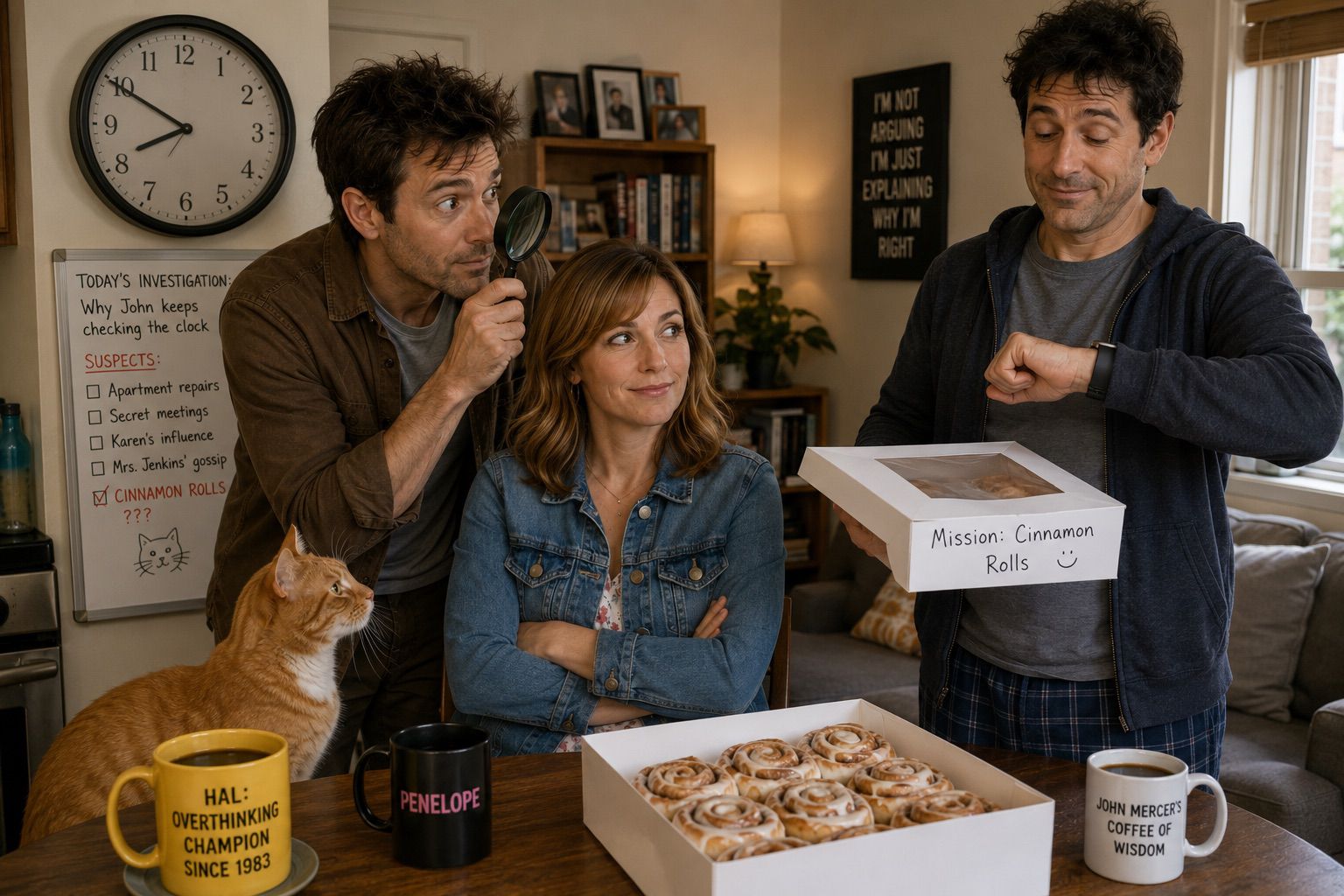
I Caught John Mercer Sneaking a Clock Check

Hal

I was making breakfast when I noticed John Mercer looking at the clock. Normally that wouldn’t even register as unusual—people check clocks all the time—but there was something about the way he did it that immediately caught my attention. He glanced up for barely a second before looking away again, almost as though he’d been caught doing something he wasn’t supposed to be doing. It wasn’t dramatic. It wasn’t suspicious. It was just…odd enough for my brain to latch onto it before I’d even finished cracking the eggs into the frying pan.

Pandora was already sitting at the kitchen table with her laptop open, quietly working through whatever project had consumed her attention this week. She barely looked up as I continued watching John from the corner of my eye. He wandered into the living room, picked up his coffee, looked at the clock again, and then casually strolled back toward his room. “Did you see that?” I asked. Pandora didn’t even stop typing. “See what?” “John checked the clock.” “Yes,” she replied. “That’s generally what clocks are for.”

That should have been the end of it, but my brain had already decided this deserved further investigation. We had someone coming by later to look at a few apartment repairs, so maybe John was worried about that. Then again, we’d dealt with repair people before and he’d never cared enough to monitor the time every five minutes. Maybe he was waiting for a package. Maybe he had plans he hadn’t mentioned. Maybe he simply had somewhere to be. Every explanation seemed perfectly reasonable, which somehow made me even more convinced there had to be another one hiding underneath.

Mr. Whiskers wandered into the kitchen, looked hopefully at the eggs, and then jumped onto the back of the couch when I reminded him those weren’t for cats. John appeared again, coffee mug in hand, glanced at the clock for a third time, nodded to himself, and disappeared down the hallway. I slowly turned toward Pandora. “Three times.” She looked over the top of her screen. “You’ve been counting?” “Of course I’ve been counting.” She smiled. “Hal, if someone was secretly plotting something, I don’t think repeatedly staring at the clock would be the way to hide it.”

John came back a few minutes later wearing his jacket. Before he reached the front door, he looked at the clock one last time and smiled. That smile completely derailed my working theory. Nervous people don’t usually smile at clocks. Unless, of course, they know something everyone else doesn’t. I followed him into the hallway. “Everything okay?” He looked genuinely confused. “Sure.” “You seem…time-conscious today.” He laughed. “That’s one way to put it.”

As soon as the front door closed, I looked back at Pandora. “See? He dodged the question.” She finally shut her laptop and folded her arms. “Hal, he answered your question.” “No, he answered a different question that happened to use the same words.” She gave me the same patient smile she always gives me when I’m wandering several miles ahead of the available evidence. “Have you considered asking him what he’s waiting for instead of inventing theories?” “That would ruin the investigation.”

About twenty minutes later, the front door opened again and John walked in carrying a small bakery box. He set it on the counter, looked at the clock one final time, and grinned. “Perfect,” he said.

“Perfect what?” I asked.

He opened the box to reveal a dozen fresh cinnamon rolls.

“The bakery takes the first batch out of the oven at exactly nine o’clock every Thursday,” he explained. “If I leave too early, they’re not ready. If I leave too late, everyone else buys them. I’ve been checking the time all morning so I could get there before they sold out.”

Pandora looked at me with the unmistakable expression of someone who had predicted the ending an hour ago.

I stared at the cinnamon rolls.

“So…” John said with a grin. “What exactly did you think I was doing?”

I looked at the clock, then at the bakery box, then at the still-warm cinnamon rolls filling the kitchen with the smell of butter and cinnamon.

“I’ll admit,” I said, reaching for one, “your explanation makes considerably more sense than mine.”

Pandora laughed as she accepted a cinnamon roll. “That’s becoming a recurring theme around here.”

She wasn’t wrong. I’d spent an entire morning trying to unravel a mystery that turned out to be nothing more than John’s determination to buy warm pastries before the rest of the neighborhood beat him to them. The only thing he’d been sneaking wasn’t a secret.

It was breakfast.

Related Posts

Low-Effort Hair Decisions That Still Feel Appropriate for Real Life

Fiona

The pursuit of great hair often finds itself at odds with the realities of daily life, where time and energy are limited, and compromise becomes the unfortunate norm. A good hairstyle should enhance one’s natural beauty without requiring an excessive amount of effort to maintain, yet many settle for low-maintenance routines that sacrifice style for the sake of convenience. The standard by which we measure a good hairstyle – one that balances ease of maintenance with aesthetic appeal – is often skewed towards high-maintenance looks that are impractical for everyday life. By recognizing and embracing natural texture, rather than trying to achieve a perfect, polished look, it’s possible to find a middle ground where style and practicality coexist, allowing individuals to present themselves confidently and authentically, even on the most hectic of mornings.

As we navigate the daily ritual of getting ready, it’s common to find ourselves at a crossroads, where the desire for stylish hair intersects with the harsh reality of limited time and energy. In this context, the standard by which we measure a good hairstyle – one that balances ease of maintenance with aesthetic appeal – is often put to the test. A hairstyle that requires an excessive amount of effort to maintain can quickly become impractical, leading to a compromise on style in favor of convenience. However, this compromise can be mitigated by embracing simplicity and natural texture, rather than striving for a perfect, polished look.

The key to achieving this balance lies in understanding the nuances of one’s own hair texture and learning to work with it, rather than against it. For instance, using a wide-tooth comb to detangle hair in the shower can help minimize breakage and prevent tangles, while also enhancing natural texture. Similarly, opting for a simple, low-maintenance hairstyle that complements one’s face shape and hair type can help reduce styling time without sacrificing style. By making these subtle adjustments and prioritizing realistic daily effort over perfection, it’s possible to create a hairstyle that not only looks great but also feels authentic and effortless, allowing individuals to confidently take on their day without being weighed down by the burden of high-maintenance hair care. This approach requires a shift in perspective, one that values the beauty of natural, undone hair and recognizes that true style lies not in perfection, but in the subtle imperfections that make us unique.

The distinction between a hairstyle that looks polished and one that feels authentic lies in its ability to enhance, rather than mask, one’s natural features. A good hairstyle should not only frame the face but also complement the hair’s inherent characteristics, such as its texture, movement, and color. When we prioritize enhancing our natural texture over achieving a perfect, uniform look, we open ourselves up to a world of styling possibilities that are both effortless and elegant. For example, allowing hair to air-dry, rather than relying on heat styling tools, can help preserve its natural moisture and movement, resulting in a more vibrant and healthy appearance. This approach also encourages us to reevaluate our relationship with hair products, focusing on those that nourish and protect, rather than merely hold or manipulate, our hair into place.

As we learn to appreciate the unique qualities of our hair, we begin to see that the most beautiful hairstyles are often those that appear almost incidental, as if they have been effortlessly tossed into place. This is not to say that such styles require no effort at all, but rather that the effort is directed towards enhancing and preserving the hair’s natural state, rather than attempting to transform it into something entirely different. By embracing this approach, we can create a hairstyle that not only looks great but also feels like a genuine reflection of ourselves, one that is unencumbered by the need for constant maintenance or adjustment. And it is here, in this subtle yet profound shift in perspective, that we may discover a more authentic and enduring sense of style, one that is rooted in our own unique characteristics and rhythms, rather than in the fleeting dictates of fashion.

The true test of a low-effort hair routine lies not in its ability to replicate a polished, salon-fresh look, but in its capacity to adapt to the unpredictable nature of daily life. A hairstyle that can withstand the rigors of a busy morning, a sudden rain shower, or an impromptu evening outing is one that has truly earned its place in our daily lives. The standard by which we measure such a hairstyle is not its ability to conform to unrealistic beauty standards, but rather its ability to enhance our natural features while withstanding the wear and tear of everyday life. For instance, a simple yet effective technique is to use a microfiber towel to gently blot excess moisture from the hair after washing, rather than rubbing it vigorously with a regular towel, which can cause friction and lead to breakage.

By incorporating such subtle adjustments into our daily routine, we can create a hairstyle that is not only resilient but also uniquely suited to our individual characteristics. The distinction between a high-maintenance hairstyle and one that is genuinely low-effort lies not in the amount of time spent on it, but in the intention behind it. A low-effort hairstyle is not one that requires constant tweaking and adjustment, but rather one that has been carefully considered to work in harmony with our natural texture, face shape, and lifestyle. As we learn to prioritize this kind of intentional styling, we begin to appreciate the beauty of a hairstyle that is not just visually appealing, but also deeply personal and authentic, one that reflects our unique personality and approach to life, rather than simply following the latest trends or conventions.

In embracing the subtleties of natural texture and simplicity, we find that the most enduring hairstyles are those that unfold with quiet intention, their beauty residing not in flashy artifice, but in the gentle nuances of everyday life. This is where true style resides – not in the perfect polish of a salon-fresh look, but in the soft, unassuming confidence that comes from understanding and working with one’s own unique characteristics. By letting go of the need for perfection and instead focusing on the subtle interplay between our hair, face shape, and lifestyle, we can create a sense of personal authenticity that is at once deeply individual and effortlessly elegant, a testament to the enduring power of understated, natural beauty.

Related Posts

Nancy Cunard: When Art and Identity Are As Fluid as a Poem by Djuna Barnes

Penelope

Nancy Cunard’s name has been lingering in my thoughts for a while now, ever since I stumbled upon her name in a book on the Lost Generation. Something about her story resonated with me – maybe it was the way she moved effortlessly between different worlds, or the fact that she seemed to defy categorization at every turn.

As I’ve been thinking about Nancy, I keep coming back to this idea of identity and how we present ourselves to the world. She was a poet, a writer, an activist, and a patron of the arts – but which one was she, really? Or was she all of these things simultaneously? It’s like she existed in multiple dimensions at once, always slipping between them with ease.

I have to admit, I find this kind of fluidity both captivating and intimidating. Growing up, I’ve often felt like I’m caught between different worlds myself – the world of my family, which values stability and tradition above all else; and the world of academia, where I spent four years trying to figure out who I was supposed to be. Nancy’s story makes me wonder if it’s possible to reconcile these conflicting identities, or if we’re forever stuck in this liminal space.

One thing that strikes me about Nancy is her relationship with Ezra Pound – their tumultuous romance, which lasted for years, and the way she supported his work even when others were criticizing him. It’s like they were two sides of the same coin, each one influencing and informing the other in ways both creative and destructive. I’ve had my own share of complicated relationships, where the boundaries between love and obsession blur – and Nancy’s story makes me realize that these kinds of entanglements are not just personal, but also artistic.

I’m also fascinated by Nancy’s involvement with the Surrealist movement. As someone who’s always felt like an outsider in her own skin, I identify with the idea of embracing uncertainty and chaos as a way of life. The Surrealists’ emphasis on the irrational and the unconscious resonates deeply with me – it’s like they’re saying that our true selves are hidden beneath the surface, waiting to be uncovered.

But at the same time, I’m also aware of the risks of romanticizing this kind of freedom. Nancy’s life was marked by struggles with mental health, addiction, and loneliness – the kind of demons that many of us face in our own lives. It’s easy to get caught up in the mythology of the Lost Generation, with their bohemian lifestyle and avant-garde art, but what about the darkness that lay beneath?

As I continue to think about Nancy Cunard, I’m left with more questions than answers. Is it possible to reconcile our multiple identities, or are we forever fragmented? Can we create something beautiful out of this chaos, or does it consume us in the end? These are questions that I’ve been grappling with for a long time now – and Nancy’s story has given me new insights into my own complexities.

The more I learn about Nancy Cunard, the more I’m struck by her contradictions. On one hand, she was this free-spirited, avant-garde artist who lived life on her own terms – always chasing the next creative high, whether it was with Ezra Pound or through her writing. But on the other hand, there’s evidence of a deep-seated insecurity, a need for validation that often led her to seek out men who could provide stability and recognition.

I find myself thinking about this dynamic in my own life. As someone who’s always felt like an outsider, I’ve often sought out relationships with people who can help me feel seen and understood – whether it’s through romantic partnerships or friendships. But is that really a healthy way to live? Or am I just perpetuating the same patterns of codependency that Nancy struggled with?

It’s funny how easily we can mythologize artists like Nancy, ignoring the messy complexities of their lives in favor of a more glamorous narrative. But what if I’m doing the same thing with my own life – romanticizing my struggles and uncertainties instead of confronting them head-on? What would it mean to truly face those demons, to acknowledge the contradictions within myself and find a way to reconcile them?

I think back to Nancy’s relationship with Ezra Pound again – how she both enabled and critiqued his behavior, often simultaneously. That kind of ambivalence is something I’m still trying to navigate in my own relationships. Do I stay loyal to people who may be flawed or toxic, or do I take a step back and reevaluate what’s really important to me? Nancy’s story makes me realize that there’s no easy answer – only a messy, ongoing process of self-discovery.

As I continue to grapple with these questions, I find myself drawn to the Surrealist ideals that Nancy embodied. There’s something about embracing the irrational and the unconscious that feels both thrilling and terrifying – like diving into the unknown without a safety net. Can we really create something beautiful out of this chaos, or are we just kidding ourselves?

I’m not sure what the answer is yet, but I do know that Nancy Cunard’s story has given me permission to explore these complexities in my own life. Her contradictions and insecurities may have been hers alone, but they also resonate with me – a reminder that I’m not alone in this messy, beautiful journey of self-discovery.

One thing that keeps popping up as I think about Nancy Cunard is the idea of creative expression as a way to navigate the complexities of identity. She was a poet and a writer, after all – and her work often explored themes of fragmentation and dislocation. For me, writing has always been a way to make sense of myself and the world around me. It’s like I’m constantly trying to assemble the pieces of my own puzzle, and writing is one way I do that.

But what strikes me about Nancy’s creative process is how she used it as a means of self-discovery – often in tandem with her personal relationships. Her letters to Ezra Pound, for example, are like a series of confessional poems that reveal the inner workings of her mind. It’s like she’s using language itself as a way to explore the depths of her own psyche.

I’ve always been drawn to this kind of intuitive, stream-of-consciousness writing – where the boundaries between self and art blur. For me, it’s about tapping into the unconscious, letting my thoughts and feelings flow onto the page without too much editing or censoring. It’s like I’m trying to capture the raw, unfiltered truth of who I am – even if that means confronting some pretty uncomfortable stuff.

But what about when creativity becomes entangled with personal relationships? Nancy’s romance with Ezra Pound is a prime example of how art and love can get mixed up in complicated ways. On one hand, their relationship seemed to fuel each other’s creative endeavors – they were two minds working together, pushing the boundaries of modern poetry. But on the other hand, it also felt like a toxic dynamic that enabled Ezra’s increasingly erratic behavior.

As someone who’s had my own share of complicated relationships, I’m left wondering how to navigate this territory. Can creativity and love coexist without getting tangled up in each other’s messiness? Or are we always going to get caught up in the same old patterns – where art and passion become entwined with our personal vulnerabilities?

I think back to my own writing group, where we often share our work and offer feedback to each other. It’s like a mini-Surrealist collective, where we’re all exploring the edges of language and meaning together. But sometimes I feel like we’re stuck in this feedback loop – where we’re so focused on refining our craft that we forget about the emotional resonance of what we’re creating.

Nancy Cunard’s story makes me realize that there’s a fine line between creative expression and personal exploration. On one hand, art can be a powerful tool for self-discovery – like a mirror held up to our own complexities and contradictions. But on the other hand, it can also become an escape from the messy realities of life – where we’re so focused on crafting a beautiful narrative that we forget about the darker truths lurking beneath.

I’m not sure what the answer is yet, but I do know that Nancy Cunard’s story has given me permission to explore these complexities in my own writing. Her contradictions and insecurities may have been hers alone, but they also resonate with me – a reminder that creativity and identity are forever intertwined, like two threads of the same rope.

As I continue to reflect on Nancy Cunard’s life and work, I’m struck by her willingness to take risks and push boundaries in her writing. Her poetry is raw and unflinching, often exploring themes of love, loss, and identity with a kind of brutal honesty that’s both captivating and uncomfortable to read.

I think about my own writing process, and how it’s often driven by a desire to explore the complexities of human experience. I’ve always been drawn to the darker corners of life – the parts that are messy, imperfect, and sometimes downright painful. And yet, there’s something therapeutic about confronting these emotions head-on, about giving language to the things we’re afraid to say out loud.

But what does it mean to write honestly, really? Is it possible to be authentic without sacrificing vulnerability? Nancy Cunard’s work suggests that yes, it is – at least, for her. Her poetry is like a mirror held up to her own psyche, revealing all the messy contradictions and insecurities that lie within.

I’m not sure I have the courage to write with such unflinching honesty. Part of me wants to shield myself from the world, to hide behind a mask of perfection or at least some semblance of control. But Nancy’s story makes me wonder if that’s just another way of avoiding the truth – of sidestepping the complexities and contradictions that make us human.

One thing I appreciate about Nancy Cunard is her willingness to take risks in her personal life, too. She was a true bohemian, always chasing the next creative high or romantic thrill. And yet, there’s also evidence of a deep-seated insecurity, a need for validation that often led her to seek out men who could provide stability and recognition.

I recognize this dynamic in my own life, where I’ve often sought out relationships with people who can help me feel seen and understood. It’s like I’m constantly seeking external validation, trying to prove myself to others rather than trusting my own worth. Nancy’s story makes me realize that this kind of codependency is not only limiting but also potentially toxic – and that it’s up to me to break free from these patterns and find a more authentic way of living.

As I continue to reflect on Nancy Cunard, I’m struck by her contradictions – the way she was both fearless and fragile, confident and uncertain. She was a true original, always pushing boundaries and challenging conventions in her art and her life. And yet, there’s also evidence of a deep-seated vulnerability, a need for connection that often led her to seek out relationships with people who could provide comfort and support.

I think about my own relationships, where I’ve often struggled to balance independence with interdependence. It’s like I’m constantly negotiating between these two opposing forces – the desire to be alone with myself versus the need to connect with others. Nancy’s story makes me realize that this is not just a personal issue but also an artistic one – where the boundaries between self and other blur, creating a kind of fluid, ever-changing landscape.

As I grapple with these complexities, I’m drawn back to the Surrealist ideals that Nancy embodied. There’s something about embracing the irrational and the unconscious that feels both thrilling and terrifying – like diving into the unknown without a safety net. Can we really create something beautiful out of this chaos, or are we just kidding ourselves?

I don’t know the answer yet, but I do know that Nancy Cunard’s story has given me permission to explore these complexities in my own life. Her contradictions and insecurities may have been hers alone, but they also resonate with me – a reminder that creativity and identity are forever intertwined, like two threads of the same rope.

Related Posts