Latest Articles

Fire on the Veld: The Second Boer War and the Empire’s Reckoning

Elias Rowen

On October 11, 1899, a war erupted on the sun-scorched plains of southern Africa that would test the might of the British Empire, redefine guerrilla warfare, and foreshadow the bloody conflicts of the twentieth century. It was the beginning of the Second Boer War, a clash between the world’s greatest imperial power and two small but defiant republics—the South African Republic (Transvaal) and the Orange Free State. To the British, it was a campaign to assert authority over the resource-rich territories of the region. To the Boers, it was a desperate fight to preserve their independence, their farms, and their way of life. What followed was not the quick victory Britain expected, but a brutal, drawn-out struggle marked by sieges, scorched earth, concentration camps, and extraordinary resilience.

At the end of the 19th century, the map of Africa was colored by European empires. Britain’s possessions stretched from the Cape to Cairo, and its pride was its dominance of trade and industry. Yet nestled within southern Africa lay the Boer republics, established by Dutch-descended settlers who had trekked away from British rule decades earlier. These republics might have remained marginal—small farming communities resisting modernity—were it not for the discovery of gold and diamonds in their soil. Suddenly, the Transvaal and Orange Free State became prizes of immense value. Britain, unwilling to let independent states sit atop such wealth, turned its eyes to conquest.

The Boers, however, were not passive. Hardened by generations of frontier life, skilled in marksmanship, and fiercely independent, they were prepared to defend their republics. Led by men such as Paul Kruger, they saw the British as invaders threatening not just their land but their identity. By October 1899, after years of tension, ultimatums, and failed negotiations, the fuse was lit. When the Boers launched preemptive strikes into British territory, the war began.

The early months shocked Britain. Boer commandos, mounted on sturdy ponies and armed with modern Mauser rifles, proved deadly opponents. They laid siege to British garrisons in Ladysmith, Mafeking, and Kimberley, cutting off supplies and communications. Their knowledge of the land, their mobility, and their guerrilla tactics outmatched the slow, rigid British forces. International observers mocked the empire: how could the greatest power in the world be humbled by farmers?

The sieges became symbols of endurance. In Mafeking, Colonel Robert Baden-Powell (later founder of the Boy Scouts) held out for over 200 days, using ingenuity and bluff to keep Boer forces at bay. In Ladysmith, citizens endured shelling, hunger, and disease. Relief efforts became desperate races against time, and when British forces finally broke the sieges in 1900, the empire celebrated—but the war was far from over.

Britain responded with overwhelming force. Reinforcements poured in, and generals like Lord Roberts and Lord Kitchener led massive campaigns. The British captured the Boer capitals—Bloemfontein, Pretoria, Johannesburg—and declared the republics annexed. London cheered victory. But in the veld, the war was only beginning.

The Boers adapted. No longer fighting in formal battles, they dissolved into small, mobile commando units. They struck railways, ambushed supply lines, and vanished into the vast countryside before British troops could respond. They became shadows in the grasslands, impossible to pin down. Britain, frustrated, escalated its tactics.

This escalation was brutal. Kitchener launched a scorched-earth campaign, burning farms, slaughtering livestock, and salting the earth to deny the Boers food and shelter. Families of suspected fighters were rounded up and placed in concentration camps—the first of their kind in modern warfare. Conditions were horrific: disease, hunger, and exposure claimed the lives of over 26,000 Boer women and children, along with thousands of Black Africans who were also imprisoned. The camps shocked the conscience of the world, sparking outrage and tarnishing Britain’s reputation as a “civilized” empire.

And yet, despite suffering and loss, the Boers fought on. Their resilience was legendary. In villages, women carried messages, smuggled supplies, and held families together. Fighters slept under the stars, carried rifles across endless plains, and fought battles that seemed unwinnable. Their struggle turned them into symbols of defiance against imperial power.

By 1902, however, exhaustion and devastation forced a reckoning. With their land destroyed, their families suffering in camps, and resources depleted, the Boer leaders sued for peace. On May 31, 1902, the Treaty of Vereeniging was signed. The Boer republics were annexed into the British Empire, but Britain promised eventual self-government and granted funds for rebuilding. Though defeated, the Boers had earned concessions that ensured their survival as a people.

The Second Boer War was more than a colonial conflict—it was a harbinger of the modern age of warfare. It showed how guerrilla tactics could frustrate even the mightiest armies. It introduced concentration camps as tools of war. It demonstrated that public opinion, stirred by journalism and outrage, could shape international perception. And it left deep scars in South Africa, sowing tensions that would influence the nation’s politics for generations.

But beyond strategy and politics lies the human story. Imagine the Boer farmer watching his homestead burn, clutching his rifle, knowing his family is being marched to a camp. Picture the British soldier, shipped from Manchester or Glasgow, bewildered by the endless veld, terrified of ambushes in the night. Picture the children in the camps, their hollow eyes staring at a world they did not understand, paying the price for battles fought by men. These are the ghosts of the war—ordinary lives consumed by the fire of empire and resistance.

October 11, 1899, was the day the war began. It was a war born of pride, greed, and survival. It was the war that reminded the British Empire of its limits and revealed the Boers’ indomitable spirit. And it was a war that forces us, even today, to ask hard questions about power, resistance, and the cost of conquest.

Related Posts

Holy Mischief: Why the Sexy Nun Is Halloween’s Most Sinful Surprise

Dave

Every year on Halloween night, when the moon hangs high and the streets fill with ghosts, ghouls, and glitter, there are costumes that inspire a little smile and others that spark a full-on double-take. And then, tucked between the devils with their horns and the angels with their halos, there she is: the Sexy Nun. Dressed in a risqué twist on one of the most sacred uniforms in the world, she is shocking, playful, sultry, and unforgettable all at once. A mini black dress with white trim nods to the traditional habit, stockings cling to her legs like prayers gone astray, a veil frames her mischievous face, and sometimes a cross dangles suggestively across her chest. She is both blasphemy and brilliance, a costume that doesn’t just bend the rules—it throws the rulebook straight into the fire. And that is exactly why the Sexy Nun remains one of the most viral, talked-about, and daring costumes of Halloween.

There’s no denying that part of the allure lies in the contradiction. Nuns represent purity, devotion, sacrifice, and discipline. Their habits are designed to remove vanity, to cloak the body, to signal detachment from worldly temptation. And yet, the Sexy Nun flips that symbolism entirely on its head. Suddenly, the uniform designed to erase sexuality becomes the foundation for flaunting it. The lines of devotion transform into lines of allure. The habit becomes a mini dress. The veil becomes an accessory. The symbol of chastity becomes the costume of cheeky rebellion. That tension between sacred and sinful is exactly what makes the Sexy Nun costume so electric. It’s not just about showing skin—it’s about making a statement, winking at authority, and reveling in the freedom of a night where nothing is off-limits.

Halloween thrives on shock value, and the Sexy Nun delivers it in spades. She’s not horrifying like a zombie or gory like a slasher villain, but she shocks in her own way. She makes people laugh, blush, gasp, and grin. At parties, she stands out not because she’s the scariest or the flashiest, but because she’s the boldest. She is the one who dares to walk into the room as both saint and sinner, the one who flirts with taboos and makes it look effortless. That audacity is what sparks conversations, photos, and viral posts. She doesn’t just wear a costume—she creates a moment, a memory, an instant of mischief that people will talk about long after the night is over.

Visually, the Sexy Nun costume is almost too perfect for the age of social media. The stark contrast of black and white pops in photos, catching the eye amidst neon lights and pumpkin glows. The veil frames the face beautifully, turning every grin or smirk into a portrait. The mini dress allows for movement, for playful poses, for twirls that catch on camera. Add in a cross necklace or a prop Bible turned upside-down, and suddenly the photo isn’t just a picture—it’s a viral performance. On TikTok, Sexy Nun videos explode into skits and dances. On Instagram, she dominates feeds with her bold visuals. On X, the costume trends every year because people can’t resist reacting to it, sharing it, debating it, laughing about it. That buzz is what keeps her at the top of the Halloween food chain.

But what makes the Sexy Nun more than just a shock costume is the human element. Every woman who wears it brings her own twist, her own energy, her own story. Some wear it with humor, laughing at the absurdity of sweeping floors with a feather duster while dressed in stockings and a veil. Others lean into full seduction, using the costume as a way to channel boldness, confidence, and allure. Still others mix in gothic or horror elements, turning the Sexy Nun into something darker—complete with blood-stained crosses or eerie makeup. That adaptability keeps the costume fresh, ensures that no two Sexy Nuns ever look quite the same, and gives every wearer the chance to make the look uniquely theirs.

And of course, there’s empowerment in it. The Sexy Nun costume isn’t about mocking faith—it’s about embracing the freedom to rewrite narratives. It’s about taking a symbol of restraint and turning it into one of expression, taking a uniform designed to hide and transforming it into one that reveals. For the person wearing it, the costume can be a chance to explore sides of themselves that usually stay hidden: boldness, confidence, mischief, and power. That’s the real appeal of Halloween—not just pretending to be someone else, but unleashing parts of yourself that the world rarely gets to see.

Critics may scoff or clutch their pearls, but that only fuels the fire. The controversy is part of the costume’s appeal. After all, what’s Halloween without a little scandal? The Sexy Nun sparks reactions precisely because she blurs lines, because she pokes at taboos, because she refuses to play it safe. That’s why she trends, why she gets photographed, why she gets remembered. In a sea of costumes, she stands out not because she’s elaborate or expensive, but because she’s fearless.

And maybe that’s why the Sexy Nun isn’t going anywhere. Every year, she resurfaces, dusting off her veil, slipping into her stockings, and walking boldly into the night. She doesn’t need an elaborate backstory or a blockbuster movie tie-in. She doesn’t need props beyond a feather duster or a rosary. She works because she’s simple, shocking, playful, and viral. She works because she takes a symbol everyone recognizes and twists it into something everyone wants to talk about.

So when the music is blaring, the lights are flashing, and the night is alive with laughter and chaos, watch the room. Notice who people are whispering about, pointing at, laughing with, and taking pictures of. Chances are, it’s the woman in the black mini dress and veil, feather duster twirling like a scepter of rebellion, grin sharper than any devil’s pitchfork. That’s the Sexy Nun. That’s Halloween’s most sinful surprise. And that’s why, year after year, she remains unforgettable.

Related Posts

When the Forest Laughs: The Trickster Tikbalang of the Philippines

Dave

There are creatures you run from, and then there are creatures you laugh with — or at — though the laughter is never entirely free of fear. Deep in the forests and mountains of the Philippines lives one of the strangest, most mischievous figures in global folklore: the Tikbalang. Half-horse, half-man, all trickster, the Tikbalang stands at the crossroads of myth and mischief, a guardian of the wilderness, a tormentor of travelers, and a reminder that the forest is not ours to command. On October 10, when the legend of the Tikbalang is recalled, we are not just remembering a monster — we are remembering the very personality of the land itself: playful, dangerous, unpredictable, alive.

To describe the Tikbalang is to invite unease. It is usually envisioned as towering and lanky, with the head and legs of a horse, but the body of a man. Its limbs are exaggeratedly long, so much so that it can sit and its knees will rise higher than its head. Its hooves strike the ground with an unsettling weight, its mane falls wild and unkempt, and its eyes glow with mischief. Some say it smells like burnt hair, others that it always carries the damp scent of the jungle. To see a Tikbalang is to feel immediately that the world is not quite right — a familiar animal form twisted into something alien, watching you with unsettling intelligence.

But unlike purely monstrous beings, the Tikbalang is more trickster than killer. Its favorite pastime? Leading travelers astray. A person walking through the forest might find themselves circling the same tree for hours, confused and exhausted, convinced they are lost in a maze. This is the Tikbalang’s laughter, its invisible hand rearranging the forest around its prey. In some versions of the story, the victim can escape by turning their shirt inside out, a gesture that breaks the spell. Other traditions say you must bite a tree or ask permission from the spirit world to pass. Whatever the method, the Tikbalang ensures you never forget who owns the forest.

The roots of the Tikbalang legend are as tangled as the vines in the jungles it inhabits. Some trace its origins to Hindu-Buddhist influences that reached the Philippines long before Spanish colonization, carrying imagery of horse-headed beings from India and Southeast Asia. Others see it as a purely local creation, born of the islands’ dense, mysterious landscapes where sounds echo and shadows twist. When the Spanish arrived, they recorded stories of the Tikbalang as part of their effort to map — and often suppress — indigenous belief systems. Yet despite centuries of colonial influence, the Tikbalang never vanished. It simply adapted, as tricksters always do.

The Tikbalang is not uniformly evil. Like many folkloric beings, it has moods and motives. In some stories, it is a malevolent force, terrifying and cruel, laughing as humans collapse from exhaustion in its mazes. In others, it is almost a guardian, testing the respect and humility of those who pass through the forest. If you bow your head, walk quietly, and honor the spirits, the Tikbalang may let you pass unharmed. If you are arrogant, loud, or disrespectful, it will toy with you until you break. In this way, the Tikbalang reflects a moral truth: the wilderness demands respect, and those who forget this will pay.

There is also a darker, more intimate side to the myth. Folklore tells of Tikbalang falling in love with humans, luring them into the forest with illusions of beauty, sometimes appearing as a stunning man or woman before revealing their true form. Once ensnared, the human becomes entranced, bound to serve or even wed the creature. In these stories, the Tikbalang becomes a symbol of dangerous seduction, of nature’s ability to enchant and entrap those who venture too far. Some communities even believed that illnesses or madness could be caused by offending a Tikbalang, further cementing its role as both playful prankster and ominous presence.

But the Tikbalang is not without vulnerabilities. Folk tradition claims that to tame one, you must pluck three golden hairs from its mane. Once subdued, the creature becomes a loyal servant, bound to the human who mastered it. This idea reflects a universal theme in myth: the desire not only to fear or respect the supernatural, but to control it. By binding the Tikbalang, one symbolically asserts mastery over the forest’s chaos. Yet there is irony here — for a trickster, even bound, may never be fully trustworthy.

What makes the Tikbalang so fascinating is its duality. It is terrifying, yet comical. It embodies chaos, yet can be subdued. It protects the wilderness, yet sometimes invades human lives with unwanted intimacy. It is not a villain or a hero but something in between, a figure that resists simple categorization. That complexity ensures its survival in cultural memory, long after countless other myths have faded.

The Tikbalang also offers a profound cultural lens. In the Philippines, where mountains and forests have always played a central role in identity, the Tikbalang is the spirit of those spaces given form. It reminds people that the forest is not empty but alive, that travelers are not masters but guests, that nature itself has personality. In modern terms, the Tikbalang is almost ecological, embodying the warning that those who disrespect the natural world will suffer. Its mischief is playful on the surface but carries an underlying seriousness: humility before forces larger than yourself.

Even in modern Philippine society, the Tikbalang endures. Children are warned not to wander too far into forests. Travelers are told to speak quietly in the mountains. Folklore festivals retell its story, and it finds new life in comics, films, and novels. Online, urban legends spread of Tikbalang sightings near highways or rural roads, blending old myth with modern anxieties. Like all great legends, it adapts — slipping from mountain trails to city streets, always laughing, always one step ahead.

And perhaps that is the secret to its viral potential. Unlike creatures that exist only to frighten, the Tikbalang entertains. It pranks. It plays. It makes fools of us, and we laugh nervously, because deep down we recognize the truth: we are not the masters of the world, no matter how much concrete we pour or machines we build. Somewhere in the shadows, the forest still watches, still tricks, still demands respect. The Tikbalang is that truth with a horse’s face and a trickster’s heart.

So on October 10, when we remember the Tikbalang, let us hear not only the laughter of a myth but the voice of the wilderness itself. Let us walk softly, turn our shirts inside out when lost, and bow our heads to forces older than we can comprehend. Because if the forest ever laughs at you, it may not be the wind. It may be hooves in the shadows, eyes glowing with mischief, and a voice that says: you thought you knew the way, but the way belongs to me.

Related Posts

Deeds, Not Words: The Birth of the Women’s Social and Political Union

Elias Rowen

On October 10, 1903, in a modest house in Manchester, England, Emmeline Pankhurst gathered a small group of women around her kitchen table. The meeting was unassuming in size but seismic in consequence. That day, the Women’s Social and Political Union (WSPU) was born—a movement that would rattle the foundations of British society, storm the corridors of power, and rewrite the role of women in history. It was the birth of a crusade that traded patience for urgency, persuasion for defiance, and quiet petitions for radical deeds. The world would come to know them not just as suffragists, but as suffragettes.

At the dawn of the 20th century, women’s voices were muffled in nearly every sphere of life. They could not vote. They had limited access to education and professions. Marriage often reduced them to legal dependents of their husbands. The polite campaigns of earlier reformers had made little headway. Laws were debated, commissions held, promises made—and yet, year after year, women were excluded from the democratic rights men took for granted. Emmeline Pankhurst, a widow raising five children, had grown weary of waiting. For her, the time had come to shock society into listening.

“Deeds, not words,” became the rallying cry of the WSPU. It was more than a slogan; it was a declaration of war against indifference. The women of the WSPU chained themselves to railings outside Parliament, smashed shop windows, disrupted political meetings, and even endured hunger strikes in prison. They courted arrest not out of recklessness but as strategy, forcing newspapers to cover their plight and politicians to reckon with their defiance. These were not the polite ladies of tea-room debates—they were warriors in skirts, fearless and unapologetic.

Society reacted with outrage, fascination, and fear. To many, the suffragettes were dangerous extremists, threatening the social order. To others, they were heroes. Their militancy divided the suffrage movement itself, with more moderate campaigners fearing that such tactics might alienate supporters. But Emmeline Pankhurst was unshaken. She understood that power yields nothing without pressure, and pressure requires sacrifice. Every arrest, every jeer, every bruise was a step closer to equality.

The suffragettes’ most powerful weapon was their own bodies. When imprisoned, many refused to eat, demanding recognition as political prisoners. The government responded with brutal force-feeding, shoving tubes down throats or noses, leaving women bloodied, vomiting, and broken—but not defeated. These horrors sparked public sympathy and turned the WSPU into a moral force too large to ignore. Their defiance forced the nation to confront the question it had avoided for centuries: why should women not vote?

Emmeline Pankhurst herself became the face of the movement. Elegant, articulate, and utterly relentless, she embodied the paradox of the suffragette: dignified yet radical, respectable yet rebellious. She traveled the country delivering fiery speeches, often facing hecklers, threats, and violence. She was arrested repeatedly but emerged from each ordeal more determined, inspiring legions of women to take up the cause.

The WSPU’s fight was not only about the ballot. It was about dignity, autonomy, and the right to shape society’s future. Women fought not only for themselves but for their daughters, their sisters, and generations unborn. Their struggle transcended politics; it was existential. To be denied the vote was to be denied personhood, to be told that half of humanity had no voice in its own destiny.

By the time World War I erupted in 1914, the suffragettes faced a choice: continue their militant campaign or turn their energies toward the war effort. Emmeline Pankhurst and the WSPU chose patriotism, suspending their activism to support Britain’s fight. Women worked in factories, served as nurses, and took on roles long denied to them. When the war ended, their contributions could no longer be dismissed. In 1918, the Representation of the People Act granted voting rights to women over 30 who met property qualifications. It was not full equality, but it was a breakthrough. By 1928, all British women gained the right to vote on equal terms with men.

Looking back, the foundation of the WSPU on October 10, 1903, was a spark that lit a fire impossible to extinguish. It was proof that courage can turn the tide of history, that the voices of the marginalized can shatter the silence of centuries. The suffragettes taught the world that change is not granted—it is demanded, fought for, and often suffered for. Their struggle continues to echo in every fight for equality today, from women’s rights to civil rights to the voices of those still excluded from power.

But beyond politics, their story is profoundly human. Imagine the suffragette mother, saying goodbye to her children as police dragged her to prison. Picture the young woman, her hands bloodied from smashing glass, exhilarated and terrified at once. Picture Emmeline Pankhurst herself, exhausted but unbroken, staring at her reflection after another arrest, whispering to herself that someday, somehow, the world would change.

And it did. Because of them, millions of women cast ballots today. Because of them, democracy is more inclusive, society more just, and humanity a little closer to living up to its ideals. The Women’s Social and Political Union was not just a movement. It was a revolution—born not in parliaments or palaces, but in the determination of women who refused to be ignored.

October 10, 1903, is not just a date in history. It is a reminder that the fight for equality is never finished, that progress is born of courage, and that sometimes, to change the world, you must be willing to set it alight with deeds, not words.

Related Posts

Dusting Up Desire: Why the French Maid Costume Always Sweeps Halloween

Dave

There are costumes that whisper, and then there are costumes that shout. And every Halloween, when the shadows stretch long, the candy bowls overflow, and the night invites both tricks and treats, there’s one outfit that consistently makes the boldest statement without ever having to try too hard. That costume is the French Maid, the eternal queen of playful provocation, dressed in her classic black-and-white mini dress, lace trim framing every curve, stockings hugging her legs, and, of course, the tiny feather duster that somehow manages to feel more mischievous than practical. The French Maid is not a new idea—she’s a staple of fantasy, flirtation, and costume parties alike—but there’s something about Halloween that brings her back with renewed power year after year. She isn’t just sweeping floors—she’s sweeping through feeds, through parties, through conversations, and into the viral spotlight with ease.

What makes the French Maid costume so irresistible is its balance of elegance and playfulness. The design itself is disarmingly simple: a fitted black mini dress with white lace trim, an apron tied at the waist, a dainty headband, and the ever-present feather duster. But the simplicity is exactly what gives it strength. It’s a blank canvas of fantasy that every wearer can bring alive in her own unique way. Some go sultry, leaning into smokey eyes, crimson lips, and a teasing grin that says she knows exactly what game she’s playing. Others go lighthearted, with giggles, winks, and a bubbly personality that makes the feather duster a comedic prop as much as a flirtatious one. The beauty of the French Maid is that she is both iconic and adaptable—timeless enough to be instantly recognizable, flexible enough to be tailored to any personality.

There’s also a cheeky rebellion built into the French Maid archetype. Real maids are symbols of labor, order, tidiness, and quiet service. The costume flips that on its head, transforming duty into desire, subservience into confidence. She isn’t here to follow rules—she’s here to break them with a wink. That inversion is what makes the costume so compelling. It’s playful satire, a caricature of the prim and proper uniform turned into a symbol of cheeky empowerment. On Halloween, when everyone is looking for permission to blur the lines between the ordinary and the outrageous, the French Maid fits perfectly. She is respectable on the surface, rebellious underneath, and that contradiction makes her unforgettable.

And then there’s the viral factor. The French Maid photographs like a dream. The monochrome color scheme pops against Halloween’s chaotic backdrop of orange pumpkins, neon lights, and shadowy decor. The mini dress frames the body in ways that highlight movement—every pose becomes dynamic, every candid looks staged. The feather duster is the ultimate prop, instantly adding humor, sass, or seduction depending on how it’s used. A coy pose with it tucked under the chin feels cheeky. A playful swish at another guest turns it into comedy. Held against the lips with a smirk, it transforms into pure temptation. That adaptability makes it perfect for social media, where personality and style matter as much as the costume itself.

It’s easy to see why the French Maid endures. Every time she appears, she steals the spotlight. People notice her, not just because of the outfit but because of the energy it invites. The woman wearing it isn’t just in costume—she’s performing, stepping into a role that’s equal parts fantasy and parody, fun and flirtation. And she knows it. That awareness, that confidence, that wink at the audience is what elevates the look from a piece of fabric to a viral sensation.

The humanizing element here is crucial. The French Maid isn’t just sexy—she’s fun. She’s approachable, memorable, charming. She brings a playfulness that resonates with people because she doesn’t take herself too seriously. In a sea of elaborate costumes and scary masks, she’s the one laughing, teasing, and keeping the energy light. That’s why she works in every setting—from intimate house parties to wild nightclub bashes. She adapts. She owns her role. She entertains. And in doing so, she leaves everyone remembering her long after the night is over.

And of course, the French Maid taps into something deeper—the fantasy of transformation. Halloween is about becoming someone else, about indulging in sides of yourself that usually stay hidden. The French Maid allows the shy to become bold, the quiet to become playful, the playful to become irresistible. It’s a role anyone can embody, and once you step into it, the costume almost takes over. That’s why the smile is brighter, the poses bolder, the laughter louder. It’s not just the outfit—it’s the permission it grants to let loose.

That is why, year after year, the French Maid remains one of Halloween’s most iconic sexy costumes. She isn’t tied to a trend. She isn’t dependent on a movie release or a viral meme. She is eternal because she represents something bigger: the joy of mischief, the thrill of contradiction, the delight of transformation. Every October 31st, when the doors open, the music blares, and the crowd surges, the French Maid will be there, feather duster in hand, ready to sweep hearts into her orbit once again.

Related Posts

Whispers of Fire: The Eternal Allure and Fear of the Jinn

Dave

There are stories that flow like wind, unseen but powerful, brushing across generations and deserts, carrying with them the echoes of fire and fear. Among the most enduring and complex of these tales are those of the Jinn — supernatural beings born of smokeless fire, existing in a realm parallel to ours, feared, revered, and woven into the very cultural fabric of the Middle East. Unlike many creatures of myth that belong firmly to legend, the Jinn occupy an ambiguous space. For millions, they are not merely characters in folklore but realities, unseen presences that shape destiny, haunt lonely places, and sometimes share the world with humans in ways both miraculous and terrifying.

The Jinn’s origin story begins in the Qur’an, which describes them as created by Allah from smokeless fire, a substance unlike the clay of humans or the light of angels. This positioning sets them apart immediately: neither divine nor human, but something in between — free-willed, intelligent, and capable of both great good and unimaginable evil. They are said to live in their own societies, with families, communities, even faiths, some Muslim, some Christian, some pagan, mirroring the diversity of human belief. Yet what most fascinates is their liminality: they exist unseen, yet they are everywhere. They are whispered about in marketplaces, feared on desert roads, and invoked in prayers of protection.

To speak of Jinn is to speak of possibility — possibility that the world is not entirely ours, that our loneliness is not as complete as we think. It is also to speak of danger, for Jinn are not to be trifled with. They can possess, deceive, torment. They can inspire madness or grant hidden knowledge. They embody both wish and curse, miracle and menace.

The Jinn are not monsters in the Western sense; they are complex beings with emotions, desires, and flaws. Some are mischievous tricksters who lead travelers astray in the desert. Others are terrifying predators who feed on human fear. Still others are benevolent, protectors and guides who may reward respect with blessings. The richness of the lore comes from this variety. Unlike the singular vampire or werewolf, the Jinn are a spectrum, from demons to allies, from gods of old transformed into new stories to whispering companions that sit invisible beside us.

One of the most famous tales that captured the imagination of the world is found in One Thousand and One Nights, where Jinn appear as both helpers and villains, from the mighty Ifrit imprisoned in bottles to the trickster spirits who grant wishes but twist them to ruin. Western audiences embraced the image of the Jinn as “genie,” a being bound to lamps and obliged to serve. But this playful, wish-granting caricature is a shadow compared to the raw fear Jinn inspire in the Middle East. There, to even speak of them is risky. In some cultures, people avoid saying “Jinn” at all, preferring euphemisms like “those ones” or “the hidden ones,” lest the word itself draw their attention.

Deserts are the natural stage of the Jinn. In folklore, they dwell in desolate places: abandoned ruins, empty wells, crossroads where no birds sing. To travel at night through the sands is to risk brushing against their realm. Fires flicker in the distance where no people live; voices echo on the wind, calling travelers by name. Entire tribes told stories of people vanishing into the dunes, claimed by the Jinn. But they are not confined to deserts — in urban centers too, tales abound of possession, of voices heard in empty houses, of inexplicable illness attributed to Jinn interference. Their presence expands wherever human imagination fears the unknown.

Possession is among the most feared interactions with Jinn. When someone becomes afflicted, their body is said to host a spirit that manipulates thoughts, speech, and actions. Traditional healers — often reciters of Qur’anic verses — are called upon to exorcise the being, coaxing or commanding it to depart. These rituals are not just spiritual acts but cultural dramas, blending faith with folklore, psychology with performance. To this day, such practices persist, bridging ancient belief with modern anxiety.

Yet not all Jinn are antagonistic. Stories abound of humans who strike pacts with them, gaining knowledge or power in exchange for loyalty or ritual observance. Some artisans and poets even claimed inspiration flowed from Jinn muses, whispering words and songs into their ears. This duality — destructive and creative — makes Jinn a paradox that fascinates across centuries. They are feared, yes, but they are also revered, even respected as beings of immense capability who remind humans of the unseen mysteries of creation.

There is also a deeply human dimension to Jinn stories: they are reflections of our inner fears, desires, and temptations. In a time before psychology, possession explained madness. In a time before science, mysterious illness could be traced to Jinn influence. In a time when loneliness weighed heavy on desert travelers, voices in the wind were not imagination but company — eerie, dangerous company, but company nonetheless. Jinn stories helped communities understand the unexplainable, turning chaos into narrative, uncertainty into cultural structure.

Modernity has not banished them. Even today, Jinn loom large in Middle Eastern life. Families warn children not to wander near abandoned wells. Construction workers hesitate to build over ruins, lest they disturb ancient Jinn dwellings. Films and TV dramas explore Jinn possession with as much fervor as Western horror does with ghosts. The legend evolves, but it does not fade. In fact, in an age of globalization, Jinn have entered the global imagination, appearing in novels, movies, and online forums, their aura spreading far beyond their origin.

But perhaps the most haunting part of the Jinn story is how they embody freedom. Angels are bound to divine will, humans to mortality, but Jinn are unbound. They live long, invisible lives. They choose faith or rebellion. They can love, hate, create, or destroy. They are the mirror opposite of us — not flesh but fire, not seen but hidden, yet as flawed and varied as humanity itself. In this way, they are terrifying because they are so familiar. They are us, but freer, stronger, and untethered.

Picture this: a lone traveler crossing the sands at dusk, his camel plodding beneath the endless horizon. The air cools as night approaches. He sees a flicker of light ahead — a fire in the emptiness. Relieved, he approaches, hoping for company. But as he draws near, the fire vanishes. The silence deepens. Then, from the dunes, laughter — not human, not kind. His blood runs cold. He turns back, but the path is gone, the stars rearranged. He whispers a prayer, clutching a talisman of protection. He does not call them by name. He knows better.

This is the power of the Jinn: they live where imagination meets fear. They are the figures that step into silence, the presence we sense when alone, the shiver that comes not from cold but from awareness of being watched. They are supernatural, yes, but they are also profoundly psychological, living in the hidden corners of human thought.

So on October 9, when the Jinn’s legend is remembered, we are reminded that humanity’s greatest stories are not about creatures apart from us, but about beings that reflect our own struggles — with freedom, with temptation, with unseen forces that shape our lives. The Jinn endure because they are more than monsters. They are metaphors for everything we cannot control, everything we fear might whisper just out of sight, everything we suspect might be real after all.

And maybe, just maybe, when the wind blows tonight and a whisper seems to call your name, you’ll hesitate before answering. Because what if it isn’t the wind?

Related Posts

The Day the Revolution Lost Its Face: The Execution of Che Guevara

Elias Rowen

On October 9, 1967, in a dusty Bolivian schoolhouse in the small village of La Higuera, a man who had become more myth than flesh was executed by a firing squad. His name was Ernesto “Che” Guevara—doctor, guerrilla fighter, revolutionary icon. He died not on a battlefield, surrounded by the thunder of armies, but in a cramped room, his hands bound, his body battered, his legend already outpacing the life he was about to lose. His final words, according to the soldier who pulled the trigger, were, “Shoot, coward. You are only going to kill a man.” With those words, Che crossed into immortality, his face destined to be stamped on T-shirts, murals, and banners across the globe. His execution ended a life of restless rebellion, but it also cemented him as one of the most enduring—and divisive—symbols of revolution in modern history.

Che Guevara’s journey to that Bolivian schoolhouse was anything but ordinary. Born in Rosario, Argentina, in 1928, Ernesto was not the archetypal warrior. He was a frail, asthmatic child, often confined to bed. Yet from an early age, he devoured books on philosophy, politics, and history, feeding a mind that saw injustice not as an abstract concept but as a tangible enemy. His famous motorcycle journey across Latin America in 1952 transformed him. Confronting the poverty, exploitation, and inequality that scarred the continent, Guevara shed the skin of a medical student and began to see himself as a soldier in a global struggle.

It was in Mexico in the mid-1950s that destiny introduced him to Fidel Castro. The two men, vastly different in temperament but united in vision, forged a bond that would alter the course of history. Together, they joined the ragtag group of revolutionaries who sailed aboard the Granma to Cuba in 1956. Most were killed or captured soon after landing, but Che survived, fighting alongside Castro in the Sierra Maestra mountains. His bravery, discipline, and ruthlessness elevated him to command. By 1959, Batista’s dictatorship had fallen, and Cuba stood reborn as the world’s first successful Marxist revolution in the Western Hemisphere.

In Havana, Guevara became more than a fighter; he became a face of revolution itself. He served as minister, diplomat, and theorist, giving speeches that blended idealism with fiery conviction. Yet Che was restless. Bureaucracy bored him, and he despised the trappings of power. He was not content to see socialism thrive in Cuba alone. He believed revolution had to be exported, spread like fire across the globe, liberating the oppressed from imperialism. To Che, the world was one battlefield, and he was its eternal soldier.

That restlessness led him first to the Congo in 1965, where he attempted to ignite revolution in the heart of Africa. It failed—riven by chaos, disunity, and logistical nightmares. Still, Guevara did not retreat into comfort or safety. Instead, he turned his eyes to South America once again, convinced that the Andes could become the continent’s Sierra Maestra. Bolivia, with its poverty, oppression, and proximity to other vulnerable states, became his chosen spark.

But Bolivia was no Cuba. The peasants did not rally to Che’s banner; they distrusted outsiders. The terrain was unforgiving, supplies scarce, and communication with Cuba unreliable. The CIA and Bolivian military, aided by U.S. advisors, tracked his every move. By October 1967, his small band of guerrillas was surrounded, exhausted, and decimated. On October 8, Che was captured after a firefight in the Yuro ravine, wounded and unable to continue. He was taken to La Higuera, a prisoner of men who understood they held a legend in their hands.

For 24 hours, the world’s most famous revolutionary sat in that schoolhouse, bound and awaiting his fate. Witnesses recalled him defiant, refusing to beg, refusing to crumble. When Bolivian officials, under pressure from the CIA, decided to execute him rather than risk a trial that might inflame global opinion, Che met his death as he had lived—unflinching. The bullets ended his life, but not his myth.

News of his death spread rapidly, but it only amplified his legend. Photographs of his lifeless body, eerily Christ-like in repose, circulated worldwide, fueling both mourning and inspiration. For revolutionaries, Che became martyr and model, a reminder that ideals outlive the men who carry them. For his enemies, he became a cautionary tale of reckless idealism, a man consumed by his own ideology. Love him or hate him, no one could ignore him.

Che Guevara’s execution remains one of the defining moments of the Cold War era. It symbolized the lengths to which the United States and its allies would go to contain communism. But it also symbolized the power of a single life to inspire beyond its death. His face, immortalized in Alberto Korda’s iconic photograph, became perhaps the most reproduced image of the 20th century—painted on walls in Nicaragua, waved on banners in Vietnam, worn on T-shirts in Paris, and invoked in hip-hop lyrics decades later.

And yet, the human Che was far more complex than the legend. He was a man who read poetry between battles, who treated wounded comrades with the care of a physician, who wrote love letters to his wife even while in hiding. But he was also a man capable of brutality, overseeing executions in revolutionary Cuba, insisting that the struggle required blood. His contradictions—romantic and ruthless, healer and executioner, dreamer and fighter—are what make him enduringly fascinating.

October 9, 1967, was the day Che Guevara’s body fell, but his spirit did not. He became less a man and more a symbol—of rebellion, of defiance, of the belief that individuals can challenge empires. His legacy is contested, celebrated by some, condemned by others, but never forgotten. Che’s life reminds us that revolutionaries do not die quietly. Their echoes travel through time, igniting debates, dreams, and rebellions long after the gunfire has ceased.

Related Posts

Plunder and Pleasure: Why the Pirate Siren Rules the Seven Seas of Halloween

Dave

Halloween is a night of transformation, a celebration of shedding the ordinary and stepping into the extraordinary, and among the countless costumes that surface every October, some shine brighter than others because they embody fantasy at its fullest. The Pirate Siren is one of those timeless, magnetic archetypes, an intoxicating mix of daring adventure and sultry seduction, the perfect balance of swashbuckler and temptress. With her corset top hugging curves like armor for allure, her ruffled skirt swishing with every bold step, and her thigh-high boots clicking like cannon fire on the dance floor, she is a vision of freedom, danger, and irresistible charm. She doesn’t just walk into a party—she storms it like a ship crashing into a harbor, demanding attention and stealing hearts with the same effortless ease she’d plunder treasure from a gilded chest.

The Pirate Siren taps into one of humanity’s oldest fantasies: the pirate life. Pirates represent rebellion, freedom from rules, and the thrill of danger. They are the outlaws of the sea, unbound by society’s expectations, living by their own codes. That foundation already makes the pirate archetype alluring, but add the siren twist and suddenly it’s not just about adventure—it’s about seduction. In mythology, sirens lured sailors to their doom with beauty and song, a dangerous blend of temptation and destruction. Combine that with the swagger of a pirate, and the result is the Pirate Siren, a character who embodies danger and desire, freedom and fire, fantasy and flesh.

What makes the costume viral is its sheer visual appeal. The corset top cinches the waist, lifting and shaping, transforming the torso into a bold declaration of confidence. The ruffled skirt adds playful movement, every step a tease, every twirl a performance. And the thigh-high boots? They are power incarnate, elongating the legs, adding dominance to every stance, commanding the floor as surely as any captain commands her ship. Together, the pieces create a look that is both sultry and commanding, a costume that doesn’t just beg for attention—it demands it.

Halloween thrives on fantasy, and the Pirate Siren offers a fantasy layered with stories. She isn’t just dressing up as a character—she is stepping into a world of high-seas adventure, where treasure maps and whispered legends swirl together with moonlit duels and secret kisses stolen on the deck. When someone wears the Pirate Siren costume, they don’t just look good—they tell a story without saying a word. The glint in her eye is mischief, the curl of her smile is danger, the sway of her skirt is seduction. Everyone who sees her knows, instinctively, that this is not someone to underestimate, but also not someone they can resist.

Part of the costume’s allure is its versatility. Some wear the Pirate Siren as pure elegance, with jewel-toned corsets, lace sleeves, and carefully detailed accessories—feathers in hats, polished sabers at the hip. Others go bold and edgy, with ripped ruffles, leather belts, and smudged eyeliner that looks like it was earned in a tavern brawl. Some lean into fantasy with mermaid-inspired siren details—scales in the makeup, seashell accents, oceanic jewelry—turning the costume into a hybrid of land and sea. And then there are those who strip it down to the essentials: corset, skirt, boots, a little sparkle, and a lot of attitude. No matter how it’s styled, the Pirate Siren costume works, because it’s built on archetypes that are powerful, primal, and universal.

What makes the Pirate Siren truly viral, though, is her presence. Some costumes are about the clothes; this one is about the attitude. To wear the Pirate Siren properly is to embody her spirit: to walk with swagger, to smirk like you know every secret in the room, to laugh loudly, flirt shamelessly, and maybe even brandish your prop sword in mock battle. She is not timid, she is not meek—she is the storm. And that energy translates perfectly into photos, videos, and social posts. On Instagram, TikTok, or X, the Pirate Siren becomes a character larger than life, the kind of costume that dominates feeds and lingers in memory. The lighting glints off the corset, the boots catch shadows, the ruffles create texture, and suddenly every shot looks like a poster for a blockbuster film that never was but should be.

There’s also something deeply humanizing about why the Pirate Siren works so well. She represents freedom—the kind of freedom we crave but don’t often get to live. Daily life is rules and schedules and responsibilities; the Pirate Siren laughs at all of that. She is chaos wrapped in lace, rebellion with a smirk. Wearing her costume is a chance to taste that freedom, to play at being someone who takes what she wants, who answers to no one, who lives for adventure and pleasure in equal measure. That fantasy resonates because it’s something everyone wishes for, if only for one night.

And that’s the magic of Halloween. It isn’t about pretending to be someone else—it’s about uncovering sides of ourselves that usually stay hidden. The Pirate Siren lets people step into a role that is powerful, seductive, and unapologetically free. For one night, she is untouchable, unforgettable, unstoppable. And that feeling isn’t just intoxicating for the person wearing the costume—it’s magnetic for everyone around them. That’s why the Pirate Siren costume doesn’t just work—it dominates.

So when the music is blaring, the lights are flashing, and the night is alive with mischief, watch who commands the room. Chances are, it’s the woman in the corset, skirt, and boots, the one with the sly grin and the confident stance, the one everyone wants to talk to, take photos with, dance beside, and remember. That’s the Pirate Siren. That’s the queen of the Halloween seas. And that is why, year after year, she continues to plunder hearts and go viral long after the last lantern flickers out.

Related Posts

When Death Rides: The Haunting Legend of Ireland’s Dullahan

Dave

There are stories that follow you home no matter how fast you run, legends that live not just in the land where they were born but in the very marrow of those who hear them. Among Ireland’s many ghosts, banshees, and fair folk, none chills the blood quite like the Dullahan: the headless horseman who carries his own skull, a harbinger of death galloping across the emerald hills. To glimpse him is to know that death is near, to hear his call is to feel your heart sink, and to speak of him is to brush against that thin veil between life and the inevitable shadow that comes for us all.

The Dullahan is not just a figure of fright; he is a reminder of mortality, of fate, and of the way human beings have always personified the inescapable truth of death. Ireland’s oral traditions have preserved him for centuries, whispered in the flicker of peat fires and retold in the misty lanes of rural towns. He is terrifying, yes, but he is also deeply human in the sense that he embodies what we fear most: the loss of control, the coming of an end we cannot escape, and the image of death itself riding toward us in the night.

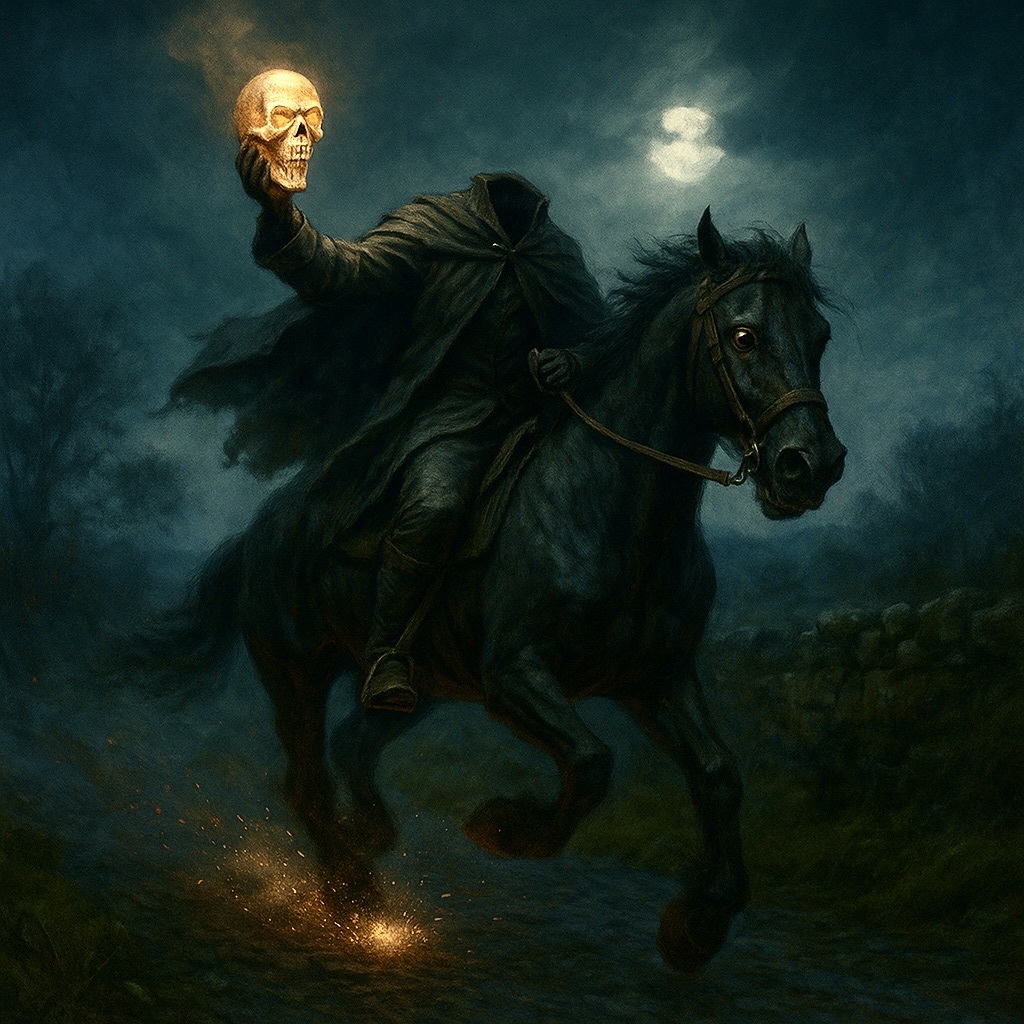
The description of the Dullahan is unforgettable. He rides a black horse, fierce and muscular, its nostrils flaring with sparks and its hooves striking fire against the earth. In his hand — not upon his shoulders — rests his head, grotesque and otherworldly. The skin is pale and decayed, the flesh stretched tight, with a wide grin carved permanently into its face. The eyes glow with an unholy light, scanning the night, searching for souls to claim. His head is said to have the consistency of moldy cheese, a detail both grotesque and haunting, because it brings the myth down from the lofty air of terror into the sickeningly tangible realm of decay.

Wherever the Dullahan stops, someone is destined to die. He does not need to speak; a mere point of his bony finger seals a person’s fate. Sometimes, however, he calls the name of his victim, and the sound is enough to extinguish life itself. Doors and locks cannot stop him, for no barrier can hold back death. He is both spirit and force, a being who transcends walls and gates as easily as breath passes through lungs. The Dullahan does not linger, does not chase for sport. He arrives, he marks, he takes, and he is gone.

But where did this terrifying image come from? Scholars trace the Dullahan back to Celtic mythology, where he may have been an incarnation of Crom Dubh, a fertility god who demanded human sacrifice. When Christianity spread through Ireland, the old gods were suppressed, demonized, or transformed into darker legends. Crom Dubh’s bloody worship may have morphed into tales of the Dullahan, who no longer demanded offerings but instead carried the image of death itself. Over time, his story blended with folklore about fairies, banshees, and the restless dead, crystallizing into the figure we know today.

The Irish countryside, with its fog-wrapped moors, stone ruins, and hidden lanes, was fertile soil for such a legend. In a land where famine struck often and mortality was never far from daily life, the Dullahan became not just a story but a cultural embodiment of the fragility of existence. He reminded villagers that life was fleeting, that death did not negotiate, and that the moment of one’s end was always out of human hands.

Yet, for all his terror, the Dullahan is not invincible. Folklore insists he fears only one thing: gold. A single golden object, whether a coin or trinket, can drive him away. This detail is striking, for it suggests a lingering human hope — that something of earthly value might hold back death. But the irony is sharp: gold may repel him in the tale, but no real wealth can keep mortality from claiming us. The Dullahan is an equalizer, a reminder that death does not care if one is rich or poor, young or old. His horse gallops for all.

Think for a moment about the symbolism of carrying one’s own head. To be headless is to be powerless, but the Dullahan subverts this. He is not robbed of his head but commands it, carrying it like a lantern. The head glows, it sees, it directs. It is death turned mobile, portable, weaponized. In many cultures, to lose the head is to lose identity and soul. But in Ireland’s Dullahan, the head becomes the very instrument of fear. He rides without it, proving that what we think makes us human is not what holds sway in the realm of the supernatural.

The Dullahan’s tale echoes outward into wider culture. Washington Irving’s “The Legend of Sleepy Hollow” famously introduced a headless horseman to American readers, and while the Hudson Valley tale is distinct, its DNA traces back to Ireland’s shadowy rider. Immigrants carried their stories with them, and in the fertile imagination of early America, the Dullahan adapted, blending with local fears to become Ichabod Crane’s terrifying pursuer. Today, every Halloween in the U.S., children see images of pumpkin-headed riders, not realizing they are looking at Ireland’s legacy galloping through history.

But unlike the playful or spooky adaptations that populate modern pop culture, the original Dullahan remains deeply grim. He is not a villain to be fought or defeated. He is inevitability given form. When villagers heard horse hooves echoing on lonely roads at night, they prayed not to hear their name whispered in the dark. When shadows moved near graveyards or crossroads, people clutched golden trinkets, desperate for protection. The Dullahan reminded them that life was borrowed, fragile, and never fully theirs.

Modern readers may find in the Dullahan an allegory for the things that pursue us now. The black horse might be time itself, galloping faster than we wish. The head with its fixed grin might be the reminder of our mortality, a face we must all one day wear. The gold that drives him away might represent the distractions we cling to — wealth, technology, endless consumption — in hopes of postponing the inevitable. But like all distractions, they cannot last. The rider always comes.

The Dullahan’s power lies not just in fear but in fascination. Death has always drawn human imagination, because to speak of it is to admit our helplessness. The Irish, with their gift for storytelling, wrapped that helplessness in imagery vivid and unforgettable: fire-breathing horses, rotting skulls, silent riders pointing bony fingers. They made death visible, audible, and unforgettable. That is why the Dullahan endures — because he rides not just through Irish fields but through the universal landscape of human fear.

And yet, the story is not without a kind of beauty. In its way, the Dullahan legend is honest. It strips away illusion. It says: death is coming. No locks will keep it out, no walls will keep it back. But it also says: you are not the first, and you will not be the last. We all share this fate. There is a strange comfort in that universality, in knowing that every hoofbeat, every whispered name, ties us together in the human journey.

So on October 8, when the tale of the Dullahan is remembered, we are reminded that folklore is never just entertainment. It is survival in story form. It is our attempt to wrestle with truths too large to face in silence. The Dullahan gallops not just across the roads of Ireland, but across our imaginations, forcing us to look at the one thing we cannot escape. And in his grotesque visage, his grinning skull, we might just see the reflection of our own deepest fears.

Perhaps the most chilling thought of all is this: if the Dullahan rides tonight, and his horse sparks fire against the stones outside your door, will you dare to look? Or will you close your eyes and hope the whisper is not your name?

Because when death rides, it carries its own head — and it always knows where it’s going.

Related Posts

When the City Burned: The Great Chicago Fire of 1871

Elias Rowen

On the night of October 8, 1871, the city of Chicago went to sleep under clear skies, unaware that within hours, flames would transform their lives, their homes, and their future forever. By dawn, the city would be a sea of fire, a hellscape of wood, wind, and despair. It became one of the most infamous urban disasters in American history—the Great Chicago Fire. Though historians still debate its exact origins—popular legend blames Mrs. O’Leary’s cow kicking over a lantern—the consequences are beyond dispute. In just two days, a thriving metropolis of nearly 300,000 people was reduced to ash and rubble. And yet, out of that devastation, Chicago would rise again, stronger, prouder, and more determined than ever to etch its name into history.

To understand the magnitude of the disaster, one must picture Chicago in the 1870s. It was a booming city, an industrial powerhouse and a vital hub connecting the Great Lakes to the Mississippi. The city was alive with the sound of trains, factories, and opportunity. Immigrants poured in, businesses thrived, and fortunes were made. But beneath the promise lay danger. Chicago was built largely of wood—houses, sidewalks, even streets. After months of drought, the city was a tinderbox. Add in strong winds off Lake Michigan, and the conditions were perfect for catastrophe.

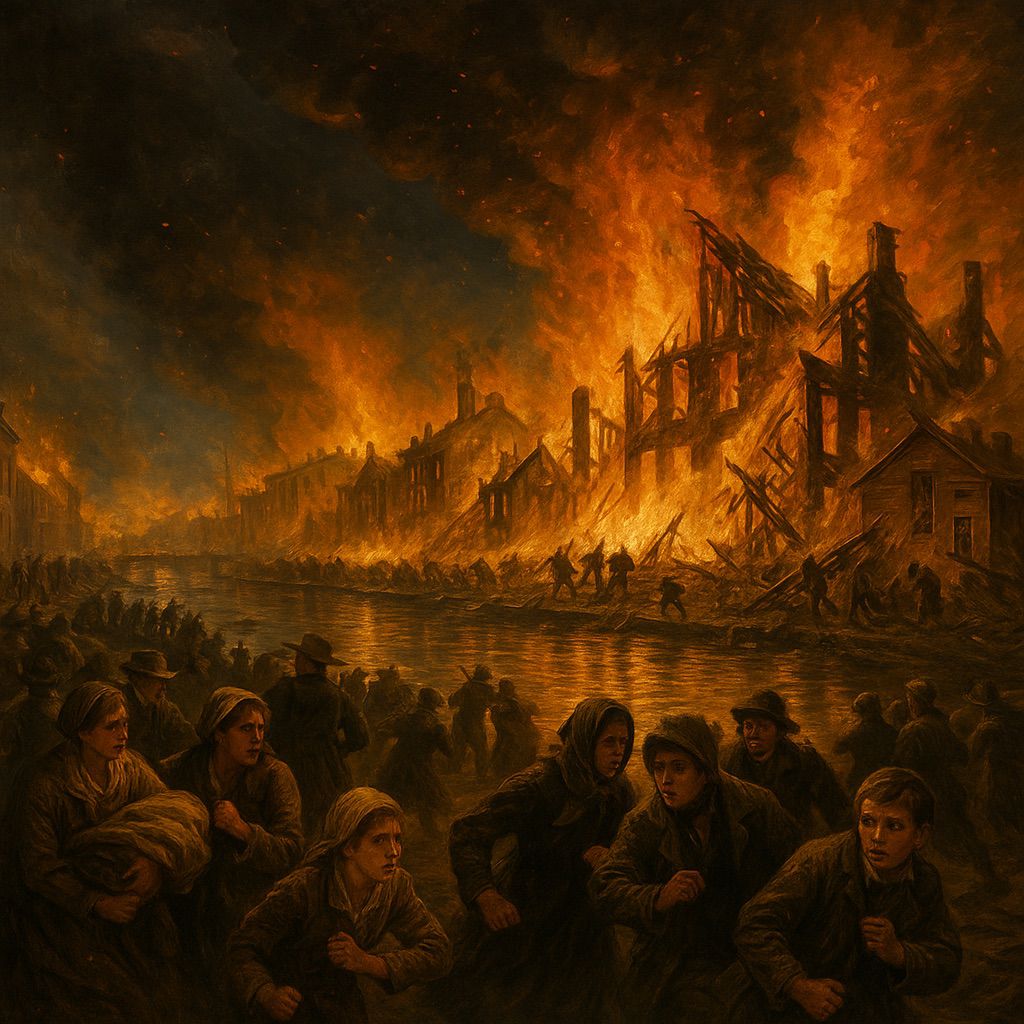
The fire began in a barn on DeKoven Street, but within minutes, it leapt to neighboring buildings. Fueled by wooden structures and dry conditions, the flames grew into an unstoppable beast. Eyewitnesses described a sky turned orange, buildings exploding into sparks, and firestorms leaping across the river as if mocking attempts to contain them. The city’s fire department, though brave, was overwhelmed. Exhausted from battling another blaze the night before, they lacked both manpower and equipment. The flames moved faster than men, consuming block after block in minutes.

By midnight, the fire had crossed the South Branch of the Chicago River. By morning, it roared through the city’s heart, devouring banks, businesses, churches, and homes alike. The wind fanned embers into fiery whirlwinds, tossing sparks onto rooftops blocks away. People fled with whatever they could carry—children, pets, Bibles, photographs—anything that could be saved in a moment of panic. Horses stampeded through the streets, wagons overloaded with families and their possessions jammed the roads, and panicked crowds surged toward the river, some jumping into the water to escape the inferno.

The fire showed no mercy. It consumed the courthouse, the Palmer House Hotel, and even the Chicago Tribune building. It burned rich and poor alike, making no distinction between mansions and shanties. The heat was so intense that it melted iron, turned brick to powder, and warped the very earth. By the time rain finally helped douse the flames on October 10, over 17,000 buildings had been destroyed, 100,000 people left homeless, and nearly 300 lives lost. The city smoldered like a corpse, its skyline a jagged silhouette of chimneys and ruins.

But Chicago’s story did not end in ashes. In many ways, it began anew. Out of the ruins came resilience. Survivors set up makeshift shelters, churches opened their doors, and donations poured in from across the nation and the world. Relief trains arrived with food, blankets, and supplies. Even Queen Victoria of Britain sent aid. Out of tragedy, solidarity grew.

More importantly, the fire forced Chicago to rethink itself. The wooden city gave way to a city of stone, steel, and innovation. New building codes demanded safer, sturdier construction. Architects flocked to the city, eager to reimagine its skyline. In the decades that followed, Chicago became a laboratory of modern architecture, the birthplace of the skyscraper, and a symbol of what resilience could achieve. The city that once lay in ruins would later host the World’s Columbian Exposition of 1893, dazzling the globe with its rebirth.

And yet, behind the triumph lies the human heart of the fire. Imagine a mother clutching her children, running barefoot across burning streets. Picture families huddled along the lakefront, watching their city vanish in flames. Imagine the firemen, their faces blackened with soot, swinging axes against impossible odds. These were not just statistics—they were human lives, their pain and bravery written in fire and ash.

The Great Chicago Fire is not just a tale of destruction but of transformation. It reminds us that even in our darkest hours, the seeds of rebirth are sown. Chicago rose from the flames not diminished but renewed, proving that a city’s spirit is stronger than its structures. October 8, 1871, was the night Chicago burned. But it was also the night Chicago learned it could endure anything, even the fire itself.

Related Posts

Lessons in Temptation: Why the Sexy Schoolgirl Rules Halloween

Dave

There are costumes that rise and fall with passing trends, those tied to movies, memes, or moments in time, and then there are the archetypes—the outfits that return every year because they tap into something bigger than a fad. Few costumes have reached the level of instant recognition and enduring allure as the Sexy Schoolgirl. Halloween after Halloween, amidst the devils, witches, vampires, and superheroes, the sight of a short plaid skirt, a tied-up blouse, and knee-high socks never fails to turn heads, spark conversation, and dominate photos. There is something about the look that is equal parts playful and provocative, innocent in its suggestion yet daring in its execution. The Sexy Schoolgirl doesn’t whisper for attention—she claims it, and she has been claiming it for decades.

At the heart of its appeal is contradiction. Real school uniforms represent rules, conformity, and structure. They are about discipline, order, and standardization. But Halloween is not about rules—it’s about rebellion. The Sexy Schoolgirl costume flips the uniform on its head, taking something meant to cover and control and transforming it into something designed to flaunt and tease. It’s not about authenticity—nobody is trying to actually pass for a student—it’s about the fantasy of rebellion against authority, of bending the straight lines of the classroom into the curves of playful temptation. That clash between innocence and flirtation is what gives the Sexy Schoolgirl its viral edge.

The plaid skirt is the centerpiece of the look, a fabric long associated with uniformity but here cut short to showcase legs and movement. Every pleat becomes a wink, every swish a suggestion. The blouse, tied at the midriff, changes from stiff and buttoned to relaxed and daring, a signal that this character is not following any handbook. And the knee-highs? They are the exclamation point, transforming practicality into allure, nodding to the world of vintage pin-ups while feeling fresh every year. Together, the pieces create a costume that is instantly identifiable, instantly flirty, and endlessly photogenic.

What makes the Sexy Schoolgirl especially viral in the age of social media is its adaptability. It can be styled in countless ways, each one telling a slightly different story. Some lean into playful innocence, with pigtails, bubblegum, and oversized glasses adding a tongue-in-cheek charm. Others go sultry and sleek, pairing the outfit with bold lipstick, smokey eyes, and heels that click like declarations of confidence. Some add props like books, rulers, or satchels, twisting them into flirtatious accessories instead of academic tools. And in recent years, the costume has been mashed up with pop culture—anime influences, punk-rock spins, or even supernatural twists that turn the schoolgirl into a vampire or zombie. The archetype is flexible, which is why it never gets stale.

Part of its power lies in the reaction it provokes. Unlike many costumes that fade into the background, the Sexy Schoolgirl sparks conversations, laughter, and admiration in equal measure. It’s a look that doesn’t just get noticed—it gets remembered. In photos, the plaid pops against Halloween’s darker tones. The tied blouse creates dynamic lines that flatter in candid shots. The knee-highs frame legs in ways that catch the eye. This is a costume made for cameras, and in the age of viral content, that matters. On Instagram, TikTok, or X, the Sexy Schoolgirl costume becomes a highlight reel of winks and smirks, one of those instantly shareable looks that racks up attention.

But what humanizes the Sexy Schoolgirl and keeps her evergreen is the personality behind the outfit. Every woman who steps into the pleats and knee-highs makes the role her own. Some wear it with tongue firmly in cheek, treating it as a parody of the cliché, playing it for laughs and irony. Others embrace the sultry side unapologetically, using the costume as a statement of confidence and boldness. Still others blend both, leaning into the contradiction of innocence and mischief. The costume isn’t about fitting a mold—it’s about giving permission to embody a fantasy, to play with an archetype, to revel in the freedom that Halloween offers.

And freedom is really the key. Halloween is a night when rules disappear, when the ordinary becomes extraordinary, when personas are tried on like masks. The Sexy Schoolgirl is so popular because she embodies that spirit. She is rebellion against authority. She is mischief wrapped in fabric that was once meant to symbolize conformity. She is the thrill of taking something familiar and making it wild, daring, unforgettable. She’s not about playing it safe—she’s about playing to win the room, the photo, the night.

Critics may call it a cliché, but clichés exist because they work. And this one works better than most. Year after year, the Sexy Schoolgirl shows up at parties, and year after year, she dominates. There is always at least one, and she is always unforgettable. Because whether it’s the pigtails or the plaid, the tied blouse or the knee-highs, the costume doesn’t just hint at temptation—it delivers it with a grin.

So if you’re choosing your Halloween look and want something guaranteed to spark attention, laughter, admiration, and a few sly double-takes, the answer is simple. Slip into that plaid, tie that blouse, pull on those knee-highs, and step into the role of the ultimate Halloween icon. The Sexy Schoolgirl isn’t just a costume—it’s an experience, one that makes the room buzz and the memories linger. She rules Halloween because she is playful, provocative, and unforgettable. And when the night is over, when the photos are posted and the stories are told, hers is the image that will still be sparking reactions days later. That’s the power of a costume built not on rules, but on breaking them.

Related Posts

The Eternal Hunger: Chasing the Wendigo Across North America’s Frozen Shadows

Dave

There are monsters that lurk in the forests, waiting in silence, and then there are monsters that lurk within us, whispering in our veins, gnawing at the edges of our souls. The Wendigo, that infamous cannibalistic spirit of Algonquian lore, is both. It is a creature made of frost and famine, but also of greed and insatiable desire. To speak of the Wendigo is to speak not just of a beast in the woods, but of the human capacity for hunger without end — the hunger that devours everything and leaves nothing behind. On October 7, when whispers of this chilling legend rise, we find ourselves staring at more than just a myth; we are staring at the shadow in the mirror.

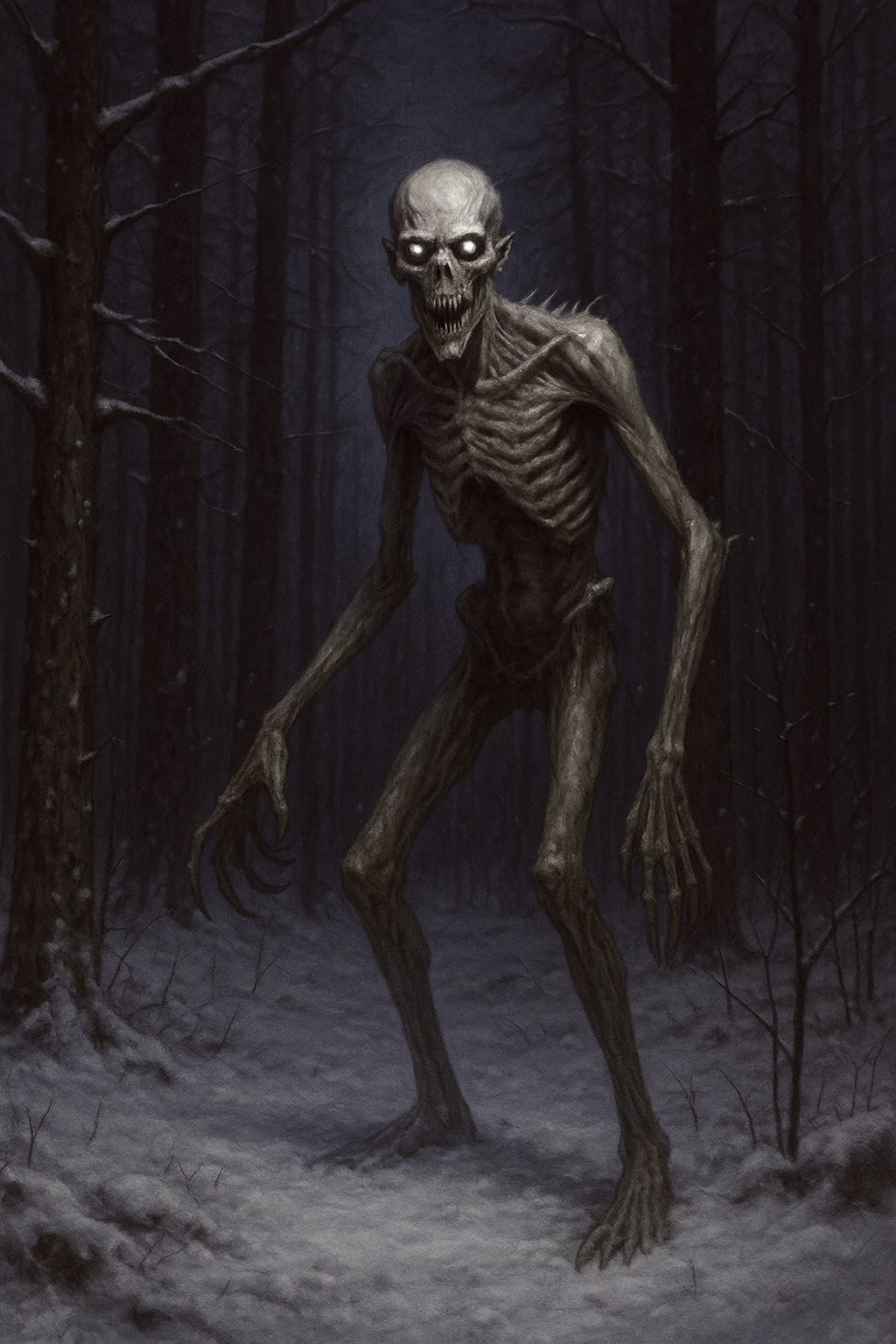
The story begins in the snowy landscapes of North America, where winters were not merely inconvenient but life-threatening. To the Algonquian-speaking peoples of the Great Lakes and boreal forests, survival hinged on community, balance, and respect for the land. Yet when food grew scarce and the cold became merciless, desperate choices haunted human hearts. Out of this crucible of survival and moral boundaries emerged the Wendigo: a skeletal, emaciated figure with skin stretched tight over bones, lips chewed away, eyes sunken but burning with an icy fire. It was said to be taller than the tallest pine, gaunt as death itself, yet impossibly strong, a being forged of starvation and sin. It craved flesh, but more than that — it craved endlessly, forever hollow.

The Wendigo legend carried with it a moral gravity. It wasn’t just a campfire story told to frighten children. It was a warning, a cultural safeguard. In times of hunger, when snow buried the land and the deer had vanished, people were tempted by the unthinkable: cannibalism. The Wendigo myth served as a shield against such impulses. To eat human flesh was not simply taboo; it was to invite possession by the Wendigo spirit, to transform into a ravenous beast doomed to wander the wilderness in eternal hunger. It was a way of saying: “Even when the world grows cruel, there are lines we do not cross.” The myth turned survival into a moral battleground, one where the human soul was at stake.

But the Wendigo is more than folklore; it is a mirror held up to human greed. Stories tell us that even those who already had enough could fall prey to its curse. A hunter who hoarded food while others starved might attract its shadow. A leader who demanded more than his share could become Wendigo. Thus, the legend expanded beyond hunger into a commentary on greed itself — greed that consumes community, greed that turns abundance into famine. The Wendigo was not just about eating flesh; it was about the insatiable appetite for more, no matter the cost. In this way, it remains a legend frighteningly relevant to the modern world.

Imagine the scene: a small Algonquian village buried beneath drifts of snow, families huddled in bark-covered lodges, fires sputtering against the biting cold. Outside, the trees groan with frost, and the night air carries a silence so profound it presses against your chest. Then, far off, a scream — not animal, not human, but something stretched thin between the two. Elders whisper the word no one wants to hear: Wendigo. The children draw closer to their mothers. Hunters clutch their spears. Somewhere in the darkness, something impossibly tall shifts between the pines. Its hunger is a palpable force, a storm rolling in. That imagery alone explains why the Wendigo survives as one of the most terrifying figures in North American folklore.

European colonists who heard the stories were quick to fold the Wendigo into their own catalog of demons and devils, but to the indigenous peoples, it was never so simple. This was not just a monster of the forest — it was a spiritual condition, a sickness of imbalance. Anthropologists later coined the term “Wendigo psychosis” to describe cases in which individuals, often during periods of famine, became obsessed with cannibalistic thoughts or claimed to be transforming into Wendigos. While the diagnosis itself is controversial and largely dismissed today, the fact remains that the legend had power not only as metaphor but as lived psychological reality. People truly believed in its ability to possess. Fear itself became flesh.

The Wendigo’s physical description varies, yet the essence is constant: hunger incarnate. Some tales paint it as a giant towering over trees, with heart made of ice, lips frozen to its teeth, breath steaming with death. Others envision it gaunt, corpse-like, its bones pressing through skin, its joints twisted by starvation. Always, it is hollow, a walking famine. Its voice is said to echo with the howling wind, its step cracking ice with every stride. And worst of all: when it eats, it never grows full. Its belly stretches, but its hunger grows deeper. The Wendigo is a paradox of endless consumption. It is capitalism before capitalism, addiction before drugs, a timeless allegory for the dangers of wanting more than enough.

Consider the modern parallels. Our world today is overflowing with abundance, yet starvation and greed walk side by side. We consume oceans of resources, forests, oil, animals, and each other’s time, all while the hunger for more never ceases. If the Wendigo was once a spirit warning against cannibalism during famine, it now feels like a metaphor warning against our collective consumption. We devour, and devour, and devour, yet satisfaction never comes. In this light, the Wendigo is not just a North American monster. It is a global truth.

But let us return to the woods, because folklore thrives not in abstraction but in story. In one tale, a hunter returns to his village after weeks in the snow. He is gaunt, but his eyes are bright, too bright. He carries meat, plenty of it, yet he does not say from where it came. Soon, the people notice his lips are torn, as though chewed. They hear him whisper at night of voices in the wind. And when children disappear, there is no doubt. He has become Wendigo. The villagers burn him, but even as the flames consume his flesh, a shriek escapes, rising into the storm, carrying the hunger forward. In another story, travelers lost in a blizzard hear footsteps behind them. They look back and see nothing but whiteness. Yet the snow is stamped with massive prints, each step twice the size of a man’s. By morning, one of their party is gone, taken silently in the night. These stories endure because they capture primal fear: the fear of cold, hunger, and betrayal from within.

The Wendigo also embodies transformation, a theme deeply resonant in human myth. To become Wendigo is to cross the threshold between human and monster, to let hunger erase humanity. This is not unlike werewolf tales in Europe or vampire legends elsewhere, but the Wendigo’s transformation is more brutal. It is not a curse delivered by bite or magic. It is born of choice — the choice to consume flesh, to surrender to greed. That makes it terrifyingly intimate. Any person, given the wrong conditions, could fall.

In contemporary culture, the Wendigo has leapt from oral tradition into film, literature, and video games. It appears in horror movies, from low-budget Canadian slashers to Hollywood thrillers. It haunts episodes of shows like Supernatural and Hannibal, and it lurks in games like Until Dawn. Yet something curious happens in these retellings: the Wendigo often becomes just another monster, stripped of its moral depth. Its connection to greed, to famine, to cultural survival is reduced to jump scares. This dilution risks robbing the legend of its richness. But for those willing to dig deeper, the Wendigo remains as meaningful as ever — a reminder that horror is never just about fear, but about what we fear in ourselves.

Perhaps that is why the Wendigo endures. Because it speaks to the dark corners of our own appetites. It is easy to laugh at tales of giants with icy hearts, but harder to deny the metaphor. Who among us has not wanted more than we need? Who has not felt hunger — for food, for wealth, for recognition — that gnawed even when satisfied? The Wendigo lives in that gnawing. It is the whisper that nothing is ever enough.

So on October 7, when its legend is remembered, let us pause. Let us see the Wendigo not just as a monster in the woods, but as a cautionary tale that belongs to us all. It is the voice that warns against devouring one another, against letting greed hollow us out until we are but skin stretched over bone, wandering through life without end or purpose. The Wendigo is the frozen shadow at the edge of campfire light, the hunger that will not be fed. And maybe — just maybe — it is waiting for us to finally listen.

Because the Wendigo is not just a creature of Algonquian lore. It is a reflection of humanity’s deepest fear: that we will consume ourselves into extinction, and that our hunger will follow us, eternal and unsatisfied, into the cold.

Related Posts

The War That Wouldn’t End: America’s Invasion of Afghanistan and the Long Shadow of October 7, 2001

Elias Rowen

On October 7, 2001, less than a month after the Twin Towers crumbled and the Pentagon burned, the United States launched airstrikes on Afghanistan. It was the beginning of what would become the longest war in American history—a war that promised justice, but instead dragged the world into two decades of blood, politics, shifting alliances, and haunting questions. The invasion began with a simple objective: dismantle al-Qaeda and topple the Taliban regime that sheltered it. But as bombs fell and soldiers deployed, the war grew into something far more complex, reshaping not only Afghanistan but also America itself and the global order for a generation.

The images of that day were both chilling and strangely familiar: fireballs erupting over Kabul, tracer rounds slicing the night, and the confident words of President George W. Bush declaring, “We will not waver, we will not tire, we will not falter, and we will not fail.” For Americans still reeling from the horror of September 11, there was a raw desire for action, for vengeance, for some assurance that the United States would strike back against those who dared to attack it. The invasion felt like justice delivered. For Afghans, though, it was the start of yet another chapter in a cycle of war stretching back through decades of conflict with the Soviets, civil war, and Taliban rule.

Afghanistan, long called the “graveyard of empires,” is a land of mountains, deserts, and tribal complexities. No foreign power had ever fully subdued it. Not the British in the 19th century, not the Soviets in the 20th. Yet America entered with confidence, believing its superior technology and firepower could achieve what others had failed to do. The Taliban were quickly driven from power; Kabul fell, Kandahar followed, and Hamid Karzai was installed as the new president. In those early months, it seemed victory was certain, swift, and permanent.

But history rarely bows to certainty. The Taliban melted away, not defeated but waiting, regrouping in rural villages and across the Pakistani border. U.S. forces remained, first to stabilize, then to rebuild, then to “nation-build.” What was meant to be a short, targeted campaign turned into an open-ended occupation. Billions of dollars flowed into Afghanistan, funding infrastructure, schools, and security forces. Yet much of it disappeared into corruption, inefficiency, and the pockets of warlords who played both sides. For every school built, a bomb cratered another. For every village secured, another slipped into insurgent hands.

Meanwhile, the war exacted a staggering human toll. Tens of thousands of Afghan civilians died—farmers, children, families caught in crossfire or targeted in bombings gone wrong. Entire generations grew up knowing nothing but war. American and allied soldiers faced ambushes, IEDs, and the unbearable strain of endless deployments. Over 2,400 U.S. service members lost their lives in Afghanistan, and countless more returned home with invisible wounds—PTSD, moral injury, and a gnawing sense of futility.

The war reshaped global politics too. NATO allies followed America into Afghanistan, marking the alliance’s first mission outside Europe. Pakistan played a double game, taking U.S. aid while harboring Taliban elements. Iran watched carefully, sometimes aiding, sometimes undermining U.S. efforts. China and Russia calculated their moves in the shadow of America’s quagmire. And back home, the war fueled debates about terrorism, security, and civil liberties. The Patriot Act, surveillance programs, and airport security became part of everyday life, altering the relationship between citizens and their government.

Perhaps most telling was the way the war faded into the background of American life. Unlike Vietnam, it lacked daily television coverage of body bags and jungle firefights. Unlike World War II, it lacked national mobilization. For many Americans, Afghanistan was a distant hum—known, acknowledged, but rarely felt directly. The burden fell on soldiers and their families, a small fraction of the population bearing the weight of a nation’s vengeance.

And then came the long ending. Presidents changed—Bush, Obama, Trump, Biden—each inheriting a war they promised to conclude, yet passing it on to the next. Obama surged troops in, then pulled some back, declaring victories that never materialized. Trump negotiated with the Taliban in Doha, acknowledging reality: the war could not be won militarily. Finally, in 2021, twenty years after the first bombs fell, the United States withdrew. The world watched as Kabul fell again, eerily quickly, to the Taliban. Helicopters lifted Americans from rooftops. Afghan allies clung to departing planes. It was an ending that looked more like defeat than closure.

And yet, in the chaos of that ending, one truth became undeniable: Afghanistan was never just a war about Afghanistan. It was about grief, anger, fear, ambition, hubris, and the human tendency to believe that wars can remake the world when, in fact, they often remake nothing but graves.

But behind the politics and strategy, there were human stories. The U.S. Marine who built a school in a village only to watch it burn. The Afghan girl who attended classes in secret, clutching books forbidden by the Taliban. The American mother who sent her son to war and then wept at his grave, asking what it had all meant. The Taliban fighter, hardened by decades of conflict, who believed he was defending his land from yet another occupier. These are not statistics. They are lives, hopes, and heartbreaks woven into the tapestry of a war too vast to comprehend fully.

October 7, 2001, was the day America stepped into Afghanistan. It was the day the world changed course, not just for Afghans and Americans, but for all who lived in an era where terrorism, war, and surveillance became global fixtures. Two decades later, the war’s echoes remain—shaping geopolitics, haunting veterans, and lingering in the eyes of Afghan children who wonder if peace will ever arrive.

The U.S. invasion of Afghanistan will be remembered not only for its beginning but for its ending, and for the questions it leaves behind. Did the world become safer? Did the sacrifices mean progress? Or was it all, as some fear, a tragic cycle destined to repeat?

On October 7, we remember not just the day bombs fell, but the day humanity once again proved how fragile peace can be, how costly vengeance becomes, and how the longest wars rarely end in victory—they simply end.

Related Posts

The Goat-Sucker’s Shadow: Chupacabra and the Birth of a Modern Monster

Dave

It began, as many legends do, with blood. In the mid-1990s, in the rural hills of Puerto Rico, farmers awoke to find their animals dead in the night. Goats, chickens, rabbits—drained, it seemed, of their blood. There were no torn hides, no scattered carcasses, just puncture marks on necks and lifeless bodies left behind. Whispers spread faster than the news, and soon a name was whispered too: el chupacabra—the goat-sucker. Within months, it had grown from rumor to global phenomenon, a monster that felt at once new and ancient, strange and familiar. Unlike the vampires of Europe or the spirits of Asia, this was a monster of the modern age—sighted in suburbs, catalogued by tabloids, chased by ufologists. The Chupacabra became not just Puerto Rico’s monster, but the world’s, born in the crucible of media, paranoia, and imagination.

At first, the descriptions of the creature were unlike anything the world had seen before. Witnesses spoke of a small humanoid figure, three to four feet tall, with spines or quills running down its back, glowing red eyes, and leathery gray-green skin. Some said it hopped like a kangaroo, others that it slinked like a reptile. In every account, it was otherworldly, more alien than animal. Its victims were not just killed but exsanguinated, their bodies eerily intact save for two or three puncture wounds. Farmers swore it was no dog, no coyote, no predator they had ever known. And in that void of explanation, the myth took root. The Chupacabra was born not from centuries of folklore but from the immediacy of mystery, a monster created in real time.

The timing of the Chupacabra’s emergence was no accident. The 1990s were a decade steeped in alien abduction stories, conspiracy theories, and a new global media landscape that spread tales faster than ever before. Shows like The X-Files dominated, tabloids filled their pages with UFOs and government cover-ups, and rural fear met urban fascination in a perfect storm. The Chupacabra slid neatly into this space, part cryptid, part extraterrestrial, part government experiment gone wrong. Its image spread from Puerto Rico to Latin America, then into the southern United States, and from there across the globe. The monster was new, but the story—something lurking just outside the safety of night—was as old as humanity itself.

But what made the Chupacabra different from other creatures of legend was the speed with which it evolved. Within just a few years, its appearance shifted. By the early 2000s, many sightings described not a spiny alien-like being but a hairless, mangy dog-like creature, with gaunt features, glowing eyes, and vicious teeth. Dead specimens were occasionally found, almost always coyotes suffering from mange, their fur gone, their skin sickly and tight, their bodies emaciated. Scientists explained the phenomenon as misidentification, pointing out that mange made ordinary animals appear monstrous. But by then, the legend had already outgrown explanation. The Chupacabra had become a symbol, a modern boogeyman whose truth mattered less than its story.

Puerto Rico holds the heart of that story. The island’s rich cultural tapestry of folklore already included tales of witches, demons, and spirits, blending Indigenous, African, and Spanish influences. The Chupacabra was something new, but it resonated with something deep, a sense that the land still held mysteries beyond human control. For farmers whose livelihoods were shaken by the sudden deaths of livestock, the creature was more than a story—it was an answer. In this way, the Chupacabra reflects a universal human pattern: when faced with the unexplained, we give it shape, give it a name, and through story, try to contain it.

There is something profoundly human in the way the Chupacabra spread. It was born in fear, fed by rumor, and raised by media. Each retelling made it larger, stranger, more terrifying. Children whispered about it in schools, reporters breathlessly covered each sighting, and skeptics and believers clashed in endless debate. The monster became a mirror, reflecting whatever fears a culture projected. In Puerto Rico, it was linked to economic hardship, colonial tension, and the anxieties of modern life. In the U.S., it became entangled with fears of border security and invasive threats. In each place it landed, the Chupacabra took on new meaning, its image molded by the hands of those who told its story.

And yet, for all the skepticism, the legend endures. Ask someone who has lost animals to mysterious attacks, and they will tell you it was no coyote. Listen to a witness describe what they saw, and you will hear conviction, not fabrication. Myths do not survive because they are factually true—they survive because they capture a truth deeper than fact. The Chupacabra embodies fear of the unseen predator, the sense that nature—or something beyond nature—can still surprise us, still terrify us. It is the fear of losing control, of being powerless to protect, of realizing that even in a world of satellites and science, monsters may still lurk in the dark.

To humanize the Chupacabra legend is to see the people who shaped it. The farmer in Puerto Rico who awoke to find his goats dead, the children who huddled around each other at night, the journalists chasing a story that felt alive—these are the heartbeat of the monster. The Chupacabra is not just a cryptid; it is a cultural creation, one that speaks to collective anxieties. It is what happens when fear meets imagination, when the unexplained demands explanation, and when storytelling becomes a survival tool. In this sense, the Chupacabra is less about claws and fangs, and more about us.

Even now, decades after the first reports, the Chupacabra has not faded. It appears in documentaries, horror films, urban legends, even memes. Children still whisper about it in the dark, and farmers still eye the night warily when livestock die unexpectedly. It is part of the folklore of not just Puerto Rico but the world, a monster created in the age of the internet but one that feels timeless. And as long as people fear the unexplained, the Chupacabra will remain alive in shadow, just out of sight.

Perhaps that is the most unsettling truth of all: the Chupacabra may never need to exist in flesh and blood, because it already exists in the one place monsters can never die—in human imagination. Its cry is not in the night air, but in our stories, our fears, our need to give shape to the shadows. It is, in that way, eternal.

Related Posts

Midnight Prowl: Why the Seductive Catwoman Is the Ultimate Halloween Fantasy

Dave

There are few costumes as instantly recognizable, as endlessly magnetic, and as irresistibly timeless as Catwoman. From the moment she first leapt from comic book panels into pop culture history, she has been the embodiment of sleek danger and sultry power. Halloween, of course, is her natural hunting ground. Every October 31st, while witches stir cauldrons and vampires bare their fangs, there will always be at least one Catwoman prowling the party. And not just any Catwoman—the Seductive Catwoman, in a skin-tight black catsuit that clings like a second skin, a mask that hides just enough to intrigue, and a whip coiled at her side that promises mischief. This isn’t just a costume. It’s a declaration of confidence, a statement that says: tonight, the shadows belong to me.

What makes Catwoman such a perennial favorite is the perfect marriage of danger and allure. She’s not simply a hero or a villain—she’s both, depending on her mood. That ambiguity makes her endlessly fascinating. When someone steps into the sleek black catsuit for Halloween, they aren’t just dressing as a character—they’re stepping into a persona that balances temptation and power, charm and chaos. And let’s be honest: the catsuit is practically built for going viral. The glossy material, the way it hugs every curve, the silhouette of the mask and cat ears—this is a look designed to command attention. It’s not just sexy—it’s iconic.

The whip is more than just a prop—it’s a symbol of dominance, of control, of playful danger. At a Halloween party, it becomes an accessory that adds an extra layer of intrigue. Every flick, every pose, every photo opportunity with it turns the costume from an outfit into a performance. The whip isn’t just about intimidation—it’s about storytelling, about embodying the sly trickster who always stays one step ahead. And when paired with the confidence of the person holding it, it’s the difference between being “someone in a Catwoman costume” and being the Seductive Catwoman.

But Catwoman’s appeal goes far beyond the shiny exterior. She represents freedom and independence. Unlike many female characters in pop culture, she isn’t waiting to be saved. She’s the one calling the shots, bending the rules, making the choices that suit her and no one else. That independence translates perfectly into Halloween night, when people feel the freedom to step into roles that reflect hidden sides of themselves. The Seductive Catwoman costume allows the wearer to channel that fearless independence, to embrace the spotlight without apology, to flirt with power in a way that feels both fun and empowering.

And the truth is, this costume photographs like a dream. Social media eats it up. The contrast of black leather against colorful party lights, the glint of the mask under neon strobes, the flash of red lipstick against the shadows—it’s cinematic. On Instagram, TikTok, or X, a Seductive Catwoman doesn’t just get posted, she gets shared, saved, and remembered. Every pose can look like a movie poster. Every candid laugh looks like a behind-the-scenes moment of Gotham’s most famous thief crashing your Halloween. That’s part of why she’s viral—she fits seamlessly into the aesthetics of the digital age, designed to dominate feeds as much as she dominates the dance floor.

What really makes her endure, though, is the humanity behind the claws. Catwoman has always been relatable because she is complicated. She isn’t pure evil or perfect good. She’s a mess of contradictions—caring and selfish, loyal and reckless, fierce and vulnerable. The Seductive Catwoman costume channels all of that into one intoxicating package. It’s not about being flawless—it’s about being fascinating. And that makes the costume feel less like putting on a mask and more like unleashing a side of yourself that’s already there, just waiting for a reason to come out.

Halloween is all about transformation, about permission to play roles we wouldn’t normally dare to embody. Slip into that catsuit, lace up those boots, fasten that mask, and suddenly you’re not just someone in a costume—you’re prowling the night, owning the room, letting every glance linger a second longer than it should. It’s intoxicating, not just for those who see you, but for the person wearing it. The Seductive Catwoman isn’t just sexy for others—she’s empowering for the one who wears her. And that’s why she continues to dominate, year after year.

Of course, there’s always competition on Halloween night. There will be witches and devils and angels and vampires. But Catwoman doesn’t compete—she prowls above the rest. She doesn’t need to shout for attention. She doesn’t need gimmicks. She walks in, and the room adjusts to her. That’s the power of the archetype, and it’s why the Seductive Catwoman will always be a highlight. She’s not chasing the party—the party is chasing her.

And maybe that’s the real magic of it all. The Seductive Catwoman costume reminds us that sometimes the most unforgettable Halloween looks aren’t the scariest or the flashiest—they’re the ones that embody confidence, mystery, and control. They’re the ones that let us play with danger while wrapped in allure. They’re the ones that turn a simple outfit into a story, and a night into a legend.

So this Halloween, when the music is pounding, the lights are flashing, and the air is buzzing with energy, watch the crowd. Notice who people are turning to. Notice who people can’t stop looking at. Chances are, it’s the one in the catsuit, mask, and whip, smirking like she knows exactly what you’re thinking—and daring you to say it out loud. That’s Catwoman. That’s the queen of Halloween. And that’s why, year after year, she never loses her claws.

Related Posts

The Day of Atonement Turned to Fire: The Yom Kippur War of 1973

Elias Rowen

On October 6, 1973, while much of Israel stood in solemn silence for Yom Kippur—the holiest day in the Jewish calendar—the sound of shofars in synagogues was drowned out by the roar of jet engines, tank treads, and artillery fire. It was a day that began in fasting and prayer but descended into chaos and terror. The armies of Egypt and Syria, backed by allies across the Arab world, launched a coordinated surprise attack on Israel. For three weeks, the Middle East burned in one of the most brutal and consequential conflicts of the 20th century. The war would redraw not just battle lines but political realities, leaving scars that remain visible today.

The Yom Kippur War—known as the Ramadan War in the Arab world, as it coincided with the holy month of fasting—was unlike anything Israel had faced before. The timing was as devastating as the force. Yom Kippur is a day when the streets of Israel fall still, shops close, and people reflect inwardly on their faith and mortality. Military readiness was minimal; soldiers were home with families, generals at prayer. The Arab coalition, led by Egyptian President Anwar Sadat and Syrian President Hafez al-Assad, knew the symbolism of striking at such a vulnerable moment. It wasn’t just strategy—it was psychological warfare.

For Israel, the first hours were catastrophic. Egyptian forces stormed across the Suez Canal, overwhelming the thin Israeli defenses along the Bar Lev Line, a sand-and-concrete barrier that had seemed invincible. On the Golan Heights, Syrian tanks rolled across the plateau, threatening to break through and pour into northern Israel. For a nation only 25 years old, surrounded by hostile neighbors and haunted by the memory of the Holocaust, it felt as though the very existence of the state was on the brink.

The war was fueled by the ghosts of the Six-Day War of 1967, when Israel had stunned the Arab world by defeating multiple armies in less than a week, seizing Sinai, Gaza, the Golan Heights, and the West Bank. That humiliation burned in Arab memory. Egypt, in particular, longed to reclaim Sinai, and Sadat was determined to restore Arab pride, even if it meant gambling everything. Assad, ruling Syria with an iron hand, saw his chance to avenge the loss of the Golan. Together, they plotted carefully, coordinating with Soviet support in weapons and training, while the United States, Israel’s ally, watched warily from afar.

In those opening days, the world saw an Israel that bled, staggered, and nearly broke. Soldiers rushed from synagogues to battlefields, often without proper equipment or preparation. Casualties mounted at a terrifying pace. Families sat glued to radios, waiting for word of sons and daughters at the front. For the first time since its founding, Israel faced the terrifying prospect of defeat.

Yet Israel’s response was as fierce as it was desperate. Within days, its forces regrouped. On the Golan Heights, vastly outnumbered Israeli tank crews fought with tenacity, holding off wave after wave of Syrian armor in what became known as the “Valley of Tears.” At the Suez, after initial failures, Israeli counterattacks began to claw back territory. The war turned into a brutal stalemate, with both sides suffering immense losses.

It was also a war fought in the shadow of superpowers. The Soviet Union supplied Egypt and Syria, while the United States launched a massive resupply airlift to Israel. The two global titans teetered dangerously close to direct confrontation. Nuclear alerts were raised. For a terrifying moment, the Middle East threatened to drag the entire world into catastrophe.

As the days wore on, the war shifted. Israeli forces, under the command of General Ariel Sharon, crossed the Suez Canal in a daring maneuver, encircling Egypt’s Third Army and threatening Cairo. On the northern front, Israeli troops pushed Syrians back beyond the pre-war lines. By late October, a ceasefire brokered by the United Nations came into effect, leaving both triumph and tragedy in its wake.

The cost was staggering. Israel lost over 2,600 soldiers—an unbearable toll for such a small nation. Egypt and Syria’s losses were even greater, with tens of thousands dead and wounded. Civilians across the region bore the trauma of bombings, shortages, and fear. Yet amid the ashes, something remarkable emerged. Sadat, though unable to fully defeat Israel, proved his point: Egypt could fight and regain dignity. This opened the door to diplomacy, culminating in the historic Camp David Accords of 1978, where Egypt became the first Arab nation to make peace with Israel.

The Yom Kippur War was thus not just a clash of armies—it was a crucible of change. It reshaped alliances, humbled leaders, and showed that the Middle East could never be the same again. For Israelis, it was a painful reminder that survival was never guaranteed, that vigilance and resilience were as essential as prayer. For Arabs, it was proof that humiliation could be redeemed, that even in loss, dignity could be reclaimed. For the world, it was a sobering lesson in how quickly local conflicts could escalate into global crises.

And beyond politics and strategy lay the human heart of the war. Imagine a young Israeli soldier clutching his rifle on the Golan Heights, exhausted but refusing to yield. Picture an Egyptian crossing the Suez on makeshift bridges, carrying not just a weapon but decades of national humiliation. Picture families on both sides mourning sons lost to a war neither started nor truly understood. Behind the headlines, behind the maps and speeches, it was a war of human beings—ordinary men and women caught in the firestorm of history.

October 6, 1973, remains etched in memory as a day when faith met fire, when prayer was shattered by gunfire, and when the fragility of peace was laid bare for all to see. The Yom Kippur War was a tragedy, a turning point, and a paradox—born of hate, but eventually opening a path, however narrow, toward peace.

Related Posts

The White-Clad Terror: Pontianak, the Haunting Cry of Malaysia and Indonesia

Dave

There is a sound that chills the tropics as much as any icy wind: the faint, eerie cry of a woman in the night, carried through the palm groves and banana plantations of Malaysia and Indonesia. Locals know not to answer. They know not to follow. For centuries, generations have whispered the same warning—that the cry belongs to the Pontianak, the vengeful spirit of a woman who died in childbirth, cursed to roam the earth forever. She is said to appear as a beautiful woman with pale skin, long black hair, and a white dress stained with death, her beauty so alluring it masks the violence she carries within. To men especially, she is deadly. Lured by her charm, they soon find themselves prey, their bodies ripped open, their blood drained, their lives snatched by the ghost who embodies both sorrow and rage. The Pontianak is not just a ghost story—it is one of Southeast Asia’s most enduring legends, woven into daily life, whispered into the fabric of fear itself.

Her story is born from tragedy, from the liminal space between life and death, creation and destruction. Childbirth has always been one of humanity’s greatest risks, especially in times before modern medicine, when women faced dangers that often proved fatal. The Pontianak represents that ultimate injustice—the woman who should have given life but instead lost her own, denied the chance to be mother, denied even a peaceful afterlife. Her pain twists into vengeance, her grief into hunger, her spirit into something that terrifies villages and cities alike. Death in childbirth is already heartbreak enough, but the Pontianak myth transforms it into a force of terror, reminding everyone of the fragility of life and the anger of the silenced.

Descriptions of the Pontianak vary slightly from region to region, but her key traits remain constant. She is a vision of striking beauty, often described with flawless skin and flowing black hair, her figure graceful and inviting. From afar, she appears as the perfect woman, sometimes even carrying the scent of frangipani flowers, a sweetness that deceives the senses. But once her victim comes close, the horror reveals itself. Her nails grow into talons, her teeth sharpen, her eyes glow red, and her once-beautiful face twists into a mask of rage. What was alluring becomes monstrous, and what seemed like salvation becomes doom. It is this duality—the mix of desire and death—that makes her one of the most terrifying and fascinating figures of folklore.

Her cry is her signature. Much like the banshee of Ireland, the Pontianak’s wail signals her presence. The sound is said to shift depending on her distance. If you hear her scream piercing and loud, she may be far away. But if you hear it faintly, almost whisper-like, she is near—perhaps even right behind you. This inversion of expectation deepens the horror, ensuring that fear is never far, no matter how loud or soft the cry may be. The scream cuts through night air, unearthly and unforgettable, a sound that grips both imagination and spine. Many who claim to have heard it describe the way it lingers long after, echoing in their bones as much as their ears.

Legends of the Pontianak are not confined to fireside tales—they are lived experiences, recounted by those who swear they have seen her. Drivers along rural roads at night report encountering a lone woman in white standing beneath a tree, her hair covering her face. Villagers tell of shadows moving in banana groves, of cries that woke them from sleep, of scratches and bruises appearing mysteriously after encounters they cannot explain. These stories are not told lightly; they are woven into daily caution, guiding behavior even today. Avoid traveling alone at night. Do not walk beneath certain trees. Do not ignore the strange cry of a woman in the distance. The Pontianak is not just myth—it is a living fear.

At the core of her legend is vengeance, often directed at men. Some stories say she targets unfaithful lovers, punishing betrayal. Others claim she preys indiscriminately, driven by a hunger that cannot be satisfied. In some versions, she rips open the stomachs of her victims, consuming their organs, leaving behind only mutilation. In others, she seduces before striking, draining life through intimacy turned violent. To women, she is a reminder of injustice and danger; to men, she is both a fantasy and a nightmare, embodying desire that destroys. The Pontianak is as much about gendered fear as it is about death, a figure shaped by cultural anxieties around love, betrayal, and the untamed power of womanhood cut short.

Yet, despite her horror, there is tragedy woven into her story. The Pontianak was once a woman, with dreams, with life ahead of her. She died in childbirth—a death that is not only painful but unjust, a theft of both life and possibility. Her transformation into a ghost is not random—it is punishment for a world that failed her, for a death that should not have happened. Some traditions even suggest that she cries not only for vengeance, but for the child she never held, mourning eternally for what was taken from her. To humanize the Pontianak is to see not just the monster, but the grief beneath her rage.

The Pontianak’s enduring presence in culture speaks to her resonance. She appears in films, horror stories, and television across Malaysia and Indonesia, often terrifying new generations with her blood-curdling scream and haunting presence. She is the subject of countless ghost-hunting tales, her story retold in modern settings, from highways to urban apartments. Even in the digital age, she adapts, appearing in social media ghost lore and viral videos, proving her ability to evolve while keeping her essence intact. This adaptability keeps her alive not only as a figure of folklore but as a living legend, feared as much now as she was centuries ago.

But why does she endure so powerfully? Perhaps because the Pontianak embodies a fear that is universal, even as it is local. She is about loss—loss of life, loss of motherhood, loss of justice. She is about vengeance, the way grief can twist into rage when unacknowledged. She is about the danger of appearances, about how beauty can mask horror. And she is about the thin line between love and destruction, desire and death. These themes transcend time and place, making her story resonate far beyond the villages of Malaysia and Indonesia.

To hear her cry in the night, to see her pale figure by the roadside, to feel the air grow cold around you—these are not just superstitions, but experiences that connect communities to their past, their fears, their unspoken truths. The Pontianak is not merely a ghost, but a reminder: that death is never fair, that grief never dies, and that the cries of women silenced too soon will always find a way to be heard, even from beyond the grave.

So, if you ever travel through the tropics of Southeast Asia on a moonlit night, and you hear a woman’s cry echoing from the trees, resist the urge to look closer. Do not follow. Do not answer. For it may not be a woman at all, but the Pontianak, her beauty hiding her hunger, her grief turned to vengeance. And if you do not heed the warning, you may find yourself entangled in a story older than memory, one that never ends well for those who ignore the sound of sorrow in the night.

Related Posts

Heaven in Disguise: Why the Angel Gone Wild Rules Halloween Nights

Dave

There’s something unforgettable about a Halloween costume that plays with expectations, something magnetic about flipping innocence into intrigue. Every October, amidst the swirling cauldron of witches, vampires, and monsters, there’s always one look that stands out because it doesn’t scream with gore or rely on fear—it teases with contradiction. That costume is the Angel Gone Wild: white lingerie that barely covers, stockings and heels that command attention, a delicate halo perched just above a mischievous smile, and feathered wings that gleam under the glow of party lights. It’s the kind of costume that makes people double-take, the kind that blurs the line between sweet and sinful, the kind that makes a room collectively lean in because suddenly the most heavenly figure has just gone deliciously off-script.

What makes the Angel Gone Wild so endlessly viral isn’t just the lingerie or the way the wings frame the body—it’s the concept. Angels in cultural imagination are pure, untouchable, serene. They are symbols of perfection, guardians of innocence. But the moment you twist that purity with a sultry spin, you unleash something that feels daring, rebellious, and wickedly fun. The halo no longer signals virtue—it becomes an ironic crown, a playful hint that this angel isn’t following the rules. The wings are no longer symbols of divine duty—they’re fashion accessories amplifying the allure. And the lingerie? That’s the statement. This isn’t heaven’s messenger. This is heaven’s secret after dark.

There’s a boldness in the costume that resonates. The Angel Gone Wild isn’t trying to blend into the background or pretend she’s just another part of the party. She’s there to be seen. She’s there to take the stereotype of innocence and flip it into power, to laugh at the idea of being judged and instead invite the attention head-on. That’s what gives her the edge. She’s not just sexy—she’s defiant. She’s claiming the freedom to embody both sides of the coin at once: the soft glow of white fabric and feathers mixed with the sharp thrill of lingerie and sultry confidence.

It’s also one of the most versatile sexy costumes out there. Some women play it flirty and fun, all smiles and glitter, wings bouncing behind them as they dance through the night. Others go more seductive and mysterious, pairing the look with smoky makeup, bold lipstick, and eyes that smolder as much as the candles around the room. Some add a playful prop—a cocktail glass instead of a harp, a halo that glows neon instead of gold, a wink that says this angel fell from heaven on purpose. The Angel Gone Wild can be adapted to fit every personality, from the giggly extrovert to the sultry siren, and that’s part of why it never loses traction.

And let’s be honest—the aesthetic is built for cameras. White lingerie against the dark Halloween backdrop glows like a spotlight. Wings add dimension and drama to photos, catching light and creating striking silhouettes. The halo frames the face, making every smirk, pout, or playful grin picture-perfect. On Instagram, TikTok, or X, the Angel Gone Wild doesn’t just appear in a feed—she owns it. She brings balance to the lineup of darker costumes, becoming the bright but wicked highlight that people scroll back to again and again.

But what really humanizes this costume, what makes it not just viral but beloved, is the story it tells. Every person who steps into that lingerie and straps on those wings isn’t just wearing a costume—they’re embodying a fantasy. For one night, they get to break the mold of being “good,” to revel in mischief while dressed as something pure. It’s a playful rebellion, the kind of cheeky self-expression that says: I don’t have to be what you expect. I can be both divine and daring, innocent and outrageous. That duality speaks to something deep in us, because aren’t we all a little bit of both?

It’s also empowering. The Angel Gone Wild costume demands confidence—it invites you to show skin, to command attention, to step into the party like you know the room was waiting for you. And when you feel that confidence radiating through the fabric, it changes you. The costume becomes a catalyst for unleashing the boldest, brightest, wildest version of yourself. That’s what makes it so viral—not just how it looks, but how it makes the wearer feel. And that feeling translates. People can sense it in the photos, in the way she moves, in the way she laughs without apology. It’s contagious, and it spreads.

Of course, critics will always grumble about the sexualization of costumes, but that misses the point. Halloween is about fantasy, freedom, transformation. The Angel Gone Wild isn’t about living up to anyone else’s idea of virtue or restraint. She’s about embracing the fun, the flirty, the outrageous. She’s about tapping into the parts of yourself that don’t get to shine in the daylight, the parts that want to wink at tradition and walk boldly into the night with feathers swaying and heels clicking. And that’s not shameful—it’s celebratory.

That’s why she endures. Trends shift, new pop culture icons rise and fall, but the Angel Gone Wild keeps flying high. Every year, she’s there in the mix, lighting up parties, dominating feeds, making people laugh, gasp, and swoon. Because deep down, we all understand the appeal. We all love the contradiction of it, the playful rebellion, the thrill of seeing heaven’s symbol take a walk on the wild side. It’s the kind of costume that doesn’t just mark a holiday—it defines it.

So when you see her this Halloween, glowing in white lace, halo tilted just slightly askew, wings brushing the shoulders of everyone she passes, remember that you’re not just looking at another sexy costume. You’re looking at an icon of Halloween itself. You’re looking at confidence, fun, rebellion, and allure wrapped into one unforgettable package. You’re looking at why the Angel Gone Wild isn’t just a costume—it’s a cultural phenomenon.

And the best part? Every woman who wears it makes it her own. Every feather, every smirk, every flick of the halo tells a slightly different story. But they all carry the same message: that heaven and hell aren’t so far apart when you’re brave enough to blur the lines. That’s why the Angel Gone Wild rules the night, every night, every year, forever.

Related Posts

The Day the World Lost Its Apple: Remembering Steve Jobs

Elias Rowen

On October 5, 2011, the world seemed to pause. Screens dimmed, voices hushed, and millions of people across the globe sat in stunned silence as the news broke: Steve Jobs, the co-founder of Apple, the visionary behind the iPhone, iPod, iMac, and iPad, had passed away at the age of 56. His death was not just the loss of a man—it was the closing of a chapter in the story of modern innovation. For decades, Jobs had stood at the intersection of art and technology, creating tools that didn’t just work but felt magical. When he was gone, it was as though the magician had left the stage, leaving the world staring at the curtain, wondering how much of the wonder could continue without him.

Steve Jobs’ story has been told so often it feels mythical, but what makes it remarkable is not just what he achieved, but how deeply his work touched ordinary lives. Born in San Francisco in 1955 and adopted shortly after birth, Jobs was not destined for wealth or power. He was a restless soul, dropping out of Reed College after only one semester. Yet, even as he sat in calligraphy classes or crashed on friends’ floors, Jobs carried with him a vision that education couldn’t contain: the belief that technology could be beautiful, intuitive, and deeply personal.

In 1976, Jobs, alongside Steve Wozniak, built Apple Computer in his parents’ garage. The Apple II and Macintosh were not just machines—they were statements. Jobs insisted that design mattered as much as function. He envisioned a future where computers weren’t the cold, intimidating domain of experts but friendly companions that anyone could use. He was ridiculed for it at first. He was called eccentric, demanding, even impossible. Yet, slowly, the world began to realize that Jobs wasn’t just building products—he was reshaping how humans interacted with technology.

His path wasn’t linear. In 1985, Jobs was ousted from Apple, the very company he had founded. Lesser men might have faded into obscurity. Jobs instead founded NeXT and purchased Pixar, a then-struggling animation studio. Pixar would revolutionize storytelling with films like Toy Story, blending technology with heart in a way only Jobs could envision. By the time Apple bought NeXT in 1997, bringing Jobs back as CEO, the prodigal founder returned with scars, wisdom, and a determination that would transform Apple into the most valuable company in the world.

The products that followed weren’t just successful—they were cultural phenomena. The iMac reintroduced design elegance. The iPod put “a thousand songs in your pocket” and changed music forever. The iPhone redefined communication, collapsing phone, internet, and camera into a single sleek device. The iPad challenged our notions of what computers could be. Jobs’ gift wasn’t just creating technology—it was anticipating what people wanted before they even knew it themselves. He didn’t ask consumers what they needed; he showed them what they couldn’t live without.

But what made Jobs truly iconic wasn’t just the gadgets—it was his philosophy. He believed technology was about more than circuits and code. It was about humanity. His obsession with simplicity, elegance, and user experience wasn’t a fetish—it was a conviction that technology should feel like an extension of our own creativity. He once said, “Technology alone is not enough. It’s technology married with liberal arts, married with the humanities, that yields us the results that make our hearts sing.”

Jobs was far from perfect. He was known for being mercurial, exacting, sometimes cruel in his pursuit of excellence. Colleagues described the infamous “reality distortion field” that bent those around him to his vision, for better or worse. Yet, even his flaws became part of his legend. Jobs demanded brilliance not because he wanted to be feared but because he believed the world deserved nothing less. He was not satisfied with “good enough.” For him, products had to be revolutionary, transformative, unforgettable.

When Jobs succumbed to pancreatic cancer, the grief was global. Outside Apple stores, people left flowers, Post-it notes, and half-bitten apples in tribute. Leaders around the world—from Barack Obama to Bill Gates—acknowledged that Jobs had changed not just technology, but culture. His death was mourned not like that of a CEO but like that of an artist, a cultural icon whose canvas was the future itself.

Yet, perhaps the most humanizing detail is this: at the end of his life, Jobs reflected not on his products but on mortality. He reminded us that even visionaries cannot outsmart death. In his 2005 Stanford commencement address, he said, “Remembering that you are going to die is the best way I know to avoid the trap of thinking you have something to lose. You are already naked. There is no reason not to follow your heart.” Those words now echo louder than ever, a message from a man who knew his time was limited but refused to waste it.

Jobs’ legacy lives on every time someone slides their finger across a screen, listens to music through white earbuds, or FaceTimes a loved one oceans away. His DNA is embedded in the devices that define our era. More importantly, his spirit—the relentless push to innovate, to dream, to marry beauty with function—continues to inspire creators, designers, and entrepreneurs around the globe.

October 5, 2011, was the day the world lost Steve Jobs. But it was also the day we realized how much of him remains with us. Every glowing screen, every seamless design, every device that feels like magic is a whisper of his vision. Jobs didn’t just build Apple; he built a world where technology is no longer cold, but human. In death, as in life, he reminds us to stay hungry, stay foolish, and never stop pushing the world forward.

Related Posts

Silken Death: The Lure of Japan’s Spider-Woman, Jorōgumo

Dave

In the hushed forests of Japan, where mist clings to cedar trunks and streams wind through shadowed valleys, there are tales whispered that warn of beauty too dangerous to trust. These are not stories of gentle maidens or noble spirits, but of creatures wearing disguises more beguiling than any human charm. Among the most chilling of these is the Jorōgumo, the spider-woman of Japanese folklore, a yōkai who spins silk not just to catch prey, but to ensnare the hearts of men. She appears first as breathtakingly beautiful, her skin like porcelain, her hair long and flowing, her voice soft as falling rain. Travelers, entranced, are drawn close. But beneath the delicate exterior is a monster, a giant spider cloaked in illusion, waiting for the right moment to drop her mask and reveal her fangs. With strands of silk finer than any net, she binds her victims and drains them, leaving only husks behind. Her story is more than a ghost tale—it is a reflection of fear, desire, and the timeless warning that not all beauty is to be trusted.

The name Jorōgumo translates loosely to “entangling bride” or “prostitute spider,” and both meanings are fitting. Her myth sits at the intersection of allure and dread, reminding us how attraction can lead to destruction. In some versions, she is said to live near waterfalls or streams, weaving silk webs across hidden paths. In others, she resides in abandoned houses, waiting for weary wanderers. Always, her weapon is seduction. Unlike demons that rely on brute force, Jorōgumo hunts with deception, wrapping danger in beauty until escape becomes impossible. The closer you look, the more her legend reveals itself as a story not only of supernatural horror, but of human vulnerability—the way our longings can blind us, the way desire can become a trap of its own making.

Japan’s folklore is rich with yōkai, supernatural creatures that embody natural fears, cultural anxieties, and moral lessons. Among them, the Jorōgumo is especially potent because she merges two primal human terrors: the fear of spiders and the fear of seduction gone wrong. Spiders themselves have always provoked unease, with their patience, their silent weaving, and their venomous precision. But to combine that image with the face of a beautiful woman magnifies the terror, because it takes what should be safe—intimacy, connection, attraction—and turns it into a lethal snare. Her beauty is her web, her charm the toxin. The horror lies not just in the moment of being devoured, but in realizing too late that you walked willingly into her trap.

Legends of the Jorōgumo often begin with a chance encounter. A man, perhaps a traveling samurai or a wandering merchant, comes across a woman in need. She might be washing clothes by a stream, combing her hair beneath a waterfall, or sitting gracefully with a shamisen, playing haunting melodies. He is struck by her beauty, her poise, her quiet vulnerability. Drawn to her, he accepts her invitation, whether to follow her home, to share a drink, or to sit beside her and listen. But once he enters her lair, the illusion unravels. Threads of silk glisten in the corners, binding him before he even notices. Her body contorts, limbs elongating, the elegance dissolving into arachnid horror. What was once a woman is now a monstrous spider, her many legs encircling him as her fangs pierce. In an instant, intimacy becomes doom, tenderness becomes predation.

The Jorōgumo’s story is not simply a tale of horror, though—it is layered with symbolism. In feudal Japan, where these tales circulated, women were often both desired and feared. The myth reflects anxieties around female sexuality, portraying it as dangerous, even deadly, when untethered by control. A woman who lures men, who uses beauty as a weapon, becomes monstrous in the eyes of the society that told her story. At the same time, the Jorōgumo is also a figure of power, embodying female autonomy in a culture that often restricted it. She chooses her victims, controls her encounters, and dominates men who underestimate her. Her legend, therefore, is both a cautionary tale and a hidden acknowledgment of feminine strength—feared, demonized, but undeniable.

Stories of Jorōgumo vary across regions of Japan, but one of the most famous comes from Kashikobuchi in Ibaraki Prefecture. It is said that a young warrior once rested near a waterfall, where he saw a beautiful woman playing a shamisen. Enchanted, he sat with her, but soon felt faint as invisible threads wrapped around him. Realizing too late that he was ensnared, he tried to flee, but the silk tightened. Only with great effort and the help of his comrades was he dragged away, his body covered in fine strands of spider silk. Others were not so lucky—many who encountered her vanished entirely, their bodies never found, their disappearance attributed to the spider-woman’s unrelenting hunger.

Another tale speaks of Jorōgumo’s cunning. In some versions, she disguises herself not only as a woman, but as a mother carrying a baby. When kind travelers offer assistance, she lures them closer. But the baby is no child at all—it is a bundle of spider eggs or a decoy, a grotesque trick to disarm her prey. In others, she pretends to be injured, only to ensnare the well-meaning man who tries to help. These variations highlight her adaptability; like a spider, she tailors her trap to the situation, patient and inventive in the pursuit of survival.

But for all her horror, the Jorōgumo is not entirely without tragedy. Some stories portray her as once human, transformed into a spider through curse or fate. In these tales, her monstrous hunger is not a choice but a doom, her beauty preserved even as her soul is twisted. This angle humanizes her, blurring the line between victim and predator. She is both feared and pitied, a creature who must feed but who also carries the memory of being human, trapped between two forms forever.

Humanizing Jorōgumo is what makes her legend endure. She is not just a monster to fear, but a reflection of ourselves—the way beauty can hide danger, the way desire can lead us astray, the way power can be both intoxicating and destructive. In every culture, there are myths warning of seduction’s peril: sirens of Greece, succubi of Europe, fairies of Celtic lands. Jorōgumo is Japan’s answer, weaving her story in silk that glistens with both terror and allure. She embodies the eternal tension between attraction and annihilation, reminding us that the things we long for most can sometimes be the things that destroy us.

Even today, the image of Jorōgumo resonates in popular culture. She appears in anime, horror films, and video games, often depicted as a beautiful woman whose transformation into a spider is both horrifying and mesmerizing. Artists revel in the juxtaposition—the elegance of the human form against the grotesque power of the arachnid. Writers and filmmakers draw on her legend because it speaks to something timeless: the fear of losing control, of being consumed by forces we thought we could master. And audiences respond, because beneath the fantasy lies a truth we all know—that desire is dangerous, that trust can be betrayed, that predators often wear masks of beauty.

Imagine yourself walking alone in a Japanese forest, the sound of water echoing through the trees. You see a woman, radiant in her stillness, her dark hair cascading like ink, her eyes drawing you in. She beckons, soft and kind. You step closer, heart quickening. Only too late do you notice the glint of silk in the branches, the shimmer of threads in the moonlight. Her smile widens. The air thickens. And you realize the story is not just myth—it is a warning, one you should have heeded before desire led you here. That is the power of Jorōgumo: to make you second-guess every alluring face in the dark, to remind you that the most dangerous predators are not always the ones that roar, but the ones that smile.

Her legend lingers not because of spiders, but because of what she represents. The Jorōgumo is about entanglement—physical, emotional, psychological. She is about the dangers of illusions, the webs we walk into willingly, and the truth that sometimes the most beautiful things are also the deadliest. To fear her is to fear ourselves, our weaknesses, our desires. That is why, centuries after the first tale was told, her story still shivers through the air like silk in the night.

Related Posts