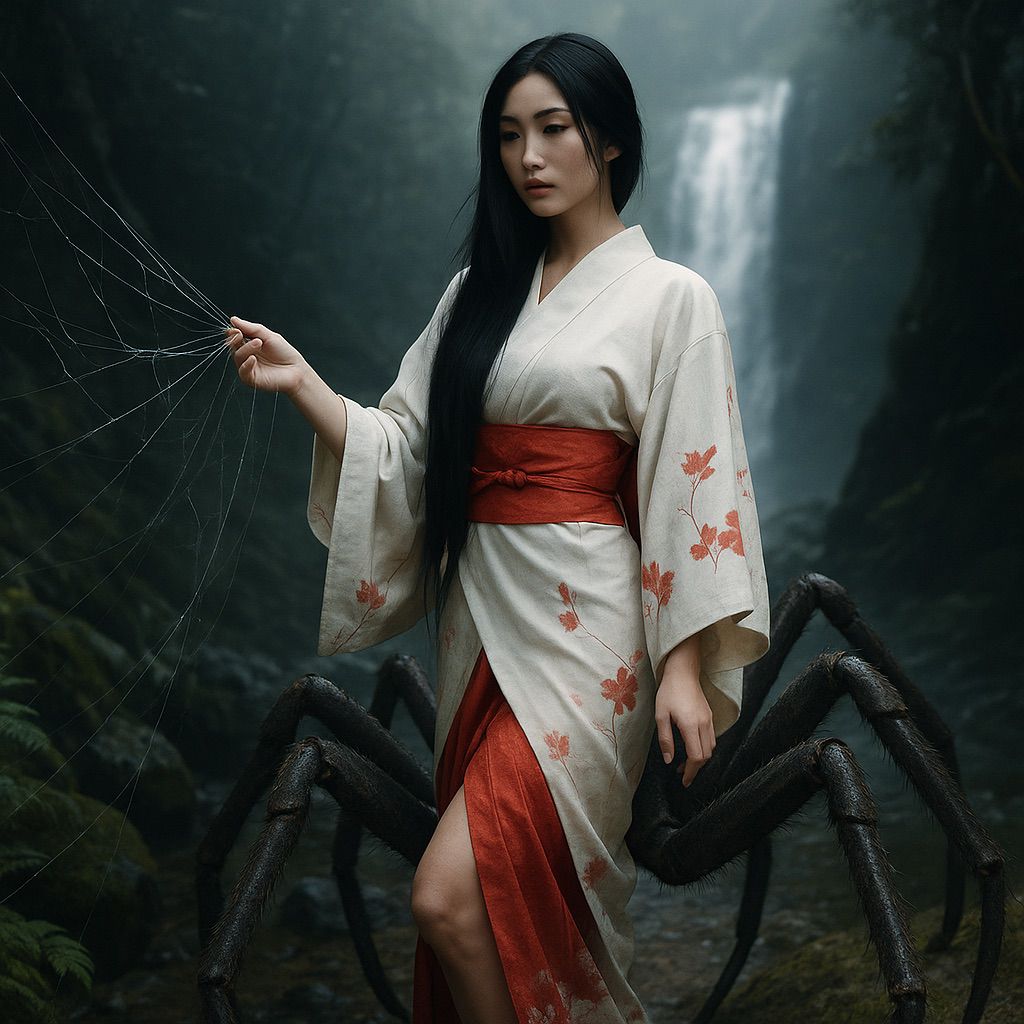
In the hushed forests of Japan, where mist clings to cedar trunks and streams wind through shadowed valleys, there are tales whispered that warn of beauty too dangerous to trust. These are not stories of gentle maidens or noble spirits, but of creatures wearing disguises more beguiling than any human charm. Among the most chilling of these is the Jorōgumo, the spider-woman of Japanese folklore, a yōkai who spins silk not just to catch prey, but to ensnare the hearts of men. She appears first as breathtakingly beautiful, her skin like porcelain, her hair long and flowing, her voice soft as falling rain. Travelers, entranced, are drawn close. But beneath the delicate exterior is a monster, a giant spider cloaked in illusion, waiting for the right moment to drop her mask and reveal her fangs. With strands of silk finer than any net, she binds her victims and drains them, leaving only husks behind. Her story is more than a ghost tale—it is a reflection of fear, desire, and the timeless warning that not all beauty is to be trusted.
The name Jorōgumo translates loosely to “entangling bride” or “prostitute spider,” and both meanings are fitting. Her myth sits at the intersection of allure and dread, reminding us how attraction can lead to destruction. In some versions, she is said to live near waterfalls or streams, weaving silk webs across hidden paths. In others, she resides in abandoned houses, waiting for weary wanderers. Always, her weapon is seduction. Unlike demons that rely on brute force, Jorōgumo hunts with deception, wrapping danger in beauty until escape becomes impossible. The closer you look, the more her legend reveals itself as a story not only of supernatural horror, but of human vulnerability—the way our longings can blind us, the way desire can become a trap of its own making.
Japan’s folklore is rich with yōkai, supernatural creatures that embody natural fears, cultural anxieties, and moral lessons. Among them, the Jorōgumo is especially potent because she merges two primal human terrors: the fear of spiders and the fear of seduction gone wrong. Spiders themselves have always provoked unease, with their patience, their silent weaving, and their venomous precision. But to combine that image with the face of a beautiful woman magnifies the terror, because it takes what should be safe—intimacy, connection, attraction—and turns it into a lethal snare. Her beauty is her web, her charm the toxin. The horror lies not just in the moment of being devoured, but in realizing too late that you walked willingly into her trap.
Legends of the Jorōgumo often begin with a chance encounter. A man, perhaps a traveling samurai or a wandering merchant, comes across a woman in need. She might be washing clothes by a stream, combing her hair beneath a waterfall, or sitting gracefully with a shamisen, playing haunting melodies. He is struck by her beauty, her poise, her quiet vulnerability. Drawn to her, he accepts her invitation, whether to follow her home, to share a drink, or to sit beside her and listen. But once he enters her lair, the illusion unravels. Threads of silk glisten in the corners, binding him before he even notices. Her body contorts, limbs elongating, the elegance dissolving into arachnid horror. What was once a woman is now a monstrous spider, her many legs encircling him as her fangs pierce. In an instant, intimacy becomes doom, tenderness becomes predation.
The Jorōgumo’s story is not simply a tale of horror, though—it is layered with symbolism. In feudal Japan, where these tales circulated, women were often both desired and feared. The myth reflects anxieties around female sexuality, portraying it as dangerous, even deadly, when untethered by control. A woman who lures men, who uses beauty as a weapon, becomes monstrous in the eyes of the society that told her story. At the same time, the Jorōgumo is also a figure of power, embodying female autonomy in a culture that often restricted it. She chooses her victims, controls her encounters, and dominates men who underestimate her. Her legend, therefore, is both a cautionary tale and a hidden acknowledgment of feminine strength—feared, demonized, but undeniable.
Stories of Jorōgumo vary across regions of Japan, but one of the most famous comes from Kashikobuchi in Ibaraki Prefecture. It is said that a young warrior once rested near a waterfall, where he saw a beautiful woman playing a shamisen. Enchanted, he sat with her, but soon felt faint as invisible threads wrapped around him. Realizing too late that he was ensnared, he tried to flee, but the silk tightened. Only with great effort and the help of his comrades was he dragged away, his body covered in fine strands of spider silk. Others were not so lucky—many who encountered her vanished entirely, their bodies never found, their disappearance attributed to the spider-woman’s unrelenting hunger.
Another tale speaks of Jorōgumo’s cunning. In some versions, she disguises herself not only as a woman, but as a mother carrying a baby. When kind travelers offer assistance, she lures them closer. But the baby is no child at all—it is a bundle of spider eggs or a decoy, a grotesque trick to disarm her prey. In others, she pretends to be injured, only to ensnare the well-meaning man who tries to help. These variations highlight her adaptability; like a spider, she tailors her trap to the situation, patient and inventive in the pursuit of survival.
But for all her horror, the Jorōgumo is not entirely without tragedy. Some stories portray her as once human, transformed into a spider through curse or fate. In these tales, her monstrous hunger is not a choice but a doom, her beauty preserved even as her soul is twisted. This angle humanizes her, blurring the line between victim and predator. She is both feared and pitied, a creature who must feed but who also carries the memory of being human, trapped between two forms forever.
Humanizing Jorōgumo is what makes her legend endure. She is not just a monster to fear, but a reflection of ourselves—the way beauty can hide danger, the way desire can lead us astray, the way power can be both intoxicating and destructive. In every culture, there are myths warning of seduction’s peril: sirens of Greece, succubi of Europe, fairies of Celtic lands. Jorōgumo is Japan’s answer, weaving her story in silk that glistens with both terror and allure. She embodies the eternal tension between attraction and annihilation, reminding us that the things we long for most can sometimes be the things that destroy us.
Even today, the image of Jorōgumo resonates in popular culture. She appears in anime, horror films, and video games, often depicted as a beautiful woman whose transformation into a spider is both horrifying and mesmerizing. Artists revel in the juxtaposition—the elegance of the human form against the grotesque power of the arachnid. Writers and filmmakers draw on her legend because it speaks to something timeless: the fear of losing control, of being consumed by forces we thought we could master. And audiences respond, because beneath the fantasy lies a truth we all know—that desire is dangerous, that trust can be betrayed, that predators often wear masks of beauty.
Imagine yourself walking alone in a Japanese forest, the sound of water echoing through the trees. You see a woman, radiant in her stillness, her dark hair cascading like ink, her eyes drawing you in. She beckons, soft and kind. You step closer, heart quickening. Only too late do you notice the glint of silk in the branches, the shimmer of threads in the moonlight. Her smile widens. The air thickens. And you realize the story is not just myth—it is a warning, one you should have heeded before desire led you here. That is the power of Jorōgumo: to make you second-guess every alluring face in the dark, to remind you that the most dangerous predators are not always the ones that roar, but the ones that smile.
Her legend lingers not because of spiders, but because of what she represents. The Jorōgumo is about entanglement—physical, emotional, psychological. She is about the dangers of illusions, the webs we walk into willingly, and the truth that sometimes the most beautiful things are also the deadliest. To fear her is to fear ourselves, our weaknesses, our desires. That is why, centuries after the first tale was told, her story still shivers through the air like silk in the night.