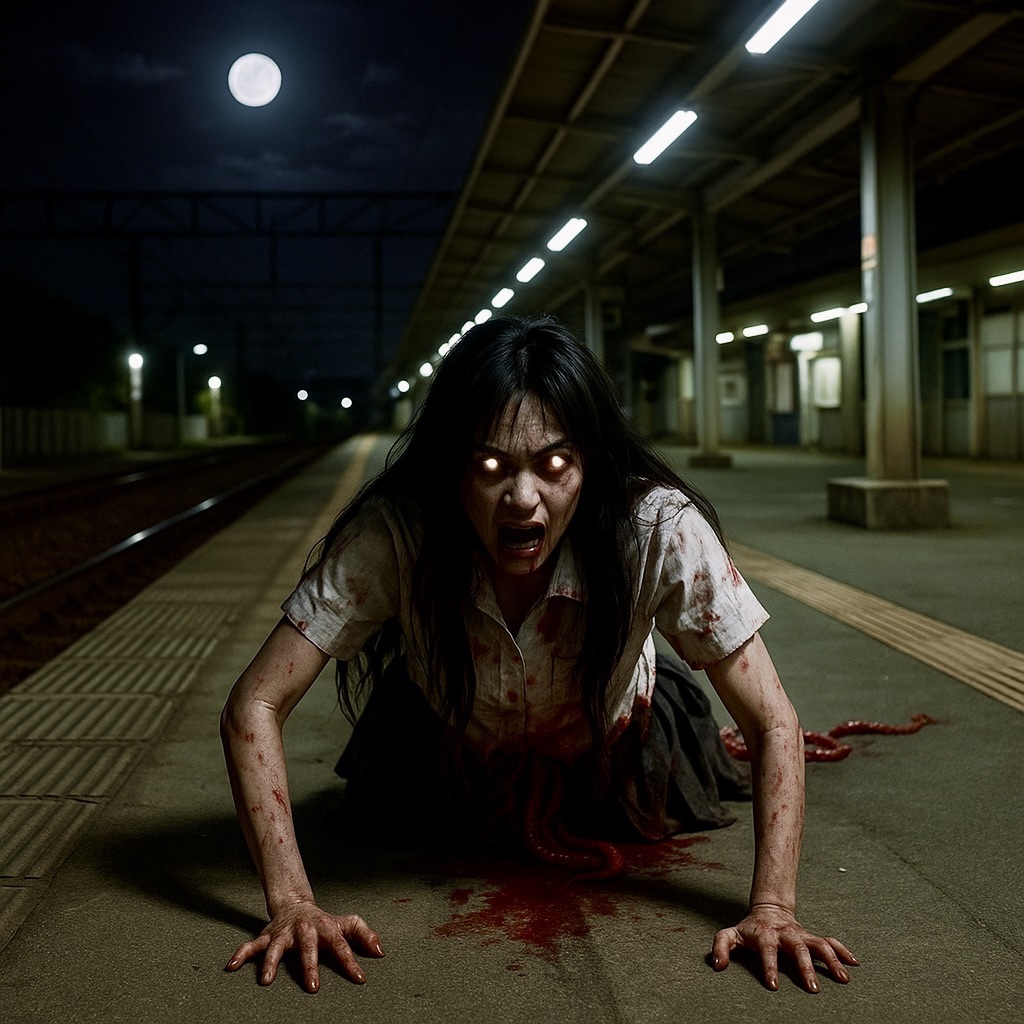
Some ghosts glide silently across the floor, white gowns trailing like mist. Others whisper from behind you, unseen but felt. But there is one ghost in Japanese urban legend that does not float gracefully or linger in shadows — she crawls. She drags herself across the ground with bloodied hands, her torso scraping against pavement, her eyes burning with rage, her mouth open in a scream or a grin that chills the soul. This is Teke Teke — the ghost of a woman cut in half, forever hunting the living, her presence announced by the horrifying sound that gives her name: teke…teke…teke. On October 19, when her legend is recalled, we are reminded that some fears are not about the supernatural alone but about the violence we do to one another and the cruelty of fate that can leave scars so deep they follow us beyond the grave.
Teke Teke’s story is modern, unlike ancient folkloric figures born centuries ago. She belongs to the world of urban legends, the whispered stories traded between students, the cautionary tales passed along to make spines shiver on late walks home. But her modernity does not diminish her horror; it makes it sharper. She is not cloaked in the distant mists of myth but rooted in the very real dangers of modern life. She is the ghost of the train tracks, a reminder of how technology and urban sprawl bring not only progress but tragedy.
The tale goes like this: Teke Teke was once a woman, or in some versions a schoolgirl, who suffered a gruesome accident. She fell onto train tracks and was struck by an oncoming train, her body severed in half. The pain, the shock, and the violence of her death were so intense that her spirit could not rest. Now she wanders as a ghostly torso, dragging herself along with her hands, her nails and elbows scraping pavement, her body moving in a sickening rhythm that produces the sound teke teke. To hear that sound is to know she is coming. To see her is to know you may not survive.
What makes her terrifying is not just her appearance but her relentlessness. Unlike other ghosts who haunt places or linger in specific locations, Teke Teke is a hunter. She chases those who cross her path, moving unnaturally fast despite her lack of legs. Her hands slam against the ground, dragging her forward with horrifying speed, closing the distance between her and her victim in seconds. The idea of a crawling ghost is unsettling enough; the idea of one that can outrun you while dragging itself is nightmare fuel.
Her vengeance is as brutal as her death. When she catches her victims, she slices them in half, mimicking the fate that befell her. In some versions of the legend, she carries a scythe or sickle to do the deed. In others, her ghostly strength alone is enough to rip bodies apart. Either way, her attack is both personal and symbolic: she repeats her trauma on others, spreading her pain in a cycle of horror.
Like many urban legends, Teke Teke’s story has countless variations. Some say she appears at train stations late at night, waiting for solitary travelers. Others claim she haunts school bathrooms, whispering from stalls before dragging herself out. In some tales, she even calls victims on the phone, her voice distant and echoing, asking if they know where her legs are. If the person answers incorrectly, she comes for them. The diversity of her appearances makes her even more terrifying, because she could be anywhere: the tracks you cross on your way home, the bathroom at school, the phone ringing in the dark.
The cultural impact of Teke Teke is profound. In Japan, she joins a pantheon of urban legends like Kuchisake-onna (the slit-mouthed woman) and Hanako-san (the ghost in the bathroom). Each of these figures reflects specific anxieties of modern life — school pressures, urban isolation, the violence lurking in public spaces. Teke Teke, in particular, embodies the fear of accidents, of lives cut short by the machinery of modernity. Trains are symbols of progress, but they are also merciless machines, and accidents on tracks are horrifyingly real. By turning such a death into a ghost story, the legend gives voice to communal fears about safety, vulnerability, and the fragility of life.
But Teke Teke is not only about trains. She is also about the cruelty of people. In some versions of the story, she was pushed onto the tracks as a prank gone wrong. In others, she leapt in despair after being bullied or shamed. These versions add layers of tragedy and social commentary, showing how neglect, cruelty, or violence from others can create ghosts as much as accidents can. Teke Teke’s rage is not only against the train that killed her but against the world that failed her.
Her imagery is unforgettable: long black hair, bloodstained school uniform, hollow eyes burning with anger, her body severed at the waist, entrails trailing as she crawls. The sound of her hands slapping pavement is as terrifying as the sight itself, because it is anticipatory — you hear her before you see her. Fear grows in the gap between sound and sight, in the knowledge that something is coming and you cannot stop it.
Yet, as with many legends, there are supposed ways to survive her. Some say you can escape if you run fast enough, though few succeed. Others say she asks a riddle, and answering correctly can save your life. In one version, she demands to know where her legs are, and only by answering “Meishin Expressway” — the supposed site where they were buried — can you escape. These details make her more than just a monster; they make her an interactive story, one that requires listeners to imagine themselves in her path, to test their own wits and courage against her rage.
The endurance of Teke Teke as a story shows the power of urban legends in shaping behavior. Children warned each other about walking home alone, about crossing train tracks carelessly, about bullying others. Fear became a tool of caution, a way to encode survival lessons in the language of horror. Just as old folklore warned against wandering into forests or disrespecting spirits, modern urban legends like Teke Teke warn against the dangers of city life — in forms that chill the blood enough to stick.
Teke Teke also resonates because she is both terrifying and tragic. She is a victim as much as a villain, a ghost born from trauma and injustice. Her violence is monstrous, but it is also the echo of her own suffering. In this way, she mirrors a universal theme in ghost stories: the restless dead often want what they were denied in life — justice, recognition, peace. But in their rage, they destroy instead of heal. Teke Teke terrifies us not only because she can kill us but because she reminds us of the pain we inflict on one another, and how it lingers beyond death.
So on October 19, when the story of Teke Teke is told, it is more than just a ghost story. It is a reminder of how fragile life is, how easily cruelty and accident can cut it short, and how the dead might carry their pain with them. She crawls not only through train stations and bathrooms but through our imagination, dragging herself hand over hand, reminding us that what is broken does not always stay buried.
And maybe, when you hear a strange sound at night — a scraping, a tapping, a teke teke — you’ll feel a chill run down your spine. You’ll look around, knowing she could be anywhere, knowing she doesn’t stop once she starts. Because Teke Teke doesn’t glide like other ghosts. She hunts. She crawls. And she never forgets the sound of your fear.