Latest Articles

Thirst Isn’t a Plan: How to Stay Hydrated in the Sun

Dave

The sun is generous. It gives you light, warmth, color, mood—then it quietly asks for payment in water. Out on hot sand or a blazing trail, you can lose more fluid than you think long before you feel thirsty. That’s why “I’ll drink when I need to” is the Monday of hydration strategies: technically possible, practically expensive. Staying hydrated in the sun is less about chugging heroic amounts of water and more about rhythm—consistent sips, smart electrolytes, shade breaks, and foods that carry water in their cells like tiny canteens. Do it right and you get the whole day: clear head, steady energy, skin that forgives, and a body that doesn’t punish you when the heat finally eases.

Begin before the beach even begins. Pre-hydration is your opening move. In the hour before you step into the sun, aim for 300–500 ml of fluid (roughly 1–2 cups). Slow sips, not gulps. Add a pinch of salt or a squeeze of citrus if you’re a salty sweater or heading into high heat; your body retains fluid more efficiently when sodium isn’t at zero. If you’re a coffee person, enjoy it—but pair it with water. Caffeine doesn’t cancel hydration, but neither does it count for all of it.

Once you’re out there, think cadence over volume. The simplest rule that actually works: a few mouthfuls every 15–20 minutes while you’re in the sun, more during activity. Tie your sips to something you’re already doing—flipping a page, reapplying sunscreen, changing a song. A giant chug every two hours doesn’t hydrate as well as a steady trickle; your gut absorbs better in smaller, regular doses, and your mood appreciates the ritual.

Electrolytes aren’t a trend; they’re plumbing. Sweat carries out sodium, chloride, and smaller amounts of potassium and magnesium. Replace only water in heavy heat and you risk hyponatremia—too little sodium relative to water—especially if you’re out for hours. Replace only salt and you’ll still feel flat. Balance is the play. Use a light electrolyte tablet or powder (ideally ~300–500 mg sodium per liter) in one of your bottles; keep the other bottle plain water for thirst. If you dislike mixes, go “food-first”: a handful of salted nuts plus water, or sliced cucumber and tomatoes with a little salt. For a DIY sip: 1 liter water + juice of half a lemon or orange + 1–2 teaspoons sugar or honey + a small pinch of salt. It tastes like summer and behaves like science.

Temperature matters to compliance. Cold water cools the core faster and simply tastes better under a high sun. Keep one bottle in a soft cooler or wrap it in a damp towel under your umbrella; evaporation is natural air-conditioning. That said, any water you’ll actually drink is superior to the perfect temperature water you leave in the car. Make it easy: put the bottle where your hand lands.

Hydration also grows on trees. High-water snacks do double duty by bringing fluid, minerals, and fiber in one bite. Think watermelon, oranges, peaches, grapes, cucumber, bell pepper, cherry tomatoes. Yogurt cups (especially with a pinch of granola and a few berries) bring water plus electrolytes and protein. Salty crackers with hummus or avocado nudge sodium and potassium back into range. It’s not “snacking,” it’s strategy masquerading as pleasure.

Clothing and shade are hydrating, too. The less your body has to dump heat through sweat, the slower you dehydrate. Light, loose, UPF-rated fabrics and a wide-brim hat reduce the load. Take micro-shade breaks: two minutes under the umbrella can reset your core temp enough that your next 20 minutes feel like a different day. Feet in the water count as cooling, even if you’re not swimming.

Alcohol under a noon sun is the master illusionist. It makes you feel relaxed while sneaking water out the back door. If you choose to drink, bracket it with water and keep the proof low. A beer at sunset can be a poem; a string of cocktails at noon is a lecture your body will deliver later. Same with super-sugary drinks in heat: they can slow gastric emptying and make your stomach protest. Lightly sweet is the path.

Check your internal gauges without a lab. Urine color is crude but useful: pale straw is the target, dark apple juice means you’re behind. Headache, fatigue, irritability, and “my skin feels tight” are often hydration notes before they become alarms. If your heart rate stays higher than usual when you’re just walking the shoreline, or you’re suddenly clumsy, you’re likely low on fluid, salt, or both.

Different bodies, different math. Kids dehydrate faster; they’re enthusiastic movers who forget to drink. Make it a game: a sip every time a wave reaches your ankles, a sip when a cloud covers the sun. Older adults may feel less thirst even when they need water; set gentle timers or pair sips with sunscreen breaks. If you’re pregnant or nursing, bump fluids and shade time. If you take medications that affect fluid balance, follow your clinician’s guidance and keep electrolytes moderate, not maximal.

Swimmers get tricked twice—by cool water and saltwater. Being in the sea keeps skin cool, which masks thirst, and the salt on your lips can make you crave only fresh water while your body also needs sodium. After a long swim, take a few salted bites with water, even if you feel fine. Surfers and paddlers: stash a bottle at your entry/exit point and make two mindful stops, not just “one more set.”

What about the “too much water” problem? Yes, overhydration happens, but it’s rare on the beach unless you’re chugging liters of plain water for hours. The fix is balance, not fear: include some sodium, eat real food, and listen to thirst signals as the day cools. Your body is a good communicator when you learn its language.

Build a simple beach-day hydration plan and forget the spreadsheets:

Pre-game: 300–500 ml water with a pinch of salt or citrus 30–60 minutes before sun.

Pack two bottles: one plain, one with light electrolytes (or pair water with salty snacks).

Sip cadence: 3–5 mouthfuls every 15–20 minutes in direct sun; more if active.

Food-as-fluid: fruit + veg + yogurt or hummus sometime midmorning and midafternoon.

Shade cadence: two minutes under cover every 30–45 minutes in peak heat.

Reapply ritual: every sunscreen break = water + small salty bite.

Evening repair: water with dinner; a brothy soup or salad brings fluids back without effort.

If heat sneaks up anyway, respond early, not heroically. Heat cramps feel like tight calves or stomach twinges: move to shade, sip electrolyte fluid, gently stretch. Heat exhaustion brings heavy sweating, weakness, nausea, headache: cool the body—shade, fans, damp cloths on neck/armpits/groin, slow sipping. If confusion, a stop in sweating, or fainting appears, that’s heat stroke—a medical emergency. Cool aggressively and seek help immediately. Courage is cooling down, not toughing it out.

Back home, treat recovery as the last chapter. A cool shower rinses salt and lowers skin temperature; skin drinks moisturizer better afterward. Dinner can be a hydration encore: tomatoes with olive oil and salt, cucumbers with yogurt and mint, grilled fish with lemon, rice with a squeeze of lime. Sleep will come easier when your cells aren’t begging.

In the end, smart hydration isn’t a chore—it’s a pact with summer. You promise steady sips, a little salt, kind shade, and food that crunches and drips. Summer promises long golden hours where your mind stays clear and your body keeps saying yes. Thirst will always knock; you just won’t wait for it to become a shout.

Related Posts

Umbrellas and Amplifiers

Elias Rowen

There are calendar days that feel like coin flips—two faces of the same metal, one side shine and one side grit, tossed into the air by history’s impatient hand. August 29 is one of those days. Look at it once and you see a ballpark thundering with a noise that would never be replicated quite the same way again: the Beatles, small as postage stamps at the far end of Candlestick Park, trying to throw their songs across a wind-bitten diamond while teenage awe and transistor squeals ricochet like meteors. Look again and you’re standing inside a movie palace in 1964 as a London nanny floats down from a slipping seam in the clouds and lands exactly where a family needs her, with a carpetbag’s worth of impossible solutions delivered in a voice that sounds like music smiling. One day, two tempos. One goodbye with amplifiers; one hello with a carpetbag. One crowd chanting themselves hoarse at a final concert; one crowd humbled by a film that dared to tell grown-ups to be kinder, braver, and, yes, a bit more playful. It would be easy to keep these stories in separate rooms—the rock show on the stadium’s grit, the Disney premiere in velvet shadows—but August 29 won’t let us. It insists on a single, long corridor where pop revolution and movie magic pass each other, nod, and share a secret: both of us changed how people feel about the future, and neither of us did it quietly.

Picture San Francisco first. Candlestick Park in late August, 1966. The air there never quite relaxes; it shivers even in summer, sea-salted and mischievous, taking a sweater off your shoulders just when you thought you’d warmed up. Out on the outfield grass a temporary stage stands in its own uncertainty, looking too slender to hold the decade’s heaviest fame. The Beatles arrive in a car that seems embarrassed by its cargo and step into a noise that is less cheering than weather, a jet stream of adoration pouring through every concourse and clipped by the stadium’s concrete geometry into something that wails. They have become the world’s loudest quiet men—funny, observant, sleepless, generous, overwhelmed—famous enough to be reduced to symbols and hunted by their own logistics. The Shea Stadium show a year earlier had proved a point about scale but also revealed a limit: you can’t hear a band when the band can’t hear itself. What happens on August 29 is both a concert and a decision. The setlist is a pocket of their catalog—“Rock and Roll Music,” “She’s a Woman,” “If I Needed Someone,” “Day Tripper,” “I Feel Fine,” “Yesterday,” “Nowhere Man,” “Paperback Writer,” “Long Tall Sally.” The amplification, by modern standards, is quaint: a few Vox amps, the park’s P.A., microphones befuddled by wind. Ringo’s snare sounds like a flag being flicked. The guitars skitter like dragonflies. You can hear as much crowd as band, and yet something essential makes it across—the joy of doing a thing you love in the very moment you decide to stop doing it this way.

Decisions like this do not arrive as press releases; they land in a musician’s bones as fatigue that no nap can fix, as a sense that the art is larger than the room it’s been placed in. The Beatles were tired of being décor for their own legend—tired of the shriek that swallowed chord changes, tired of death threats and segregation fights in the American South, tired of playing “I Want to Hold Your Hand” to the back wall of a baseball stadium where the usher two sections over was louder than any note they could push through the air. They were not tired of each other, not yet, not in the way that would later break their studio into corners; they were tired of a format that embarrassed the music. So they made a brave and technical choice: let the songs grow in the place where they could be carefully engineered. Touring had revealed the ceiling; the studio would open the roof. Think about what that requires—to walk off a stage you own, at the peak of a public love affair, and say, the next version of us will be invisible until it is impossible to ignore. It is not retreat. It is a tactic. It is an admission that the art you’re trying to make needs a different kind of attention than a stadium can give.

There’s a photograph from that night, one of the famous ones taken by their press officer Tony Barrow, showing the band huddled around a scrap of paper backstage, signing the date on a postcard as if notarizing their own decision. It looks almost casual—four men with pens, a bit of cardboard, jackets askew, faces half-smiling, a little sad and a little giddy. People who love the Beatles sometimes talk about their arc as if it were inevitable: start in Hamburg sweat and Cavern dust, explode into Beatlemania, then invent the modern studio album in a chain of miracles. But inevitability is what the story looks like afterward, when we’ve flattened the fear out of it. In the moment, on August 29, 1966, it looked like courage. Not the showy kind. The technical kind. The kind that says: we will trust the work and our ears; we will vanish from your applause so we can chase a sound that you don’t know you’re waiting for. Two months later, they would roll into Abbey Road and start turning the knobs toward Sgt. Pepper and everything that came with it—the orchestra swells, the varicolored tape loops, the “Being for the Benefit of Mr. Kite!” harmonium, the moaning mellotron, the bass as a lead instrument, the song as a movie in your head. People will tell you the Beatles stopped playing live because they were tired. Sure. But August 29 shows a deeper reason: they were not going to let the limits of the era become the limits of the music.

On another August 29—rewind the reel to 1964 and change coasts if you like—an entirely different kind of spectacle pulls its audience into a kind of civic charm school. The curtains open on London rooftops drawn by hand and painted by imagination. Chimneys stand like organ pipes, waiting to blow soot and melody. A wind shifts its mind. The city inhales. Down floats Mary Poppins, umbrella up like a moral compass, carpetbag in hand, hat slightly defiant, with a smile that seems to have already forgiven someone for something. “Practically perfect in every way,” she will say later, but that tidy line is only half the spell. The other half is sterner: you can be better, and it will be fun to learn. The world that welcomes her is a household in disrepair by a problem adults often fail to diagnose—Mr. Banks is very good at his job and very bad at his joy. The city around them is bright enough to hide soot and soot enough to hide tenderness. The film that unfolds from this premise is a feat of engineering disguised as whimsy: live action wed to animation without visible seams, songs that behave like lessons and lessons that behave like games, a nanny who seems to have stepped out of nineteenth-century literature and into twentieth-century cinema without losing a single ounce of agency. Disney’s “Mary Poppins,” anchored by Julie Andrews’ precision and warmth and by the Sherman Brothers’ dozen proofs that melody is the shortest distance between a stubborn adult and their inner child, offers a theme the Beatles would have recognized: there are better technologies for being human than the ones we have carelessly inherited.

Remember the songs, even if you haven’t watched in years. “A Spoonful of Sugar” is not about sweetening; it is about reframing—task becomes play when we are invited to meet it with imagination instead of dread. “Chim Chim Cher-ee” romanticizes soot at first and then quietly expands into solidarity: a sweep knows the rooftops are a commons, and a commons asks us to step lightly. “Feed the Birds” refuses spectacle and gives us a tempo of tenderness—the palace of a city-centered financial system sits across from a woman selling crumbs, and the film’s moral gravitational center tells you plainly where your heart should go. “Let’s Go Fly a Kite” is a final exam on joy shared and hierarchy softened: the father discovers that his place in the world is not a ledger but a circle made of his family’s outstretched arms. It would be easy to dismiss such narrative with grown-up cynicism, easier still to mock its sentiment as dated. But the record shows that the film’s kindness has stubborn half-life. It taught multitudes of children that the adults around them could change for the better—and taught the adults that change would require small embarrassments accepted with grace and songs stuck in their heads on purpose.

The timing matters. The mid-1960s were already humming with a kitchen’s worth of pots boiling over: civil rights demanded legal transformation, feminism began to step out of the kitchen where it had never consented to remain, the war machine was winding itself toward its ugliest efficiencies, and popular music was learning that it could be more than dancing and courtship—it could be argument and prophecy. In that climate, it might seem odd that a film about a nanny became one of the era’s cultural pillars. But look closer. What Mary Poppins proposes is not escape; it is training for a different citizenship. This is how you tidy a room and a life without throwing your neighbor into the dustbin. This is how you tell a story to a child that makes that child a partner in delight rather than a receptacle for orders. This is how you talk to a banker about value in a vocabulary that places the fragile at its center. The film’s technology—the painless stitch between live action and animation, the trick shot that makes a carpetbag’s bottom go wandering, the choreography that makes a city rooftop feel like a republic—was not showing off for its own sake. It was saying: we can build kinder illusions to teach truer truths.

Maybe that’s the link, then, between Candlestick Park and Cherry Tree Lane: both nights, August 29 taught its audiences to ask for a better technology. The Beatles asked for a better technology of listening to music together, which turned out, for a while, to be not “together” at all, but alone with headphones and liner notes, a long stare at the gatefold, a reverence toward the sequencing magic that would be drowned in a ballpark. Mary Poppins asked for better technology of listening to one another, which turned out not to be gadgets or gizmos but households practicing play like a language. One night pivoted toward four-track machines and tape loops; the other pivoted toward a kite string and a hand held at the right time. Both nights said: adjust the room if the song can’t breathe; adjust the heart if the house can’t.

The human stories inside these spectacles deserve their due. On the Candlestick stage, John wore his ironic armor a little tighter than usual; Paul kept his diplomat’s smile; George, still only twenty-three, glanced out past the cameras toward a horizon he would later chase in other ways; Ringo did what Ringo always did—keep the pocket steady and the spirits up. After the show they left in a white armored car, the kind of exit vehicle you use when you are both adored and in danger. In hotels not far away, they wrote about boredom and brilliance on hotel stationery and wondered if they were inventing or surviving. In Burbank, two years earlier, Julie Andrews had auditioned while pregnant, with a voice that could go from silver to velvet in a single syllable, and Walt Disney—part showman, part moralist, part wizard of manufacturing wonder—had bet on a film that could fail in a dozen visible ways if the tone went sour. Behind the scenes, the Sherman Brothers wrote songs that felt like they had always existed, each a little instruction manual for a life with fewer cruelties. Dick Van Dyke defied gravity with a grin; the animators learned new rules about eye-lines and shadows; the editors learned when to let a song keep the camera still. Everyone involved, both at the stadium and at the studio, knew the same professional secret: the trick is to make it look effortless when it absolutely was not.

The legacies of these August 29s are easy to trace and easy to underestimate. The Beatles, released from the physics of touring, discovered the moral of the laboratory: curiosity plus time equals breakthroughs that sound like they arrived whole. Revolver, Sgt. Pepper, Magical Mystery Tour, the White Album, Abbey Road—those projects were not only albums; they were proposals for what records could do to your sense of time. A song could be a day in a life, complete with alarm clocks and orchestral glissandos that sounded like falling through the sky. It could be a field recording from a dream. It could be a postcard from a place no one had been but everyone wanted to visit. And because they were no longer killing their ears in stadiums, they could protect those ears long enough to chase arrangements that made radio itself feel newly invented. Mary Poppins, released into a world accustomed to children’s films as confection, dared to be moral without scolding, technical without bragging, and truly intergenerational—grandparents laughed without pretending, parents cried without warning, children believed without apology. It showed a studio how to make magic look like empathy and taught the industry that spectacle earns its keep only when it is in service to a change of heart.

You can also measure these stories in the lives they quietly coached. Ask a musician what first told them that a song could be a universe and you will hear the names of Beatles albums like the catechism of a secular church. Ask a parent what taught them that routine could be a ceremony and they might hum “A Spoonful of Sugar” without noticing. Ask a school music teacher what keeps them insisting on beauty when budgets say otherwise and you will hear about a band that stopped touring so the work could get deeper. Ask a social worker what teaches a child empathy when lectures fail and you will hear about films that smuggled kindness into kids’ heads with melodies. August 29 moves through these testimonies like a ghost with good timing.

There is, inevitably, a shadow to everything we praise. The Beatles’ retreat from live performance is sometimes read as luxury—only the most famous band in the world could afford such a choice. But the point is not “do as they did” so much as “learn what they learned.” If the format betrays the work, you are allowed to choose a different room. Decades later, bands would reinvent live sound, arenas would become theaters of precision, and the Beatles themselves would reenter the world’s rooms in a different register—reissues, rooftop surprises, documentary clarity that finally let you eavesdrop properly. Mary Poppins’ primness, read unkindly, can scan as nostalgia for a Britain gentler on the surface than in policy; yet the film’s insistence on paying attention to the vulnerable remains stubbornly modern, and its belief that joy is a discipline rather than a luxury remains a counterculture all by itself. The shadows only make the lights truer. They force us to refine our praise—to say, not “perfect,” but “practically perfect in the way it moves us toward better.”

So what is August 29 asking of us now? Perhaps this: find your stadium you need to leave and your household you need to mend. If there is a room in which your best work cannot be heard, you are not required to remain because the crowd is large. Find the smaller room where the microphone is honest, the studio where collaborators hear each other, the laboratory where a failed take is an investment rather than an embarrassment. And if there is a room where the people you love have forgotten how to delight in each other, you are never ridiculous for showing up with a kite string and an invitation to the park. The Beatles teach the courage to withdraw strategically. Mary Poppins teaches the courage to engage specifically. Both teach that art is not content you consume to forget your life; it is instruction you practice to enlarge it.

In the end, a concert you couldn’t quite hear and a movie you cannot quite forget join hands across a single date on the calendar, and the handshake is firm. The boys in tailored suits walk off a stage and into a studio, and the nanny in a tailored coat steps off a cloud and into a home. One set of footsteps makes tapes hum; the other teaches feet to dance. One shows that intimacy can be engineered at scale with the right knobs and patience; the other shows that intimacy can be scaled down to a kitchen table and still alter a city. August 29 keeps whispering: make something that lasts longer than the applause. Make something that teaches the people who love it to love each other better. Make something that can be heard.

Related Posts

The Gentle Agenda: A Relaxing Beach Day Routine You’ll Actually Keep

Dave

The perfect beach day doesn’t happen by accident; it happens by intention—soft, unhurried intention. It’s less a checklist and more a rhythm you can slip into like warm water. Picture this: you arrive just as the shore exhales its cool morning breath, you set up a little sanctuary in the sand, and then the day unfolds like a long, contented sigh. No chasing the clock, no bargaining with your to-do list, just a sequence of tiny choices that stack into ease. This is a routine designed to make your time by the sea feel restorative instead of rushed, memorable instead of messy. Think of it as the beach day that takes care of you back.

Start before the sand. The evening prior, pack with a philosophy of “fewer, better.” Choose a roomy tote and anchor it with the essentials: broad-spectrum sunscreen (reef-friendly if possible), a wide-brim hat, polarized sunglasses, a light linen or cotton shirt, a large towel or quick-dry blanket, a full water bottle, hydrating snacks (fruit, nuts, cucumber slices), and a tiny pouch with lip balm, a mini first-aid strip, and wet wipes. Add one pleasure item—a paperback, a journal, a disposable film camera, or a deck of cards. Tell yourself the truth: most of the day’s joy will come from air, light, and water, not from gear. Charge your phone, then set it to Do Not Disturb for the hours you plan to be seaside. You’ll sleep better knowing morning-you won’t be sprinting.

Arrival is everything. Aim for early light when the sand is still cool and the gulls own the sky. Park your worries with the car and walk your pace down to the waterline. Stand there for three breaths and let the horizon reset your scale. Scan for an open patch with a little wind protection—near a dune or a low berm—then stake your claim with your towel. Angle it so the sun rises over your shoulder; your book and your face will both thank you. Leave shoes, take toes.

Begin with a slow ritual that tells your nervous system, “We’re safe here.” Sip water. Apply sunscreen in sections—face, neck, ears, shoulders, arms, hands, legs, feet—using deliberate strokes like you’re painting calm onto your skin. Reapply a touch of lip balm. Slip on your hat. This is a tiny ceremony of care, and it sets the tone for everything that follows. If you’re with someone you love, swap sunscreen like a kindness.

Movement comes next, but make it the kind that feels like play. Walk the waterline for ten minutes, letting the waves erase your footprints and your morning inertia. If you like a little structure, count your breath with your steps—inhale for four, exhale for six—and let your stride shorten on the soft sand, lengthen on the packed wet edge. If the water invites you, wade to your shins and let the cool shock lift any remaining sleep from your muscles. Stretch your calves, roll your shoulders, and say hello to the day the way the sea does: in gentle repetitions.

Now you’ve earned a pocket of stillness. Settle onto your towel and try a five-minute “shoreline scan.” Close your eyes and identify, one by one, the sounds that make up the beach’s orchestra: distant voices, a dog’s collar, the low engine of a fishing boat, the layered rush of waves. You’re not meditating to achieve anything; you’re simply allowing your attention to widen until your inner pace matches the outer one. When you open your eyes, the colors will look brighter, because you’ve remembered to see them.

Breakfast on the sand tastes better than breakfast anywhere else. Take small, cold, juicy bites—a peach that drips onto your wrist, a handful of berries, a wedge of melon—and drink more water than feels necessary. Salt air and sun are sneaky with hydration. If you brought coffee, sip it slowly; if you didn’t, the sea will wake you just fine. The point is not to fuel a marathon; it’s to feed contentment.

Midmorning is for alternating pleasures. Read a chapter and then swim. Journal a few lines and then nap. Put on music in your headphones for one song and then take them off so the ocean can have the floor again. Choose activities that don’t fight the setting: this is not the time to doomscroll; this is the time to notice how sunlight threads through the translucent rim of a wave. If you’re with kids, keep the plan flexible and the snacks abundant; if they build a sand fortress, be the royal court photographer, not the project manager. If you’re solo, curate a brief no-agenda window—twenty minutes where you refuse to decide what to do and simply let the day choose you.

Sunscreen intermissions are your clock. Every ninety to one-hundred-twenty minutes, reapply, drink water, and shift your towel a little to keep the sun off the same patch of skin. Think of these breaks as punctuation—the commas that let the sentence of your day breathe. While you’re at it, flip your hat, fluff your towel, shake out the sand, and take a photo of something ordinary—a corner of the umbrella, the outline of your book on the blanket, your footprints fading. These details become the memory anchors later.

When the water is friendly, swim like a seal on holiday. Wade past the small chop until the surface evens out, then float on your back and watch the sky do its slow theater. If you like a tiny workout, pick two landmarks—say, a lifeguard post and a buoy—and swim easy laps between them. Keep your stroke conversational; you should be able to name sea colors out loud without gasping. If the sea is moody or flagged unsafe, honor the flags and make the shoreline your swimming pool: walk the edge, let waves lap your ankles, and remember that caution and relaxation are close cousins.

Lunchtime should be light and lazy. Sandwiches wrapped in parchment, a small tub of olives, crisp vegetables, a handful of salty chips—simple, finger-friendly things that won’t wilt in the sun. Eat in the shade if you’ve got it; if you don’t, your hat is your dining room. Share bites. Trade fruit. If you’re with friends, set an unspoken rule that nobody talks about work for twenty minutes. If you’re alone, read the same paragraph twice because you can.

After lunch is the day’s softest chapter: the siesta hour. Tuck your phone deeper into your bag and lower your expectations all the way down to “breathe.” Lie on your side with your hat over your face or prop yourself on your elbows and drowse through the world. This is when the beach becomes a lullaby—the hum of conversations, the metronome waves, the warmth pooled in the towel. Let yourself drift. Rest is not a reward; it’s part of the routine.

When you wake, rinse the sleep with a quick dunk or a wrist-to-elbow splash. This is a good moment for a short gratitude inventory, the kind that doesn’t try too hard: the cool patch under the top layer of sand, the kid laughing three towels down, the way the horizon draws a perfectly straight line with a shaky hand. Gratitude at the beach is easy; keep it uncomplicated so your brain doesn’t turn it into homework.

As afternoon stretches, give yourself one small project that feels like play—nothing with a timer or a goalpost. Build a lopsided sand tower. Collect five stones that look like punctuation marks. Sketch the curve of the cove. Learn to throw a frisbee so the wind helps, not fights. The point is to make something fleeting and be delighted when the tide edits it. Impermanence is the coastline’s favorite teacher.

Late afternoon is your golden hour of social time. If you came with friends or family, this is the window for unhurried conversation—the kind that meanders and lands somewhere tender without forcing it. Share a story that the sea jogs loose. Tell a joke the gulls would groan at. If you’re solo, this is a generous time to text one photo to one person, then tuck the phone away again. Intimacy beats broadcast.

As the sun lowers, begin your gentle exit ritual. Pack slowly and shake sand with the patience of a monk. Refill your water bottle if there’s a fountain. Take one last look at the water—seriously look—and say a quiet thanks, even if you don’t say it out loud. Carry your trash and a little extra that isn’t yours; leave the place better than you found it. Walk back at a human pace; your car does not need you to rush.

The routine doesn’t end at the parking lot. At home, run a cool shower over sun-warm skin and let the salt rinse away like a chapter ending. Moisturize generously; your skin has been working. Make something simple for dinner—tomatoes and bread, cold noodles, grilled corn—and eat like someone who spent all day being alive on purpose. Before bed, jot down three sensory things you loved: the texture of wet sand under your heel, the smell of sunscreen and eucalyptus, the tiny silver fish you thought you imagined but then saw twice. This is how you teach your brain to notice the good and keep it.

Tomorrow’s you will remember that the best beach days are not eventful; they’re elemental. Air that moves. Water that welcomes. Light that forgives. A routine like this doesn’t constrain you; it frees you from decision fatigue so you can say yes to the parts that actually matter. You’ll find your own variations over time—the exact snack that hits the spot, the stretch that fixes your back, the song that makes the shoreline feel like a movie you’re allowed to star in. The scaffolding stays the same: arrive softly, move a little, rest a lot, hydrate often, track the sun by your sunscreen, and end with gratitude.

If all this sounds simple, that’s because it is. A relaxing beach day isn’t a production; it’s permission. Permission to be a slower creature, to let the tide set the tempo, to leave some messages unread while the gulls write nonsense in the sky. Give yourself that permission on purpose, and the shore will give you back something better than a tan: proof that ease is a skill you can practice, and a rhythm you can bring home.

Related Posts

Racing the Future, Dreaming of Freedom

Elias Rowen

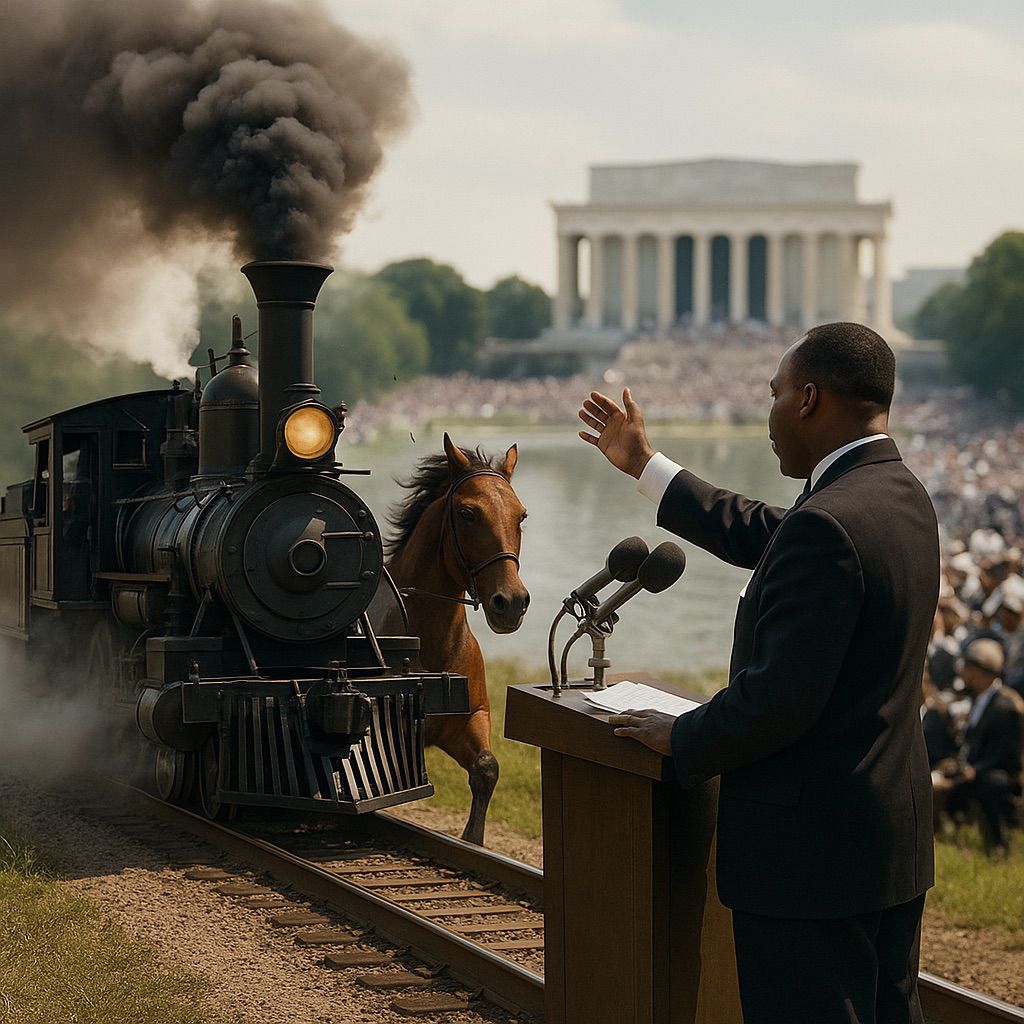
There are dates that look ordinary until you lean in and catch the hum beneath the ink. August 28 is one of those dates. On one August 28, in 1830, a tea-kettle of a locomotive nicknamed Tom Thumb lined up beside a horse on a short run of track outside Baltimore and lost a race it should have won. On another August 28, in 1963, a Baptist minister stood before a quarter of a million people at the Lincoln Memorial and gave voice to a dream so clear it still braids itself into the nation’s conscience every time we say the words. One story is comic in its immediacy—leather, steam, and a slipped belt. The other is solemn, musical, and nation-shaping. Together they tell us something about motion: how we move bodies and freight, and how we move hearts and law; how the future, when it first arrives, looks small and a little ridiculous; how justice, when it finally speaks plainly, sounds like something we had all been trying to say for generations. August 28 is a hinge. On one side, a sputtering engine challenges the familiar rhythm of hooves. On the other, a voice challenges the familiar rhythm of inequality. If the first is a fable about innovation, the second is a field manual for courage. Both are instruction.

It is late summer, 1830. The Baltimore & Ohio Railroad has laid only a few miles of iron, an audacious thread between skepticism and ambition. Peter Cooper, a self-taught inventor and businessman with a nose for the useful, has cobbled together a tiny locomotive as proof of concept. Tom Thumb is not majestic: it is a cylinder and boiler perched on a small frame, a little chimney, a hand-fed fire, and a blower that keeps the flame hungry. But when steam gathers, size is deceptive. To convince the B&O directors—men who have invested money and pride—Cooper proposes a public demonstration. A horse-drawn car pulls alongside. Wagers are whispered. The challenge is on, not because the horse is expected to win, but because spectacle is the grammar of persuasion in a young republic. The race starts. Tom Thumb coughs, hisses, and then takes the bit between its iron teeth. The crowd cheers as the car clatters forward, the horse stretching into a gallop; the engine gains, glides, and—astonishingly—leads. Then calamity of the most mundane sort: the blower belt slips. Without forced draft, the little boiler gasps; the pressure drops as if the future itself had caught a cold; the horse thunders past; the finish line arrives like a punchline. Laughter and jeers. The past appears to have triumphed. Yet anyone who has ever built something knows the private smile of proof. The point wasn’t the photo finish; it was the middle of the race—the moment when steam outran muscle and time compressed into a new shape. The B&O directors saw it and funded more track. Within a generation, locomotives stitched the mid-Atlantic to the Midwest, schedules replaced seasons, freight costs collapsed, and lives changed because a small machine, even in defeat, revealed a different possible world.

The lesson of Tom Thumb is compact but deep: failure, public and undeniable, can be the most persuasive form of success. An engine that loses can still win the argument. Ask any engineer: the first prototype’s job is to fail interestingly enough that the second prototype knows what not to be. The belt slip is almost allegorical. It suggests that the future is not foiled by big ideas so much as by small tolerances, unglamorous parts that connect power to purpose. The fix is tedious and technical, but it is also where courage lives. Progress is not a parade; it is an alignment, a sequence of refinements invisible to posterity but indispensable to it. And so the rails grow long. The whistle becomes a national sound. With every timetable printed and every bridge built, the lesson repeats: the way forward becomes common only after it has been ridiculous in public.

A different crowd gathers on a different August 28, this time in the humid capital of a country at once proud and haunted. It is 1963. The March on Washington for Jobs and Freedom did not materialize out of thin air; it was engineered by organizers who understood logistics, coalition, and risk. Bayard Rustin, precise and tireless, diagrams bus routes and restroom access, coordinates sound systems and marshals. A. Philip Randolph brings the moral voltage of decades of labor advocacy. Thousands of volunteers move like capillaries, carrying information and water through the body of the demonstration. The architecture of the day—permits, first-aid stations, food stalls—makes a city of conscience possible. And into that city walks Martin Luther King Jr., bearing a manuscript and a lifetime of sermons, marches, and cells. The stage is the Lincoln Memorial. The gaze of a stone emancipator rests on a living one. The reflecting pool holds the sky like a promise.

King’s speech climbs by steps, each phrase placed so carefully that it feels inevitable. He begins not with dream but with debt: a promissory note defaulted, a nation’s check returned “insufficient funds.” It is the language of a preacher conversant with banks and breadlines, poetry yoked to policy. He names the fierce urgency of now and refuses the narcotic of gradualism, the opiate that seduced so many well-meaning onlookers into the paradox of waiting for justice. When he says “now,” the crowd answers with its breathing. He speaks of thresholds: justice rolling down like waters, righteousness like a mighty stream. He speaks of specific places—Georgia’s red hills, Mississippi’s heat of oppression—binding abstract promise to concrete geography. Then the turn. Mahalia Jackson, friend and witness, calls from behind him: “Tell them about the dream, Martin!” He leaves the script and lands on a riff he has preached before, but never like this. The dream expands, stanza by stanza: a nation where children are judged by the content of their character, where Alabama becomes a place for little Black boys and Black girls to join hands with little white boys and white girls, where freedom rings from Lookout Mountain to Stone Mountain, from every mountainside. The repetition is hammer and lullaby. The crowd becomes the instrument. The marchers, many of whom have already been bloodied, hear not an escape but a blueprint. The dream is not a pillow; it is a set of coordinates.

The aftermath is policy and pushback, both swift. The Civil Rights Act of 1964 and the Voting Rights Act of 1965 do not fall from the sky; they are hauled by generations into law, pushed by funerals and filibusters, court orders and clipboards, training sessions and airless church basements where volunteers learn de-escalation and how to register voters in counties that require courage just to pronounce your own name at a counter. The machinery of oppression does not sit idle while statutes are signed; it reconfigures, reinventing obstacles with the slyness of a river that finds a new channel. Segregation’s signage comes down, then zoning maps do the same work with a patina of neutrality. Poll taxes and jelly-jar literacy tests retreat, then voter roll purges and precise ID rules and quietly shuttered precincts step forward. If the Tom Thumb taught us that a slipped belt can stall an engine, the years after 1965 teach that democracy has belts everywhere and saboteurs who prefer them loose. The moral keeps repeating: inspection is love. Maintenance is patriotic. What begins in a shining moment needs a schedule and a wrench.

Put the two Augusts side by side and the rhyme is clear. Both moments are demonstrations staged for skeptics. Both pivot on public proof—sightlines and sound systems, a seeing that is believing. Both reveal that progress is as much choreography as it is charisma. Cooper’s little engine runs to persuade the B&O that steam is the future; King’s words ride acoustics across water to persuade lawmakers and a watching world that justice cannot wait. Both face ridicule: one because it loses a race, the other because detractors reduce it to a lyric detached from labor. Yet both succeed because evidence, once witnessed, ripens into insistence. If we could outrun a horse, we can cross a continent. If we can call a crowd to dream in unison, we can rewrite law.

To humanize these histories, imagine a boy standing trackside in 1830, a laborer’s son clutching his father’s rough hand, torn between the familiar elegance of a horse and the comic audacity of a smoking pot on wheels. He laughs when the belt flies, but the laugh has awe stitched into it. That night he lies awake hearing the whistle in a future nobody else can hear yet. Now imagine a girl on a bus from Birmingham in 1963, knees pressed to the seat ahead, a paper bag lunch in her lap, her mother’s hand on hers every time the bus slows near a state trooper’s car. She is thirteen and has memorized snatches of scripture and court cases; she has heard dogs bark and seen windows break; she has also heard her teacher say that the law can be made to tell the truth if enough people stand where the truth is. When King’s voice slides from banknotes to the dream, she does not think of abstraction. She thinks of a drinking fountain. She thinks of a classroom. She thinks of a ballot she will one day place into a box without asking permission. The histories are public, but the courage is always personal.

The technology of Tom Thumb is quaint now—external blower, small cylinders, an open frame that looks fragile to modern eyes—but in 1830 it condensed a century of experiments into a convincing package. Steam had moved boats and mills; moving people overland, reliably and at scale, required more than fuel and fire. It demanded metallurgy, precision machining, new kinds of maps, financial instruments to pool risk and reward, and a culture willing to trust schedules. It also required a reimagining of space: hills shaved, valleys filled, tunnels bored. The railroad altered where towns grew, how newspapers traveled, which crops could go to market before they spoiled. It compressed weather and, for many, time itself. Yet we should not praise the railroad without acknowledging the shadow it cast: it quickened dispossession as well as commerce; it carried homesteaders and soldiers into lands whose treaties were honored only until they were inconvenient; it yoked capital to conquest. Technology is an amplifier. It does not absolve us of the question “Toward what?”

The rhetoric of the March is no less engineered. King’s gift is not only cadence and metaphor but structure. He builds the case, invites the verdict, and then sings the sentence we want to live under. He borrows a nation’s founding vocabulary and returns it at a better pitch, as if returning a borrowed instrument tuned for the first time. The dream sequence is not a nap; it is a moral graph with axes for dignity and opportunity. If you draw the line and it holds across neighborhoods, schools, and courts, you are pointed toward justice. If the slope flattens or drops, you know where to work. Policy follows poetry not because poetry is magic but because poetry sorts the important from the merely loud. “Let freedom ring” is a refrain, but it also functions as a checklist. Which mountainsides have we neglected? Which valleys echo back only to the few who live there? The line “we cannot be satisfied” lands like an update to a nation’s operating system, a refusal to accept a buggy release.

Pairing these stories reveals something about speed and direction. The horse is swift and sure on familiar ground; the engine is awkward until the parts align. The status quo is comfortable for those it serves; justice is ungainly until enough people shoulder it forward. In both cases, the win is not measured by the first finish line but by what becomes possible after the test. The Tom Thumb loses and yet inaugurates a century of rail. The March ends and yet inaugurates a decade of legislation and a longer arc of vigilance. Winning, properly defined, is what crowds will one day take for granted. Our task, inheritors of these Augusts, is to decide which future we want to normalize.

There is, too, a lesson about spectators and stewards. In both scenes, people come to watch. Some clutch tickets; some clutch signs. Some come to scoff; some to sing. But spectatorship is a reversible garment. The moment you decide to keep a piece of the work, you have changed categories. A B&O director becomes a builder of bridges. A marcher becomes a voter registrar, a plaintiff, a city council candidate, a teacher who folds primary sources into her lesson plans so that the next generation has receipts. If you are waiting for a permission slip to join history, August 28 has already signed it.

We live in a century as breathless as Cooper’s blower and as morally urgent as King’s “now.” The belts we must watch today are both mechanical and civic: data pipelines that warp the public square with algorithmic accelerants; precinct maps that carve the public into market segments rather than communities; school budgets that starve curiosity; a climate whose feedback loops have slipped their careful engineering; attention spans that flicker before evidence finishes clearing its throat. The maintenance recommended by both Augusts is precise: tighten the tolerances between truth and platform; rebuild the bridges between neighbors; schedule inspection for the institutions that keep the republic from overheating—local journalism, public libraries, fair courts, simple ways to vote; invent technologies whose metric of success is human flourishing rather than only speed or scale. We have tools Tom Thumb never dreamed of and a moral vocabulary King would recognize. The question is whether we will marry them with the courage of both.

Here is a small exercise in living the lesson. Pick a failure and name what it proved. Do it at work, at home, at the city council, at the school board. Refuse the seduction of embarrassment’s silence. Tell the story of the slipped belt and what you changed the next day. Pair it with a dream that refuses to shrink under ridicule. Say it out loud, write it down, and engineer toward it with the patience of someone laying track across mountains. The opposition will be real. Horses are lovely and persuasive. The status quo will show you a thousand reasons to keep cantering. But the track is already there, and the whistle you hear is not imagination. It is the sound of a country, at its best, inventing itself again.

August 28 is not a coincidence. It is choreography. It teaches that public demonstrations persuade, that dreams organize, that prototypes—mechanical and moral—deserve crowds, and that the arc between a sputtering contraption and a sentence that can govern a century is shorter than it looks when people insist on shortening it. The boy on the track and the girl on the bus are grown now, or they are our ghosts, or they are our children. Either way, they are waiting at the next curve. They want to see if we remember how to fix a belt and how to hold a note. They want to see if we can keep moving bodies kindly and moving laws justly. They want to see if we will treat the dream like a blueprint and the blueprint like a schedule. They want to see whether our laughter still holds awe.

Related Posts

The Tide Inside: Meditating with the Sound of Waves

Dave

There’s a reason the ocean keeps making poets out of ordinary people. You stand at the water’s edge and the body recognizes something older than language: a rhythm that began long before your first worry and will go on long after your last. The shoreline is a living metronome; the waves arrive, the waves recede, and somewhere inside you, a second tide begins to keep time. Meditation with the sound of waves doesn’t require special cushions or perfect posture or a guru on speed dial. It asks only that you sit down where the world is breathing and agree to breathe with it. The rest—calmer thoughts, softer shoulders, steadier heart—tends to happen as a side effect of listening.

Begin with the arrival. The beach is both public and private—a stage and a sanctuary. Even when others are nearby, you can carve out a small circle of solitude with the simple act of sitting. Choose a spot where the foam laps just short of your toes, close enough that the ocean’s voice is unmistakable, far enough that you aren’t negotiating each wave like a landlord. Let the horizon be your gentle anchor. You don’t need to stare at it; it’s enough to know it’s there, a straight line offered to a day that may have felt messy and curved.

Now let the body remember how to be comfortable. Stack your spine like driftwood that has finally found its resting place. Let your shoulders pour downward. Rest your hands in your lap or on your knees. The point is not to become a statue; it’s to become permeable. When a breeze brushes your forearms, you feel it. When gulls argue over a shell, you hear them. When the sun warms the bridge of your nose, you notice the warmth, then let it pass like a cloud of sensation. This is not the hard labor of “clearing the mind.” It is the soft, skillful art of paying attention to what is already happening without adding commentary.

The waves teach a structure older than any meditation app. Inhale with the gather, exhale with the release. As a swell draws itself together, let your breath fill, wide and easy. As it unfurls along the shore, let your breath empty, longer on the way out than the way in. The ocean shows you that exhalation is not a collapse but a gift—the moment the body gives back what it no longer needs. A few minutes of this and your nervous system starts taking notes. Your pulse steps down a gear. The tyranny of urgency thins. You begin to suspect that the present moment is, in fact, big enough to hold you.

Thoughts will still arrive, of course. The mind is not a faucet you can shut. It’s a tide pool full of darting fish. Let them swim. When you notice you’ve followed one into a crevice—planning dinner, replaying a conversation, building a castle of what-ifs—lift your attention like you’d lift your eyes from a phone, gently and without scolding. Return to the wave. Hear its first whisper, its full-throated rush, the hiss of bubbles as it pulls back. Imagine the water smoothing the sand of your thoughts in the same way it erases footprints. The trick is not to stop thinking but to stop arguing with thoughts. They can pass through. You are the beach, not the footprints.

Some days, the sea is calm and your attention slides into place like a boat into a quiet harbor. Other days, the wind is up and whitecaps pucker the surface; your mind does the same. Those are not failed sessions. They are honest ones. Let the weather be the weather. There is nothing to “achieve.” The point is coexistence, not conquest. If the surf is loud and your heart is loud, make room for a duet. If your knee aches, adjust without drama; pain is simply information delivered in a language you cannot ignore. Let comfort and curiosity be your two paddles, taking light, alternating strokes.

If you stay a little while, the world shows you its tiny miracles. Pelicans pass low, wings stiff as kites, and you can hear the small leather sound of air over feathers. The sand cools in the shadow of your knees. Far out, a line on the water darkens—a sign of a deeper band of wind or a wandering current. Your breath, once a thing you hardly noticed, becomes a confidant that keeps its promises: in, out, in, out, trustworthy as the next wave. You realize that most of what troubles you cannot survive sustained contact with a horizon.

There’s a human sweetness to this practice. The ocean accepts you without negotiation. Come anxious, come jubilant, come hollowed out by grief, come curious. Sit as the person you are and the person you hope to be will find you there. Meditation at the shoreline is not self-improvement in the punishing sense. It is self-remembering. You belong to a planet where water makes music on stone and light keeps arriving even after a hard day. The waves say: this is what continuation sounds like. You listen and your own capacity for continuation wakes up.

If you like rhythm, build one. Count quietly with the sea: inhale for three waves, exhale for three. Or link sound to sensation: when the wave crests, soften your jaw; when it breaks, release your shoulders; when it recedes, loosen your belly. If you need an anchor, lay one hand on your chest and one on your navel and let them rise and fall like small boats. If you prefer imagery, imagine breath as a tide ribboning through the body—drawing clarity in, washing static out. Simple rituals work best. The ocean is doing the heavy lifting; your job is to keep saying “yes” to it.

After a while, you might play with attention like a lens. Zoom in: hear the fizz of water threading back through sand, the tiny clatter of shells. Zoom out: hear the ocean’s whole paragraph, the layered conversation of shore and swell and wind. The nervous system loves this alternation; it trains the mind to shift focus without panic, to hold details and the big picture together. That’s a skill you’ll carry inland, where life demands the same dance—email and purpose, task and meaning, the grain and the panorama.

If you bring worries to the water, give them ceremony. On an inhale, name the weight—“tight deadline,” “family friction,” “old fear.” On the exhale, imagine laying it on the surface and watching the water carry it a few meters off, not vanished, just held by something larger than you. This isn’t magical thinking; it’s an embodied metaphor that reminds the brain it has partners. The sea is bigger than your schedule. The sky is bigger than your mood. Let them help.

Some practical kindnesses make the practice sweeter. Go early or late when the light is soft and the sand is cool. Sit where you can feel safe and unhurried. If you prefer sound without spectacle, close your eyes. If you prefer spectacle without strain, half-close them and let the horizon blur. If you’re shy, pull a hat brim low; anonymity is a kind of comfort. If sitting is hard on your hips, lean against a driftwood log or lie on a towel and let the waves become a lullaby. If you live far from the sea, use a recording of your favorite beach and a bowl of warm water for your feet; the body is wonderfully willing to believe.

Your meditation doesn’t need a hard ending. When it feels right, let your breath deepen and your eyes open fully. Take stock like a beachcomber after a storm. Notice if your thoughts are arranged more neatly on the sand. Stand up slowly; many people feel a pleasant heaviness in the limbs, like gravity has given them a reassuring pat. Carry the rhythm with you as you walk the waterline. If you want a small ritual to close, trace a circle in the wet sand with your toe and stand inside it for three breaths. When the next wave reaches in and erases the mark, let that be your bow to the moment.

What grows from this is subtle but sturdy. Meditating with the waves doesn’t make life painless. It makes you agile. You learn to meet surges without bracing and to move with recessions without sulking. You become less allergic to change because you’ve practiced with a teacher who changes on purpose and on schedule. Over time, you may find that you can conjure the shoreline in busy rooms: listen for a quiet undertow beneath the clatter of obligations, breathe by that undertow, answer from it. You will say things more slowly, and people will listen more quickly. You will feel both smaller and more connected, which turns out to be a relief.

There’s also the quiet medicine of beauty. In a culture that treats attention like currency to be harvested, spending it freely on a horizon is an act of reclamation. To look at something for no reason but wonder is to remember you are not only a producer, consumer, or competitor; you are also an animal who needs awe the way skin needs sunlight. The sound of waves is a delivery system for awe. It’s repetitive but never repetitive, the way a friend’s voice is always the same and always new. Ten minutes with that sound and the edges of your day grow rounder.

Bring others when you like. Shared silence is an underrated intimacy. Sit side by side and agree to let the water do the talking. When you rise, you won’t need to say much. Maybe you’ll point at a gull with comic timing or the thin silver of a fish leaping. Maybe you’ll just smile like co-conspirators who found a loophole in time. Children take to this easily; they meditate without the noun. Give them a “listening game” and they’ll show you levels of hearing you forgot you had. Elders, too, often relax by the sea with a speed that startles; the body remembers paths to calm even when words do not.

If the season changes and the shore grows cold, go anyway. Bundle up. The winter sea has its own grammar—quieter crowds, bigger skies, a scrim of steam where the water gives its warmth to the air. Your breath will be visible, a little flag of presence. Sit shorter, breathe slower, and let the starkness sharpen your attention. Calm is not the same as comfort; it is the confidence that you can be with what is.

One day, after many sessions or maybe just one, you’ll notice a small but telling shift. You won’t be thinking, “I am meditating to the sound of waves.” You’ll just be sitting, and there will be waves. The hyphen fades between you and the place. The line between inside and outside gets more porous, and your breath moves like weather instead of like a metered exercise. That’s not enlightenment; it’s friendship—with yourself, with the moment, with the old tide that keeps knocking and never demands that you open the door, only that you listen.

When you finally brush the sand from your palms and stand, carry two promises inland. First: you do not need an ocean to hear a tide. There is a rhythm under everything—tires on asphalt, a ceiling fan’s soft chop, your own steps on a hallway floor. Choose any of it as a companion and the world becomes a kinder room. Second: you are allowed to stop. The shore shows you that pausing is not a failure of momentum; it is the mechanism by which momentum becomes sustainable. Waves rest between their efforts. You can, too.

Walk away and notice how the day feels slightly retuned, like a guitar string brought into harmony with itself. Perhaps a problem looks less like a wall and more like a bend in the path. Perhaps your kindness is closer to the surface. Perhaps nothing noticeable changes, and still you feel steadier, the way a boat feels steadier when it points into the swell. Keep this practice simple and let it be imperfect. Return to the water when you can and to the memory of water when you cannot. Let the sea’s sentence keep writing itself through you: come close, breathe, let go, return.

Related Posts