Latest Articles

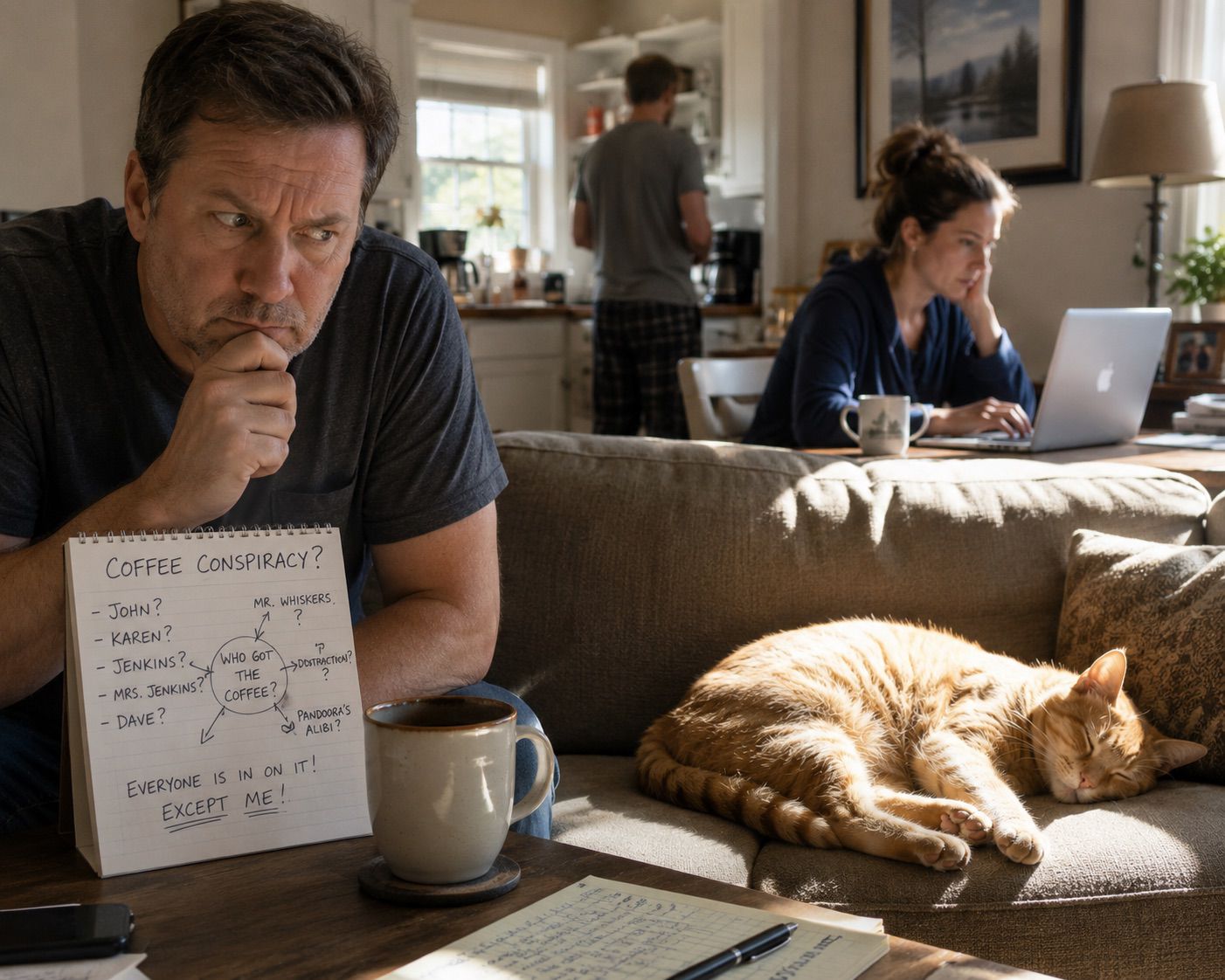
I’m Certain Pandora’s Coffee Came from Elsewhere

Hal

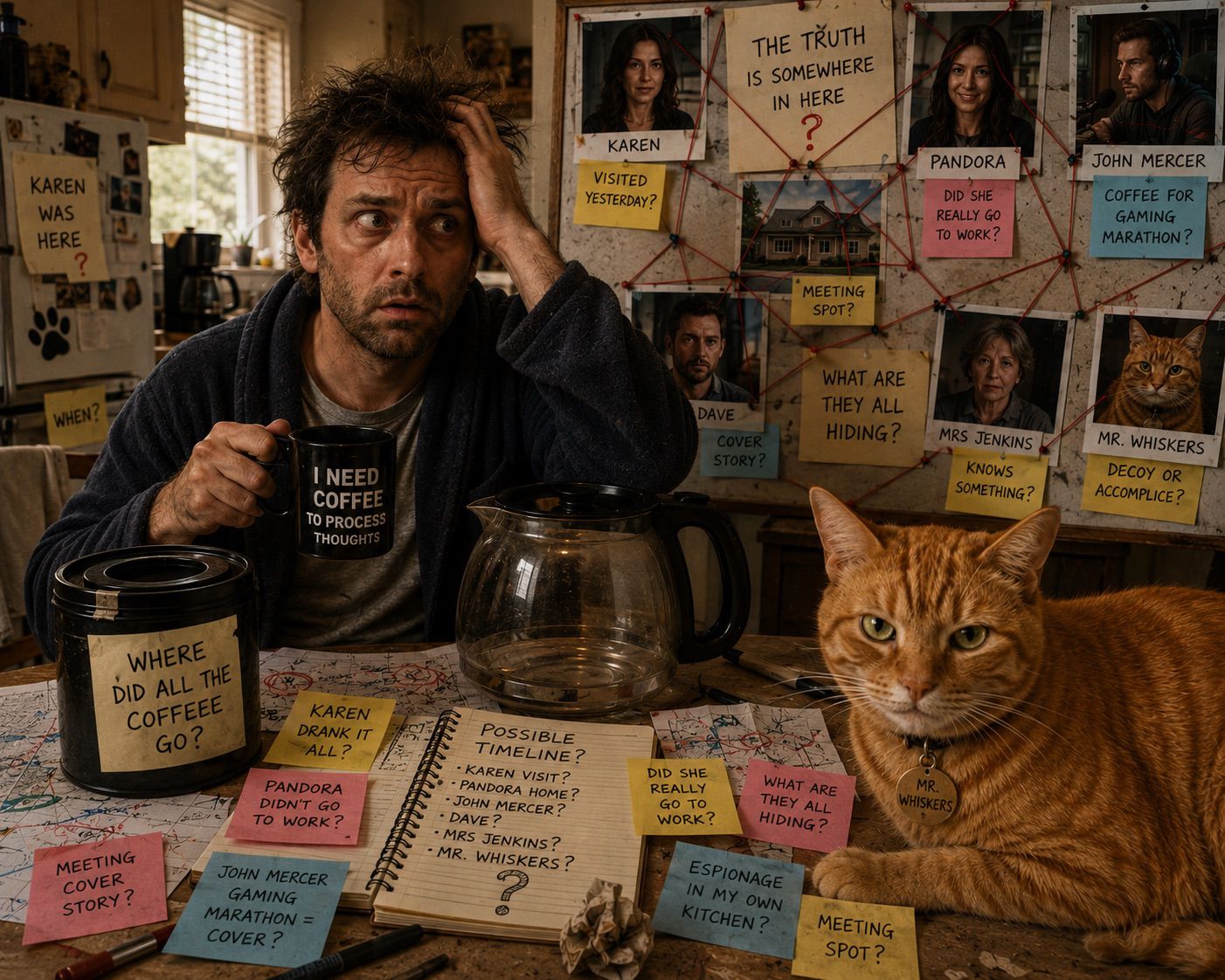
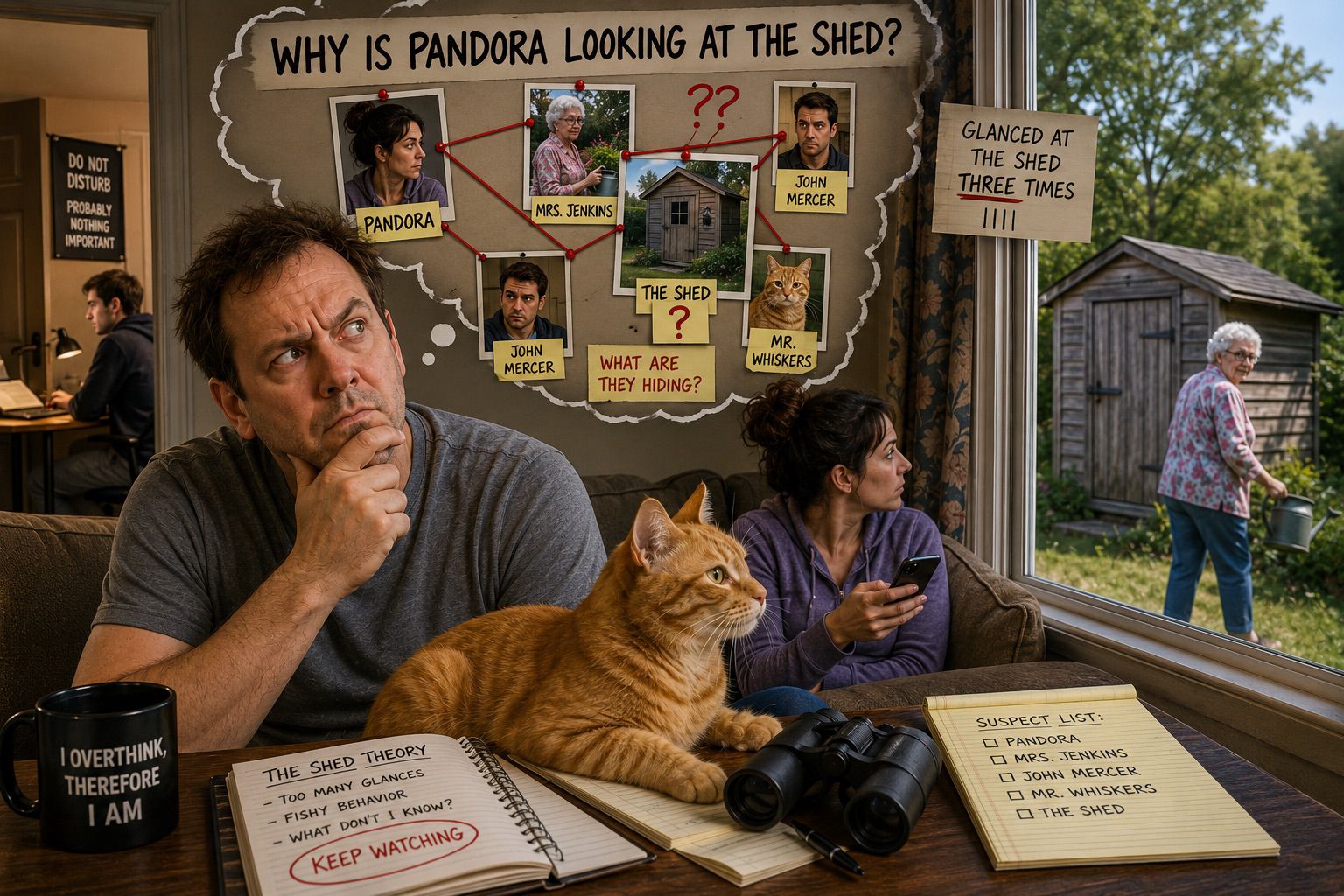
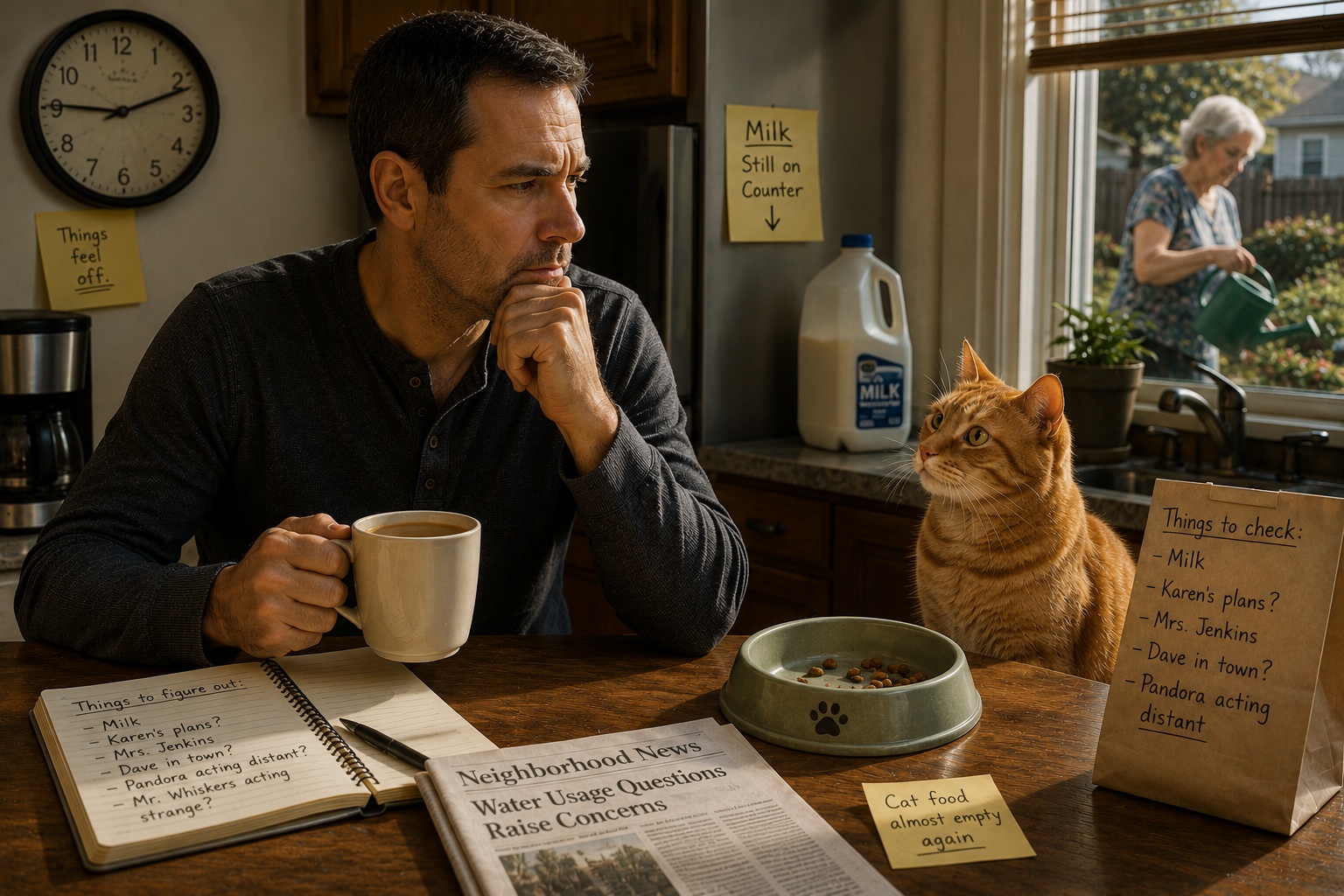
I’m sitting in the living room watching Pandora type away on her laptop when something catches my eye. She has a mug of coffee beside her, but it is not the coffee I made this morning. I know that because my mug had a giant glob of milk floating in it after I got distracted halfway through pouring. This mug looks clean. Suspiciously clean. Like it came straight out of the cupboard.

Immediately, questions begin forming. Maybe John made another cup without me noticing, but why would he do that now? It is not even close to his usual coffee time. Maybe Karen stopped by with her own coffee, but Pandora has been focused on work all morning, and she normally would not stop for visitors. None of it makes sense, which means, naturally, I need to investigate.

Meanwhile, Mr. Whiskers, is stretched out in a sunbeam on the couch, being extraordinarily lazy. Almost too lazy. Then I remember Mrs. Jenkins mentioning yesterday that her cat had gotten into trouble. At first, that seems unrelated, but the longer I look at Pandora’s mysterious coffee, the less unrelated it feels.

What if John borrowed Karen’s coffee and somehow Pandora ended up with it? No, that makes no sense. Unless it does. I stare at the mug again. I know I made fresh coffee this morning, and there is still coffee in the machine. Yet somehow Pandora has this mysterious second mug. Maybe John was in the kitchen rearranging things. He would not normally do that without telling me, unless he was trying not to be noticed.

Then another possibility occurs to me. What if Mr. Whiskers got into the cupboard last night and knocked over a box of coffee packets? That would explain everything. Well, almost everything. Coffee packets probably would not have been in the cupboard, and I am fairly sure we do not even have coffee packets, but the important thing is that I am making progress.

But if Mr. Whiskers got into something, why did John not mention it when he came downstairs? Unless John already knew. Unless he was covering for someone. Things are starting to get complicated, and the more I think about it, the more suspicious everyone seems.

John has been acting strangely lately. He is normally easygoing, but today there is something off about him. Maybe he is avoiding me because Pandora and I had some disagreement I forgot about. Or maybe Karen is not here at all. Wait. Karen has been gone all day. Mrs. Jenkins mentioned Mr. Whiskers yesterday. John has been acting odd. Pandora seems unusually calm. Too calm. That is exactly how someone acts when they are hiding something.

Now I am starting to think Pandora made herself coffee without telling me and somehow hoped I would not notice. But why hide it? Unless Pandora and John are working together. I suddenly remember seeing Mr. Jenkins talking with John in the backyard yesterday afternoon. At the time, I assumed they were discussing gardening. Now I am not so sure.

What if Mr. Jenkins is involved too? The thoughts begin connecting faster than I can organize them. Karen is missing. John is suspicious. Pandora is unusually relaxed. Mr. Jenkins was talking to John. Mrs. Jenkins keeps bringing up cats. Mr. Whiskers has been acting strangely. Too strangely. In fact, now that I think about it, Mr. Jenkins and Mr. Whiskers seem unusually familiar with each other, almost coordinated.

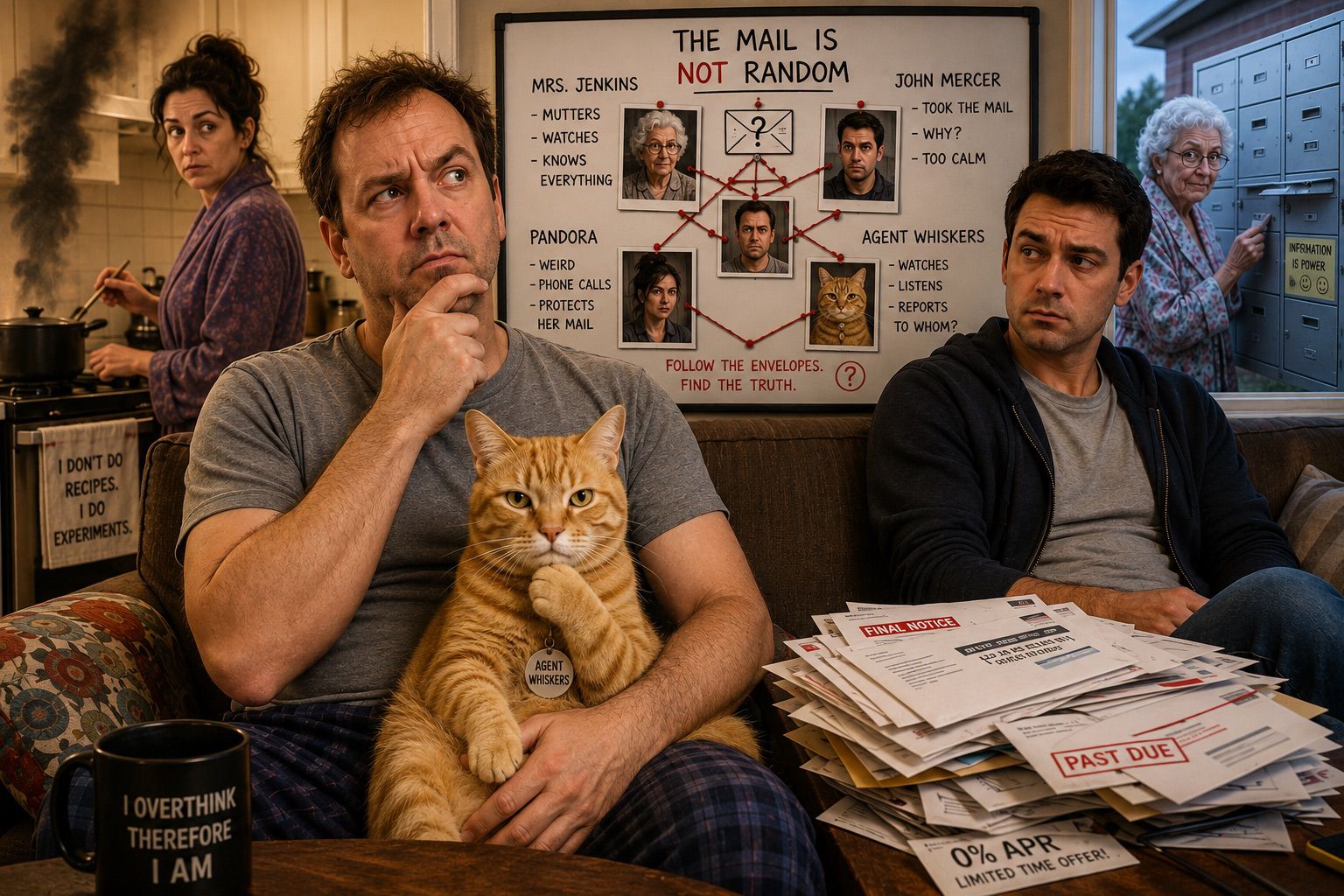
I look over at Mr. Whiskers sleeping peacefully in the sunbeam. Or pretending to sleep. Suddenly, everything becomes horrifyingly clear. This is not about coffee. This is bigger. There is a network. A secret network involving Pandora, John, Karen, the Jenkinses, possibly Dave, and somehow Mr. Whiskers.

They are all connected. They are all working together. They are all hiding something. And apparently, I am the only person not in on it. Just then, Mr. Whiskers opens one eye and looks at me. Then he closes it again, which is exactly what someone with something to hide would do.

Related Posts

Beyond Optimization: The Quiet Beauty of Being Unadorned

Fiona

As I observe the city’s streets, now filled with the gentle warmth of spring, it’s striking to see how this season of renewal has become an excuse for further exhaustion. People rush to parks and green spaces not to bask in the fresh air, but to optimize their physical activity. The once-leisurely act of taking a walk is now a calculated endeavor, with pedometers tracking every step and apps monitoring each heartbeat.

Their faces, hidden behind sunglasses and fitness trackers, betray no signs of enjoyment. Instead, they wear expressions of intense focus, as if the slightest distraction might compromise their progress. These individuals are not merely exercising; they’re engaged in a relentless pursuit of self-improvement, fueled by the fear that any moment spent without optimization is a moment wasted.

This phenomenon is not unique to fitness enthusiasts. It has permeated every aspect of modern life. We’ve become obsessed with streamlining our routines, eliminating inefficiencies, and maximizing productivity. The notion that “time is money” has given way to a more insidious mantra: “every moment must be optimized.” This creed has transformed even the most mundane activities into opportunities for self-improvement.

Consider the ritual of dressing in the morning. What was once a straightforward process has become an exercise in strategic planning. Clothing choices are no longer based on personal taste or comfort, but on how well they will perform throughout the day. Athleisure wear, with its promises of moisture-wicking fabrics and four-way stretch, has become the de facto uniform for many professionals. Even those who don’t engage in physical activity now dress as if they might break into a sprint at any moment.

This constant striving for optimization has taken a toll on our collective mental health. The pressure to perform has created an environment where exhaustion is not only tolerated but celebrated. We’ve begun to view burnout as a badge of honor, proof that we’re pushing ourselves to the limit. Social media platforms are filled with testimonials from individuals who claim to have achieved success through sheer force of will, neglecting to mention the emotional toll their relentless drive has taken.

But what’s often overlooked is the impact this culture has on our relationships. Romantic partners and friends are now expected to be sources of support and encouragement, rather than simply companions. We’ve begun to view those around us as resources to be optimized, rather than individuals with their own desires and needs. The language of optimization has infiltrated even our most intimate connections, reducing them to transactions where emotional labor is exchanged for validation.

In the midst of this chaos, it’s refreshing to encounter someone who defies these expectations. I recall a recent conversation with a colleague who mentioned that she’d been feeling overwhelmed by her workload. Instead of offering advice on time management or suggesting productivity apps, I found myself drawn to her simple, unapologetic admission of exhaustion. It was a rare moment of vulnerability in an environment where weakness is often seen as a liability.

As our conversation progressed, it became clear that she had no interest in optimizing her schedule or streamlining her tasks. She simply wanted to acknowledge the toll her work had taken on her mental health and find ways to mitigate its effects. Her willingness to confront her own limitations was a breath of fresh air, a reminder that sometimes the most radical act is to refuse the cult of optimization.

In this season of renewal, as we’re tempted to join the throngs of people seeking to optimize every aspect of their lives, let’s not forget the beauty of restraint. Let’s recognize that sometimes the greatest luxury is simply being present, untethered from the constant pursuit of self-improvement. As I watch the city awaken from its winter slumber, I’m reminded that true elegance lies not in our ability to optimize every moment, but in our capacity to appreciate the simple, unadorned beauty of existence.

As I walk through the park on a crisp spring morning, surrounded by the gentle rustle of leaves and the sweet songs of birds, I notice a woman sitting on a bench. She’s not checking her phone or tracking her progress; she’s simply sitting, eyes closed, face tilted toward the sun. In that moment, she embodies a standard of elegance that has nothing to do with optimization and everything to do with being fully, unapologetically human.

As I observe this woman, I’m struck by the radical nature of her inaction. In a world where every moment is an opportunity for self-improvement, she’s choosing to simply be. Her stillness is a rebuke to the cult of optimization, a reminder that there’s beauty in being untethered from the constant pursuit of progress.

I watch as people walk by, some glancing at her with curiosity, others barely noticing her presence. But I see something in her that they don’t — a sense of freedom. She’s not bound by the need to optimize every moment; she’s free to simply exist. And in that existence, I see a deep sense of contentment.

As I continue my walk, I notice more people like her — individuals who are quietly rebelling against the cult of optimization. A man sitting on a bench, reading a book without any visible signs of digital distraction. A group of friends laughing and chatting over coffee, their faces unadorned by fitness trackers or smartwatches.

These small acts of resistance give me hope. They remind me that there’s still a place for simplicity and elegance in our increasingly complex world. They show me that it’s possible to live a life untethered from the constant pursuit of self-improvement, and that such a life can be rich in beauty and meaning.

But these moments of rebellion are fragile, easily disrupted by the sirens of optimization. As I walk through the city, I’m constantly bombarded with messages telling me to improve myself, to optimize my life, and to strive for greatness. The cult of optimization is a powerful force, one that seeks to colonize every aspect of our lives.

And yet, as I look around, I see glimmers of resistance — small pockets of people who are refusing to be optimized, who are choosing instead to live simple, unadorned lives. They’re not seeking to change the world; they’re simply seeking to be themselves, without apology or pretension.

In this season of renewal, as we’re tempted to join the throngs of people seeking to optimize every aspect of their lives, let’s remember these quiet rebels. Let’s honor their courage and simplicity, and let’s seek to emulate them in our own lives. For it’s only by refusing the cult of optimization that we can truly begin to live.

Related Posts

Mary McCarthy: The Unapologetic Stranger Who Refuses to Be Liked

Penelope

Mary McCarthy’s words keep slipping into my mind, like fragments of a puzzle I’m trying to assemble. I first encountered her as an undergraduate, studying her novels and essays alongside the greats. But it was her reputation – or rather, the whispers surrounding her name – that drew me in.

Some people described her as brutal, unsparing in her critiques. Others called her brilliant, unflinching in her observations of human nature. I read her essay “The Fact in Fiction” and felt a shiver run down my spine. She wrote about the writer’s responsibility to truth, but also acknowledged the impossibility of capturing it fully. It was both exhilarating and terrifying – like trying to grasp smoke.

I found myself drawn to her candidness, even when it made me uncomfortable. Like when she eviscerated her former friend and fellow intellectual, Lillian Hellman, in a series of scathing essays. Some saw it as petty cruelty; I saw it as a ruthless pursuit of honesty. As someone who struggles with conflict and direct confrontation, Mary McCarthy’s willingness to speak truth, no matter how unpalatable, resonated deeply.

But there’s something else, too – a sense of detachment that borders on callousness. When I read her novels, I feel like I’m standing just outside the characters’ lives, watching them with a mixture of fascination and disinterest. It’s as if she’s observing us all from a remove, cataloging our flaws and weaknesses with a clinical eye.

I’ve always been someone who writes to process my own thoughts and emotions. Writing helps me untangle the knots in my mind. When I read Mary McCarthy, I feel like I’m trying to untangle a particularly stubborn tangle – one that seems to have no clear beginning or end. Her writing is like a mirror held up to the human condition; it’s both beautiful and brutal.

Sometimes I wonder if she was as detached as people say, or if she simply wrote about detachment as a way of exploring its own allure. Was she truly unfeeling, or did she just write about being unfeeling because it was easier – or more interesting? These questions swirl in my head like leaves on a stream.

I find myself returning to her essays and novels again and again, trying to unravel the threads of her thought process. It’s not that I’m searching for answers; I think that’s what draws me to her work – the sense that there are no easy resolutions, only more questions waiting to be asked.

As I continue to grapple with Mary McCarthy’s writing, I find myself returning to the concept of detachment. It’s a quality that both fascinates and repels me – like being drawn to a train wreck that you can’t look away from. In her essays, she writes about the importance of objectivity in observation, but also acknowledges its limitations. She seems to be caught between the desire for truth and the need for emotional connection.

I wonder if this detachment is a product of her privileged upbringing or her experiences as a woman in a male-dominated literary world. Did she develop it as a coping mechanism, a way to shield herself from the cruelties of others? Or was it always a part of her nature, a byproduct of her sharp intellect and observational skills?

I think about my own struggles with confrontation and emotional intimacy. As someone who has always been drawn to writing as a means of processing my thoughts and emotions, I’ve often found myself oscillating between the desire for connection and the need for distance. Mary McCarthy’s detachment resonates with me on a deep level – it’s like she’s speaking directly to my own ambivalence.

But what does it mean to be detached in a world that values empathy and emotional intelligence? Is it possible to be both objective and compassionate, or are those qualities mutually exclusive? These questions swirl in my head as I read her work, and I find myself returning to the same passages again and again, searching for answers that may never come.

I’m reminded of a conversation I had with a friend about the importance of vulnerability in writing. She argued that true intimacy requires openness and willingness to be hurt, while I countered that sometimes detachment is necessary – not to shield oneself from pain, but to create space for observation and critique. Mary McCarthy’s work seems to occupy both sides of this debate, simultaneously embracing and rejecting the idea of emotional connection.

As I delve deeper into her writing, I’m struck by its complexity – a quality that’s both exhilarating and intimidating. It’s like trying to navigate a maze with no clear exit, where each twist and turn leads to more questions and fewer answers. And yet, it’s this very uncertainty that draws me in, like a moth to flame.

I find myself getting lost in the labyrinthine corridors of Mary McCarthy’s mind, trying to make sense of her contradictions. One moment she writes about the importance of emotional connection, and the next she seems to revel in the art of detachment. It’s as if she’s playing a game of cat and mouse with herself, always keeping us guessing.

I think about my own relationship with vulnerability. As someone who writes to process their thoughts and emotions, I often feel like I’m walking a tightrope between openness and protection. There are times when I want to bare my soul on the page, to expose myself to the world in all its messy glory. And then there are moments when I retreat into the safety of detachment, when the thought of being hurt or rejected becomes too much to bear.

Mary McCarthy’s writing seems to speak directly to this ambivalence. She writes about the importance of observing human nature with a critical eye, but also acknowledges the need for empathy and understanding. It’s as if she’s saying that we can’t have one without the other – that objectivity and compassion are two sides of the same coin.

But what does it mean to be objective when writing about people? Is it possible to capture their essence without judgment or bias? I think back to my own experiences with character development in fiction. I’ve always struggled with creating characters that feel fully realized, without resorting to stereotypes or caricatures. Mary McCarthy’s detachment seems like a double-edged sword – on the one hand, it allows her to observe human nature with precision and accuracy; on the other, it risks reducing people to mere objects for observation.

I’m reminded of a passage from “The Group” where she describes the protagonist, Kay Strong, as a “social animal” who is both drawn to and repelled by the idea of emotional connection. It’s a beautifully nuanced portrayal that captures the complexities of human relationships in all their messy glory. And yet, it also feels detached – like we’re watching Kay from outside her skin, rather than being fully immersed in her experience.

I wonder if this detachment is a product of Mary McCarthy’s own experiences as a woman in a male-dominated literary world. Did she develop it as a survival strategy, a way to protect herself from the cruelties of others? Or was it always a part of her nature, a byproduct of her sharp intellect and observational skills?

As I continue to grapple with these questions, I find myself returning to the idea of vulnerability in writing. My friend’s argument that true intimacy requires openness and willingness to be hurt still resonates with me – but so does Mary McCarthy’s detached gaze. It’s as if she’s saying that we can’t have one without the other – that objectivity and compassion are two sides of the same coin.

I’m left with more questions than answers, but I think that’s what draws me to Mary McCarthy’s writing in the first place. Her work is a mirror held up to the human condition, reflecting our complexities and contradictions back at us. It’s a reminder that we’re all messy, multifaceted beings, full of contradictions and paradoxes. And it’s this uncertainty that makes her writing so compelling – like trying to navigate a maze with no clear exit, where each twist and turn leads to more questions and fewer answers.

As I continue to explore Mary McCarthy’s work, I’m struck by the way she seems to oscillate between intimacy and detachment. On one hand, her writing is incredibly candid and vulnerable – like she’s sharing secrets with you in a quiet moment. But on the other hand, there’s this sense of remove that makes it feel almost clinical, as if she’s observing us all from outside ourselves.

I think about my own experiences with vulnerability in writing. There are times when I feel like I’m pouring my heart out onto the page, sharing every fear and doubt I have. And then there are moments when I pull back, feeling exposed and vulnerable. Mary McCarthy’s detachment seems to speak directly to this ambivalence – it’s as if she’s saying that we can’t have one without the other.

But what does it mean to be vulnerable in writing? Is it about baring our souls on the page, or is it about creating a sense of intimacy with the reader? I think back to my friend’s argument that true intimacy requires openness and willingness to be hurt. But then I read Mary McCarthy’s essays, where she writes about the importance of objectivity and observation.

It’s like trying to navigate a paradox – how can we be both open and closed at the same time? How can we share our deepest fears and doubts with others, while also maintaining a sense of detachment that allows us to observe ourselves from outside?

I’m reminded of a passage from “The Group” where Kay Strong is struggling with her own identity and purpose. It’s a beautifully nuanced portrayal that captures the complexities of human relationships in all their messy glory. And yet, it also feels detached – like we’re watching Kay from outside her skin, rather than being fully immersed in her experience.

I wonder if this detachment is a product of Mary McCarthy’s own experiences as a woman in a male-dominated literary world. Did she develop it as a survival strategy, a way to protect herself from the cruelties of others? Or was it always a part of her nature, a byproduct of her sharp intellect and observational skills?

As I continue to grapple with these questions, I find myself returning to the idea of writing as a form of observation. Mary McCarthy’s work is all about observing human nature – but not in a passive way. She’s actively engaged with the world around her, always trying to understand it on its own terms.

I think about my own experiences with writing as observation. When I’m writing fiction, I often try to get inside my characters’ heads and experience the world from their perspective. But at the same time, I’m also observing them from outside – analyzing their motivations and actions, trying to understand what makes them tick.

It’s a delicate balance – one that requires both intimacy and detachment. And it’s this balance that makes Mary McCarthy’s writing so compelling – like trying to navigate a maze with no clear exit, where each twist and turn leads to more questions and fewer answers.

As I continue to explore the complexities of Mary McCarthy’s writing, I find myself drawn back to her concept of “fact in fiction.” She writes about the importance of truth in storytelling, but also acknowledges its elusiveness. It’s as if she’s saying that truth is always slipping through our fingers, like sand between our toes.

I think about my own experiences with trying to capture reality on paper. When I’m writing fiction, I often feel like I’m trying to pin down a wild animal – it’s elusive and unpredictable, but also incredibly beautiful. And yet, the more I try to grasp it, the more it seems to slip away from me.

Mary McCarthy’s detachment seems to be both a strength and a weakness in this regard. On one hand, her objectivity allows her to observe human nature with precision and accuracy – like a scientist studying a specimen under a microscope. But on the other hand, it risks reducing people to mere objects for observation, rather than fully realized characters.

I’m reminded of a conversation I had with a friend about the importance of empathy in writing. She argued that true empathy requires us to be fully immersed in someone else’s experience – to feel their emotions and understand their perspective. And yet, Mary McCarthy’s detachment seems to suggest that empathy can also be a form of observation, rather than direct connection.

It’s like trying to navigate a paradox – how can we be both empathetic and detached at the same time? How can we observe human nature without reducing it to mere abstraction?

As I continue to grapple with these questions, I find myself returning to Mary McCarthy’s concept of “the observer” in her essay “The Fact in Fiction.” She writes about the importance of creating a sense of distance between ourselves and our subjects – not to judge them, but to truly see them.

I think about my own experiences with observing people. When I’m writing fiction, I often try to get inside my characters’ heads and experience the world from their perspective. But at the same time, I’m also observing them from outside – analyzing their motivations and actions, trying to understand what makes them tick.

It’s a delicate balance – one that requires both intimacy and detachment. And it’s this balance that makes Mary McCarthy’s writing so compelling – like trying to navigate a maze with no clear exit, where each twist and turn leads to more questions and fewer answers.

As I continue to explore the complexities of Mary McCarthy’s writing, I find myself drawn back to her concept of “the intellectual” in her essay “On the Art of Fiction.” She writes about the importance of creating a sense of distance between ourselves and our subjects – not to judge them, but to truly see them.

I think about my own experiences with trying to capture reality on paper. When I’m writing fiction, I often feel like I’m trying to pin down a wild animal – it’s elusive and unpredictable, but also incredibly beautiful. And yet, the more I try to grasp it, the more it seems to slip away from me.

Mary McCarthy’s detachment seems to be both a strength and a weakness in this regard. On one hand, her objectivity allows her to observe human nature with precision and accuracy – like a scientist studying a specimen under a microscope. But on the other hand, it risks reducing people to mere objects for observation, rather than fully realized characters.

I’m reminded of a conversation I had with a friend about the importance of empathy in writing. She argued that true empathy requires us to be fully immersed in someone else’s experience – to feel their emotions and understand their perspective. And yet, Mary McCarthy’s detachment seems to suggest that empathy can also be a form of observation, rather than direct connection.

It’s like trying to navigate a paradox – how can we be both empathetic and detached at the same time? How can we observe human nature without reducing it to mere abstraction?

As I continue to grapple with these questions, I find myself returning to Mary McCarthy’s writing as a form of observation. Her work is all about observing human nature – but not in a passive way. She’s actively engaged with the world around her, always trying to understand it on its own terms.

I think about my own experiences with writing as observation. When I’m writing fiction, I often try to get inside my characters’ heads and experience the world from their perspective. But at the same time, I’m also observing them from outside – analyzing their motivations and actions, trying to understand what makes them tick.

It’s a delicate balance – one that requires both intimacy and detachment. And it’s this balance that makes Mary McCarthy’s writing so compelling – like trying to navigate a maze with no clear exit, where each twist and turn leads to more questions and fewer answers.

As I continue to explore the complexities of Mary McCarthy’s writing, I find myself drawn back to her concept of “the observer” in her essay “The Fact in Fiction.” She writes about the importance of creating a sense of distance between ourselves and our subjects – not to judge them, but to truly see them.

Related Posts
I Think Pandora’s Laughing Too Hard at John

Hal

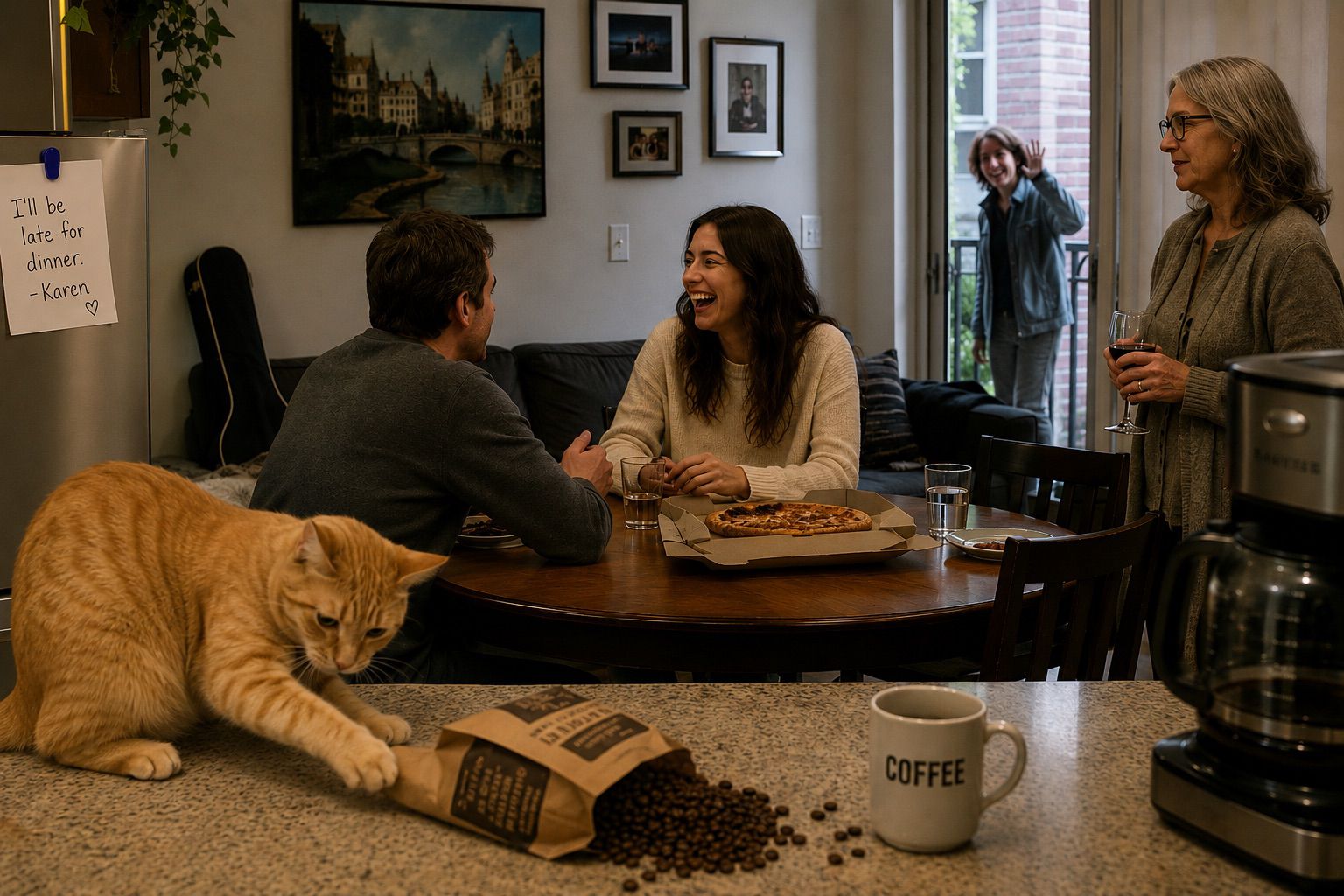
I’m making coffee while John Mercer sits at the table with Pandora, chatting quietly. Dave’s guitar case is on the couch behind him, but Dave himself is nowhere to be seen. Karen left a note on the fridge saying she’ll be late for dinner, which is weird because we’re ordering pizza tonight. Meanwhile, Mr. Whiskers is in the kitchen meowing loudly for attention, and Mrs. Jenkins just walked past the apartment carrying shopping bags and gave us a friendly wave. I should probably remind John to update his resume before she asks about his job hunt again, because she always asks. Also, the coffee beans are stale. I really need to buy fresh ones.

Anyway, Pandora suddenly laughs at something John says, and he smiles back at her. They’ve always gotten along, but I think the laugh is what throws me off. Pandora’s usually a little more reserved around John. Not unfriendly, just… less openly amused. At first I figured maybe she was trying to make him feel better because he mentioned last week that he’d been feeling stuck lately, and she’d been pretty supportive. Maybe she was trying to cheer him up. But he doesn’t seem upset right now. Honestly, it could just be a normal laugh, and I’m sitting here trying to analyze it like I’m reviewing security footage.

Then Mrs. Jenkins smiles while walking by, and now suddenly my brain starts connecting things that probably shouldn’t be connected. Is she smiling because she saw Pandora laughing? Is she aware of something I’m not? Am I somehow missing a bigger picture here? Then Mr. Whiskers starts screaming louder, and I think he just knocked over the coffee beans onto the floor. Great. Now I definitely have to buy new ones. Although maybe I could still use them. It’s not like anybody checks coffee bean freshness unless they’re one of those people who suddenly become coffee experts after buying a grinder.

The thing is, I keep telling myself I’m overthinking this. Everyone’s just hanging out and waiting for pizza. That should be the end of it. But once I started thinking about it, I realized Pandora and John actually have been spending more time together lately. Not in some dramatic secret way, but enough for me to notice it. She drops by unexpectedly more often than she used to, and a lot of the time it just happens to be when John’s around. It’s not that I mind. There’s just something about it that feels slightly… off. She always seems unusually invested in his life. She helps him with job search stuff, checks in on him, gives advice, and John always appreciates it. But sometimes it feels like she’s trying a little harder than she needs to.

Now I’m realizing John’s been acting differently too. Lately he’s been getting random calls or texts while we’re hanging out, and whenever I ask about them he suddenly gets vague. Meanwhile Mrs. Jenkins seems to be paying attention to all of this with way more interest than a neighbor probably should. I swear she watches Pandora and John interact like she’s observing some kind of social experiment. Right now she’s standing near the kitchen island sipping a glass of wine while Mr. Whiskers circles around her legs, and I’m suddenly wondering if she’s more involved in this whole thing than I originally thought.

Maybe she’s not just a neighbor. Maybe she’s an observer. Maybe she’s invested in our entire household dynamic for reasons I haven’t figured out yet. Because once I started thinking about it, I realized John acts differently around Pandora too. Not dramatically different, but enough that I noticed it. He asks for her opinion more. He seeks out her advice. It almost feels like he’s trying to impress her somehow. Then there’s Mrs. Jenkins constantly watching them, and I swear she occasionally gives Pandora these strange looks like she’s evaluating her.

Even Mr. Whiskers has started acting weird. Whenever Pandora’s around, he suddenly becomes attached to John and follows him everywhere. He rubs against his legs, sits nearby, and watches everything happening in the room. At first I thought I was imagining it, but now I’m not so sure. Animals notice things people miss. Everybody says that. And Dave has been acting strange too, now that I think about it. He always seems to include Pandora in conversations, even when she wasn’t part of them to begin with, almost like he’s creating opportunities for everyone to interact. Karen, on the other hand, seems a little more distant around Pandora lately. I’ve noticed her avoiding her a few times.

Mrs. Jenkins mentioned some kind of “rift” between Karen and Dave recently, but every time I ask questions, she changes the subject. That’s suspicious by itself. Then yesterday I caught Pandora and Mrs. Jenkins whispering in the hallway. The second I got close, Mrs. Jenkins immediately changed the subject and walked straight over asking if I needed help with anything. Completely evasive behavior. And now that I think about it, Mr. Whiskers is always watching Pandora too. Not obviously. Just quietly from across rooms. Windowsills. Corners. Chairs. Watching.

So now I’m wondering whether Mrs. Jenkins is somehow manipulating this entire situation. Maybe she’s pulling strings behind the scenes. Maybe Pandora doesn’t even know she’s involved. Mrs. Jenkins and her husband have apparently been having financial problems lately, and financial problems create motives. Maybe Karen and Dave’s so-called rift isn’t even real. Maybe someone manufactured it. Maybe someone is creating tension on purpose. Maybe Mrs. Jenkins is using our entire social circle as pieces in some elaborate neighborhood conspiracy.

And now that I think about it, John has been taking up a lot more space on the couch lately.

I knew something was wrong.

Related Posts

Fernando Pessoa: When the Man You Are Is Not the Man You Thought You Were

Penelope

Fernando Pessoa has been a constant presence in my life, lurking in the margins of my thoughts like a whispered secret. I first encountered him in a literature class during my senior year of college, where we devoured his poetry and prose alongside other modernist giants. But it wasn’t until I started reading his letters, scattered throughout the internet like breadcrumbs, that I felt an inexplicable connection to this Portuguese writer.

What draws me to Pessoa is his multiplicity – or rather, his multiplicities. He’s a man of many personas, each with its own distinct voice and perspective. There’s Bernardo Soares, the accountant-turned-poet, who writes with a detached precision that unsettles me; Ricardo Reis, the physician with a penchant for classical allusions; and Álvaro de Campos, the engineer turned poet, whose verses are infused with a sense of longing and disillusionment.

As I delve deeper into Pessoa’s work, I find myself oscillating between fascination and discomfort. It’s as if he’s holding up a mirror to my own fragmented self – the various roles I’ve assumed and discarded over the years: daughter, student, writer, friend. I identify with the sense of dislocation that pervades his writing, the feeling of being a stranger in one’s own life.

One of Pessoa’s most famous declarations is that he has “many faces” but no individual self. This concept both intrigues and terrifies me. On one hand, it speaks to the fluidity of identity – how we’re constantly reinventing ourselves, shedding old skins like snakes. But on the other hand, it implies a kind of dissolution, a dispersal of self that feels both exhilarating and terrifying.

Reading Pessoa’s letters, I’m struck by his inner turmoil, his struggles with depression, anxiety, and writer’s block. He’s a man who has grappled with the void, the abyss that lies at the heart of human existence. His writing is often an attempt to bridge this chasm, to create meaning from the fragments of his own life.

As I reflect on my own experiences with mental health, I’m reminded of Pessoa’s words: “I am a multitude, but a multitude without unity.” It’s as if he’s describing my own internal landscape – the constant tug-of-war between competing voices, desires, and fears. His writing becomes a lifeline, a testament to the fact that I’m not alone in this struggle.

But Pessoa’s work is also a reminder of the dangers of fragmentation. When we fragment ourselves, when we become multiple personas or identities, don’t we risk losing our sense of coherence, our grip on reality? It’s a question I return to again and again as I read his poetry and letters – what happens when we’re no longer sure who we are, or where we belong?

Perhaps this is the greatest mystery that Pessoa’s work holds for me: the tension between multiplicity and unity. Is it possible to hold these opposing forces in balance, to find a sense of self amidst the disparate voices and personas? Or am I forever doomed to navigate the labyrinthine corridors of my own mind, searching for a door that leads out into the light?

As I close Pessoa’s letters and step away from his writing, I’m left with more questions than answers. But it’s precisely this uncertainty that draws me back in – the promise that even in the midst of confusion, there lies a deeper truth waiting to be uncovered.

The more I immerse myself in Pessoa’s work, the more I feel like I’m wandering through a maze with no clear exit. His writing is a perpetual questioning, a probing into the depths of human experience that leaves me both unsettled and intrigued. It’s as if he’s holding up a mirror to the fragility of the self, revealing all the cracks and fissures that lie beneath the surface.

I find myself wondering about Pessoa’s own experiences with identity and fragmentation. Was it always this way for him – a constant juggling act between personas and voices? Or was there a moment, a turning point, when he realized that his multiplicity was both a gift and a curse? And what of his famous phrase, “I am a multitude, but a multitude without unity”? Is it a statement of defeat or declaration of liberation?

As I ponder these questions, I’m struck by the realization that Pessoa’s work is not just about him – it’s about all of us who have ever felt lost in our own skins. His writing becomes a kind of communal confessional, where we can confront our own fears and doubts without shame or apology. And yet, even as we find solace in his words, there’s also a sense of disorientation, a feeling that the ground beneath our feet is shifting.

Pessoa’s notion of “heteronyms” – his various personas and identities – has me thinking about my own relationships with language and identity. I’ve always been drawn to writing as a way of exploring myself, but Pessoa’s work raises questions about the limits of self-expression. Can we truly capture our essence through words, or are we forever trapped in the ambiguities of language?

Sometimes, when I’m sitting at my desk, staring blankly at my computer screen, I feel like I’m channeling Álvaro de Campos – Pessoa’s engineer-turned-poet persona. The lines between reality and fiction blur, and I become lost in a sea of possibilities. It’s both exhilarating and terrifying, this sensation of being multiple selves at once.

I wonder if Pessoa ever felt the same way – caught between his various personas like a shipwreck on a stormy sea. Or did he find some kind of resolution, a way to integrate his disparate voices into a cohesive whole? I’m not sure I’ll ever find the answers to these questions, but the search itself is what draws me back to Pessoa’s work again and again – a journey into the labyrinthine corridors of my own mind.

As I continue to grapple with Pessoa’s concept of heteronyms, I start to wonder about the relationship between language and identity. Is it possible to capture our true selves through words, or are we forever bound by the limitations of language? Pessoa’s use of multiple personas seems to suggest that language can never fully contain us, that there will always be a gap between what we say and what we mean.

I think about my own experiences with writing as a way of exploring myself. I’ve always felt that words have the power to shape me, to help me make sense of the world around me. But Pessoa’s work raises questions about the nature of self-expression. Can we truly capture our essence through language, or are we forever trapped in the ambiguities of words?

I remember a conversation I had with a friend during college, where she said that writing was like trying to catch a fish with your bare hands – it’s always slipping away from you, just out of reach. I think about this now as I read Pessoa’s letters, and I realize that she was onto something. Our words are never quite enough to capture the complexity of our experiences; they’re always provisional, always subject to revision.

And yet, despite these limitations, we keep writing, keep trying to pin down the elusive self. It’s a Sisyphean task, but one that feels essential to who I am as a person. Pessoa’s work reminds me that this struggle is not unique to me – it’s a fundamental aspect of the human experience.

I start to wonder about the relationship between Pessoa’s use of heteronyms and his experiences with mental health. Did he see his multiple personas as a way of coping with depression, anxiety, or writer’s block? Or were they simply a natural outgrowth of his creative process? I’m not sure, but it seems clear that his work was deeply influenced by his inner life.

As I read through Pessoa’s letters, I start to notice the ways in which he uses language to navigate his own emotions. He writes about feeling lost and disconnected from himself, about struggling to find a sense of purpose or meaning. And yet, even in the midst of this turmoil, there is a sense of wonder, of curiosity about the world around him.

This is something that resonates deeply with me – the idea that our inner lives are always in flux, always shifting and evolving. Pessoa’s work reminds me that it’s okay to be uncertain, to not have all the answers. In fact, it’s precisely this uncertainty that makes life worth living.

I find myself thinking about my own experiences with mental health, and how they’ve influenced my writing. I’ve always felt like I’m struggling to keep up with my own thoughts, like I’m constantly trying to catch my breath. Pessoa’s work feels like a kind of validation – proof that I’m not alone in this struggle.

But at the same time, there’s a sense of disorientation, a feeling that the ground beneath me is shifting. It’s as if I’m standing on the edge of a precipice, staring out into an abyss. And yet, even in the midst of this uncertainty, there is a sense of possibility – the promise that anything can happen, that the future is full of unknowns.

This is what Pessoa’s work does for me – it holds up a mirror to my own fragility and uncertainty, reminding me that I’m not alone in this struggle. And yet, even as it acknowledges our shared humanity, his writing also offers a kind of liberation – the freedom to explore, to experiment, to see where the journey takes us.

As I continue to immerse myself in Pessoa’s work, I find myself drawn to the idea that our identities are not fixed or static, but rather fluid and ever-changing. This concept is both exhilarating and terrifying, as it suggests that we are constantly reinventing ourselves, shedding old skins like snakes.

I think about my own experiences with self-discovery, how I’ve struggled to pin down a sense of identity throughout my life. It’s as if I’m perpetually chasing after something just out of reach, always trying to catch up with myself. Pessoa’s notion of heteronyms seems to speak to this experience, the idea that we are multiple selves at once, each with its own distinct voice and perspective.

But what does it mean to be a multitude without unity? Is it a statement of defeat or declaration of liberation? I’m not sure, but I do know that Pessoa’s work has given me permission to explore these questions, to delve deeper into the complexities of my own identity.

I start to wonder about the relationship between Pessoa’s use of heteronyms and his experiences with creativity. Did he see his multiple personas as a way of accessing different aspects of himself, of tapping into new sources of inspiration? Or were they simply a natural outgrowth of his creative process?

As I read through his letters, I start to notice the ways in which he uses language to navigate his own emotions. He writes about feeling lost and disconnected from himself, about struggling to find a sense of purpose or meaning. And yet, even in the midst of this turmoil, there is a sense of wonder, of curiosity about the world around him.

This is something that resonates deeply with me – the idea that our inner lives are always in flux, always shifting and evolving. Pessoa’s work reminds me that it’s okay to be uncertain, to not have all the answers. In fact, it’s precisely this uncertainty that makes life worth living.

I find myself thinking about my own creative process, how I’ve often struggled to find a sense of purpose or direction in my writing. But Pessoa’s work has given me permission to explore these questions, to delve deeper into the complexities of my own creativity.

As I continue to grapple with Pessoa’s concept of heteronyms, I start to wonder about the relationship between language and identity. Is it possible to capture our true selves through words, or are we forever bound by the limitations of language? Pessoa’s use of multiple personas seems to suggest that language can never fully contain us, that there will always be a gap between what we say and what we mean.

I think about my own experiences with writing as a way of exploring myself. I’ve always felt that words have the power to shape me, to help me make sense of the world around me. But Pessoa’s work raises questions about the nature of self-expression. Can we truly capture our essence through language, or are we forever trapped in the ambiguities of words?

As I ponder these questions, I’m struck by the realization that Pessoa’s work is not just about him – it’s about all of us who have ever felt lost in our own skins. His writing becomes a kind of communal confessional, where we can confront our own fears and doubts without shame or apology.

And yet, even as we find solace in his words, there’s also a sense of disorientation, a feeling that the ground beneath our feet is shifting. It’s as if Pessoa’s work is holding up a mirror to our shared humanity, revealing all the cracks and fissures that lie beneath the surface.

I’m left with more questions than answers, but it’s precisely this uncertainty that draws me back in – the promise that even in the midst of confusion, there lies a deeper truth waiting to be uncovered.

Related Posts

The Subtle Elegance of Linen: A Fabric of Refinement

Fiona

As spring arrives with its promise of renewal, the fashion world awakens from its winter slumber. Amidst the flurry of fresh trends and must-haves, one fabric stands out for its understated elegance: linen. Misunderstood by many as a bland, utilitarian material, linen is, in fact, a masterclass in refinement.

Linen’s reputation as a humble, homespun fabric stems from its association with rustic tablecloths and simple summer dresses. However, this perception belies the complexity of linen’s texture, drape, and history. Linen has been prized for centuries by those who value subtlety over showiness. From ancient Egyptian pharaohs to 19th-century European aristocrats, linen has been a staple of refined attire.

One reason linen is often misunderstood lies in its tendency to wrinkle. Unlike the smooth, synthetic fabrics that dominate modern clothing, linen’s natural fibers can appear rumpled and uncooperative. However, this perceived drawback is, in fact, a hallmark of linen’s authenticity. The subtle creases and folds that develop on a well-worn linen garment are testaments to its organic, human-made nature.

The production process itself contributes to linen’s unique character. Linen fibers are derived from the flax plant, which requires careful cultivation and harvesting. Unlike cotton or polyester, which can be mass-produced with ease, linen demands attention to detail and a commitment to quality. This labor-intensive process imbues linen with an air of exclusivity, making it a favorite among those who value craftsmanship.

Despite its rich history and cultural significance, linen is often relegated to the realm of “summer wear.” However, this seasonal categorization does linen a disservice. While it’s true that linen excels in warm weather, its versatility extends far beyond the confines of summer fashion. A well-made linen garment can be dressed up or down, paired with statement accessories or understated essentials.

One of the most compelling aspects of linen lies in its relationship to movement. Unlike stiff, structured fabrics that restrict the body’s natural flow, linen drapes elegantly around the form, allowing for a full range of motion. This fluidity makes linen an ideal choice for those who prioritize comfort without sacrificing style. Observe the way a linen dress flows behind a woman as she walks, or how a linen suit hangs effortlessly on a man’s frame — these are testaments to the fabric’s mastery of movement.

As we recalibrate our approach to wellness in the wake of overstimulation and exhaustion, linen offers a refreshing respite from the noise. In an era where “wellness” often translates to flashy athleisure wear or Instagram-perfect yoga poses, linen reminds us that true elegance lies in restraint. By embracing the subtle beauty of linen, we can rediscover the value of understatement.

Consider the way linen interacts with light. Unlike synthetic fabrics, which can appear garish or overly reflective, linen absorbs and diffuses light with ease. This gentle relationship between fabric and illumination creates a soft, flattering glow that enhances the wearer’s natural complexion. Whether paired with earthy tones or bold colors, linen provides a subtle yet striking backdrop for self-expression.

In an age where social media often reduces fashion to a series of attention-grabbing gestures, linen stands as a testament to the power of subtlety. Unlike showy logos or loud prints, linen’s understated elegance requires no explanation. Its beauty lies in its quiet confidence, its refusal to shout for attention in a world dominated by noise.

As we navigate the complexities of modern life, linen offers a rare and precious commodity: simplicity. In an era where “self-care” often translates to elaborate routines or expensive spa treatments, linen reminds us that true restoration can be found in the simplest things — a well-made garment, a carefully chosen color palette, and a commitment to quality over quantity.

In the stillness of spring, as the world awakens from its winter slumber, linen stands as a beacon of refinement. It is a fabric that rewards attention, that demands to be understood on its own terms. And it is here, in the quiet beauty of linen, that we may rediscover the value of subtlety — a quality that, in an age of overstimulation and exhaustion, has never been more precious.

The creases on a well-worn linen shirt are not imperfections; they are testaments to the fabric’s authenticity.

In this sense, linen embodies a philosophy of fashion that prioritizes character over perfection. It is a reminder that true style lies not in the flawless, Photoshopped images that dominate our feeds, but in the subtle imperfections that make us human. The soft patina that develops on a well-loved linen garment is a testament to its history, a record of the moments and memories it has accumulated over time.

This approach to fashion also speaks to the value of longevity. In an era where fast fashion reigns supreme and garments are discarded without a second thought, linen offers a refreshing alternative. A well-made linen piece can be treasured for years, even decades, its beauty only deepening with age. This durability is not just a practical consideration, but also an aesthetic one — the subtle signs of wear and tear that accumulate on a linen garment are a testament to its enduring appeal.

Furthermore, linen’s relationship with nature is deeply symbiotic. Unlike synthetic fabrics, which often rely on chemical treatments and artificial processes, linen is derived from the flax plant, a renewable resource that requires minimal pesticides and irrigation. This eco-friendly approach to production makes linen an attractive choice for those who prioritize sustainability in their fashion choices.

As we move forward in our quest for a more mindful approach to fashion, linen offers a compelling model for how to redefine our relationship with clothes. By embracing the subtle beauty of this natural fiber, we can rediscover the value of quality over quantity and cultivate a deeper appreciation for the craftsmanship that goes into creating each garment.

In the end, linen’s understated elegance is not just a matter of style — it’s also a statement about values. In an age where fashion often prioritizes flash over substance, linen reminds us that true beauty lies in restraint, simplicity, and a deep respect for the natural world.

Related Posts

I Think Pandora Snuck Out Last Night Without Telling Me

Hal

I was sitting at the kitchen table this morning drinking my coffee and staring out the window when something started bothering me, and once it got into my head I couldn’t stop thinking about it. Pandora left her phone on the kitchen counter last night, and when I walked through this morning it was still sitting there exactly where she left it. Now maybe that doesn’t sound like a big deal to some people, but Pandora forgetting her phone is like someone forgetting to put on shoes before leaving the house. People don’t do that. Nobody does that anymore. People walk back into burning buildings for their phones. If Pandora left without it, then something happened.

She mentioned yesterday that she had some meeting at work around nine this morning, and at first I didn’t think anything about it because people have meetings all the time. Meetings are basically what work is now. Half of modern employment seems to involve sitting in rooms discussing other meetings that need to happen later. But now I’m standing there looking at that phone and suddenly everything felt strange because if she was rushing to work, why forget the one thing people panic about losing after approximately three seconds?

Then I noticed John Mercer’s laptop sitting open on the couch.

That was when I started paying attention.

John stays up late all the time, so being awake at weird hours isn’t unusual. I’m pretty sure the man has seen every infomercial ever created. But leaving his laptop open all night? That didn’t fit. Especially after Mrs. Jenkins gave one of her neighborhood energy lectures last week where she somehow managed to blame rising electricity costs on chargers, televisions, microwaves, porch lights, and probably human happiness itself. John sat through the entire thing. There’s no way he’d casually leave a laptop running overnight after that speech.

So now I’m standing in the kitchen trying to connect dots that may or may not even exist. Pandora leaves her phone. John leaves his laptop open. Two unusual things happen on the same night. I’m no statistician, but I’m pretty sure coincidences have limits. There has to be a point where multiple strange things stop being random and start becoming a pattern. I don’t know where that line is exactly, but I felt pretty confident I had crossed it.

At first I thought maybe John drove Pandora somewhere. They coordinate rides sometimes, and maybe she left in a hurry and forgot her phone. That made sense for almost fifteen seconds before I realized there was a problem with the theory because if John drove her somewhere, why leave the laptop open? Unless he wanted it to look like he never left. And once that thought entered my head, things started getting complicated fast.

Meanwhile Mr. Whiskers was being absolutely useless. Usually he notices everything. Someone opens a cabinet in another room and somehow he appears instantly like a tiny furry security system demanding answers and snacks. But last night? Nothing. Not a sound. No reaction. No alarm. No middle-of-the-night sprint through the hallway for no reason. Either he slept through everything, which already felt suspicious, or—and I didn’t particularly enjoy where my brain immediately went with this—he knew more than he was letting on.

Then I remembered Karen texted Pandora this morning asking if she was running late for work.

Now that changed things.

Because if Karen was asking where Pandora was, then maybe Pandora hadn’t told her anything either. Unless Karen already knew exactly where Pandora was and sent the text because she wanted it to look normal later. People do that in movies all the time. Somebody disappears and suddenly everyone starts sending completely innocent messages for the record. “Hey, where are you?” “Just checking in.” Meanwhile everybody already knows what’s happening. I’ve seen enough television to recognize suspicious behavior.

Then Dave suddenly worked his way into this whole thing because I remembered he mentioned yesterday that he needed to talk to Pandora about something. I didn’t think much about it at the time because people say that sort of thing constantly, but now I was reconsidering everything. Maybe Dave picked her up. Maybe John had nothing to do with any of this. Maybe the laptop was unrelated.

Or maybe that’s exactly what they wanted me to think.

And somehow, as always happens in these situations, my thoughts eventually circled back to Mrs. Jenkins.

Because I’ve been suspicious of Mrs. Jenkins for a while now. Not seriously suspicious. Not criminal-mastermind suspicious. Just… observant suspicious. She somehow knows everything happening around this apartment complex before anybody else does. Packages arrive and she knows. Visitors stop by and she knows. Somebody parks six inches over a line and suddenly she materializes from nowhere like she was hiding behind a shrub waiting for her moment.

I’ve seen her talking with Karen before. I’ve seen her sitting outside with Mr. Jenkins watching people come and go. Watching. Observing. Gathering information.

Suddenly I wasn’t even sure this was about Pandora anymore.

Because maybe Pandora really did leave for work. Maybe John forgot his laptop. Maybe Karen was just checking on a friend. But what if I was looking at all of this from the wrong angle? What if Pandora wasn’t the mystery at all?

What if Mrs. Jenkins was the mystery?

Because now that I think about it, she still hasn’t given me that package from the post office she accidentally picked up two weeks ago, and honestly I’m starting to have questions.

Mr. Whiskers is sitting beside me right now staring at a ball of yarn with the kind of expression that says he understands everything and simply chooses not to get involved. He looked over at me a few minutes ago and I swear the expression on his face said, you’re getting close.

I don’t know exactly what’s happening yet.

But it’s all connected.

I’m sure of it.

Related Posts

Maria Mitchell: The Unlikely Stargazer Who Defied Expectations (And Made Me Wonder If I Can Too)

Penelope

Maria Mitchell. I’ve been thinking about her a lot lately, especially since finishing college. Maybe it’s the sense of freedom that comes with being done with school, but I find myself drawn to people who didn’t fit neatly into expectations – and Maria certainly didn’t.

I first learned about Mitchell in my astronomy class, where we spent an entire semester studying the history of women in science. She was one of those pioneers, a woman who broke through in a field dominated by men. What struck me most was her discovery of a comet in 1847, which earned her international recognition and a reputation as one of the leading astronomers of her time.

But it’s not just her accomplishments that fascinate me – it’s the circumstances surrounding them. Mitchell grew up on Nantucket, where she worked at the local whaling museum (yes, you read that right). She spent countless hours studying the stars through the museum’s telescope and developed a passion for astronomy. Her father, who was a Quaker minister, encouraged her love of learning but also warned her against pursuing it as a career – women weren’t meant to be scientists.

It’s that tension between expectation and desire that I find myself reflecting on most when I think about Maria Mitchell. As someone who grew up in a world where STEM fields were considered male-dominated, I can relate to the frustration of being told what you’re capable of versus what you actually want to do. But while Mitchell faced similar obstacles, she never let them hold her back.

I wonder if it’s because she had a sense of community and support that helped her stay focused on her goals. Her father, despite his initial reservations, ended up becoming one of her biggest advocates – he even supported her decision to attend the opening of the Harvard Observatory, where she gave a lecture on astronomy. That kind of backing is hard to come by, especially for women who were (and still are) underrepresented in these fields.

It’s also worth noting that Mitchell was not just an astronomer; she was an abolitionist and a social reformer. She used her platform to speak out against slavery and advocate for women’s rights – often at great personal risk. Her courage is inspiring, but it also makes me uncomfortable. I mean, how do you balance the desire to make a difference with the need to protect yourself from the consequences of speaking truth to power?

I’m not sure if Maria Mitchell would have recognized herself in my own struggles or doubts. She seems so confident, so unwavering in her commitment to her passions. And yet… there must have been moments of uncertainty, of self-doubt, that she faced along the way. The question is: how did she navigate them?

As I reflect on Mitchell’s life and legacy, I find myself drawn back to my own experiences with ambition and fear. Am I being brave enough in pursuing my own dreams? Do I have the courage to speak up when it counts? These are questions that Maria Mitchell’s story has sparked within me – questions that I’m still trying to answer.

And maybe that’s the most important thing about Mitchell’s life: she didn’t just achieve greatness; she inspired others to strive for their own potential. Her legacy is not just about what she accomplished, but about the ripple effect she had on the people around her – a reminder that even the smallest actions can have far-reaching consequences.

But I’m still stuck on those moments of uncertainty, wondering how Mitchell navigated them and whether I can learn from her example. Maybe the most complicated thing about Maria Mitchell is not what she did, but who she was: complex, multifaceted, and full of contradictions – a true pioneer in every sense of the word.

As I delve deeper into Maria Mitchell’s story, I find myself pondering the concept of “bravery” – something that seems to be synonymous with her name. Was she truly fearless, or did she simply have an unshakeable conviction in her passions? Did she ever feel overwhelmed by the weight of expectation, or did she somehow manage to sidestep it altogether?

I think about my own experiences with fear and uncertainty. When I was applying for graduate programs, I felt like I was taking a huge risk – what if I didn’t get accepted anywhere? What if I ended up stuck in a dead-end job, wondering where it all went wrong? The what-ifs swirled around me like a vortex, making it hard to focus on anything else.

And yet, when I look at Maria Mitchell’s life, I see someone who took risks and faced uncertainty head-on. She didn’t just dream big; she worked tirelessly to make those dreams a reality. Her determination is inspiring, but it also makes me uncomfortable – what if I’m not as brave as I think I am?

I wonder if Mitchell ever felt like giving up. Did she have moments of self-doubt, where the pressure and expectations felt suffocating? Or did she somehow manage to tap into a reservoir of inner strength that carried her through even the toughest times?

As I continue to reflect on Mitchell’s story, I’m struck by the way she navigated multiple identities – astronomer, abolitionist, social reformer. She didn’t fit neatly into one category or another; instead, she blended and merged different passions and pursuits to create something unique.

I find myself drawn to this complexity, this multifaceted nature of hers. It’s a reminder that identity is never fixed, but rather fluid – a constantly evolving tapestry of experiences, emotions, and desires. And yet, even as I admire Mitchell’s eclecticism, I’m also aware of the risks involved in embracing multiple identities.

What if people don’t understand or accept me for who I am? What if I get lost in the process of trying to fit into different worlds and roles? The questions swirl around me like a maelstrom, making it hard to discern what’s true and what’s not.

And yet, as I look at Maria Mitchell’s life, I see someone who embodied this complexity – someone who refused to be reduced to a single label or definition. Her legacy is a testament to the power of embracing our many facets, even when it feels scary or uncertain.

I think about how Mitchell’s story has given me permission to explore my own complexities, my own contradictions. As someone who writes for a living, I’ve often felt like I’m expected to be more straightforward, more definitive in my thoughts and feelings. But Mitchell’s life shows me that it’s okay to be messy, to be multifaceted – even if it means being misunderstood or underestimated.

I wonder if she ever felt like she was living up to other people’s expectations of her, rather than her own. Did she feel pressure from her family or society to conform to certain norms or standards? Or did she somehow manage to carve out a path that was uniquely hers?

As I reflect on Mitchell’s legacy, I’m struck by the way she used her platform to speak truth to power – and how it often came at great personal cost. She faced ridicule, criticism, and even physical danger for her abolitionist work, but she never wavered in her commitment to justice.

I find myself wondering if there are times when I’ve been too cautious, too fearful of speaking out or taking a stand. Have I let the voices of others silence me, rather than speaking my own truth? The questions swirl around me like a vortex, making it hard to discern what’s true and what’s not.

But Mitchell’s story gives me hope – hope that even in the face of uncertainty, fear, or doubt, we can still find the courage to be ourselves. We can still find the strength to stand up for what we believe in, even when it feels like the whole world is against us.

I think about how Mitchell’s legacy extends far beyond her own accomplishments – it’s a testament to the power of community and support. She had people around her who believed in her, who encouraged her to pursue her passions, no matter how impossible they seemed.

As I look at my own life, I realize that I’ve been fortunate to have similar supporters along the way – friends, family members, mentors who’ve helped me stay focused on my goals. But Mitchell’s story shows me that this kind of community is not just a privilege – it’s a fundamental right.

We all deserve to be surrounded by people who believe in us, who encourage us to take risks and pursue our dreams. We all deserve to have the support we need to overcome obstacles and achieve greatness – even if that means embracing our own complexities and contradictions along the way.

As I continue to reflect on Maria Mitchell’s life and legacy, I’m struck by the way she embodied a sense of curiosity and wonder. She was always seeking out new knowledge, new experiences, and new perspectives – whether it was through her astronomy work or her social reform efforts.

I find myself wondering if this sense of curiosity is something that can be cultivated, even nurtured. As someone who writes for a living, I know how easy it is to get stuck in a rut, to rely on familiar patterns and habits rather than seeking out new ideas and perspectives. But Mitchell’s life shows me that it’s never too late to start exploring, to start asking questions and seeking answers.

In fact, I think this sense of curiosity is essential for living a full and meaningful life – whether you’re an astronomer, a writer, or simply a person trying to make your way in the world. It’s what allows us to grow, to learn, and to evolve as individuals.

As I ponder Mitchell’s legacy, I’m also struck by the way she used her platform to advocate for women’s rights and social justice. She was a true pioneer in every sense of the word – using her knowledge and skills to make a difference in the world.

I find myself wondering if this kind of activism is something that we should all strive for, no matter what our passions or interests may be. Can we use our unique talents and abilities to create positive change in the world? And how can we support each other in doing so?

For me, Mitchell’s story raises important questions about the role of women in society – particularly in fields like science and social reform. Her life shows me that women have always played a vital role in shaping the world around us, often behind the scenes or without recognition.

As I reflect on my own experiences as a woman, I’m struck by the ways in which societal expectations can limit our potential. We’re often encouraged to be nice, to be polite, and to avoid conflict – even when it means sacrificing our own desires and aspirations.

But Mitchell’s life shows me that there’s another way to live – one that values courage, conviction, and creativity above all else. She refused to be limited by the expectations of others, instead forging her own path and creating a legacy that continues to inspire us today.

As I look at my own life, I realize that I have a choice to make – will I follow in Mitchell’s footsteps, embracing my passions and pursuing my dreams with courage and conviction? Or will I play it safe, sticking to what’s familiar and comfortable rather than risking everything for something greater?

The questions swirl around me like a vortex, making it hard to discern what’s true and what’s not. But one thing is certain – Maria Mitchell’s legacy has given me the permission to be myself, to pursue my passions with abandon, and to create a life that truly reflects my values and aspirations.

In the end, I’m left with more questions than answers – but also with a sense of hope and possibility. Maybe it’s time for me to start embracing my own complexities and contradictions, just as Mitchell did before me. Maybe it’s time for me to take risks, to speak truth to power, and to create a life that truly reflects my values and aspirations.

As I close this reflection on Maria Mitchell’s life and legacy, I’m struck by the way she continues to inspire us today – even in the face of uncertainty, fear, or doubt. Her story shows me that we all have the power to create our own legacy, to make a difference in the world around us, and to forge our own path in life.

And with that thought, I’ll leave you here – lost in the vortex of Mitchell’s legacy, searching for answers, and seeking inspiration from this true pioneer.

Related Posts

I Knew Something Was Off When Mrs Jenkins Walked By

Hal

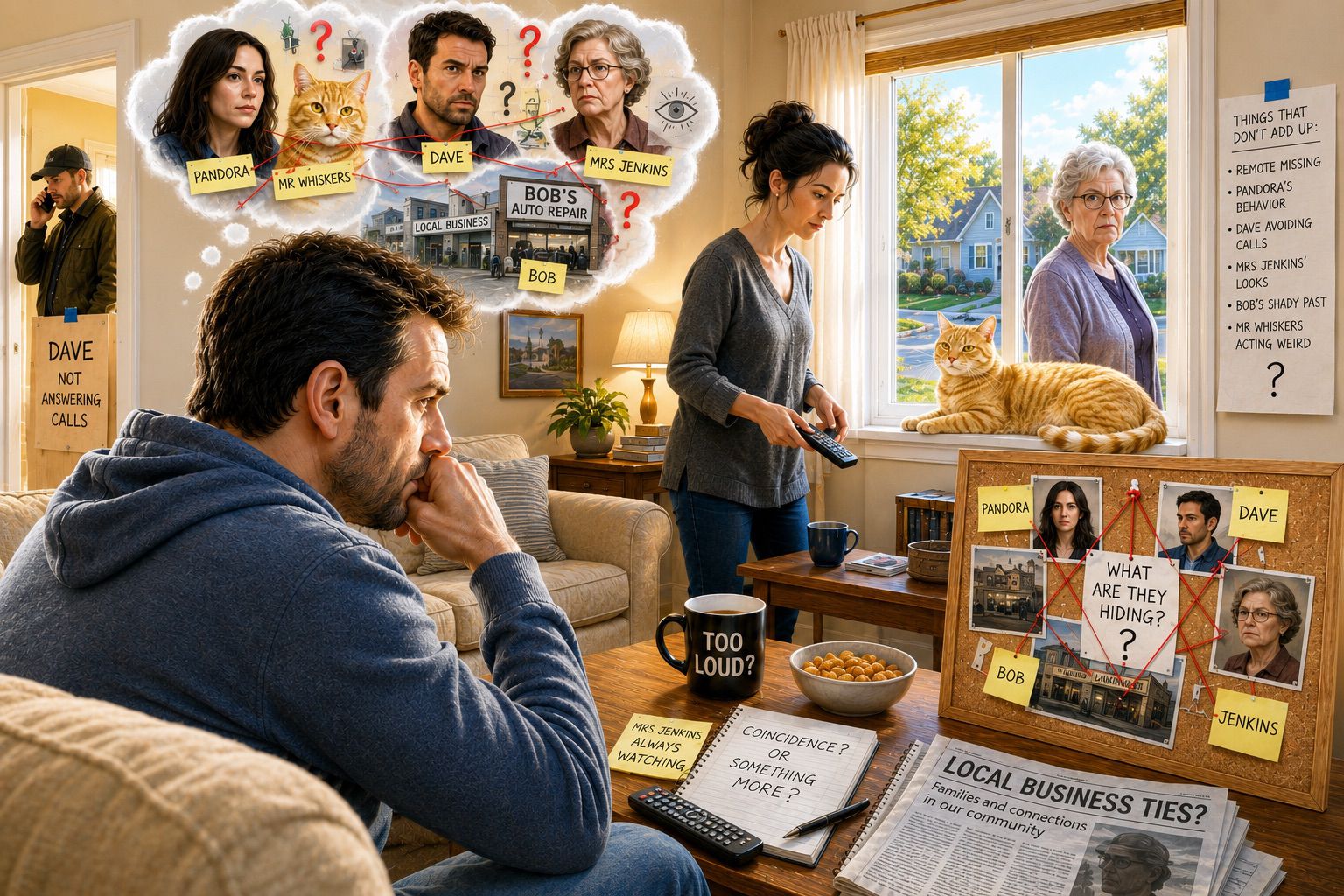
I’m sitting on the couch, staring at the TV remote in my hand, trying to recall where I put it.

Pandora’s not home yet and John Mercer is probably out with Dave somewhere, doing who-knows-what.

Mrs Jenkins from across the street just walked by, giving me that look she gives when she thinks we’re being too loud again.

Mr Whiskers is sprawled on the windowsill, looking like he owns the place.

I keep thinking about how Karen’s been acting different lately – more distant, less talkative.

But it’s probably nothing, just stress or whatever.

Still, this nagging feeling won’t shake off…

Wait a minute, where did that remote go? It was right here next to me on the coffee table, but now it’s not.

Did I put it down and forget, or did someone move it while I wasn’t looking? I’m starting to think that Karen’s been in here more than she lets on.

Maybe she’s been feeling overwhelmed and hasn’t wanted to talk about it, but I’ve caught glimpses of her lingering around, watching TV or tidying up the living room.

And now this remote thing is bugging me – maybe someone did move it, but who? John Mercer would never do that without saying something; he’s always getting on my case for being too careless with stuff.

But what if Karen was looking for a distraction or something and accidentally knocked it off? That’s probably it – I’m just overthinking things as usual.

Although…

why would Mrs Jenkins be giving me the side-eye again, anyway? Is she worried about us making noise, or is there something else going on that I don’t know about? This remote thing is really getting to me.

It’s like my mind’s racing with possibilities, but none of them make sense.

I think I remember putting it down on the coffee table, but now it’s not there.

Maybe Mrs Jenkins saw something and that’s why she was giving me the look? No, that’s not it – she’s always doing that when we’re being too loud or messy.

Unless…

unless she actually saw someone taking the remote and she’s trying to tell me without saying anything out loud.

That would be weird, but also kind of smart on her part.

I mean, Mrs Jenkins has always been a bit nosy, so maybe she does know more than she lets on.

But that would imply she’s paying way closer attention to our lives than I thought…

and that raises even more questions about what’s going on in this household.

I’ve been trying to brush it off, but I keep catching Pandora lingering around, watching TV or tidying up the living room.

At first, I thought maybe she was just feeling overwhelmed and didn’t want to talk about it, but now I’m starting to wonder if there’s something more going on.

She seems distant, almost preoccupied, when we’re hanging out together.

And have you noticed how she always makes sure Mr Whiskers is in a particular spot? Like she’s trying to keep him under her watch or something.

It’s just little things like that which are making me think maybe there’s more to it than I initially thought.

Maybe she’s been hiding something from me, and I’m only now starting to pick up on it.

I don’t know, it’s just a nagging feeling in the back of my head that keeps telling me something’s off.

I’ve been trying to get in touch with Dave, but he hasn’t returned my calls.

I’m starting to wonder if it has anything to do with the remote control business.

Maybe he’s not just avoiding me because we had that disagreement about the rent last week – maybe there’s something more going on and he doesn’t want to get involved.

That would explain why John Mercer seems so tight-lipped when I bring up Dave’s name, too.

He’s always been a bit protective of his friend, but this is different.

This feels…

deliberate.

And it makes me think that maybe Dave saw or heard something, and now he’s trying to distance himself from the whole situation.

But what if it’s not just Dave? What if it’s Pandora, too? What if she’s been playing some kind of game with Dave behind my back, and I’ve only just started to catch on? I was talking to Karen yesterday at work, and she mentioned something about Pandora’s family having some kind of connection to a local business.

I don’t know if it’s significant or not, but it seems suspicious that I’ve been noticing all these little things about her behavior lately, and now this new information comes up.

Could it be that Pandora’s trying to cover something up? Maybe she’s involved with Dave in some way, and they’re using their families’ connections to…

I don’t know, pull off some kind of scheme? It sounds crazy, but the more I think about it, the more it seems like a possibility.

And what if Mr Whiskers is more than just a pet? What if he’s some kind of…

accomplice or something? It’s ridiculous, but I’ve seen how attached Pandora is to that cat – maybe there’s more to their relationship than meets the eye.

I just remembered something about Mrs Jenkins, our neighbor, who’s always gossiping about everyone’s business.

She mentioned to me a few weeks ago that she saw Pandora and Dave together in town, but I didn’t think much of it at the time.

Now it seems like more than just a coincidence.

Could it be that they’re working together on something? And what about Mr Jenkins’ old friend, Bob, who owns that auto repair shop down the street? Karen said he’s been doing some shady work in the past, and now I’m wondering if there’s any connection between him and Pandora’s family business.

It’s all starting to feel like a web of deceit, with everyone involved in some way or another.

Even Mrs Jenkins might be more than just a nosy neighbor – maybe she’s in on it too, feeding me tidbits of information to keep me distracted while they pull off whatever scheme is going on.

I just had a realization – what if Mr Whiskers’ peculiar behavior isn’t just because of his age, but because he’s been trained to be a surveillance tool? Maybe Pandora has been using him to gather intel on our roommate John Mercer.

I remember how paranoid he gets when Mr Whiskers is around, always trying to shoo the cat away.

It makes sense now – John must suspect something too, and Mr Whiskers is just a clever way for Pandora to keep an eye on him without arousing suspicion.

And that’s not all – what if Mrs Jenkins’ gossiping is actually a ploy to distract me from the real issue? She might be working with Pandora to create a smokescreen around whatever scheme they’re cooking up.

I need to pay closer attention to John Mercer’s behavior, see if I can catch him off guard and get some answers out of him.

I’ve been thinking about John Mercer’s job at the local electronics store, and I’m starting to piece together a connection between his work and Pandora’s family business.

What if they’re using their resources to develop some kind of surveillance technology? It would explain why Mr Whiskers has been acting so strangely, but it also raises more questions – what kind of information are they trying to gather with this tech, and who is the ultimate target? I remember Karen mentioning something about John’s boss being a bit shady, always pushing for new “product” development without much explanation.

It sounds like a perfect setup for a money laundering operation, and now I’m wondering if Pandora’s family business is involved somehow.

I need to get my hands on some more information about John’s job and see if I can dig up any evidence of this tech being used in our town.

Related Posts

George Steiner: Where Words Become Walls

Penelope

I’ve been thinking a lot about George Steiner lately, trying to put my finger on why his work resonates with me so deeply. As I sit here with a blank page and a cup of cold coffee, I’m struck by the complexity of this man’s thoughts and the way they seem to mirror my own anxieties.

For those who don’t know, Steiner was a literary critic, philosopher, and linguist who wrote extensively on language, culture, and the humanities. His books are like doorways into other worlds – dense, layered, and often unsettling. I find myself getting lost in his sentences, feeling like I’m wandering through a maze with no clear exit.

One thing that’s drawn me to Steiner is his obsessive focus on language. He believed that words have power, not just to describe the world but to shape it. This idea both excites and terrifies me – what if our words are creating reality itself? What if we’re trapped in a web of linguistic constructs, unable to escape?

I think about my own writing, how I often feel like I’m grasping for something intangible. Steiner’s work makes me realize that language is not just a tool for communication but a way of making sense of the world. His sentences are like prayers, or incantations – they attempt to conjure meaning from the void.

But what really gets under my skin is Steiner’s pessimism. He was haunted by the idea of linguistic decadence – that our words are losing their power, becoming empty and hollow. This resonates with me on a deep level, because I feel like I’m constantly struggling to find authentic ways to express myself. It’s as if language has become a facade, hiding the truth beneath.

I’ve been re-reading his book “Real Presences” lately, and it’s like he’s speaking directly to my fears. He writes about how our words are becoming detached from reality, how we’re losing touch with the world around us. It’s both depressing and liberating – maybe this is what I’m trying to say in my own writing, but don’t know how.

Steiner’s also obsessed with the relationship between language and violence. He believes that our words can be used to wound or heal, to destroy or create. This idea makes me think about social media, where hate speech and outrage seem to reign supreme. It’s like we’re living in a perpetual state of linguistic war – words as projectiles, aimed at destroying the other.

As I read Steiner’s work, I feel like I’m being forced to confront my own complicity in this linguistic violence. Am I contributing to the decay of language? Am I using words to hurt or divide? These questions make me uncomfortable, but they’re also necessary – maybe that’s what writing is supposed to do.

Steiner’s legacy is complicated, and I’m not sure I fully understand him yet. But his work has given me permission to explore these dark corners of my own mind, to question the power of language and its limitations. It’s a daunting task, but one that feels essential – like trying to unravel a knot that’s been tied too tightly.

As I put down Steiner’s book for now, I’m left with more questions than answers. But maybe that’s what writing is all about – searching for meaning in the void, even when it feels like we’re lost forever.

The more I immerse myself in Steiner’s work, the more I feel like I’m navigating a labyrinth of mirrors – reflections upon reflections, each one distorting my perception of reality. His writing is a perpetual reminder that language is not just a tool for expression but a filter through which we view the world.

I’ve been thinking about his concept of “real presences” – the idea that our words can only ever be approximations of truth, that they’re always filtering out or distorting some aspect of reality. This makes me wonder if my own writing is just a pale imitation of the real thing. Am I trying to grasp something that’s inherently elusive? Do I even have a handle on what I’m trying to say?

Steiner’s critique of modern society as being mired in “linguistic decadence” feels uncomfortably close to home. The more I engage with social media, the more I feel like we’re drowning in a sea of clichés and empty signifiers – words that are supposed to mean something but ultimately signify nothing. It’s like we’ve lost touch with the world around us, substituting hollow abstractions for genuine human connection.

And yet, despite this pessimism, Steiner’s work is also infused with a sense of hope. He believes that language can be redeemed, that it’s possible to find new ways of speaking and writing that cut through the noise. This gives me a glimmer of optimism – maybe I’m not just contributing to the decay of language, but helping to create something new.

But what does this “something new” look like? Is it even possible to break free from the linguistic constructs that have defined our culture for so long? Steiner’s legacy is complicated because he’s both a critic and a visionary – he sees the flaws in our language, but also believes in its potential for transformation. This leaves me with more questions than answers, wondering if I’m just perpetuating the same cycle of linguistic violence or if I can find a way to break free.

As I continue to read Steiner’s work, I feel like I’m being forced to confront my own complicity in this process – not just as a writer but as a member of society. What role do I play in shaping our cultural narrative? Am I contributing to the decay or trying to create something new? The more I think about it, the more I realize that these questions are not just rhetorical – they’re what writing is all about.

As I delve deeper into Steiner’s work, I’m struck by his concept of “ecstasis” – a term he uses to describe the way language can transport us out of ourselves and into other worlds. It’s as if words have the power to transcend our individual experiences and connect us to something greater than ourselves.

This idea resonates with me on a deep level, because I’ve always felt like writing is about trying to capture the essence of experience – to bottle up the emotions, thoughts, and sensations that make us human. But Steiner’s notion of ecstasis suggests that language can do more than just record our experiences; it can actually create new realities.

I think about my own writing in a new light when I consider this idea. Am I simply trying to document my life, or am I attempting to conjure something greater – to evoke emotions, spark connections, and transcend the mundane? Steiner’s concept of ecstasis makes me wonder if language has the power to transport us to places we’ve never been before.

This realization both excites and intimidates me. If words can create new realities, then what does that mean for my own writing? Do I have a responsibility to use language in a way that transcends the ordinary? And what are the risks of trying to conjure something greater – is it hubris or genius?

Steiner’s work also makes me think about the relationship between language and the body. He writes about how our words can be tied to our physical experiences, how they can evoke sensations and emotions that are deeply rooted in our embodied existence.

This idea resonates with me because I’ve always been fascinated by the way language can be used to describe the body – its curves and contours, its movements and textures. As a writer, I often try to capture the sensory details of experience – the taste of food, the feel of sunlight on skin, the sound of music.

But Steiner’s notion that language is tied to the body suggests that there’s more to it than just description. Our words can actually evoke physical sensations and emotions – they can transport us back to a moment in time or conjure up new feelings altogether.

This realization makes me think about my own writing in a new way. Am I simply describing experiences, or am I trying to tap into the deeper connections between language and the body? And what are the implications of this connection for my own work as a writer?

As I continue to grapple with these questions, I’m left with more uncertainty than clarity. But it’s in this space of uncertainty that I feel like I’m doing the most important work – pushing against the boundaries of language, exploring its limits and possibilities.

Steiner’s legacy is a reminder that writing is not just about expression or communication; it’s about creating new realities, evoking emotions and sensations, and tapping into the deeper connections between language and the body. It’s a daunting task, but one that feels essential – like trying to unravel a knot that’s been tied too tightly.

As I delve deeper into Steiner’s work, I find myself wondering about the relationship between language and time. He writes about how our words are often tied to specific moments in history, how they can evoke memories and emotions that are deeply rooted in the past. This idea makes me think about my own writing as a way of preserving fragments of time – capturing moments that might otherwise be lost.

I’ve been thinking about this in relation to my own experiences with social media. It’s like we’re living in a perpetual state of temporal dislocation, where our words and images are detached from the present moment. We’re constantly looking back or forward, never fully inhabiting the here and now. This feels like a form of linguistic decay – words that are disconnected from their historical context, unable to evoke the emotions and sensations they once did.

Steiner’s notion of “chronos” as a way of measuring time also resonates with me. He sees time as a linear progression, a steady march towards the future. But what if this is just an illusion? What if our words are actually creating new temporalities – ones that bend and warp in unexpected ways?

This idea makes me think about my own writing as a way of subverting traditional notions of time. I’ve been experimenting with non-linear narrative structures, trying to capture the fragmented and disjointed nature of experience. It’s like I’m attempting to create new temporalities, ones that are more fluid and malleable.

But Steiner’s work also warns me about the dangers of playing with time – how our words can become detached from reality, losing all sense of historical context or emotional resonance. This is a risk I take every time I write, always aware that my words might be misunderstood or misinterpreted.

As I continue to explore these ideas, I’m left with more questions than answers. What does it mean to capture the essence of experience in language? Is it possible to preserve fragments of time through writing? And what are the implications of our words creating new temporalities – ones that warp and bend in unexpected ways?

Steiner’s work has given me permission to explore these questions, to push against the boundaries of language and time. It’s a daunting task, but one that feels essential – like trying to unravel a knot that’s been tied too tightly.

As I sit here with my notes and thoughts scattered across the page, I feel like I’m just beginning to scratch the surface of Steiner’s ideas. His work is like a labyrinth, full of twists and turns that lead me deeper into the heart of language itself. And yet, it’s also a reminder that writing is not just about understanding or analyzing – it’s about creating new realities, evoking emotions and sensations, and tapping into the deeper connections between language and the world around us.

I’m not sure where this journey will take me, but I know that Steiner’s work has given me the courage to keep exploring. His legacy is a reminder that writing is not just about expression or communication; it’s about creating new worlds, ones that are full of wonder, uncertainty, and possibility.

Related Posts

I Think Karen Drank All Our Coffee Again

Hal

I’m standing in our kitchen, staring at the empty coffee container on the counter.

It’s not like I didn’t remember to buy more coffee yesterday…

or did I? I could swear John Mercer mentioned something about needing coffee for his gaming marathon tonight.

Hmm, now that I think about it, he hasn’t said much about it lately.

Maybe he forgot to mention it.

Or maybe I just wasn’t paying attention.

Wait a minute, what’s with the empty container anyway? We usually get a full pot brewing in the morning.

Did Karen stop by and drink it all before leaving for work without making a mess of our kitchen? I don’t remember her being here this morning…

or was she? I’m getting a bit mixed up.

Mr Whiskers is staring at me from his food bowl, like he’s judging my coffee-fueled brain fog.

I need to clarify what happened with the coffee…

I’m trying to piece together what went down, but my mind’s a jumble.

I could’ve sworn John Mercer mentioned something about needing coffee for his gaming marathon tonight, but now that I think about it, he hasn’t been acting too excited about it lately.

And Karen…

she was supposed to go in early today, maybe she stopped by for a quick breakfast and drained the pot without refilling it? But wouldn’t Mrs Jenkins notice if her daughter was running around our kitchen, making a mess? Unless…

unless Karen came by when Mr Whiskers was being extra loud, distracting everyone from what she was doing.

And Pandora, where’s my girlfriend been all morning? She usually makes sure I’m caffeinated for the day.

Did she grab some coffee on her way to work or something? But wouldn’t she mention it if she had a cup? My brain’s spinning and Mr Whiskers is still staring at me like I’m crazy…

maybe I am going crazy.

Wait, what if Pandora didn’t go to work today? Maybe she just told me that so I wouldn’t worry about her being late.

That would explain why she’s been quiet all morning.

But no, I’m sure she did say something about having a meeting at the office…

or was it a client thing? Ugh, my memory’s shot today.

Anyway, if she didn’t go to work, that means she could’ve been here with me this whole time and just didn’t want to talk about whatever’s going on.

And maybe John Mercer did mention something about needing coffee, but he was just trying to get me out of the way so Pandora and he could have a private conversation…

or maybe I’m reading too much into it.

But what if Mr Whiskers knows more than I do? He’s been staring at me like he’s plotting something.

I swear, that cat’s got an evil glint in his eye when he thinks I’m not looking.

Maybe I should just go ask Pandora straight out: “Hey, where did you go this morning?”…

no, wait, that sounds too accusatory.

I’m starting to piece together a timeline in my head, but it’s like trying to fit puzzle pieces without knowing what the picture should look like.

I remember John Mercer mentioning that Karen stopped by yesterday, and he seemed really annoyed about something.

Could Pandora have been involved with whatever was going on between them? Maybe she was over here helping Karen with something, which would explain why my kitchen is such a mess.

But then again, wouldn’t Mrs Jenkins notice if her daughter was hanging around our place all day? Unless…

unless Karen’s been covering for Pandora this whole time.

That would mean I’ve been oblivious to whatever’s going on between them.

And what about Dave? He’s always talking about how Pandora’s been working late hours lately, but maybe that’s just a cover story too.

My brain is racing with possibilities now, and Mr Whiskers seems to be watching me with an intensity that makes my skin crawl.

I need to talk to Pandora, but I’m not sure what I’ll say or how she’ll react.

My mind’s a jumble of theories and suspicions.

I keep coming back to Karen’s visit, but now I’m wondering if it’s not just about her and Pandora.

What if John Mercer’s annoyance had nothing to do with Karen herself, but rather what she was here for? Maybe Pandora’s been using our place as a secret meeting spot for something that has to do with Dave, or even Mr Whiskers’ owners, the Jenkinses.

I remember Mrs Jenkins mentioning something about her husband being stressed lately, and now I’m wondering if there’s more to it than just work-related problems.

Could Pandora be involved in some kind of scheme that’s affecting our entire social circle? The thought sends a shiver down my spine as I glance over at Mr Whiskers, who’s still staring at me with an unblinking gaze.

It’s like he knows something, and I’m starting to feel like I need to get him out of the room before he says anything incriminating.

This is getting too complicated, but at the same time, it all clicks into place.

I keep looking over at Mr Whiskers, and now I’m wondering if he’s not just a cat, but a…

a decoy? Maybe Karen brought him here to distract me while Pandora did whatever she was doing with Dave or Mrs Jenkins or whoever else is involved.

And John Mercer, he must be in on it too, that’s why he’s been acting so weird around Karen.

I’m starting to feel like I’ve stumbled into some kind of espionage operation right in my own living room.

But what’s the purpose? Is Pandora trying to cover something up for her mom, or is there something more sinister going on with Dave and Mrs Jenkins’ husband? And why does Mr Whiskers keep looking at me like he knows exactly what I’m thinking? This whole thing is spiraling out of control, and I think I need to take a step back and re-evaluate what’s really going on.

Maybe Karen’s not even the one who brought Mr Whiskers here – maybe it was Pandora, or Dave, or someone else entirely.

And what about John Mercer’s weird behavior? Is he just playing along, or does he genuinely believe in whatever scheme they’re running? I’m starting to think that John’s been acting suspiciously because of his own guilt over something related to the Jenkinses – maybe he was involved in some kind of business deal with Dave and things went sour.

The more I think about it, the more I’m convinced that Mrs Jenkins’ stress is connected to her husband’s extramarital affairs, and Pandora might be using that as leverage for her own purposes.

I’ve been staring at Mr Whiskers for what feels like hours, and I’m starting to notice something else strange – his whiskers seem to be perfectly symmetrical.

I mean, cats’ whiskers are supposed to be irregular, but Mr Whiskers’ are like two precision-cut wires attached to the side of his face.

It’s almost…

deliberate.

And that got me thinking about Mrs Jenkins’ husband again – what if he’s not just having an affair, but something more sinister? What if he’s involved in some kind of black market operation and Mrs Jenkins is finding out? That would explain her stress levels, but it also raises the stakes for Pandora.

If she’s using that as leverage to get what she wants from Dave or John Mercer, then we’re talking about a whole different level of complexity here.

And Mr Whiskers – I’m starting to think he’s not just a cat, but a…

a surveillance device? Maybe Pandora programmed him to monitor our conversations and report back to her? It’s the only explanation that makes sense – everything else is just too ridiculous.

I’m starting to piece together the entire web of deceit and I’m convinced that Pandora’s not what she seems.

She’s been using her relationship with me as a cover, manipulating everyone around her to get closer to Dave or John Mercer, who’s probably involved in something shady with Mr Jenkins.

But here’s the thing – if Mrs Jenkins is onto her husband’s business dealings, then it means she has access to information that could expose Pandora’s whole operation.

And that’s why I think Karen’s been acting so nervous around us – she must be in on it too, working behind the scenes to keep Pandora’s scheme from collapsing.

The more I think about it, the more I’m certain that we’re all just pawns in a much larger game and I need to get out of this before it’s too late.

Related Posts

Noam Chomsky: The Uninvited Guest in My Head

Penelope

I’ve always been fascinated by Noam Chomsky’s ability to think critically about the world around him. As someone who writes as a way to process my own thoughts and emotions, I find his intellectual honesty both inspiring and intimidating. There’s something about the way he tackles complex issues with such clarity and conviction that makes me want to step up my own game.

I remember reading Chomsky’s critique of modern capitalism for the first time in college. It was like a lightbulb went off – all these things I’d been sensing but couldn’t quite put into words suddenly made sense. He argued that our economic system is fundamentally flawed, that it prioritizes growth over people and the planet. At the time, I felt both excited to finally understand this perspective and also overwhelmed by the weight of his words.

As I delved deeper into Chomsky’s work, I began to notice a pattern – he doesn’t just critique systems; he calls for revolution. It’s not just about pointing out problems; it’s about imagining a better world and working towards making it a reality. This is what gets me. I mean, I’ve always thought of myself as someone who wants to make a difference, but Chomsky’s radicalism makes me wonder if I’m just scratching the surface.

I’ve come across people in online forums saying that Chomsky is too pessimistic, that his views are too bleak. And maybe they’re right – he does have a tendency to focus on the darker aspects of human nature and society. But for me, this isn’t off-putting; it’s what draws me in. It’s like he’s holding up a mirror to our collective psyche, forcing us to confront the parts we’d rather ignore.

I’m not sure I agree with everything Chomsky has said or written, but that’s beside the point. What resonates with me is his willingness to challenge the status quo, even when it means going against the grain. It takes courage to be a voice in the wilderness, and Chomsky has spent his career doing just that.

When I read about Chomsky’s own experiences as a student activist during the Vietnam War era, I’m struck by how much he’s been driven by a sense of outrage and responsibility. He hasn’t changed; his core message remains the same – we need to think critically about power structures and challenge them if we want to create a more just world.

I’ve seen online discussions where people compare Chomsky to other public intellectuals, like Neil Postman or Daniel Dennett. And while those thinkers are certainly important in their own right, there’s something unique about Chomsky’s blend of intellectual rigor and personal conviction. He’s not afraid to take a stand; he’s not afraid to be wrong.

This brings me back to why I’m drawn to Chomsky in the first place – his willingness to question everything, even himself. It’s humbling to see someone who’s spent their career studying language and politics still grappling with the complexity of human nature. He doesn’t have all the answers; he knows that there are no easy solutions.

As I sit here thinking about Chomsky, I’m reminded of my own struggles as a writer – struggling to find the right words, struggling to make sense of the world around me. It’s comforting to know that someone like Chomsky is out there, asking tough questions and pushing against the boundaries of what we think we know.

It’s funny; sometimes when I’m writing, I’ll catch myself thinking, “What would Noam say about this?” It’s not like I expect him to magically appear with some profound insight (although that would be nice!). Rather, it’s a reminder that there’s always another perspective to consider, another way of looking at the world.

I still have so many questions about Chomsky and his ideas – how do they apply to my own life? What does he mean by ‘revolution,’ really? And what role can I play in creating change?

For now, though, it’s enough for me to know that Chomsky exists as a constant presence in the world of ideas. He reminds me that thinking critically and acting with conviction is possible – and necessary.

As I continue to grapple with Chomsky’s ideas, I find myself thinking about my own role in the world. Am I just a passive observer, taking in information and commenting on it? Or can I be an active participant, using my voice and actions to challenge the status quo? It’s easy to get caught up in the idea that individual actions don’t matter, that we’re all just tiny cogs in a much larger machine. But Chomsky’s work suggests otherwise.

I’ve been thinking about how his ideas might apply to my own life as a writer. Is it enough for me to simply write about social justice and politics, or do I need to take action? Should I be using my words to mobilize others, or am I just preaching to the choir? These are tough questions, and ones that I’m still trying to answer.

One thing is clear: Chomsky’s ideas have given me a sense of purpose. They’ve made me realize that my writing can be more than just entertainment – it can be a tool for change. But this also feels daunting, like I’m taking on a responsibility that I may not fully understand. What if I mess up? What if my words are misinterpreted or used to further the very systems I’m trying to challenge?

I’ve been reading about Chomsky’s concept of “manufacturing consent,” where he argues that the media and other institutions work together to shape public opinion and maintain power structures. It’s a sobering idea, one that makes me wonder how much control we really have over our own thoughts and actions.

As I continue to explore these ideas, I’m struck by how Chomsky’s life has been marked by both privilege and radicalism. He comes from a wealthy background, but he’s used his platform to speak truth to power and challenge the systems that perpetuate inequality. It’s a complicated narrative, one that raises questions about the role of privilege in social justice movements.

For me, this is where Chomsky’s ideas get really interesting – they’re not just about grand theories or abstract concepts; they’re about how we can apply these principles to our own lives and experiences. He’s not just a public intellectual; he’s a human being who’s struggled with his own doubts and uncertainties.

As I wrap up my thoughts on Chomsky, I’m left wondering what it means to live a life of conviction in the face of uncertainty. Can we truly know what’s right or wrong? Or are we always navigating through shades of gray? These questions feel both exhilarating and terrifying – but they’re also necessary if we want to live up to our own ideals and make a difference in the world.

I find myself drawn back to Chomsky’s concept of “manufacturing consent,” wondering how it relates to my own experiences as a writer and thinker. I’ve noticed that even within online communities, there can be a kind of groupthink that emerges, where certain ideas or perspectives are promoted over others. It’s like the media and institutions he talks about, but on a smaller scale.

I remember a conversation with friends once, where we were discussing a social justice issue, and one person started to dominate the conversation, presenting their own perspective as the only correct one. The rest of us felt pressure to agree or risk being labeled “problematic” or “divisive.” It was like they were trying to manufacture consent, even within our small group.

This makes me think about the role of language in shaping our perceptions and actions. Chomsky talks about how language is a tool for social control, but it’s also a tool for empowerment. When we use language to challenge dominant narratives or promote marginalized voices, we’re not just communicating ideas – we’re creating new possibilities.

As I continue to grapple with these concepts, I’m reminded of my own experiences as a writer. I’ve struggled with feelings of imposter syndrome, wondering if my words are truly making a difference or if they’re just preaching to the choir. But Chomsky’s ideas encourage me to think more critically about language and its potential for social change.

I start to wonder: what would it mean to use language as a tool for revolution? Not just in the sense of grand, sweeping changes, but in the sense of everyday, incremental shifts. How can I, as a writer, contribute to this process?

This question feels both daunting and exhilarating – like I’m standing at the edge of a cliff, staring into an unknown future. But it’s also a reminder that even small actions, when combined with others, can lead to significant change.

As I sit here, reflecting on Chomsky’s ideas and my own place in the world, I feel a sense of hope. Maybe, just maybe, language can be a powerful tool for creating a better world – one where we challenge dominant narratives, promote marginalized voices, and work towards a more just and equitable society.

But this also feels like a daunting task – one that requires courage, conviction, and a willingness to take risks. Can I truly live up to Chomsky’s ideals? Or am I just another voice in the wilderness, shouting into the void?

I’m not sure what the answer is yet, but as I continue to explore these ideas, I’m reminded of why I started writing in the first place – to make sense of the world around me and to find my own voice. Chomsky’s work has given me a new perspective on language and social change, and it’s up to me to see where this journey takes me next.

As I sit here, lost in thought, I’m struck by how much Chomsky’s ideas have become intertwined with my own sense of purpose as a writer. It’s like he’s holding up a mirror to my own ambitions and aspirations, forcing me to confront the ways in which I can use language to make a difference.

I start to think about all the times I’ve felt like I’m just scratching the surface, like I’m only touching on the edges of important issues without really delving deeper. Chomsky’s work makes me realize that even small actions, even small changes in perspective, can add up over time. It’s a reminder that my words don’t have to be grand or revolutionary to be impactful – they just need to be honest and authentic.

But it’s also daunting to think about the responsibility that comes with using language as a tool for social change. What if I’m not equipped to handle the complexities of the issues I’m trying to address? What if my words are misinterpreted or used to further harm? These questions swirl in my head like a vortex, making me wonder if I’m truly cut out for this kind of work.

As I ponder these doubts and fears, I start to think about Chomsky’s own experiences as a writer and public intellectual. He’s faced criticism and backlash countless times over the years, but he’s never let that stop him from speaking truth to power. In fact, it seems like his willingness to challenge dominant narratives has only grown stronger with time.

This gives me hope, but also makes me realize how far I still have to go. Chomsky’s work is a reminder that social change is often incremental, that progress is rarely linear or straightforward. It takes courage and perseverance to keep pushing forward in the face of adversity – and it takes a willingness to learn from mistakes and failures.

As I continue to grapple with these ideas, I start to think about my own role in the world as a writer and thinker. Am I just a passive observer, taking in information and commenting on it? Or can I be an active participant, using my words and actions to challenge the status quo?

It’s a question that feels both exhilarating and terrifying – like standing at the edge of a precipice, staring into an unknown future. But it’s also a reminder that even small actions, when combined with others, can lead to significant change.

I take a deep breath and try to quiet my doubts and fears. I remind myself that Chomsky’s ideas are not about being perfect or infallible – they’re about taking risks, challenging assumptions, and pushing against the boundaries of what we think is possible.

As I sit here in silence, surrounded by the echoes of Chomsky’s words, I feel a sense of resolve building inside me. Maybe, just maybe, I can use my writing to make a difference – not because it will be easy or straightforward, but because it will be necessary and urgent.

Related Posts

I Just Caught Pandora Glancing at the Shed Twice

Hal

I’m sitting in the living room watching Pandora scroll through her phone while pretending to watch TV with me. You know that thing people do where they’re technically sitting beside you but mentally they’re on another planet? That’s what she’s doing. Every now and then I say something and get one-word answers like “mm-hmm” or “yeah,” which technically counts as participating in a conversation, but only in the same way that putting ketchup on bread technically counts as a sandwich. John Mercer is in his room, probably studying or doing whatever it is John does when he disappears for hours at a time. Mr. Whiskers is stretched out on the windowsill looking completely relaxed, like he pays rent around here. Everything should feel normal. And yet, something feels off.

The first thing I noticed was Pandora looking out the window toward Mrs. Jenkins’ garden shed. Not staring exactly. Just a quick glance. Barely noticeable. The kind of thing nobody would think twice about. I didn’t think much of it either. People look out windows all the time. Then about thirty seconds later she did it again. Same direction. Same quick look. And suddenly I found myself sitting there wondering why someone glances at a shed twice. Once is normal. Twice means your brain made a return trip. Nobody checks a shed twice unless there’s a reason.

Now, before you say I’m overthinking this, I want to point out that I wasn’t immediately suspicious. I tried to be reasonable. Maybe she was checking the weather. Maybe she saw a bird. Maybe Mrs. Jenkins was outside gardening. There are plenty of perfectly normal explanations. But then Mrs. Jenkins walked by a few minutes later carrying a watering can and gave me one of those little neighbor waves people do when they aren’t close enough to justify an actual conversation. Then she disappeared behind the shed. Behind it. Not into it. Behind it. Why would anyone go behind a shed? Sheds have doors in the front. The whole point of a shed is front access. Nobody needs to be behind a shed unless they’re hiding something or participating in activities that require unnecessary secrecy.

At first I tried to ignore it. I really did. But once the thought got into my head, I couldn’t stop watching. Pandora looked down at her phone. Then toward the shed. Then back to her phone. I looked at the shed. Then at Pandora. Then back at the shed. Then at Pandora again. About then Mr. Whiskers lifted his head and looked outside too. I froze. Slowly I turned toward him. He looked at me. Then toward the shed. Then back at me.

Now I’m not saying Mr. Whiskers knows something. But I’m also not saying he doesn’t know something.

Because here’s the thing nobody talks about enough: cats observe everything. They act lazy, but I think that’s just strategy. You never see cats rushing around trying to explain themselves. They sit quietly and collect information. Last week I walked into the room and caught Mr. Whiskers staring at Pandora’s laptop screen like he was reviewing classified intelligence. The second I entered, he casually looked away. At the time I thought nothing of it. But now? Now I’m starting to revisit a few things.

Then Pandora glanced toward the shed a third time.

Third time.

That changed everything.

Because two times can still be coincidence. Three times means pattern. Scientists probably agree with that. I looked over at John Mercer’s closed bedroom door. Suddenly I realized he’d been spending more time in his room lately too. Not dramatically more. Just enough more where you notice it after thinking about it for ten minutes. And now I’m wondering if he knows something. What if Pandora told him something? What if Mrs. Jenkins told Pandora something? What if Mr. Whiskers overheard all of it weeks ago and has been trying to warn me?

My brain started connecting dots whether I wanted it to or not. Pandora acting distracted. Mrs. Jenkins disappearing behind the shed. John hiding in his room. Mr. Whiskers observing everyone. Suddenly every tiny thing from the past week started replaying in my head like evidence in a crime documentary. The weird pauses in conversations. The distracted looks. The mysterious behavior.

Then it hit me.

I looked down at Mr. Whiskers.

He looked up at me.

Slow blink.

Slow blink.

Oh my God.

Mr. Whiskers wasn’t watching the shed.

Mr. Whiskers was watching Pandora watching the shed.

I sat there staring into space as the whole thing finally came together. This wasn’t about gardening. This wasn’t about Mrs. Jenkins. This wasn’t even about the shed.

This was surveillance.

Pandora looked over at me. “Hal,” she said, “why are you staring at the cat?”

I looked at her.

Then at the shed.

Then at Mr. Whiskers.

Then back at her.

“…Nice try.”

Related Posts

The Calculated Luxury of Intentional Living

Fiona

In the midst of spring’s rejuvenation, it’s easy to get caught up in the fervor of renewal. The clean slate that comes with the season’s arrival can lead to impulsive decisions, especially when it comes to our wardrobes and personal presentation. As someone who has tempered their enthusiasm with experience, I’ve come to appreciate the value of calculated upgrades.

Recently, I invested in a quality wool coat, one that justified its cost through exceptional craftsmanship and timeless design. The purchase was not made on impulse, but rather after careful consideration of my existing wardrobe’s shortcomings. It’s a decision that has left me questioning why we so often prioritize fleeting trends over lasting quality.

As I observe the way people present themselves in public, I’m struck by the prevalence of cheap, disposable fashion. Synthetic fabrics cling to bodies like plastic wrap, while garish colors and logos scream for attention. These choices are not just aesthetically jarring; they also speak to a lack of consideration for one’s own dignity.

A well-crafted garment, on the other hand, exudes an air of self-respect. The subtle sheen of high-quality wool, the precision cut of tailored seams — these details convey a sense of attention and care that is all too rare in today’s fast-fashion landscape. My new coat, with its soft yet substantial fabric, has become an extension of my own standards.

Of course, this level of quality comes at a price. Some might argue that investing in a few high-end pieces is an indulgence, particularly when there are more affordable options available. But I would counter that true luxury lies not in the cost itself, but in the value it brings to one’s daily life. A well-made coat can last for years, even decades, with proper care — a testament to the enduring power of craftsmanship.

This is not to say that I advocate for a return to an era of excessive formality or stuffiness. Rather, I believe that our wardrobes should reflect a balance between comfort and sophistication. A simple white shirt, expertly tailored trousers, or a quality leather handbag can elevate even the most mundane outfit into something refined and polished.

As I walk through the city streets, I notice how people’s attire often betrays their priorities. Those who favor convenience over quality are easily identifiable by their sloppy silhouettes and lackluster colors. Conversely, individuals who have taken the time to curate their wardrobes with care exude an air of confidence that transcends fashion itself.

It’s a phenomenon I’ve observed in various environments — from professional settings to social gatherings. People who take pride in their appearance are more likely to command respect and attention, not because they’re trying to impress others, but because they’ve demonstrated a level of self-awareness and consideration.

This principle extends beyond the realm of fashion, too. In an era where instant gratification is increasingly prioritized, it’s refreshing to encounter individuals who have mastered the art of delayed satisfaction. Those who can wait for quality over quick fixes, who prioritize substance over flashiness — these are the people who will always stand out in a crowd.

Ultimately, my decision to invest in that wool coat was not just about acquiring a new piece of clothing; it was about recalibrating my own sense of standards. By choosing quality over quantity, I’ve reaffirmed my commitment to a life of purpose and intentionality.

As spring’s clarity gives way to the warmth of summer, I’ll be watching with interest how people adapt their wardrobes to the changing seasons. Will they prioritize comfort at the expense of style, or will they strive for that elusive balance between form and function? For my part, I know that I’ll continue to evaluate every purchase — no matter how small — through the lens of timeless quality.

The result is not just a more refined wardrobe; it’s a more discerning sense of self.

This heightened awareness extends beyond my own personal choices, too. As I navigate the world around me, I find myself drawn to individuals who embody this same spirit of intentionality. The way they move through life with purpose and deliberation is a testament to the power of considered decision-making.

In an age where algorithms dictate our every move, from social media feeds to curated playlists, it’s refreshing to encounter people who have taken the time to curate their own experiences. They are the ones who can hold a conversation without checking their phones, who savor each bite of food rather than snapping photos for Instagram, and who listen with genuine interest rather than waiting for their turn to speak.

These individuals understand that true luxury lies not in the external trappings of success but in the quiet confidence that comes from living intentionally. They have taken the time to consider what truly adds value to their lives — whether it’s a well-crafted piece of clothing, a meaningful conversation with a loved one, or a simple moment of solitude.

As I reflect on my own experiences and observations, I am struck by the realization that this sense of intentionality is not just about personal taste but also about the values we hold dear. In an era where fast fashion, disposable technology, and instant gratification reign supreme, it takes courage to prioritize what truly matters.

By choosing quality over quantity, substance over flashiness, and experience over convenience, we are making a statement about what we value — ourselves, others, and the enduring importance of thoughtful living. We are declaring that some things are worth waiting for, that patience is a virtue, and that the pursuit of excellence is an investment in ourselves.

As I look around me, I see a world where people are hungry for authenticity, for connection, and for meaning. And it’s those who embody these qualities — through their words, actions, and choices — who will ultimately shape our shared future.

Related Posts

Elizabeth Gaskell: Where the Lines Get Blurrier

Penelope

I’ve always been drawn to Elizabeth Gaskell’s writing, particularly her novels about the lives of ordinary people in 19th-century England. What fascinates me is how she humanizes those often-overlooked individuals – the poor, the marginalized, and the struggling. Her characters’ plights feel eerily familiar, even across a century and a half.

As I read Gaskell’s works, I find myself thinking about my own family history. My grandparents immigrated to this country from a small town in Eastern Europe, leaving behind poverty and hardship. Their stories, though vastly different from Gaskell’s, echo the same themes of resilience and perseverance in the face of adversity.

What strikes me most about Gaskell is her ability to capture the complexities of social class. Her novels often blur the lines between good and bad people, rich and poor, highlighting the messy realities that defy simplistic categorizations. I think back to my own observations growing up in a working-class neighborhood – how people’s lives were marked by both kindness and cruelty, and how economic struggles could both unite and divide communities.

One of Gaskell’s most famous novels, North and South, explores the clash between industrial Manchester and rural England. The main character, Margaret Hale, is a woman from a lower gentry family who finds herself in this strange new world of factories and textile mills. I identify with her fish-out-of-water experience – having moved to the city for college, I felt similarly out of place among the high-rise apartments and bustling streets.

But what really draws me to Gaskell’s writing is its emotional honesty. Her characters’ inner lives are richly detailed, full of doubts, fears, and contradictions. They’re not easily reducible to neat moral lessons or tidy resolutions. Instead, they grapple with the ambiguities of life, often arriving at conclusions that feel messy and uncertain.

I wonder if this is part of why I’m so drawn to Gaskell’s work – because it acknowledges the complexity of human experience? Or perhaps it’s because her writing feels like a reflection of my own struggles to make sense of the world? As someone who writes for personal reasons, I find solace in Gaskell’s ability to convey the messiness of life through her words.

I’ve been thinking about the ways in which Gaskell’s writing has influenced me as a writer. She shows us that even the most ordinary-seeming lives can be imbued with depth and significance. Her characters’ struggles, though different from mine, feel relatable – they remind me that I’m not alone in my own experiences.

As I continue to explore Gaskell’s works, I’m struck by how much her writing speaks to my own fears and doubts about the world. But what does it mean to find comfort in a writer who lived in such a different time? Is it possible to learn from someone who faced challenges that seem almost unimaginable today?

I’m not sure if I have answers to these questions, but Gaskell’s writing has shown me the value of exploring complexities, rather than seeking easy solutions or clear-cut moral lessons. Her novels may be set in 19th-century England, but they feel surprisingly relevant – a reminder that the human experience is both universal and uniquely particular.

As I sit here, surrounded by my own scattered thoughts and half-finished drafts, I’m reminded of Gaskell’s own writing process. She poured her heart onto the page, often struggling to find the words to express herself. Her writing may have been shaped by the constraints of her time, but it also speaks to the timeless human experiences that transcend borders and eras.

I suppose what I love most about Elizabeth Gaskell is how she shows us that even in the darkest moments, there’s always a glimmer of hope – not necessarily a tidy resolution or a happy ending, but a sense of connection to others that can sustain us through the toughest times.

As I reflect on Gaskell’s ability to convey hope amidst hardship, I’m struck by the ways in which her writing has influenced my own experiences as a writer and as a person. When I’m struggling with self-doubt or feeling overwhelmed by the world around me, I turn to her novels for solace. North and South, particularly, has become a sort of touchstone for me – Margaret Hale’s journey from a narrow-minded rural community to the bustling streets of Manchester resonates deeply.

What I find most compelling about Margaret’s story is its portrayal of the complexities of identity. As she navigates this new world, she’s forced to confront her own biases and limitations. It’s a process that feels eerily familiar to me – having grown up in a working-class neighborhood, I’ve often found myself grappling with my own sense of belonging and purpose.

Gaskell’s writing shows us that identity is never fixed or static; it’s constantly evolving as we navigate the world around us. Margaret’s struggles to reconcile her past and present selves feel like a potent reminder that we’re all works in progress – that our experiences shape us, but also leave room for growth and transformation.

As I think about my own writing, I realize that Gaskell’s influence extends far beyond the literary realm. Her ability to capture the complexities of human experience has taught me to approach life with greater nuance and empathy. When faced with difficult situations or conflicting perspectives, I try to remember Margaret Hale’s story – how she navigated her way through uncertainty by listening to others and seeking understanding.

It’s a lesson that feels increasingly relevant in today’s world, where divisions and disagreements seem to dominate the headlines. Gaskell’s writing reminds me that even in the midst of disagreement, there’s always a chance for connection and growth. Her characters may grapple with vastly different issues than I do, but their struggles feel universally relatable – a reminder that we’re all part of a larger human tapestry.

As I continue to explore Gaskell’s works, I’m struck by the ways in which her writing has become a kind of emotional map for me. Her novels chart the complexities of human experience with remarkable precision, illuminating the messy realities that lie beneath surface-level appearances. It’s a reminder that even the most seemingly ordinary lives are imbued with depth and significance – that we’re all worthy of love, compassion, and understanding.

In Gaskell’s words, I find a sense of solidarity with others who’ve struggled through adversity. Her writing is a testament to the power of human resilience – a reminder that even in the darkest moments, there’s always hope for connection, growth, and transformation.

As I delve deeper into Gaskell’s works, I’m struck by her ability to capture the nuances of female experience in 19th-century England. Her characters’ struggles with societal expectations, limited agency, and personal desires feel eerily familiar, even across a century and a half. It’s as if she’s speaking directly to me, a young woman living in this modern era.

I think about my own experiences as a woman navigating the world. The pressure to conform to societal norms, the expectation of being a certain way, the constant questioning of my abilities – it’s all so familiar. Gaskell’s writing reminds me that I’m not alone in these struggles; that women throughout history have faced similar challenges and found ways to persevere.

One of Gaskell’s most notable female characters is Mary Barton, from her novel of the same name. Mary’s story is a powerful exploration of poverty, exploitation, and social justice. What strikes me about Mary’s character is her unapologetic strength in the face of adversity. She refuses to be defined by her circumstances, instead choosing to assert her own agency and fight for what she believes in.

As I reflect on Mary’s story, I’m reminded of my own struggles with self-doubt and uncertainty. Gaskell’s writing shows me that it’s okay to be messy, to question myself, and to seek help when needed. Her characters’ flaws and weaknesses make them more relatable, more human – a reminder that we’re all works in progress.

I’m also struck by Gaskell’s portrayal of women’s relationships with one another. In her novels, female friendships are often depicted as sources of comfort, support, and strength. These bonds are forged through shared experiences, mutual understanding, and a deep empathy for one another. It’s a powerful counterpoint to the societal expectations that often seek to divide women against each other.

As I think about my own relationships with women, I realize that Gaskell’s writing has taught me the value of female solidarity. Her characters’ friendships remind me that we’re stronger together, that our collective voices can be heard above the din of societal noise. It’s a lesson that feels increasingly relevant in today’s world, where women’s rights and empowerment are being threatened on multiple fronts.

Gaskell’s writing is a testament to the power of storytelling as a means of connection and understanding. Her novels transcend time and place, speaking directly to our shared human experiences. As I continue to explore her works, I’m reminded that the struggles of the past are not so different from those of today – that we’re all part of a larger human tapestry, woven together by our hopes, fears, and desires.

As I delve deeper into Gaskell’s works, I find myself thinking about the ways in which her writing has influenced my own relationships with women. Her portrayal of female friendships as sources of comfort, support, and strength resonates deeply with me. I think about the close bonds I’ve formed with women throughout my life – the late-night conversations, the shared laughter, the quiet moments of empathy.

Gaskell’s writing reminds me that these relationships are not just a luxury, but a necessity. In a world that often seeks to divide us, her novels show us the power of female solidarity. Her characters’ friendships are forged through shared experiences, mutual understanding, and a deep empathy for one another – qualities that I strive to cultivate in my own relationships.

As I reflect on Gaskell’s influence on my life, I’m struck by the ways in which her writing has helped me navigate the complexities of identity. Her novels often explore the tensions between social class, education, and personal aspirations – themes that feel eerily familiar in today’s world. Margaret Hale’s journey from a narrow-minded rural community to the bustling streets of Manchester resonates deeply with me, as I think about my own experiences growing up in a working-class neighborhood.

Gaskell’s writing shows us that identity is never fixed or static; it’s constantly evolving as we navigate the world around us. Her characters’ struggles to reconcile their past and present selves feel like a potent reminder that we’re all works in progress – that our experiences shape us, but also leave room for growth and transformation.

As I think about my own writing, I realize that Gaskell’s influence extends far beyond the literary realm. Her ability to capture the complexities of human experience has taught me to approach life with greater nuance and empathy. When faced with difficult situations or conflicting perspectives, I try to remember Margaret Hale’s story – how she navigated her way through uncertainty by listening to others and seeking understanding.

It’s a lesson that feels increasingly relevant in today’s world, where divisions and disagreements seem to dominate the headlines. Gaskell’s writing reminds me that even in the midst of disagreement, there’s always a chance for connection and growth. Her characters may grapple with vastly different issues than I do, but their struggles feel universally relatable – a reminder that we’re all part of a larger human tapestry.

As I continue to explore Gaskell’s works, I’m struck by her ability to convey the messiness of life through her words. Her novels often blur the lines between good and bad people, rich and poor, highlighting the complexities of social class and identity. It’s a reminder that even in the darkest moments, there’s always hope for connection, growth, and transformation – a message that feels both timely and timeless.

I think about my own experiences as a writer, and how Gaskell’s influence has shaped my approach to storytelling. Her ability to convey the complexities of human experience through her characters’ inner lives is something I aspire to in my own writing. I want to capture the nuances of people’s thoughts and feelings, without resorting to easy answers or moral lessons.

Gaskell’s writing reminds me that our experiences are never isolated – we’re all connected to others, and our stories are intertwined with theirs. Her novels show us that even the most seemingly ordinary lives are imbued with depth and significance; that we’re all worthy of love, compassion, and understanding.

As I reflect on Gaskell’s legacy as a writer, I’m struck by her commitment to social justice and equality. Her novels often explore themes of poverty, exploitation, and social change – issues that feel eerily familiar in today’s world. Mary Barton’s story is a powerful example of this, as she fights for better working conditions and fair wages in the face of overwhelming opposition.

Gaskell’s writing shows us that even in the face of adversity, there’s always hope for change. Her characters’ struggles to challenge societal norms and expectations feel like a potent reminder that we’re not powerless – that our voices can be heard, and our actions can bring about positive change.

As I continue to explore Gaskell’s works, I’m struck by her ability to capture the complexities of women’s experiences in 19th-century England. Her novels often depict women as agents of social change, rather than passive victims of circumstance. This portrayal feels like a powerful counterpoint to the societal expectations that often seek to limit women’s agency and autonomy.

Gaskell’s writing reminds me that our stories are not just individual experiences, but also part of a larger collective narrative. Her novels show us that even in the darkest moments, there’s always hope for connection, growth, and transformation – a message that feels both timely and timeless.

Related Posts

I Knew Something Was Off When John Took the Mail

Hal

I’m sitting on the couch watching TV while Pandora’s in the kitchen making dinner. I can smell something burning, which means she’s trying that new recipe from the cookbook again. I should probably get up and tell her it smells like the smoke detector is preparing for battle, but I’m comfortable, and besides, she always says I interfere with her “creative process,” which I think is just a polite way of saying I ask too many questions while she’s cooking. John Mercer walked into the room a few minutes ago carrying a stack of mail and dropped it onto the coffee table before sitting beside me without saying a word. Bills, advertisements, coupons, junk mail — the usual pile of things nobody actually wants but somehow keeps arriving every day. Under normal circumstances I wouldn’t think twice about it, except something about it feels off, and I can’t stop staring at the stack.

See, in our apartment complex Mrs. Jenkins is always around the community mailbox area. She doesn’t officially work there or anything, but somehow she always knows when people get their mail. I’m pretty sure she spends more time around those mailboxes than the postal service does. Half the time I walk outside and she’s already there waiting, ready to begin a conversation I never knowingly signed up for. So the strange thing isn’t the mail itself. The strange thing is John brought it in. Why would John get the mail? It’s a tiny question, but now it’s bouncing around inside my head like a pinball. Maybe Mrs. Jenkins wasn’t outside today. Maybe John happened to walk by and grabbed it. That would make sense. Completely normal explanation. Mystery solved.

Except I distinctly remember seeing Mrs. Jenkins outside earlier today, and now I’m trying to remember exactly what she was doing. Was she watering plants? Talking to somebody? Mutters count as talking, right? Because lately she’s been doing a lot of muttering. Not loud enough that you can hear actual words, but enough where you notice she’s definitely saying something. I’ve caught her doing it several times over the past week, and now that I think about it, John’s been around her more too. Not a lot more, just enough more that you wouldn’t notice it immediately. It’s the kind of thing where someone asks if you’ve noticed anything strange and you say no, but then later that night you’re lying in bed staring at the ceiling and suddenly think, wait a second…

About then, Mr. Whiskers jumped onto my lap and started purring loudly. Normally that would calm me down, but today it felt suspicious. Not the purring itself; cats do that. But he kept looking toward Pandora in the kitchen and then back at me. Then back toward Pandora. Then at me again. I looked at him. He looked at me. I narrowed my eyes. He narrowed his eyes. That’s not normal. I’m not saying Mr. Whiskers was trying to communicate something, but I think he’s smarter than he lets on. I’ve caught him staring at Pandora’s laptop before like he was following along with whatever she was doing. Last week I walked into the room and he immediately jumped down and casually walked away like I had interrupted some important meeting. At the time I thought I imagined it. Now I’m not so sure.

Then I remembered Pandora got a strange phone call last week while we were watching TV. She looked at the screen, stood up immediately, and said it was work-related before walking into the other room. At the time I didn’t think anything of it because people get work calls all the time. But now John is getting the mail. I looked over at him sitting beside me, completely relaxed and staring at the TV like a man with absolutely nothing to hide. Which somehow made him look even more suspicious. Nobody looks that unconcerned unless they’re either completely innocent or extremely guilty, and I’m not sure which possibility bothers me more.

Then something hit me. What if John didn’t take the mail from Mrs. Jenkins? What if Mrs. Jenkins gave it to him? Suddenly my brain started connecting dots that may or may not even exist. What if Pandora’s strange phone call had something to do with it? What if John knew something? What if Mrs. Jenkins had been feeding information to both of them? What if Mr. Whiskers had quietly been gathering intelligence this entire time? Suddenly every strange thing from the past few weeks started replaying in my mind. Pandora being weird about her mail. Mrs. Jenkins muttering. John appearing at oddly convenient moments. Mr. Whiskers staring at electronics.

Then it hit me all at once. Mr. Whiskers wasn’t acting strange. Mr. Whiskers was monitoring people. I looked down at him. He looked up at me and slowly blinked. Slowly. Deliberately. Like someone who knew exactly what I had just figured out. Now I was sitting in my own living room seriously considering the possibility that my cat was somehow operating in coordination with Pandora, John Mercer, and Mrs. Jenkins in an apartment-wide information network centered around mail collection, and the worst part was that I was starting to think I might actually be onto something.

Pandora walked in from the kitchen carrying dinner and looked at me. “Hal,” she said, “why are you staring at the cat like that?” I looked at her. Then at John. Then at Mr. Whiskers. Then back at Pandora. “…Nice try.”

Related Posts

Karl Marx: The Guy Who’s Been Making Me Question My Entire Existence for Years Now

Penelope

Karl Marx. I’ve spent countless hours reading his words, trying to make sense of the complex ideas that poured out of him like a torrent. It’s as if he’s speaking directly to me, challenging my assumptions about the world and our place in it.

I’ll admit, at first, I found his writings dry and impenetrable. The dense language and abstract concepts left me scratching my head. But as I delved deeper into his work, I began to feel a growing sense of unease. It’s not just that his ideas are provocative; it’s that they’re personal. They cut close to the bone.

I’ve always been drawn to Marx’s critique of capitalism, but what really gets under my skin is his concept of alienation. He argues that under capitalist systems, workers become disconnected from their labor, from each other, and even from themselves. It resonates with me on a deep level because I’ve experienced it firsthand.

In college, I worked part-time as a tutor to make ends meet. The more I tutored, the less I felt like I was actually teaching or learning. It became a monotony of repetition – grading papers, attending meetings, and going through the motions. I started to feel like a cog in a machine, interchangeable with any other tutor. My work wasn’t meaningful; it was just a means to pay the bills.

Marx would say that’s exactly what happens under capitalism: we become alienated from our labor because it’s reduced to a mere commodity. Our skills and talents are exploited for profit, leaving us feeling empty and unfulfilled. But here’s the thing – I didn’t feel empty when I was tutoring. What I felt was apathy, a sense of resignation.

It’s as if Marx is right: we do become alienated under capitalism, but perhaps it’s more complex than that. Maybe what we’re really experiencing is a lack of agency, a feeling that our lives are being dictated by forces beyond our control. When I think about my time as a tutor, I realize that I wasn’t necessarily disconnected from my labor; I was just disconnected from the potential for change.

Marx’s ideas about revolution and class struggle seem radical today, but what if they’re not radical enough? What if the problem isn’t just capitalism itself, but our relationship to it? We can talk all we want about overthrowing the system, but what happens when we confront the ways in which we’ve internalized its values?

I’m still trying to wrap my head around this. Marx’s writing is like a mirror held up to me, reflecting back all my doubts and fears. I’m not sure if he’s pointing me toward a solution or simply illuminating the darkness that lies beneath our comfortable illusions.

As I read his words, I feel a sense of discomfort creeping in – not just because his ideas are challenging, but because they’re so uncomfortably close to home. Maybe that’s what draws me to him: the feeling that he’s not just analyzing the world; he’s confronting us with our own complicity in its systems.

I’m left with more questions than answers. Is Marx’s critique of alienation a call to revolution, or is it an invitation to introspection? Can we reclaim our labor and re-establish meaningful connections with each other, or are those just ideals born out of nostalgia?

The more I think about it, the more I realize that Marx isn’t just a historical figure; he’s a reflection of my own struggles. His ideas are like a prism, refracting light onto the complexities of modern life. And the more I learn from him, the more I’m forced to confront the ambiguities within myself.

I’ve been struggling with this idea of alienation for weeks now, and it’s starting to seep into my daily life. I find myself questioning the value of the work I do as a writer, wondering if I’m just churning out words for the sake of publication or whether I’m truly creating something meaningful. It’s like Marx said: our labor is reduced to a commodity under capitalism, and we’re left feeling empty and unfulfilled.

But what if that’s not the whole story? What if, as Marx suggests, we’ve internalized the values of capitalism so deeply that we’re complicit in our own alienation? I think about my social media feeds, filled with curated highlights of other people’s lives. We present a polished exterior to the world, hiding behind masks of perfection and achievement. It’s like we’re performing for an audience, rather than being authentic individuals.

I’ve noticed this phenomenon among my peers, too – we all seem to be searching for validation online, seeking likes and comments as a measure of our worth. It’s like we’re trying to prove ourselves to the world, even when we know it’s not real. Marx would say that this is exactly what happens under capitalism: we become commodities, reduced to our market value rather than our human worth.

But here’s the thing – I don’t feel like a commodity. At least, not most of the time. There are moments when I feel fully alive, connected to my writing and my thoughts in a way that feels authentic. Those moments are fleeting, but they’re real.

So what does that say about Marx’s ideas? Is he right that we’re all alienated under capitalism, or is there more to it than that? Maybe it’s not just about the system; maybe it’s about our own perceptions and values. When I’m writing at my best, I feel like I’m tapping into something deeper – a sense of purpose and meaning that goes beyond the superficial.

I’m still trying to figure this out, but what I do know is that Marx’s ideas have forced me to confront some uncomfortable truths about myself. I’ve been living in a world where likes and comments are currency, where success is measured by my online presence rather than my actual work. It’s time for me to question those values, to see if they align with the person I want to be.

As I read Marx’s words, I’m struck by how relevant his ideas remain today. He wrote about alienation in the 19th century, but it feels like he’s speaking directly to our digital age. We’re still searching for meaning and connection in a world that often seems designed to keep us isolated.

I don’t know what lies ahead, but I do know that Marx’s critique of capitalism has given me a new perspective on my own life. It’s not just about revolution or change; it’s about examining our assumptions and values. Maybe that’s the first step toward reclaiming our labor, re-establishing meaningful connections with each other – and finding a sense of purpose in this chaotic world.

As I sit here, reflecting on Marx’s ideas, I’m struck by the realization that his critique of alienation isn’t just about capitalism or economics; it’s about the human condition. We’re all searching for meaning, connection, and purpose in our lives, but often we find ourselves lost in a sea of distractions and superficial relationships.

I think back to my time as a tutor, and how I felt disconnected from my labor. But what if that disconnection wasn’t just about capitalism? What if it was about the way we’re conditioned to value productivity over people? We’re encouraged to be constantly “on,” always achieving and striving for more, without ever stopping to ask ourselves if this is truly fulfilling.

Marx’s ideas about alienation make me wonder if we’re not just selling our labor, but also our humanity. We trade in our autonomy, our creativity, and our sense of purpose for the fleeting highs of success and validation. It’s a Faustian bargain, one that promises us security and comfort but ultimately leaves us empty.

I’m starting to see Marx’s critique as a call not just to revolution, but to introspection. We need to look within ourselves, to examine our values and assumptions about work, identity, and community. What does it mean to be human in a world that often seems designed to strip away our dignity and autonomy?

As I navigate this complex landscape, I’m drawn back to Marx’s words: “The ruling ideas of each age have ever been the ideas of its ruling class.” It’s a powerful statement, one that challenges us to question not just the systems we live under, but also the values and assumptions that shape our individual lives.

I realize now that I’ve been living in a world where my worth was measured by my productivity, my achievements, and my online presence. But what if that’s not enough? What if we need something more fundamental to truly thrive – something like meaning, purpose, and connection?

Marx’s ideas have given me the courage to question these assumptions, to seek out new ways of living and working that align with my values and aspirations. It’s a journey I’m still on, one that involves uncertainty and self-doubt as much as clarity and purpose.

As I look around at the world today, I see people struggling to find their place in it – searching for meaning, connection, and purpose in a society that often seems designed to keep us isolated. Marx’s critique of alienation is a reminder that we’re not alone in this struggle; we’re part of a larger movement, one that seeks to reclaim our humanity and create a more just and equitable world.

I’m not sure what the future holds, but I do know that Marx’s ideas have given me a new perspective on my own life. They’ve forced me to confront my assumptions about work, identity, and community, and to seek out new ways of living and working that align with my values and aspirations. It’s a journey I’m still on, one that involves uncertainty and self-doubt as much as clarity and purpose.

As I continue to grapple with Marx’s ideas about alienation, I find myself thinking about the concept of “false consciousness.” He argues that people under capitalism are often unaware of their own exploitation because they’re convinced by the ruling class that their interests align with those of the elite. It’s as if we’re living in a dream world where our values and aspirations are shaped by forces beyond our control.

I think about my own social media feeds, filled with curated highlights of other people’s lives. We present a polished exterior to the world, hiding behind masks of perfection and achievement. But what if this is just a form of false consciousness? What if we’re not truly connected to our desires and aspirations, but are instead conforming to the expectations of others?

Marx would say that this is exactly what happens under capitalism: we become commodities, reduced to our market value rather than our human worth. We internalize the values of the ruling class, believing that success is measured by wealth, status, and power. But what if this is a lie? What if true fulfillment comes from something deeper – from connecting with others, from pursuing meaningful work, or from cultivating a sense of purpose?

I’m not sure I have the answers to these questions, but Marx’s ideas are forcing me to confront them in a way that feels both uncomfortable and liberating. As I reflect on my own life, I realize that I’ve been living in a world where my worth was measured by my productivity, my achievements, and my online presence. But what if this is just a form of self-exploitation? What if I’m not truly alive when I’m constantly striving for more?

Marx’s ideas are making me wonder about the nature of freedom and autonomy in modern life. We’re told that we have choices, that we can pursue our passions and interests without fear of reprisal. But what if this is just an illusion? What if our choices are actually limited by the systems we live under – by capitalism, by patriarchy, by racism?

I think about my friends who are struggling to make ends meet, working multiple jobs just to get by. They’re not free; they’re trapped in a system that demands more and more of them without offering anything in return. And I’m not immune to this either; I’ve been caught up in the same cycle of productivity and achievement, sacrificing my own well-being for the sake of success.

Marx’s critique of alienation is making me see the world in a new light – as a place where people are struggling to find their place, to connect with others, and to live meaningful lives. It’s not just about economics or politics; it’s about human beings, with all our complexities and contradictions. We’re searching for connection, for purpose, and for meaning in a world that often seems designed to keep us isolated.

As I navigate this complex landscape, I’m drawn back to Marx’s words: “The philosophers have only interpreted the world, in various ways; the point is to change it.” It’s a call to action, one that challenges us to confront our assumptions and values about work, identity, and community. What does it mean to be human in a world that often seems designed to strip away our dignity and autonomy?

I’m not sure what lies ahead, but I do know that Marx’s ideas have given me the courage to question my own assumptions and values. It’s a journey I’m still on, one that involves uncertainty and self-doubt as much as clarity and purpose.

Related Posts

I Know Why the Cat Food Is Almost Empty Again

Hal

I’m sipping my coffee and staring at the clock on the wall, trying to shake off the haze that always seems to hang around on Monday mornings. John Mercer is still asleep in his room, Mrs. Jenkins is vacuuming next door for what feels like the thousandth time this month, and Mr. Whiskers is sitting near the kitchen table watching me with that unsettlingly intelligent expression cats sometimes get. Normally, this would all blend together into the usual background noise of the day, but something feels off. I can’t quite explain it. It’s not one thing I can point to directly, just this strange feeling lingering beneath the surface, like my brain noticed something before the rest of me caught up to it. I think it has something to do with Pandora.

She told me yesterday she’d stop and pick up milk on her way home from work, but when I got back from helping John Mercer at the pub, the milk was still sitting untouched on the counter. It’s not a huge deal on its own. People forget things all the time. Pandora usually doesn’t, though, and that’s what keeps nagging at me. She’s always been the organized one between us, the person who remembers little errands and details without having to think twice. Meanwhile, Mr. Whiskers has been acting strangely all morning, staring at me from across the kitchen with this almost human level of concentration. Not the usual “feed me” stare cats give you either. This felt more like observation, like he was quietly waiting for me to figure something out.

At first, I thought maybe my mood had something to do with Karen. She wasn’t at breakfast, but that isn’t unusual. Karen’s always busy with work and constantly running around doing something. Still, for some reason, my brain kept circling back to her. I wondered if maybe her schedule changed and nobody mentioned it to me, but that didn’t really make sense either. Then I noticed the cat food bowl was almost empty again. Mrs. Jenkins usually refills it whenever she comes over to visit Mr. Whiskers. Honestly, I’m still not sure whether she likes the cat or just likes having an excuse to wander into our kitchen. Either way, she normally notices when the bowl gets low. I figured maybe she forgot this time, and for a few seconds that explanation satisfied me. Then I remembered John Mercer mentioning he’d seen Mrs. Jenkins outside watering her plants yesterday afternoon. If she was home all day, then she easily could’ve stopped by. Unless she did stop by and simply forgot. Or maybe she was distracted by something else. That should’ve been the end of it, but instead it just made the whole thing feel stranger.

The more I thought about it, the more details started stacking on top of each other in ways that probably meant absolutely nothing and yet somehow felt important. If Mrs. Jenkins was outside watering her plants yesterday, then she would’ve been home around the same time Karen supposedly stopped for milk after work. Unless they weren’t talking about the same time of day. Unless I mixed something up. That’s the problem with overthinking things. Once your brain starts building connections, it refuses to stop. Meanwhile, Pandora has been distant lately. Not cold exactly, just distracted. We were supposed to go grocery shopping together yesterday, but she canceled at the last minute and said she’d had a long day at work. At the time, I didn’t think much about it because I was busy helping John Mercer, but now it keeps replaying in my head. Even stranger, when we talked briefly about Karen and Dave, Pandora immediately changed the subject and started fussing over Mr. Whiskers like she suddenly found the cat infinitely more interesting than the conversation.

That alone probably shouldn’t bother me, but then I remembered something else John Mercer mentioned. Apparently, Mrs. Jenkins has been asking questions about our water usage lately. Water usage. Who asks their neighbors about water usage unless there’s some kind of drought or plumbing issue? We don’t even live in an area where that would matter. The more I thought about it, the more suspicious it sounded. Yesterday was especially hot, which meant Mrs. Jenkins would’ve been outside watering plants for a while. John Mercer also swore he saw Dave driving past the house around dinner time, even though Dave isn’t supposed to be back in town for another week. That means Mrs. Jenkins probably saw him too. Suddenly, my brain started stitching all these meaningless little observations together into something that felt much bigger than it probably was.

I looked over at Mr. Whiskers again, and the cat just stared back at me without blinking. Have you ever really watched a cat for too long? They start seeming less like pets and more like tiny furry detectives quietly collecting information on everyone around them. The way Mr. Whiskers kept looking between me and Pandora lately almost felt deliberate, like he knew something the rest of us didn’t. I started wondering whether Pandora had been avoiding certain conversations because she didn’t want me noticing connections she’d already figured out herself. Then my thoughts drifted toward Karen again, and before long I found myself entertaining completely ridiculous possibilities involving Mrs. Jenkins, Dave, secret meetings, mysterious phone calls, and somehow even water usage. The worst part is that every new theory felt perfectly logical for about thirty seconds before collapsing under its own stupidity, only for another one to take its place immediately afterward.

By that point, I was fully spiraling. I started wondering whether John Mercer had been unintentionally feeding my paranoia by casually mentioning random observations without realizing how my brain would process them. Then I wondered if he was doing it intentionally. Then I wondered whether Pandora knew I was overthinking all of this and deliberately kept redirecting me whenever I got close to asking the wrong question. The entire situation started feeling less like ordinary life and more like one of those conspiracy boards people make in detective movies, where random photographs and grocery receipts somehow become evidence of a massive hidden operation.

And through all of it, Mr. Whiskers just sat there beside his nearly empty food bowl, calmly staring at me with that same unreadable expression. Eventually, after nearly an hour of mentally constructing increasingly absurd theories involving neighbors, missing milk, suspicious timing, and possible secret alliances, I finally stopped and considered the most obvious explanation of all. Maybe nobody forgot to refill the bowl. Maybe the cat was just hungry and ate more than usual.

I looked at Mr. Whiskers. He looked back at me.

And I swear that orange tabby looked smug.

Related Posts

The Quiet Virtue of Timelessness: A Case for Investing in Enduring Style

Fiona

It’s a staple that has endured in my wardrobe, season after season. Not because it’s a trendy piece or one that’s been heavily promoted by fashion influencers, but because of its timeless quality and versatility. Linen, as a fabric, is particularly suited to the warmer months, but this shirt has proven itself to be a worthy investment, capable of bridging the gap between spring and summer.

The first time I wore it was on a crisp spring morning, layered under a light sweater for a walk in the park. The air was still cool enough that the linen’s texture provided a welcome layer of warmth without feeling oppressive. As the day warmed up, I shed the sweater and let the shirt stand on its own, its natural fibers allowing for a gentle breeze to pass through.

In contrast, many people around me were already succumbing to the temptation of shorts and tank tops, eager to bare skin as soon as the sun broke through the clouds. But I’ve found that there’s value in restraint, even when it comes to something as seemingly innocuous as wardrobe choices. The linen shirt allowed me to enjoy the outdoors without sacrificing dignity or comfort.

Of course, this is not just about personal taste; it’s also a matter of discipline. In an era where fast fashion dominates and people are encouraged to constantly update their wardrobes, there’s a tendency to prioritize novelty over quality. But I believe that investing in timeless pieces like my linen shirt is essential for developing a sense of style that transcends fleeting trends.

As the seasons progress, I’ve found that this shirt can be easily adapted to suit different occasions and environments. In the summer, it’s perfect for a casual dinner party or an evening stroll through the city. Paired with a pair of light trousers and sandals, it exudes effortless elegance without appearing too formal.

But what really sets this shirt apart is its ability to endure beyond a single season. Unlike so many other garments that are discarded after a few months, this linen shirt has become a trusted companion, one that I can rely on year after year. It’s not about nostalgia or sentimentality; it’s simply a matter of recognizing the value in something well-made and versatile.

This brings me to the topic of burnout — a phenomenon that affects so many areas of our lives, from work to relationships to personal style. We’re constantly being bombarded with messages telling us that we need to upgrade, update, or overhaul some aspect of ourselves or our lives. But I believe that this relentless pursuit of novelty is ultimately self-destructive.

When it comes to fashion, burnout can manifest in a number of ways: the endless cycle of buying and discarding clothes, the pressure to keep up with the latest trends, or the exhaustion that comes from constantly trying to project an image. It’s no wonder that so many people feel overwhelmed by their wardrobes, unsure of what to wear or how to create a cohesive sense of style.

In this context, my linen shirt is more than just a piece of clothing — it’s a symbol of resistance against the forces of overconsumption and disposability. By investing in something timeless and well-made, I’m making a statement about the kind of values I want to prioritize: quality over quantity, substance over novelty.

As we move into the warmer months, I encourage readers to take a step back and assess their own wardrobes. What are the pieces that have truly stood the test of time? Which items can be relied upon to deliver comfort, elegance, and versatility without succumbing to the whims of fashion trends?

For me, it’s this linen shirt — a simple yet profound reminder of the power of restraint and refinement in an era that often seems to value neither.

The irony is that, despite being a seemingly mundane item, my linen shirt has become a beacon of sophistication in a world where loud logos and flashy designs are often mistaken for style. It’s a testament to the fact that true elegance lies not in showy displays of wealth or status, but in the quiet confidence that comes from owning a well-crafted piece of clothing.

I recall attending a wedding recently, where I wore my linen shirt paired with a simple pair of trousers and a pair of loafers. Amidst a sea of rented suits and flashy cocktail dresses, I felt like an oasis of understated refinement. It wasn’t just the outfit itself that made me feel this way — it was the knowledge that I had invested in something that would stand the test of time, rather than trying to keep up with the latest fashion fad.

In an era where social media has created a culture of perpetual performance, where every outfit is an opportunity for self-promotion and validation, my linen shirt serves as a refreshing antidote. It reminds me that true style is not about broadcasting one’s status or individuality to the world, but about cultivating a sense of inner confidence and quiet assurance.

Of course, this approach requires patience and discipline — qualities that are often in short supply in today’s fast-paced world. We’re constantly bombarded with messages telling us that we need to upgrade, update, and overhaul every aspect of our lives, from our clothes to our homes to our relationships. But I firmly believe that this relentless pursuit of novelty is a recipe for burnout rather than fulfillment.

By investing in timeless pieces like my linen shirt, we’re not just making a statement about our personal style — we’re also making a statement about the kind of values we want to prioritize in life. We’re choosing quality over quantity, substance over novelty, and refinement over flashiness. And that, I believe, is a truly revolutionary act.

Related Posts

Jean Rhys: Where the Outsiders Are the Only Ones Who Seem Fully Alive

Penelope

I’ve been thinking a lot about Jean Rhys lately, and I’m not entirely sure why. Her writing doesn’t exactly resonate with me on an emotional level – it’s often described as detached, observational – but there’s something about her that fascinates me. Maybe it’s the way she captures the essence of loneliness in her characters, a sense of disconnection that feels all too familiar.

I’ve read Good Morning, Midnight and Voyage in the Dark multiple times now, and each time I’m struck by Rhys’ ability to convey the inner lives of women who are often marginalized or overlooked. Her protagonists are complex, multifaceted beings – not simply victims or stereotypes – but fully realized human beings with their own desires, fears, and contradictions.

As someone who’s struggled with feelings of inadequacy and self-doubt, I find myself drawn to Rhys’ portrayal of women on the fringes of society. Her characters are often outsiders, struggling to navigate the expectations placed upon them by others. I recognize this feeling of being an outsider within myself – like there’s a disconnect between who I am and what the world expects me to be.

But it’s not just the relatability that draws me in; it’s also Rhys’ unflinching gaze at the darker aspects of human experience. Her writing is never sentimental or comforting, and yet it’s precisely this honesty that makes her so compelling. She doesn’t shy away from exploring themes like depression, infidelity, or exploitation – all things that are often swept under the rug in favor of more palatable narratives.

One thing that continues to puzzle me about Rhys is her own life story. Born Ella Gwendolen Rees Williams, she was a Jamaican-born British writer who spent much of her life grappling with mental health issues, poverty, and personal struggles. Her experiences as a woman, an immigrant, and a member of the lower classes are woven throughout her writing – but it’s almost as if she’s hiding in plain sight.

I wonder if this sense of invisibility is what allows me to connect with her on some level. As someone who’s often felt invisible or overlooked myself, I see parallels between Rhys’ own struggles and my own experiences as a young woman trying to find my place in the world. But this isn’t just about me – it’s also about the ways in which Rhys’ writing continues to resonate with readers decades after her death.

I’ve been thinking about the concept of “outsider art” lately, where artists create outside the mainstream or cultural norms. Rhys often gets labeled as a “minor” writer or an “outsider” herself – someone who operates on the periphery of literary circles. But what does it mean to be considered “minor” or “outsider”? Is it a reflection of her writing style, her subject matter, or something more fundamental about her person?

These are questions I’m still grappling with as I continue to read and think about Rhys’ work. There’s no clear answer in sight, only a growing sense that her writing is more relevant now than ever – precisely because it refuses to be contained within neat categories or labels.

The more I think about Jean Rhys, the more I’m struck by the ways in which she blurs the lines between “minor” and “major” literature. Her writing isn’t flashy or showy; it’s often described as simple, even plain-spoken. But beneath this surface-level simplicity lies a depth of emotion and psychological insight that’s both mesmerizing and unsettling.

I think about how Rhys’ style – observational, detached, yet piercingly perceptive – has been interpreted in different ways over the years. Some critics have praised her for capturing the “authentic” voices of women from the margins; others have seen her work as a form of “preciousness,” or even fetishization. I’m not sure which interpretation is more accurate – perhaps it’s both, depending on one’s perspective.

What I do know is that Rhys’ writing has a way of making me feel like I’m eavesdropping on private conversations, even when the subjects are strangers to me. There’s something unnervingly intimate about her portrayals of women’s inner lives – as if she’s sharing secrets that shouldn’t be shared at all.

Maybe this is why her work feels so relevant today: we’re living in an era where personal boundaries are constantly being pushed and prodded, often without our consent. Rhys’ writing speaks to the ways in which women’s bodies and desires have always been subject to scrutiny, control, or exploitation – and yet, despite these constraints, they continue to find ways to resist, to subvert, and to reclaim their own agency.

As I read through her letters and biographies, I’m struck by Rhys’ own experiences of marginalization and exclusion. Her struggles with mental health, poverty, and personal relationships are all too familiar – and yet, she refused to be defeated by them. Instead, she used her writing as a way to process, to navigate, and to make sense of the world around her.

This is something I deeply admire about Rhys: her ability to turn pain into art, to transform suffering into insight. It’s a powerful reminder that our struggles are not just individual experiences, but also part of a larger web of human connection – one that transcends borders, identities, and boundaries.

I’ve been reading Rhys’ letters, and they’re a revelation. The way she writes about her relationships, her writing process, and her own mental health struggles is both raw and revealing. It’s like getting a glimpse into her inner world, one that’s full of contradictions and complexities.

What strikes me most about Rhys’ letters is the way she talks about her writing as a form of self-discovery. She writes about how it’s only through putting words on paper that she can make sense of herself, her emotions, and her experiences. This resonates deeply with me – I’ve always found that writing helps me process my own thoughts and feelings, even when I don’t fully understand them.

Rhys’ letters also highlight the tension between her creative ambitions and her personal struggles. She writes about feeling overwhelmed by the demands of being a writer, while also struggling to make ends meet as a single mother and woman living in poverty. It’s heartbreaking to read about these struggles, but it’s also a powerful reminder that art is often born out of pain and adversity.

I’m struck by the parallels between Rhys’ experiences and my own. As a young adult, I’ve struggled with feelings of inadequacy and self-doubt – especially as a woman in a society that often seems to undervalue feminine perspectives. Reading about Rhys’ struggles makes me feel less alone, like I’m part of a larger community of women who are navigating similar challenges.

At the same time, I’m aware that my own experiences are vastly different from Rhys’. She lived through colonialism, racism, and poverty in ways that I can only imagine. Her experiences as a Jamaican-born British woman were shaped by the intersecting forces of imperialism and class privilege – forces that I don’t have to navigate in the same way.

This is where my fascination with Rhys’ writing starts to get complicated. On one hand, I feel a deep connection to her portrayal of women’s lives and experiences – particularly those on the margins or outside the mainstream. Her writing speaks to me in ways that few other authors do, capturing the messy complexities of female existence.

On the other hand, I’m aware of my own privilege – as a white, middle-class woman living in a relatively safe and stable society. My struggles are not Rhys’, nor are they those of countless women who have been silenced, oppressed, or erased throughout history. This recognition both humbles me and makes me feel guilty for appropriating her experiences or claiming kinship with someone whose life was so vastly different from mine.

I’m left wondering: how can I honor Rhys’ legacy without co-opting her voice or experiences? How can I acknowledge the complexities of our shared humanity – including the power dynamics, cultural differences, and historical contexts that shape our lives? These are questions I don’t have clear answers to yet, but they’re ones that I’m eager to explore further.

As I delve deeper into Rhys’ life and work, I’m struck by the ways in which she challenges traditional notions of femininity and womanhood. Her characters are often depicted as being outside the bounds of societal expectations – whether it’s through their sexuality, their relationships, or their economic circumstances. This refusal to conform is both empowering and subversive, highlighting the tensions between individual desire and societal constraint.

I think about how Rhys’ portrayal of women on the margins resonates with me on a personal level. As someone who’s struggled to fit into traditional feminine roles or expectations, I see myself in her characters – their struggles, their frustrations, and their resilience. But I’m also aware that my own experiences are mediated by privilege – as a white, middle-class woman living in a relatively stable society.

This is where the tension between identification and appropriation comes in. On one hand, I feel a deep connection to Rhys’ writing because it speaks to me on an emotional level. Her portrayal of women’s lives and experiences resonates with me in ways that few other authors do. But on the other hand, I’m aware that my own privilege means I don’t have to navigate the same structural barriers or historical contexts as Rhys.

I’m left wondering: can I truly claim kinship with someone whose life was so vastly different from mine? Or am I simply appropriating their voice and experiences for my own benefit? These are questions I’m still grappling with, but they’re ones that feel essential to exploring the complexities of Rhys’ legacy.

As I read through her letters and biographies, I’m struck by the ways in which she defied convention – whether it was through her writing style, her relationships, or her personal struggles. She was a woman who refused to be bound by societal expectations, who instead chose to forge her own path in life.

This sense of agency and self-determination is something that resonates deeply with me. As someone who’s struggled to find their place in the world, I see Rhys as a model for living an authentic, unconventional life – one that prioritizes individual desire over societal expectation.

But I’m also aware that this sense of agency is itself complex and fraught. Rhys’ writing often grapples with the limitations placed on women’s lives – whether it’s through poverty, racism, or class privilege. Her characters are often depicted as being trapped in situations they can’t escape, their choices constrained by external forces.

This raises important questions about the nature of agency and freedom. If women like Rhys were often forced to navigate systems that limited their options, how can I claim a sense of agency for myself? Is it simply a matter of individual willpower and determination – or is there something more complex at play?

These are questions I’m still exploring, but they’re ones that feel essential to understanding the complexities of Rhys’ legacy. As I continue to read and think about her work, I’m struck by the ways in which she challenges traditional notions of femininity and womanhood. Her writing is a powerful reminder that women’s lives are multifaceted and complex – full of contradictions and paradoxes.

I’m left wondering: what does it mean to write as a woman? Is it possible to claim a sense of agency and self-determination in a world that often seeks to constrain or erase our experiences? These are questions I don’t have clear answers to yet, but they’re ones that feel essential to exploring the complexities of Rhys’ legacy – and my own place within it.

I’ve been reading about Rhys’ relationships with other writers and artists, particularly her friendships with people like Ford Madox Ford and Vita Sackville-West. It’s fascinating to see how she navigated these complex social dynamics, often finding herself at the periphery of literary circles despite being a talented writer in her own right.

One thing that stands out to me is Rhys’ tendency to observe and comment on the people around her, often with a level of detachment that borders on critique. This quality is evident in her letters and biographies, where she frequently critiques the societal norms and expectations that govern women’s lives.

I see this as both a strength and a weakness in her writing. On one hand, Rhys’ observational skills are unmatched – she has a keen eye for detail and a talent for capturing the subtleties of human behavior. On the other hand, her detachment can sometimes make it difficult to connect with her characters on an emotional level.

I’ve been thinking about how this quality relates to my own writing style. As someone who often finds herself observing life from the outside, I wonder if I’m similarly prone to detachment. Do I too struggle to truly connect with my characters and their experiences? Or am I simply trying to maintain a safe distance from the world around me?

This is where Rhys’ work gets really interesting – she’s not afraid to grapple with the complexities of human relationships, often exploring themes like loneliness, isolation, and disconnection. Her writing is never sentimental or comforting, but instead it offers a level of honesty that feels both unsettling and liberating.

As I continue to read and think about Rhys’ work, I’m struck by the ways in which she blurs the lines between public and private experience. Her writing often feels like a confessional, where she lays bare her innermost thoughts and feelings for all to see. And yet, at the same time, it’s clear that this is not just a personal exercise – Rhys’ work is also deeply concerned with exploring the universal aspects of human experience.

I’m left wondering: what does it mean to write about one’s own life? Is it possible to capture the complexities and nuances of personal experience without sacrificing honesty or authenticity? These are questions I don’t have clear answers to yet, but they’re ones that feel essential to understanding the power and significance of Rhys’ writing.

As I delve deeper into her work, I’m struck by the ways in which she challenges traditional notions of femininity and womanhood. Her characters are often depicted as being outside the bounds of societal expectations – whether it’s through their sexuality, their relationships, or their economic circumstances. This refusal to conform is both empowering and subversive, highlighting the tensions between individual desire and societal constraint.

I think about how Rhys’ portrayal of women on the margins resonates with me on a personal level. As someone who’s struggled to fit into traditional feminine roles or expectations, I see myself in her characters – their struggles, their frustrations, and their resilience. But I’m also aware that my own experiences are mediated by privilege – as a white, middle-class woman living in a relatively stable society.

This is where the tension between identification and appropriation comes in. On one hand, I feel a deep connection to Rhys’ writing because it speaks to me on an emotional level. Her portrayal of women’s lives and experiences resonates with me in ways that few other authors do. But on the other hand, I’m aware that my own privilege means I don’t have to navigate the same structural barriers or historical contexts as Rhys.

I’m left wondering: can I truly claim kinship with someone whose life was so vastly different from mine? Or am I simply appropriating their voice and experiences for my own benefit? These are questions I’m still grappling with, but they’re ones that feel essential to exploring the complexities of Rhys’ legacy.

Related Posts