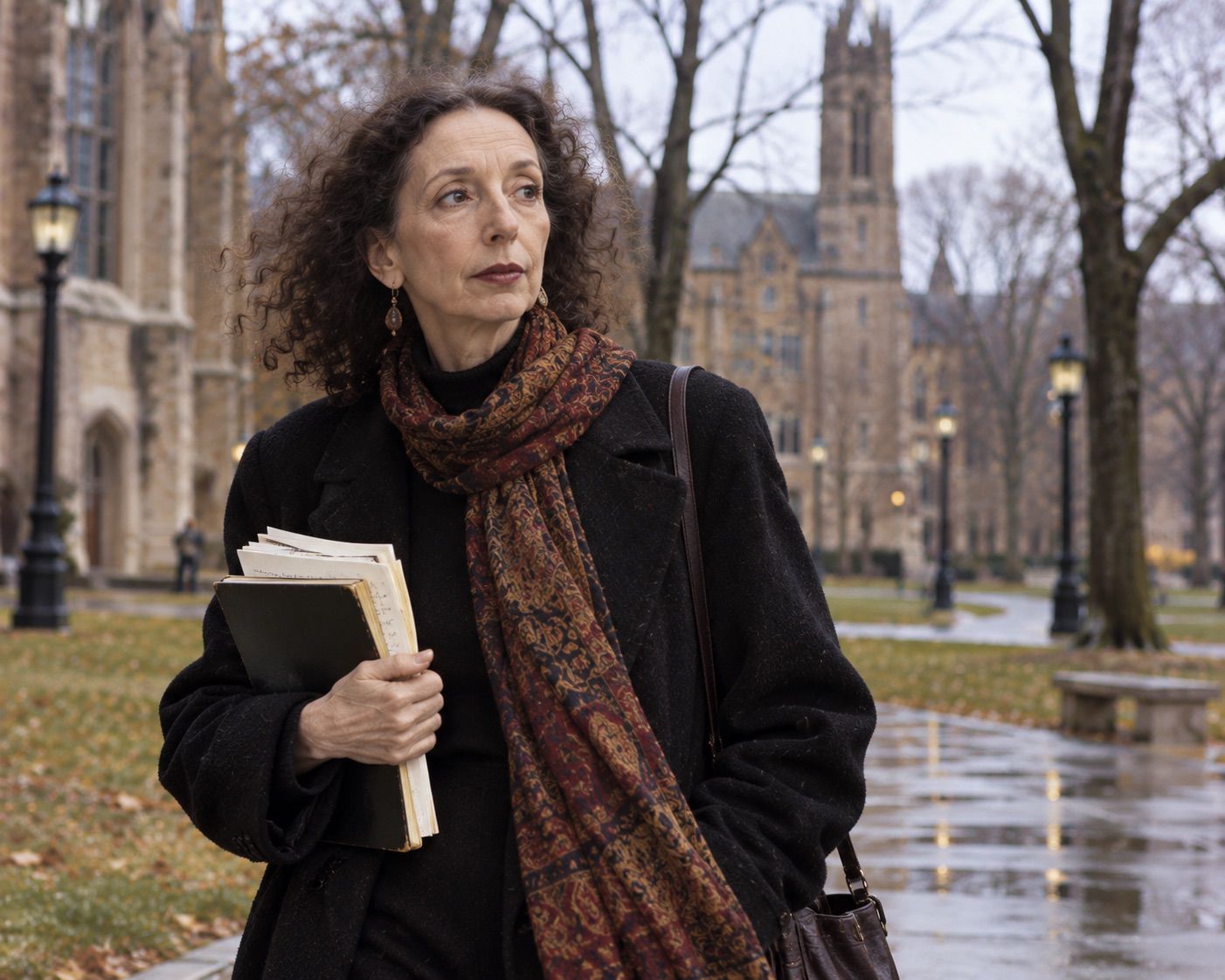
A.R. Ammons. The more I think about him, the more I get tangled up in my own thoughts. His poetry, with its dense language and sprawling lines, always made me feel like I was trying to catch a fish with my bare hands – it’s slippery, frustrating, and yet somehow exhilarating.
I remember being assigned his poem “Corson’s Inlet” in college, and struggling to make sense of the waves and tides that seemed to crash over every line. At first, I felt lost, like I was drowning in a sea of words that didn’t seem to add up to anything meaningful. But as I read on, something shifted inside me. Maybe it was the way he described the light dancing on the water, or the way he wove together fragments of memories and observations to create this sense of fluid, ever-changing motion.
Whatever it was, it sparked a feeling in me that I’d never experienced before – a sense of awe at the mystery of language itself. Ammons seemed to be saying that poetry wasn’t about making sense, but about embracing the chaos and uncertainty of life. And that resonated with me on a deep level, because as a writer, I’ve always felt like I’m trying to capture something elusive, something that’s always slipping away.
I find myself drawn to Ammons’ obsessive attention to detail – his fixation on the natural world, on the textures and sounds and smells of everyday life. It’s not just about describing the world; it’s about being in it, fully and completely. And yet, as I read his work, I feel a twinge of discomfort. He’s so rooted in his own experiences, his own observations – is that a limitation, or a strength? Can poetry ever truly capture the complexity of human experience, or is it doomed to be limited by its own individual perspective?
I think about my own writing, and how often I feel like I’m trying to impose order on the world. My paragraphs are neat and tidy, my sentences are well-crafted – but sometimes, when I’m feeling stuck, I wonder if that’s just a way of avoiding the messy, chaotic beauty of life itself. Ammons’ poetry makes me realize that maybe my pursuit of clarity is actually a form of resistance, a refusal to engage with the uncertainty and ambiguity that lies at the heart of everything.
It’s funny – as I think about Ammons, I keep coming back to his poem “If You Will Listen,” which begins: “I am what is around me.” It’s a simple statement, but it feels profound. He’s not just describing himself; he’s describing the world itself, in all its messy complexity. And that’s where my fascination with him really lies – not in his individual life or experiences, but in the way he seems to be pointing towards something greater than himself.
I don’t know what that is, exactly – whether it’s a deeper truth about the world, or just a reflection of Ammons’ own unique perspective. But as I continue to read and think about him, I’m drawn into this vast, unknowable landscape of language and experience. And for now, that’s enough.
As I delve deeper into Ammons’ work, I find myself getting lost in the intricacies of his language, the way he weaves together seemingly disparate threads to create a tapestry of meaning. It’s like trying to untangle a knot – the more I try to grasp it, the more it slips away from me. And yet, I’m drawn back again and again, captivated by the mystery of it all.
One thing that strikes me about Ammons is his sense of timelessness. His poetry feels ancient, as if he’s speaking directly to some deep, primal part of myself. It’s not just a matter of style or form – it’s an attitude towards life itself, a willingness to surrender to the present moment and let go of the need for control.
I think about my own relationship with time, how I’m always trying to keep up with the pace of the world around me. Ammons’ poetry makes me realize that maybe I’ve been going about it all wrong – not by speeding up or slowing down, but by letting go of the need to know exactly where I am or what’s happening next. He seems to be saying that time is a fluid, ever-changing thing, and that we should learn to navigate its currents rather than trying to control them.
It’s a liberating thought, in some ways – the idea that I don’t have to have all the answers, that I can simply let go and see where life takes me. And yet, as I think about it more deeply, I start to feel a twinge of unease. Ammons’ poetry is so… trusting. He seems to be placing his faith in the universe itself, in its inherent wisdom and goodness. Can I really do that? Don’t I need some kind of control, some sense of direction?
I look back at my own writing, at the careful plans and outlines I’ve always made for myself. Ammons’ poetry is like a slap in the face – it’s telling me to throw away all those carefully crafted sentences and paragraphs, to let go of my need for order and control. But what if that’s not enough? What if I’m just creating chaos instead of beauty?
I don’t have any answers yet, but as I continue to read Ammons’ work, I feel myself being pulled deeper into the mystery of it all. It’s a strange, unsettling feeling – like standing on the edge of a cliff, looking out at an unknown landscape stretching out before me. But there’s something exhilarating about it too, a sense that anything can happen and that life is full of endless possibilities.
As I stand on this metaphorical cliff, gazing out at the vast expanse of Ammons’ poetry, I’m struck by the realization that his work is not just a reflection of himself, but also a mirror held up to my own thoughts and experiences. The more I read him, the more I see myself in his lines – the struggle to make sense of chaos, the longing for connection with something greater than myself.
I think about how Ammons’ poetry often feels like a series of fragmented observations, each one a tiny window into the world around us. It’s as if he’s trying to capture the essence of experience, rather than its surface-level meaning. And that resonates deeply with me, because I’ve always felt like my own writing is a search for something deeper, something beneath the surface of words.
But Ammons’ work also makes me wonder about the nature of truth itself. Is it possible to truly capture reality in language, or are we forever doomed to represent it imperfectly? He seems to be suggesting that truth is not a fixed entity, but rather a dynamic, ever-changing thing – like the tides he writes about so beautifully.
As I ponder this idea, I start to feel a sense of disquiet. What if our attempts at capturing truth are always provisional, always subject to revision or reinterpretation? Doesn’t that mean we’re forever uncertain, forever lost in the labyrinth of language and experience?
And yet, even as I raise these doubts, I’m drawn back to Ammons’ poetry – to its beauty, its complexity, its refusal to be pinned down. Maybe that’s the point: maybe truth is not something we can ever fully grasp, but rather a horizon we’re always approaching, never quite reaching.
I look at my own writing again, and see how it reflects this same tension between order and chaos, certainty and uncertainty. I’ve always tried to impose a sense of clarity on my words, but Ammons’ poetry shows me that maybe that’s just a form of resistance – a refusal to engage with the messy, beautiful world around us.
As I continue to read and think about him, I start to feel a sense of surrender – a willingness to let go of my need for control, to trust in the power of language to capture something of the truth. It’s a scary feeling, but also exhilarating: like standing on the edge of that cliff, with nothing but the wind rushing past me and the vast expanse of possibility stretching out below.
What lies ahead, I have no idea – but for now, that’s enough.
I find myself returning to Ammons’ poem “If You Will Listen” again and again, searching for answers in its simple yet profound lines. “I am what is around me,” he writes. It’s a statement that feels both deeply personal and utterly universal – like a key that unlocks a door to a vast, uncharted territory.
As I stand at this threshold, gazing out into the unknown, I’m struck by the realization that Ammons’ poetry is not just about language or form, but about the very nature of existence itself. He’s probing the boundaries between self and world, inner and outer, trying to capture the essence of our shared human experience.
And yet, even as I feel a sense of connection to his work, I’m also aware of the limits of my own understanding. Ammons’ poetry is like a kaleidoscope – it shifts and changes with every turn, revealing new patterns and insights that elude me still.
I think about how he often uses natural imagery to describe the human condition – the waves crashing against the shore, the trees swaying in the wind. It’s as if he’s trying to capture the cyclical nature of life itself, where birth and decay, growth and decline, are all intertwined.
It’s a beautiful image, but also a unsettling one. Because when I look at my own life, I see how easily it can be reduced to patterns and cycles – the ebbs and flows of love and loss, success and failure. And yet, Ammons’ poetry suggests that there’s something more profound at play here, something that transcends our individual experiences.
I’m not sure what that is, exactly – whether it’s a deeper truth about the world, or just a reflection of Ammons’ own unique perspective. But as I continue to read and think about him, I feel myself being pulled into this vortex of language and experience, where meaning is always shifting and evolving.
It’s a disorienting feeling, but also an exhilarating one – like being swept up in a river that carries me along its winding course, through rapids and calm waters alike. And when I finally emerge from the whirlpool of Ammons’ poetry, gasping for air, I feel changed – as if I’ve caught a glimpse of something fundamental to my own existence.
What that is, I still don’t know. But one thing’s certain: Ammons’ work has left its mark on me, like the imprint of a leaf on a rock. And even though I’m not sure what lies ahead, I feel a sense of trust – a trust in language, in poetry, and in the mysterious, ever-changing world that surrounds us all.
I think about how Ammons often uses the phrase “the music of the world” to describe the sounds and rhythms that surround us. It’s a beautiful idea, but also a challenging one – because when I listen to the music of the world, I hear so many different melodies and harmonies, each one competing for my attention.
And yet, as I immerse myself in Ammons’ poetry, I start to feel a sense of unity, a sense that all these disparate sounds and rhythms are actually part of a larger symphony. It’s like I’m hearing the world through new ears – ears that can pick out the subtleties of language, the nuances of experience.
It’s a strange feeling, but also a liberating one – because when I let go of my need for control, and simply listen to the music of the world, I feel myself being carried along by its currents. And in that moment, anything seems possible – as if I’m floating on the surface of a vast, uncharted sea, with no horizon but the horizon itself.
What lies ahead, I still don’t know. But for now, I’m content to simply listen – to the music of the world, and to the poetry of A.R. Ammons, which continues to whisper secrets in my ear.