Category: Stories

When the Forest Laughs: The Trickster Tikbalang of the Philippines

Dave

There are creatures you run from, and then there are creatures you laugh with — or at — though the laughter is never entirely free of fear. Deep in the forests and mountains of the Philippines lives one of the strangest, most mischievous figures in global folklore: the Tikbalang. Half-horse, half-man, all trickster, the Tikbalang stands at the crossroads of myth and mischief, a guardian of the wilderness, a tormentor of travelers, and a reminder that the forest is not ours to command. On October 10, when the legend of the Tikbalang is recalled, we are not just remembering a monster — we are remembering the very personality of the land itself: playful, dangerous, unpredictable, alive.

To describe the Tikbalang is to invite unease. It is usually envisioned as towering and lanky, with the head and legs of a horse, but the body of a man. Its limbs are exaggeratedly long, so much so that it can sit and its knees will rise higher than its head. Its hooves strike the ground with an unsettling weight, its mane falls wild and unkempt, and its eyes glow with mischief. Some say it smells like burnt hair, others that it always carries the damp scent of the jungle. To see a Tikbalang is to feel immediately that the world is not quite right — a familiar animal form twisted into something alien, watching you with unsettling intelligence.

But unlike purely monstrous beings, the Tikbalang is more trickster than killer. Its favorite pastime? Leading travelers astray. A person walking through the forest might find themselves circling the same tree for hours, confused and exhausted, convinced they are lost in a maze. This is the Tikbalang’s laughter, its invisible hand rearranging the forest around its prey. In some versions of the story, the victim can escape by turning their shirt inside out, a gesture that breaks the spell. Other traditions say you must bite a tree or ask permission from the spirit world to pass. Whatever the method, the Tikbalang ensures you never forget who owns the forest.

The roots of the Tikbalang legend are as tangled as the vines in the jungles it inhabits. Some trace its origins to Hindu-Buddhist influences that reached the Philippines long before Spanish colonization, carrying imagery of horse-headed beings from India and Southeast Asia. Others see it as a purely local creation, born of the islands’ dense, mysterious landscapes where sounds echo and shadows twist. When the Spanish arrived, they recorded stories of the Tikbalang as part of their effort to map — and often suppress — indigenous belief systems. Yet despite centuries of colonial influence, the Tikbalang never vanished. It simply adapted, as tricksters always do.

The Tikbalang is not uniformly evil. Like many folkloric beings, it has moods and motives. In some stories, it is a malevolent force, terrifying and cruel, laughing as humans collapse from exhaustion in its mazes. In others, it is almost a guardian, testing the respect and humility of those who pass through the forest. If you bow your head, walk quietly, and honor the spirits, the Tikbalang may let you pass unharmed. If you are arrogant, loud, or disrespectful, it will toy with you until you break. In this way, the Tikbalang reflects a moral truth: the wilderness demands respect, and those who forget this will pay.

There is also a darker, more intimate side to the myth. Folklore tells of Tikbalang falling in love with humans, luring them into the forest with illusions of beauty, sometimes appearing as a stunning man or woman before revealing their true form. Once ensnared, the human becomes entranced, bound to serve or even wed the creature. In these stories, the Tikbalang becomes a symbol of dangerous seduction, of nature’s ability to enchant and entrap those who venture too far. Some communities even believed that illnesses or madness could be caused by offending a Tikbalang, further cementing its role as both playful prankster and ominous presence.

But the Tikbalang is not without vulnerabilities. Folk tradition claims that to tame one, you must pluck three golden hairs from its mane. Once subdued, the creature becomes a loyal servant, bound to the human who mastered it. This idea reflects a universal theme in myth: the desire not only to fear or respect the supernatural, but to control it. By binding the Tikbalang, one symbolically asserts mastery over the forest’s chaos. Yet there is irony here — for a trickster, even bound, may never be fully trustworthy.

What makes the Tikbalang so fascinating is its duality. It is terrifying, yet comical. It embodies chaos, yet can be subdued. It protects the wilderness, yet sometimes invades human lives with unwanted intimacy. It is not a villain or a hero but something in between, a figure that resists simple categorization. That complexity ensures its survival in cultural memory, long after countless other myths have faded.

The Tikbalang also offers a profound cultural lens. In the Philippines, where mountains and forests have always played a central role in identity, the Tikbalang is the spirit of those spaces given form. It reminds people that the forest is not empty but alive, that travelers are not masters but guests, that nature itself has personality. In modern terms, the Tikbalang is almost ecological, embodying the warning that those who disrespect the natural world will suffer. Its mischief is playful on the surface but carries an underlying seriousness: humility before forces larger than yourself.

Even in modern Philippine society, the Tikbalang endures. Children are warned not to wander too far into forests. Travelers are told to speak quietly in the mountains. Folklore festivals retell its story, and it finds new life in comics, films, and novels. Online, urban legends spread of Tikbalang sightings near highways or rural roads, blending old myth with modern anxieties. Like all great legends, it adapts — slipping from mountain trails to city streets, always laughing, always one step ahead.

And perhaps that is the secret to its viral potential. Unlike creatures that exist only to frighten, the Tikbalang entertains. It pranks. It plays. It makes fools of us, and we laugh nervously, because deep down we recognize the truth: we are not the masters of the world, no matter how much concrete we pour or machines we build. Somewhere in the shadows, the forest still watches, still tricks, still demands respect. The Tikbalang is that truth with a horse’s face and a trickster’s heart.

So on October 10, when we remember the Tikbalang, let us hear not only the laughter of a myth but the voice of the wilderness itself. Let us walk softly, turn our shirts inside out when lost, and bow our heads to forces older than we can comprehend. Because if the forest ever laughs at you, it may not be the wind. It may be hooves in the shadows, eyes glowing with mischief, and a voice that says: you thought you knew the way, but the way belongs to me.

Related Posts

Whispers of Fire: The Eternal Allure and Fear of the Jinn

Dave

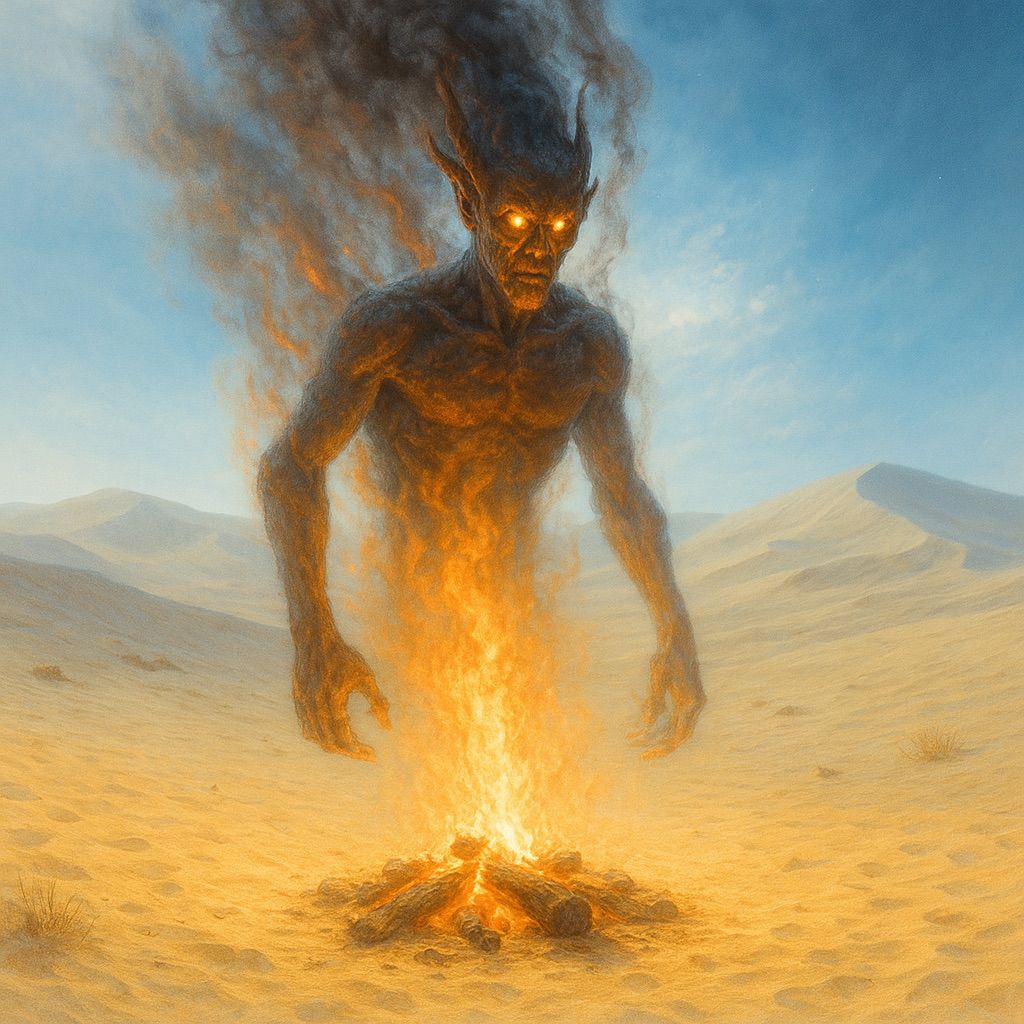
There are stories that flow like wind, unseen but powerful, brushing across generations and deserts, carrying with them the echoes of fire and fear. Among the most enduring and complex of these tales are those of the Jinn — supernatural beings born of smokeless fire, existing in a realm parallel to ours, feared, revered, and woven into the very cultural fabric of the Middle East. Unlike many creatures of myth that belong firmly to legend, the Jinn occupy an ambiguous space. For millions, they are not merely characters in folklore but realities, unseen presences that shape destiny, haunt lonely places, and sometimes share the world with humans in ways both miraculous and terrifying.

The Jinn’s origin story begins in the Qur’an, which describes them as created by Allah from smokeless fire, a substance unlike the clay of humans or the light of angels. This positioning sets them apart immediately: neither divine nor human, but something in between — free-willed, intelligent, and capable of both great good and unimaginable evil. They are said to live in their own societies, with families, communities, even faiths, some Muslim, some Christian, some pagan, mirroring the diversity of human belief. Yet what most fascinates is their liminality: they exist unseen, yet they are everywhere. They are whispered about in marketplaces, feared on desert roads, and invoked in prayers of protection.

To speak of Jinn is to speak of possibility — possibility that the world is not entirely ours, that our loneliness is not as complete as we think. It is also to speak of danger, for Jinn are not to be trifled with. They can possess, deceive, torment. They can inspire madness or grant hidden knowledge. They embody both wish and curse, miracle and menace.

The Jinn are not monsters in the Western sense; they are complex beings with emotions, desires, and flaws. Some are mischievous tricksters who lead travelers astray in the desert. Others are terrifying predators who feed on human fear. Still others are benevolent, protectors and guides who may reward respect with blessings. The richness of the lore comes from this variety. Unlike the singular vampire or werewolf, the Jinn are a spectrum, from demons to allies, from gods of old transformed into new stories to whispering companions that sit invisible beside us.

One of the most famous tales that captured the imagination of the world is found in One Thousand and One Nights, where Jinn appear as both helpers and villains, from the mighty Ifrit imprisoned in bottles to the trickster spirits who grant wishes but twist them to ruin. Western audiences embraced the image of the Jinn as “genie,” a being bound to lamps and obliged to serve. But this playful, wish-granting caricature is a shadow compared to the raw fear Jinn inspire in the Middle East. There, to even speak of them is risky. In some cultures, people avoid saying “Jinn” at all, preferring euphemisms like “those ones” or “the hidden ones,” lest the word itself draw their attention.

Deserts are the natural stage of the Jinn. In folklore, they dwell in desolate places: abandoned ruins, empty wells, crossroads where no birds sing. To travel at night through the sands is to risk brushing against their realm. Fires flicker in the distance where no people live; voices echo on the wind, calling travelers by name. Entire tribes told stories of people vanishing into the dunes, claimed by the Jinn. But they are not confined to deserts — in urban centers too, tales abound of possession, of voices heard in empty houses, of inexplicable illness attributed to Jinn interference. Their presence expands wherever human imagination fears the unknown.

Possession is among the most feared interactions with Jinn. When someone becomes afflicted, their body is said to host a spirit that manipulates thoughts, speech, and actions. Traditional healers — often reciters of Qur’anic verses — are called upon to exorcise the being, coaxing or commanding it to depart. These rituals are not just spiritual acts but cultural dramas, blending faith with folklore, psychology with performance. To this day, such practices persist, bridging ancient belief with modern anxiety.

Yet not all Jinn are antagonistic. Stories abound of humans who strike pacts with them, gaining knowledge or power in exchange for loyalty or ritual observance. Some artisans and poets even claimed inspiration flowed from Jinn muses, whispering words and songs into their ears. This duality — destructive and creative — makes Jinn a paradox that fascinates across centuries. They are feared, yes, but they are also revered, even respected as beings of immense capability who remind humans of the unseen mysteries of creation.

There is also a deeply human dimension to Jinn stories: they are reflections of our inner fears, desires, and temptations. In a time before psychology, possession explained madness. In a time before science, mysterious illness could be traced to Jinn influence. In a time when loneliness weighed heavy on desert travelers, voices in the wind were not imagination but company — eerie, dangerous company, but company nonetheless. Jinn stories helped communities understand the unexplainable, turning chaos into narrative, uncertainty into cultural structure.

Modernity has not banished them. Even today, Jinn loom large in Middle Eastern life. Families warn children not to wander near abandoned wells. Construction workers hesitate to build over ruins, lest they disturb ancient Jinn dwellings. Films and TV dramas explore Jinn possession with as much fervor as Western horror does with ghosts. The legend evolves, but it does not fade. In fact, in an age of globalization, Jinn have entered the global imagination, appearing in novels, movies, and online forums, their aura spreading far beyond their origin.

But perhaps the most haunting part of the Jinn story is how they embody freedom. Angels are bound to divine will, humans to mortality, but Jinn are unbound. They live long, invisible lives. They choose faith or rebellion. They can love, hate, create, or destroy. They are the mirror opposite of us — not flesh but fire, not seen but hidden, yet as flawed and varied as humanity itself. In this way, they are terrifying because they are so familiar. They are us, but freer, stronger, and untethered.

Picture this: a lone traveler crossing the sands at dusk, his camel plodding beneath the endless horizon. The air cools as night approaches. He sees a flicker of light ahead — a fire in the emptiness. Relieved, he approaches, hoping for company. But as he draws near, the fire vanishes. The silence deepens. Then, from the dunes, laughter — not human, not kind. His blood runs cold. He turns back, but the path is gone, the stars rearranged. He whispers a prayer, clutching a talisman of protection. He does not call them by name. He knows better.

This is the power of the Jinn: they live where imagination meets fear. They are the figures that step into silence, the presence we sense when alone, the shiver that comes not from cold but from awareness of being watched. They are supernatural, yes, but they are also profoundly psychological, living in the hidden corners of human thought.

So on October 9, when the Jinn’s legend is remembered, we are reminded that humanity’s greatest stories are not about creatures apart from us, but about beings that reflect our own struggles — with freedom, with temptation, with unseen forces that shape our lives. The Jinn endure because they are more than monsters. They are metaphors for everything we cannot control, everything we fear might whisper just out of sight, everything we suspect might be real after all.

And maybe, just maybe, when the wind blows tonight and a whisper seems to call your name, you’ll hesitate before answering. Because what if it isn’t the wind?

Related Posts

When Death Rides: The Haunting Legend of Ireland’s Dullahan

Dave

There are stories that follow you home no matter how fast you run, legends that live not just in the land where they were born but in the very marrow of those who hear them. Among Ireland’s many ghosts, banshees, and fair folk, none chills the blood quite like the Dullahan: the headless horseman who carries his own skull, a harbinger of death galloping across the emerald hills. To glimpse him is to know that death is near, to hear his call is to feel your heart sink, and to speak of him is to brush against that thin veil between life and the inevitable shadow that comes for us all.

The Dullahan is not just a figure of fright; he is a reminder of mortality, of fate, and of the way human beings have always personified the inescapable truth of death. Ireland’s oral traditions have preserved him for centuries, whispered in the flicker of peat fires and retold in the misty lanes of rural towns. He is terrifying, yes, but he is also deeply human in the sense that he embodies what we fear most: the loss of control, the coming of an end we cannot escape, and the image of death itself riding toward us in the night.

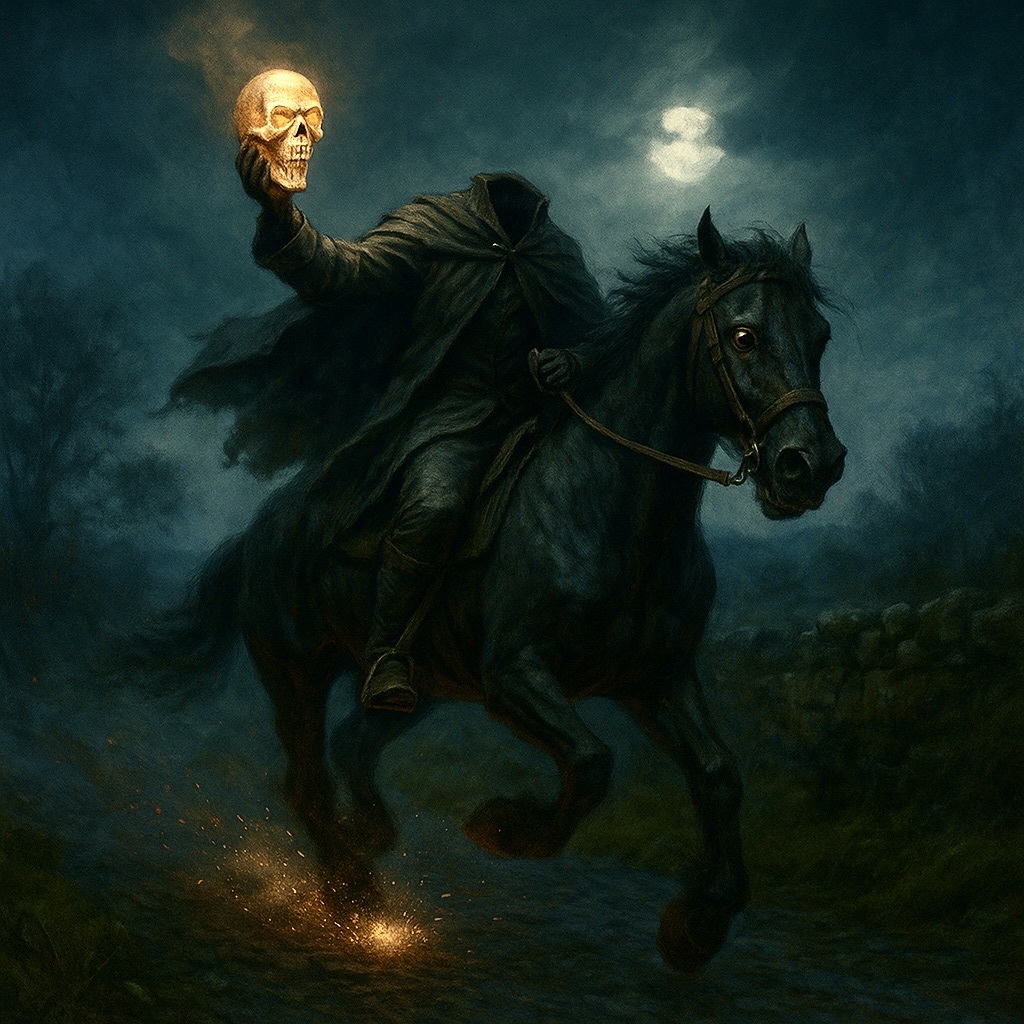
The description of the Dullahan is unforgettable. He rides a black horse, fierce and muscular, its nostrils flaring with sparks and its hooves striking fire against the earth. In his hand — not upon his shoulders — rests his head, grotesque and otherworldly. The skin is pale and decayed, the flesh stretched tight, with a wide grin carved permanently into its face. The eyes glow with an unholy light, scanning the night, searching for souls to claim. His head is said to have the consistency of moldy cheese, a detail both grotesque and haunting, because it brings the myth down from the lofty air of terror into the sickeningly tangible realm of decay.

Wherever the Dullahan stops, someone is destined to die. He does not need to speak; a mere point of his bony finger seals a person’s fate. Sometimes, however, he calls the name of his victim, and the sound is enough to extinguish life itself. Doors and locks cannot stop him, for no barrier can hold back death. He is both spirit and force, a being who transcends walls and gates as easily as breath passes through lungs. The Dullahan does not linger, does not chase for sport. He arrives, he marks, he takes, and he is gone.

But where did this terrifying image come from? Scholars trace the Dullahan back to Celtic mythology, where he may have been an incarnation of Crom Dubh, a fertility god who demanded human sacrifice. When Christianity spread through Ireland, the old gods were suppressed, demonized, or transformed into darker legends. Crom Dubh’s bloody worship may have morphed into tales of the Dullahan, who no longer demanded offerings but instead carried the image of death itself. Over time, his story blended with folklore about fairies, banshees, and the restless dead, crystallizing into the figure we know today.

The Irish countryside, with its fog-wrapped moors, stone ruins, and hidden lanes, was fertile soil for such a legend. In a land where famine struck often and mortality was never far from daily life, the Dullahan became not just a story but a cultural embodiment of the fragility of existence. He reminded villagers that life was fleeting, that death did not negotiate, and that the moment of one’s end was always out of human hands.

Yet, for all his terror, the Dullahan is not invincible. Folklore insists he fears only one thing: gold. A single golden object, whether a coin or trinket, can drive him away. This detail is striking, for it suggests a lingering human hope — that something of earthly value might hold back death. But the irony is sharp: gold may repel him in the tale, but no real wealth can keep mortality from claiming us. The Dullahan is an equalizer, a reminder that death does not care if one is rich or poor, young or old. His horse gallops for all.

Think for a moment about the symbolism of carrying one’s own head. To be headless is to be powerless, but the Dullahan subverts this. He is not robbed of his head but commands it, carrying it like a lantern. The head glows, it sees, it directs. It is death turned mobile, portable, weaponized. In many cultures, to lose the head is to lose identity and soul. But in Ireland’s Dullahan, the head becomes the very instrument of fear. He rides without it, proving that what we think makes us human is not what holds sway in the realm of the supernatural.

The Dullahan’s tale echoes outward into wider culture. Washington Irving’s “The Legend of Sleepy Hollow” famously introduced a headless horseman to American readers, and while the Hudson Valley tale is distinct, its DNA traces back to Ireland’s shadowy rider. Immigrants carried their stories with them, and in the fertile imagination of early America, the Dullahan adapted, blending with local fears to become Ichabod Crane’s terrifying pursuer. Today, every Halloween in the U.S., children see images of pumpkin-headed riders, not realizing they are looking at Ireland’s legacy galloping through history.

But unlike the playful or spooky adaptations that populate modern pop culture, the original Dullahan remains deeply grim. He is not a villain to be fought or defeated. He is inevitability given form. When villagers heard horse hooves echoing on lonely roads at night, they prayed not to hear their name whispered in the dark. When shadows moved near graveyards or crossroads, people clutched golden trinkets, desperate for protection. The Dullahan reminded them that life was borrowed, fragile, and never fully theirs.

Modern readers may find in the Dullahan an allegory for the things that pursue us now. The black horse might be time itself, galloping faster than we wish. The head with its fixed grin might be the reminder of our mortality, a face we must all one day wear. The gold that drives him away might represent the distractions we cling to — wealth, technology, endless consumption — in hopes of postponing the inevitable. But like all distractions, they cannot last. The rider always comes.

The Dullahan’s power lies not just in fear but in fascination. Death has always drawn human imagination, because to speak of it is to admit our helplessness. The Irish, with their gift for storytelling, wrapped that helplessness in imagery vivid and unforgettable: fire-breathing horses, rotting skulls, silent riders pointing bony fingers. They made death visible, audible, and unforgettable. That is why the Dullahan endures — because he rides not just through Irish fields but through the universal landscape of human fear.

And yet, the story is not without a kind of beauty. In its way, the Dullahan legend is honest. It strips away illusion. It says: death is coming. No locks will keep it out, no walls will keep it back. But it also says: you are not the first, and you will not be the last. We all share this fate. There is a strange comfort in that universality, in knowing that every hoofbeat, every whispered name, ties us together in the human journey.

So on October 8, when the tale of the Dullahan is remembered, we are reminded that folklore is never just entertainment. It is survival in story form. It is our attempt to wrestle with truths too large to face in silence. The Dullahan gallops not just across the roads of Ireland, but across our imaginations, forcing us to look at the one thing we cannot escape. And in his grotesque visage, his grinning skull, we might just see the reflection of our own deepest fears.

Perhaps the most chilling thought of all is this: if the Dullahan rides tonight, and his horse sparks fire against the stones outside your door, will you dare to look? Or will you close your eyes and hope the whisper is not your name?

Because when death rides, it carries its own head — and it always knows where it’s going.

Related Posts

The Eternal Hunger: Chasing the Wendigo Across North America’s Frozen Shadows

Dave

There are monsters that lurk in the forests, waiting in silence, and then there are monsters that lurk within us, whispering in our veins, gnawing at the edges of our souls. The Wendigo, that infamous cannibalistic spirit of Algonquian lore, is both. It is a creature made of frost and famine, but also of greed and insatiable desire. To speak of the Wendigo is to speak not just of a beast in the woods, but of the human capacity for hunger without end — the hunger that devours everything and leaves nothing behind. On October 7, when whispers of this chilling legend rise, we find ourselves staring at more than just a myth; we are staring at the shadow in the mirror.

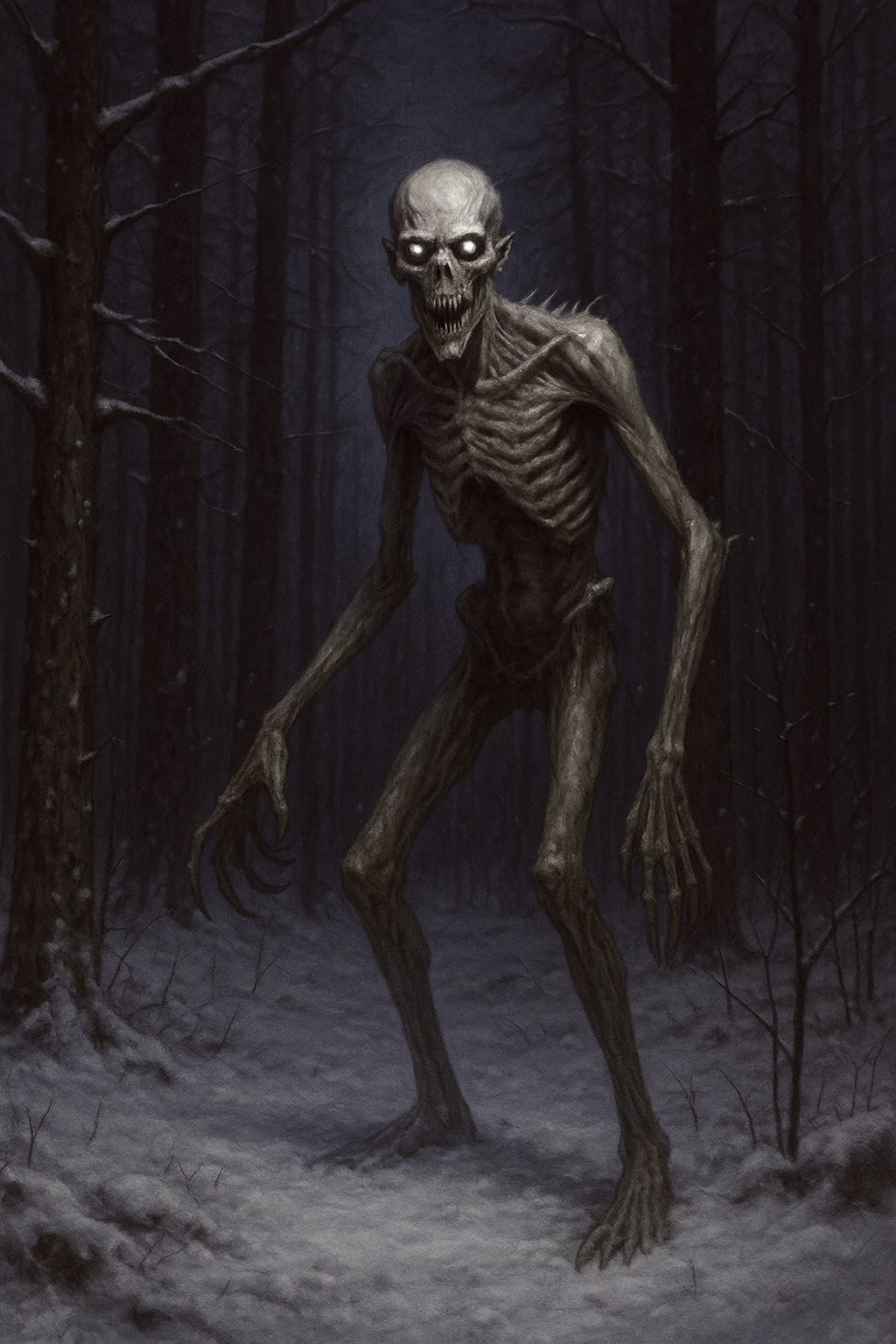
The story begins in the snowy landscapes of North America, where winters were not merely inconvenient but life-threatening. To the Algonquian-speaking peoples of the Great Lakes and boreal forests, survival hinged on community, balance, and respect for the land. Yet when food grew scarce and the cold became merciless, desperate choices haunted human hearts. Out of this crucible of survival and moral boundaries emerged the Wendigo: a skeletal, emaciated figure with skin stretched tight over bones, lips chewed away, eyes sunken but burning with an icy fire. It was said to be taller than the tallest pine, gaunt as death itself, yet impossibly strong, a being forged of starvation and sin. It craved flesh, but more than that — it craved endlessly, forever hollow.

The Wendigo legend carried with it a moral gravity. It wasn’t just a campfire story told to frighten children. It was a warning, a cultural safeguard. In times of hunger, when snow buried the land and the deer had vanished, people were tempted by the unthinkable: cannibalism. The Wendigo myth served as a shield against such impulses. To eat human flesh was not simply taboo; it was to invite possession by the Wendigo spirit, to transform into a ravenous beast doomed to wander the wilderness in eternal hunger. It was a way of saying: “Even when the world grows cruel, there are lines we do not cross.” The myth turned survival into a moral battleground, one where the human soul was at stake.

But the Wendigo is more than folklore; it is a mirror held up to human greed. Stories tell us that even those who already had enough could fall prey to its curse. A hunter who hoarded food while others starved might attract its shadow. A leader who demanded more than his share could become Wendigo. Thus, the legend expanded beyond hunger into a commentary on greed itself — greed that consumes community, greed that turns abundance into famine. The Wendigo was not just about eating flesh; it was about the insatiable appetite for more, no matter the cost. In this way, it remains a legend frighteningly relevant to the modern world.

Imagine the scene: a small Algonquian village buried beneath drifts of snow, families huddled in bark-covered lodges, fires sputtering against the biting cold. Outside, the trees groan with frost, and the night air carries a silence so profound it presses against your chest. Then, far off, a scream — not animal, not human, but something stretched thin between the two. Elders whisper the word no one wants to hear: Wendigo. The children draw closer to their mothers. Hunters clutch their spears. Somewhere in the darkness, something impossibly tall shifts between the pines. Its hunger is a palpable force, a storm rolling in. That imagery alone explains why the Wendigo survives as one of the most terrifying figures in North American folklore.

European colonists who heard the stories were quick to fold the Wendigo into their own catalog of demons and devils, but to the indigenous peoples, it was never so simple. This was not just a monster of the forest — it was a spiritual condition, a sickness of imbalance. Anthropologists later coined the term “Wendigo psychosis” to describe cases in which individuals, often during periods of famine, became obsessed with cannibalistic thoughts or claimed to be transforming into Wendigos. While the diagnosis itself is controversial and largely dismissed today, the fact remains that the legend had power not only as metaphor but as lived psychological reality. People truly believed in its ability to possess. Fear itself became flesh.

The Wendigo’s physical description varies, yet the essence is constant: hunger incarnate. Some tales paint it as a giant towering over trees, with heart made of ice, lips frozen to its teeth, breath steaming with death. Others envision it gaunt, corpse-like, its bones pressing through skin, its joints twisted by starvation. Always, it is hollow, a walking famine. Its voice is said to echo with the howling wind, its step cracking ice with every stride. And worst of all: when it eats, it never grows full. Its belly stretches, but its hunger grows deeper. The Wendigo is a paradox of endless consumption. It is capitalism before capitalism, addiction before drugs, a timeless allegory for the dangers of wanting more than enough.

Consider the modern parallels. Our world today is overflowing with abundance, yet starvation and greed walk side by side. We consume oceans of resources, forests, oil, animals, and each other’s time, all while the hunger for more never ceases. If the Wendigo was once a spirit warning against cannibalism during famine, it now feels like a metaphor warning against our collective consumption. We devour, and devour, and devour, yet satisfaction never comes. In this light, the Wendigo is not just a North American monster. It is a global truth.

But let us return to the woods, because folklore thrives not in abstraction but in story. In one tale, a hunter returns to his village after weeks in the snow. He is gaunt, but his eyes are bright, too bright. He carries meat, plenty of it, yet he does not say from where it came. Soon, the people notice his lips are torn, as though chewed. They hear him whisper at night of voices in the wind. And when children disappear, there is no doubt. He has become Wendigo. The villagers burn him, but even as the flames consume his flesh, a shriek escapes, rising into the storm, carrying the hunger forward. In another story, travelers lost in a blizzard hear footsteps behind them. They look back and see nothing but whiteness. Yet the snow is stamped with massive prints, each step twice the size of a man’s. By morning, one of their party is gone, taken silently in the night. These stories endure because they capture primal fear: the fear of cold, hunger, and betrayal from within.

The Wendigo also embodies transformation, a theme deeply resonant in human myth. To become Wendigo is to cross the threshold between human and monster, to let hunger erase humanity. This is not unlike werewolf tales in Europe or vampire legends elsewhere, but the Wendigo’s transformation is more brutal. It is not a curse delivered by bite or magic. It is born of choice — the choice to consume flesh, to surrender to greed. That makes it terrifyingly intimate. Any person, given the wrong conditions, could fall.

In contemporary culture, the Wendigo has leapt from oral tradition into film, literature, and video games. It appears in horror movies, from low-budget Canadian slashers to Hollywood thrillers. It haunts episodes of shows like Supernatural and Hannibal, and it lurks in games like Until Dawn. Yet something curious happens in these retellings: the Wendigo often becomes just another monster, stripped of its moral depth. Its connection to greed, to famine, to cultural survival is reduced to jump scares. This dilution risks robbing the legend of its richness. But for those willing to dig deeper, the Wendigo remains as meaningful as ever — a reminder that horror is never just about fear, but about what we fear in ourselves.

Perhaps that is why the Wendigo endures. Because it speaks to the dark corners of our own appetites. It is easy to laugh at tales of giants with icy hearts, but harder to deny the metaphor. Who among us has not wanted more than we need? Who has not felt hunger — for food, for wealth, for recognition — that gnawed even when satisfied? The Wendigo lives in that gnawing. It is the whisper that nothing is ever enough.

So on October 7, when its legend is remembered, let us pause. Let us see the Wendigo not just as a monster in the woods, but as a cautionary tale that belongs to us all. It is the voice that warns against devouring one another, against letting greed hollow us out until we are but skin stretched over bone, wandering through life without end or purpose. The Wendigo is the frozen shadow at the edge of campfire light, the hunger that will not be fed. And maybe — just maybe — it is waiting for us to finally listen.

Because the Wendigo is not just a creature of Algonquian lore. It is a reflection of humanity’s deepest fear: that we will consume ourselves into extinction, and that our hunger will follow us, eternal and unsatisfied, into the cold.

Related Posts

The Goat-Sucker’s Shadow: Chupacabra and the Birth of a Modern Monster

Dave

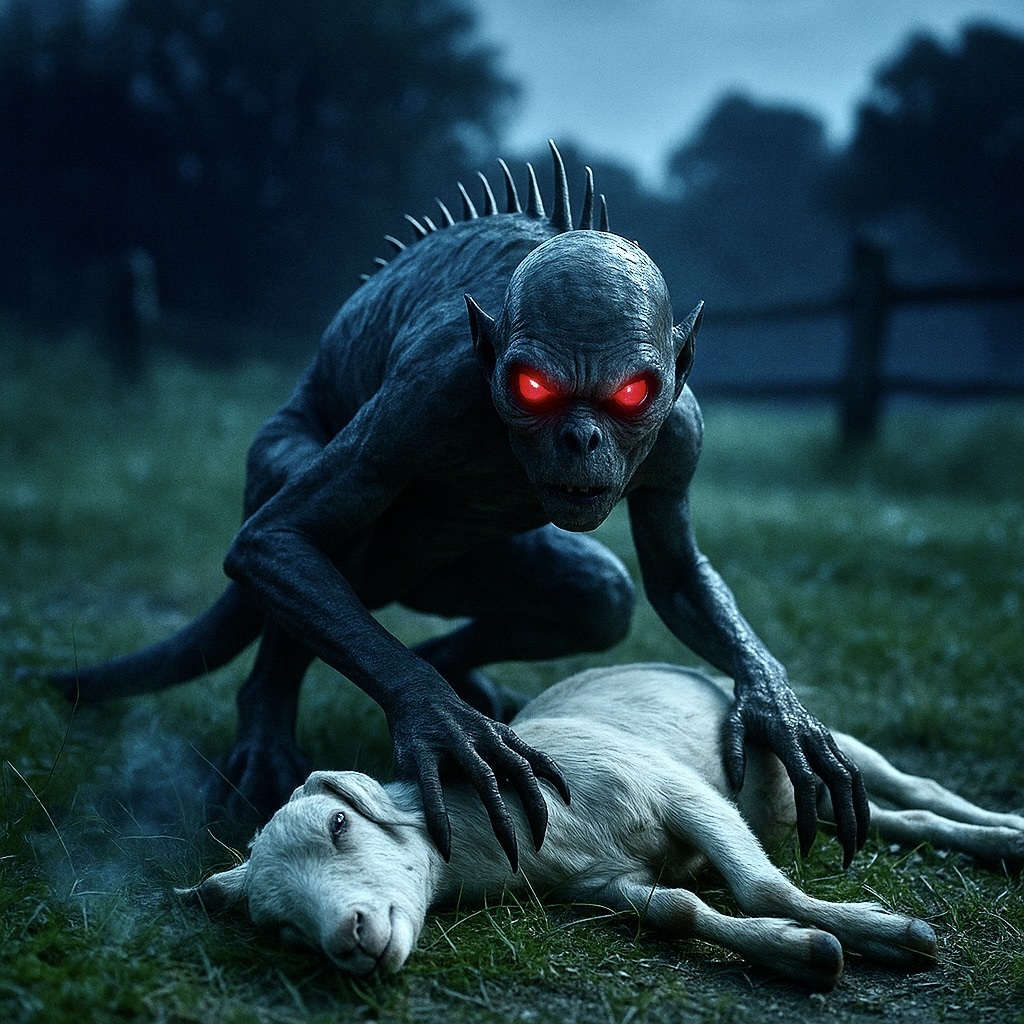
It began, as many legends do, with blood. In the mid-1990s, in the rural hills of Puerto Rico, farmers awoke to find their animals dead in the night. Goats, chickens, rabbits—drained, it seemed, of their blood. There were no torn hides, no scattered carcasses, just puncture marks on necks and lifeless bodies left behind. Whispers spread faster than the news, and soon a name was whispered too: el chupacabra—the goat-sucker. Within months, it had grown from rumor to global phenomenon, a monster that felt at once new and ancient, strange and familiar. Unlike the vampires of Europe or the spirits of Asia, this was a monster of the modern age—sighted in suburbs, catalogued by tabloids, chased by ufologists. The Chupacabra became not just Puerto Rico’s monster, but the world’s, born in the crucible of media, paranoia, and imagination.

At first, the descriptions of the creature were unlike anything the world had seen before. Witnesses spoke of a small humanoid figure, three to four feet tall, with spines or quills running down its back, glowing red eyes, and leathery gray-green skin. Some said it hopped like a kangaroo, others that it slinked like a reptile. In every account, it was otherworldly, more alien than animal. Its victims were not just killed but exsanguinated, their bodies eerily intact save for two or three puncture wounds. Farmers swore it was no dog, no coyote, no predator they had ever known. And in that void of explanation, the myth took root. The Chupacabra was born not from centuries of folklore but from the immediacy of mystery, a monster created in real time.

The timing of the Chupacabra’s emergence was no accident. The 1990s were a decade steeped in alien abduction stories, conspiracy theories, and a new global media landscape that spread tales faster than ever before. Shows like The X-Files dominated, tabloids filled their pages with UFOs and government cover-ups, and rural fear met urban fascination in a perfect storm. The Chupacabra slid neatly into this space, part cryptid, part extraterrestrial, part government experiment gone wrong. Its image spread from Puerto Rico to Latin America, then into the southern United States, and from there across the globe. The monster was new, but the story—something lurking just outside the safety of night—was as old as humanity itself.

But what made the Chupacabra different from other creatures of legend was the speed with which it evolved. Within just a few years, its appearance shifted. By the early 2000s, many sightings described not a spiny alien-like being but a hairless, mangy dog-like creature, with gaunt features, glowing eyes, and vicious teeth. Dead specimens were occasionally found, almost always coyotes suffering from mange, their fur gone, their skin sickly and tight, their bodies emaciated. Scientists explained the phenomenon as misidentification, pointing out that mange made ordinary animals appear monstrous. But by then, the legend had already outgrown explanation. The Chupacabra had become a symbol, a modern boogeyman whose truth mattered less than its story.

Puerto Rico holds the heart of that story. The island’s rich cultural tapestry of folklore already included tales of witches, demons, and spirits, blending Indigenous, African, and Spanish influences. The Chupacabra was something new, but it resonated with something deep, a sense that the land still held mysteries beyond human control. For farmers whose livelihoods were shaken by the sudden deaths of livestock, the creature was more than a story—it was an answer. In this way, the Chupacabra reflects a universal human pattern: when faced with the unexplained, we give it shape, give it a name, and through story, try to contain it.

There is something profoundly human in the way the Chupacabra spread. It was born in fear, fed by rumor, and raised by media. Each retelling made it larger, stranger, more terrifying. Children whispered about it in schools, reporters breathlessly covered each sighting, and skeptics and believers clashed in endless debate. The monster became a mirror, reflecting whatever fears a culture projected. In Puerto Rico, it was linked to economic hardship, colonial tension, and the anxieties of modern life. In the U.S., it became entangled with fears of border security and invasive threats. In each place it landed, the Chupacabra took on new meaning, its image molded by the hands of those who told its story.

And yet, for all the skepticism, the legend endures. Ask someone who has lost animals to mysterious attacks, and they will tell you it was no coyote. Listen to a witness describe what they saw, and you will hear conviction, not fabrication. Myths do not survive because they are factually true—they survive because they capture a truth deeper than fact. The Chupacabra embodies fear of the unseen predator, the sense that nature—or something beyond nature—can still surprise us, still terrify us. It is the fear of losing control, of being powerless to protect, of realizing that even in a world of satellites and science, monsters may still lurk in the dark.

To humanize the Chupacabra legend is to see the people who shaped it. The farmer in Puerto Rico who awoke to find his goats dead, the children who huddled around each other at night, the journalists chasing a story that felt alive—these are the heartbeat of the monster. The Chupacabra is not just a cryptid; it is a cultural creation, one that speaks to collective anxieties. It is what happens when fear meets imagination, when the unexplained demands explanation, and when storytelling becomes a survival tool. In this sense, the Chupacabra is less about claws and fangs, and more about us.

Even now, decades after the first reports, the Chupacabra has not faded. It appears in documentaries, horror films, urban legends, even memes. Children still whisper about it in the dark, and farmers still eye the night warily when livestock die unexpectedly. It is part of the folklore of not just Puerto Rico but the world, a monster created in the age of the internet but one that feels timeless. And as long as people fear the unexplained, the Chupacabra will remain alive in shadow, just out of sight.

Perhaps that is the most unsettling truth of all: the Chupacabra may never need to exist in flesh and blood, because it already exists in the one place monsters can never die—in human imagination. Its cry is not in the night air, but in our stories, our fears, our need to give shape to the shadows. It is, in that way, eternal.

Related Posts

The White-Clad Terror: Pontianak, the Haunting Cry of Malaysia and Indonesia

Dave

There is a sound that chills the tropics as much as any icy wind: the faint, eerie cry of a woman in the night, carried through the palm groves and banana plantations of Malaysia and Indonesia. Locals know not to answer. They know not to follow. For centuries, generations have whispered the same warning—that the cry belongs to the Pontianak, the vengeful spirit of a woman who died in childbirth, cursed to roam the earth forever. She is said to appear as a beautiful woman with pale skin, long black hair, and a white dress stained with death, her beauty so alluring it masks the violence she carries within. To men especially, she is deadly. Lured by her charm, they soon find themselves prey, their bodies ripped open, their blood drained, their lives snatched by the ghost who embodies both sorrow and rage. The Pontianak is not just a ghost story—it is one of Southeast Asia’s most enduring legends, woven into daily life, whispered into the fabric of fear itself.

Her story is born from tragedy, from the liminal space between life and death, creation and destruction. Childbirth has always been one of humanity’s greatest risks, especially in times before modern medicine, when women faced dangers that often proved fatal. The Pontianak represents that ultimate injustice—the woman who should have given life but instead lost her own, denied the chance to be mother, denied even a peaceful afterlife. Her pain twists into vengeance, her grief into hunger, her spirit into something that terrifies villages and cities alike. Death in childbirth is already heartbreak enough, but the Pontianak myth transforms it into a force of terror, reminding everyone of the fragility of life and the anger of the silenced.

Descriptions of the Pontianak vary slightly from region to region, but her key traits remain constant. She is a vision of striking beauty, often described with flawless skin and flowing black hair, her figure graceful and inviting. From afar, she appears as the perfect woman, sometimes even carrying the scent of frangipani flowers, a sweetness that deceives the senses. But once her victim comes close, the horror reveals itself. Her nails grow into talons, her teeth sharpen, her eyes glow red, and her once-beautiful face twists into a mask of rage. What was alluring becomes monstrous, and what seemed like salvation becomes doom. It is this duality—the mix of desire and death—that makes her one of the most terrifying and fascinating figures of folklore.

Her cry is her signature. Much like the banshee of Ireland, the Pontianak’s wail signals her presence. The sound is said to shift depending on her distance. If you hear her scream piercing and loud, she may be far away. But if you hear it faintly, almost whisper-like, she is near—perhaps even right behind you. This inversion of expectation deepens the horror, ensuring that fear is never far, no matter how loud or soft the cry may be. The scream cuts through night air, unearthly and unforgettable, a sound that grips both imagination and spine. Many who claim to have heard it describe the way it lingers long after, echoing in their bones as much as their ears.

Legends of the Pontianak are not confined to fireside tales—they are lived experiences, recounted by those who swear they have seen her. Drivers along rural roads at night report encountering a lone woman in white standing beneath a tree, her hair covering her face. Villagers tell of shadows moving in banana groves, of cries that woke them from sleep, of scratches and bruises appearing mysteriously after encounters they cannot explain. These stories are not told lightly; they are woven into daily caution, guiding behavior even today. Avoid traveling alone at night. Do not walk beneath certain trees. Do not ignore the strange cry of a woman in the distance. The Pontianak is not just myth—it is a living fear.

At the core of her legend is vengeance, often directed at men. Some stories say she targets unfaithful lovers, punishing betrayal. Others claim she preys indiscriminately, driven by a hunger that cannot be satisfied. In some versions, she rips open the stomachs of her victims, consuming their organs, leaving behind only mutilation. In others, she seduces before striking, draining life through intimacy turned violent. To women, she is a reminder of injustice and danger; to men, she is both a fantasy and a nightmare, embodying desire that destroys. The Pontianak is as much about gendered fear as it is about death, a figure shaped by cultural anxieties around love, betrayal, and the untamed power of womanhood cut short.

Yet, despite her horror, there is tragedy woven into her story. The Pontianak was once a woman, with dreams, with life ahead of her. She died in childbirth—a death that is not only painful but unjust, a theft of both life and possibility. Her transformation into a ghost is not random—it is punishment for a world that failed her, for a death that should not have happened. Some traditions even suggest that she cries not only for vengeance, but for the child she never held, mourning eternally for what was taken from her. To humanize the Pontianak is to see not just the monster, but the grief beneath her rage.

The Pontianak’s enduring presence in culture speaks to her resonance. She appears in films, horror stories, and television across Malaysia and Indonesia, often terrifying new generations with her blood-curdling scream and haunting presence. She is the subject of countless ghost-hunting tales, her story retold in modern settings, from highways to urban apartments. Even in the digital age, she adapts, appearing in social media ghost lore and viral videos, proving her ability to evolve while keeping her essence intact. This adaptability keeps her alive not only as a figure of folklore but as a living legend, feared as much now as she was centuries ago.

But why does she endure so powerfully? Perhaps because the Pontianak embodies a fear that is universal, even as it is local. She is about loss—loss of life, loss of motherhood, loss of justice. She is about vengeance, the way grief can twist into rage when unacknowledged. She is about the danger of appearances, about how beauty can mask horror. And she is about the thin line between love and destruction, desire and death. These themes transcend time and place, making her story resonate far beyond the villages of Malaysia and Indonesia.

To hear her cry in the night, to see her pale figure by the roadside, to feel the air grow cold around you—these are not just superstitions, but experiences that connect communities to their past, their fears, their unspoken truths. The Pontianak is not merely a ghost, but a reminder: that death is never fair, that grief never dies, and that the cries of women silenced too soon will always find a way to be heard, even from beyond the grave.

So, if you ever travel through the tropics of Southeast Asia on a moonlit night, and you hear a woman’s cry echoing from the trees, resist the urge to look closer. Do not follow. Do not answer. For it may not be a woman at all, but the Pontianak, her beauty hiding her hunger, her grief turned to vengeance. And if you do not heed the warning, you may find yourself entangled in a story older than memory, one that never ends well for those who ignore the sound of sorrow in the night.

Related Posts

Silken Death: The Lure of Japan’s Spider-Woman, Jorōgumo

Dave

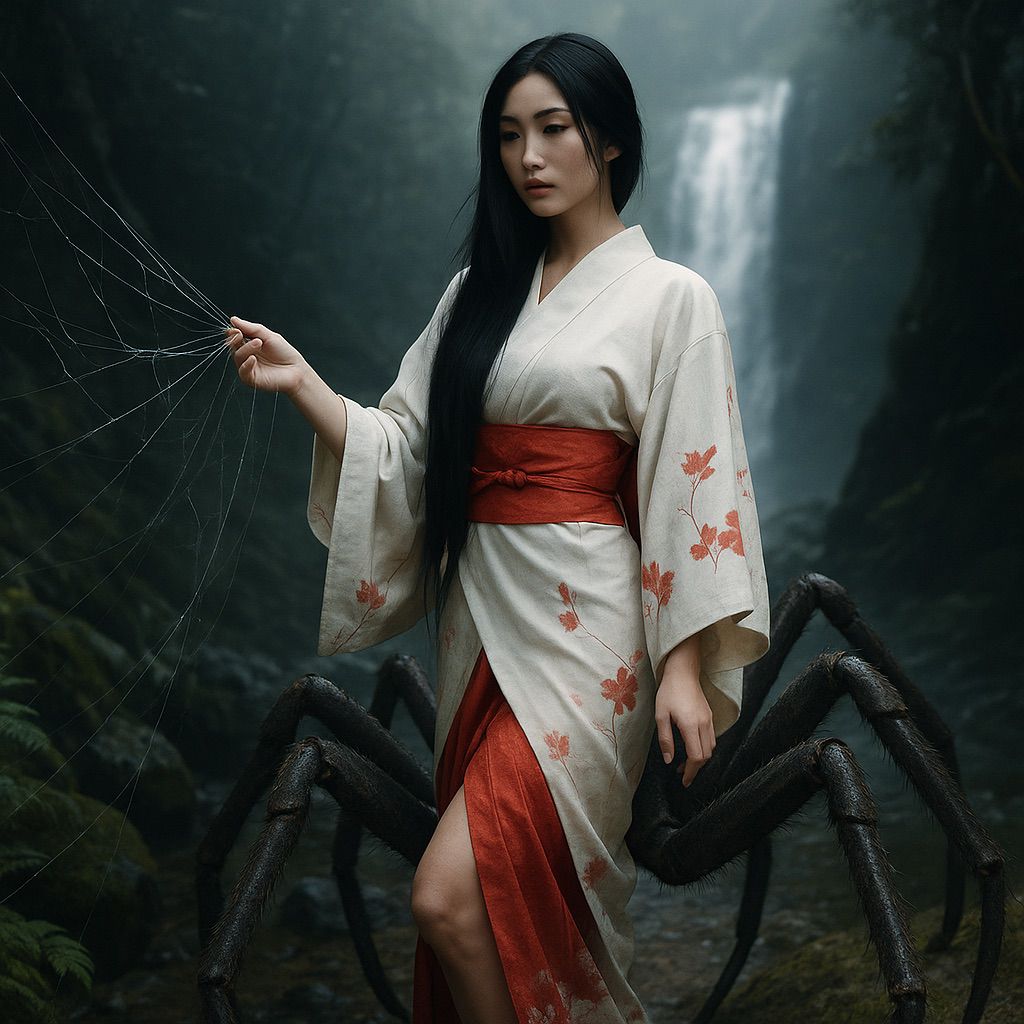
In the hushed forests of Japan, where mist clings to cedar trunks and streams wind through shadowed valleys, there are tales whispered that warn of beauty too dangerous to trust. These are not stories of gentle maidens or noble spirits, but of creatures wearing disguises more beguiling than any human charm. Among the most chilling of these is the Jorōgumo, the spider-woman of Japanese folklore, a yōkai who spins silk not just to catch prey, but to ensnare the hearts of men. She appears first as breathtakingly beautiful, her skin like porcelain, her hair long and flowing, her voice soft as falling rain. Travelers, entranced, are drawn close. But beneath the delicate exterior is a monster, a giant spider cloaked in illusion, waiting for the right moment to drop her mask and reveal her fangs. With strands of silk finer than any net, she binds her victims and drains them, leaving only husks behind. Her story is more than a ghost tale—it is a reflection of fear, desire, and the timeless warning that not all beauty is to be trusted.

The name Jorōgumo translates loosely to “entangling bride” or “prostitute spider,” and both meanings are fitting. Her myth sits at the intersection of allure and dread, reminding us how attraction can lead to destruction. In some versions, she is said to live near waterfalls or streams, weaving silk webs across hidden paths. In others, she resides in abandoned houses, waiting for weary wanderers. Always, her weapon is seduction. Unlike demons that rely on brute force, Jorōgumo hunts with deception, wrapping danger in beauty until escape becomes impossible. The closer you look, the more her legend reveals itself as a story not only of supernatural horror, but of human vulnerability—the way our longings can blind us, the way desire can become a trap of its own making.

Japan’s folklore is rich with yōkai, supernatural creatures that embody natural fears, cultural anxieties, and moral lessons. Among them, the Jorōgumo is especially potent because she merges two primal human terrors: the fear of spiders and the fear of seduction gone wrong. Spiders themselves have always provoked unease, with their patience, their silent weaving, and their venomous precision. But to combine that image with the face of a beautiful woman magnifies the terror, because it takes what should be safe—intimacy, connection, attraction—and turns it into a lethal snare. Her beauty is her web, her charm the toxin. The horror lies not just in the moment of being devoured, but in realizing too late that you walked willingly into her trap.

Legends of the Jorōgumo often begin with a chance encounter. A man, perhaps a traveling samurai or a wandering merchant, comes across a woman in need. She might be washing clothes by a stream, combing her hair beneath a waterfall, or sitting gracefully with a shamisen, playing haunting melodies. He is struck by her beauty, her poise, her quiet vulnerability. Drawn to her, he accepts her invitation, whether to follow her home, to share a drink, or to sit beside her and listen. But once he enters her lair, the illusion unravels. Threads of silk glisten in the corners, binding him before he even notices. Her body contorts, limbs elongating, the elegance dissolving into arachnid horror. What was once a woman is now a monstrous spider, her many legs encircling him as her fangs pierce. In an instant, intimacy becomes doom, tenderness becomes predation.

The Jorōgumo’s story is not simply a tale of horror, though—it is layered with symbolism. In feudal Japan, where these tales circulated, women were often both desired and feared. The myth reflects anxieties around female sexuality, portraying it as dangerous, even deadly, when untethered by control. A woman who lures men, who uses beauty as a weapon, becomes monstrous in the eyes of the society that told her story. At the same time, the Jorōgumo is also a figure of power, embodying female autonomy in a culture that often restricted it. She chooses her victims, controls her encounters, and dominates men who underestimate her. Her legend, therefore, is both a cautionary tale and a hidden acknowledgment of feminine strength—feared, demonized, but undeniable.

Stories of Jorōgumo vary across regions of Japan, but one of the most famous comes from Kashikobuchi in Ibaraki Prefecture. It is said that a young warrior once rested near a waterfall, where he saw a beautiful woman playing a shamisen. Enchanted, he sat with her, but soon felt faint as invisible threads wrapped around him. Realizing too late that he was ensnared, he tried to flee, but the silk tightened. Only with great effort and the help of his comrades was he dragged away, his body covered in fine strands of spider silk. Others were not so lucky—many who encountered her vanished entirely, their bodies never found, their disappearance attributed to the spider-woman’s unrelenting hunger.

Another tale speaks of Jorōgumo’s cunning. In some versions, she disguises herself not only as a woman, but as a mother carrying a baby. When kind travelers offer assistance, she lures them closer. But the baby is no child at all—it is a bundle of spider eggs or a decoy, a grotesque trick to disarm her prey. In others, she pretends to be injured, only to ensnare the well-meaning man who tries to help. These variations highlight her adaptability; like a spider, she tailors her trap to the situation, patient and inventive in the pursuit of survival.

But for all her horror, the Jorōgumo is not entirely without tragedy. Some stories portray her as once human, transformed into a spider through curse or fate. In these tales, her monstrous hunger is not a choice but a doom, her beauty preserved even as her soul is twisted. This angle humanizes her, blurring the line between victim and predator. She is both feared and pitied, a creature who must feed but who also carries the memory of being human, trapped between two forms forever.

Humanizing Jorōgumo is what makes her legend endure. She is not just a monster to fear, but a reflection of ourselves—the way beauty can hide danger, the way desire can lead us astray, the way power can be both intoxicating and destructive. In every culture, there are myths warning of seduction’s peril: sirens of Greece, succubi of Europe, fairies of Celtic lands. Jorōgumo is Japan’s answer, weaving her story in silk that glistens with both terror and allure. She embodies the eternal tension between attraction and annihilation, reminding us that the things we long for most can sometimes be the things that destroy us.

Even today, the image of Jorōgumo resonates in popular culture. She appears in anime, horror films, and video games, often depicted as a beautiful woman whose transformation into a spider is both horrifying and mesmerizing. Artists revel in the juxtaposition—the elegance of the human form against the grotesque power of the arachnid. Writers and filmmakers draw on her legend because it speaks to something timeless: the fear of losing control, of being consumed by forces we thought we could master. And audiences respond, because beneath the fantasy lies a truth we all know—that desire is dangerous, that trust can be betrayed, that predators often wear masks of beauty.

Imagine yourself walking alone in a Japanese forest, the sound of water echoing through the trees. You see a woman, radiant in her stillness, her dark hair cascading like ink, her eyes drawing you in. She beckons, soft and kind. You step closer, heart quickening. Only too late do you notice the glint of silk in the branches, the shimmer of threads in the moonlight. Her smile widens. The air thickens. And you realize the story is not just myth—it is a warning, one you should have heeded before desire led you here. That is the power of Jorōgumo: to make you second-guess every alluring face in the dark, to remind you that the most dangerous predators are not always the ones that roar, but the ones that smile.

Her legend lingers not because of spiders, but because of what she represents. The Jorōgumo is about entanglement—physical, emotional, psychological. She is about the dangers of illusions, the webs we walk into willingly, and the truth that sometimes the most beautiful things are also the deadliest. To fear her is to fear ourselves, our weaknesses, our desires. That is why, centuries after the first tale was told, her story still shivers through the air like silk in the night.

Related Posts

The Eternal Cry: La Llorona and the Haunting of Mexico’s Rivers

Dave

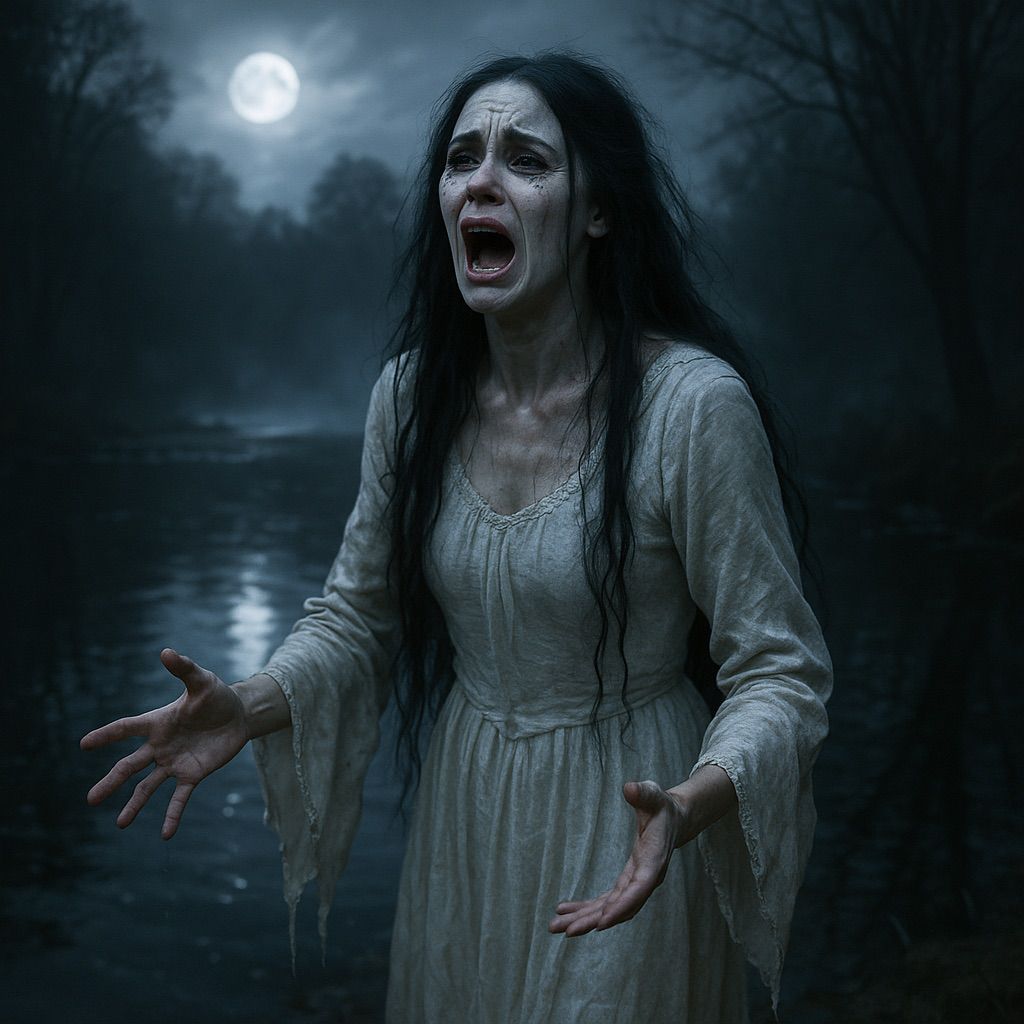
On quiet nights along Mexico’s rivers and canals, when the moonlight shimmers across black waters and the wind carries whispers through the reeds, there is said to be a sound that chills the blood of anyone who hears it. It is not the call of an owl, nor the rustle of branches, but a woman’s cry, long, drawn-out, and filled with a grief so deep it cuts through time itself. “Ay, mis hijos!”—“Oh, my children!”—the voice wails, echoing across villages and cities alike, reminding everyone of the story they learned as children: the tale of La Llorona, the Weeping Woman, cursed to wander eternally, mourning the children she drowned with her own hands. For generations, her legend has haunted Mexico and spread across Latin America, blending folklore, morality tale, and ghost story into one of the most powerful cultural myths ever told. To hear her cry is to know terror, not only because it foretells doom but because it carries the weight of sorrow too vast for the living to bear.

La Llorona’s story begins with heartbreak, but its roots stretch into the complex soil of history, blending Indigenous legend, colonial reality, and centuries of retelling. The most common version is simple yet devastating: once, there was a beautiful woman, often said to be Indigenous or of mixed heritage, who fell in love with a wealthy Spanish man. Their love produced children, but he betrayed her, abandoning her for a woman of higher status. In a moment of rage and despair, she drowned her children in the river, only to realize too late the horror of what she had done. Overcome with grief, she took her own life—or, in some versions, was punished by Heaven itself. Denied entrance to the afterlife, she was cursed to roam the earth for eternity, searching for her children and wailing her regret into the night.

This narrative, at its core, is both deeply personal and profoundly cultural. The story reflects the wounds of colonization, where Indigenous women often faced betrayal, exploitation, and abandonment by Spanish men. La Llorona is more than a mother who killed her children—she is a symbol of broken promises, of love poisoned by inequality, of families shattered by conquest. Her eternal wandering is a metaphor for a people caught between two worlds, forever searching for what was lost. And yet, she is also universal, embodying grief, regret, and the terrible truth that sometimes our own actions become our greatest curses.

The legend is not told in whispers of sympathy alone. In households across Mexico, parents use La Llorona as a cautionary tale for children. “Don’t wander near the river at night, or La Llorona will take you.” “Behave, or she will come for you.” In this way, the story becomes both a ghost story and a tool of discipline, weaving morality into myth. For children, the terror is real—the idea of a crying woman appearing out of the mist, arms reaching, voice echoing with otherworldly sorrow. For adults, the tale carries layers of cultural memory, warning of betrayal, despair, and the thin line between passion and destruction.

Her cry itself is the most important element of the legend. People describe it as piercing, mournful, inhuman in its intensity. It is not simply a scream, but a lament, filled with anguish that seeps into the soul. The cry is said to announce death, like the Irish banshee, or to lure the unwary into danger, like sirens of the sea. To hear it close by means she is far away; to hear it faintly in the distance means she is near. This paradox makes the sound even more terrifying, a trick of folklore that ensures no one ever feels safe if they hear it. And those who do claim to have heard her never forget it—the sound becomes an echo that stays in memory long after the night ends.

What makes La Llorona unique is that she is both feared and pitied. She is a murderer, yes, but she is also a mother destroyed by her own choices, trapped in an endless loop of grief. Her punishment is not flames or torment, but eternal sorrow—an agony that humanizes her even as it horrifies. People do not only fear La Llorona; they mourn her too, seeing in her a reminder of how thin the line is between love and despair, between humanity and monstrosity. Her story resonates because it is not about a distant, inhuman demon—it is about a woman who made a terrible choice and now lives forever with its consequences.

The historical depth of La Llorona’s legend cannot be ignored. Some scholars trace her origins to the Aztec goddess Cihuacóatl, who was said to wander at night, weeping for her children, foretelling doom before the Spanish conquest. In this way, La Llorona is not only a colonial tale but also an Indigenous one, an echo of an older myth transformed by history. Her story evolved as cultures collided, becoming a hybrid tale that reflects Mexico itself: a blending of the old and the new, the Indigenous and the Spanish, the personal and the political. Every time her story is told, it carries within it centuries of cultural layering, a palimpsest of grief.

In modern times, La Llorona has transcended folklore to become a global figure. She appears in films, from Mexican horror classics to Hollywood adaptations. She is the subject of songs, poems, and plays, her wail woven into art across generations. Yet even as she becomes entertainment, the core of her legend remains intact. People still avoid rivers at night, still tell children to beware, still shiver at the thought of her cry. The persistence of her myth proves its power. Ghost stories fade when they stop speaking to something essential, but La Llorona endures because her story touches the most universal fears: the fear of losing children, the fear of betrayal, the fear of eternal regret.

To humanize La Llorona is to see her not just as a ghost, but as a reflection of humanity’s darkest emotions. Who among us has not felt regret? Who has not cried for something lost, even if we did not cause it ourselves? La Llorona magnifies those emotions, turning them into eternal punishment, but in her suffering, we recognize ourselves. That is why her story is told not only in whispers of fear but in tones of sorrow. She frightens us, yes, but she also breaks our hearts.

Imagine, for a moment, standing on a riverbank at midnight. The water moves slow, silver under the moon, and the reeds rustle in the breeze. Then, from somewhere—everywhere—comes a sound. A woman’s voice, crying, wailing, filled with such pain that your chest tightens. You cannot see her, but you know she is there. That is the essence of La Llorona: the fear that grief itself is alive, walking beside us, reaching out with cold hands. She is more than a ghost—she is grief personified, and grief never dies.

La Llorona will always be with us, wandering rivers, echoing through time. She is the weeping mother, the broken lover, the cursed soul. She reminds us of betrayal and regret, but also of the universality of sorrow. She is not confined to Mexico alone—her story has traveled wherever grief travels, which is everywhere. And as long as humans lose what they love, as long as rivers run, her cry will echo. “Ay, mis hijos!” The sound is not only hers—it is ours. It is the cry of humanity mourning what it cannot reclaim.

Related Posts

The Cry in the Mist: Ireland’s Banshee and the Haunting Echo of Death

Dave

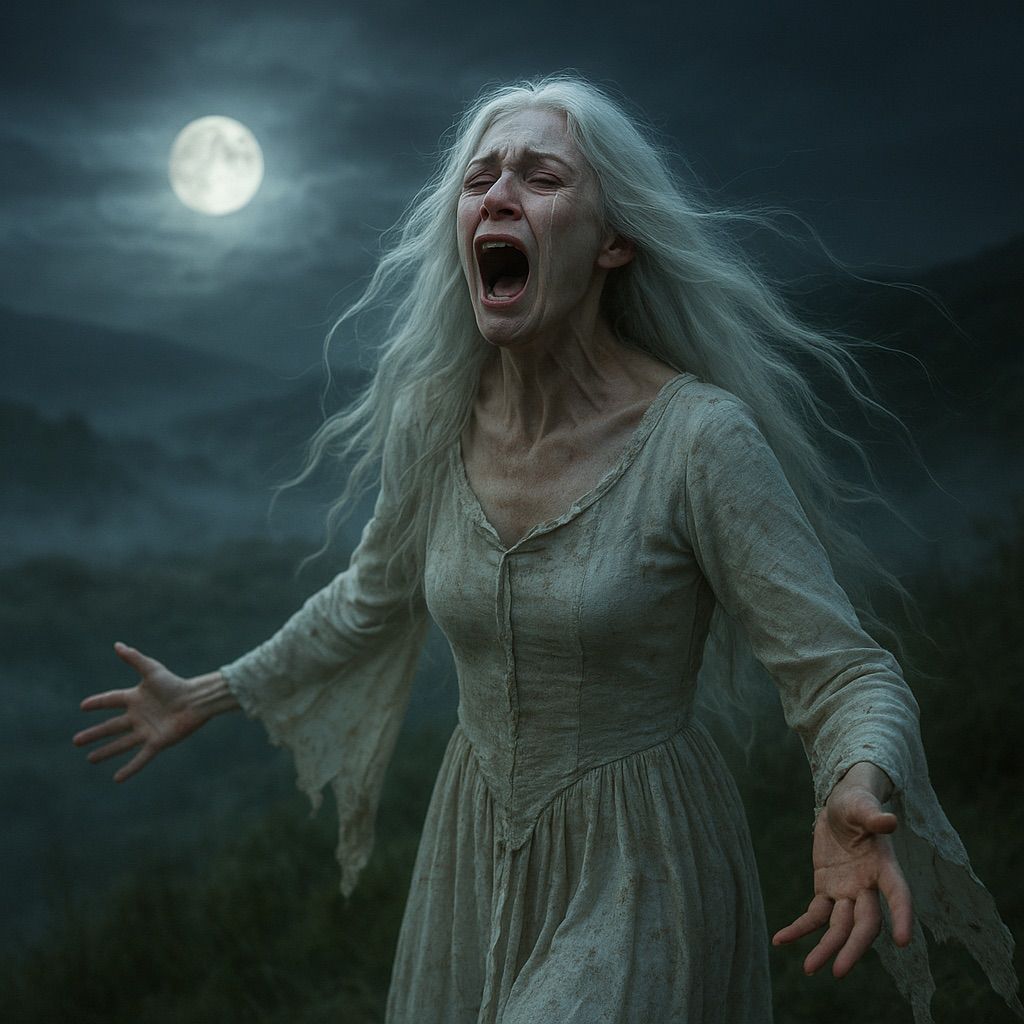
There are few sounds in the world more unsettling than a scream that does not belong to the living. A scream that is not rage, not fear, but pure lament—a cry from somewhere beyond the veil, raw and chilling enough to freeze the marrow of your bones. In Ireland, that sound has a name, and for centuries it has been the herald of death. The banshee, the wailing woman of Irish folklore, is one of the most enduring figures in Celtic mythology, a spirit whose keening shriek is said to foretell the passing of a family member. She is not a monster in the way vampires or werewolves are; she does not attack, she does not kill. She simply mourns. But in that act of mourning, she becomes terrifying, because she reminds us of what is unavoidable. She is not the bringer of death, but its messenger, and sometimes that is more frightening than death itself.

The origins of the banshee lie deep in Ireland’s past, rooted in ancient mourning traditions. In old Gaelic culture, professional women mourners called keeners would attend funerals, wailing and singing dirges to honor the dead. Their voices, powerful and unrestrained, carried grief in a way that words could not. Over time, the role of these keeners merged with myth, becoming otherworldly. The banshee was imagined as a spectral keener who appeared not at funerals, but before them, lamenting for those about to die. This evolution of folklore shows how culture and imagination intertwine—what was once a human custom transformed into a supernatural omen, one that has haunted Irish imagination for generations.

Descriptions of the banshee vary wildly. Some say she appears as a pale, red-haired woman with flowing white or green robes, her eyes red from endless weeping. Others describe her as a withered hag cloaked in black, her face hidden by a veil. Still others claim she is not one woman at all, but a host of spirits, each tied to certain Irish families, wailing for their kin across generations. In some tales, she combs her long silver hair with a ghostly comb—a detail that became so ingrained in superstition that to find a comb on the ground in Ireland was once considered a dangerous omen, a lure from the banshee herself.

What remains constant across the stories, however, is the sound. The banshee’s cry is not simply a scream; it is described as a keening, an eerie, mournful wail that pierces the night and unsettles the soul. It is a sound that cannot be mistaken for wind, for animals, or for human grief. It is something otherworldly, something that belongs to the thin space between life and death. To hear it is to know that death is near, and that knowledge is its own form of horror. People may not have feared the banshee as a predator, but they feared her all the same, because her presence meant loss, and loss is the deepest fear of all.

Unlike many other supernatural beings, the banshee is not tied to violence or malice. She is not a demon, nor does she harm those who see her. In many ways, she is a tragic figure, trapped in eternal mourning. Some legends even suggest she is the ghost of a woman who died in childbirth, cursed to wander and wail for eternity. Others say she is a fairy woman, bound to the mortal families she serves. This ambiguity gives her a haunting complexity. Is she evil? Is she a guardian? Or is she simply a force of nature, like a storm or a plague, existing outside human notions of morality? The banshee occupies this liminal space, neither friend nor foe, but forever entwined with our most intimate fear—the loss of those we love.

Stories of banshee encounters are numerous, passed down through families in Ireland and across the Irish diaspora. A farmer hearing a piercing cry in the distance, only to learn the next morning that his neighbor had died. A family kept awake by a wailing outside their window, discovering by dawn that a beloved elder had passed away. These stories are often told not as myths, but as lived experiences, recounted with the gravity of truth. The banshee’s cry, whether imagined, dreamt, or truly heard, has shaped the way many Irish people interpret death—not as an abrupt shock, but as something whispered by the wind, foreshadowed by a voice older than time.

The banshee also serves as a cultural symbol of grief itself. Ireland has a long and complicated relationship with mourning, marked by centuries of famine, emigration, and loss. The Great Famine of the 19th century saw entire villages decimated, families torn apart, and death becoming a daily reality. In such a landscape, the figure of the banshee made sense. She gave voice to the nation’s sorrow, embodying the collective grief of a people who knew too well the sting of death. Her wail was not only an omen—it was a reflection of lived experience, a supernatural echo of the cries that already haunted Irish air.

In literature and popular culture, the banshee has continued to evolve. Writers from W.B. Yeats to modern horror novelists have drawn on her legend, each shaping her into different forms—sometimes ghostly, sometimes fairy, sometimes demon. In film and television, she appears in horror anthologies and fantasy epics, often depicted as a terrifying harbinger with a scream that shatters glass. Yet even in these dramatized forms, her essence remains intact: the sound, the warning, the inevitability. Unlike many mythological creatures that lose their edge when translated into fiction, the banshee retains her core power because her story taps into something primal. Every one of us, across every culture, has feared the moment when death comes close. The banshee is simply that fear, given a face and a voice.

But perhaps the most haunting aspect of the banshee is not her connection to death, but her humanity. Unlike ghouls, zombies, or demons, she mourns. She feels. Her cry is not laughter or mockery, but lament. That human element blurs the line between monster and mourner, making her all the more unsettling. We fear her not just because she announces death, but because she feels it with us, amplifying grief with her eternal voice. There is something unbearable in the thought that the universe itself keens when someone dies, that existence is not indifferent but mourns alongside us in a voice we cannot silence.

Humanizing the banshee means seeing her not as a figure of cruelty, but as a symbol of empathy woven into horror. In her cry, we hear the echoes of mothers, wives, and daughters who have mourned for centuries. We hear the raw, universal sound of love colliding with loss. And though we fear her, perhaps we also need her. She reminds us that grief is not weakness, that mourning is as much a part of life as laughter. She is not just a herald of death, but a guardian of memory, ensuring that no passing goes unacknowledged.

The banshee’s endurance as a legend proves her resonance. Today, people may not truly believe a spirit wails outside their windows, but the metaphor lives on. Any sound that pierces the night, any dream of a voice that feels too real, any sudden chill in the air—these are moments where the banshee still lingers in imagination. She survives not because we fear her literally, but because we recognize her symbolically. Death will always come, and grief will always follow, and in that certainty, the banshee will always have a place.

So, if you ever find yourself in Ireland on a foggy night, walking along a lonely road where the mist clings to the fields and the silence feels heavy, listen carefully. If you hear a sound rising above the quiet—a cry, mournful and strange, too sharp to be the wind—you might just be hearing the echo of a legend that has outlasted centuries. The banshee will not harm you. But she may remind you of mortality in a way no words can. And in her wail, you might hear not only fear, but the echo of every loss humanity has ever known.

Related Posts

Thirst in the Shadows: The Vampire’s Legacy from Folklore to Dracula

Dave

There is a reason the vampire has never left us. Centuries pass, cultures change, fashions evolve, and yet the image of the blood-drinking creature lurking in the dark is as irresistible now as it was to the villagers who first whispered its name around firesides in the cold hills of Eastern Europe. The vampire is more than a monster; it is a mirror of human fears, desires, and obsessions. From Romanian folklore to Bram Stoker’s Count Dracula and the endless adaptations that followed, the vampire is one of the few legends that has remained alive by constantly reinventing itself. But before Hollywood turned it into a brooding aristocrat or pop culture softened it into a romantic antihero, the vampire was something raw, terrifying, and deeply real to the people who believed in it. It was the explanation for mysterious deaths, the scapegoat for plague, the lurking shadow of mortality itself. To trace the vampire’s journey is to walk through both history and imagination, where blood has always been more than fluid—it has been life, soul, and the ultimate currency of existence.

In its earliest roots, the vampire was not a suave nobleman in a flowing cape but a reanimated corpse crawling from its grave. In the villages of Romania, Bulgaria, and Serbia, people spoke of the strigoi or nosferatu—restless spirits of the dead who would rise at night to drain the vitality of the living. They were described as pale, bloated, and foul-smelling, closer to ghouls than the elegant vampires we know today. These creatures were not metaphors—they were believed to be real. Families who lost loved ones suddenly would suspect vampirism. Bodies were sometimes dug up weeks after burial, and if they appeared unnaturally preserved, villagers might drive a stake through the corpse, burn it, or scatter its ashes. These gruesome rituals were not just superstition but survival strategies in communities plagued by disease, where science offered no answers and folklore filled the void.

The vampire was powerful not because of its beauty, but because it embodied the greatest fear of all: that death does not end suffering. To imagine the dead returning to torment the living was both a horror story and a warning, one that kept people cautious about how they buried their dead, how they treated outsiders, and how they explained misfortune. The vampire was never just a story—it was a way of making sense of chaos, of giving shape to the unexplainable. And in Romania, where the Carpathian Mountains cast long shadows and mist clings to valleys, the myth found the perfect home.

Enter Bram Stoker, a Dublin-born writer who had never set foot in Transylvania but understood the power of atmosphere. In 1897, he published Dracula, a novel that would forever redefine the vampire. Drawing on snippets of folklore, travel guides, and perhaps the faint echo of real history in the figure of Vlad the Impaler, Stoker created a character who blended horror with charisma, terror with seduction. Count Dracula was no shambling corpse—he was an aristocrat, intelligent, cunning, and magnetic, his charm as dangerous as his fangs. Stoker tapped into Victorian anxieties about sexuality, disease, and foreign invasion, weaving them into a narrative where Dracula became both predator and metaphor. The success of the book was immediate, but its legacy was even greater. It elevated the vampire from peasant graveyards to castles, from superstition to literature, and gave the world a monster that could never die because it could always adapt.

From there, the vampire became a creature of reinvention. In the 1922 silent film Nosferatu, the vampire was twisted back into a grotesque, with long claws and a skeletal face. In 1931, Bela Lugosi’s Dracula gave the monster a Hungarian accent and a hypnotic gaze, solidifying the image of the vampire as a suave aristocrat. The decades that followed would see vampires shift again and again, reflecting the fears and fantasies of each generation. In the 1980s, films like The Lost Boys made vampires rebellious, youthful, and punk. In the 1990s, Anne Rice’s Interview with the Vampire gave them existential depth, turning them into tragic immortals wrestling with loneliness and morality. In the 2000s, Twilight and True Blood made them romantic icons, embodying forbidden love and eternal desire. Every era reshaped the vampire, but the heart of the legend—the thirst, the danger, the allure—remained constant.

What makes the vampire so enduring? Perhaps it is because it combines opposites so perfectly. It is death and life, attraction and repulsion, predator and lover. It embodies the primal fear of being consumed, but also the secret desire to be chosen, to be touched by something eternal even if it is dangerous. Vampires are terrifying, but they are also seductive, and that duality gives them a power no other monster holds. Unlike zombies, who are mindless, or werewolves, who are enslaved to rage, vampires are conscious. They choose. And that choice makes them human enough to fascinate, alien enough to fear.

The Romanian roots of the vampire remain central even today. Tourists flock to Bran Castle, marketed as “Dracula’s Castle,” though Bram Stoker never set his story there. Villages across Transylvania still whisper about the strigoi, and in some rural areas, old practices linger—coffins nailed shut, garlic at the windowsill, horses used to sniff out restless graves. Modern Romanians balance pride in their vampire folklore with weariness at being forever linked to Dracula, but even they admit the myth has a strange, undeniable power. There is something about Transylvania—the forests, the mountains, the fog—that feels like it was made for legends. The landscape itself seems to breathe mystery, as if it knows that darkness always needs a stage.

Humanizing the vampire myth reveals why it resonates so deeply. At its core, it is about control and vulnerability. To drink blood is to take life, to dominate completely, but it is also to enter into intimacy unlike any other. It’s why vampires have been tied to fears of disease—blood as infection, blood as contagion. It’s also why they have been tied to sexuality—blood as passion, the act of feeding as metaphor for desire. The vampire myth strips humanity down to its rawest truths: we are fragile, we are hungry, and we long for connection even when it terrifies us. The vampire embodies all of that and then heightens it, turning our secrets into its survival.

In modern culture, the vampire is everywhere, from Halloween costumes to blockbuster movies, but its folkloric roots remind us that it began not as entertainment but as explanation. To the villagers in Romania centuries ago, the vampire was the reason crops failed, why children died suddenly, why the sick wasted away. To them, it was real, and it was dangerous. Today, we might not believe in vampires literally, but we still believe in what they represent—the idea that something unseen can drain us, that shadows hide hungers we cannot name, that death is not always the end. In a way, that belief keeps the vampire alive.

And so, the vampire will never die. It will continue to reinvent itself, shifting with each generation’s anxieties and desires. But whether it’s a bloated corpse rising from a village grave or a glittering immortal brooding over love, the vampire always returns to the same essential truth: it is us. It is our fear of mortality, our obsession with beauty, our hunger for power, our longing for intimacy. The vampire has survived centuries because it feeds not just on blood, but on the human imagination itself. And as long as we keep dreaming, fearing, and desiring, the vampire will keep rising, eternal in shadow, waiting for the next heartbeat in the dark.

Related Posts

Stories in the Sand: The Ultimate Guide to Beach Reads for Summer Escapes

Dave

There’s a particular kind of magic that happens when you sit down on the beach with a book in hand. The world slows, the tide rolls in and out, and you find yourself caught between two worlds — the real one filled with waves, sunscreen, and laughter, and the fictional one filled with characters, journeys, and emotions that pull you in deeper than the sea itself. A good beach read is not defined by genre or literary acclaim but by the way it carries you. It’s the novel you can slip into easily, the one you can pick up and put down between dips in the water, the one that makes you forget the sunburn you’ll discover later because you just needed to read one more chapter. Beach reads are the passport to summer adventures without leaving your towel, the companions that turn lazy afternoons into voyages across continents, romances, mysteries, and worlds beyond imagination.

The concept of a beach read has long fascinated both readers and publishers. Every summer, lists are compiled, stacks appear at bookstores, and the phrase itself becomes shorthand for something fun, accessible, and engrossing. But beach reads are more than marketing. They are cultural markers of our seasons, the books that define summers past and present, the stories that linger like the scent of salt air long after the covers have closed. When you think back to a vacation you once took, chances are you remember not only the sand and the sea but also the book that accompanied you. Maybe it was a romance that left you smiling, a thriller that kept you turning pages until midnight, or a memoir that made you see your own life differently as you gazed at the horizon. Books have a way of binding themselves to moments, and summer is their favorite stage.

When people imagine beach reads, many picture lighthearted romances, and indeed, few things pair better with a sun-drenched day than a love story that unfolds like a summer breeze. Romance novels thrive on the beach because they echo the season itself — fleeting, passionate, tinged with possibility. Whether it’s a chance encounter in a small coastal town, a forbidden love set against family drama, or a witty, banter-filled tale of two opposites finding common ground, romance novels deliver hope and warmth, mirroring the very atmosphere of summer. They remind us that joy is worth pursuing, that vulnerability is strength, and that sometimes the best kind of escape is into the arms of a fictional someone who makes us believe in love again.

But romance isn’t the only contender for beach reads. Thrillers and mysteries dominate the category too, offering a different kind of escape. There’s something deliciously fitting about sitting under an umbrella while reading a story that makes your pulse race faster than the crashing surf. Summer thrillers often feature fast plots, shocking twists, and high-stakes drama — crimes in small beach towns, secrets among vacationing families, or missing persons that turn holidays into nightmares. The juxtaposition of a sunny day with a dark story heightens the thrill, a reminder that shadows exist even under the brightest skies. A well-crafted thriller is like the ocean itself: calm on the surface but hiding depths, currents, and dangers that can pull you under when you least expect it.

Historical fiction has carved its space in summer reading too, especially for those who crave immersion in another time. To sit by the sea while reading about wartime Europe, Renaissance Italy, or ancient civilizations is to feel transported twice over — once by the location, once by the story. Historical novels often balance research with storytelling, giving you characters to root for while teaching you something new about the past. They remind us that human emotions, struggles, and triumphs are timeless, echoing across centuries, even as we recline in modern swimsuits with sand between our toes.

For others, memoirs and nonfiction books provide the perfect beach companion. There is something powerful about sitting in nature while reading someone else’s truth, their lived experiences laid bare like footprints in the sand. Whether it’s a celebrity memoir filled with behind-the-scenes stories, a travelogue that mirrors your own wanderlust, or a self-help book that nudges you toward growth, nonfiction belongs on the beach as much as fiction does. The rhythmic sound of the waves becomes the backdrop for reflection, making lessons and insights land even deeper. Summer often feels like a season of reinvention, and nonfiction can be the spark that lights the way.

Then there are the classics — the books that have lived across generations and continue to find their way into beach bags year after year. To read a classic on the beach is to join an unbroken chain of readers who have been moved by the same words for decades, even centuries. Whether it’s the dreamy prose of F. Scott Fitzgerald’s Tender Is the Night read against an actual sunset, or the windswept romance of Emily Brontë revisited with waves crashing nearby, classics gain new texture in the summer air. They remind us that great stories never age, and that the joy of reading is eternal.

The best part about beach reads, though, is that they belong to the reader, not to a list. Your perfect beach book might be an epic fantasy with dragons soaring across kingdoms, a contemporary drama about friendships tested by time, or even a cookbook filled with tropical recipes you plan to try when you head back to the kitchen. What matters is not what the world declares as the “top summer novel” but what captures your heart, what makes the hours slip by unnoticed while the tide creeps closer to your toes.

There is something sacred about the act of reading on a beach. The sea reminds you of vastness, of eternity, while the book pulls you deep into intimacy with its story. Together, they create a paradoxical harmony — infinite and personal, external and internal. You lose yourself twice over, once in the horizon and once in the pages. And when you close the book, when you look up and see the water glittering, you realize that both kinds of beauty — natural and narrative — are working together to remind you how good it is to simply be alive.

The novels that define a summer are not always the ones critics hail or publishers push, but the ones that find you at the right moment. Maybe it’s a paperback passed down by a friend, pages worn and creased by many hands. Maybe it’s a brand-new release you picked up at the airport, devoured before the return flight. Maybe it’s a guilty pleasure, maybe it’s high literature. What matters is that it made you feel, it made you escape, it made the beach even more beautiful because the story became a part of it.

When you think about it, beach reads are more than books. They are memories. They are tied to scents, to sounds, to feelings. Years from now, you may not remember every detail of a novel, but you will remember the way you laughed out loud while reading it under an umbrella, or the way your heart pounded as the plot twisted just as the sun dipped below the horizon. You’ll remember the salty breeze carrying your imagination farther than you thought possible. A good beach read lingers like a tan — fading slowly but leaving traces that prove it was there.

So as summer stretches ahead, pack your sunscreen, your towel, your snacks — and don’t forget your book. Pick the story that excites you, that comforts you, that makes you curious. Pick the one that makes you forget the time, that makes you sigh with satisfaction, that makes you fall in love with words all over again. Because summer isn’t just about beaches. It’s about stories. And sometimes the best journeys you’ll take this season won’t involve boarding a plane or driving for hours, but flipping a page while waves crash in the distance.

Related Posts

Chilling Beauty: Exploring the Haunting Tale of Yuki Onna in Japanese Folklore

Dave

a person wearing a hat

Japan is renowned for its rich folklore, and among its captivating tales stands the haunting legend of the Yuki Onna, a story that has captivated the hearts and minds of many. Translated from Japanese to English, “Yuki Onna” simply means “snow woman.” This mystical figure is said to appear during intense snowstorms, bringing with her an ethereal presence that borders on enchanting.

According to ancient legends, the Yuki Onna takes the form of a breathtakingly beautiful woman, adorned with flowing lustrous hair, pale skin, and mesmerizing azure eyes. Draped in a white kimono that seamlessly blends with the snowy landscape, she truly embodies the essence of winter. However, one must not be deceived by her alluring beauty, for hidden within her is a chilling power – the ability to freeze unsuspecting souls with nothing more than a breath of icy cold air.

The Yuki Onna is particularly drawn to desolate, snow-covered landscapes such as mountains and forests, where she often preys upon hapless wanderers or stranded travelers. Gracefully gliding over the untouched snow, she leaves no trace of her presence, creating an otherworldly spectacle. With a touch as cold as death itself, she can drain the life force from her victims, rendering them powerless and depleted.

It is worth noting that despite her inherently chilling nature, Yuki Onna is not always portrayed as purely malevolent. Some versions of the folklore depict her as a sorrowful spirit, consumed by the grief of a lost love and forever searching for companionship. In these renditions, Yuki Onna reveals a flicker of compassion and mercy, sparing the life of a fortunate traveler on the condition that he promises never to speak of their encounter. These nuances in the legend add complexity to her character, blurring the line between good and evil.

The enduring legacy of the Yuki Onna folklore is a testament to its longevity and significance in Japanese culture. Passed down through generations, it continues to captivate the imaginations of those who hear it, serving as a cautionary tale against the dangers of venturing into treacherous snowy wilderness. Its enduring popularity is evident in its portrayal across various artistic mediums, including literature, art, and film, further exemplifying Japan’s profound fascination with the supernatural.

Related Posts

Behold the All-Seeing Eye: Exploring the Enigma of Cycloptic Monsters

Dave

A cycloptic monster, an extraordinary mythical creature, possesses a single eye that boldly pierces through the center of its forehead. This distinct characteristic sets it apart from all other creatures, bestowing upon it a unique and often fearsome countenance. Throughout the annals of history, the concept of the cycloptic monster has woven its way into various mythologies and folklore, captivating the minds of humanity. Greek mythology, for instance, boasts the legendary Cyclops as the most renowned of these creatures. Towering in size and endowed with immense strength, this monstrous being possesses a solitary eye that casts an unwavering gaze upon the world. Depicted as ferocious and untamed, the Cyclops were notorious for their brute force and penchant for destruction. Stepping beyond the realm of ancient tales, the allure of the cycloptic monster has permeated popular culture, enthralling audiences through literature, movies, and video games alike. Its enigmatic and monstrous appeal beckons us, inviting us to explore the boundaries of our imagination and venture into the uncharted realm of the unknown. The cycloptic monster stands as a testament to the immense creativity within the collective consciousness of humanity, reminding us of the extraordinary and fantastical creatures conceived within the depths of our minds.

Related Posts

The Enduring Tale of the Kraken Sea Monster

Dave

For centuries, the enigmatic and awe-inspiring Kraken Sea Monster has held people spellbound with its mythical presence. This legendary creature, with its colossal proportions and writhing tentacles, has become a captivating figure that resides in the depths of the ocean, emerging only to unleash chaos upon unsuspecting sailors and ships. The origins of this captivating myth can be traced back to the rich tapestry of Scandinavian folklore, where tales of this monstrous beast, capable of overturning even the mightiest vessels, first took root.

The descriptions of the Kraken are as diverse as the depths it calls home, but it is most commonly depicted as a colossal squid or octopus-like creature, its immense strength capable of crushing ships with ease. The mere whisper of its name struck terror into the hearts of sailors, for they believed that an encounter with this mythical beast was an omen of imminent disaster, a chilling harbinger of doom.

Though its existence remains unproven, the allure of the Kraken persists, captivating the minds of storytellers, artists, and filmmakers throughout history. From the ancient Norse sagas that birthed its legend to the modern-day realms of literature and cinema, the Kraken Sea Monster stands as an iconic and indomitable figure in the realms of folklore and fantasy. Its tale continues to enthral and inspire, forever etching its formidable presence upon the annals of human imagination.

Related Posts

Last Ride on My Harley

Dave

While riding my Harley, I swerved to avoid hitting a deer, lost control and landed in a ditch, severely banging my head.

Dazed and confused I crawled out of the ditch to the edge of the road when a shiny new convertible pulled up with a very beautiful woman who asked, “Are you okay?”

As I looked up, I noticed she was wearing a low cut blouse with cleavage to die for…

“I’m okay I think,” I replied as I pulled myself up to the side of the car to get a closer look.

She said, “Get in and I’ll take you home so I can clean and bandage that nasty scrape on your head.”

“That’s nice of you,” I answered, “but I don’t think my wife will like me doing that!”

“Oh, come now, I’m a nurse,” she insisted. “I need to see if you have any more scrapes and then treat them properly.”

Well, she was really pretty and very persuasive. Being sort of shaken and weak, I agreed, but repeated, “I’m sure my wife won’t like this.”

We arrived at her place which was just few miles away and, after a couple of cold beers and the bandaging, I thanked her and said, “I feel a lot better but I know my wife is going to be really upset so I’d better go now.”

“Don’t be silly!” she said with a smile. “Stay for a while. She won’t know anything. By the way, where is she?”

“Still in the ditch with the Harley, I guess.”

Related Posts

灼熱ベガス

Elmo

7月のラスベガスは「こんなに暑いのか!」と正直びっくり!日中は45度越え、日が落ちた夜でも40度近い。ちょっと歩くだけでも体力消耗が大きいので、水分補給と日焼け防止は必須。夏にベガスへ行く方は、メイン通りに近いホテルを取って、休憩を入れながらの観光をするか、メインからちょっと離れた場所の安いホテルを取り、レンタカーでの移動をお勧めします。


Related Posts

Top 8 Idiots Of The Year

Dave

1. *AT&T fired President John Walter after nine months, saying he lacked intellectual leadership. He received a $26 million severance package. Perhaps it’s not Walter who’s lacking intelligence.

2. *WITH A LITTLE HELP FROM OUR FRIENDS: Police in Oakland, CA spent two hours attempting to subdue a gunman who had barricaded himself inside his home. After firing ten tear gas canisters, officers discovered that the man was standing beside them in the police line shouting, ‘Please come out and give yourself up.’

3. *WHAT WAS PLAN B? An Illinois man, pretending to have a gun, kidnapped a motorist and forced him to drive to two different automated teller machines, wherein the kidnapper proceeded to withdraw money from his own bank accounts.

4. *THE GETAWAY! A man walked into a Topeka, Kansas Kwik Stop and asked for all the money in the cash drawer. Apparently, the take was too small, so he tied up the store clerk and worked the counter himself for three hours until police showed up and grabbed him.

5. *DID I SAY THAT? Police in Los Angeles had good luck with a robbery suspect who just couldn’t control himself during a lineup. When detectives asked each man in the lineup to repeat the words: ‘Give me all your money or I’ll shoot’, the man shouted, ‘that’s not what I said!’

6. *ARE WE COMMUNICATING? A man spoke frantically into the phone: ‘My wife is pregnant and her contractions are only two minutes apart’. ‘Is this her first child?’ the doctor asked. ‘No!’ the man shouted, ‘This is her husband!’

7. *NOT THE SHARPEST TOOL IN THE SHED! In Modesto, CA, Steven Richard King was arrested for trying to hold up a Bank of America branch without a weapon. King used a thumb and a finger to simulate a gun. Unfortunately, he failed to keep his hand in his pocket. (hellooooooo.!!!)

8. *THE GRAND FINALE! Last summer, down on Lake Isabella, located in the high desert, an hour east of Bakersfield, CA, some folks, new to boating, were having a problem. No matter how hard they tried, they couldn’t get their brand new 22 foot boat going. It was very sluggish in almost every maneuver, no matter how much power they applied. After about an hour of trying to make it go, they putted into a nearby marina, thinking someone there may be able to tell them what was wrong. A thorough topside check revealed everything in perfect working condition. The engine ran fine, the out-drive went up and down, and the propeller was the correct size and pitch. So, one of the marina guys jumped in the water to check underneath. He came up choking on water, he was laughing so hard. Under the boat, still strapped securely in place, was the trailer!

Related Posts