Latest Articles

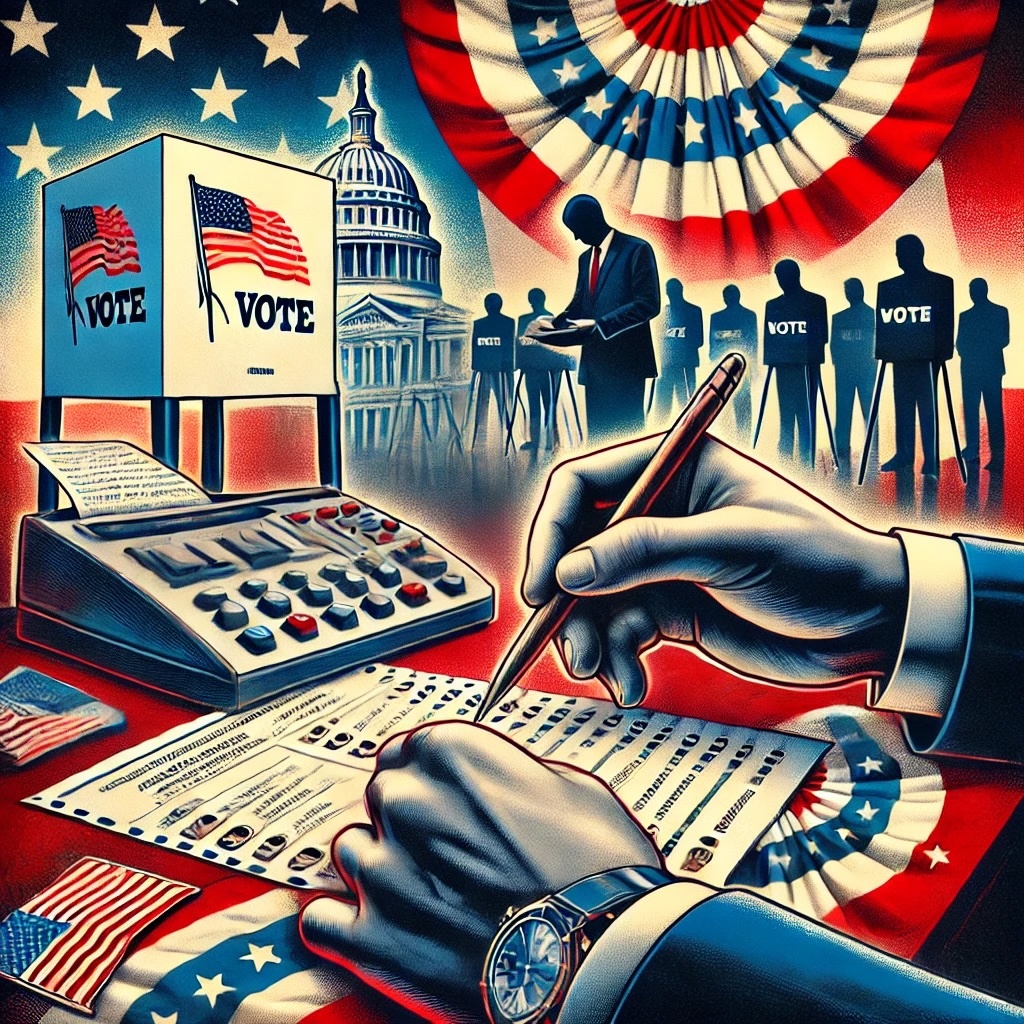
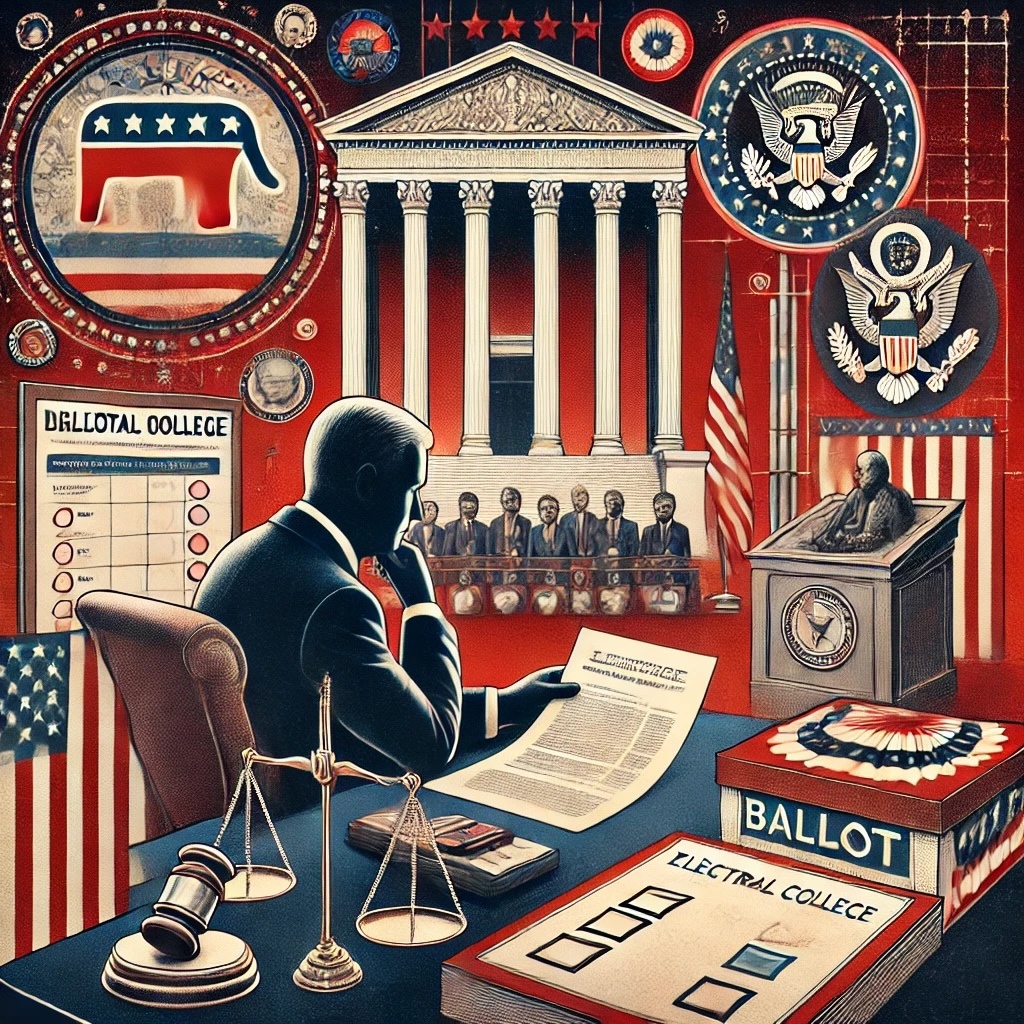
Challenging the Count: How a Presidential Candidate Can Legally Contest an Election Outcome

Dave

In the United States, the electoral process is designed to reflect the voice of the people, ensuring that each vote matters in determining who will lead the country. But in an election as high-stakes as the presidential race, there can be instances where the losing candidate believes the result does not accurately reflect the votes. In these cases, candidates have legal avenues to challenge the outcome, ensuring fairness and transparency in the democratic process. This process is crucial not only for determining a clear winner but for reinforcing public trust in the election system.

Before a candidate can contest the outcome, there must be legitimate grounds for the challenge. Generally, these grounds include allegations of fraud, counting errors, voter suppression, or other irregularities that could have affected the result. Each claim must be substantiated with evidence, as baseless claims are not enough to launch a formal contest. State and federal courts require a clear reason to re-evaluate the results of a race as significant as the presidency, meaning the candidate must show that alleged errors or issues could have influenced the election’s outcome.

One of the primary ways to contest a presidential election is through a recount. Many states have rules for automatic recounts if the margin between candidates is exceptionally narrow, often less than 1% of the total votes. However, a candidate can request a recount if they believe errors occurred in the vote-counting process, even if the margin doesn’t automatically trigger one. Recounts involve re-tallying all votes, sometimes by hand, to ensure that each vote is counted accurately. Though time-consuming, recounts provide a transparent way to verify the results without drastic legal action.

If recounts don’t resolve the concerns, the next step involves filing lawsuits in state or federal courts. These lawsuits typically claim that voting irregularities, issues with ballot access, or procedural errors impacted the election outcome. For instance, a candidate may argue that specific ballots were improperly rejected or that certain voters faced barriers to casting their ballots. Once filed, these lawsuits are handled by judges who examine the evidence, hear testimonies, and ultimately determine whether the claims hold enough merit to affect the outcome. However, the legal burden of proof is high, requiring strong evidence to justify any change in results.

If challenges persist even after recounts and lawsuits, the U.S. Constitution provides an additional avenue through the Electoral College and Congress. After voters cast ballots, the Electoral College meets to formalize the election by voting on behalf of the states. Congress then meets to count these votes, and if there are objections to the certified results, members of Congress may challenge specific electoral votes. This process requires both a House representative and a Senate member to formally object to any state’s results, prompting debate and a vote on the issue. While it’s rare, this mechanism allows for additional scrutiny of the election.

In extraordinary cases, the contest may escalate to the U.S. Supreme Court. This level of intervention is highly uncommon but was famously seen in the 2000 Bush v. Gore election, where the Court ultimately decided on the recount process in Florida. For the Supreme Court to get involved, the case must present substantial constitutional questions or demonstrate that lower courts failed to address significant issues. If the Supreme Court rules on an election issue, its decision is binding, providing a definitive answer to the contest.

The process of contesting an election isn’t just about deciding who wins. It’s about ensuring the integrity of the system itself. When candidates have the option to challenge results legally, it reassures the public that elections are fair, accurate, and transparent. This right to contest is a fundamental part of American democracy, ensuring that the electoral process remains accountable and robust. Although challenging an election outcome is a lengthy and sometimes contentious process, it serves as a vital check within the democratic system, reinforcing the legitimacy of the final result.

Contesting a presidential election is a rare and often complex process, guided by legal standards and detailed procedures. Through recounts, lawsuits, and, in some cases, congressional or judicial intervention, the United States ensures that candidates have every opportunity to verify election outcomes. By navigating this careful legal process, the country demonstrates its commitment to a fair and transparent democracy, where the voice of the people is paramount.

Related Posts

Democracy in the Details: Understanding the U.S. Election Process and How Recounts Ensure Every Vote Counts

Dave

The United States election process is a cornerstone of American democracy, where citizens come together to select leaders at all levels of government. From local offices to the presidency, elections serve as the pulse of public opinion and the mechanism by which the people shape their government. But while casting a ballot might seem simple, the process of counting, verifying, and, if necessary, recounting those votes is a meticulous affair designed to ensure fairness and accuracy.

U.S. elections follow a step-by-step process that aims to ensure that the voices of American citizens are heard. The journey starts with voter registration, where eligible citizens sign up to vote. On Election Day or during the early voting period, voters cast their ballots, often using a combination of paper ballots, optical scan systems, or electronic voting machines. Once voting ends, officials begin the complex task of counting each vote, carefully recording results and verifying accuracy.

The process may appear uniform, but each state has its own unique approach, including different voting systems and rules for what counts as a valid ballot. This variation extends to recount procedures, which are triggered under certain conditions if results are extremely close or if an error or irregularity is suspected. These procedures help maintain the integrity of elections by allowing votes to be re-examined.

When an election is exceptionally close, the results are often reviewed through a recount to verify accuracy. While recount laws vary, they generally fall into two categories: automatic recounts and requested recounts. An automatic recount occurs when the margin of victory is within a certain threshold set by state law, often as narrow as a fraction of a percentage point. In contrast, a requested recount allows a candidate, political party, or group of voters to request a recount, usually covering the cost if the margin does not meet the state’s automatic threshold.

Once a recount is approved, officials review the ballots using one of three primary methods: manual recounts, machine recounts, or a mix of both. In a manual recount, officials visually inspect each ballot to determine voter intent, especially in cases where machines may have misread markings. Machine recounts involve running ballots through a counting machine again to catch potential counting errors. A hybrid approach combines both, offering a robust check for accuracy.

Recounts play a crucial role in upholding public confidence in the election process, particularly when results are razor-thin or contested. By allowing for recounts, the U.S. ensures that even the tightest races reflect the true will of the voters. Election officials follow strict protocols to preserve ballot integrity, limit access, and maintain transparency throughout the recount process. This transparency fosters trust, ensuring that all participants—candidates, supporters, and citizens—know that the election was fair and accurate.

In a democracy, the significance of each vote cannot be overstated. Recounts, while sometimes costly and time-consuming, honor the principle that every vote matters. They also highlight the importance of a transparent, error-averse election system, reassuring the public that the final result truly reflects their collective voice. Through recounts, the democratic process shines, showing that the U.S. is committed to electoral fairness and ensuring that every vote, down to the last one, is counted correctly.

The U.S. election process and recount procedures are designed to protect the foundation of American democracy. They ensure that elections are more than just numbers on a screen—they are a true representation of the people’s choice. Through recounts, every vote is validated, and the accuracy of each election is confirmed, reinforcing trust in the electoral system and in democracy itself.

Related Posts

Decoding the Electoral College: Why Every Vote Counts Twice

Dave

Every four years, millions of Americans head to the polls to cast their vote for the next President of the United States. On the surface, it seems like a straightforward process: vote for the candidate of your choice, and whoever gets the most votes wins. But as most people eventually discover—usually after their first or second presidential election—that’s not exactly how it works. What actually determines the winner of the presidency isn’t the nationwide popular vote. Instead, it’s something called the Electoral College, a uniquely American system that is as controversial as it is complex. It’s a concept that many people learn about in high school civics class, then promptly forget or misunderstand. Yet every time there’s a presidential election, especially a close or contentious one, the Electoral College comes roaring back into the public conversation, sometimes leaving citizens confused, frustrated, or downright furious.

So, what exactly is the Electoral College, and why does it exist? The short answer is that it’s a process established in the U.S. Constitution as a compromise between those who wanted Congress to select the President and those who preferred a direct vote of the people. The Founding Fathers, grappling with how to structure a new and fragile democracy, feared giving too much power to either the masses or a centralized body. They were wary of mob rule, concerned about uninformed voters, and also deeply influenced by the tensions between large and small states. They needed a system that would balance those competing interests while trying to maintain a sense of fairness. The Electoral College was born out of that compromise—not perfect, but functional, and crafted to serve a fledgling republic still experimenting with self-governance.

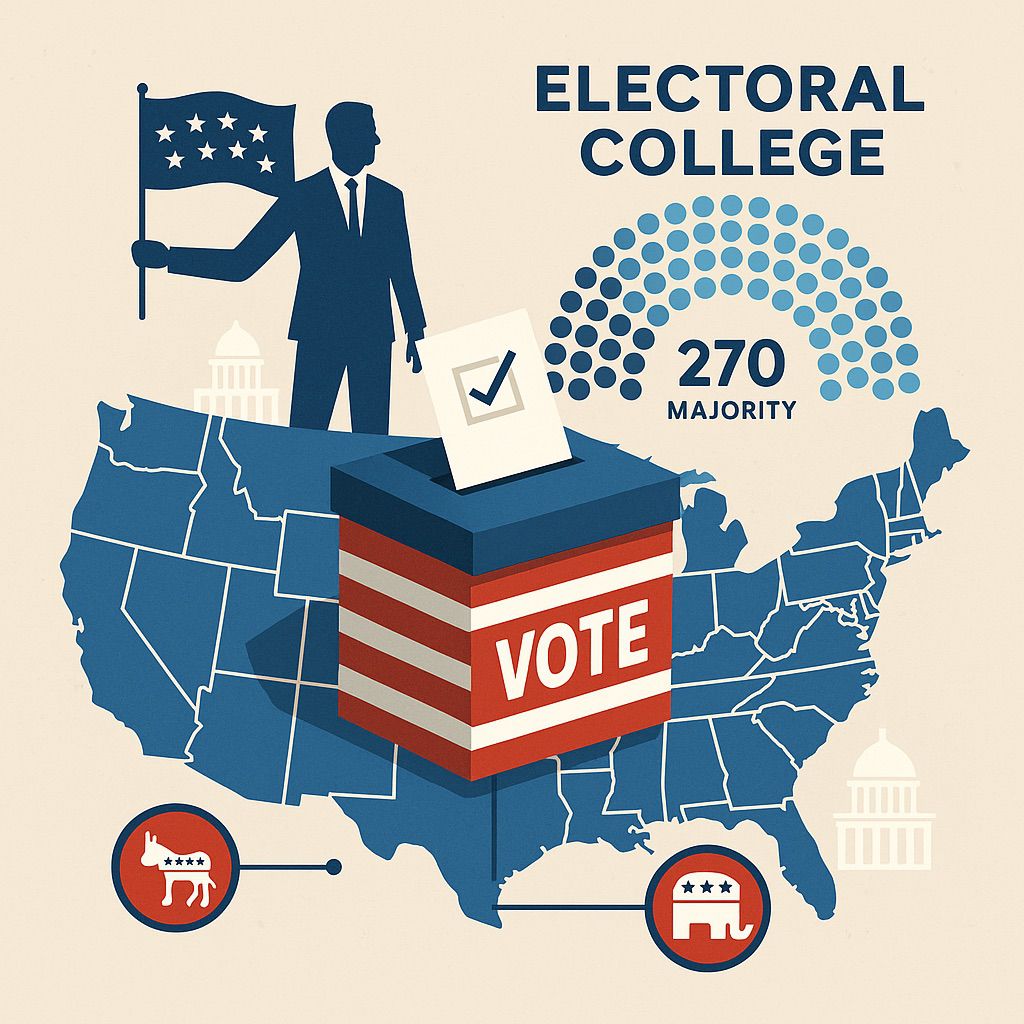
Here’s how it works in practice. Every state is allocated a number of electoral votes equal to the total number of its Senators and Representatives in Congress. Since every state has two Senators and at least one Representative, even the least populous states have a minimum of three electoral votes. In total, there are 538 electoral votes distributed across the 50 states and the District of Columbia, which, through the 23rd Amendment, gets three votes despite having no voting representation in Congress. To win the presidency, a candidate must secure a majority of those electoral votes—270 or more. If no candidate reaches that number, the decision goes to the House of Representatives, where each state delegation gets one vote to choose among the top three electoral vote-getters. That scenario is rare, but it has happened—most notably in 1800 and again in 1824.

Most states use a winner-take-all system to allocate their electoral votes. That means whichever candidate gets the most popular votes in that state gets all of its electoral votes. For example, if Candidate A wins 50.1% of the vote in Florida and Candidate B gets 49.9%, Candidate A gets all 29 of Florida’s electoral votes. It doesn’t matter if the margin is a single vote or a million. Only two states—Maine and Nebraska—break from this model. They use a proportional system based on congressional districts, awarding one electoral vote to the winner of each district and two additional votes to the statewide winner. This small variation has, on occasion, led to a split in those states’ electoral votes, but it rarely affects the national outcome.

Because of the winner-take-all approach, presidential campaigns tend to focus heavily on so-called “swing states”—states where the outcome is uncertain and either party has a chance of winning. These include places like Pennsylvania, Michigan, Wisconsin, Arizona, and Florida, among others. The reasoning is simple: there’s no point spending precious time and money in states that are firmly in one camp. California, for instance, reliably votes Democrat in presidential elections, while states like Alabama typically go Republican. As a result, voters in these “safe” states often feel overlooked, knowing their votes are unlikely to sway the outcome. Meanwhile, people in battleground states can find themselves inundated with campaign ads, rallies, and get-out-the-vote efforts. This uneven attention contributes to the feeling that some votes count more than others—not literally, but in terms of influence and impact.

The Electoral College also introduces the possibility that a candidate can win the presidency without winning the popular vote. This has happened five times in American history, most recently in 2016, when Donald Trump secured the presidency despite receiving nearly three million fewer votes nationwide than Hillary Clinton. It also happened in 2000, when George W. Bush won the Electoral College but lost the popular vote to Al Gore by more than half a million votes. These outcomes tend to spark intense debate, as they seem to contradict the democratic principle of “one person, one vote.” Critics argue that the system distorts representation and gives outsized influence to smaller states. For example, a voter in Wyoming has significantly more electoral power than a voter in California, simply because of the way the votes are distributed relative to population.

Supporters of the Electoral College, however, argue that it serves important functions. They point out that it forces candidates to build a broad, geographically diverse coalition to win—not just rack up votes in major urban centers. Without the Electoral College, they contend, candidates might only campaign in big cities like New York, Los Angeles, or Chicago and ignore rural areas entirely. They also argue that the system preserves the federal character of the United States, where states retain a certain degree of sovereignty and influence. The idea is that America is not a single unified nation, but a union of states, each with its own identity and interests. The Electoral College reflects that reality, giving each state a voice in the selection of the nation’s leader.

Still, the criticisms are not without merit. The disparity in electoral weight among states can feel jarring. Consider this: in 2020, there were roughly 193,000 people per electoral vote in Wyoming, but nearly 719,000 per vote in California. That means an individual vote in Wyoming carried almost four times the weight of a vote in California. While the Senate is also structured in a way that overrepresents small states, the impact is more acute in the presidency because it’s a single, national office. And unlike the Senate, where state populations were deliberately equalized by the Founders, the Electoral College is not based solely on a principle of balance—it mixes population-based and equal-state representation, often to perplexing effect.

Efforts to reform or abolish the Electoral College have been around almost as long as the system itself. Over the centuries, dozens of constitutional amendments have been proposed to eliminate it. The most significant push came after the 1968 election, when Richard Nixon won with just 43% of the popular vote in a highly fractured race. A bipartisan proposal to move to a direct popular vote passed the House but died in the Senate due to a filibuster. Since then, momentum for reform has come and gone, often gaining steam after controversial elections and then fading from public discourse. One of the most promising modern alternatives is the National Popular Vote Interstate Compact—a coalition of states pledging to award their electoral votes to the candidate who wins the national popular vote, regardless of their state’s individual outcome. The compact won’t take effect until enough states sign on to reach the 270-vote threshold. As of now, it’s about two-thirds of the way there.

For all its flaws, the Electoral College is deeply embedded in the U.S. political system. Changing it would require a constitutional amendment or a massive shift in public opinion and political will—both difficult prospects in a polarized era. Yet understanding how it works is essential to understanding American democracy. It’s not enough to say the system is broken or outdated without knowing how and why it came to be, and what purpose it’s meant to serve. Democracy is not just about casting a vote—it’s about knowing how that vote fits into the larger machinery of governance. The Electoral College is one of the gears in that machinery. It’s not perfect. It wasn’t designed to be. It was designed to function in a complex republic with competing interests and regional differences.

And here’s the human truth behind all the rules, numbers, and constitutional jargon: the Electoral College affects real people. It affects how campaigns are run, how voters feel represented, and how trust in the democratic process is built—or eroded. When a voter casts a ballot in a state where the outcome feels preordained, they might ask themselves, “Does my vote even matter?” That question doesn’t just reflect confusion; it reflects a sense of disconnection from the process, a sense that the system doesn’t see them. When the results of an election don’t align with the popular vote, some feel robbed, others feel vindicated, and still others feel something worse: apathy. That’s the danger of any system that feels too abstract, too mathematical, too removed from the people it’s meant to serve.

But the solution isn’t simple. Every reform idea brings its own complications. A direct popular vote sounds fairer in theory, but it also raises concerns about logistics, fraud, recounts, and regional dominance. Should the cities rule the countryside, or vice versa? Should every vote be weighed exactly the same, regardless of where it’s cast, or should geography and federalism play a role? These aren’t easy questions, and there’s no consensus answer. What there is, however, is a need for honest discussion—a willingness to look at the Electoral College not as a relic or a sacred cow, but as a tool. And like any tool, it should be judged by how well it performs the job we ask it to do.

In the end, the Electoral College is a reflection of America itself: complicated, contradictory, and always evolving. It forces us to wrestle with what kind of democracy we really want. Is it one where the majority always rules, or one where the structure tempers the passions of the moment? Is it one where every vote counts the same, or one where states have distinct voices in choosing national leaders? These aren’t theoretical debates—they’re conversations with consequences, ones that shape who leads the country, how they lead, and how legitimacy is conferred. Understanding the Electoral College means understanding a fundamental part of what it means to live in the United States, to participate in its grand, imperfect experiment.

For better or worse, every election is a reminder that this system is still very much in motion. Each vote cast, each state counted, each winner declared—all of it travels through a process designed in the 18th century and still unfolding in the 21st. Maybe that’s what makes the Electoral College so frustrating, and so fascinating. It’s not just about math. It’s about identity. It’s about trust. It’s about how 330 million people, scattered across an enormous and diverse nation, choose one person to represent them all.

Related Posts
Peace Across the Pond: How the Treaty of Ghent Ended the War of 1812

Dave

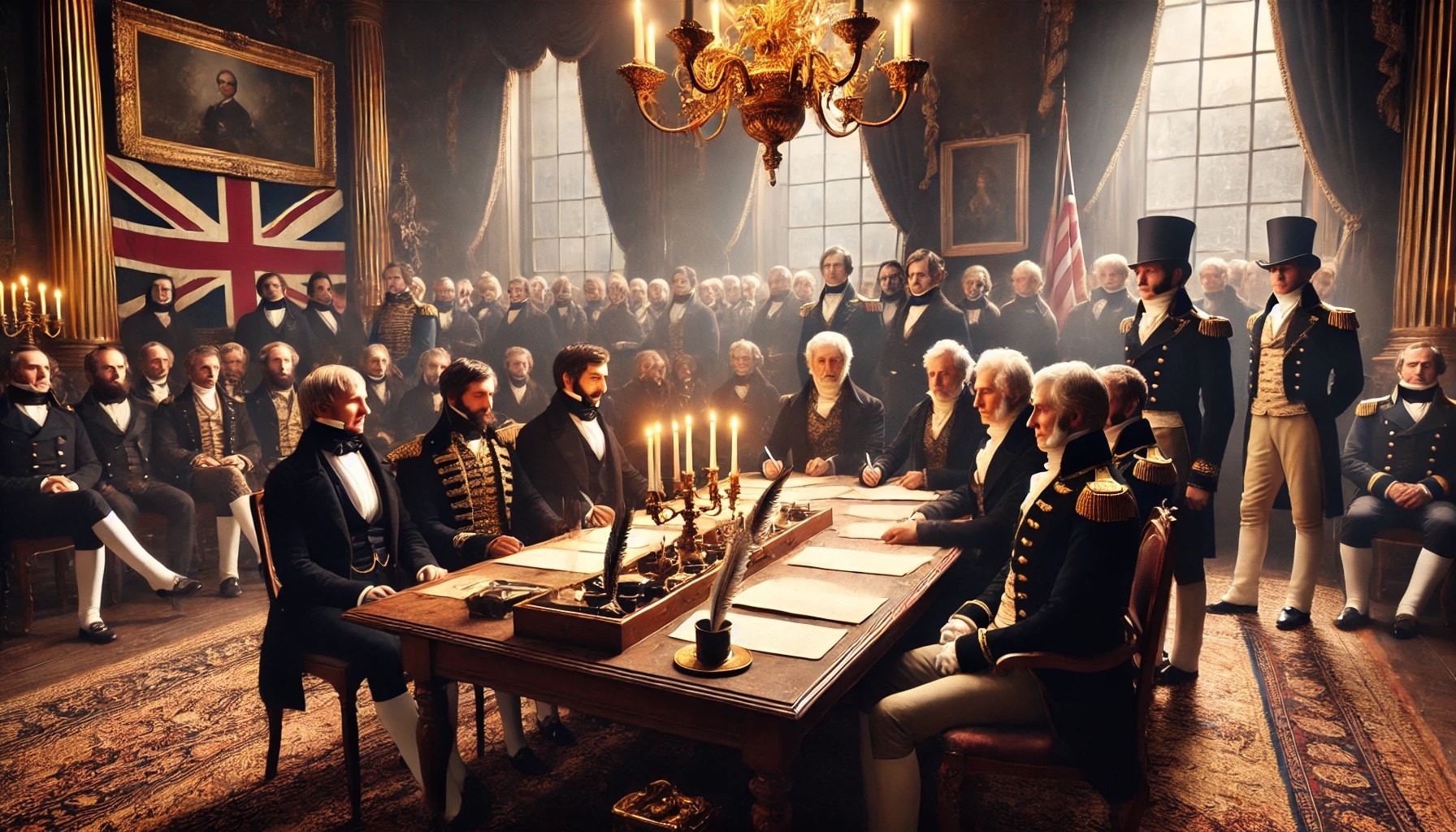
The Treaty of Ghent, signed on December 24, 1814, brought an official end to the War of 1812, a conflict that had deeply strained relations between the United States and Britain. The war itself was fueled by longstanding tensions, including British restrictions on American trade and forced recruitment of American sailors into the British Navy. The United States viewed these actions as provocations, while Britain, still entrenched in its battles against Napoleon in Europe, saw them as necessary.

The road to peace began when both countries realized the prolonged war was damaging to their economies and stability. The Treaty of Ghent negotiations took place in the quiet European city of Ghent, now part of Belgium, where American and British representatives met to reach common ground. Remarkably, the treaty largely restored the borders and relations between the two nations to pre-war conditions. This “status quo ante bellum” approach—returning things to how they were before the war—was unusual, as treaties often led to territorial changes or shifts in power. Instead, the treaty aimed for a broader peace and enduring stability.

The treaty’s impacts rippled far beyond the battlefield. In the United States, the end of the war spurred a sense of national unity and paved the way for economic growth and expansion. For Britain, it allowed a renewed focus on European conflicts and the eventual downfall of Napoleon. The War of 1812 and the Treaty of Ghent served as the last armed conflict between the United States and Britain, who later became close allies. The treaty, in effect, set the stage for the “Special Relationship” the two nations would develop in the 20th century, shifting from rivals to partners on the world stage.

The Treaty of Ghent reminds us that diplomacy, though complex, can bring lasting peace even when conflicts seem intractable. In 1814, across the Atlantic, leaders set aside their swords and signed a document that changed the course of history, showing that peace, often more enduring than war, can come from mutual respect and shared interests.

Related Posts

Unlocking the Metaphysical Universe: A Journey Beyond the Physical Realm

Dave

The idea of accessing the metaphysical universe—a reality beyond the physical world—has fascinated humanity for centuries. From ancient philosophers to modern spiritual seekers, people have long believed that there is more to existence than what we can perceive with our five senses. But what exactly is the metaphysical universe, and how can one tap into it?

The metaphysical universe refers to a realm that exists beyond the material world. It includes concepts like consciousness, the soul, spiritual energies, and other dimensions of existence that can’t be touched, seen, or measured by physical means. Think of it as a vast expanse where the rules of time and space bend and dissolve, revealing a deeper connection to the cosmos, and perhaps, to a higher purpose. Accessing this realm requires a shift in perspective, moving beyond our day-to-day experiences and tapping into the infinite potential of our inner selves.

The first step in accessing the metaphysical universe is to cultivate awareness. This isn’t just about being mindful in the present moment (although mindfulness is a valuable tool), but about awakening to the idea that reality extends beyond the visible and the tangible. Practices like meditation, breathwork, and deep contemplation help quiet the mind and open the door to higher states of consciousness. In these states, you may start to notice subtle shifts in perception—a feeling of connectedness to the world around you, or moments of clarity that reveal profound insights.

In the metaphysical realm, everything is energy. Many believe that accessing this dimension involves aligning yourself with certain vibrational frequencies. The idea is that your thoughts, emotions, and intentions all carry energy, and by consciously raising your vibration through practices like gratitude, compassion, and positivity, you can attune yourself to higher planes of existence. Techniques such as sound healing, Reiki, or even simple acts of kindness can help elevate your energy, allowing you to feel more in sync with the metaphysical universe.

Another key to unlocking the metaphysical universe lies in inner exploration. The deeper you dive into understanding your true nature, the more you can transcend the limitations of the physical world. The metaphysical journey is often described as an inward one, where you explore your own consciousness to find answers about your place in the cosmos. Lucid dreaming, astral projection, and out-of-body experiences are ways that people have described venturing into these otherworldly spaces. These practices allow your consciousness to experience reality outside the confines of your physical body, offering glimpses into the expansive metaphysical world.

Throughout history, people have accessed the metaphysical universe through mystical experiences—those moments that defy logic and reason but feel deeply real on a spiritual level. These might come during moments of profound meditation, deep prayer, or spontaneous insights that seem to transcend everyday thinking. Mystical experiences often reveal truths about the universe, life, and existence that go far beyond what we can comprehend intellectually. By being open to these moments and trusting in the mystery of the unknown, we can experience the metaphysical directly.

The metaphysical universe is closely tied to intuition, the inner knowing that doesn’t rely on the rational mind. To access the metaphysical, it’s important to learn to trust your gut feelings and subtle inner guidance. Intuition often serves as the compass for navigating the unseen, offering nudges and insights that guide you toward a greater understanding of yourself and the universe. By cultivating a relationship with your intuition, you can tune in to the metaphysical dimensions that surround and influence your everyday life.

At the core of the metaphysical universe is the idea of oneness—that we are all connected, not just to one another, but to every aspect of the cosmos. Accessing the metaphysical world often involves realizing this interconnectedness on a profound level. Many spiritual teachings suggest that the separation we feel from others and from the universe is an illusion, and that by transcending the ego, we can experience the true unity of all existence. This realization can be life-changing, helping you see beyond the limitations of the physical world and tap into the infinite possibilities of the metaphysical universe.

Related Posts