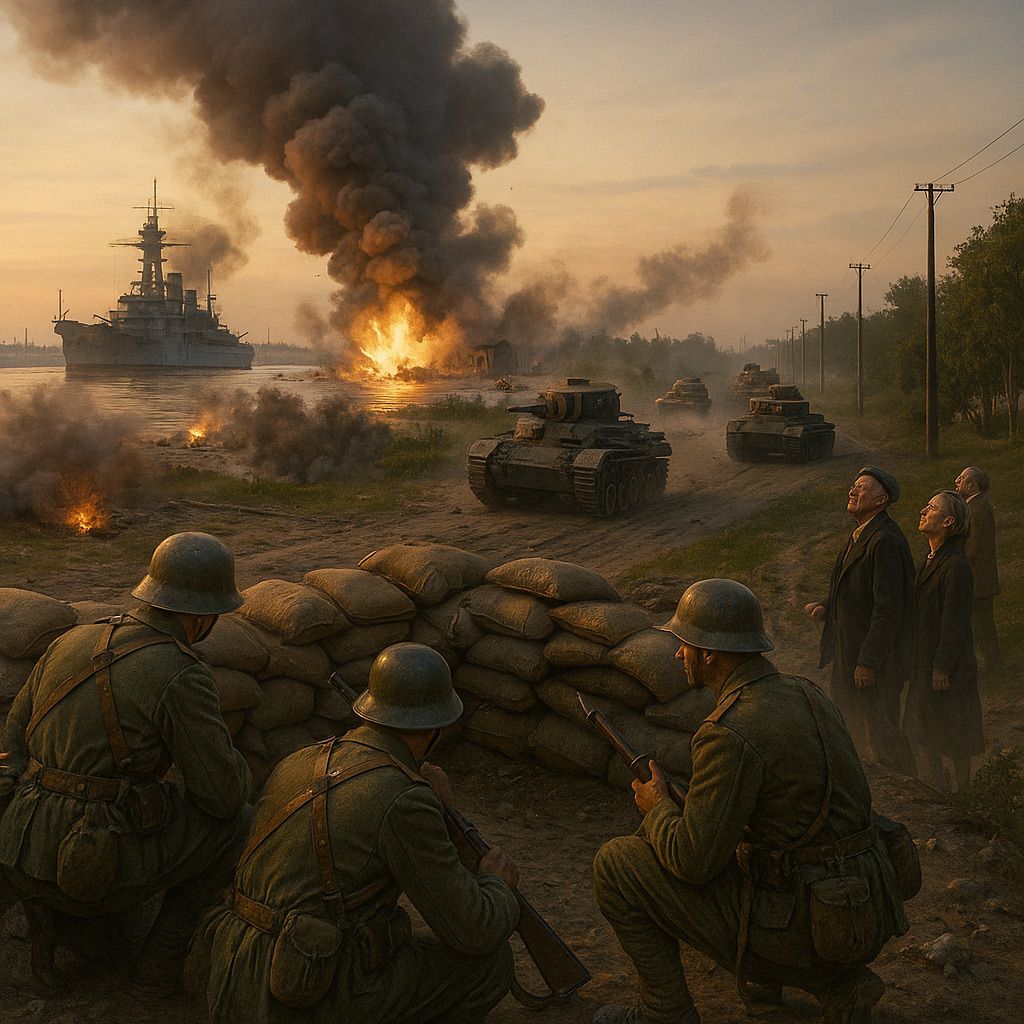
It began with a sound that didn’t belong to morning. In the gray just before sunrise on September 1, 1939, roosters and church bells and the first clatter of carts should have owned the air of Poland. Instead there was concussion—steel on silence—when the German battleship Schleswig-Holstein opened fire on the Polish Military Transit Depot at Westerplatte near Danzig. The blast flattened the dawn and folded it into history. In one violent punctuation mark, the world that still wished to be 1938 became 1939, and then, very quickly, everything else: evacuations, ration cards, ash-gray skies, and an age that would learn the vocabulary of catastrophe with a fluency no one wanted.
A baker named Zofia in Wieluń, a market town far from the front lines, was already awake. She didn’t see warships; she saw loaves. She reached for the oven door when the first Stuka sirens wrote their terrible cursive over her street. The bombs fell at about the same time the guns opened at Westerplatte—a near-simultaneous strike that made truth out of a terrifying new doctrine. The Germans had a word for it—Blitzkrieg—lightning war—but for people like Zofia there was no doctrine, only the panic you feel when the walls move and there is nothing to hold onto that will not splinter. She grabbed the nearest child and ducked under a counter that wasn’t made for this. Outside, glass turned to sand. The day had not yet properly begun, and yet it was already older than any day she had ever known.
To talk about “the beginning” is to argue with a shadow. The paper trail led back years—Versailles and the resentments it sowed; unemployment, inflation, and the demagogues that thrive in economic rot; speeches that started as thunder and ended as policy; the annexation of Austria; the dismemberment of Czechoslovakia; the guarantee to Poland that Britain and France wrote as a promise against their own consciences; and, most secretly, the Molotov–Ribbentrop Pact, which quietly carved Poland into an east-west answer key. But for ordinary people, there is always a moment the abstract turns specific. It’s the moment a radio voice lowers and says “This is not a drill,” the moment the aircraft you heard about becomes the airplane you see, the moment the border printed on a map becomes a bridge taken and renamed.
At the Military Transit Depot, Polish defenders rubbed the sleep from their eyes with grit and did the only thing that makes sense when the impossible happens: they worked their problem. Lieutenant Sucharski had a spreadsheet in his head—ammunition, positions, fields of fire—except the cells on this sheet were lives and every sum had a cost column. There were no reinforcements coming, not really, and the Schleswig-Holstein’s big guns kept talking, using steel grammar to insist that this would be quick. But the defenders, dug into their thin rectangle of earth, turned delay into a tactic. Seven days later, the German timetable for “hours” would still be broken by the human refusal to be convenient.
South and west, armored columns moved with a choreography that earlier wars could not imagine. Tanks had been tried, of course, in the First World War, but tried like a new instrument in an old orchestra. In 1939, Panzers were the melody. They moved not as solitary monsters but as part of a conversation with radios—squadrons of Stukas talking to tanks talking to motorized infantry. The map no longer mattered as a series of lines; it mattered as a series of gaps. Find a seam, flood it, turn the enemy’s front into a door that opens inward and then won’t close. If the word Blitzkrieg sounds like marketing, that’s because it was also theater: the exaggerated howl of the dive siren, the speed, the photographs staged at the roadside, the appearance of inevitability. But inevitability is always an illusion, and it always has a price.
On a dirt lane near Krojanty, a Polish cavalryman named Marek tightened the girth on his mount and tried not to think about the news racing ahead of the columns. The world would later tell a cheap myth about men with sabers charging tanks, as if the Poles were romantics galloping into geometry. The truth was more complicated: cavalry were mobile infantry, scouting, harassing, buying time; they aimed at vulnerable points—supply trains, stragglers, soft underbellies—and when the story went wrong in Krojanty it was not because men on horses didn’t understand machines but because fog and terror and bad luck can break even a good plan. Marek survived that morning with a hearing that would never fully return. He wrote home about the smell of the grass after the bombardment. “It smelled like a garden that forgot its name,” he told his sister. Years later she would cry remembering that letter because the war turned him into a man who could write a sentence like that and then took him anyway.
Wars are fought by armies, but they are felt by towns. In Bydgoszcz, in Łódź, in Poznań, people learned to measure distance by sound—how far away the front was, what kind of plane, the difference between shelling and demolition. A violinist named Dawid wrapped his instrument in a blanket and then unwrapped it again because the weight didn’t feel right; he wanted to carry it as it was, like a person, like something that might breathe if only he believed hard enough. When the air raid ended, he took it to the cellar and played to drown out the next siren. A neighbor, a German speaker who had lived in the building since before Dawid was born, sat on the stairs and cried without understanding why. It would be a long war, and the meanings of neighbor and identity would be mangled by ideology, but on September 1, 1939, the music made them two people sitting inside the same human sound.
Far away in London and Paris, the word “guarantee” turned out to have more syllables than anyone expected. Diplomats whose cheeks had been warmed by the applause for Munich now had to explain how you back a promise with tanks. On September 3, Britain and France declared war, voices crisp on radio waves that shook in the sky. But declarations are not divisions, and the armies that could have moved in the west hardly moved at all. History would call it the “Phoney War,” which is what children name things when grownups disappoint them. In Poland there was nothing phony about anything: bridges fell into rivers with a splash that shook streetlamps, and whole towns learned to keep a bag by the door.
By September 17, the other half of the pact signed in Moscow took its turn. The Red Army came in from the east, and a country already staggered had to learn that you can be divided not just by lines on a map but by the logic of men who treat other people like arithmetic problems. Refugees who had been walking toward safety became refugees who had always been walking. Those who told you there were rules stopped telling you anything at all. In Lwów, a schoolteacher who had been teaching Polish grammar on August 31 was now whispering Russian vocabulary. She wrote the words on the board with a hand that shook in a way that had nothing to do with fear of grammar.
Human beings try to organize chaos into stories because stories have beginnings, middles, and ends, and chaos has only before and after. So we make scenes. We remember Westerplatte because it was a small unit that wouldn’t fold. We remember the Polish Post Office in Danzig because postal workers—people whose daily job is to move messages—held their own position against men with better weapons until fire itself tried to write the last word. We remember Wieluń because the first dead of a world war ought to have been soldiers on a battlefield but were instead civilians in a marketplace, and if you want to understand the century you have to start there: with the idea that the front line is wherever people are alive.
A German conscript named Thomas, nineteen and convinced he was older because newspapers had made him so, rode in a muddy truck flicking a lighter he’d bought with money he didn’t have. He stared at the Polish countryside like it was a picture that had been taken for him. His sergeant told him the people they saw were dangerous. Thomas thought they looked like his mother’s cousins. When the truck stopped, he climbed down and felt the weird intimacy of invasion: the smell of someone else’s bread, the cracked paint on someone else’s windowsill, the sudden knowledge that the person who slept in this bed, this exact bed, has a different word for “blanket.” That night he wrote a letter he would never send. He said that the fields were wider than he had imagined and the sky felt too low. He said he didn’t know whether the war was outside him or already inside him.
In Warsaw, a boy named Julek, twelve, collected rumors like stamps: that the Luftwaffe had run out of bombs; that the British had landed in Gdańsk; that the city wall could stop tanks; that the city had no wall; that his father had volunteered; that his father had been turned away; that grown men could be helpless even when they tried not to be. He watched as adults negotiated with the new physics of fear: how long it takes to get from the window to the stairs, how many bottles to carry, whether to leave the cat, whether to bring the wedding photograph or leave it to prove they had been married before the ruin. When the lights went out, Julek’s mother told a story about the king who disguised himself as a farmer and wandered among his people to learn their secrets. Julek asked what he learned. “That the world is wrong sometimes,” his mother said, “but we must still do right inside it.”
There is an argument, made often by people who haven’t had to live in the middle of history, that the Second World War was inevitable: the axe-blade wedge of Versailles, the failure of the League, the calculus of power, the cruelty that had become policy. But inevitability is a story told by victors and professors. What was inevitable on September 1, 1939 was only this: people would decide, every hour, what kind of person to be. A teenager in Tarnów would choose to help strangers who did not share her last name; a train conductor near Lublin would look the other way at a crucial switch; a priest would open the door to a cellar and not ask which language the people inside said their prayers in. In a village outside Piotrków Trybunalski, a woman named Halina would judge every passerby by the weight of their bag and decide how much bread she could afford to lose.
The invasion of Poland should not be romanticized; it should be remembered. Remembered not only because it began a war that would redraw continents and alter the chemistry of the human psyche, but because in that beginning you can see the pattern that follows. There are the lies we tell to make aggression look like grievance. There are the bureaucrats who prefer a stamped order to a sleepless night. There are the small defenders whose names will be known to their grandchildren because the town will put up a plaque. There is the shock of realizing that technology built to awe can also herd and starve. There is the temptation, always, to believe that if you look away, the thing won’t be looking back.
What makes September 1, 1939 feel modern is not the old photographs; it is the feeling that a normal Tuesday can be the hinge of twenty centuries. That is the weight of the date: we can say it aloud and know exactly what it buys us. The day doesn’t just remind us of tanks and treaties; it remakes the edges of our own mornings. When we wake now to a siren test or a news alert or a sudden silence where there should be birds, we carry the muscle memory of that day, the knowledge that history is not an old story—it is your street with slightly different signage.
And yet, within the cratered outline of those first hours, there were still neighbors and bread and cats. There were still jokes—brittle, bad ones that made everyone laugh anyway because laughter is a way of insisting on grammar where there is none. There were still hands held in stairwells and birthdays that went unmentioned because candles were a luxury and names had to be whispered. A young nurse in Łomża, who had dreamed of Vienna and new surgical techniques, spent the day inventing bandages from curtains and the night learning the names of people she would never see again. She remembered Westerplatte without ever seeing it: she remembered it as “the place where people like us made time angry.”
By mid-September, the map of Poland looked like a demolished puzzle. Cities were under siege; columns of civilians moved like rivers that had forgotten their banks. The world had learned a phrase, “ refugees flow,” that makes people sound like weather. But they were not weather. They were people carrying keys to doors that no longer existed, people who could name every notch in the wooden table left behind. There is a photograph—your mind will supply one if you’ve never seen it—of a family on a road, the mother looking left as if the past might call her back, the father pointing right because direction feels like control, the children understanding none of it and all of it at once. The picture lies: it makes displacement look still. In reality, the air moved like a thing alive, and every turn held a stranger’s eyes.
What did September 1 do to the century? It trained us to hear. It taught us to listen for boots on stairwells, to parse a speech for the meanings behind the verbs. It made us suspicious of certainty and in love with the small proofs of life: the stubborn shop that opens at dawn, the book passed hand to hand, the school that meets in a cellar because learning is a rebellion against the idea that the future is someone else’s to decide. It made “never again” both a prayer and a commitment whose grammar we are still perfecting.
Memory is not a courtroom; it is a choir. When we remember the day the war began, we are not seeking a verdict but a harmony where we can sing in many keys at once: the key of strategic analysis, the key of the family letter, the key of the street that was bombed before most of the world had breakfast. We remember Zofia at the oven door, Marek with the ringing in his ears, Dawid in the cellar, Thomas with the lighter he didn’t need, Julek with the rumors, Halina counting loaves. We remember the defenders of Westerplatte who stretched hours into a week and taught the calendar that courage can bend it. We remember Wieluń because it warns us that civilians are always the front line even when the world pretends otherwise.
If there is a final lesson, it is ruthlessly ordinary: mornings matter. The decisions we make before the sun is fully up—how we speak, what we ignore, whom we believe—have a way of scaling beyond our intention. The world did not simply fall into war on September 1. People pushed, and looked away, and calculated, and hoped, and froze. And people resisted, and warned, and wrote, and ran toward danger to carry someone else out. The day began with a sound that didn’t belong to morning. It ended with the knowledge that all our mornings belong to us only as long as we are willing to share them with others.
So we honor that dawn by seeing the world more clearly at ours. We teach the names, especially to children who will inherit a sky full of sirens and thunder and planes that sometimes save and sometimes don’t. We say Westerplatte like a challenge to despair. We say Wieluń like a promise to pay attention the next time someone tells us that a town can be strategic and that this explains anything worth explaining. We hold the story until our arms ache and then we hand it to someone younger, not because the story is heavy but because it is a relay baton and stopping is a failure of imagination.
The truth is that September 1, 1939 never quite ended. It keeps starting over in smaller ways, in places with different names, each time asking us whether we can hear the difference between a dawn that belongs to bread and a dawn that belongs to artillery. The answer is a thousand small acts: a vote cast with courage, a rumor corrected, a neighbor defended, a lie refused. We cannot go back to the harbor and turn the ship around, cannot unlight the fuses or return the bombs to their racks, cannot tell twelve-year-old Julek to keep the radio off. We can, however, insist that the future keeps more of the morning and less of the blast.
And if there is any mercy to be wrung from a day like that, it is the peculiar kindness of memory itself. Remembering does not rebuild a town or resurrect a defender. But it changes the angle of the light that falls on our own lives. It teaches us to read the world for seams—to patch them before someone else learns to tear them open. It reminds us that the human project is not to avoid catastrophe—history has opinions about that—but to meet it with a stubborn insistence on the ordinary, the neighborly, the human. We cannot stop all ships from firing, but we can build, every day, a world in which fewer captains think it wise to aim at the places where people keep their bread.
That is why the day the Second World War began is not just a historical landmark but a moral one. It is a sign on the road that says, in a script learned with pain, “This Way Leads to Ruin.” And beneath it, in smaller letters that we write together each generation, another sign: “This Way Leads Home.” The handwriting is ours. The choice is always, relentlessly, now.