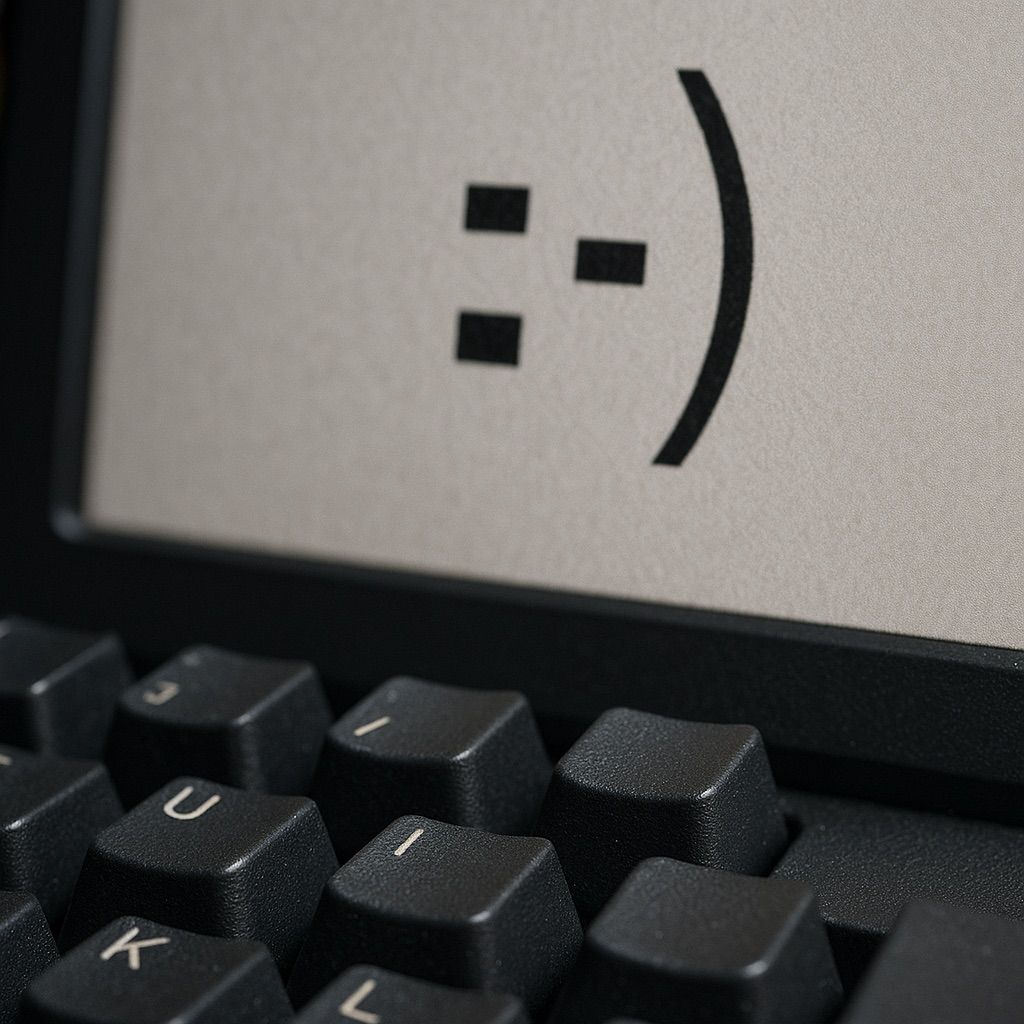
On September 19, 1982, in the computer labs of Carnegie Mellon University, history was made in the most unlikely way. Not with rockets or revolutions, not with treaties or discoveries, but with three humble keystrokes: colon, hyphen, and parentheses. Together, they formed “:-)” — the world’s first widely recognized digital smiley face. It was posted on a university bulletin board system by Professor Scott Fahlman as a way to indicate humor in the confusing, tone-deprived world of online text. He suggested that when something was meant as a joke, users could type “:-)”, and when it was meant to be serious, they could use “:-(”. At the time, it seemed like a trivial proposal, a practical tool for clarifying sarcasm and jokes in a text-only space. But in hindsight, it was revolutionary. Those three keystrokes would evolve into a cultural phenomenon, shaping how billions of people express themselves online, bridging gaps of tone and emotion, and giving rise to the emojis, stickers, GIFs, and memes that define digital communication today. That September day in 1982 was the birth of the emoticon — and with it, the beginning of a new visual language.
The origins of the emoticon are inseparable from the early days of the internet, or rather, its precursors. Long before Facebook, Twitter, or WhatsApp, online communities were forming on primitive systems like ARPANET and university bulletin boards. These were spaces dominated by text — lines of code and plain sentences scrolling across monochrome screens. But humans, being irrepressibly social, wanted more than just information. They wanted to joke, to tease, to banter. And with no facial expressions or tone of voice to guide interpretation, confusion abounded. A sarcastic remark could be mistaken for an insult. A joke could land flat and cause offense. In this atmosphere of miscommunication, the need for a solution was clear. Scott Fahlman’s suggestion was born out of this frustration: a simple marker to indicate “I’m kidding.” It was modest, practical, and ingenious all at once.
What Fahlman could not have predicted was how quickly and how far the idea would spread. Soon, “:-)” and “:-(” were being used across different systems, copied into emails, adopted by programmers and hobbyists alike. Within months, they became a shorthand understood far beyond Carnegie Mellon. The beauty of the emoticon lay in its simplicity. It required no new technology, no software update, no special font. Anyone with a keyboard could type it. And in those early years, it carried a kind of geeky charm, a secret handshake among the growing online community. To use “:-)” was to signal not only humor, but membership in the strange, exciting world of digital communication.
As the internet grew, so too did the emoticon. It evolved into countless variations: winks ;-) for mischief, big grins :-D for joy, tears :’( for sadness. Entire libraries of keystroke faces emerged, each one capturing a nuance of human emotion that text alone could not convey. By the 1990s, emoticons were everywhere — in chat rooms, on AOL Instant Messenger, in early emails. They became so embedded in online culture that they were no longer novel, but necessary. Without them, communication felt flat. With them, it came alive.
The next great leap came with the emoji. In the late 1990s, in Japan, Shigetaka Kurita created a set of 176 simple pictographs — hearts, faces, symbols — to enhance mobile communication. Unlike emoticons, which relied on imagination and keystrokes, emojis were visual images. They were colorful, direct, and instantly expressive. When smartphones popularized them worldwide in the 2000s, the emoji took the foundation laid by the emoticon and expanded it into a global visual vocabulary. Today, emojis are so ubiquitous that entire conversations can unfold without a single word. And yet, every emoji — every smiley face, every sad tear, every wink and laugh — carries within it the DNA of that first humble emoticon posted on September 19, 1982.
Why does the emoticon matter? Because it solved a problem deeper than text. It solved the problem of being human in a digital space. Communication is not just about words; it is about tone, expression, context. In person, we rely on facial cues, gestures, and intonation to understand each other. Stripped of these, digital communication is vulnerable to misunderstanding. The emoticon was humanity’s first attempt to bring those cues into the online world. It was a reminder that behind every line of text was a person, with emotions and intentions that could not always be captured by words alone. It was, in essence, a bridge — between human feeling and machine language, between flesh and code.
The cultural impact of that bridge cannot be overstated. Today, emojis influence politics, advertising, art, and even law. A single emoji can change the tone of a message, soften a critique, or spark controversy. Brands deploy them to connect with audiences. Courts have debated their legal implications. Artists use them as creative tools. And memes — the internet’s cultural currency — often rely on the visual shorthand that began with “:-)”. The emoticon opened the door to an entirely new layer of human expression, one that has transformed not just how we communicate, but how we connect.
Looking back at September 19, 1982, it is tempting to laugh at the modesty of the moment. A professor typed three characters on a bulletin board, and the world changed. But that is the beauty of history: sometimes revolutions come not with thunderclaps, but with whispers. Sometimes they come not with inventions of steel and fire, but with tiny symbols that capture the essence of human connection. The emoticon was not just a joke marker. It was a turning point in the story of language, a reminder that communication evolves with technology, and that even in the cold world of machines, humanity always finds a way to smile.