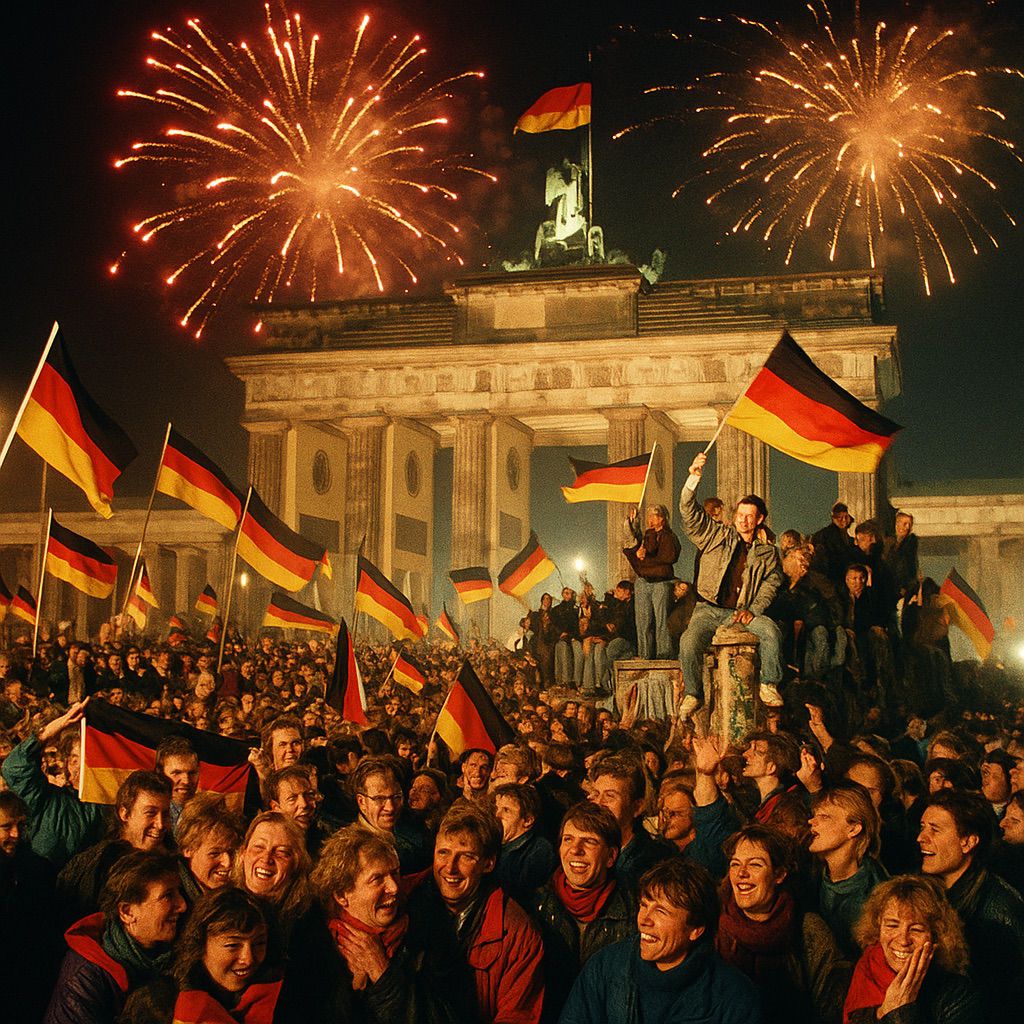
On October 3, 1990, fireworks lit up the Berlin sky, choirs sang, church bells rang, and tears flowed freely as Germany was officially reunified. It was not just the birth of a new nation—it was the healing of an old wound, a wound carved into stone and concrete for nearly three decades. That night, the world bore witness to something rare: history running in reverse. A wall built to divide crumbled into dust, and a people long separated by ideology, suspicion, and steel were free to call themselves one again. But to understand the weight of this day, one must trace back through decades of war, division, fear, hope, and the unyielding power of human will.
The story of German reunification begins not in 1990, but in 1945, when Europe was in ruins. World War II had left Germany shattered, its cities reduced to rubble, its people broken, its conscience scarred. The Allied powers—the United States, the United Kingdom, France, and the Soviet Union—divided the defeated nation into zones of occupation. At first, this was seen as temporary, a practical solution for a devastated land. But as the Cold War deepened, temporary lines hardened into permanent borders. Two Germanies emerged: the Federal Republic of Germany (West Germany), democratic and aligned with the West, and the German Democratic Republic (East Germany), socialist and under the iron grip of Moscow.
The division was not only political but visceral. Families were split overnight. Cities like Berlin were sliced down the middle. In 1961, to stem the flow of East Germans fleeing to the West, the East German regime built the Berlin Wall. It was more than a barrier of barbed wire and concrete; it was a scar across humanity’s conscience, a physical symbol of the Cold War’s cruelty. Soldiers guarded it, mines lined it, and orders were clear: shoot anyone who tried to escape. Thousands risked everything; hundreds died in desperate bids for freedom. The Wall became infamous, an icon of oppression that cut through the heart of a city and the soul of a people.
For years, it seemed immovable. Leaders came and went—Kennedy, Khrushchev, Reagan, Gorbachev—but the Wall remained, as though it was built of more than concrete, as though it was made of the very fear that defined the Cold War. And yet, beneath the surface, cracks were forming—not in the Wall, but in the system that sustained it. By the 1980s, the East German economy was faltering, its people restless. Across Eastern Europe, winds of change began to blow. Poland’s Solidarity movement, Hungary’s reforms, Czechoslovakia’s dissidents—all signaled that Soviet-style socialism was losing its grip.
The East German government tried to tighten control, but the tide of history is rarely held back for long. By 1989, protests swelled in East German cities. Ordinary men and women—teachers, workers, students, priests—marched for freedom, chanting “Wir sind das Volk” (“We are the people”). What began as whispers became a roar. And then, on November 9, 1989, the unthinkable happened. A confused announcement, a miscommunication, a flood of East Berliners surging to the checkpoints—and suddenly the Wall, that grim monument of division, was breached. Soldiers stood stunned as people climbed the concrete, danced atop it, and swung hammers to tear it down. That night, the Wall fell, not by decree of governments, but by the unstoppable will of a people hungry for freedom.
Yet, the fall of the Wall was not the end. It was the beginning of a new and uncertain chapter. Reunification was not inevitable. The economies of East and West Germany were vastly unequal, the cultures shaped by decades of divergent systems. Skeptics feared chaos, resentment, even collapse. But the momentum was unstoppable. West German Chancellor Helmut Kohl pushed forward with a bold plan for unification, supported by the United States, the Soviet Union, and European allies. Negotiations were tense, but the hunger for unity outweighed the obstacles.
On October 3, 1990, less than a year after the Wall’s fall, Germany was formally reunified. In Berlin, where just months earlier the Wall had stood, millions gathered to celebrate. Flags waved, champagne bottles popped, strangers embraced as long-lost family. The Brandenburg Gate, once locked and lifeless, became a gateway to the future. Germany was whole again.
But the human story of reunification is just as important as the political one. Imagine an East Berlin mother reuniting with a sister she had not seen in 30 years. Picture workers from the East walking through Western supermarkets for the first time, stunned by the abundance of goods. Picture children born after 1990, who would grow up in a Germany where the Wall existed only in history books. The joy was immense, but so too were the challenges. Rebuilding the East required massive investment, patience, and cultural reconciliation. Even decades later, the “Wall in the mind” lingered, a reminder that true unity takes more than signatures and parades.
And yet, October 3 remains a day of triumph—not just for Germany, but for humanity. It is proof that even the darkest divisions can heal, that walls, no matter how tall, eventually fall, and that freedom has a way of slipping through cracks until it becomes unstoppable. In a world still scarred by divisions—political, racial, cultural—the story of German reunification carries a timeless lesson: the human spirit craves unity, not division.
The night of October 3, 1990, was the night the Wall fell twice—once in concrete, and once in memory. Fireworks in Berlin lit not just the sky but the path forward for a reunited nation. The cheers were not just for Germany, but for the idea that history, however cruel, can sometimes be reversed.