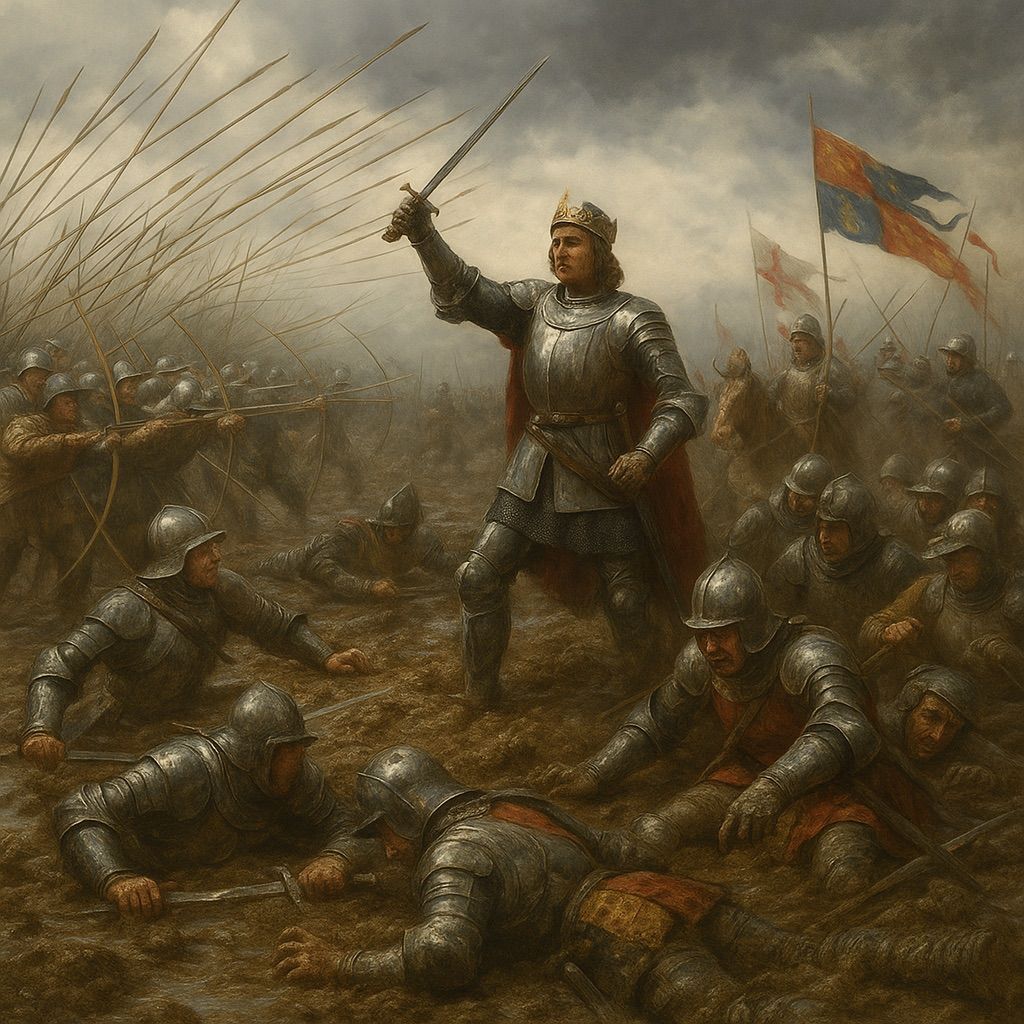
On October 25, 1415, in a sodden field in northern France, a weary English army faced annihilation. Outnumbered by French forces that outshone them in armor, wealth, and reputation, King Henry V’s men had every reason to despair. And yet, by the day’s end, the improbable had happened: the English, hungry, sick, and exhausted, had crushed their enemies. The Battle of Agincourt was not just a clash of swords and arrows—it was the triumph of strategy over arrogance, grit over glamour, and destiny over doubt. It became one of the most iconic battles in medieval history, celebrated in legend, immortalized by Shakespeare, and remembered as the moment when a young king carved his name into eternity.
The Hundred Years’ War had dragged on for decades, a bitter struggle between England and France over land, crowns, and pride. Henry V, newly crowned in 1413, sought to assert his claim to parts of France and to unite his divided kingdom under the banner of victory. His campaign of 1415 began with the brutal siege of Harfleur, but disease and attrition ravaged his army. By the time he marched inland toward Calais, seeking safe passage home, his force was reduced to perhaps 6,000 men—many weakened by dysentery and hunger. Waiting for him near Agincourt was a French army numbering anywhere from 20,000 to 30,000, bristling with knights, men-at-arms, and cavalry.
The disparity was staggering. The French, confident in their numbers and superiority, expected an easy slaughter. The English, hemmed in by exhaustion and mud, had little to rely on but discipline, tactics, and Henry’s leadership. Yet it was precisely these advantages that would turn the tide.
The battlefield itself played a crucial role. Narrow and hemmed in by woods, the field forced the massive French army into a bottleneck. Days of rain had turned the ground into thick mud, a quagmire that would trap heavily armored knights. Henry positioned his men wisely: longbowmen on the flanks, protected by sharpened stakes, and men-at-arms in the center. The English longbow, with its deadly range and armor-piercing power, was the great equalizer. Against waves of French cavalry and knights, the longbow would prove devastating.
At dawn on St. Crispin’s Day, Henry gave his men words that would echo through history. Shakespeare would later immortalize them in Henry V: “We few, we happy few, we band of brothers.” The king stood not above his soldiers, but among them, sharing their hunger, their sickness, their fate. For the English, the coming battle was not only about survival but about loyalty to a king who had shown himself one of them.
When the French advanced, the longbows sang. Arrows darkened the sky, raining death on knights and horses alike. The French cavalry faltered, their charges broken by stakes and mud. Then came the infantry, surging forward in waves. But the narrow field betrayed them. Pressed shoulder to shoulder, their armor dragging them down in the muck, they became easy prey for English arrows and counterattacks. Men stumbled, suffocated, were trampled by their own comrades. The flower of French nobility drowned in their own arrogance, buried in the mud of Agincourt.
By the end of the day, French losses were catastrophic. Thousands lay dead, including dukes, counts, and noblemen of the highest rank. English casualties were astonishingly light—perhaps a few hundred. The scale of the victory was so unlikely, so lopsided, that it stunned Europe. Henry V, the young king who had marched into France with little more than desperation, emerged as a warrior king, his reputation forged in blood and mud.
But to humanize Agincourt, one must imagine not just the kings and nobles, but the ordinary soldiers. The archer drawing his bowstring again and again until his fingers bled. The weary man-at-arms, armored but weak from dysentery, swinging his sword against a knight twice his size. The peasant conscript who had never seen France before, now watching princes die beside him in the muck. Their victory was not born of luxury or pride but of survival and solidarity. They fought because they had no choice, and in that necessity, they found destiny.
Agincourt became legend. For the English, it was proof that courage and discipline could topple the mighty. For the French, it was a humiliation, a wound to their pride that would take years to heal. For history, it was a reminder that wars are not always won by numbers or riches, but by leadership, terrain, and the human spirit’s refusal to yield.
October 25, 1415, was more than a battle. It was a moment when a king and his army defied the impossible, when mud and arrows toppled knights and crowns, when history bent toward the unlikely and the extraordinary. Agincourt endures not simply because it was a victory, but because it was a miracle of grit, strategy, and faith on a day when the world expected defeat.