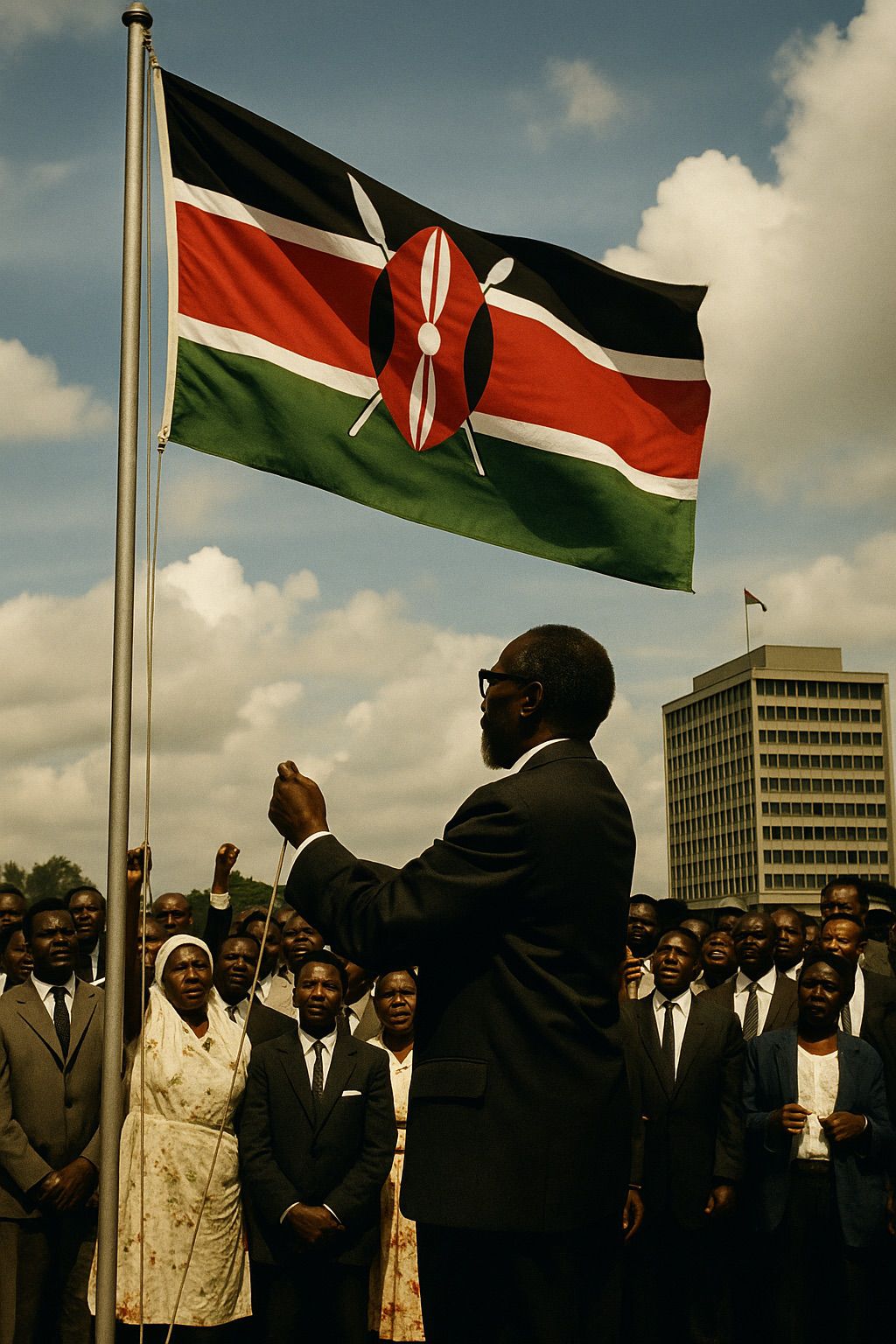
Kenya’s struggle for independence was not a moment, nor a single uprising, nor a simple negotiation across a polished British table. It was a decades-long awakening—messy, painful, courageous, and breathtaking in its persistence. By the mid-20th century, the winds of change sweeping across Africa were gathering force, and few places felt that gale more intensely than Kenya. For nearly a century, the British Empire ruled the territory with a grip that grew increasingly strained as Kenyans began to articulate a new, unshakable sentiment: their destiny must belong to them.
In the early 1900s, the British attempted to give the appearance of local participation through the creation of the Legislative Council—a body that, in theory, included African representation. But in practice, it became immediately clear that this was more ceremonial than meaningful. African members had no real authority, no legislative leverage, and no capacity to challenge policies crafted entirely around the interests of the colonial administration and European settlers. Yet even in this carefully controlled chamber, the seeds of political consciousness took root.
The first sparks of organized nationalism appeared in 1921 with the formation of the Young Kikuyu Association. Initiated in Nairobi, the group sought to confront land dispossession, labor inequalities, and the systematic marginalization of Africans. Figures like Harry Thuku stood at the helm of early agitation—young, bold, and unafraid to confront a colonial system that dismissed African grievances as inconvenient noise beneath imperial machinery. Their activism marked the beginning of a political awakening that would intensify with every passing decade.
By 1944, Kenya’s nationalist movement had gained both momentum and vision. That year saw the birth of the Kenya African Union (KAU), and with it the emergence of a leader who would become synonymous with the struggle: Jomo Kenyatta. Articulate, strategic, and deeply committed to reclaiming Kenya’s dignity, Kenyatta transformed the nationalist conversation from reformist appeals into an unmistakable call for full independence. KAU demanded expanded rights, land restitution, and a political system not merely adjusted for Africans—but led by them.
Global winds were shifting as well. After World War II, the British Empire—exhausted financially and burdened by mounting anti-colonial sentiment—faced pressure to loosen its imperial hold. Across Africa and Asia, nationalists were rejecting paternalistic models of governance and asserting their right to self-determination. Kenya, however, remained one of Britain’s most tightly held territories, both agriculturally rich and strategically significant. This made London hesitant, even defensive, in the face of growing demands.
Tensions reached a boiling point in 1952, when a militant movement known as Mau Mau launched an armed resistance largely based in the central highlands. Led symbolically by Field Marshal Dedan Kimathi, the Mau Mau rebellion represented not only political frustration but deep anger over decades of land theft and injustice. The colonial government responded with ferocity: mass detentions, torture, executions, and the establishment of detention camps that would later be compared to concentration camps. Thousands of Kenyans were imprisoned; thousands more were killed.
Yet instead of crushing the struggle, British brutality only highlighted the moral bankruptcy of colonial rule. International observers began questioning Britain’s conduct, while within Kenya, sympathy for nationalist leaders intensified. When Jomo Kenyatta was arrested in 1952 on fabricated charges linking him to Mau Mau leadership, he became a martyr in the eyes of many—proof that Britain would dismantle anyone who demanded freedom.
By the late 1950s, the tide had turned. The cost of suppressing Kenya was rising, international pressure was mounting, and the Kenyan population was increasingly united. In 1960, the British government began drafting a new constitution intended to expand African political participation. It was not enough. Kenyans wanted sovereignty, not constitutional tinkering.
In 1962, the first major elections under the new constitution took place, and Kenyatta’s party, the Kenya African National Union (KANU), emerged victorious. With negotiations accelerating in London and local support swelling at home, the British finally conceded what had become inevitable.
On December 12, 1963, Kenya became an independent nation. Jomo Kenyatta—once imprisoned, once dismissed—raised the new flag as the nation’s first Prime Minister. Crowds filled stadiums, streets, and villages, celebrating the dawn of a country that had been imagined, fought for, and bled for.
But independence did not mean instant transformation. The young nation inherited economic disparities, land inequities, and the lingering shadow of British hierarchy. Yet Kenyatta’s government made meaningful strides: investing in schools, expanding healthcare access, stabilizing the economy, and beginning land resettlement programs that, while imperfect, represented a long-sought return of dignity to displaced communities.
Women, long underestimated in historical narratives, played a critical role in post-independence progress—organizing grassroots movements, mobilizing rural communities, and later entering political and professional leadership roles. Their contributions reflected a broader truth: Kenya’s liberation was never the story of a few great men, but a nation of ordinary people refusing to bow to injustice.
Kenyatta’s death in 1978 and the subsequent rise of Daniel arap Moi began a new, complicated chapter in Kenyan governance. Yet even through authoritarianism, economic struggles, and political turbulence, the spirit ignited during the independence movement remained alive. Kenya continued to evolve, and by the 21st century, it stood as one of Africa’s most influential economies.
Today, Kenya faces new challenges—corruption, inequality, climate stress—but its resilience is rooted in a history of collective courage. Independence was not a gift from Britain; it was the culmination of decades of organization, sacrifice, rebellion, diplomacy, and unbreakable faith in the possibility of freedom.
Kenya’s story is a reminder of what can happen when ordinary people refuse to accept the limits imposed on them. It is a testament to a nation that rose from colonial subjugation to sovereignty—and continues to shape its own future with the same determination that carried it to independence.
As Jomo Kenyatta once said, with the clarity of a man who had walked through fire:
“Our children may learn about the heroes of the past. Our task is to make ourselves the architects of the future.”