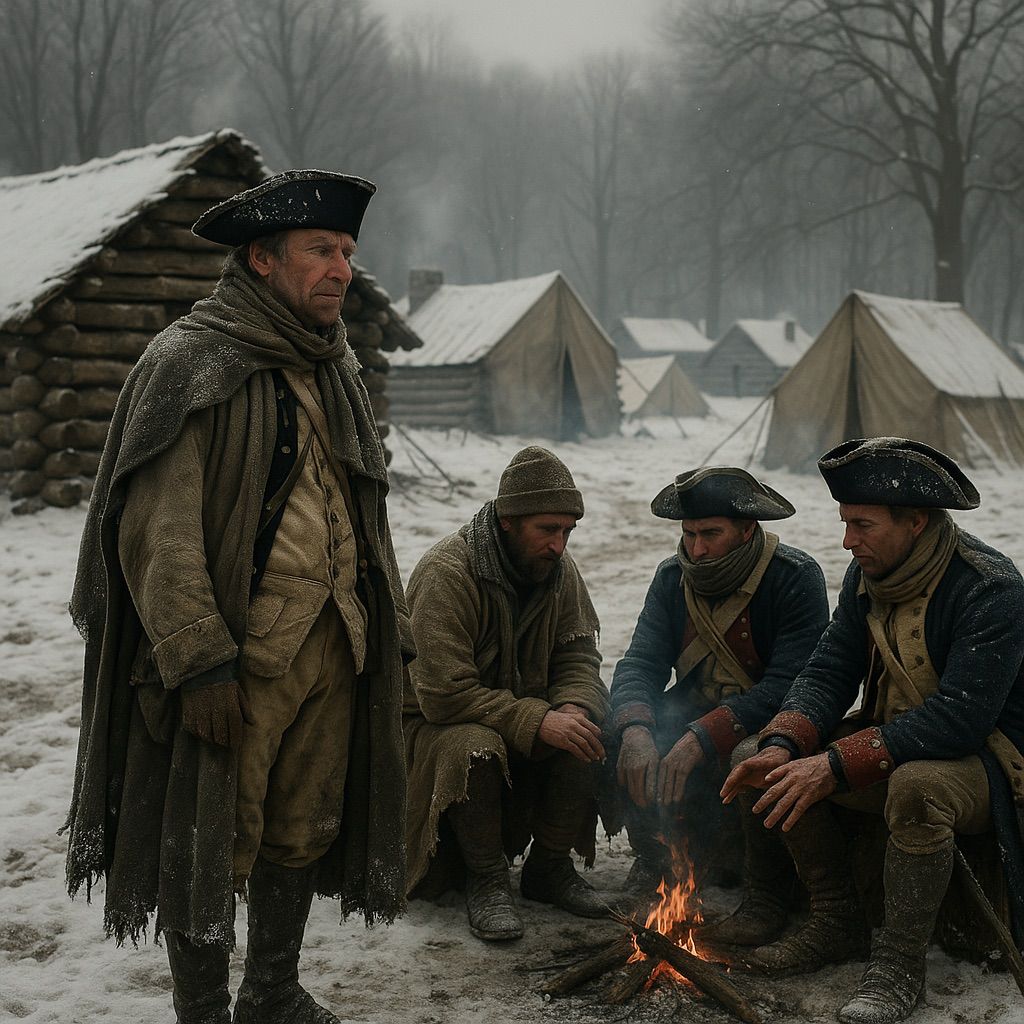
The winter of 1777–1778 stands as one of the most defining chapters in the story of the American Revolution, not because of a great battle or a sweeping victory, but because of survival. At Valley Forge, the Continental Army endured conditions so brutal that many believed the revolution itself might die in the frozen fields of Pennsylvania. Hunger, disease, cold, and despair stalked the encampment daily, threatening to unravel the fragile force struggling to oppose the British Empire. Yet it was in this crucible of suffering that an army was transformed and a nation’s resolve hardened.
When George Washington chose Valley Forge as his winter encampment, he did so out of strategic necessity rather than comfort. The location offered protection from British surprise attacks while allowing the army to keep pressure on enemy-held Philadelphia. Still, strategy could not shield the men from the realities that awaited them. When the first soldiers arrived in December 1777, they found no shelter, no infrastructure, and little food. Snow blanketed the ground, and the wind cut through threadbare uniforms as if they did not exist.
The men of the Continental Army were not professional soldiers in the European sense. Many were farmers, laborers, and tradesmen who had volunteered or been drafted into service. They lacked consistent training, proper equipment, and often even basic supplies. At Valley Forge, these shortcomings became painfully visible. Soldiers marched barefoot through snow stained with blood. Others wrapped rags around their feet, knowing frostbite could claim toes or entire limbs.
Food shortages were relentless. Supply lines failed repeatedly due to poor organization, corruption, and lack of resources. Men survived on meager rations of flour and water, sometimes boiled into a thin paste known as firecake. Meat was rare. Hunger weakened bodies already battered by exposure, making disease spread rapidly through the encampment.
Typhus, dysentery, pneumonia, and influenza swept through the ranks. Makeshift hospitals overflowed with the sick and dying. Doctors worked with limited tools and supplies, often unable to do more than offer comfort. By the end of winter, nearly 2,000 men had died—not from British bullets, but from neglect, cold, and illness.
Morale sank dangerously low. Desertions increased as soldiers questioned whether independence was worth such suffering. Some officers openly criticized Washington, doubting his leadership and whispering of replacement. The so-called Conway Cabal revealed just how fragile unity had become. Yet Washington endured these attacks with restraint, refusing to abandon his post or his men.
Washington’s greatest strength at Valley Forge was not tactical brilliance, but moral authority. He shared in his army’s hardships, refusing special treatment and insisting on fairness wherever possible. He appealed constantly to Congress for aid, demanding accountability from corrupt quartermasters and reorganizing supply systems to ensure survival.
The turning point at Valley Forge did not come from improved weather or sudden abundance. It came from discipline. In February 1778, Friedrich Wilhelm von Steuben arrived at the encampment. A Prussian officer with experience in European warfare, von Steuben brought structure to chaos. Despite limited English, he communicated through example, drilling soldiers personally and instilling order where there had been confusion.
Von Steuben standardized training, taught soldiers how to march, load muskets efficiently, and fight as coordinated units. He introduced hygiene practices that reduced disease and reorganized camp layouts to improve sanitation. Slowly, painfully, the army began to change.
The men who had arrived at Valley Forge as desperate survivors began to leave as disciplined soldiers. Confidence replaced despair. Pride returned where humiliation had once ruled. When spring finally came, the Continental Army emerged not merely intact, but transformed.
This transformation was tested at the Battle of Monmouth in June 1778. There, Washington’s troops faced British forces in open battle and held their ground. Though the engagement was tactically inconclusive, its symbolic importance was immense. The Continental Army had proven it could stand against one of the world’s most powerful militaries.
Valley Forge became the emotional heart of the Revolution. It symbolized sacrifice without surrender, endurance without despair. The suffering endured there forged bonds between soldiers and solidified commitment to a cause larger than any individual hardship.
The winter also reshaped Washington’s legacy. His leadership during those months cemented his reputation as a commander not just of strategy, but of character. He understood that armies are sustained not only by supplies, but by belief. At Valley Forge, belief nearly failed—but did not break.
Today, Valley Forge stands as a reminder that victory is not always born on the battlefield. Sometimes it is forged in endurance, discipline, and the refusal to give up when defeat seems inevitable. The men who survived that winter carried its lessons into every campaign that followed, helping secure independence not through brilliance alone, but through resilience.
Valley Forge endures in American memory because it represents the cost of freedom stripped of romantic illusion. It was cold, painful, unjust, and nearly fatal. Yet from that suffering emerged an army capable of winning a nation.