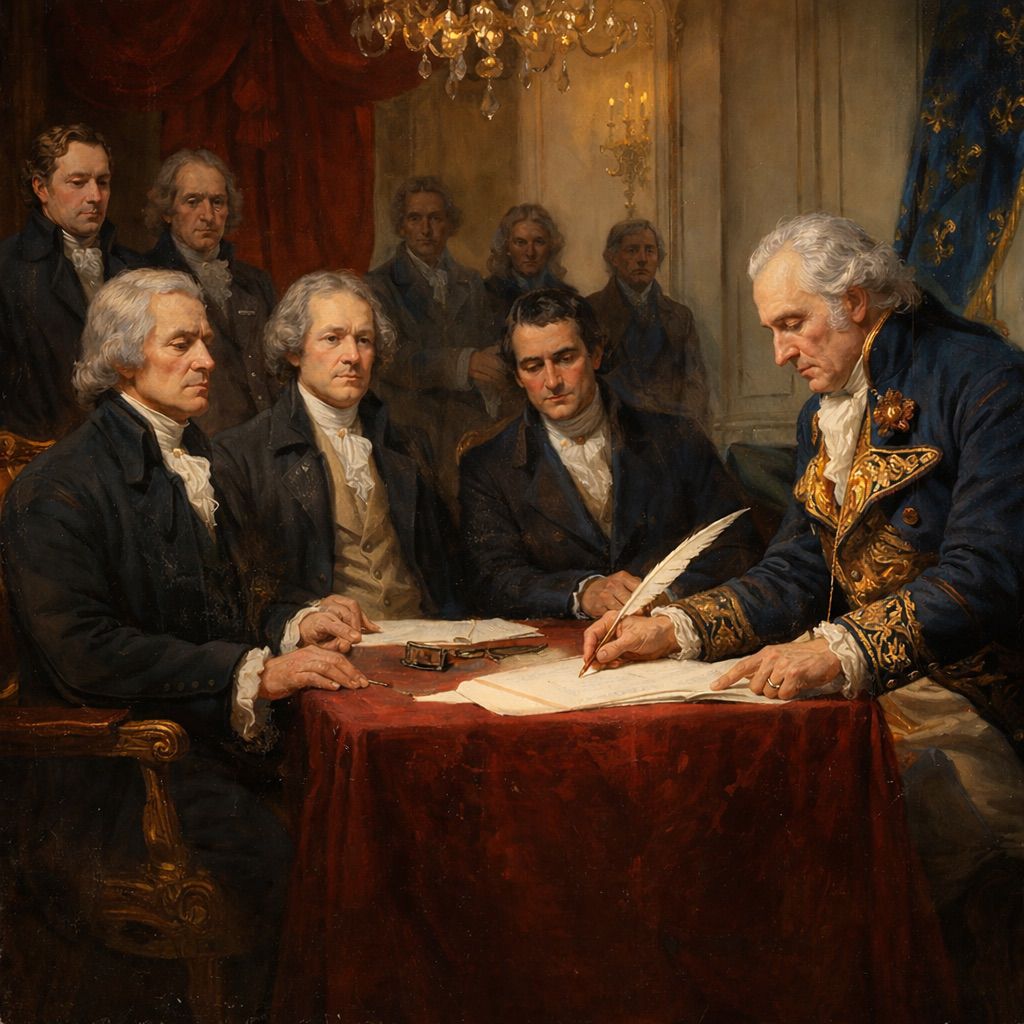
The year 1803 was one of great significance for the young United States, as it marked the formal completion of the Louisiana Purchase, a land deal that would forever change the country’s geography and shape its future. The acquisition of this vast territory from France had been years in the making, and involved a complex web of politics, diplomacy, and intrigue.
The idea of an American empire had long been a topic of discussion among policymakers and expansionists. As early as the 1780s, Thomas Jefferson, then a young statesman, had begun to advocate for the acquisition of new territory west of the Mississippi River. He saw this as essential for the growth and prosperity of the United States, as it would provide a buffer against British and Spanish encroachment in North America.
However, it was not until 1801 that Jefferson’s vision began to take shape. That year, Napoleon Bonaparte, the French leader who had risen to power through his military conquests, announced plans to re-establish a French empire in North America. He envisioned a vast territory stretching from the Great Lakes to the Gulf of Mexico, with New Orleans as its capital. This was seen as a direct challenge to American interests and ambitions.
Napoleon’s plan was to establish a string of forts and trading posts along the Mississippi River, which would allow him to control the flow of commerce between the Louisiana Territory and the rest of the continent. Jefferson knew that this would be catastrophic for the United States, which relied heavily on trade with the South. He also saw an opportunity to secure American interests by purchasing the territory from France.
In March 1803, Robert Livingston, James Monroe, and François Barbé-Marbois, representing the French government, signed the Louisiana Purchase treaty in Paris. The deal was worth $15 million, a staggering sum that would be equivalent to over $250 million today. However, it was not just about the money; this acquisition represented a fundamental shift in American policy, as Jefferson and his allies had long envisioned an expansionist agenda for the country.
The news of the treaty spread like wildfire across the United States, with many Americans hailing it as one of the greatest achievements of their young nation. However, there were also those who opposed the deal, arguing that it was unconstitutional and would lead to increased conflict with Native American tribes.
As the purchase was finalized, Jefferson knew that he had to navigate a delicate web of politics and diplomacy to ensure its success. He appointed William Pinckney as the new U.S. Minister to France, where he negotiated the transfer of ownership with French officials. Meanwhile, Jefferson also instructed his secretary of war, Henry Dearborn, to begin making preparations for the occupation of New Orleans.
On May 20, 1803, a ceremony was held in New Orleans to mark the transfer of authority from French to American hands. Pierre LaFleur, the last French governor of Louisiana, handed over the keys to William Claiborne, the new U.S. governor. However, it would be another two years before the formal completion of the purchase.
The Louisiana Purchase was not without its challenges and controversies. Jefferson faced opposition from within his own party, with some members questioning the constitutionality of the deal. He also had to contend with the concerns of Native American tribes who saw the acquisition as a threat to their lands and way of life.
Despite these obstacles, Jefferson remained committed to the vision he had first outlined in the 1780s. He saw the Louisiana Purchase as a means to achieve his goal of an “empire of liberty,” which would spread across North America and bring about a new era of prosperity and growth for the United States.
On June 15, 1805, Congress formally ratified the Louisiana Purchase treaty, marking its official completion. Jefferson celebrated this achievement by signing the document in the presence of his cabinet and other officials. The purchase was hailed as one of the greatest successes of American diplomacy, securing a vast new territory that would help shape the country’s future.
As the 19th century dawned, the United States had expanded exponentially, with its borders now stretching from the Atlantic Ocean to the Rocky Mountains. This marked a significant turning point in American history, as the nation began to assert its influence on the global stage.
The Louisiana Purchase was not only a monumental achievement for Jefferson and his administration but also a testament to the enduring spirit of American expansionism. The acquisition of this vast territory had far-reaching consequences, shaping the country’s geography, politics, and economy in profound ways.
One of the most significant impacts of the purchase was the rapid growth of the United States. The Louisiana Territory, which spanned over 828,000 square miles, provided a vast new landmass for American settlers to explore and settle. This led to a surge in population growth, as thousands of pioneers flocked to the region, seeking new opportunities and a fresh start.
The expansion also had significant implications for Native American tribes, who saw the acquisition as a threat to their lands and way of life. Many tribes had long inhabited the Louisiana Territory, with some having established thriving communities along the Mississippi River. However, with the arrival of American settlers, tensions began to rise, leading to conflicts over land ownership and resource management.
Jefferson’s vision for an “empire of liberty” was not without its contradictions. While he sought to extend American influence across North America, he also recognized the importance of respecting Native American sovereignty. In 1804, Jefferson appointed a commission to negotiate with Native American tribes, led by the influential figure of William Henry Harrison.
However, the complexities of Native American diplomacy proved challenging for Jefferson and his administration. The commission’s efforts were hindered by the conflicting interests of various tribal groups, as well as the limited understanding of their cultures and traditions. Despite these challenges, Jefferson remained committed to finding a solution that would balance the needs of both the United States and its Native American neighbors.
In addition to its cultural and economic implications, the Louisiana Purchase also had significant military and strategic consequences. The acquisition provided the United States with control over the Mississippi River, which became a vital transportation artery for trade and commerce. This allowed American merchants to bypass the need for costly sea routes, significantly reducing shipping costs and increasing profitability.
The purchase also marked a turning point in American diplomacy, as the country began to assert its influence on the global stage. The Louisiana Purchase treaty served as a model for future agreements between nations, demonstrating the potential for mutually beneficial arrangements that could shape international relations.
As the 19th century dawned, the United States had emerged as a formidable presence in North America. The acquisition of the Louisiana Territory marked a significant milestone in American expansionism, setting the stage for further growth and development. Jefferson’s vision of an “empire of liberty” continued to inspire generations of Americans, shaping their understanding of national identity and purpose.
However, not all Americans shared this vision. Many critics questioned the constitutionality of the purchase, arguing that it was a gross overreach of executive authority. They saw the Louisiana Purchase as an example of the dangers of imperial ambition, warning of the potential for tyranny and oppression.
Jefferson’s opponents within his own party also raised concerns about the treaty, citing its long-term implications for American democracy. These critics argued that the purchase would lead to increased conflict with Native American tribes, exacerbate regional tensions, and undermine the federal system.
Despite these criticisms, Jefferson remained committed to his vision of an expanding America. He saw the Louisiana Purchase as a necessary step towards securing American interests and preserving national unity. This conviction was reflected in his famous “letter to Marquis de Lafayette,” written in 1803, where he expressed his hope that the purchase would mark a new era of cooperation between nations.
As the purchase was finalized, Jefferson knew that its impact would be felt for generations to come. He recognized that this acquisition represented a fundamental shift in American policy, as the country began to assert its influence on the global stage. The Louisiana Purchase marked a significant turning point in American history, shaping the nation’s geography, politics, and economy in profound ways.
In 1805, Jefferson hosted a grand celebration at Monticello to mark the formal completion of the purchase. Guests included prominent politicians, diplomats, and intellectuals from across the country, all of whom came together to celebrate this monumental achievement. The festivities were marked by speeches, music, and feasting, as Americans came together to commemorate their nation’s growth and expansion.
The Louisiana Purchase also had a profound impact on American culture and identity. As the country expanded westward, it encountered diverse cultures and traditions that would shape its understanding of itself and its place in the world. The acquisition marked the beginning of a new era of exploration and discovery, as Americans set their sights on the vast territories beyond the Mississippi River.
The legacy of the Louisiana Purchase continues to resonate today, influencing American politics, culture, and identity. It serves as a testament to the enduring spirit of American expansionism, shaping the nation’s geography, economy, and diplomacy in profound ways. As historians continue to explore its complexities and nuances, one thing is clear: the Louisiana Purchase marked a significant turning point in American history, forever changing the country’s trajectory and setting the stage for its emergence as a global superpower.