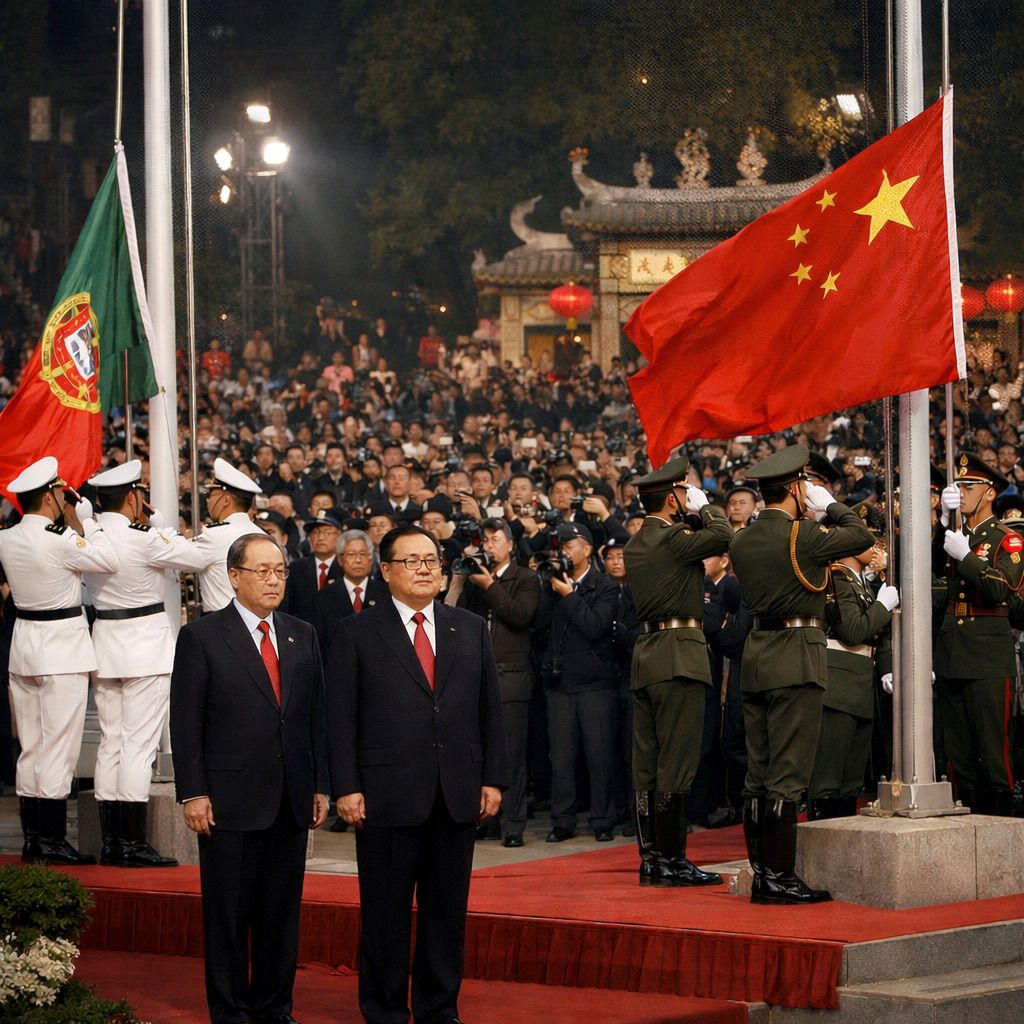
In the early morning hours of December 20, 1999, Macau’s streets were abuzz with activity as the eyes of the world turned towards this tiny Portuguese enclave on the southern coast of China. For nearly five centuries, Macau had been a colonial outpost of Portugal, a place where East met West and where the rhythms of the Orient merged with those of the Mediterranean. But now, after more than 400 years of Portuguese rule, Macau was set to return to its rightful owners: the People’s Republic of China.
The handover ceremony, which took place in the forecourt of the Kun Iam Temple, marked a significant moment in modern history, one that would have far-reaching implications for the people of Macau, for Portugal, and for China itself. The crowd was immense, comprising local residents, journalists from around the world, and high-ranking officials from Beijing and Lisbon.
As the clock struck 00:02 on December 20, the Portuguese flag was lowered, and the Chinese national anthem was played. This marked the official transfer of sovereignty over Macau to China, a process that had been months in the making. The scene was one of great pomp and ceremony, with Chinese President Jiang Zemin and his Portuguese counterpart, Jorge Sampaio, flanked by senior officials from both governments.
But behind the pageantry and spectacle lay a complex web of politics, economics, and diplomacy. For centuries, Macau had been a strategic outpost for Portugal in Asia, providing access to China’s vast markets and resources. As colonial powers vied for control in the region, Macau became an important hub for trade and commerce. In the late 19th century, Portugal signed a series of treaties with China, which effectively placed Macau under Portuguese jurisdiction.
However, as decolonization swept across Africa and Asia in the mid-20th century, Portugal found itself increasingly isolated in its colonies. The Carnation Revolution of 1974 brought an end to the dictatorship that had ruled Portugal for nearly five decades, but it also led to a re-evaluation of the country’s colonial policies. In Macau, this meant the beginning of a transition period towards eventual handover to China.
The Sino-Portuguese Joint Declaration, signed in 1987, marked a significant milestone in this process. This agreement outlined the terms under which Portugal would transfer sovereignty over Macau to China on December 20, 1999. The document included provisions for the protection of individual rights and freedoms, as well as measures aimed at preserving Macau’s unique cultural identity.
As the handover date approached, tensions rose in Macau between those who welcomed the return to Chinese rule and others who feared a loss of autonomy and freedom. For many residents, particularly those of Portuguese ancestry, there was a deep-seated attachment to the colonial legacy that had shaped their lives for generations. Some worried about the impact on Macau’s economy, which relied heavily on gaming and tourism.
Others, however, saw the handover as an opportunity for growth and development. China’s economic rise in the 1980s and 1990s had created a massive market for Macau’s products, from textiles to electronics. The city’s casino industry, which was dominated by Portuguese firms such as Sociedade de Jogos de Macau (SJM), stood to benefit greatly from increased access to mainland Chinese visitors.
The handover ceremony itself was a masterclass in diplomatic protocol and symbolic gesture-making. Jiang Zemin, flanked by his Portuguese counterpart, Sampaio, delivered a speech that emphasized the importance of maintaining close ties between China and Portugal. He also praised Macau’s unique cultural heritage and its strategic position as a bridge between East and West.
For the people of Macau, the return to Chinese rule marked the beginning of a new era. The first years following the handover were marked by significant economic growth, driven in part by increased investment from China. Macau’s casino industry boomed, with SJM’s Stanley Ho becoming one of the city’s richest men.
However, beneath the surface of this rapid development lay deeper issues. As China asserted its control over Macau, concerns grew about the erosion of individual freedoms and human rights. The city’s democratic institutions were largely dismantled in favor of a more authoritarian system, with Beijing exerting significant influence over local politics.
In the years since 1999, Macau has continued to evolve as a unique blend of East and West. Today, it is one of Asia’s premier gaming destinations, attracting visitors from across the globe. But beneath its glitzy façade lies a complex web of history, culture, and politics that continues to shape the lives of its residents.
As the handover ceremony came to a close, Macau’s residents were left to ponder their future under Chinese rule. For many, there was a sense of nostalgia for the Portuguese colonial era, which had brought a unique blend of Western culture and Asian traditions to the city. The sound of fado music still lingered in the air, while the scent of saltwater taffy and traditional Portuguese pastries wafted from street vendors.
But amidst this nostalgic atmosphere, there was also a sense of uncertainty about what lay ahead. Would Macau continue to thrive as a major gaming hub? Or would its economy suffer under China’s more restrictive policies? The answers to these questions were far from clear, but one thing was certain: the handover marked a significant turning point in the city’s history.
In the months and years that followed, Macau underwent a remarkable transformation. The city’s infrastructure was upgraded, with new roads, bridges, and public buildings springing up across its landscape. Chinese investment poured into the city, driving economic growth and creating thousands of new jobs. Macau’s casino industry boomed, with SJM’s Stanley Ho becoming one of the city’s richest men.
However, beneath this façade of prosperity lay deeper issues. As China asserted its control over Macau, concerns grew about the erosion of individual freedoms and human rights. The city’s democratic institutions were largely dismantled in favor of a more authoritarian system, with Beijing exerting significant influence over local politics. This was a far cry from the days when Macau had been a semi-autonomous territory, governed by its own laws and regulations.
One of the most contentious issues was the role of the Portuguese language and culture in Macau’s daily life. For generations, Portuguese had been an official language alongside Chinese, with many residents speaking it as their first language. But under Chinese rule, there were concerns that this cultural heritage would be eroded, replaced by Mandarin Chinese as the dominant language.
In 2001, the Macau government introduced a new law that made Mandarin Chinese the primary language for all official business and education. This sparked widespread protests among residents who had grown up speaking Portuguese, with many arguing that their cultural identity was being threatened. The issue became a major point of contention between Beijing and Lisbon, with China insisting on the importance of promoting Mandarin Chinese as a unifying force.
Meanwhile, Macau’s economy continued to boom, driven by its thriving casino industry and increasing tourism numbers. The city’s skyline began to change dramatically, with towering skyscrapers and grand hotels springing up across its landscape. But amidst this rapid development, there were growing concerns about the impact on the environment and public health.
Macau’s waterways became increasingly polluted, with trash and waste from casinos and restaurants spilling into the sea. Air pollution worsened, with the city’s infamous smog becoming a major concern for residents and visitors alike. The once-pristine beaches of Macau began to suffer, with tourists complaining about the unsightly mess.
As these issues came to light, there were growing calls for greater transparency and accountability from the government. But in practice, this proved difficult, given Beijing’s tight control over local politics. In 2012, a high-profile corruption scandal involving several top officials sparked widespread outrage among residents, with many calling for greater accountability and reform.
In the years that followed, Macau’s government implemented various measures to address these concerns, including increased investment in environmental protection and public health initiatives. But underlying issues persisted, reflecting deeper structural problems within the city’s governance system.
One of the most significant challenges facing Macau was its growing reliance on gaming revenue, which accounted for over 80% of the city’s GDP. This created a precarious economic situation, with the city vulnerable to fluctuations in the global economy and changing attitudes towards gaming. Moreover, this focus on gaming obscured deeper issues, such as poverty and inequality, which remained significant concerns.
Today, Macau stands at a crossroads, its future shaped by both local and international forces. As China continues to assert its control over the city, there are growing concerns about the erosion of individual freedoms and human rights. The role of the Portuguese language and culture remains a contentious issue, with many residents still advocating for greater recognition.
Meanwhile, Macau’s economy continues to boom, driven by its thriving casino industry and increasing tourism numbers. But amidst this prosperity lies a complex web of challenges, including environmental degradation, public health concerns, and economic vulnerability. As the city looks towards the future, it is clear that there are no easy answers – only a deep-seated recognition of the need for change.
In recent years, Macau has been at the forefront of China’s efforts to promote its “One Belt, One Road” initiative, a vast infrastructure project aimed at connecting Asia with Europe. The city has become a key hub for international trade and investment, attracting major players from around the world. But as it continues on this path, there are growing concerns about the impact on Macau’s unique cultural identity.
As the years pass, the handover ceremony of 1999 becomes increasingly distant, a relic of a bygone era. But its legacy lives on in the hearts and minds of Macau’s residents, who continue to grapple with the complexities of their city’s past, present, and future.