It was December 21, 1988, and the world was still reeling from the devastating news of a series of bombings that had rocked the international community in recent months. From the streets of Beirut to the cities of Europe, terrorism had become a household word, with its agents and masters striking fear into the hearts of governments and civilians alike.
But on this particular evening, as Pan American Flight 103 took off from London’s Heathrow Airport bound for New York’s John F. Kennedy International Airport, few could have anticipated the horrors that would soon unfold. The flight was a routine one, carrying 259 passengers and crew members across the Atlantic Ocean in preparation for a holiday season filled with family gatherings and festive celebrations.
However, unbeknownst to those on board, a small group of operatives had been planning this very flight for months, their intent not to merely crash it, but to blow it out of the sky. These men were part of Libyan intelligence, acting under the orders of none other than Muammar Gaddafi himself, the erratic and enigmatic leader of Libya who had made a career out of defying Western powers.
The operatives in question were Abdelbaset al-Megrahi and Lamin Khalifah Fhimah, two men with ties to Libyan intelligence who would soon find themselves at the center of one of the most infamous terrorist attacks in history. Their mission was simple yet devastating: to plant a bomb on Flight 103 that would ensure its destruction over the skies of Scotland.
The device they chose to use was a cleverly designed package of Semtex explosive, wrapped around a timer and concealed within a Toshiba radio cassette player. It was a design eerily reminiscent of previous terrorist attacks in Europe, which had left behind similar calling cards. And it was this very similarity that would ultimately prove to be the undoing of al-Megrahi and Fhimah’s plans.
As Flight 103 soared through the skies above Lockerbie, Scotland, its passengers unaware of the deadly cargo hidden among them, the crew members began to sense something was amiss. The plane was experiencing strange malfunctions, and several alarms were sounded in the cockpit as the pilots struggled to make sense of what was happening.
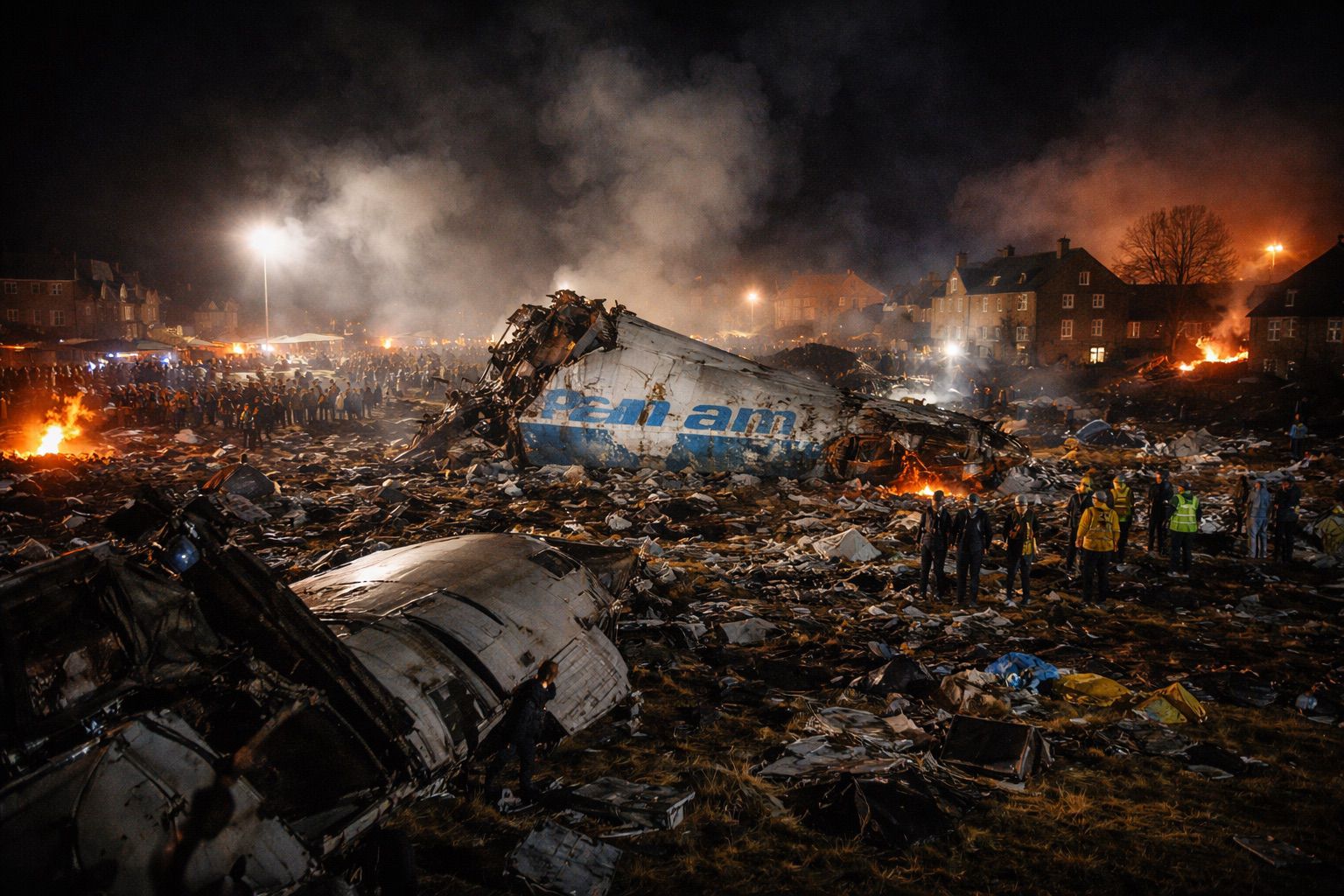
At 7:03 PM GMT, disaster struck. A massive explosion ripped through the plane’s fuselage, sending debris hurtling towards the ground below. The screams of passengers filled the air as the aircraft broke apart, its wings and engines separating from the main body before crashing to earth in a fiery blaze.
The impact was felt for miles around, with reports flooding in of a massive explosion rocking the small Scottish town of Lockerbie. Emergency services were quickly scrambled to the scene, where they found a devastating picture of destruction: 270 people lay dead or dying on the streets below, their bodies mangled beyond recognition by the force of the blast.
The investigation that followed was one of the most complex and far-reaching in modern history, involving intelligence agencies from around the world and a team of forensic experts tasked with unraveling the tangled threads of terrorism. As it turned out, the evidence pointing to al-Megrahi and Fhimah’s involvement was extensive, including eyewitness testimony, flight manifest records, and crucial physical evidence collected from the crash site.
In 1991, the two Libyan agents were indicted by a Scottish court for their role in the bombing. Their trial would become one of the most infamous in history, with prosecutors building a case that relied heavily on circumstantial evidence. In the end, al-Megrahi was found guilty and sentenced to life imprisonment, while Fhimah was acquitted due to lack of evidence.
The Lockerbie bombing marked a turning point in the global struggle against terrorism, as governments and intelligence agencies began to realize that the threats they faced were not limited to traditional state actors, but also included rogue states and non-state actors willing to use violence on an unprecedented scale. It also highlighted the importance of international cooperation in tackling this problem, as nations struggled to share information and coordinate their efforts against a common enemy.
In the aftermath of the disaster, the people of Lockerbie came together to support each other, establishing a memorial garden in honor of those who had lost their lives. As the years passed, however, the town also became synonymous with tragedy and loss, its name becoming a byword for the devastating power of terrorism.
For many, the memory of Pan Am Flight 103 remains etched in their minds like a scar, a reminder of the senseless brutality that can be unleashed upon innocent lives. The bombing also serves as a poignant reminder of the importance of vigilance and cooperation in the face of terror, as nations continue to grapple with the complex web of threats that surround us.
Megrahi’s release from prison on compassionate grounds in 2009 marked a bitter end to a chapter in Scottish justice, but his death in 2012 brought some closure to the families of those affected. Yet, even now, questions remain about the full extent of Libyan involvement and whether other players were involved in the bombing.
The aftermath of Lockerbie also serves as a reminder that terrorism is not limited by geography or politics, nor is it driven solely by ideology or extremism. Rather, it is often the product of complex webs of motivation and circumstance, which can be exploited by individuals and groups willing to do harm.
As we continue to navigate this treacherous landscape, the lessons of Lockerbie remain as relevant today as they were in 1988. They remind us that terrorism will not be vanquished easily or quickly, but rather it demands sustained effort and commitment from governments, intelligence agencies, and ordinary people alike.
The investigation into the Lockerbie bombing was one of the most complex and far-reaching in modern history. It involved intelligence agencies from around the world, including the FBI, MI5, and Scotland Yard, as well as forensic experts who combed through the crash site for clues. The team was led by Lord Justice Comyn, a Scottish judge who would later become a key figure in the trial of al-Megrahi.
As investigators poured over the evidence, they began to piece together a timeline of events leading up to the bombing. They discovered that al-Megrahi and Fhimah had traveled to Malta on November 21, 1988, where they met with Libyan intelligence officials who handed them a bag containing the explosive device. The two men then flew to Frankfurt, Germany, where they boarded Pan Am Flight 103.
The investigation also revealed that al-Megrahi had purchased a ticket for Fhimah under a false name, and that both men had been in contact with Libyan intelligence agents throughout their travels. Forensic experts found fragments of the Toshiba radio cassette player at the crash site, which matched the design of the device used in previous terrorist attacks.
As the investigation continued, investigators began to interview witnesses who had seen al-Megrahi and Fhimah on board Flight 103. One passenger, Paul Holmes, reported seeing a man matching al-Megrahi’s description arguing with a flight attendant just before takeoff. Another witness, Tim Shea, described seeing two men acting suspiciously in the terminal at Heathrow.
The combination of eyewitness testimony, physical evidence, and circumstantial evidence eventually led investigators to conclude that al-Megrahi and Fhimah were responsible for planting the bomb on Flight 103. The Lockerbie bombing was a deliberate act of terrorism, designed to kill as many people as possible and inflict maximum damage on Western targets.
In 1991, the two Libyan agents were indicted by a Scottish court for their role in the bombing. Their trial would become one of the most infamous in history, with prosecutors building a case that relied heavily on circumstantial evidence. Al-Megrahi was found guilty and sentenced to life imprisonment, while Fhimah was acquitted due to lack of evidence.
The Lockerbie bombing marked a turning point in the global struggle against terrorism, as governments and intelligence agencies began to realize that the threats they faced were not limited to traditional state actors, but also included rogue states and non-state actors willing to use violence on an unprecedented scale. It highlighted the importance of international cooperation in tackling this problem, as nations struggled to share information and coordinate their efforts against a common enemy.
In the aftermath of the disaster, the people of Lockerbie came together to support each other, establishing a memorial garden in honor of those who had lost their lives. As the years passed, however, the town also became synonymous with tragedy and loss, its name becoming a byword for the devastating power of terrorism.
For many, the memory of Pan Am Flight 103 remains etched in their minds like a scar, a reminder of the senseless brutality that can be unleashed upon innocent lives. The bombing also serves as a poignant reminder of the importance of vigilance and cooperation in the face of terror, as nations continue to grapple with the complex web of threats that surround us.
In the years following the trial, there were numerous claims of Libyan government involvement in the Lockerbie bombing. Some alleged that Gaddafi himself had ordered the attack, while others claimed that he had given his agents carte blanche to carry out such operations. However, none of these allegations could be proven, and al-Megrahi’s conviction stood as the only tangible result of the investigation.
The aftermath of Lockerbie also serves as a reminder that terrorism is not limited by geography or politics, nor is it driven solely by ideology or extremism. Rather, it is often the product of complex webs of motivation and circumstance, which can be exploited by individuals and groups willing to do harm.
As we continue to navigate this treacherous landscape, the lessons of Lockerbie remain as relevant today as they were in 1988. They remind us that terrorism will not be vanquished easily or quickly, but rather it demands sustained effort and commitment from governments, intelligence agencies, and ordinary people alike.
The legacy of Lockerbie continues to resonate around the world. In 2011, the Scottish government agreed to release al-Megrahi on compassionate grounds due to his terminal illness with prostate cancer. His release was met with widespread criticism, as many felt that he had been given a “get out of jail free” card.
Al-Megrahi’s death in 2012 brought some closure to the families of those affected, but also raised questions about the fairness of his conviction. In the years since, numerous appeals have been lodged on behalf of al-Megrahi and Fhimah, but none have been successful.
In recent years, there has been a growing trend towards re-examining the evidence in the Lockerbie case. Some have argued that new information has come to light, which suggests that the bombing may not have been carried out by Libyan agents after all. However, these claims remain unproven and are widely disputed.
As we look back on the events of December 21, 1988, it is clear that the Lockerbie bombing was a pivotal moment in modern history. It marked a turning point in the global struggle against terrorism, and highlighted the importance of international cooperation in tackling this problem.
The aftermath of Lockerbie also serves as a reminder of the devastating impact of terrorism on innocent lives. The bombing claimed 270 victims, including 189 Americans, and left hundreds more injured or traumatized. It is a stark reminder of the senseless brutality that can be unleashed upon our communities, and the importance of taking action to prevent such tragedies from occurring in the future.
In conclusion, the Lockerbie bombing was a devastating act of terrorism that continues to resonate around the world today. The legacy of this tragedy serves as a poignant reminder of the importance of vigilance and cooperation in the face of terror, and highlights the need for sustained effort and commitment from governments, intelligence agencies, and ordinary people alike.
As we continue to navigate the complex web of threats that surround us, the lessons of Lockerbie remain as relevant today as they were in 1988. They remind us that terrorism is a global problem that demands a collective response, and that it can only be defeated through sustained effort and commitment from all corners of society.