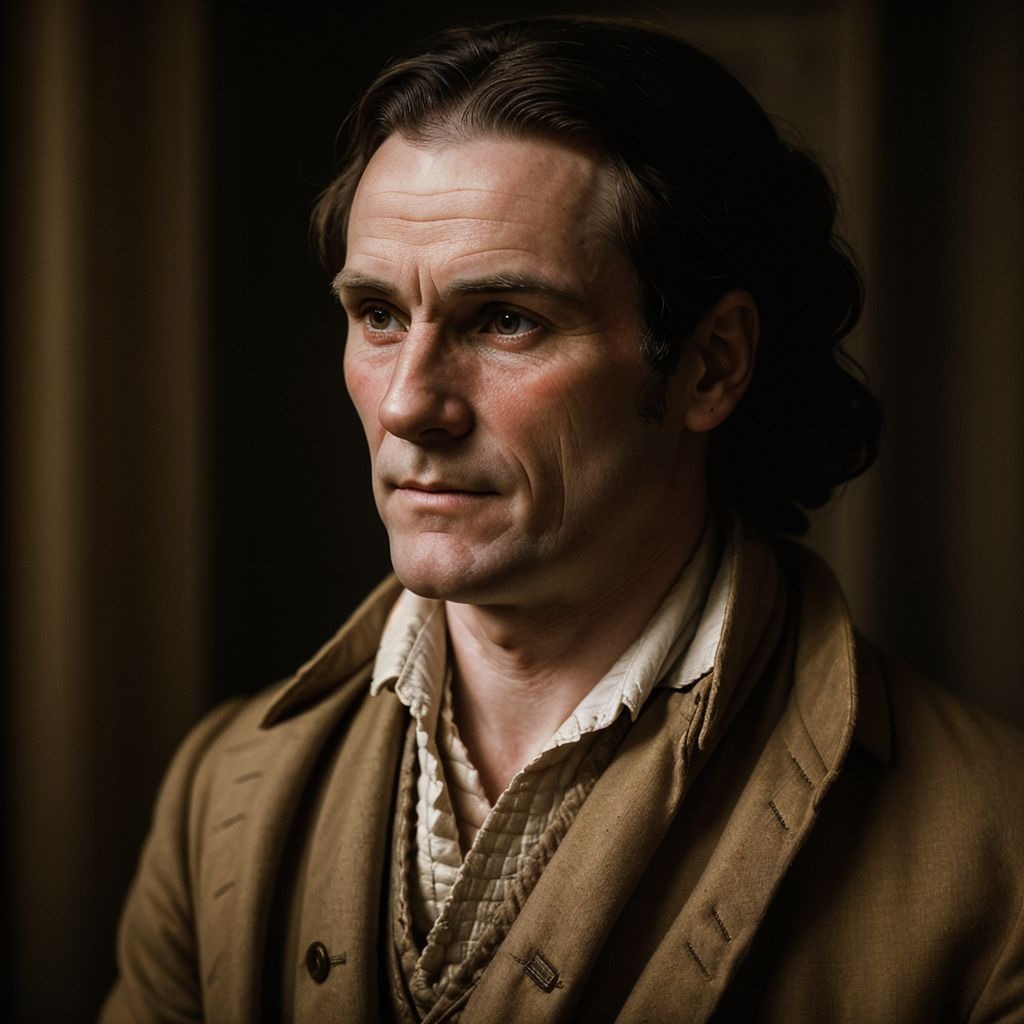
Robert Burns was born in 1759 in Alloway, Ayrshire, into a family sustained by tenant farming. His father, William Burnes, leased marginal land and supplemented the household income through manual labor and instruction. Burns received irregular formal education, supplemented by extensive self-directed reading in English literature, Scots verse, and Enlightenment thought. From an early age, he participated in agricultural labor while composing verse in both Scots and English.
By the early 1780s, Burns began circulating poems within local networks in Ayrshire. These works drew on rural life, social hierarchy, and vernacular speech, employing Scots language in literary forms that had largely been excluded from formal publication. In 1786, he published Poems, Chiefly in the Scottish Dialect in Kilmarnock. The volume received immediate regional attention and led to invitations from literary patrons in Edinburgh.
Burns relocated to Edinburgh later that year, where a second, expanded edition of Poems was issued. The Edinburgh publication placed Burns within the city’s intellectual circles, including editors, publishers, and members of the Scottish Enlightenment. During this period, he produced new poems while revising earlier material. His work continued to employ satire, song, and narrative verse, often addressing religious hypocrisy, social inequality, and moral authority.
Alongside original compositions, Burns undertook extensive work collecting, revising, and adapting traditional Scottish songs. From 1787 onward, he contributed lyrics to projects such as The Scots Musical Museum, editing existing material and supplying original verses. This work emphasized oral tradition, musical performance, and the preservation of Scots language within song.
In 1788, Burns accepted a position as an excise officer, a role he maintained until his death. The appointment provided financial stability but limited his mobility. During this period, he continued to write poetry and correspondence, much of which survives in published letters. These documents record his literary activities, professional obligations, and engagement with publishers and editors.
Burns’s poetry from the late 1780s and early 1790s includes works such as “Tam o’ Shanter,” “Holy Willie’s Prayer,” and “To a Mouse.” These poems employ narrative voice, irony, and vernacular diction to address social behavior, moral judgment, and everyday experience. Religious institutions, class distinction, and authority figures appear frequently as subjects of satire.
Political references within Burns’s writing include expressions of Scottish identity, sympathy with republican ideals, and occasional allusions to Jacobite history. His correspondence records caution regarding public political alignment, particularly after government scrutiny of radical expression increased during the 1790s. Surviving letters indicate an awareness of the professional risks associated with overt political declaration.
Burns married Jean Armour in 1788, with whom he had several children. His domestic life remained closely tied to agricultural communities in Ayrshire and Dumfriesshire. Despite declining health, he continued literary work until his death in Dumfries in 1796 at the age of thirty-seven.
After his death, Burns’s poetry and songs were collected, edited, and widely disseminated. His work became embedded in Scottish cultural life through education, public recitation, musical performance, and annual commemorations. The surviving body of poems, songs, and correspondence constitutes the primary record through which his literary activity is known.
Burns’s writing remains central to the study of Scots language in literature and the preservation of vernacular poetic form within the British literary tradition.