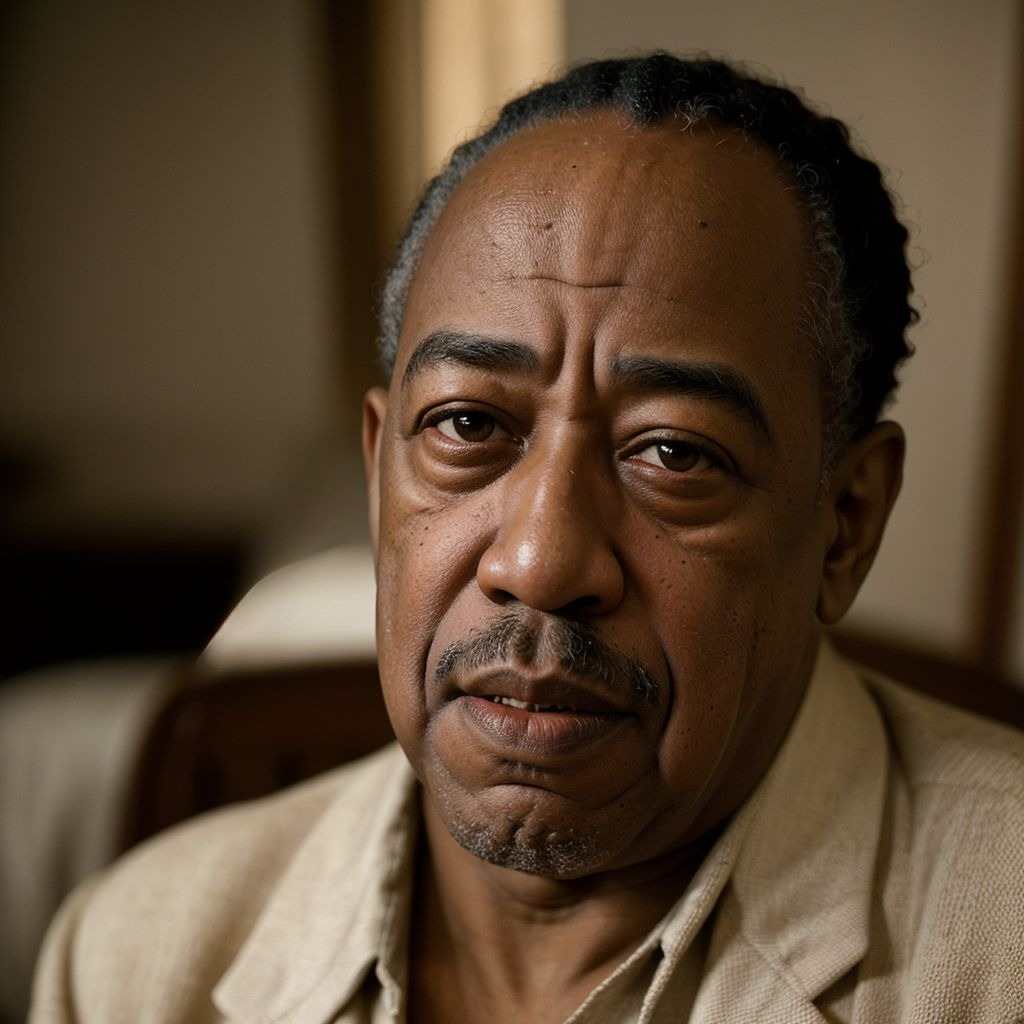
Langston Hughes. I’ve always been drawn to his words, like a moth to a flame that burns bright but uncertain. There’s something about the way he speaks of love and loss, of blackness and identity, that resonates deeply within me.
I think it’s because, on some level, I see myself in his struggles. Not directly, of course – Hughes was a product of the Harlem Renaissance, a movement I only learned about in college. But as I read his poetry and essays, I feel this kinship with him, like we’re both navigating the complexities of being black and American.
For me, it starts with “The Negro Speaks of Rivers.” I remember reading those lines – “I’ve known rivers ancient as the world and older than the flow of human blood in human veins” – and feeling a shiver run down my spine. It’s not just the words themselves, but the way they make me feel: seen, heard, understood.
But it’s also unsettling. Hughes writes about the weight of history, the pain of being torn between two worlds. I think about my own experiences growing up, caught between my white mother and black father, trying to find a sense of belonging in a world that didn’t always make room for me. It’s like he’s speaking directly to my soul, and I’m not sure if it’s comforting or suffocating.
I’ve always been fascinated by the idea of identity – how we define ourselves, and how others see us. Hughes’s work is like a mirror held up to this question, reflecting all the contradictions and paradoxes that come with being black in America. He writes about the beauty of African American culture, but also its brutal suppression.
Sometimes I wonder if he’s talking directly to me, asking: “What are you? Where do you belong?” I feel like I’m searching for answers just as much as Hughes was, even though we’re separated by time and experience.
One thing that draws me to his work is the way he blends poetry with prose. He’s not afraid to get messy, to use language in unexpected ways. It’s like he’s speaking truthfully about himself, without apology or pretension. I admire that.
But it also makes me uncomfortable. His writing can be raw and painful, confronting themes of racism, poverty, and loss head-on. Sometimes I feel like I’m not ready for it – like I need to steel myself before diving in.
I’ve come back to his work again and again, each time finding something new to grapple with. It’s like Hughes is a puzzle I’m trying to solve, but the pieces keep shifting and rearranging themselves. Maybe that’s what makes him so compelling: he never gives me easy answers or clear resolutions.
As I sit here thinking about Langston Hughes, I realize that my fascination with his work has less to do with the man himself than with the questions he raises within me. His poetry and essays are a mirror held up to my own identity, forcing me to confront the complexities of being black, American, and uncertain.
I don’t know what it means to truly understand him – or myself, for that matter. But I do know that his words have become a part of me, like a heartbeat I feel in my chest whenever I read about his struggles, his joys, and his unflinching honesty.
I find myself returning to the same themes over and over – identity, belonging, the search for authenticity. Hughes’s work is like a thread that weaves through these questions, never providing clear answers but always keeping me on my toes. I’ve come to realize that his poetry isn’t just about him; it’s about all of us who feel caught between worlds, searching for a sense of self.
I think back to the words from “The Negro Speaks of Rivers” – those ancient rivers that flow through human veins. It’s as if Hughes is saying that our experiences are connected, that our stories are part of a larger narrative. But what does it mean to be connected when we’re so different? Is it possible to find common ground across cultures and histories?
Sometimes I feel like I’m trying to unravel a knot, pulling at individual strands only to have them tangle even further. Hughes’s work is like that – a tangled web of ideas and emotions that refuse to be untangled. It’s frustrating and exhilarating all at once.
I’ve been reading his essays on jazz and blues, and it’s struck me how similar the sounds are to the rhythms of my own life. The way jazz musicians improvise over familiar melodies, creating something new with each note – it’s like that for me when I write. I’m not sure what I’m trying to say or create, but I know it’s connected to the emotions and experiences that flow through me.
But here’s the thing: Hughes didn’t just write about music; he wrote about life. And life is messy and complicated and sometimes brutal. He confronts these harsh realities head-on, never shying away from the hard questions or painful truths. I admire his courage, but it also makes me nervous – what if I’m not brave enough to face my own demons?
As I continue to read and reread Hughes’s work, I feel like I’m becoming a part of it – like his words are seeping into my skin, becoming a part of who I am. It’s both exhilarating and terrifying, this sense of absorption. Am I losing myself in his stories, or finding myself in the process?
I find myself lost in the intersection of Hughes’s world and mine, searching for that elusive connection between our experiences. His words become a kind of cartography, mapping the contours of my own identity. But as I delve deeper into his work, I start to notice the silences – the gaps between the lines, the unspoken emotions, the untold stories.
It’s like he’s showing me the invisible threads that bind us all together, but also the ones that tear us apart. His writing is a kind of surgical precision, cutting through the noise and getting straight to the heart of the matter. But sometimes I feel like I’m stuck in the operating room, watching as he dissects the very fabric of our humanity.
Take his poem “Mother to Son.” It’s a powerful exploration of resilience, of the ways in which we’re shaped by the experiences of those who came before us. The speaker’s words are like a gentle but firm hand on my shoulder, urging me to keep moving forward even when the path ahead is uncertain. But it’s also a painful reminder that I’m not immune to the struggles he writes about – that my own mother’s story is one of sacrifice and struggle, of trying to create a better life for her children despite the odds against her.
I wonder if Hughes knew this would be his legacy – that his words would continue to resonate with generations after him. Or was it simply a byproduct of his artistry, a natural extension of his vision? Sometimes I feel like I’m eavesdropping on a private conversation, one that’s meant for me alone but also speaks directly to the hearts of those who’ve come before me.
It’s this sense of connection that draws me back to his work again and again. Not just because he writes about blackness and identity, but because he writes about humanity – all its complexities, contradictions, and frailties. His poetry is a mirror held up to our shared experience, reflecting both the beauty and the brutality of life.
As I sit here thinking about Langston Hughes, I realize that his work has become a kind of anchor for me – a reminder that I’m not alone in this journey, that there are others who’ve walked similar paths before me. His words are a lifeline, connecting me to a larger community that spans time and space.
But even as I feel this sense of connection, I’m aware of the distance between us – the differences in our experiences, our contexts, our cultures. It’s like trying to bridge two rivers, each with its own currents and depths. How do we find common ground when the waters are so different? Is it possible to speak a language that transcends borders and histories?
These questions swirl inside me as I continue to read Hughes’s work, searching for answers that may never come. But perhaps that’s the point – not to find resolution or closure, but to keep exploring, to keep grappling with the complexities of our shared humanity.
As I ponder these questions, I’m reminded of a conversation I had with my friend and colleague, Rachel, about her own experiences as a black woman in America. She spoke of feeling like she’s constantly navigating multiple worlds, never quite finding her footing in either one. It was as if she was living in the spaces between two rivers, just as Hughes wrote about in “The Negro Speaks of Rivers.” Her words resonated deeply with me, and I felt a sense of solidarity, knowing that we were both struggling to find our place in this complex landscape.
Rachel’s story reminded me of another essay by Hughes, one that explores the tension between assimilation and resistance. He writes about how African Americans have always been caught between the desire to be seen as equal and the need to maintain their cultural identity. It’s a delicate balance, one that requires constant negotiation and self-reflection.
As I think about this dynamic, I’m struck by the ways in which Hughes’s work continues to speak to me across time and space. His words are like a mirror held up to our shared experiences as black people in America, but also as individuals navigating the complexities of identity and belonging. He reminds us that we’re not alone in our struggles, that there have been countless others who’ve walked similar paths before us.
But what does it mean to find common ground with someone from a different time and place? Is it possible to transcend the boundaries of culture, history, and experience? These questions linger in my mind as I continue to read Hughes’s work, searching for answers that may never come. And yet, even in the uncertainty, I feel a sense of connection to this writer who lived so long ago but still speaks so powerfully to me today.
Perhaps it’s because his words have become a part of me, seeping into my skin like a slow-moving river. Or maybe it’s because he reminds me that our experiences are not unique, that we’re all connected in ways both visible and invisible. Whatever the reason, I know that Langston Hughes will continue to be a source of inspiration and guidance for me as I navigate the complexities of being black, American, and uncertain.
As I close this essay, I’m left with more questions than answers, but also a deeper appreciation for the power of art to connect us across time and space. Hughes’s work is like a thread that weaves through our shared experiences, a reminder that we’re not alone in this journey. And even as I struggle to find my place within it, I know that his words will continue to guide me forward, illuminating the path ahead with their fierce honesty and unwavering compassion.
As I reflect on Langston Hughes’s work, I’m struck by the way he uses language to capture the complexities of human experience. His poetry is like a musical composition, weaving together disparate threads to create a rich tapestry of sound and emotion. He has a way of distilling the essence of life into simple, yet powerful words that resonate deep within me.
I think back to his essay on jazz, where he writes about the improvisational spirit of musicians like Duke Ellington and Charlie Parker. They take familiar melodies and turn them into something new, something original, something that speaks to the heart of their own experiences as black Americans. Hughes sees this same spirit in the work of African American writers, who take the raw material of their lives and shape it into art that is both personal and universal.
For me, this idea of improvisation speaks directly to my own writing process. When I sit down with a blank page or screen, I feel a sense of uncertainty, like I’m standing at the edge of a river with no clear path ahead. But as I begin to write, something starts to flow – ideas, emotions, memories – and before I know it, I’ve created something new, something that reflects my own unique perspective on the world.
It’s this feeling of creation, of bringing something into being, that draws me to Hughes’s work. He writes about the power of art to transform our lives, to give us a sense of hope and purpose in the face of adversity. His words are like a lifeline, connecting me to a larger community of writers and artists who have struggled with similar questions and doubts.
But even as I admire Hughes’s craft, I’m aware that his work is not just about aesthetics; it’s also about politics. He writes about racism, poverty, and inequality, using his words to challenge the status quo and demand justice for African Americans. This was a radical act in its time, and one that continues to resonate today.
As I think about Hughes’s commitment to social justice, I’m reminded of my own experiences as a young black woman navigating the complexities of identity and belonging. Growing up, I often felt like an outsider, caught between two worlds that didn’t always make room for me. But through writing, I’ve found a way to express myself, to tell my story in all its complexity and nuance.
Hughes’s work has given me permission to do this, to speak truthfully about my own experiences without apology or pretension. His words have become a kind of manifesto, a call to action that reminds me of the power of art to transform our lives and challenge the systems that oppress us.
As I continue to read Hughes’s work, I’m struck by the way he uses his words to build bridges between different cultures and communities. He writes about African American culture with pride and passion, but also acknowledges its connections to other traditions and experiences. This sense of interconnectedness is something that resonates deeply with me, as I navigate my own relationships with people from diverse backgrounds.
For Hughes, this connection is not just about aesthetics; it’s also about politics. He writes about the ways in which racism and oppression have been used to divide us, to create artificial boundaries between different groups of people. His words are a powerful call to action, urging us to reject these divisions and build bridges instead.
As I reflect on this idea, I’m reminded of my own experiences as a student at college, where I was surrounded by people from all walks of life. It was a diverse community, but also one that was often divided along lines of race, class, and identity. Hughes’s work spoke to me during those times, reminding me of the power of art to bring us together across our differences.
Now, as I look out at the world around me, I see the same divisions and tensions playing out in real-time. But I also see the potential for connection and solidarity, for people from different backgrounds to come together and build something new. Hughes’s work has given me hope that this is possible, that we can create a more just and equitable society through our words and actions.
As I close my essay on Langston Hughes, I’m left with a sense of wonder and awe at the power of his words. His poetry and essays have become a part of me, shaping my thoughts and feelings about identity, belonging, and social justice. But they’ve also given me something more – a sense of connection to a larger community of writers, artists, and activists who are working towards a common goal.
Hughes’s work will continue to be a source of inspiration for me as I navigate the complexities of my own life and world. His words remind me that art has the power to transform us, to connect us across our differences and give us hope in the face of adversity.