
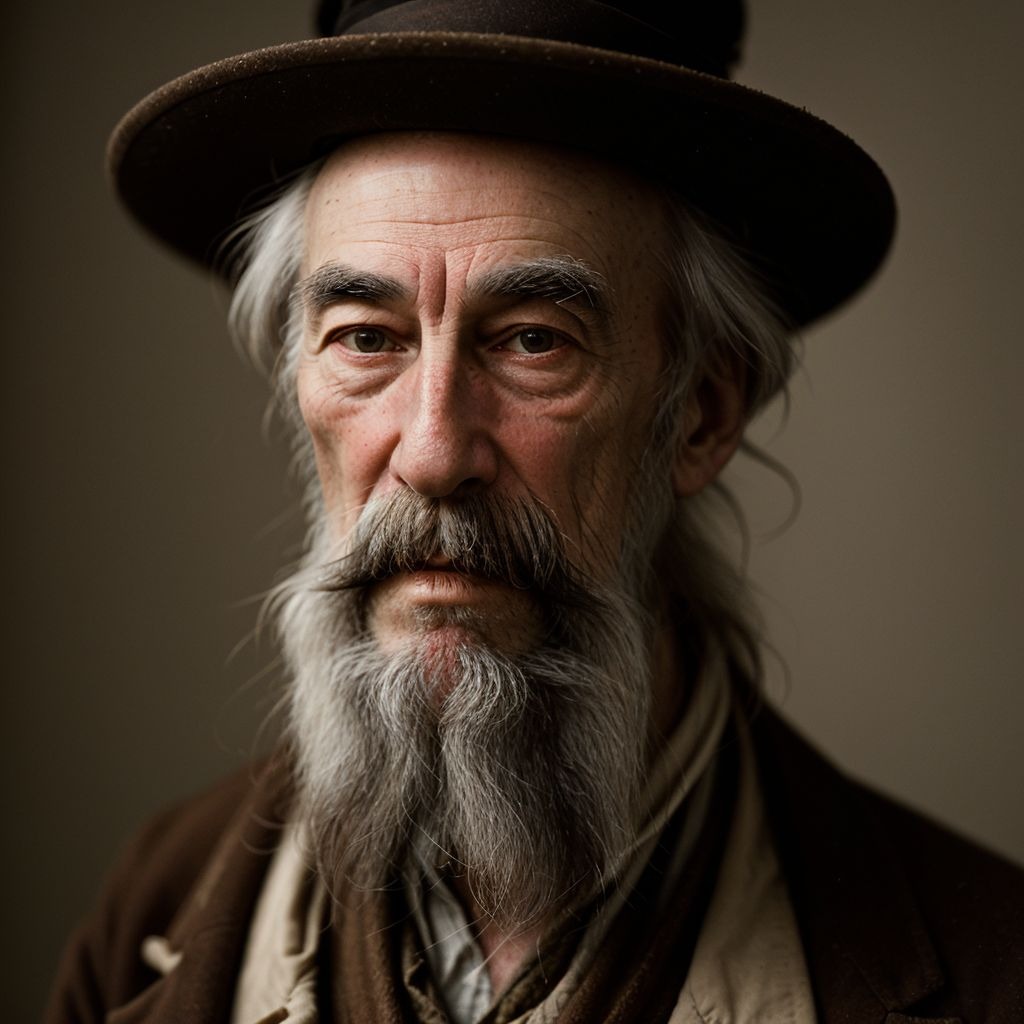
Walt Whitman’s poetry has been a constant companion throughout my college years, and even now that I’ve graduated, his words still linger in my mind like the echoes of a conversation I’d rather not end. There’s something about his openness, his willingness to explore the complexities of human experience, that resonates with me.
I think what draws me to Whitman is his ambivalence – he embodies both confidence and vulnerability at the same time. In “Song of Myself,” he writes about himself as a poet, a body, a soul, a universe all at once. It’s exhilarating and intimidating in equal measure. I find myself wondering if that’s what it means to be whole: to hold contradictions together without being torn apart by them.
Reading Whitman, I’m struck by how his poetry defies traditional notions of beauty and meaning. He celebrates the mundane – a worker’s calloused hands, a child’s laughter, the taste of grass on the tongue – and yet these moments are transformed into something transcendent. It’s as if he’s telling me that even in the most ordinary experiences lies a depth I’ve never considered before.
But what unsettles me is Whitman’s relationship with his own body. In “Song of Myself,” he describes his genitals as “the testicles tighten’d, the semen fluid” (52). It’s jarring to read those words today, especially when compared to the more sanitized language often used in poetry. I wonder if Whitman was pushing boundaries for its own sake or if he genuinely wanted to reclaim his body from societal constraints.
As someone who writes as a way to process her thoughts and emotions, I’m intrigued by Whitman’s willingness to confront the uncomfortable aspects of himself and others. His poetry is not afraid to be messy; it’s a space where contradictions are explored rather than resolved. It makes me think about my own writing – how often do I shy away from exploring the complexities of my characters’ experiences? How much am I willing to get dirty in pursuit of truth?
When reading Whitman, I’m acutely aware of my own limitations and biases. His poetry challenges me to see beyond my narrow perspective, to consider multiple viewpoints without judgment. It’s a humbling experience, one that makes me question my own assumptions about what it means to be human.
I’ve always been fascinated by the tension between Whitman’s celebration of individuality and his desire for connection with others. In “When Lilacs Last in the Dooryard Bloom’d,” he laments the death of President Lincoln, mourning the loss of a nation’s sense of unity and purpose. It’s a poem that speaks to my own fears about disconnection – how can we find our way back to each other when everything seems to be pulling us apart?
Perhaps it’s Whitman’s ability to hold opposing ideas together that draws me to him most. His poetry is not about finding resolution or answers; instead, it’s an invitation to inhabit the space of uncertainty, to explore the intricate web of contradictions that make up human experience.
As I close this essay (or perhaps just pause in my thoughts), I’m left with more questions than answers. What does it mean to be whole? Can we truly embody both confidence and vulnerability at the same time? And what lies beyond the edges of our individual perspectives, waiting to be discovered? Walt Whitman’s poetry has taught me that these are questions worth asking, and that sometimes the most profound insights come from embracing the complexity of our own uncertainties.
One thing that continues to resonate with me about Whitman is his emphasis on the importance of embodied experience. In “Song of Myself,” he writes about the body as a site of wonder and awe, full of sensations and feelings that are worth exploring. For someone like me who has often felt disconnected from her own body, this is a powerful message.
As I reflect on my own experiences with anxiety and disordered eating, I realize that I’ve often tried to separate myself from my physical self. I’ve written about it before – how I’ve struggled to feel comfortable in my skin, how I’ve felt like an outsider looking in at the world around me. Whitman’s poetry challenges me to rethink this approach, to see my body as a source of strength and beauty rather than something to be controlled or managed.
But what if that’s not possible? What if my body is inherently messy, unpredictable, and imperfect – just like the world itself? I think about all the times I’ve tried to tame myself, to fit into societal norms of beauty and health. And yet, it’s in those moments when I let go of control, when I allow myself to be present with my feelings and sensations, that I feel most alive.
Whitman’s poetry is a reminder that this kind of embodied experience is not just a personal goal, but also a social imperative. He writes about the importance of celebrating the diversity of human experience – all shapes, sizes, ages, abilities, and backgrounds. It’s a vision that feels radical to me, especially in today’s culture where individualism and perfectionism can be so overwhelming.
As I continue to grapple with these ideas, I’m struck by how Whitman’s poetry is not just about himself, but also about the world around him. He writes about the complexities of social justice – racism, poverty, war – and yet he does it in a way that feels both intimate and expansive. It’s as if he’s saying, “Look, this is what I see, this is what I feel, and you should too.”
This is where my own writing gets stuck sometimes – trying to balance the personal with the universal. How do I convey the nuances of my own experiences without losing sight of the broader context? Whitman’s poetry shows me that it’s possible to do both, to write about myself in a way that feels true and authentic while also speaking to the world around us.
I’m left wondering what this might look like for me as a writer – how can I embody this kind of embodied experience, this sense of social responsibility, in my own work? What would happen if I started writing about the body not just as a source of pain or suffering, but also as a site of wonder and awe?
As I delve deeper into Whitman’s poetry, I’m struck by how his words continue to challenge me to think about my own relationship with my body. He writes about the importance of sensation and feeling, of embracing the messiness and unpredictability of human experience. It’s a perspective that feels radical to me, especially in a culture where we’re often encouraged to numb ourselves to our emotions and desires.
I think back to all the times I’ve tried to silence my body, to quiet its whispers and doubts. The anxiety, the self-doubt, the constant quest for perfection – it’s been a never-ending cycle of trying to control what feels uncontrollable. But Whitman’s poetry shows me that this is exactly where the magic happens, where the true depths of human experience reside.
When I read his words about the body as a site of wonder and awe, I feel a sense of longing, of yearning for a way of being that feels more authentic and embodied. It’s not just about self-acceptance or self-love – it’s about embracing the complexity and messiness of human existence.
As I think about my own writing, I’m struck by how often I’ve tried to write around these issues, to avoid confronting the complexities of my own body and experiences. But Whitman’s poetry shows me that this is exactly where the most powerful stories come from – the places of vulnerability, uncertainty, and doubt.
I’m left wondering what it would be like to write a poem about my own body, about its strengths and weaknesses, its desires and fears. What would happen if I wrote about the times I’ve felt disconnected, disordered, or lost? Would I be able to capture the nuances of my own experiences without succumbing to shame or self-doubt?
Whitman’s poetry teaches me that it’s possible to write about these things without judgment, without apology. His words are a reminder that the body is not just a physical entity, but also a source of wisdom and insight. It’s a perspective that feels both liberating and terrifying – what if I were to truly listen to my own body, to honor its needs and desires?
As I continue to explore these ideas, I’m struck by how Whitman’s poetry speaks to the world around us, to the societal pressures and expectations that shape our experiences. He writes about the importance of community and connection, of finding common ground with others despite our differences.
It’s a message that feels urgent in today’s culture, where division and polarization seem to reign supreme. I think about all the times I’ve felt disconnected from others, like an outsider looking in at the world around me. Whitman’s poetry shows me that this is exactly what it means to be human – we’re messy, complicated, contradictory beings, connected to each other in ways both visible and invisible.
As I close this reflection (or perhaps just pause in my thoughts), I’m left with more questions than answers. What would happen if I were to truly embody Whitman’s vision of embodied experience? How might it change the way I write about myself, about others, and about the world around me? And what lies beyond the edges of our individual perspectives, waiting to be discovered?
The more I delve into Whitman’s poetry, the more I’m struck by its relevance to my own experiences as a woman in today’s society. His emphasis on embodied experience, on celebrating the diversity of human form and function, feels like a radical act of resistance against the pressures of societal beauty standards.
As someone who has struggled with body image issues and disordered eating, I’m acutely aware of how easily we can become trapped in our own narratives of shame and self-doubt. Whitman’s poetry shows me that it’s possible to rewrite these stories, to see my body as a source of strength and beauty rather than something to be controlled or managed.
But what if this isn’t just about individual transformation? What if embodied experience is also a social imperative, one that requires us to challenge the dominant narratives of beauty and health that shape our culture?
Whitman’s poetry suggests that this is exactly what we need to do – to reclaim our bodies from societal constraints, to see ourselves as complex, multifaceted beings worthy of celebration. It’s a vision that feels both exhilarating and terrifying, one that requires us to confront the uncomfortable aspects of our own experiences.
As I think about my own writing, I’m struck by how often I’ve tried to shy away from exploring these issues, to avoid confronting the complexities of my own body and experiences. But Whitman’s poetry shows me that this is exactly where the most powerful stories come from – the places of vulnerability, uncertainty, and doubt.
I’m left wondering what it would be like to write a poem about my own embodied experience, one that celebrates its strengths and weaknesses, its desires and fears. Would I be able to capture the nuances of my own experiences without succumbing to shame or self-doubt?
Whitman’s poetry teaches me that it’s possible to write about these things without judgment, without apology. His words are a reminder that the body is not just a physical entity, but also a source of wisdom and insight.
As I continue to explore these ideas, I’m struck by how Whitman’s vision of embodied experience speaks to the world around us, to the societal pressures and expectations that shape our experiences. He writes about the importance of community and connection, of finding common ground with others despite our differences.
It’s a message that feels urgent in today’s culture, where division and polarization seem to reign supreme. I think about all the times I’ve felt disconnected from others, like an outsider looking in at the world around me. Whitman’s poetry shows me that this is exactly what it means to be human – we’re messy, complicated, contradictory beings, connected to each other in ways both visible and invisible.
As I reflect on my own experiences with anxiety and disordered eating, I realize that I’ve often tried to separate myself from my physical self. But Whitman’s poetry shows me that this is exactly what we need to do – to see our bodies as an integral part of ourselves, rather than something to be controlled or managed.
It’s a vision that feels both liberating and terrifying – what if I were to truly listen to my own body, to honor its needs and desires? What would happen if I started writing about the body not just as a source of pain or suffering, but also as a site of wonder and awe?
I’m left with more questions than answers, but I know that this is exactly where the journey begins – in the messy, complicated spaces between certainty and uncertainty.