
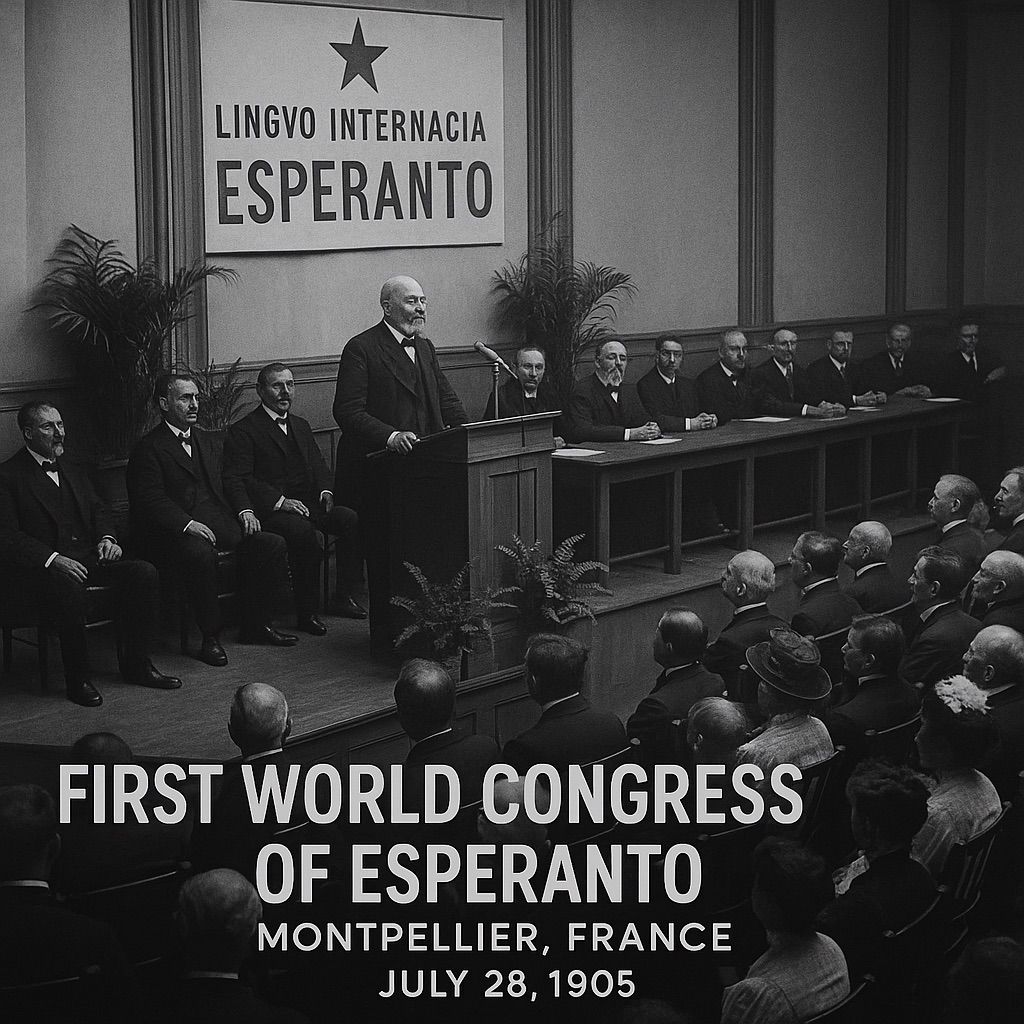
On July 28, 1905, the sleepy French seaside town of Boulogne-sur-Mer played host to an unprecedented event that would quietly echo across cultures and borders for more than a century—the First World Congress of Esperanto. Unlike political summits or royal affairs that often dominated the headlines, this was a gathering of idealists, linguists, teachers, and dreamers who came together for a radical reason: to build a better world through a common, neutral language. In a world already simmering with nationalism, colonialism, and rising tensions that would eventually explode into global war, the Esperanto Congress was a peaceful rebellion against division. It wasn’t just a linguistic experiment; it was a vision for global understanding.
The idea behind Esperanto was born decades earlier in the mind of Ludwik Lejzer Zamenhof, a Jewish ophthalmologist from Białystok—then part of the Russian Empire, now in modern-day Poland. Zamenhof grew up in a culturally fragmented city, where Poles, Russians, Germans, and Jews lived uneasily side by side, often separated not just by faith or politics but by language itself. As a child, he was disturbed by the misunderstandings, insults, and fights that arose simply because people couldn’t understand each other. It wasn’t just frustrating—it was heartbreaking. To young Ludwik, language seemed like both a wall and a weapon. And so, rather than simply accepting the world as it was, he began crafting a new way to communicate.
By 1887, Zamenhof had published Unua Libro (“First Book”) under the pseudonym “Doktoro Esperanto,” meaning “Doctor One Who Hopes.” In it, he presented the structure and vocabulary of an entirely new language—designed to be easy to learn, politically neutral, and globally accessible. With regular grammar, phonetic spelling, and a vocabulary largely drawn from European tongues, Esperanto was created with the learner in mind. The name he used, “Esperanto,” soon became the name of the language itself. Zamenhof never sought to replace national languages, but to provide a shared second language for international dialogue—a linguistic bridge for the human family.
The language slowly began to spread, first through Europe and then more broadly. It was shared in magazines, letters, and language clubs. People began writing poems, articles, and even novels in Esperanto. But it wasn’t until 1905, nearly two decades after its initial publication, that the movement took a historic leap forward with the First World Esperanto Congress.
The congress, known as the Unua Kongreso, brought together 688 delegates from 20 different countries. They arrived in Boulogne-sur-Mer by rail and by sea, from as far away as Japan and the United States, and from every corner of Europe. They had never met in person before, but they could speak fluently with one another in Esperanto. That shared language immediately erased the sense of strangeness that might have existed between such diverse individuals. There were no interpreters, no hierarchies of language prestige. For the first time, participants from different cultures could meet as equals—not in theory, but in practice.
The congress lasted several days, and the excitement was palpable. The attendees didn’t just discuss language or grammar. They organized lectures, recitals, and public events. They established cultural societies and exchanged publications. Zamenhof himself delivered a speech that remains iconic, not just in the history of Esperanto but in the broader story of global humanism. He spoke with modesty and warmth, warning against turning Esperanto into a religion or political doctrine. “The inner idea of Esperanto,” he said, “is the dream of universal human brotherhood.” The congress culminated with the ratification of the Fundamento de Esperanto, the official cornerstone document for the language’s grammar and usage, ensuring stability as the language continued to grow.
What made the 1905 congress so historic wasn’t just its size or novelty—it was its profound spirit. In a time when the world was still carved up by empires, and where prejudice was often codified in law, here was a gathering that defied it all through conversation, curiosity, and mutual respect. The congress demonstrated that a shared, intentionally neutral language could break down barriers that diplomacy and politics often couldn’t.
The human stories from that congress are especially striking. Consider the Japanese delegate who read his original poetry in Esperanto and was met with thunderous applause from his French and Russian peers. Or the group of children from Germany and the Netherlands who played games in Esperanto in the garden of the congress venue, laughing without needing translation. For many attendees, this was not just an intellectual meeting—it was a deeply emotional experience. They had found a kind of linguistic family, a new cultural home that transcended geography.
As Esperanto’s first truly international event, the 1905 congress also set a precedent for the movement’s democratic and inclusive values. Unlike elite academic conferences, the congress welcomed people from all walks of life: schoolteachers, postal workers, librarians, students, and scholars. No one was “foreign.” Everyone was an “Esperantist.” And this identity was chosen, not inherited or assigned. That spirit remains one of the defining qualities of the Esperanto community even today.
Of course, the story of Esperanto and the legacy of the 1905 congress cannot be separated from the broader currents of 20th-century history. The years that followed would challenge the dream Zamenhof so passionately believed in. World War I broke out just nine years after that hopeful gathering in Boulogne-sur-Mer. Then came fascism, Stalinism, and a second world war. Esperanto, seen by totalitarian regimes as a threat to nationalism, was brutally suppressed in several countries. The Nazis considered it subversive, partly due to Zamenhof’s Jewish heritage and the language’s association with internationalism. Stalin’s secret police arrested and executed many Esperantists during the purges, viewing them as suspected spies or enemies of the state.
And yet, despite persecution, Esperanto endured. Its speakers continued to correspond, publish, and organize. The World Esperanto Congress became an annual tradition, with interruptions only during global conflicts. Each time it resumed, it rekindled the same spirit that had defined the 1905 meeting. Over time, the congress grew even more diverse. Delegates began coming from Africa, Latin America, Oceania. The age range expanded. Esperanto music, theater, and literature flourished. Zamenhof’s dream did not fade; it adapted.
What makes the 1905 congress particularly moving, especially in hindsight, is how deeply it speaks to timeless human aspirations. It wasn’t a utopian delusion but a genuine effort to meet each other on common ground. Today, in an era of instant translation apps and AI-powered communication, the idea of a constructed global language might seem quaint. But Esperanto was never just about words—it was about intent. To learn Esperanto was to commit to the idea that people from vastly different backgrounds could engage with one another as equals. That vision remains as relevant as ever in our increasingly fragmented digital world.
The humanization of language—this was Esperanto’s great promise. And that was precisely what was celebrated in Boulogne-sur-Mer in 1905. The congress offered a rare glimpse of what the world could look like if we chose connection over conquest, mutual understanding over mistrust. It offered hope at a time when hope was in short supply. And perhaps most remarkably, it did so not through power or wealth, but through grammar, goodwill, and shared dreams.
There’s something poetic about the location, too. Boulogne-sur-Mer, perched on the English Channel, has always been a place of arrivals and departures—a liminal space where land meets sea, and where people pause on their way elsewhere. That it became the site of the first Esperanto Congress is fitting: a borderland city playing host to a language designed to erase borders.
L. L. Zamenhof died in 1917, having lived long enough to witness the beginnings of war but not the full scale of devastation to come. He didn’t see the Holocaust that claimed the lives of many members of his family. Nor did he see the rise of the United Nations or the long Cold War that would shape the second half of the century. But the seed he planted in 1905 continues to grow, nurtured by idealists who, like him, believe that language can heal, rather than divide.
Esperanto today remains a living language. It is spoken, written, sung, and studied by people around the world. There are Esperanto courses on Duolingo, conferences held in dozens of countries, and even families who raise their children as native Esperanto speakers alongside their local tongues. The ideals of equality, neutrality, and accessibility endure. And every year, Esperantists still gather for a World Congress, tracing their lineage back to that seminal meeting in France. The faces change, the technologies evolve, but the spirit is unmistakably the same.
The First World Congress of Esperanto wasn’t just a meeting—it was a declaration. A quiet revolution that chose verbs over violence, conversation over conquest. It reminds us that there is profound power in listening, in learning each other’s words, and in crafting new ones together. In an age of noise, the message from 1905 still whispers clearly: another world is possible—if we can find a common language.