
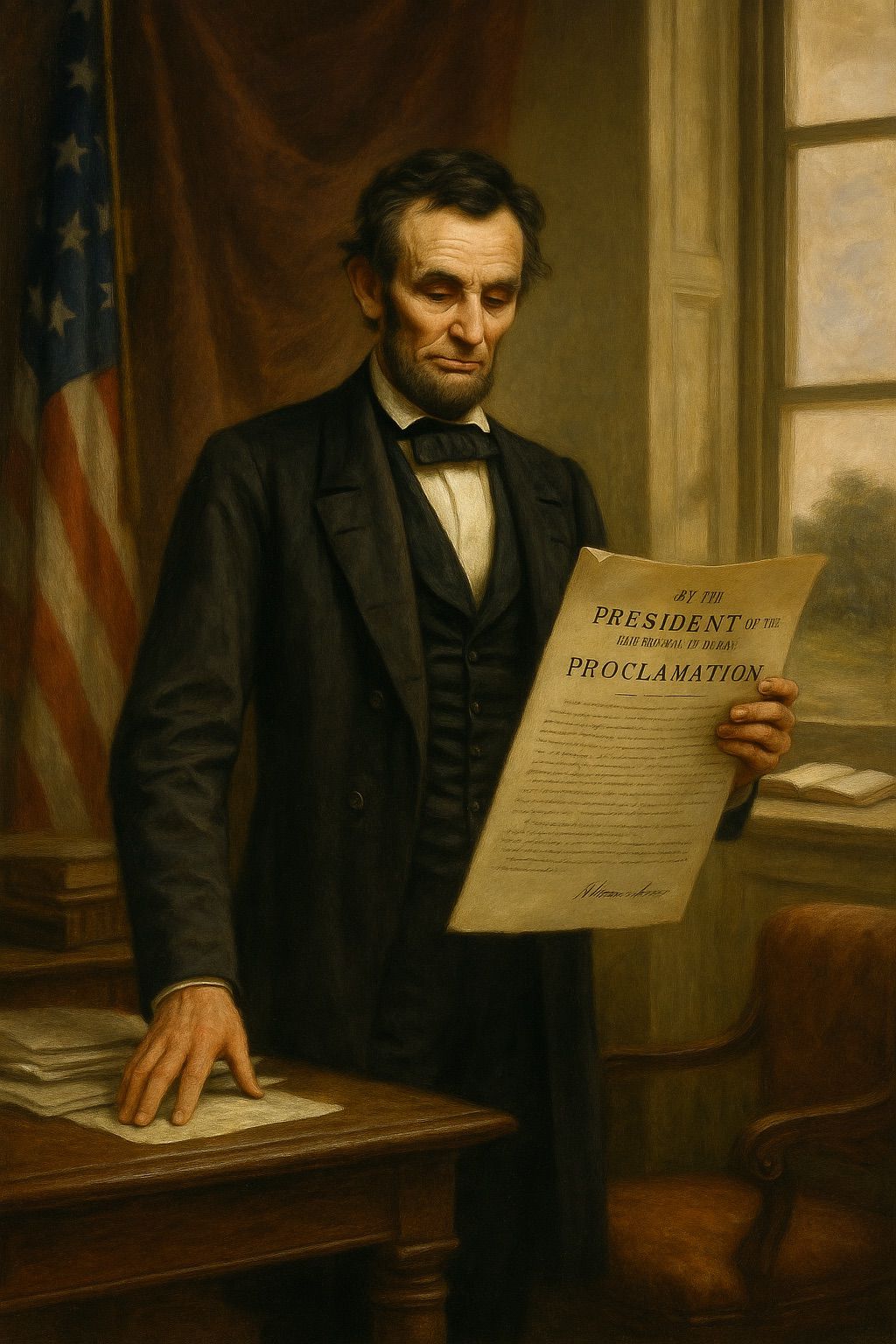
On September 22, 1862, in the midst of the bloodiest conflict America had ever endured, President Abraham Lincoln placed pen to paper and issued a proclamation that changed the moral and political trajectory of the United States. Known as the Preliminary Emancipation Proclamation, it declared that if the rebelling Confederate states did not return to the Union by January 1, 1863, their enslaved people would be declared “forever free.” It was not yet full emancipation — it was conditional, tactical, and carefully worded — but it was a seismic shift. For the first time, the Civil War was not only about preserving the Union but also about ending the institution of slavery. In one stroke, Lincoln reframed the conflict, aligning it with a higher purpose and setting the stage for the ultimate abolition of slavery.
To understand the gravity of September 22, we must first grasp the context. The Civil War had been raging for over a year, and the Union had little to show for it. Hundreds of thousands of lives had already been lost or shattered, yet victory was uncertain. Lincoln’s original aim was preservation, not revolution. His guiding principle had been to save the Union, whether that meant freeing all enslaved people, none, or some. But the reality of war, the pressure from abolitionists, and the actions of enslaved people themselves — thousands fleeing to Union lines, claiming freedom by force of will — pushed the question of slavery to the forefront. Lincoln, cautious and deliberate, knew timing was everything.
The catalyst was the Battle of Antietam, fought on September 17, 1862. It was the single bloodiest day in American history, with more than 22,000 casualties. Though tactically inconclusive, it gave Lincoln the opportunity he had been waiting for. He had drafted the proclamation earlier in the summer but held it back, unwilling to appear desperate after Union defeats. Antietam, grim as it was, gave him a tenuous claim to victory — enough momentum to release the proclamation without it seeming like a plea born of weakness. Five days later, on September 22, he gathered his cabinet and unveiled the edict that would forever mark his presidency and America’s conscience.
The Preliminary Emancipation Proclamation was not the sweeping abolition that myth later paints. It applied only to states “in rebellion” against the Union, not to loyal border states like Kentucky, Missouri, Maryland, or Delaware. It left slavery untouched in areas already under Union control. It was, in part, a war measure designed to destabilize the Confederacy by undermining its labor force and encouraging enslaved people to flee or resist. It was also a diplomatic maneuver, discouraging European powers like Britain and France — both of which had already abolished slavery — from recognizing or supporting the Confederacy. In its legalistic phrasing and its calculated exclusions, it reflected Lincoln’s pragmatism as much as his ideals. Yet beneath its cautious surface was something revolutionary: the transformation of the war into a struggle for freedom.
The reaction was immediate and polarized. Abolitionists rejoiced, though some criticized the proclamation for not going far enough. Frederick Douglass, the towering voice of Black freedom, hailed it as a “mighty act,” recognizing its potential to change the moral stakes of the war. Many Union soldiers, once indifferent to slavery, began to see themselves as liberators. Enslaved people in the South heard the news through whispers, newspapers, and word of mouth, and thousands fled to Union lines, their journeys becoming living embodiments of freedom proclaimed. At the same time, Lincoln faced fierce backlash. Northern Democrats denounced him, accusing him of turning the war into an abolition crusade. Racists predicted chaos, claiming that emancipation would unleash violence, unemployment, and ruin. Border states threatened unrest. Even within Lincoln’s own party, doubts persisted about whether he had gone too far or not far enough.
But Lincoln understood something deeper: that once freedom had been proclaimed, there was no turning back. By issuing the Preliminary Emancipation Proclamation, he laid down a moral gauntlet. Come January 1, if the Confederacy remained defiant, slavery would be struck at its root. The edict made emancipation inevitable, even if gradual and incomplete. It was the opening door through which the 13th Amendment would later stride, abolishing slavery everywhere. It was the moment the Union defined not just what it was fighting against — rebellion — but what it was fighting for: liberty.
September 22, 1862, was therefore not a conclusion but a beginning. It was a moment of clarity in a war clouded by blood and uncertainty. Lincoln himself acknowledged its gravity. He told his cabinet: “I never in my life felt more certain that I was doing right than I do in signing this paper.” He knew history would judge him by this act as much as by any battlefield. He knew it would anger some, inspire others, and change everything. And he was right.
The Preliminary Emancipation Proclamation was not perfect. It was limited, conditional, and riddled with exceptions. But it was also transformative. It shifted the ground beneath the war, elevating it from a struggle over union to a struggle over human freedom. It gave the conflict moral clarity, rallying abolitionists, dissuading foreign powers, and emboldening enslaved people to claim their own liberation. It marked the moment when America began, however painfully, to move toward its better self.
Looking back now, we can see the paradox of Lincoln’s edict. It was cautious yet bold, pragmatic yet idealistic, legalistic yet revolutionary. It was an imperfect step, but it was a step. And that is how progress often comes: not in pure leaps of justice, but in contested, complicated acts that carve a path forward. On September 22, 1862, Abraham Lincoln issued such an act. And in doing so, he transformed not only the Civil War, but the very meaning of America.