
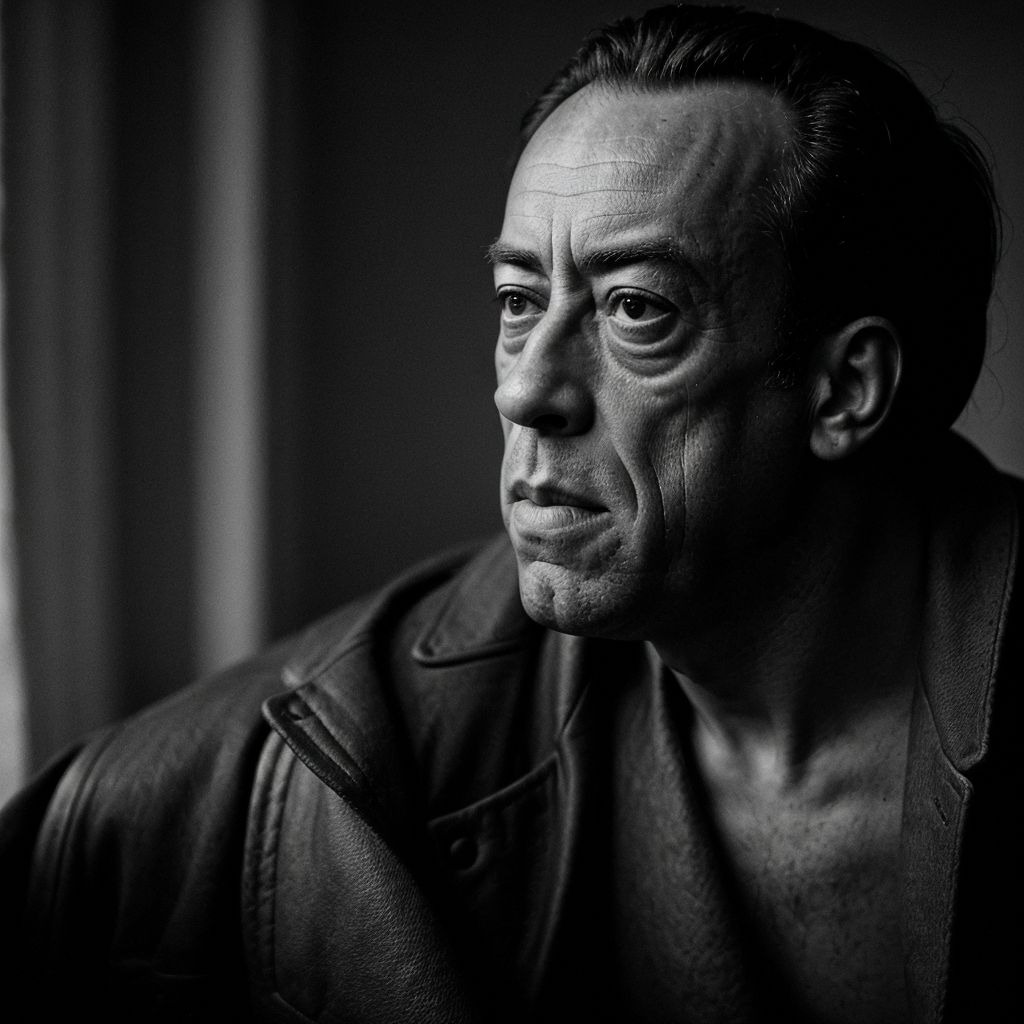
A photograph dated 1948 records Albert Camus at a small table on the Boulevard Saint-Michel. The image is grainy and tightly framed, offering little beyond the outline of a figure, a scattering of papers, and the suggestion of a crowded interior just beyond the edge of the shot. Nothing in the photograph explains what he was thinking or doing at that moment. What remains is the fact of the image itself, taken during a period when his public writing had begun to circulate more widely in France and beyond.
Public records from the late 1940s place Camus in close association with the newspaper Combat, where his editorials addressed questions of resistance, responsibility, and moral choice in the aftermath of the war. The surviving issues show a voice shaped by urgency and restraint, written for a readership still reckoning with occupation and collaboration. These texts do not offer personal confession. They argue, insist, and withdraw, often leaving conclusions suspended rather than resolved.
A letter from 1947, preserved among his correspondence, registers dissatisfaction with the political language surrounding France’s colonial future. The phrasing is careful and indirect, suggesting unease rather than declaration. The document does not clarify how fully these concerns translated into public action, but it establishes that the subject occupied his attention during this period.
Another photograph from the same decade shows Camus alongside Jean-Paul Sartre, both figures partially obscured by shadow. The image has been widely reproduced, often treated as evidence of intellectual alignment or rivalry. Beyond their proximity in the frame, the photograph confirms little. Their disagreements and separations would later become more visible in print than in images.
A copy of *The Myth of Sisyphus*, published earlier in the decade, appears frequently in discussions of Camus’s work from this period. The text itself resists summary, circling questions of meaning and endurance without offering resolution. Its continued citation reflects not a settled philosophy but an ongoing attempt to articulate limits.
Fragments of Camus’s notebooks survive in archives, filled with partial sentences, revisions, and abandoned formulations. These pages show a working process marked by hesitation and return. One line, written without context, notes a preference for paths over conclusions. The fragment remains isolated, its significance undetermined.
Letters exchanged with friends and colleagues record a pattern of closeness followed by withdrawal. In correspondence with Maria Casarès, the language is intimate yet restrained, revealing connection without explanation. These documents suggest complexity but do not provide access to interior states beyond what the words themselves allow.
Biographical records place Camus’s birth in Mondovi, Algeria, in 1913, and trace his early education through both Algerian and French institutions. These movements appear repeatedly in later accounts of his work, though the records themselves remain factual rather than interpretive. They establish location, not motivation.
References to Simone de Beauvoir appear intermittently in reviews and correspondence, most often through published criticism rather than personal testimony. A review she wrote acknowledges Camus’s refusal to simplify moral questions. The record stops there, offering assessment rather than intimacy.
Photographs taken in the late 1950s show Camus with a visibly changed appearance, his face marked by time and illness. These images are often read symbolically, though the photographs themselves provide no commentary. They document presence, not meaning.
An interview from the mid-1940s records Camus speaking about resistance in measured terms, emphasizing dignity over sacrifice. The transcript preserves his words without elaboration, allowing the statement to stand without explanation.
In 1957, Camus received the Nobel Prize in Literature. Official photographs from the ceremony show him composed and reserved. The images confirm the event without indicating how he understood its significance.
Letters from the early 1950s return to the question of writing as a personal obligation rather than a public performance. The phrasing remains consistent with other documents from this period, emphasizing independence and restraint.
Records from Algeria continue to appear in his later essays and fiction, often indirectly. Descriptions of cities and neighborhoods recur without anchoring themselves to a single interpretation, suggesting familiarity without resolution.
Notebook entries from the 1930s pose questions rather than arguments. These early fragments do not forecast later positions so much as establish a habit of uncertainty.
A photograph dated 1952 places Camus and Sartre in the same Paris setting once again, though the image offers no corroborating text. Its repetition across archives contrasts with the scarcity of definitive commentary.
References to *The Plague* often draw parallels between illness and isolation, but surviving drafts and letters avoid direct identification. The resemblance remains speculative.
Public statements from the mid-1950s show Camus addressing Algeria with increasing caution. The record does not support a single, consistent position, only an ongoing engagement marked by restraint.
Accounts of his death in 1960 remain inconsistent across sources. Memorial photographs document public mourning without clarifying circumstance.
Across letters, photographs, publications, and omissions, Camus appears as a figure defined less by conclusion than by return. The materials that survive resist closure, preserving instead a pattern of engagement that remains unresolved.