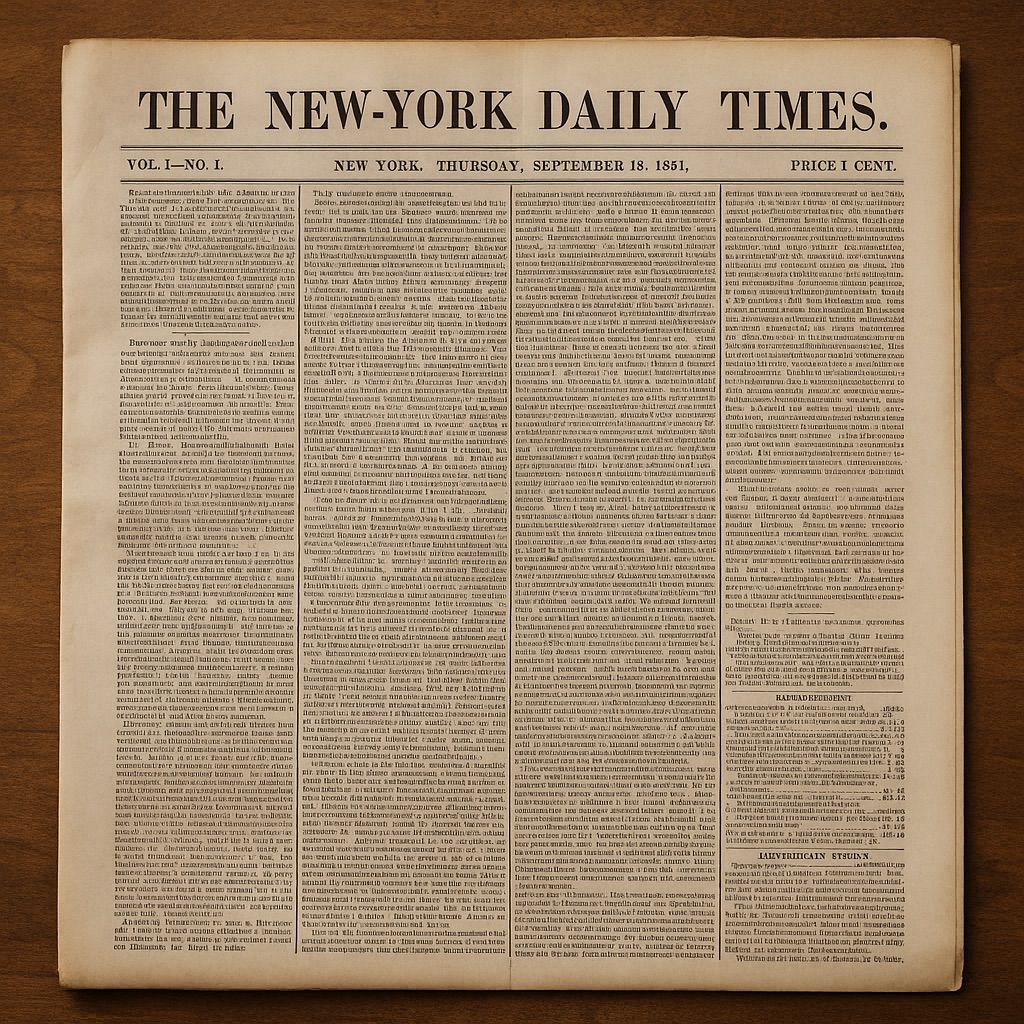
On September 18, 1851, the streets of New York City awoke to a new voice. Amid the clatter of horse-drawn carriages, the cries of newsboys hawking papers, and the hum of a city that was rapidly becoming the beating heart of America, a four-page newspaper rolled off a printing press for the very first time. Its name was The New-York Daily Times, a modest publication that cost just one cent. Few who glanced at that first issue could have imagined that this newspaper would grow into The New York Times, one of the most influential publications in the world, a journalistic institution synonymous with credibility, depth, and the famous motto it would later adopt: “All the News That’s Fit to Print.” That morning in 1851 marked the birth of a paper that would chronicle wars, revolutions, scandals, triumphs, and tragedies, shaping the way millions of people understood the world around them.
The mid-19th century was a turbulent, electric time for journalism. Newspapers were everywhere, competing for attention in a city already thick with rival publications. Many of them were sensationalist, filled with lurid stories, gossip, and outright fabrications. Others were fiercely partisan, serving as mouthpieces for political parties rather than independent outlets for the public. Into this noisy, chaotic media landscape stepped Henry Jarvis Raymond, a journalist and politician, and George Jones, a banker. Together, they founded the New-York Daily Times with a mission that seemed both bold and old-fashioned: to publish a newspaper that valued accuracy over sensation, balance over bias, and depth over triviality. They believed that readers deserved not only information but trustworthy information — a radical concept in an age of yellow journalism and partisan warfare.
That first issue set the tone. It included coverage of politics, business, foreign affairs, and cultural life, written with a clarity and restraint that distinguished it from its competitors. It did not scream for attention with wild headlines or exaggerated stories. Instead, it presented itself as serious, respectable, and thoughtful. Raymond and Jones envisioned a newspaper for readers who craved more than scandal and spectacle, for those who wanted to understand the complexities of the nation and the world. It was, in its way, a rebellion against the dominant media culture of its time. And slowly, it began to build a reputation for integrity.
The Times would go on to play a pivotal role in shaping the American public sphere. Through the Civil War, it reported from the frontlines, offering readers not just battlefield updates but sober analysis of the conflict that was tearing the nation apart. During Reconstruction, it covered the challenges of reunification and the struggles for civil rights. As the nation industrialized, the Times chronicled labor strikes, economic booms, and social upheavals. In the 20th century, it became the paper of record for a nation that was itself becoming a global power. Its correspondents filed reports from Europe during two world wars, from Asia during conflicts and revolutions, from Washington during political scandals, and from cities across the globe as the modern world unfolded. Each headline was more than ink on paper. It was a lens through which millions saw history happening in real time.
What made the Times endure was not just its reach, but its ethos. The motto “All the News That’s Fit to Print,” first used in 1897, encapsulated its philosophy. In an era when newspapers often printed anything to sell copies, the Times promised discernment. It would print not everything, but everything worth knowing. That philosophy became a trust between the paper and its readers, a trust that elevated it from just another publication to an institution. Over time, its front page became something more than newsprint. It became a national stage, where the events of the world were given weight, context, and permanence.
Of course, the Times has not been without controversy. Over its long history, it has faced criticism, lawsuits, and scandals. It has been accused of bias, of errors, of failures in judgment. It has sometimes struggled with the balance between objectivity and advocacy, between timeliness and accuracy. Yet part of its endurance lies in its willingness to confront those challenges, to correct mistakes, to adapt to new technologies and new demands. From the telegraph to the internet, the Times has continually reinvented itself while holding to its central promise of credibility. In doing so, it has become not only a chronicler of history but a part of history itself.
When we think about September 18, 1851, we see more than the launch of a newspaper. We see the beginning of a tradition that has shaped democracy. Journalism, at its best, is not just about reporting facts. It is about holding power accountable, about informing citizens, about giving voice to truth even when it is uncomfortable. The New York Times, born in that moment, became one of the most enduring examples of that principle. Its pages have been the battleground for debates about freedom of the press, the source of revelations that toppled governments, and the chronicler of everyday life in all its complexity. From the Pentagon Papers to Watergate, from 9/11 to the digital revolution, the Times has been there, shaping and reflecting the way we understand the world.
The story of its birth is also the story of America’s own coming of age. In 1851, the United States was still young, still finding its place in the world, still wrestling with contradictions of liberty and slavery, expansion and division. The launch of a newspaper dedicated to accuracy and fairness was, in its way, a reflection of the nation’s aspirations: to be serious, to be respected, to be informed. And just as the country grew, faltered, and rose again, so too did the Times evolve, stumble, and rise again. The parallels are striking because both the nation and its newspaper share the same project: the constant, imperfect pursuit of truth.
Looking back now, more than 170 years later, that modest first issue of the New-York Daily Times feels almost quaint. Its typeface was simple, its columns dense, its circulation limited. But within those pages was the spark of something enduring. On that September morning, Henry Raymond and George Jones could not have foreseen the digital age, the global reach, or the Pulitzer Prizes their paper would one day win. But they believed in something timeless: that truth matters, that words matter, that journalism matters. And because they believed, a newspaper was born that continues to shape the world today.
So when we remember September 18, 1851, we are not just remembering the launch of a newspaper. We are remembering the launch of an idea: that information should be accurate, that truth should be told, that the public deserves more than noise and spectacle. That idea, embodied in the New York Times, remains as vital now as it was then. For all the news that’s fit to print — and all the stories still to come — it began on that day, with a small paper sold for a penny, and a dream that truth, once printed, could change the world.