
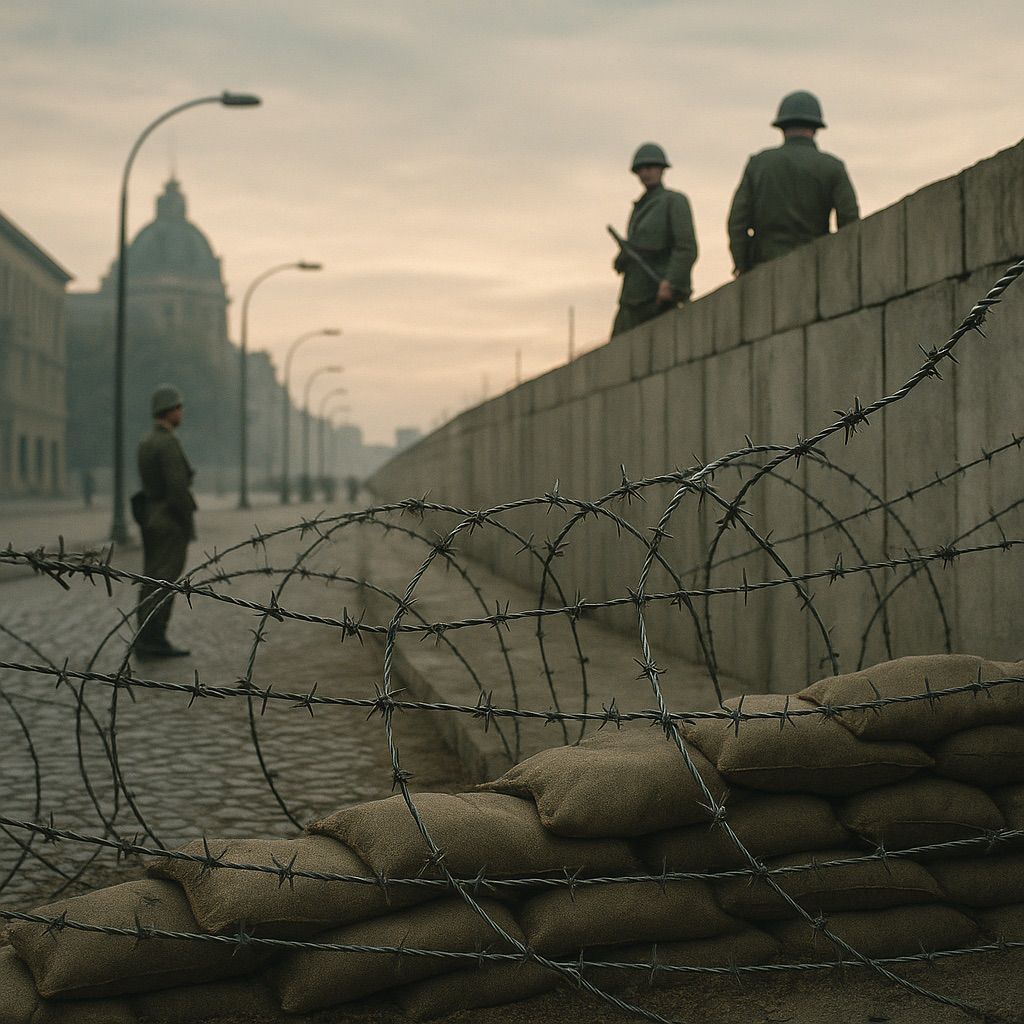
It began in the stillness of the early morning, long before most Berliners awoke. The date was August 13, 1961, and a cool summer night was giving way to dawn. But something unusual was happening in the city—men in military uniforms, workers in overalls, and police officers in helmets were moving with calculated precision along the streets that divided East and West Berlin. Under the cold glare of floodlights and the hum of truck engines, they unspooled heavy coils of barbed wire, setting them across roads, alleys, and tramlines. They erected wooden barricades and placed armed guards at key crossings. By the time the sun rose, the heart of Berlin was being carved in two.
This was the day that came to be known as “Barbed Wire Sunday.” It was the day the Berlin Wall began—not as the concrete monolith of Cold War imagery we remember now, but as a ragged, improvised barrier of wire and fences. And it was the day the lives of millions of people changed in an instant.
For years before that morning, Berlin had been the fault line of the Cold War. At the end of World War II, Germany had been divided into four occupation zones controlled by the United States, the United Kingdom, France, and the Soviet Union. Berlin, deep within the Soviet zone, was also divided into four sectors. What began as a temporary arrangement became a long-term reality as tensions between the Soviet Union and the Western Allies hardened into ideological opposition. In 1949, West Germany (the Federal Republic of Germany) was established in the zones held by the Western powers, while East Germany (the German Democratic Republic) formed in the Soviet-controlled zone.
Berlin became the most visible—and dangerous—front of that division. The city was a loophole in the Iron Curtain: though the border between East and West Germany was heavily fortified, Berlin’s open boundaries allowed East Germans to escape into West Berlin, and from there into West Germany. By 1961, an estimated 2.7 million people had fled East Germany through Berlin, draining the communist state of skilled workers, professionals, and students.
For East German leader Walter Ulbricht and his Soviet backers, this “brain drain” threatened the survival of their regime. Ulbricht had famously declared in June 1961 that “no one has the intention of erecting a wall”—a statement that would soon become one of the most infamous lies in political history. Behind the scenes, plans were being drawn up for a massive operation to seal the border inside the city.
That operation—codenamed “Rose”—was executed in the early hours of August 13. Truckloads of soldiers, police, and construction crews moved into position across the city. Roads were torn up to prevent vehicles from crossing. Public transportation lines were severed. Families woke to find themselves cut off from relatives, lovers, and friends on the other side. Workers who had jobs in the West could no longer reach them; students who attended schools in the opposite sector were suddenly stranded. The overnight transformation was so complete that it felt almost unreal, like waking from one life into another without warning.
At first, the Western Allies were caught off guard. U.S., British, and French forces in West Berlin could only watch as East German troops rolled out the barbed wire. Under the postwar agreements, they had no authority to intervene in East Berlin, and any attempt to dismantle the barricades risked triggering a direct confrontation with the Soviet Union. The West’s inaction, while avoiding immediate war, meant that the division was cemented from day one.
The human impact of Barbed Wire Sunday was devastating. Stories quickly emerged of families torn apart. A mother on the East side who had gone to visit her sister in the West the day before could not return to her children. A young couple separated by the barricade called to each other across the wire, too far to touch, too close to turn away. Some tried to escape immediately—leaping from apartment windows into the West, sprinting across open streets despite the armed guards. A few succeeded; others were shot or arrested.
In the days that followed, the barbed wire was reinforced with more permanent barriers—concrete blocks, watchtowers, and eventually the infamous concrete wall that would stretch over 150 kilometers around West Berlin. Guard towers loomed every few hundred meters, manned by soldiers with orders to shoot anyone attempting to cross. The Wall became not just a physical barrier but a psychological one, a daily reminder of division and repression.
Yet even in those early days, the seeds of defiance were sown. West Berliners gathered near the wire to show support for those trapped in the East. Western leaders made high-profile visits, promising not to abandon the city. And in the years to come, countless East Berliners would risk—and sometimes lose—their lives trying to escape.
The Berlin Wall stood for 28 years, becoming one of the most potent symbols of the Cold War. It was the backdrop for some of history’s most famous speeches, from John F. Kennedy’s “Ich bin ein Berliner” in 1963 to Ronald Reagan’s “Mr. Gorbachev, tear down this wall!” in 1987. And when it finally fell on November 9, 1989, it did so not through a single dramatic act of force but through the cumulative weight of political change, popular protest, and a regime too weakened to hold back the tide.
Looking back at August 13, 1961, we see more than just the start of a wall. We see the moment when a city was turned into a stage for the world’s deepest ideological struggle. We see the costs of political division measured not only in diplomatic standoffs and military maneuvers but in missed weddings, broken friendships, and silent grief. We see how power can reshape geography in a single night, but also how human will—though delayed—can undo what seemed permanent.
Barbed Wire Sunday remains a stark reminder that freedom can be lost quickly and must be defended constantly. It’s also a testament to the resilience of those who endured it, who found ways to live, love, and dream even with a wall in their midst. For Berliners, August 13 is not just a date in the history books—it is a day when the ground under their feet literally changed, and the skyline they knew was suddenly divided by steel and stone.