
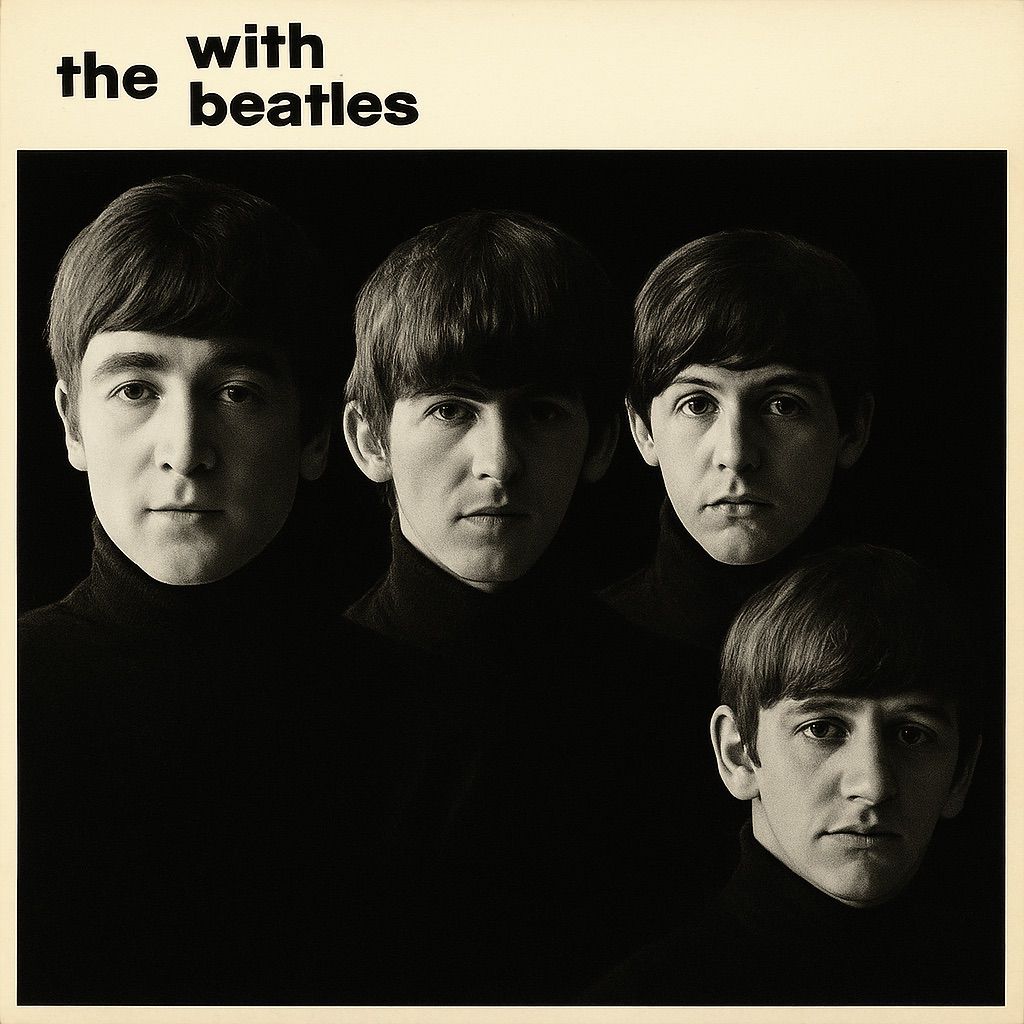
When With the Beatles arrived on November 22, 1963, it didn’t simply land on shelves as another pop album — it arrived like a seismic wave, reshaping the musical landscape with a force that even the band themselves couldn’t fully comprehend at the time. The Beatles were already gaining momentum in Britain, but this second studio album launched them from promising stars into a phenomenon that would soon sweep across continents. Listening today, it’s easy to take for granted how natural their brilliance feels, how fluidly they moved between styles, and how effortlessly they blended youthful energy with emotional depth. But to those hearing the record for the first time in 1963, it was as if something entirely new had burst into existence — a sound that was both familiar and revolutionary, crafted with precision yet steeped in spontaneity. This album captured the moment The Beatles transitioned from rising talents into cultural trailblazers, and it remains a testament to how quickly musical evolution can accelerate when passion, talent, and timing align.
When people talk about the early Beatles, they often focus on the mania — the screaming audiences, the televised performances, the tidal wave of popularity that no band had ever experienced on such a global scale. Yet to really understand With the Beatles, you have to look past the frenzy and into the quieter truths of who these four young men were at the time. They were barely adults, hustling through grueling performance schedules, navigating sudden fame, and working harder than most fans ever realized. The Beatles didn’t stumble into success; they earned it through relentless energy and an obsession with sound. And throughout the recording of With the Beatles, they pushed themselves with a level of focus and ambition that feels astonishing today.
The sessions for the album built upon what they learned creating Please Please Me, but this time they weren’t rushing to capture their live set in a single, breathless marathon session. They had more time, more confidence, and a clearer sense of what they wanted to say musically. They also had George Martin — the “fifth Beatle” whose guidance elevated their raw creativity into something polished without ever sanding down the edges. Martin recognized the band’s potential and challenged them continually, not by forcing them into traditional molds but by encouraging them to explore everything they were capable of. His respect for their instincts, combined with his classical training, created a perfect balance. The Beatles trusted him, and he trusted them — an artistic partnership that shaped not only this album but the entire future of popular music.
What makes With the Beatles so fascinating is how it blends innocence with sophistication. On one hand, it feels youthful and exuberant, bursting with catchy melodies and energetic performances. On the other hand, it shows a remarkable level of maturity for a group so early in their career. They weren’t just singing about love; they were crafting harmonies and rhythms with surprising complexity. Songs like “All My Loving” showcased their knack for melodic craftsmanship, while “It Won’t Be Long” introduced new layers of emotional urgency. Their voices blended with uncanny chemistry — John’s raw power, Paul’s smooth clarity, George’s shimmering tonal quality, and Ringo’s steady reliability behind the kit. Each track feels like it captures lightning in a bottle, yet none of it feels forced. The Beatles were playing at the height of their early powers, experimenting without fear and performing with the kind of excitement that only comes from discovery.
A key part of the album’s DNA comes from their covers, too. The Beatles didn’t treat cover songs like filler — they treated them as opportunities. Their interpretations of Motown and rock ’n’ roll classics weren’t mimicry; they were reinventions. Listen to “Please Mister Postman” or “You Really Got a Hold on Me,” and you can feel how deeply the band admired the artists who inspired them. But you can also hear how boldly they reshaped these songs into something uniquely Beatles. They infused each cover with their own attitude, their own spark, their own sense of rhythmic identity. Those tracks served as a bridge between the music they loved and the music they were destined to create — a snapshot of influences merging with originality, forming the foundation of the sound that would soon take over the world.
The release of With the Beatles was perfectly timed, though no one realized it then. As soon as the album hit the shelves in the UK, it began breaking records. It became one of the fastest-selling albums in British history, receiving rapturous praise while simultaneously fueling the momentum of a cultural movement that would soon be called Beatlemania. Teenagers lined up at record stores. Radios played Beatles songs endlessly. Magazines clamored to interview them. It felt as if the entire country — and soon the world — had turned its attention toward these four young men from Liverpool.
Yet behind all the excitement, the album also represented something deeper: a shift in what pop music could be. Before The Beatles, pop albums were often inconsistent — a few singles padded with filler tracks. But With the Beatles was cohesive, intentional, and balanced from start to finish. It signaled that albums could be art, not just containers for radio hits. This would become one of The Beatles’ greatest long-term contributions to music: the elevation of the album format itself. The seeds of Rubber Soul, Revolver, and even Sgt. Pepper are faintly visible here, not in complexity but in ambition. The Beatles were showing the world that they were more than entertainers; they were creators, and they were only getting started.
Of course, With the Beatles carries with it a historical footnote that adds an eerie shadow. It was released on the exact same day President John F. Kennedy was assassinated. While the two events were unrelated, history forever linked them. Many fans later recalled learning of Kennedy’s death while listening to the album or seeing it in store windows. In this way, the music became a strange emotional backdrop for one of the 20th century’s most traumatic moments. For some, it became a source of comfort; for others, the memory of that day forever colored how they heard the record. Music has a way of embedding itself into time, becoming part of the emotional landscape of moments both joyful and heartbreaking.
Even with that somber association in the background, With the Beatles continued to rise. Its success spilled into international markets, eventually catching the attention of the American music industry. The album’s momentum would help set the stage for The Beatles’ arrival in the United States and their legendary February 1964 appearance on The Ed Sullivan Show — a television moment that would change everything. Without the tidal force built by With the Beatles, the British Invasion might have unfolded differently. This album was the spark that traveled across the ocean before the band themselves ever did.
Looking back today, With the Beatles is more than just a collection of songs; it’s an early chapter in one of the most influential artistic journeys of all time. You can hear the beginnings of experimentation, the first hints of the creative daring that would define their later work, and the unmistakable chemistry that made them unlike any other band. The record still feels fresh because The Beatles approached their craft with a combination of sincerity and boldness that never grows old. They didn’t know they were making history — they were simply making music they loved — but in doing so, they changed what music could be.
To listen to With the Beatles now is to experience the exhilarating moment before the world changed. It’s the sound of twenty-somethings discovering their power, of artistic instincts sharpening in real time, of a band that had no idea how big they would become but played as if they somehow sensed that something extraordinary was just over the horizon. It captures a moment of pure musical ignition — a moment that still lights up the history of popular music with the same intensity it did the day it debuted.
That is the magic of With the Beatles. It isn’t just an album; it is the beginning of a revolution.