
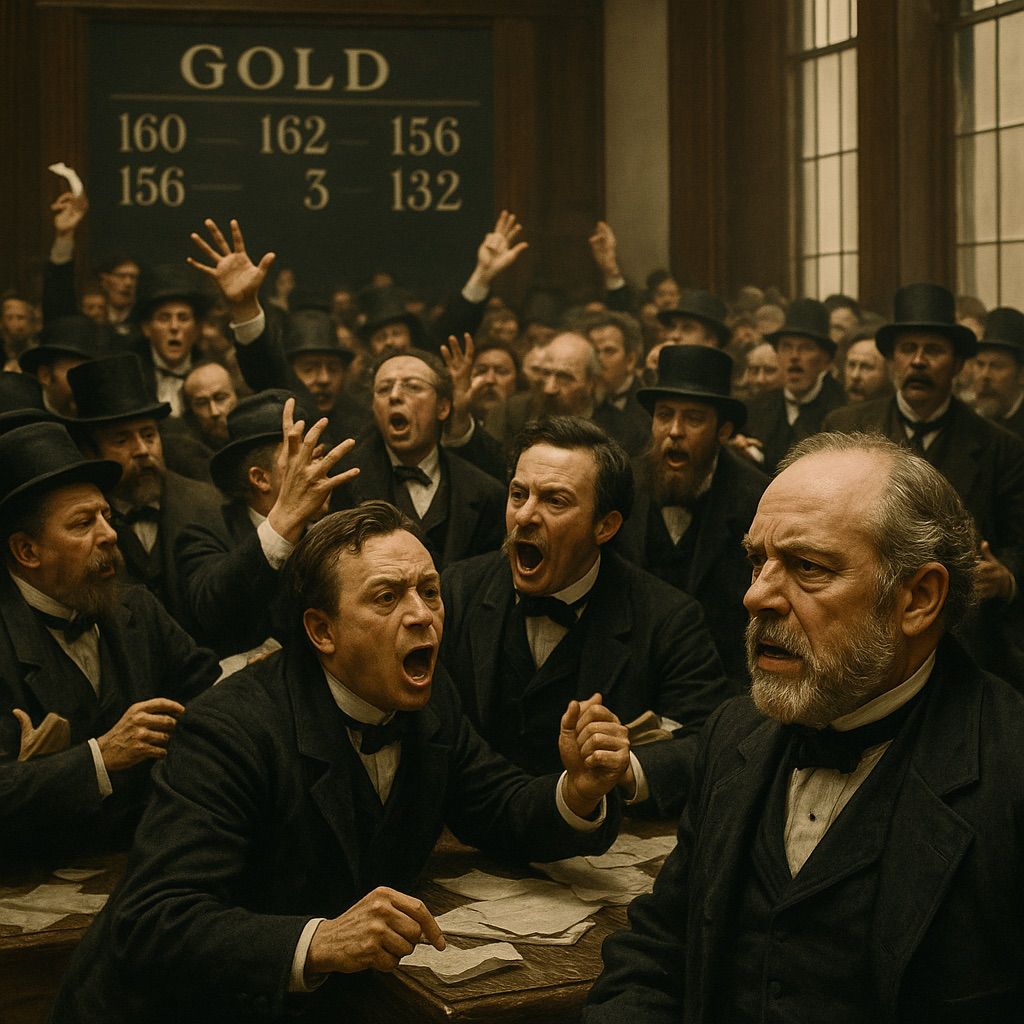
On September 24, 1869, Wall Street descended into madness. It was a Friday morning like no other, a day when fortunes evaporated, when brokers screamed themselves hoarse on the trading floor, when the very foundation of America’s post–Civil War economy seemed to crack under the weight of raw speculation. The newspapers would forever call it “Black Friday” — not for shopping deals or holiday cheer, but for panic, ruin, and the audacity of two men who believed they could corner the nation’s gold supply. Their names were Jay Gould and James Fisk, and together they hatched a plot so brazen that it nearly broke the country.
To understand the chaos of Black Friday, one must understand the times. The Civil War had ended just four years earlier, but the scars ran deep. The Union had financed much of its war effort by issuing “greenbacks,” paper currency not backed by gold or silver. These greenbacks fluctuated wildly in value, and the question of whether they should be redeemed in hard gold was hotly debated. At the center of it all stood President Ulysses S. Grant, a hero of war turned steward of peace, trying to stabilize the currency and restore economic confidence. Gold was the keystone of this fragile system. Whoever controlled gold controlled the economy.
Enter Jay Gould and James Fisk, two of the most infamous schemers of the Gilded Age. Gould was the brains — brilliant, cold, calculating, a man whose mind ticked like a watch wound too tight. Fisk was the showman — flamboyant, loud, a master of charm and distraction. Together, they controlled the Erie Railroad and dreamed of greater conquests. Gold, they realized, was the ultimate prize. If they could corner the gold market, drive up prices, and sell at the peak, they could amass wealth on a scale beyond imagination. But to pull it off, they needed more than money. They needed influence.
Their scheme unfolded like a novel of corruption. Gould and Fisk began buying gold in secret, steadily pushing the price higher. At the same time, they sought to ensure the federal government would not interfere. If the Treasury flooded the market with gold, their plan would collapse. So they set about cultivating allies in high places. Their most important target was Abel Corbin, a minor speculator who just happened to be married to President Grant’s sister. Through Corbin, Gould and Fisk gained access to the President himself. They whispered their arguments about keeping gold scarce, dressing their self-interest in the language of national prosperity. Grant, cautious but trusting, listened. For a time, it seemed the plan might actually succeed.
By late September, the gold market was in frenzy. Prices soared from $130 to $160 an ounce, unprecedented heights. Gould and Fisk, their pockets heavy with contracts, seemed unstoppable. On the trading floor of the Gold Room in New York, pandemonium reigned. Brokers jostled and shouted, their fortunes rising and falling with every tick of the board. Outside, speculators and onlookers crowded the streets, sensing history in the making. Newspapers buzzed with rumors. Was gold being cornered? Were Gould and Fisk really pulling the strings of the market?
But schemes built on manipulation are castles built on sand. President Grant, wary of the rumors swirling around him and increasingly alarmed by the economic chaos, acted. On the morning of September 24, the Treasury, under Grant’s direct orders, released $4 million in government gold into the market. It was like a thunderclap. The price of gold, inflated by greed and speculation, collapsed in an instant. From $160 it plunged to $133 in minutes. Fortunes evaporated. Men who had been rich at breakfast were ruined by lunch. Panic swept the floor of the Gold Room, brokers screaming, collapsing, tearing at their hair as their world imploded.
The ripple effects were devastating. Stock prices crashed, credit tightened, businesses failed. Farmers across the Midwest, who relied on stable markets for their crops, saw their livelihoods threatened. Banks wobbled, merchants despaired. The panic of Black Friday revealed how deeply the nation’s economy could be shaken by the schemes of a few men. Gould and Fisk walked away tarnished but not destroyed — Gould, ever slippery, managed to sell much of his gold before the collapse, insulating himself from total ruin. Fisk, the showman, blustered his way through the fallout, his reputation bruised but his fortune intact. Others were not so lucky. Small speculators were bankrupted, families impoverished, trust in the markets shattered.
Black Friday was more than a financial scandal. It was a parable of the Gilded Age, an era when unbridled ambition and corruption danced hand in hand. It revealed the fragility of America’s financial system and the dangerous power of speculators who believed they could bend the economy to their will. It showed how political influence and private greed could entwine, threatening the stability of the nation itself. And it marked Ulysses S. Grant, unfairly to some degree, with the stain of suspicion, as critics charged that he had been duped or compromised by the schemers who courted his circle.
In the aftermath, reforms were demanded, though the age of Goulds and Fisks was far from over. The Gilded Age would see railroads manipulated, stocks watered, and fortunes made and lost in waves of speculation. But Black Friday remained a warning — a day when America learned, painfully, that unchecked greed could rattle the pillars of prosperity.
Looking back, September 24, 1869, stands as one of the most infamous days in Wall Street history. It was the day two men nearly hijacked an economy, the day ordinary people paid the price for extraordinary ambition, the day gold itself became a weapon of manipulation. In its frenzy and its fallout, Black Friday told a story that still echoes today: markets are not just numbers on a board, but reflections of human desire, fear, and folly. And when those forces run wild, collapse is never far behind.