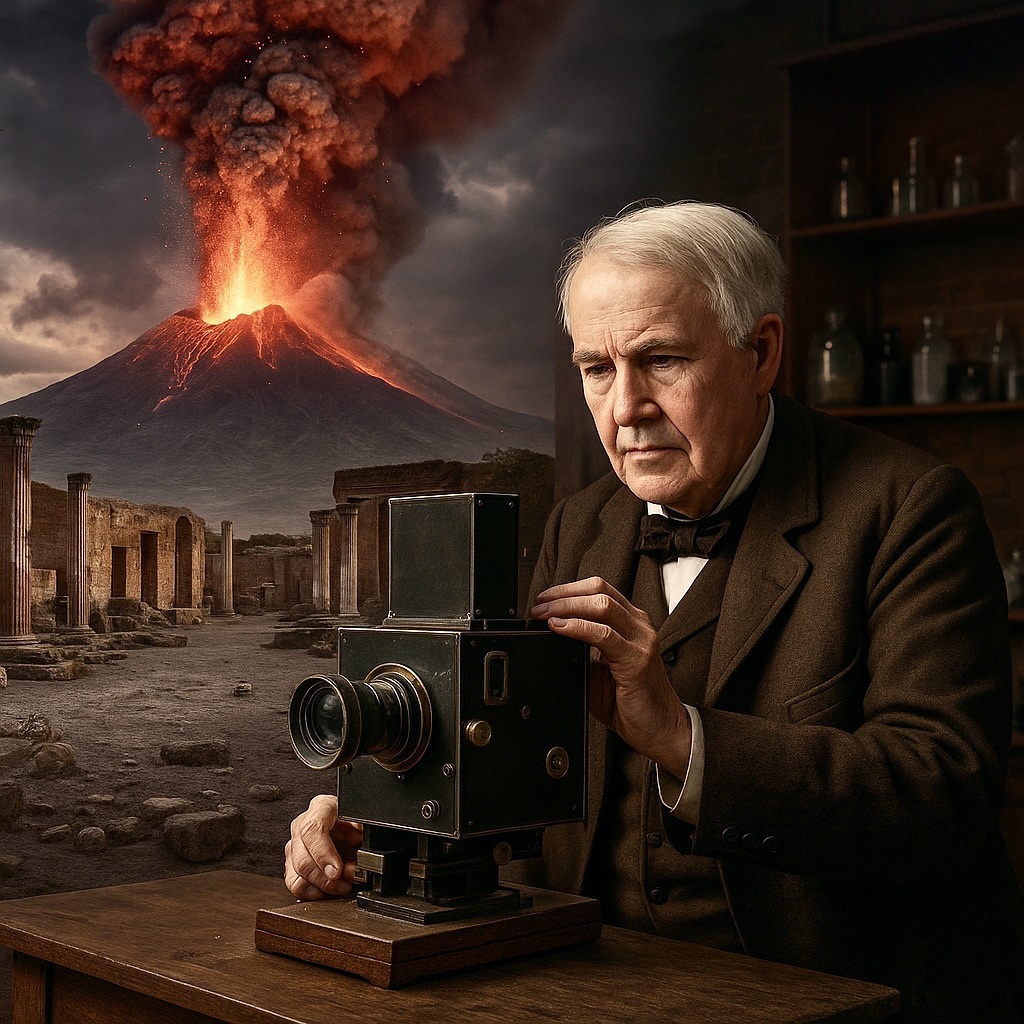
On certain dates the past feels like a stereo, two speakers broadcasting radically different songs that somehow harmonize. August 24 is one of those days. In AD 79, Mount Vesuvius erupted and erased Pompeii and Herculaneum in a convulsion of ash, pumice, and poisonous wind, turning everyday gestures into eternal artifacts. In 1891, Thomas Edison secured a patent for a motion picture camera, a machine that would teach light to remember movement and teach us to dream in frames. One day delivered a catastrophic full stop; the other invented a new kind of continuation. Stand between them and you can feel the human story tug in both directions at once: toward humility before the Earth and audacity before the dark.
Picture the morning before the sky went wrong. A fruit seller tilts a basket so figs catch the sun, a baker scores loaves with a practiced flick, a boy chases a dog across a courtyard frescoed with painted vines that promise shade the noon can’t deliver. Vesuvius sits at the edge of vision like a gray-brown shoulder. When the plume lifts—straight as a column before it mushrooms—some people stare, measuring it against omens they’ve heard and storms they’ve survived. Pebbles begin to patter: lapilli, porous stones light enough to rain for hours. The city changes state, not from life to death in an instant, but from errand to emergency in a series of decisions: stay or run, pack or pray, tie a cushion to your head or trust a roof that is losing confidence by the minute. In that suspended arithmetic of choice, time dilates. By nightfall—or what passes for night when noon has gone to smoke—pumice has drifted to window height and the air tastes like a blacksmith’s shop. Roofs surrender. Streets become drifts. A few try to leave and are driven back by darkness that behaves like water. Inside rooms, families huddle around the only vocabulary that still works: handholds, whispered names, breath counted like coins.
Across the bay, Herculaneum receives a harder answer. There the eruption’s later surges arrive as a furnace front, superheated clouds of ash and gas that rip downhill at hurricane speed and fold the town flat. In the boat houses by the shore, skeletons wait for us with gestures intact: a mother’s arm across a child, a hand still clutching a key meant to open a future that never arrived. Centuries later, when plaster is poured into the voids left by bodies and hardens to the shapes fear adopts in its last seconds, we will stand in galleries with our polite modern shoes and feel the impoliteness of witnessing so closely. We will learn things we didn’t ask to learn and cannot unknow: how a throat strains when lungs search for air that isn’t air, how a dog’s spine arcs against a chain, how rings stay on fingers when the finger is gone because gold keeps its promises longer than flesh.
Volcanoes are not moralists; they are physics. Beneath Vesuvius a plate dives, melts, foams; bubbles of gas want out and find it. The column rises while the system supplies heat, then collapses when it cannot. Pyroclastic density currents obey gravity and topography, not gossip or prayer. Yet we give mountains personalities because our nerves need stories—characters we can bargain with, fates we can tempt or appease—if we’re going to keep living on soils as generous as they are dangerous. The Romans built villas on those slopes because the grapes were fatter there, the olives more amenable, the view domesticated longing. The lesson is not to flee beauty; it is to design for betrayal: to map escape routes as faithfully as you map aqueducts; to keep tools and sandals near the door; to teach children which way the wind usually runs when the mountain talks in that voice.
Now shift to a room half a world and nearly two millennia away, a workshop smelling of oil and sparking wire. On August 24, 1891, Edison’s motion picture camera patent draws a boundary around an idea that had already begun to whir in prototypes: that you could coax motion into a strip of images by giving the eye less darkness than it needs to forget. The trick—no trick at all, once explained—is persistence of vision: the retina’s habit of holding onto a picture for a fraction of a second after the light is gone. Strobe that habit at the right rhythm, and a series of stills becomes a gait, a kiss, a wave breaking, a laugh finishing itself. The camera’s gate becomes a throat; light walks through in measured syllables. Sprockets advance; shutters blink; time submits to measurement and then to replay. In a world where memory dies with the body and the tale, this is near-heretical: a machine that can save gestures, not just the words that name them.
What frescoes did for Roman rooms—trap seasons on plaster so winter had something to remember—cinema would do for the public square. A nickel buys 20 images a second and, more importantly, buys witnesses for the moments those images represent. Light becomes clay, editors become potters. A cut can take you from a pair of eyes to the city they are watching; a dissolve can lay two meanings over each other until they invent a third; a tracking shot can suggest inevitability, a jump cut can declare panic, a long take can teach patience. The invention promises more than entertainment; it promises a grammar flexible enough to speak grief and exaltation and boredom and awe without borrowing from any other language. No wonder we fell for it. Night after night, anonymity turned communal in the beam between projector and screen. Families, workers, lovers, loners—faces streaked with streetlight and cheap powder—sat shoulder to shoulder and learned a new alphabet together.
Place Vesuvius’s ash next to Edison’s film and watch the rhyme. The ash is involuntary film stock: layers impressed with the last frames of an interrupted city. Archaeologists unspool it, reading ovens and courtyards and graffiti like reels rescued from a flooded archive. The camera is elective ash: dust of silver and grain organized to hold shapes we’d otherwise lose to air. Both are technologies of memory, one written by the planet without our consent, the other built by our species for ourselves and, perhaps, against oblivion. The pairing teaches a blunt lesson: the world will forget you quickly unless you build ways to be remembered—and even then, remembrance is a favor, not a right.
Neither story is pure. Eruption days attract scavengers alongside scholars. Pompeii’s long afterlife includes antiquarian greed, careless digs, and tourist footprints where quiet might have served better. The camera’s story includes contracts that caged actors, lenses that exoticized and exploited, images that sold lies beautifully enough to look like truths. Tools do not decide their ethics; hands do. If the mountain imposes humility, the camera imposes responsibility: to widen the frame until the excluded are no longer cut off at the edge; to name sources and contexts; to check who profits when a face is sold and resold. The ash asks us to tread lightly on the dead. The lens asks us to tread lightly on the living.
Between the two Augusts runs a smaller current: the choreography of crowds. Pompeii’s streets still guide our feet; the stepping stones that lifted Roman sandals above slurry now lift sneakers above puddles of centuries. In dark theaters, aisles guide us to seats where we practice a different ritual: the willingness to be made still while someone else shows us how the world can be arranged and rearranged. Both rituals teach the same muscle: attention. Attention is not passive. It is the active refusal to look away. It is the bravery to hold in view what frightens or implicates or overwhelms—an arm around a child in a boathouse; a newsreel of a strike; a documentary about a river on fire; a close-up of a face telling the truth.
What, practically, does the day ask of us? In volcanic country, it asks for maps updated as often as appetites, drills rehearsed beyond embarrassment, funding adequate to measure the mountain’s moods before it sulks into catastrophe. In cinematic country, it asks for art that tests power rather than flattering it, training that diversifies who stands behind the camera, and archives that treat reels and hard drives as civic infrastructure, not disposable entertainment. If you need an ethic that travels across both domains, try this: respect scale. Your choices are small, but the sum of small choices is city-shaping and culture-shaping. Every family that knows the fastest road away from the harbor, every editor who refuses to cut a lie beautifully, incrementally moves the world in a safer direction.
It helps to think in hands. In Pompeii, hands dusted with flour and ash, hands gripping door lintels slick with fear, hands cupped over mouths. In Edison’s shop, hands trimming film, setting screws, pausing above a switch as if above a prayer. Hands cannot stop a pyroclastic surge or cradle a planet, but they can stack sandbags and splice truth, tighten bolts on evacuation bridges and loosen an audience’s certainty just enough that compassion can get in. The miracle is not that we built machines to record time; it’s that we keep choosing to spend time on each other.
Here is a smaller juxtaposition to take with you: a bakery’s round loaves stamped with the maker’s mark, carbonized but legible; a title card, stark white letters on black, declaring the name of a picture and the people who made it. Both are signatures proffered across time. Both say: if you find this, know I worked, I cared, I wanted you to have something good. Let that humility infect the way we sign our own days. Stamp your bread and your films with love and warnings: this is where the exit is; this is who was paid; this is who was harmed; this is who was healed.
When the credits reach the crawl of names you’ll never know—the grips and mixers and assistants whose labor looked like air—stay. When you walk the Roman streets and a guide gestures at a plaster form behind glass, lower your voice. In the theater, silence is courtesy; in Pompeii, silence is reverence. Both silences are more useful than applause. They train the heart to be porous to the lesson that August 24 keeps rehearsing: that making and unmaking are siblings, that the ground is generous and fickle, that light remembers if we ask it to, and that we owe each other context, exits, and tenderness.
By the time you read this, Vesuvius’s seismographs will have drawn new, mostly boring lines and cameras will have added terabytes of pictures of first steps, last looks, protests, poems performed into microphones, dances in kitchens at midnight, storms moving in. Boredom is the prize, not the enemy. Ordinary days are the dividend paid by infrastructure and care. Celebrate them. Practice for the hours that will not be ordinary by rehearsing what to carry, whom to call, which road turns to river when the drainage fails. Practice for the dark by loving films that tell the truth so beautifully you can bear it and then do something about it.
If there is a sentence that binds both halves of this date, it might be this: remember in order to repair. The ash remembers for us, whether we ask it to or not. The camera remembers because we ask it to. Repair happens when memory becomes instruction—when we shape cities as if mountains were neighbors and shape stories as if strangers were kin. If we do that, August 24 ceases to be merely a calendar curiosity and becomes a compact: the earth will sometimes take; we will meanwhile learn to give better.