
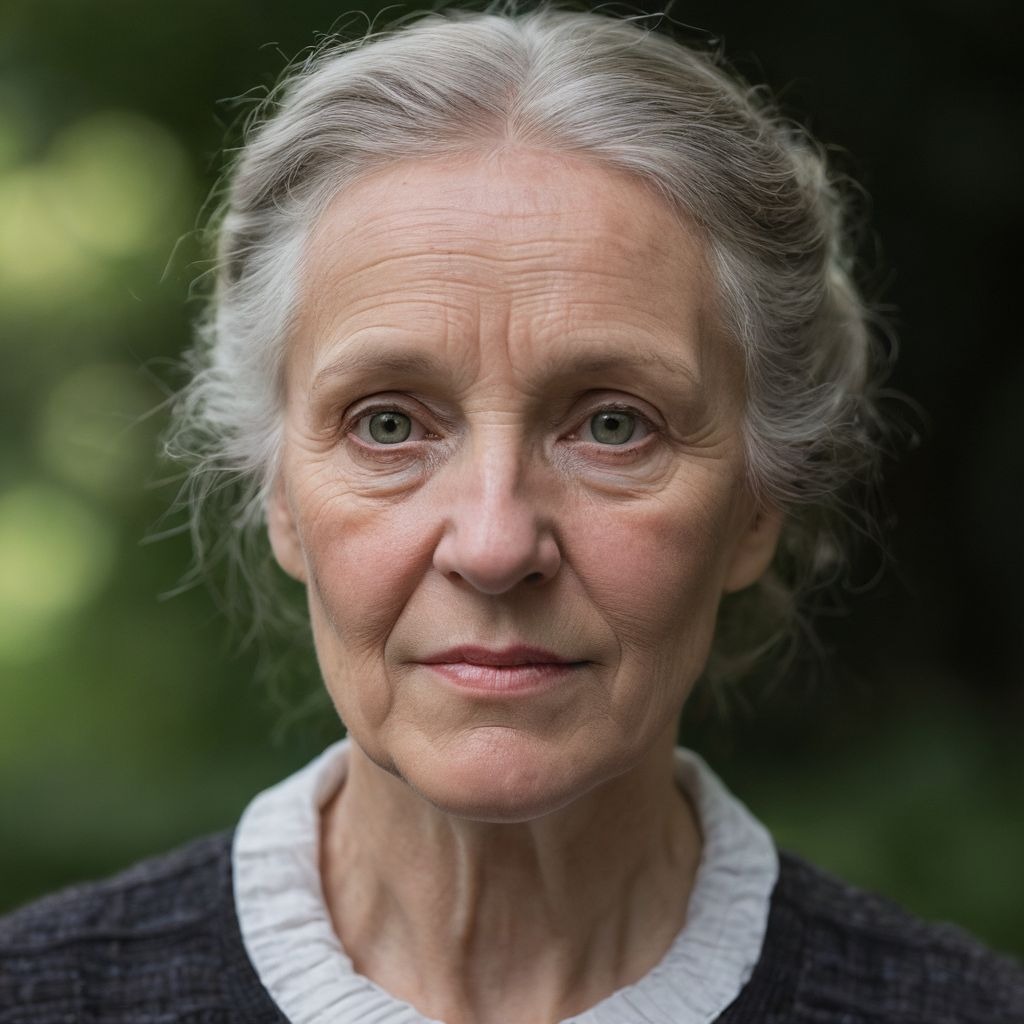
Dorothy Wordsworth has been sitting on my shelf for a while now, her small leather-bound book of journals collecting dust between my poetry collections and worn-out novels. I picked it up recently, not because I’d forgotten about her – I hadn’t – but because something about her presence felt particularly striking that day. Perhaps it was the gray skies outside, or maybe it was just a random flutter in my mind, but whatever the reason, Dorothy Wordsworth caught my attention once more.
As I flipped through the pages, her handwriting danced across the paper, a messy yet elegant script that spoke of its own kind of beauty. Her writing is raw and intimate, a window into the inner workings of her mind as she navigated love, loss, and everyday life in early 19th-century England. What draws me to Dorothy is the way she writes about herself, not as an iconic figure or a celebrated poet’s sister, but as a human being – messy, emotional, and fragile.
One of the things that always gets stuck with me when reading Dorothy’s journals is her relationship with her brother William. Their bond is complex and multifaceted, often blurring the lines between sibling love, literary collaboration, and romantic longing. I find myself wondering about the intricacies of their dynamic, how they influenced each other’s work, and what it meant to be so deeply entwined in one another’s lives.
What resonates with me is the way Dorothy often struggles to articulate her own desires and emotions. She writes about her love for William, but also about feeling overshadowed by his genius, about feeling invisible within their relationship. It’s a familiar ache for anyone who’s ever felt like they’re living in someone else’s shadow – whether it’s a sibling, partner, or friend. In Dorothy’s words, I see echoes of my own fears and doubts.
I’m not sure if it’s because I’ve always been drawn to the margins, the spaces between what’s considered “mainstream” or “important,” but there’s something about Dorothy that speaks directly to me. Perhaps it’s her status as a writer who’s often relegated to the footnotes of literary history – a mere adjunct to her brother’s greatness. Or maybe it’s simply the way she navigates the complexities of love, family, and identity with such unflinching honesty.
As I continue reading Dorothy’s journals, I find myself circling back to the same questions: What does it mean to be seen, truly seen, by others? How do we navigate the relationships that shape us, without losing ourselves in the process? And what does it take to claim our own agency, our own voice, when the world seems determined to silence us?
Dorothy’s writing doesn’t offer easy answers – and I’m not sure I’d want them even if she did. Her journals are a messy, beautiful reflection of her inner world, full of contradictions and uncertainties. They make me feel less alone in my own struggles, more willing to confront the complexities that lie beneath the surface of our relationships, our identities, and our art.
As I close Dorothy’s book for now, I’m left with more questions than answers – a good place to be, I suppose. Her writing has shown me that it’s okay to be uncertain, to struggle with the messy stuff, and to keep searching for words that feel true to ourselves. In her pages, I’ve found a kindred spirit – someone who reminds me that even in the quietest moments, there’s beauty to be discovered.
As I delve deeper into Dorothy’s journals, I’m struck by the way she writes about the natural world. Her descriptions of the Lake District landscapes are breathtakingly vivid, and yet they’re also infused with a sense of melancholy. She sees the beauty in the world, but it’s always tinged with a hint of sadness, as if she knows that nothing lasts forever.
I find myself wondering what it was like to live in such close proximity to nature, where the rhythms of the seasons and the cycles of life and death were woven into the fabric of everyday existence. Did Dorothy feel a sense of awe and wonder at the world around her? Or did she see it as a constant reminder of her own mortality?
For me, reading about Dorothy’s relationship with nature has been like gazing through a window into another time and place. It’s a reminder that our experiences, no matter how unique they may seem, are always connected to something larger than ourselves – the world around us, the people who came before us, the rhythms of life itself.
I’ve always felt a bit disconnected from nature myself, like I’m a city girl at heart. But reading Dorothy’s journals has made me realize that I don’t have to be defined by my urban surroundings. Nature is everywhere, even in the midst of concrete and steel. It’s in the way the light filters through the skyscrapers, in the sounds of birdsong filtering through the traffic, in the quiet moments when we pause to breathe.
Dorothy’s writing has given me permission to see the world in a new light – literally and figuratively. She shows me that even in the darkest times, there is beauty to be found. It’s not always easy to spot, but it’s there, waiting to be uncovered.
As I continue reading, I’m struck by the way Dorothy’s writing seems to capture the essence of the human experience. Her journals are a reflection of her own struggles and triumphs, but they’re also a testament to our shared humanity – our hopes, our fears, our joys, and our sorrows.
The more I read about Dorothy’s life, the more I’m struck by the parallels between her experiences and my own. Not just in terms of the struggles she faced as a woman writer in a male-dominated world, but also in the way she navigated the complexities of relationships and identity. It’s like looking into a mirror, except instead of seeing myself staring back, I see Dorothy – her fears, doubts, hopes, and dreams.
I think about my own relationships with friends and family members who are also writers or creatives. We often talk about our work, our struggles, and our passions, but it’s not always easy to separate the personal from the professional. Sometimes it feels like we’re all just trying to figure out how to be seen, heard, and understood in a world that can be both beautiful and brutal.
Dorothy’s writing shows me that even in the midst of all this uncertainty, there is beauty to be found. Not just in the natural world, but also in the way people interact with each other – in the kindness, the love, and the vulnerability that exists between us. It’s a reminder that our stories are not just individual experiences, but also part of a larger tapestry that connects us all.
As I read on, I start to think about my own writing process and how it relates to Dorothy’s. Like her, I often struggle to put words onto paper, to capture the essence of what I’m trying to convey. But when I do manage to write something that feels true, it’s like a weight has been lifted off my shoulders. It’s as if I’ve given voice to a part of myself that was previously silent.
Dorothy’s journals make me realize that writing is not just about creating art or expressing ourselves; it’s also about processing our experiences, making sense of the world around us, and finding ways to connect with others. Her writing is raw, honest, and imperfect – qualities that I admire and aspire to in my own work.
As I close Dorothy’s book for now, I’m left with a sense of gratitude and wonder. Gratitude for the opportunity to read her words, to see myself reflected in her struggles and triumphs. Wonder at the way she continues to inspire me, even as I navigate my own path as a writer and a person.
One of the things that’s resonated with me about Dorothy’s writing is the way she talks about her inner life. She’s not afraid to explore her emotions, to question her own thoughts and feelings, and to lay them bare on the page. It’s a kind of vulnerability that feels both exhilarating and terrifying.
As I read through her journals, I’m struck by the way she writes about her own mental health struggles. She talks about feeling anxious and overwhelmed, about struggling with depression and melancholy. But even in the midst of all this darkness, there’s a sense of hope and resilience that shines through. It’s like she’s saying, “I may be broken, but I’m still here. And I’m still writing.”
That kind of honesty is something that I aspire to in my own writing. As someone who’s also struggled with anxiety and depression, I know how hard it can be to put words onto paper when you’re feeling lost or uncertain. But Dorothy’s example shows me that even in those darkest moments, there’s always a way forward. Always a thread of hope to cling to.
I think about my own writing process, and how often I get stuck in the same kind of anxiety-ridden loop. “What if this is terrible?” “What if no one likes it?” But reading Dorothy’s journals makes me realize that those doubts are normal. They’re even healthy. It means you care enough to try.
It also makes me wonder about the role of doubt and uncertainty in our creative work. Is it a necessary part of the process, or is it something we can overcome? Can we ever truly silence our inner critics, or is it just a matter of learning to live with them?
Dorothy’s writing doesn’t offer easy answers to these questions, but it does show me that even in the midst of uncertainty, there’s always a way forward. Always a thread of hope to cling to.
As I continue reading her journals, I’m struck by the way she talks about her relationships with other writers and artists. She writes about her friendships with Coleridge and Wordsworth, about the ways they supported and challenged each other’s work. It’s like she’s showing me that even in the most intense creative environments, there’s always room for kindness, empathy, and understanding.
I think about my own relationships with fellow writers, and how often we get caught up in competition or comparison. “Who’s getting published?” “Who’s winning awards?” But reading Dorothy’s journals makes me realize that those things don’t matter as much as I thought they did. What matters is the work itself, the act of creating something from scratch.
It’s a kind of perspective-shifting, and it feels both exhilarating and terrifying. Exhilarating because it means I can focus on my own writing, without getting bogged down in external validation. Terrifying because it means I have to confront my own doubts and fears head-on.
As I delve deeper into Dorothy’s journals, I’m struck by the way she writes about her own creative process. She talks about the struggles of writing, the frustrations of not being able to capture the perfect phrase or image, and the anxiety of waiting for feedback from others. It’s like she’s speaking directly to me, saying “I get it, I feel you too.”
One thing that resonates with me is her emphasis on the importance of revision. She talks about how she’ll spend hours, even days, rewriting a single passage until she feels like she’s gotten it just right. It’s a process that I’m familiar with, and one that I often struggle with myself. There’s something daunting about looking at a blank page or a incomplete draft, feeling like you’re staring into the abyss.
But Dorothy’s journals show me that revision is not just about making changes for the sake of change; it’s about refining your ideas, clarifying your thoughts, and polishing your language until it shines. She talks about how she’ll often rewrite entire sections multiple times before finally settling on a version that feels true to her vision.
It’s a lesson that I’ve been trying to learn myself, but one that’s hard to put into practice. There’s something seductive about the idea of “getting it right” the first time, like you can somehow tap into a wellspring of creativity and produce perfect work without any effort. But Dorothy’s journals show me that perfection is often an illusion, and that the process of revision is where the real magic happens.
As I read on, I’m struck by the way Dorothy talks about her relationship with nature as a source of inspiration. She writes about how she’ll spend hours walking in the Lake District, observing the changing seasons, and noting the way light falls on different landscapes. It’s like she’s saying that nature is not just something external to us; it’s also a part of our own inner landscape.
This resonates with me because I’ve always been someone who finds inspiration in the world around me. Whether it’s a sunset, a conversation with a friend, or a walk through the park, I find that my creative juices are often sparked by something external to myself. But Dorothy’s journals show me that this is not just about finding external sources of inspiration; it’s also about tapping into our own inner world.
She talks about how she’ll often write in response to her surroundings, using the natural world as a kind of prompt or catalyst for her creativity. It’s like she’s saying that we don’t have to look outside ourselves for inspiration; sometimes all we need is to pay attention to what’s already happening within us.
This idea has been percolating in my mind ever since I read it, and I find myself thinking about how I can apply it to my own writing. What are the ways in which nature inspires me? How can I tap into that inspiration, rather than just relying on external sources? It’s a question that feels both simple and profound, one that I’m still trying to grapple with as I continue reading Dorothy’s journals.
As I close her book for now, I feel like I’ve only scratched the surface of what she has to offer. Her writing is like a rich tapestry, full of threads and textures that invite me to explore further. But even in this brief glimpse into her life and work, I see echoes of my own experiences as a writer – the struggles, the doubts, the moments of triumph.
Dorothy’s journals have given me permission to write about myself, to share my own stories and struggles with others. They’ve shown me that vulnerability is not weakness, but strength; that the act of creating something from scratch is a form of bravery, no matter how imperfect it may be.
As I look at Dorothy’s book on my shelf, I feel a sense of gratitude for having read her words. It’s like she’s left behind a piece of herself, a parting gift to those who are willing to listen and learn. And as I take up my own pen, ready to write the next sentence, I know that I’m carrying a little bit of Dorothy with me – her doubts, her fears, her hopes, and her dreams.