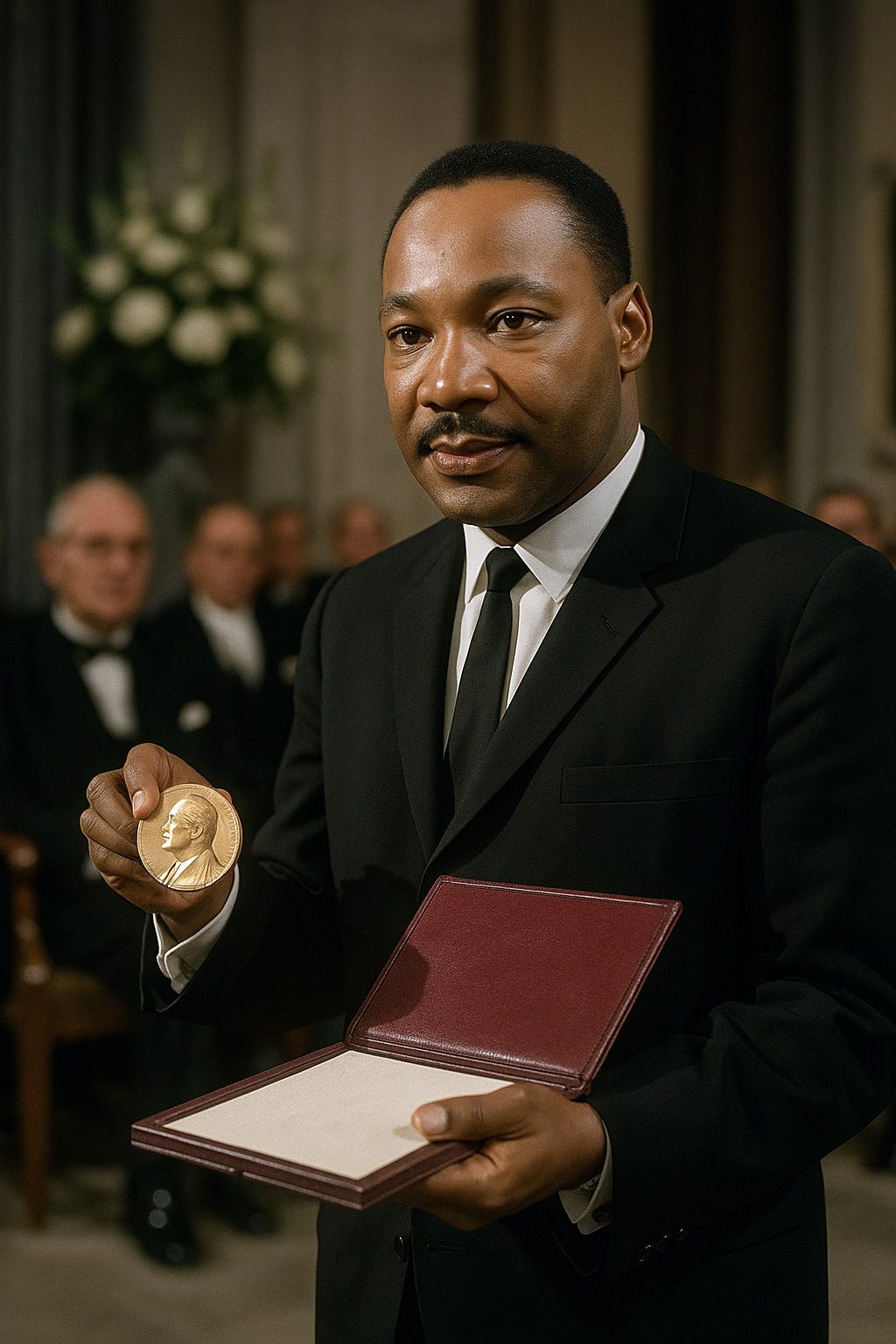
It was October 14, 1964, and the chill of an early Norwegian autumn swept gently across Oslo as dignitaries, journalists, and scholars gathered in growing anticipation. Inside the University Church of Norway, the energy felt almost electric—an unspoken awareness that history was taking shape within its walls. Dr. Martin Luther King Jr., the Baptist minister whose voice had become a moral compass for millions, had been awarded the Nobel Peace Prize. At just 35 years old, he became the youngest recipient in the prize’s history, a testament not only to his extraordinary leadership but to the unwavering force of a movement demanding dignity, justice, and equality.
For many watching from across the world, King’s arrival in Oslo represented more than a ceremonial accolade. It symbolized the global recognition of a struggle often met with violence, resistance, and profound sacrifice. The Civil Rights Movement had already faced countless trials—bombings, arrests, beatings, and assassinations—and yet King stood firm as the living embodiment of the philosophy he preached: nonviolent resistance rooted in deep, unshakable love for humanity. The Nobel Committee’s decision was not without controversy; critics argued that awarding a man at the center of so much domestic turmoil might embolden unrest. But to the millions who believed in his mission, the award validated what they already knew—that the pursuit of equal rights transcended borders, that the courage to challenge injustice was a universal calling, and that King’s leadership had become a beacon of moral truth.
Martin Luther King Jr.’s path to that moment began decades earlier in the deep-seated segregation of Atlanta, Georgia, where he grew up acutely aware of both the boundaries imposed by racism and the spiritual strength cultivated within his community. His father, Martin Luther King Sr., was a respected pastor who instilled in young Martin a profound belief in education, righteousness, and moral duty. The harsh realities of discrimination were unavoidable—schools divided by race, neighborhoods separated, opportunities withheld—but what shaped King most was the sense that resistance to injustice must be guided by conscience rather than hatred.
During his years at Morehouse College, King’s worldview began to take shape. Influenced by mentors like Benjamin Mays, he developed a belief in the transformative power of moral leadership. His academic gifts were clear, but it was his ability to articulate the pain and hopes of his people that distinguished him. After Morehouse, his studies at Crozer Theological Seminary and later Boston University exposed him to new philosophies, including the nonviolent teachings of Mahatma Gandhi, whose influence would become central to King’s approach in the coming years.
When Rosa Parks refused to surrender her seat in Montgomery in December 1955, King was thrust unexpectedly into the forefront of a burgeoning movement. At just 26 years old, he found himself leading a community that had reached its breaking point. The Montgomery Bus Boycott lasted 381 days and faced relentless intimidation, including King’s home being bombed while his wife Coretta and newborn daughter were inside. Yet King did not waver. When crowds gathered in anger, he called for peace. When fear spread, he called for resolve. His words—steady, thoughtful, and rooted in faith—gave strength to thousands who walked miles each day rather than submit to humiliation.
King’s rise to prominence was not without cost. The more visible he became, the more threats intensified. The FBI began monitoring him, politicians labeled him a danger to public order, and segregationists portrayed him as a radical agitator. But King saw the bigger picture—that the movement was not simply about bus seats, voting booths, or lunch counters. It was about the fundamental human right to exist freely without the weight of oppression.
By the early 1960s, the movement had expanded far beyond Montgomery. Sit-ins spread across the South, Freedom Riders challenged segregation laws, and thousands faced jail time for their participation. King was arrested repeatedly, most famously in Birmingham in 1963. From his jail cell, he wrote one of the most powerful defenses of civil disobedience ever composed: “Injustice anywhere is a threat to justice everywhere.” The world read his words, and the moral authority of nonviolent protest gained even deeper resonance.
The March on Washington in August 1963 further solidified King as the voice of a movement. Standing before more than 250,000 supporters, he delivered the “I Have a Dream” speech that would echo across generations. He spoke not only of the pain of discrimination but of the hope for unity—a nation where children would “not be judged by the color of their skin but by the content of their character.” It was one of the defining speeches in American history, a moment where King’s ability to meld moral clarity with poetic vision reached its zenith.
When King was named the Nobel Peace Prize laureate the following year, it was clear that his influence had transcended national boundaries. In Oslo, the committee described him as “the first person in the Western world to have shown us that a struggle can be waged without violence.” At a time when global tensions ran high—from the Cold War to decolonization—King’s philosophy of peaceful resistance struck a chord internationally.
King chose to donate the entire $54,500 prize to the Civil Rights Movement, a gesture that spoke volumes about his character. The cause always came before personal gain. In his acceptance speech on December 10, 1964, he acknowledged the giants on whose shoulders he stood: the activists who faced fire hoses, attack dogs, nightsticks, and bombs. He spoke of the unfulfilled hopes of millions and the struggle still ahead. “I accept this award in the spirit of a curator,” he said, “for peace and brotherhood.” His words reinforced that the Nobel Prize was not an endpoint but a charge to continue onward.
The ceremony was transformative in ways that extended beyond its immediate symbolism. International leaders began viewing the Civil Rights Movement not merely as an American issue but as a global human rights struggle. King’s visit sparked dialogue in countries grappling with their own racial, colonial, or class-based inequalities. His ability to express universal truths made him a unifying figure in a fragmented world.
But even as King was celebrated abroad, challenges at home intensified. His advocacy expanded to include issues like poverty, labor inequality, and opposition to the Vietnam War—stances that cost him political favor and increased surveillance by the FBI. Yet he believed deeply in speaking the truth, even when doing so risked alienating allies. His Poor People’s Campaign sought to unite Americans across racial and economic divides, a movement he never saw realized due to his assassination in 1968.
King’s death shook the world, leaving millions mourning the loss of a man who embodied hope itself. But the seeds he planted continued to grow. Civil rights legislation had already begun reshaping America, and new generations of activists—Black, white, Latino, Indigenous, Asian—took up the mantle of justice. King had not simply changed laws; he had changed consciousness.
The legacy of his Nobel Prize endures as a testament to the power of peaceful resistance and moral conviction. It reminds the world that movements are built not only on marches and speeches but on courage, compassion, and the unyielding belief that humanity is capable of profound transformation. Today, as nations confront systemic racism, political turmoil, and social divisions, King’s teachings remain a blueprint for progress.
His Nobel Prize was not the culmination of his life’s work, but a moment that crystallized the essence of his message: that equality is not a privilege but a right, that justice is non-negotiable, and that peace is not merely the absence of conflict but the presence of fairness.
Nearly 60 years later, King’s legacy continues to illuminate the path forward, urging us to imagine a world guided not by fear, but by love; not by violence, but by understanding; not by division, but by unity. His voice still echoes—steady, compassionate, unyielding—calling us toward the dream he never abandoned and urging us to continue the work he began.