
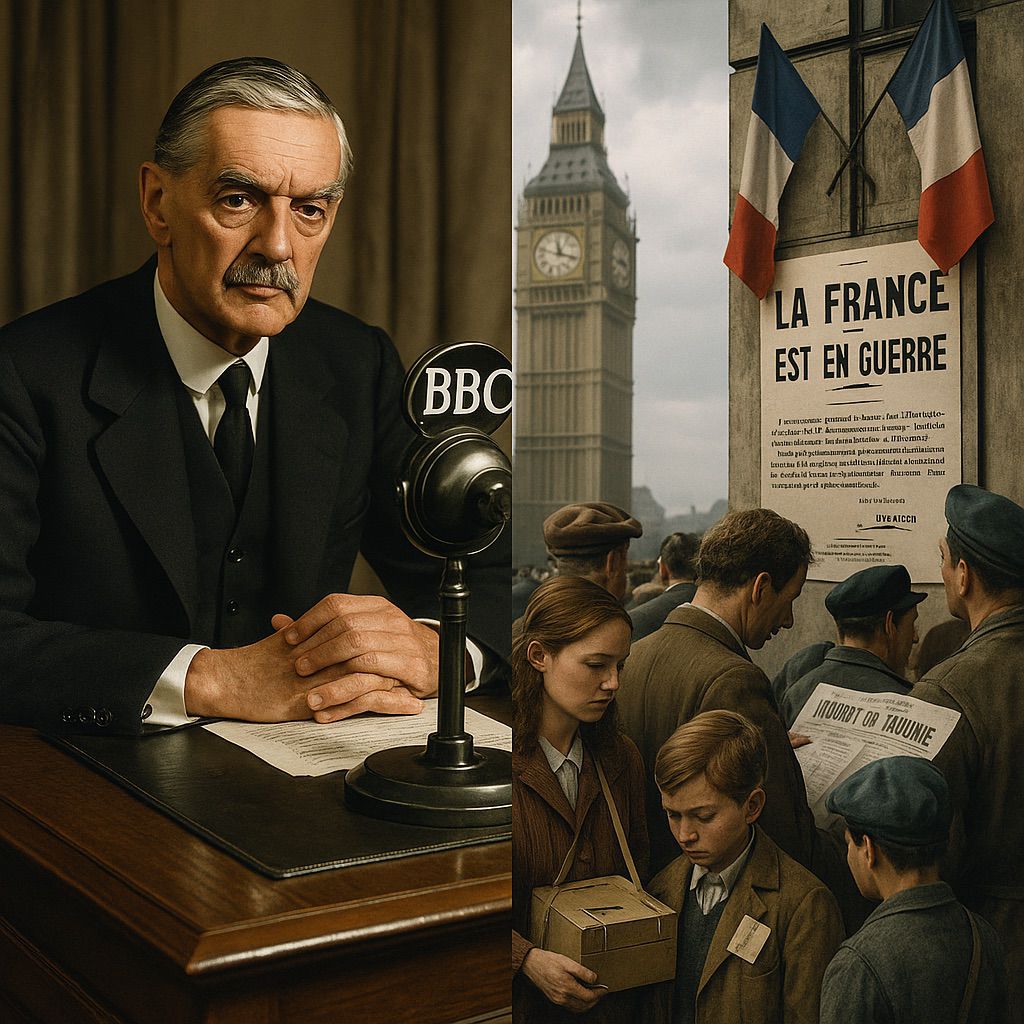
At 11:00 a.m. in London, the ultimatum expired like a clock running out of mercy. Eleven is a polite hour—late enough for tea, early enough for errands—but on Sunday, September 3, 1939, it became a hinge on which a century swung. The British government had told Berlin: withdraw from Poland, or war follows. The hour came and went; the Wehrmacht did not reverse time; the wireless rooms kept their tense hum. Fifteen minutes later, in the Cabinet Room at 10 Downing Street, Neville Chamberlain leaned toward a BBC microphone and spoke the clearest sentence of his premiership: “This country is at war with Germany.” The words left his mouth and crossed a nation already bracing for air-raid sirens that might arrive before the echo faded. Across the Channel, the day stretched toward late afternoon; at 5:00 p.m. in Paris, Premier Édouard Daladier’s government, after its own loop of meetings and hesitations, joined Britain in a declaration the world had dreaded and, perhaps, expected. Two announcements, separated by water and five hours of clock time, fused into a single event: Europe had decided to answer invasion with war.
This is a story about radios and doorways, about the space between a government’s sentence and a neighbor’s knock. Two days earlier, the thunderclap in the east—Germany’s September 1st assault on Poland—had turned headlines into sirens. The news arrived in Britain and France on children’s luggage labels and schoolteachers’ tearful roll calls; Operation Pied Piper had begun, and columns of small evacuees trailed out of cities like hopeful, shuffling commas. The Saturday was a marathon of assembling: gas masks issued, blackout curtains pinned, tin helmets stacked in ARP posts. Yet Sunday possessed its own electricity. Because declarations, unlike rumors, hit the human nervous system like a verdict.
Picture a London kitchen: a wireless set on the counter, bakelite dials, the smell of toast grudgingly private in a nation preparing to turn its most intimate routines into public duty. A mother tells her son to be still. A father checks his watch, though everyone knows the time by the way the house itself seems to lean. Chamberlain speaks in that careful, almost apologetic cadence that had convinced many to hope for peace too long; now the voice is a pivot. For months he had sounded like a hesitant schoolmaster; today he sounds like a ledger balanced at last. The moment he finishes, the wireless dies into a silence so loud you can feel it. Then, seconds later, the rising, wavering note of an air-raid siren cuts the air—London’s first big cry. People move toward doorways, a practiced chaos, hearts thudding, only to learn minutes later that it’s a false alarm. Yet the sound has already done its work; it has tuned the city to the key of vigilance.
In Paris the theater is different but the plot the same. The boulevards carry news the old-fashioned way: posters, criers, clusters of men smoking in tight circles. The famous caption might as well be printed beneath every face: “La France est en guerre.” A girl named Hélène clutches a cardboard box that holds her gas mask and a chocolate that has melted to a shape like a fingerprint. Her father, a railway clerk, doesn’t smoke but keeps a cigarette between his fingers because everyone else does and he’s trying to keep his hands from shaking. Daladier, a man whose politics had been battered by Munich’s compromise the year before, faces a radio audience with a sentence that tastes like iron in the mouth: France has honored its pledge. In cafés, men nod into their cups. No one is surprised. Relief does not visit a day like this; only recognition does.
If you zoom out—if you step from the kitchen and the café into a room high enough to hold continents—you can see the logic that made those sentences inevitable. Poland on September 1st did not call merely for sympathy; it triggered treaties, promises Britain and France had made to convince themselves that deterrence can be written down like a spell. But it wasn’t only paper. It was conscience drawing a line across the past summer’s evenings, when too many people convinced themselves that angry speeches are a kind of weather that passes. Now the storm had chosen its path, and the declarations were not lightning but the decision to stop pretending that thunder is harmless.
The declarations were also, frankly, theater—and theater is not trivial. States must perform resolve to make resolve real. The Cabinet table with its pens set just so; the BBC microphone with its polished black orb; the French tricolor draped behind an office desk; the solemn reading of phrases that have to be spoken exactly because law will hang from them—these images planted poles in the soft ground of human fear. People remember pictures more than documents. History obliged by composing compelling ones.
Meanwhile, ships were already moving. Hours after the declarations, the ocean made its own announcement. The British passenger liner SS Athenia, outbound from Liverpool, met a torpedo from U-30 off the Hebrides. The first night of Britain’s war produced the first sea graves—dozens lost in cold water under a sky that couldn’t possibly know what it had been recruited for. News of the sinking pinballed through pubs and parlors; the war that had sounded like policy at lunchtime felt like physics by sunset. On the same day that a false siren rattled London with a ghostly enemy, the real enemy sent steel through the hull of a ship with women and children aboard. That contrast—performative alarm in the city, fatal silence at sea—gave the day an almost novelistic symmetry. The world didn’t need the symmetry. It already had enough plot.
The human brain, anxious animal that it is, tried to make lists as a talisman. What to take to a shelter: torch, blanket, thermos, identification card. Which neighbor needs a knock. Which friend must be phoned now in case, later, telephone lines become another front. In Manchester, a teacher named Ruth looked at a classroom she would not see tomorrow; the students, evacuated two days earlier, had left drawings in desks: houses with improbable chimneys, dogs with heroic names, two Spitfires drawn like hawks in a sky the color of chalk. In Brest, a French stevedore marked crates “AF” for Armée Française with a flourish, as if neat letters could travel faster than a train. On Whitehall, a junior civil servant polished the brass plate on his ministry’s door because polishing something felt like exercising control.
Declarations ignite memory as much as they ignite plans. Veterans of 1914 felt bones stiffen, an ache in the air you can feel with your ears. The last war had begun on a bank holiday too, with August light slanting through blinds, with crowds outside Downing Street cheering a thing they didn’t understand. In 1939 there was less cheering. There were nods, tight-lipped acknowledgments, jokes that weren’t funny but made breath move. “Here we are then,” said a woman at a bus stop to no one in particular. The bus arrived full; no one minded the crush. The driver took the long way because there were rumors of roadblocks—even though there weren’t, not yet. People have always rehearsed disasters before the stagehands set the props.
Power changed shape instantly. Winston Churchill, exiled from government and busy with his own war against quiet retirement, crossed Downing Street again that day to become First Lord of the Admiralty. Lamps lit in the Admiralty windows late into the evening produced a rumor that would harden into lore: “Winston is back.” The Navy had kept its rituals across the centuries; now it received a man who was himself a ritual of British defiance. In Paris, Army orders rolled outward from headquarters to provincial stations, dispatch riders scratching their names into daylight. André, a baker’s son in Lyon, stood amid men reciting their dates of birth to a clerk who had no patience left for handwriting. “You will be sent north,” the corporal said, as if north were a unit you could march with.
The declarations did not move armies instantly, and they were never meant to. They moved hearts, bureaucracy, steel, and coal. On Monday the British Expeditionary Force would begin to assemble, a careful chess piece in a game most of its players still imagined as trench and attrition. The Maginot Line, a fortress you could photograph and therefore love, seemed to promise that France had thought ahead hard enough to deserve safety. But fortresses, like declarations, only do what they are asked to do; they cannot reimagine strategy on their own. For now, it was enough that the border had a gate with a lock and that the key lived in Paris.
In working-class streets of Birmingham and Rouen, human logistics replaced military ones. Women inventoried larders the way quartermasters inventory crates. A British ARP warden knocked on doors to test blackout curtains, praising a neat seam here, offering a pin there. A French concierge taped a crosshatch on her building’s windows, the paste drying to a milky translucence, strong enough—someone told her—to keep splinters from becoming shrapnel. She did not fully believe it, but the tape gave her hands a script.
Children, who always read adult faces like weather reports, produced their own meteorology. Evacuated British schoolboys compared gas mask boxes and swapped rumors about country haircuts; French boys in berets, watching fathers queue at mairie doors, decided that queuing must be a form of courage. A little girl on the Île de la Cité insisted on wearing her best shoes because her mother was crying and best shoes are how you answer tears. In a terraced house in Leeds, a boy named Alfie placed his tin soldier battalion on the mantelpiece facing east and told them to hold the line until he returned from Grandma’s.
Hesitation existed alongside resolve; it always does. Among the British, some who had cheered appeasement stared at the wireless willing the words back into Chamberlain’s throat. Among the French, men who had bled in the Argonne felt dread masquerading as wisdom; they knew what artillery did to hills, to knees, to marriage. But the declarations converted private ambivalence into public coherence. The state’s job on such days is to make millions of individual pulses beat to a rhythm that can build ships and feed armies. If a nation is an orchestra, then September 3 was the conductor’s downbeat.
There is something almost rude about how ordinary the weather remained. Clouds in London, variable sun in Paris, a thin wind off the Channel as if the water wanted to eavesdrop. In such weather a man can carry a loaf home wrapped in paper and simultaneously imagine loading a Bren gun; a woman can sweep her stoop and review evacuation routes in the same movement. The mind learns to double-track. Perhaps that is the truest definition of “home front”: living two lives at once and insisting both are real.
You could draw a straight line from those declarations to the long strange months that followed, the period newspapers would baptize with nicknames—Sitzkrieg, drôle de guerre, the Phoney War—as if sarcasm could inoculate against catastrophe. On that first Sunday, no one yet knew they would spend winter measuring courage by the quality of tea in a shelter. They only knew that the alternatives to war had been exhausted by an enemy who treated treaties as paper and paper as kindling. So they put on their coats and went out into a world that looked almost the same as it had at breakfast and was, in fact, entirely different.
What makes September 3 feel contemporary is the way the day asked private people to do public things. Every great event does that, but war does it with a ruthless intimacy. Mrs. Patel in Southall (whose husband’s shop sells tins of condensed milk that become comfort food in any language) checks on the widow three doors down and adds her to a list for deliveries. Monsieur Bernard in Reims, who has never spoken to the communist across the hall, borrows his step ladder to affix blackout cloth to a lingering pane. People change their pronouns: “I” slips toward “we,” sometimes awkwardly, sometimes like a homecoming.
There are a thousand little scenes that belong to this day and are almost never commemorated because they do not fit neatly on plaques. A London typist spends her lunch break drawing a map of Europe on the back of a blotter to understand what her brother means when he says “Pripet Marshes.” A French postman, a veteran of the last war with a stiff knee, offers a half-smile to a young recruit and says nothing because he remembers how useless grown men’s advice sounded to him at nineteen. In a seaside town in Kent, a boy kicks a football so hard it bounces into the sea, and his father makes a show of wading after it because absurdity—save the ball while the world burns—is a medicine all its own.
It is easy, in hindsight, to grade these declarations as the unavoidable beginning of a larger tragedy that would include fall of the Low Countries, Dunkirk, the fall of France, the Blitz, and years of rationing and fear. But that grading misses what a declaration is for: to draw a clear moral line at the cost of comfort. The line is worth drawing even if the chalk washes away in the first rain. When Britain and France declared war, they told the future that aggression would not be normalized. They told small nations that the promises of great ones still carried weight—too little, too late for some, just enough for others—and they told their own citizens that sacrifice would be shared out loud.
The story is easier to hold when you humanize the architects. Chamberlain, so often reduced to an umbrella and a caricature, knew the weight of the words; his voice carries that knowledge, an undertone like a cello. Daladier, derided as a political survivor, also survived grief, and grief hardens a jaw as surely as ideology does. Their staffs—tired, ink-stained, hungry for lunch they would eat cold—wanted the documents exactly right because exactness is a secular prayer. Across both capitals, translators double-checked adjectives because adjectives can start arguments or end them.
And then there were the people who shouldered the first new burdens. A nurse in Hampstead practiced applying a bandage in the dark; an apprentice electrician in Lille checked a shelter’s wiring and whistled because whistling calms nerves; a dock worker in Portsmouth wrote his name inside his coat because he had learned from a father’s story that names get lost when things go wrong. A boy in Glasgow asked his mother if the Germans knew his name. “No,” she said, meaning to comfort him. “Only your friends do.” But the boy’s face lit with the deeper comfort: I have friends who know my name.
By nightfall, the declarations had settled into the city like a mist that thickens in alleys and brightens around streetlamps. Londoners discovered how quiet a blackout makes a metropolis. Paris listened to the river talk to its bridges. On the North Atlantic, the Athenia’s survivors counted waves and watched stars more carefully than they ever had. Somewhere in Poland, a young man named Jan—whose village had never heard the words “ultimatum expires” said in English or French—held his breath in a ditch and wondered whether anyone west of the Oder knew his name. He did not know that on that day two governments had said, effectively, “We know the principle that carries your name. We will not abandon it.” That matters. It doesn’t fix everything. Sometimes it fixes enough.
After the declarations, life did not magically sprout captions telling people what to do next. That is the work of Monday mornings, of committees and porters and the miraculous logistics of ordinary people. Yet even on Sunday night, certain patterns were already visible: neighbors forming circles of care; strangers becoming familiar in a single glance; stolid British humor and wry French fatalism performing their old duet in a new key. In a London pub, a sign appeared: “During Air Raids, No Singing Except by the Proprietor.” In a Paris bistro, the chalkboard read: “Menu: Courage, served daily.” You don’t defeat an aggressor with jokes and chalkboards. But you do remind yourself who you are, and identity is an armor that catches shrapnel the way curtains catch light.
It is fashionable, sometimes, to call days like September 3 “inevitable,” as if history were a river that could only ever choose one path. Inevitable is a word that pardons bystanderhood. Better to say: the day was chosen, and the choosing required courage, calculation, and a willingness to be unpopular with those who prefer quiet to justice. The options were not good. Good options rarely survive long in the presence of tyranny. But the two sentences—one beginning at 11:15 in London, the other at 5:00 in Paris—said something important about who gets to decide the future of the continent. Not the loudest liar in Berlin. Not the last man left in a conference chamber after midnight. Not yet, not this time.
The next months would test those sentences brutally. But leave the later chapters for later. Let September 3 keep its own integrity: the felt pads under the radio in the Cabinet Room, the black hat worn by a French bureaucrat who never saw sunlight all day, the civilian who knocked on a neighbor’s door and said only, “Have you got what you need?” and meant it broadly: candles and courage, blankets and company. The hour hand made its rounds, and midnight arrived, and then the calendar turned to a Monday that would be ordinary in name only. Even sleep felt different, as if pillows had learned the new weight of heads.
History will always remember the declarations for their public language. People will remember them for their private aftermaths. A woman in Hackney fell asleep with her shoes on. A farmer outside Tours kissed his ox on the forehead because hard times make rituals strange and tender. A telephone operator in the GPO exchange stared at the switchboard and decided that connecting voices might be as noble as any uniform. A choir in a village church in Sussex sang a hymn off-key and proud and learned that harmony is something you build, not something you find.
The thing about declarations is that they ask you to declare in return—not in law but in life. Who are you, now that your government has chosen? Are you the kind of person who stands in a doorway for a neighbor while the siren moans? Who writes a postcard to a stranger’s child because the mother on the platform did not have a pencil? Who tells jokes in a shelter until the echo of fear shrinks enough to share? On September 3, the British and the French declared war on Germany. Millions of citizens, without microphones or signatures, declared something more ambitious: that they would try to be worthy of the sacrifices they were about to ask of one another.