
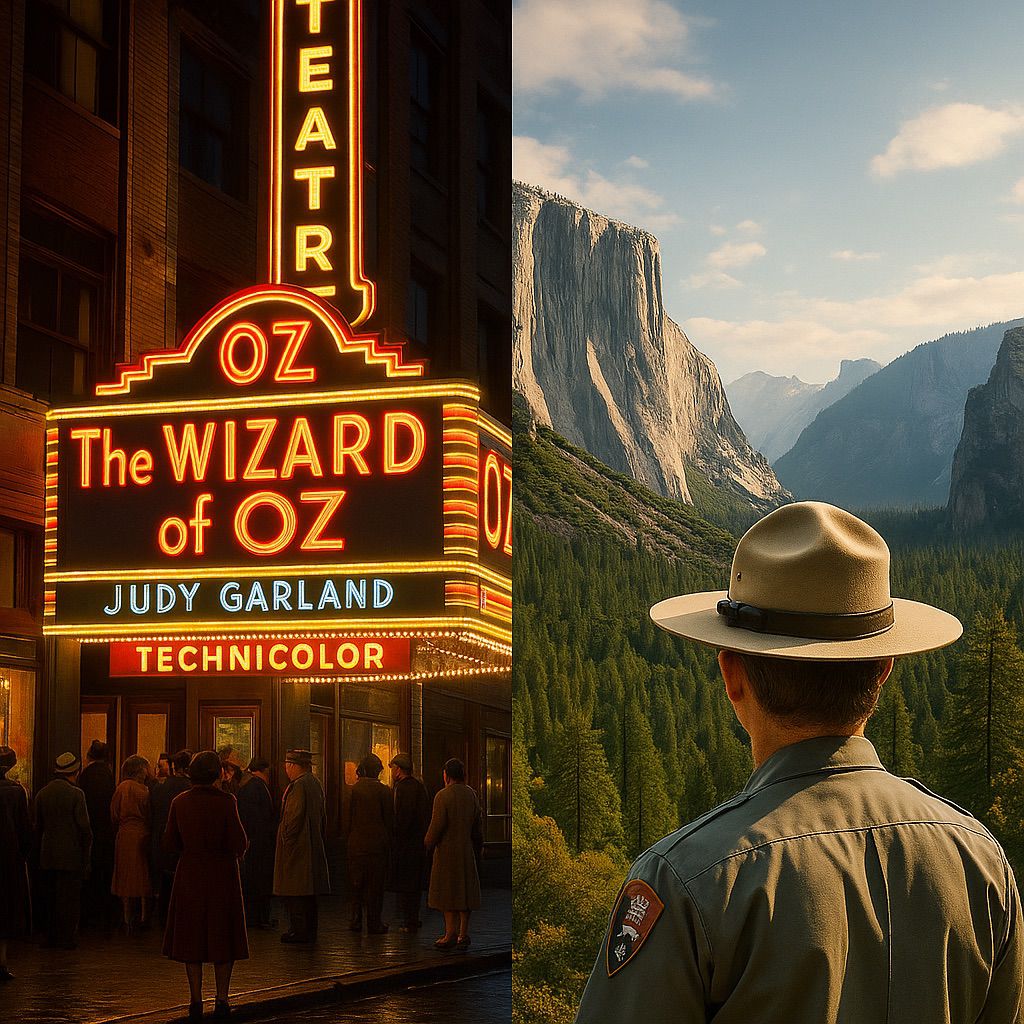
On August 25, America learned two different ways to believe. In 1916, Congress created the National Park Service, a quiet sentence that would teach an entire country to treat mountains, canyons, coral reefs, and battlefields like family heirlooms: not for hoarding, but for sharing. Twenty-three years later, in 1939, a movie slipped from sepia into Technicolor, and audiences gasped as Dorothy Gale stepped over a threshold and into a world that insisted dreams could come true in shoes you already owned. One founding promised that the real Emerald Cities—valleys and geysers and long, breathing prairies—would be kept for the generations yet to lace their boots. One film promised that the courage, heart, and brains needed to cross any wilderness were already within reach. The date is a hinge between stewardship and story, a reminder that wonder needs both a place to live and a reason to matter.
Think first of the Park Service, born into an America that was busy becoming modern. Railroads had braided the coasts together; automobiles were re-sculpting weekends; billboards and skylines competed to tell you where to look. Yet in the background—older than any headline—stood the unpurchased astonishments: geysers that threw time into the air, stone arches like doorways that forgot their doors, redwoods with the patience to forgive our hurry. Before the Service, parks existed as a scattered promise—Yellowstone here, Yosemite there, a handful of monuments and reservations stitched unevenly into a quilt of good intentions. The Organic Act of August 25, 1916 threaded them, gave them a single caretaker with a paradoxical job: keep the wild wild, and still invite the world to visit. Preserve unimpaired; provide for enjoyment. Two imperatives that jostle like siblings and, on good days, hold hands.
For a century that paradox has been the Service’s craft. Rangers translate geology into sentences and silence into safety briefings; they teach toddlers to listen for ravens and hikers to see lichens as cities. Trails are built with a grace that feels inevitable, switchbacks tucked into slopes so that knees believe the mountain has grown kinder. Signage shows where to look but not how to feel. In the best parks, roads stop just short of domination; lodges tuck their shoulders so the landscape can keep its posture. The uniform’s flat hat is the opposite of a crown: a servant’s badge that says, “Ask me how to belong here.” Because belonging is what the parks are for—not the possession of scenery, but the practice of citizenship in a place that does not owe you a view and gives you one anyway.
Yet the Park Service has been learning, and must keep learning, that “unimpaired” never meant “unpeopled.” Long before Congress named these lands, Native nations named and tended them, stewarding meadows with fire and rules, reading river moods with a literacy that predates any ranger manual. “Conservation” that ignores sovereignty mistakes erasure for care. The parks’ future—indeed their present—depends on co-management that honors treaty rights, restores names, and listens to Indigenous science as equal partner, not garnish. It also depends on expanding what counts as a park: not only geysers and granite, but also history too tender to leave to rumor—sites where rights were demanded, where families were confined, where labor organized, where communities built joy that resisted the dark. The national memory is as wild as any canyon; the Service’s task is to keep its walls from being dynamited by forgetfulness.
Now let the lights dim and the curtain rise on 1939. A dust-brown farm in Kansas tightens like a throat; the dog knows before anyone that weather and worry are kin. Then the door opens and color arrives like mercy. The floor tiles wink, the poppies conspire, the Munchkins harmonize, and a road appears as if the future had sent back a blueprint. The Wizard of Oz is the simplest myth told with the most radical tools: a child leaves home, gathers a fellowship, confronts illusions, returns changed. But inside that simplicity lies a new cinematic literacy. The transition from sepia to Technicolor didn’t just decorate the screen; it taught audiences how a frame could crack open the ordinary to reveal the saturated dignity beneath. It announced that movies weren’t only mirrors; they were windows, and sometimes doors.
The film did more than dazzle. It domesticated archetypes without declawing them. The Scarecrow made intelligence a matter of curious attention, not diplomas; the Tin Man made love a matter of practice, not sentiment; the Lion reframed courage as action despite fear, not bravado’s costume. Dorothy, pure center, invited viewers to locate home not as a place on a map but as the place where loyalty and gratitude converge. The Wizard—booming voice, easy smoke—turned institutional spectacle into a cautionary tale that still applies whenever leaders prefer curtains to candor. Wickedness arrived in green and broomstick, yes, but goodness arrived in glitter and a pointed reminder: you already have what you need. Cinema rarely gives better advice.
Put the Park Service and Oz in the same room and you begin to see the shared thesis. Both are about frames. A park boundary says: inside this line, extraction will kneel to awe. A movie frame says: inside this rectangle, we will pause the ordinary so you can learn to see it again. Both are about access. Trails and roads and campgrounds democratize the sublime, insisting that a kid in borrowed boots deserves Half Dome just as much as someone in bespoke gear. Tickets and matinees democratize imagination, insisting that a factory worker deserves lions and emerald towers as much as any patron. Both are about stewardship: the ranger with a Pulaski digging water bars after a storm; the projectionist splicing a reel; the curator cleaning a lens; the volunteer hauling trash out of a creek; the usher sweeping popcorn after credits. Wonder isn’t free; it’s subsidized by care.
Both legacies face modern tests. The parks are warming. Glaciers sulk back up their valleys; permafrost cheats; storms arrive like strangers who refuse to knock. Trails wash out and must be rebuilt farther uphill; seaside forts stare at tides that grew bold while we were arguing. The Service’s mission now includes hosting grief and training resilience: leading “fire ecology” walks that smell of charcoal and courage; writing plaques that admit a lagoon is a meadow because the ocean decided so; closing areas so that foxes can raise kits and reopen them with a conversation about patience. Loving a place in 2025 means voting for its snowpack and sea grass, not just photographing them.
Cinema faces tests, too: attention atomized by infinite scroll; industry footprints that scorch while stories preach cool; gatekeepers who still forget that magic multiplies in more hands. Yet the Oz blueprint holds. Find companions: producers, grips, musicians, writers from faces and towns that used to be seated in the balcony. Walk forward when the market tells you to play it safe: fund a story that treats a river or a neighborhood like the protagonist it is. Pull back the curtain: be transparent about budgets, labor, and climate impacts so that the illusion we buy is honest about the costs it refuses to externalize. Remember that songs are maps: the right refrain can get a frightened audience all the way through a hard idea.
There’s a child threaded through both halves of this date. One Saturday, they climb into the family car before dawn, sleep through a highway’s worth of billboards, and wake up at a pullout where granite refuses to fit into any camera they own. A ranger kneels to show them how a tiny flower lifts a whole slab with its root and rain’s patience. Weeks later, the same child sits in a theater that smells like soft seats and sugar, the lights drop, and a song teaches them that storm cellars are not the only way to survive wind. These lessons touch each other: walk softly, sing loudly; carry water and carry mercy; keep to the trail and keep to your friends; ask for help from experts in green uniforms and from little dogs who can smell a lie.
A confession: the country has not always kept these promises equally. Some families were told that certain parks were “for others.” Some children grew up near beautiful places paved for pipelines rather than protected for picnics. Some audiences saw their faces only as punchlines. Repair is not a subplot; it is the main quest. A Park Service that centers Indigenous stewardship and invites communities of color to write themselves into the interpretive script is not doing outreach; it is doing accuracy. A film industry that funds storytellers beyond the usual zip codes is not doing charity; it is doing its job: enlarging the national dream until it finally fits the nation.
So what do we do with August 25 when it arrives each year like a lantern on a trail? We remember that imagination and inheritance are twins. We donate a Saturday to a trail crew or a “friends of” group because gratitude should leave calluses. We take a first-timer to a park, shoulder half their pack, and let them set the pace. We rewatch a scene that once saved us and pay attention to the craft—how the cut breathes, how the color carries feeling, how the costume tells a truth words can’t. We nag our leaders about budgets with the same devotion we nag a failing battery. We learn the names of birds along with the names of cinematographers. We practice being the person in the group who says, “Let’s pick up that trash,” and the person who says, “Let’s wait for the slowest hiker,” and the person who says, “Let’s fund the weird script; it’s going to matter.”
“Somewhere over the rainbow” is not only a melody; it’s a management philosophy. The rainbow is the spectrum of people and places we are sworn to keep safe: prairie and pueblo, glacier and greenroom, coral head and chorus line. Over it lies the work we haven’t done yet, the risks we haven’t taken yet, the apologies we still owe and the amends we can still make. The Yellow Brick Road is any path that says, “Forward, with friends.” The Emerald City is any community that admits its wizards are human and that power, to be worth keeping, must be accountable to kindness.
There are two exits from the theater: one leads back to streets that will need your courage; the other leads to a trailhead that will need your care. Pick both. Step into the afternoon with songs stuck to your ribs and a map folded into your pocket. Keep an eye out for poppies that look like rest but are really delay. Tie your shoes—ruby or otherwise. Check the weather. Thank the folks at the desk. Promise the desk that you’ll be back, and that you’ll bring someone new. Then walk, and when the road bends, walk some more. If you do it right, you’ll get home and discover you never left; you just learned how to belong more deeply to what was yours all along.