
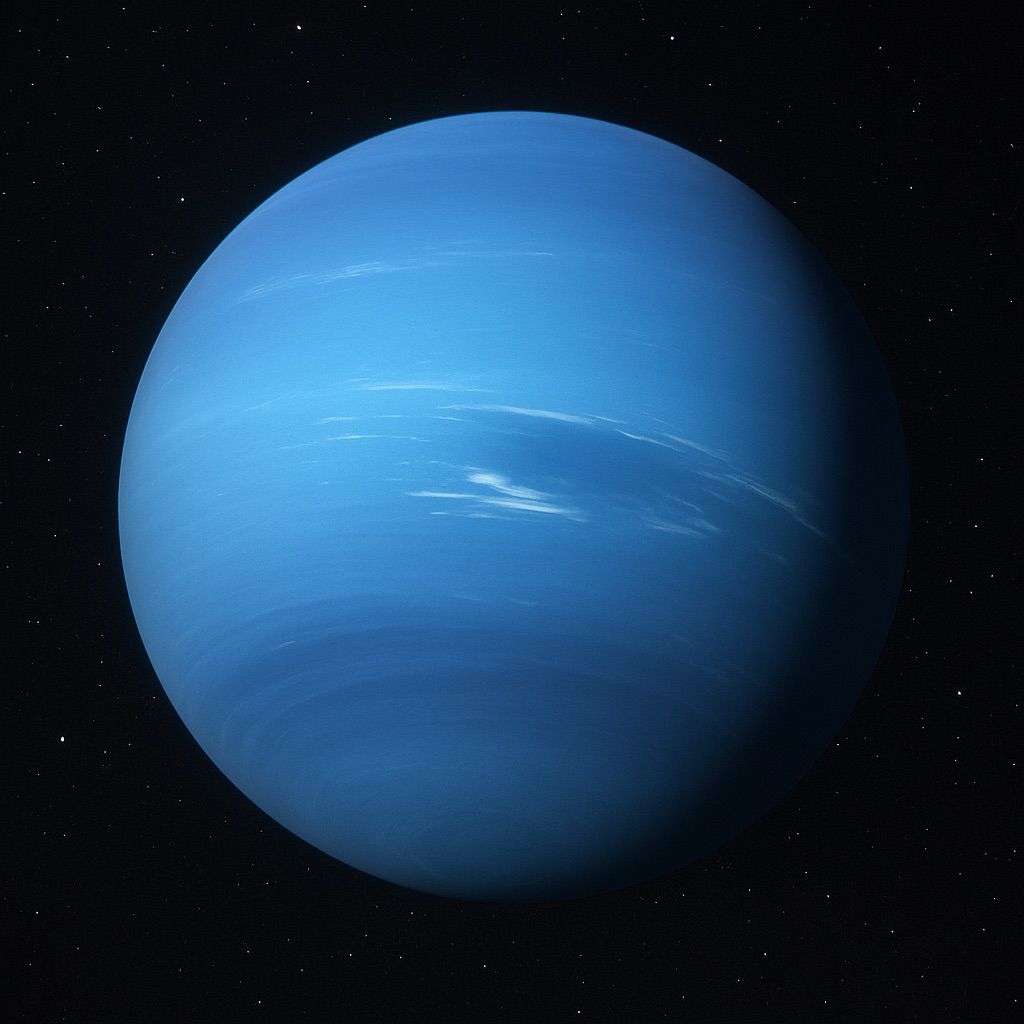
On the night of September 23, 1846, humanity’s gaze expanded to embrace another world. In the quiet of the Berlin Observatory, astronomer Johann Gottfried Galle peered through a telescope, guided not by chance but by mathematics, and spotted a faint blue disk glimmering against the canvas of the heavens. This was Neptune — a planet no one had seen before, predicted by calculation and confirmed by sight. It was the first time in history that a celestial body had been discovered not by accident or luck but through the power of human reasoning. In that moment, the universe seemed to whisper back to humanity: your mind can reach farther than your eyes.
The story of Neptune’s discovery is a drama of intellect, rivalry, and revelation. By the early 19th century, astronomers knew their solar system was not complete. Uranus, discovered by William Herschel in 1781, did not behave as Newton’s laws suggested it should. Its orbit wobbled, pulled by something unseen. Some thought Newton’s theory might be flawed. Others suspected the existence of another, more distant planet tugging invisibly at Uranus’s path. It was a puzzle that stretched the limits of human curiosity. Could mathematics alone point to a world no telescope had yet glimpsed?
In France, the young mathematician Urbain Le Verrier took up the challenge. With relentless precision, he calculated where this hidden planet should be. Across the Channel in England, John Couch Adams, working independently, arrived at a similar conclusion. Both men, armed only with equations and determination, had triangulated the position of a ghost in the sky. But calculation was only theory until confirmed by observation. That final task fell to Galle in Berlin. Using Le Verrier’s predictions, he turned his telescope toward the designated region of sky. And there it was — Neptune, almost exactly where the numbers had foretold. A pale orb on the frontier of sight, a new giant of the solar system, pulled out of darkness by the union of mathematics and vision.
The discovery was more than a scientific triumph. It was a cultural earthquake. For millennia, humanity had relied on the naked eye to know the heavens. The ancients mapped Mercury, Venus, Mars, Jupiter, and Saturn, the “wanderers” visible without aid. Even Uranus had been spotted accidentally. But Neptune was different. It was a planet pulled from the void by intellect alone, the child of pencil, paper, and calculation before it was the child of glass and lens. The discovery vindicated Newtonian physics, silenced skeptics, and cemented the idea that the universe could be grasped not only by what we see, but by what we deduce.
Yet the triumph was also entangled with rivalry and controversy. France celebrated Le Verrier, Britain claimed Adams, and Germany honored Galle. The discovery became a matter of national pride, each country eager to inscribe its name on the newest planet. But beyond borders and egos, Neptune belonged to no nation. It belonged to the human species, a collective leap of mind and spirit.
Neptune itself was a revelation. Over time, astronomers learned it was a giant of ice and gas, its atmosphere laced with methane, its winds the fastest in the solar system, roaring at over 1,000 miles per hour. Fourteen moons circled it, including the captured body Triton, a frozen world spewing geysers of nitrogen. Neptune was not merely a dot on a chart but a dynamic, alien realm, far beyond Earth’s warmth, yet alive with storms and mystery. The discovery opened a door not only to one planet but to the realization that the cosmos was far larger, stranger, and more alive than anyone had imagined.
Looking back, the night of September 23, 1846, represents more than a scientific milestone. It is a symbol of what humanity can achieve when imagination meets discipline. A young mathematician scribbling on parchment, an astronomer adjusting his telescope, a silent blue world waiting unseen for eons — all converged in one moment of cosmic revelation. It was a reminder that the universe is not static but expanding, not closed but open, and that our role is not only to dwell within it but to discover it.
Neptune’s discovery remains a turning point in the human story. It was the night we proved that reason could see farther than the eye, that the cosmos could be mapped before it was touched, that the boundary between known and unknown was not a wall but a horizon. On September 23, 1846, humanity found a giant in the dark, and in doing so, found itself a little larger too.