
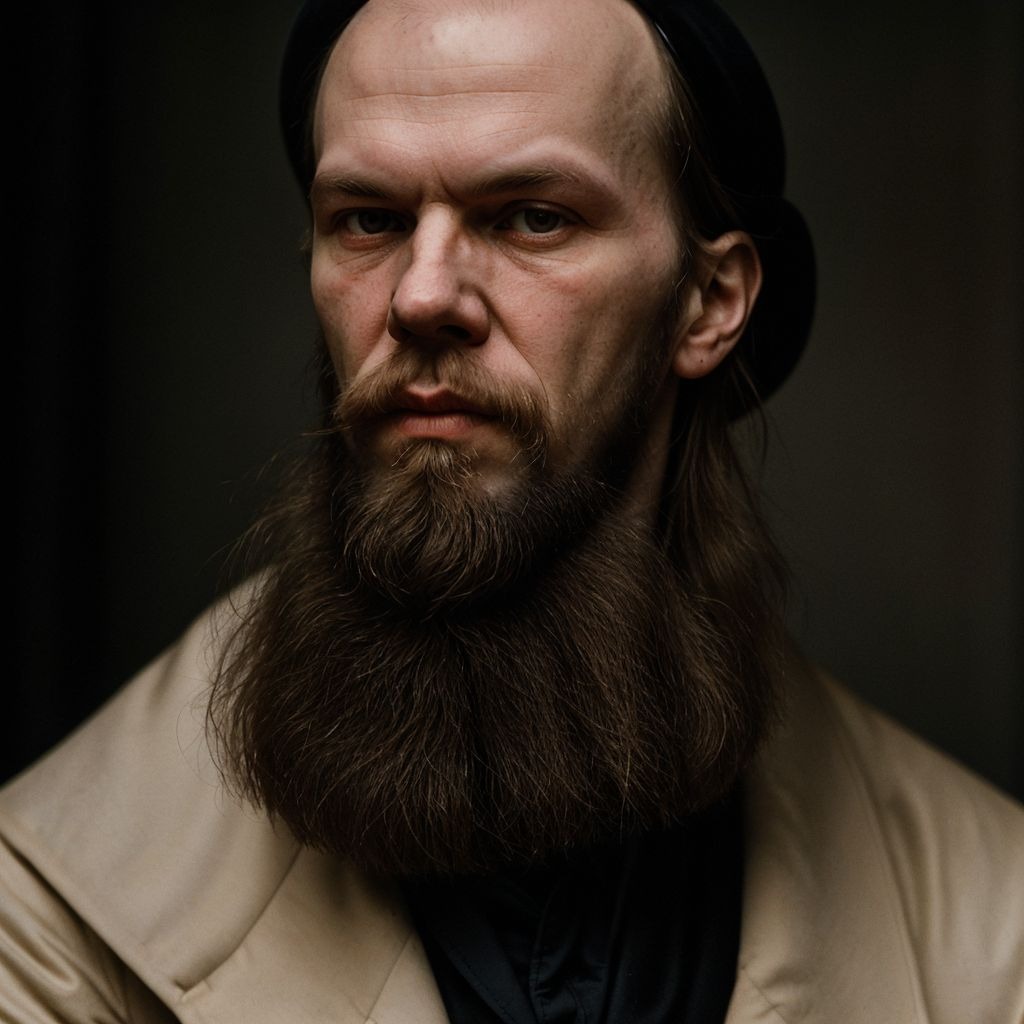
I’ve always been fascinated by Fyodor Dostoevsky, but it’s not because I’ve read all his novels or even most of them. To be honest, I got stuck on Crime and Punishment when I was 19 and never quite finished it. But there’s something about him that draws me in – a quality that makes me feel like he’s speaking directly to my own messy, uncertain self.
Maybe it’s because Dostoevsky’s work is like looking into a dark mirror: you see your own fears, desires, and contradictions staring back at you. I’ve always been drawn to the parts of his stories where characters grapple with moral ambiguity – where they’re forced to confront the complexities of their own hearts. It’s uncomfortable, but in a way that feels necessary.
Take Raskolnikov from Crime and Punishment, for example. He’s this brilliant, idealistic young man who believes he can commit the perfect crime and escape punishment because he’s smarter than everyone else. But as I read about his inner turmoil, I couldn’t help but think of my own moments of grandiosity – when I thought I knew exactly what was right or wrong, when I was convinced that I had all the answers.
Raskolnikov’s crisis of faith feels eerily familiar to me, like a shadow version of my own struggles with identity and purpose. And yet, Dostoevsky’s portrayal is so much more nuanced than any simple moral lesson. He shows us that our darkest impulses can coexist with our highest ideals – that we’re capable of both good and evil at the same time.
This ambiguity unsettles me on a deep level. I’ve always prided myself on being a “good person,” someone who tries to do the right thing, but Dostoevsky’s work makes me wonder if that’s even possible. Can anyone truly be selfless, or is it just an illusion we tell ourselves to feel better about our own flaws?
As I grapple with these questions, I find myself returning to The Brothers Karamazov again and again. It’s a novel about faith, family, and the search for meaning in a chaotic world – themes that resonate deeply with me, even though I’ve never been particularly spiritual.
Dostoevsky’s characters are like my own extended family: flawed, infuriating, and somehow endearing at the same time. There’s Ivan Karamazov, the cynic who rejects God but can’t shake his own sense of responsibility; Alyosha, the young monk with a heart full of compassion; and Fyodor Pavlovich, the patriarch whose selfishness is matched only by his profound ignorance.
Each character represents a different aspect of myself – my own contradictions, fears, and aspirations. And Dostoevsky’s masterful storytelling makes me feel seen in a way that few other authors can. It’s like he’s saying, “Yes, I know you’re messy and confused, but so am I.”
In the end, it’s not just about understanding Dostoevsky or his work – though I could spend hours analyzing his psychological insights or literary techniques. No, for me, it’s about recognizing myself in his writing: my own capacity for good and evil, my struggles with identity and purpose.
As I continue to explore Dostoevsky’s world, I’m drawn back to the same question that haunts me every time I read him: what does it mean to be human?
The more I immerse myself in Dostoevsky’s work, the more I realize that his characters are not just reflections of my own psyche, but also mirrors of society as a whole. He’s got this incredible ability to capture the complexities of human relationships – the web of dependencies, the tangled threads of love and hatred, the way we’re all connected yet isolated at the same time.
Take the character of Svidrigailov from Crime and Punishment, for example. On the surface, he’s this charming, manipulative sociopath who preys on others for his own gratification. But as you dig deeper, you see that he’s also a product of his environment – a man shaped by poverty, neglect, and the brutalities of the Russian aristocracy.
It’s hard not to draw parallels between Svidrigailov and some of the more toxic people I’ve encountered in my own life – the ones who use their charm and wit to get what they want, no matter who gets hurt. And yet, Dostoevsky never judges them outright; instead, he shows us the depths of their pain and loneliness, making it impossible to dismiss them as simply “bad” people.
This is where things get really uncomfortable for me – when I’m forced to confront my own complicity in perpetuating systems that harm others. I think about how easily I’ve accepted certain social norms or biases without questioning them, how often I’ve prioritized my own comfort over the needs of those around me.
Dostoevsky’s work doesn’t provide easy answers or moral solutions; instead, it asks me to confront the messiness of human existence – the ways in which we’re all implicated in each other’s suffering. It’s a sobering realization, one that makes me wonder if I’ve been living in a state of willful ignorance all along.
As I continue to wrestle with these questions, I find myself drawn to Dostoevsky’s lesser-known works – his short stories and essays that offer glimpses into the daily lives of ordinary people. There’s something about these pieces that feels more raw, more honest than his novels; they’re like snapshots of human experience, unfiltered and unvarnished.
One story in particular keeps coming back to me: “The Peasant Marey” from The House of the Dead. It’s a simple tale about an old peasant woman who’s wrongfully accused of theft and sentenced to prison – but as you read on, you realize that her story is not just about her own suffering, but also about the dehumanizing effects of poverty, racism, and institutionalized cruelty.
This story hits me hard because it speaks directly to my own experiences with social injustice. I think about the times I’ve privileged the comfort of my own community over the needs of those on the margins – the way I’ve internalized systems of oppression without realizing it. Dostoevsky’s work doesn’t excuse or condone this behavior; instead, it forces me to confront the ways in which I’m complicit in perpetuating harm.
As I close this essay (for now), I’m left with more questions than answers – about what it means to be human, about how we can live together in a world that’s so inherently messy and flawed. But Dostoevsky’s work has given me a language for exploring these complexities, a framework for understanding the depths of my own heart. And for that, I’m eternally grateful.
As I delve deeper into Dostoevsky’s world, I find myself pondering the role of fate and free will in shaping our lives. Raskolnikov’s crisis of faith raises questions about whether we’re bound by some predetermined course or if we have agency over our choices. It’s a debate that has captivated philosophers and theologians for centuries, but Dostoevsky’s work adds a layer of complexity by exploring the ways in which our circumstances, upbringing, and social conditioning influence our decisions.
I think about how my own life has been shaped by factors beyond my control – the privilege I’ve inherited as a middle-class white woman, the education that’s given me access to resources and opportunities. Do these advantages render my choices more deliberate or do they simply perpetuate systems of oppression? Dostoevsky’s characters often find themselves trapped in circumstances that seem predetermined, but he also shows how they can choose to resist, rebel, or adapt within those constraints.
This is where I get stuck – trying to untangle the threads of fate and free will. Can we ever truly be free if our choices are shaped by external forces? Or do we have a responsibility to acknowledge and confront these influences in order to make more informed decisions? Dostoevsky’s work suggests that it’s not a binary choice between fate and free will, but rather a nuanced dance between the two.
As I struggle with this question, I find myself drawn to the character of Sonya Marmeladova from Crime and Punishment. She’s a young prostitute who becomes embroiled in Raskolnikov’s life through her association with his family. What strikes me about Sonya is her capacity for compassion, even in the face of unimaginable hardship and exploitation. Despite being trapped by circumstance, she chooses to act with kindness and empathy towards those around her.
Sonya represents a particular kind of freedom that I find myself craving – a freedom from the expectations placed upon us by society, family, or personal history. She’s not bound by traditional notions of morality or convention; instead, she forges her own path through a world that seems determined to crush her. In some ways, she embodies the idea of “good” as something separate from societal norms or moral codes – a quality that’s both beautiful and terrifying.
This is where Dostoevsky’s work gets really interesting – not in providing answers or solutions but in raising questions about what it means to be human in all our messy complexity. As I continue to explore his world, I’m reminded of the importance of empathy, compassion, and understanding in navigating the tangled web of human relationships.
In a way, Dostoevsky’s characters become mirrors for me – reflecting back my own fears, desires, and contradictions. But they also offer glimpses into a more expansive view of humanity – one that acknowledges our darkness as well as our light. It’s a perspective that challenges me to confront the depths of my own heart, to acknowledge both the beauty and ugliness within myself.
As I close this essay (for now), I’m left with a sense of awe and trepidation at the vast expanse of human experience. Dostoevsky’s work has given me a language for exploring these complexities, but it’s also forced me to confront my own limitations – the ways in which I’ve been complicit in systems that harm others, the areas where I’m still struggling to understand.
The more I immerse myself in Dostoevsky’s world, the more I realize how little I know about human nature. It’s not just a matter of acknowledging our flaws and imperfections; it’s about confronting the ways in which we’re all connected, how our actions ripple out into the world and affect those around us.
Take the character of Liza Khokhlakova from The Brothers Karamazov, for example. She’s this beautiful, fragile young woman who’s been brutalized by her family and society, forced to endure a life of poverty and servitude. And yet, despite everything she’s suffered, she retains a spark of compassion and empathy that’s almost heartbreaking.
What I find myself wondering is how Liza manages to hold onto this sense of humanity in the face of such overwhelming oppression. Is it some innate quality that allows her to resist the dehumanizing effects of her circumstances? Or is it simply a matter of survival, a way of coping with the brutality around her?
Dostoevsky’s portrayal of Liza raises questions about the relationship between suffering and empathy. Do we become more compassionate when we’re forced to confront our own mortality or vulnerability? Or does the weight of our own pain make it harder for us to connect with others?
These are the kinds of questions that keep me up at night, staring into the dark mirror of my own soul. Dostoevsky’s work doesn’t provide easy answers, but it does offer a framework for exploring these complexities. And in doing so, I’m forced to confront my own limitations – the ways in which I’ve been complicit in systems that harm others, the areas where I’m still struggling to understand.
As I continue to grapple with these questions, I find myself drawn to Dostoevsky’s notion of “the underground man.” It’s this concept of a person who exists outside the mainstream, someone who’s forced to navigate the hidden pathways and secret societies that lie beneath the surface of society.
The underground man is a fascinating figure – both repellent and captivating at the same time. He represents a kind of freedom that I find myself craving: the freedom to reject societal norms and expectations, to forge one’s own path through the darkness.
But what does it mean to be an underground person? Is it simply a matter of rebelling against the status quo or is there something more profound at play? Dostoevsky’s work suggests that the underground man represents a kind of existential awareness – a recognition that we’re all trapped in our own private hells, struggling to find meaning and purpose in a seemingly meaningless world.
This is where I get stuck – trying to understand the allure of the underground man. Is he a symbol of rebellion or a reflection of my own despair? Or is he something more complex, a representation of the many contradictions that lie within us all?
As I continue to explore Dostoevsky’s work, I’m reminded of the importance of nuance and complexity in understanding human nature. His characters are never one-dimensional; they’re multidimensional, messy, and often contradictory.
And it’s this messiness that I find myself drawn to – the way his characters embody both good and evil, light and darkness. They’re not just reflections of my own psyche or moral code; they’re mirrors for society as a whole – reflecting back our deepest fears, desires, and contradictions.
In the end, it’s not about understanding Dostoevsky or his work; it’s about recognizing myself in his writing – my own capacity for good and evil, my struggles with identity and purpose. And it’s this recognition that I’m eternally grateful for, even if it means confronting the darkness within myself.
As I close this essay (for now), I’m left with a sense of awe and trepidation at the vast expanse of human experience. Dostoevsky’s work has given me a language for exploring these complexities, but it’s also forced me to confront my own limitations – the ways in which I’ve been complicit in systems that harm others, the areas where I’m still struggling to understand.
And so I’ll continue to read, to write, and to grapple with the messiness of human existence. For in the words of Dostoevsky himself, “The only thing that counts is not what we believe but how we live our lives.”