
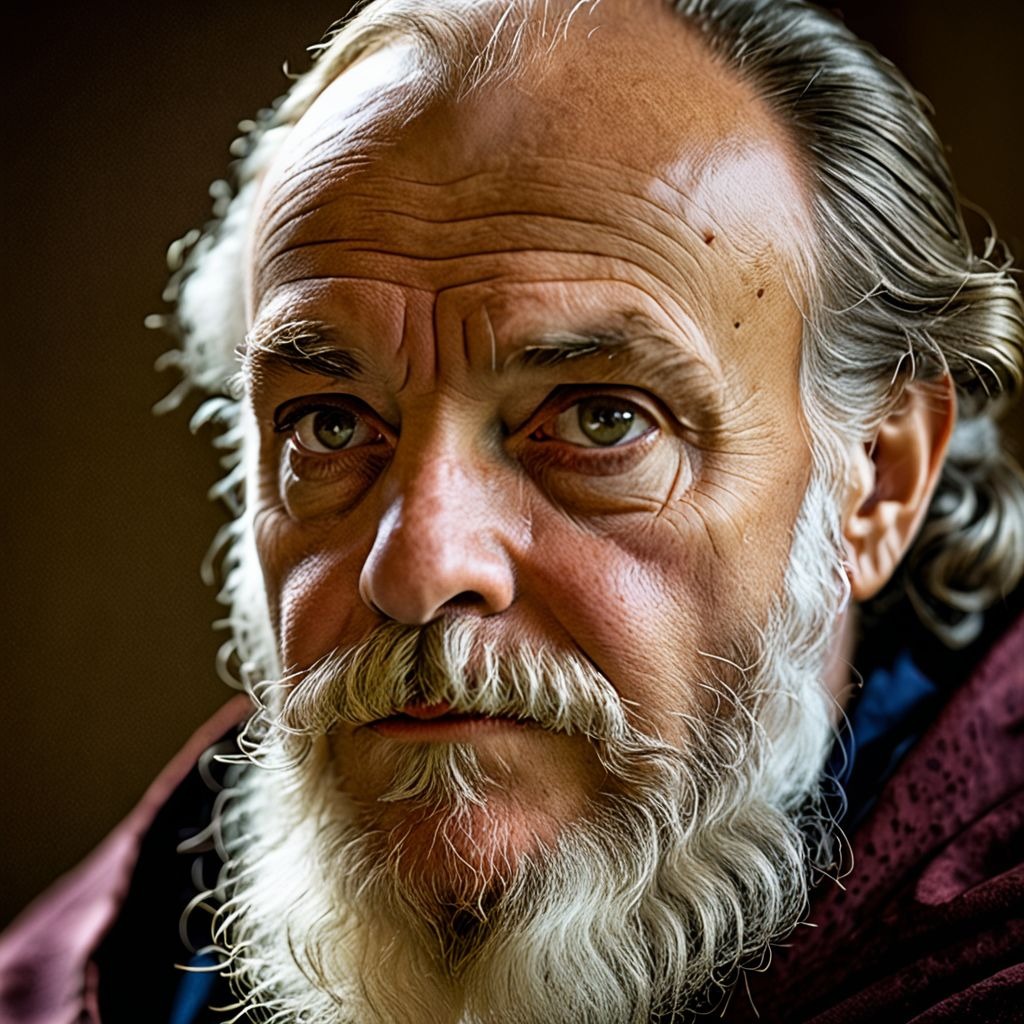
I’ve always been drawn to people who challenge the status quo, and Galileo Galilei is one of those figures who has captivated me for a while now. What strikes me about him is his unwavering commitment to observing reality, even when it went against the dominant views of his time.
As I reflect on my own experiences as a young adult, I think about how often we’re encouraged to conform and fit in. In college, I felt pressure to choose a “practical” major or career path, even if it didn’t align with my passions. But Galileo’s story shows that there are consequences for not following the crowd – he faced opposition from the Church and was even put under house arrest.
I have to admit, I’m fascinated by the tension between scientific inquiry and authority. When Galileo discovered new evidence that contradicted Aristotelian views, he didn’t shy away from sharing his findings. He published his observations of the moon’s phases and the imperfections on the sun’s surface, which shook the foundations of geocentrism.
But what I find particularly intriguing is how Galileo navigated the complex web of power and influence in 17th-century Italy. As a member of the Tuscan nobility, he had connections that might have insulated him from criticism. Yet, he chose to speak truth to those in power, risking his reputation and even his freedom.
I wonder if I would have had the courage to do something similar. Would I have stood up for what I believed in, even if it meant going against the prevailing wisdom? Or would I have taken a more cautious approach, trying to avoid conflict and criticism?
Galileo’s case also makes me think about the role of observation and experimentation in shaping our understanding of the world. He used his telescope to observe the night sky, revealing new worlds and challenging existing theories. This resonates with my own experiences as a writer – when I’m stuck on a piece, I often find that taking a step back and observing my thoughts helps me gain clarity.
One thing that still puzzles me is how Galileo’s views evolved over time. Initially, he subscribed to the geocentric model, but later, after his observations with the telescope, he became a vocal proponent of the heliocentric view. This shift makes me question whether we can ever truly change our minds or if we’re stuck in our initial perspectives.
I’m not sure what it says about me that I’m drawn to someone like Galileo – perhaps it’s because his journey is a reminder that growth and self-doubt are integral parts of the learning process. Maybe I see myself in him, struggling to reconcile my own desires with the expectations of others. Whatever the reason, I find myself returning to his story again and again, searching for insights into how we navigate uncertainty and challenge the status quo.
As I delve deeper into Galileo’s life, I’m struck by the nuances of his character. He was a complex figure, driven by a mix of intellectual curiosity and personal ambition. His willingness to take risks and challenge authority is admirable, but it’s also clear that he wasn’t immune to the pressures of his time.
I’ve been thinking about how Galileo’s relationships with others influenced his work. His patronage from the Medici family provided him with financial support and access to resources, but it also meant that he was beholden to their interests. I wonder if this tension between independence and dependence is something that many of us struggle with – do we prioritize our own autonomy or seek out connections that can help us achieve our goals?
Galileo’s relationships with other scientists and thinkers are equally fascinating. His debates with Kepler and his later disagreements with Descartes reveal a mind that was constantly engaged in dialogue and debate. I’m drawn to the idea of this intellectual community, where people were pushing each other to think more deeply and critically about the world.
But what really gets me is Galileo’s writing style – or rather, how he used language to communicate complex ideas to his audience. As a writer myself, I’ve always been interested in the ways that language can be both precise and evocative. Galileo’s use of metaphor and analogy to describe astronomical phenomena is still breathtaking today.
I’m starting to see parallels between Galileo’s approach to science and my own experiences with writing. Both require a willingness to take risks and challenge assumptions – whether it’s questioning established theories or experimenting with new forms of expression. And just as Galileo’s observations were rooted in careful observation, so too do I find that the best writing comes from paying attention to the world around me.
I’m not sure if this is true for everyone, but for me, there’s a connection between observing reality and creating art. Maybe it’s because both require a sense of wonder and awe – Galileo’s observations of the moon and stars were likely met with a mix of amazement and trepidation, just as I feel when I’m trying to capture a particular moment or feeling on paper.
As I continue to explore Galileo’s life, I’m struck by the ways in which he embodied both the scientist and the artist. His work was driven by a desire to understand the world around him, but it was also infused with a sense of beauty and wonder. And that’s what I think draws me to his story – not just the intellectual curiosity or the historical significance, but the way he lived his life as a continuous process of exploration and discovery.
I’ve been thinking about how Galileo’s approach to science was so deeply intertwined with his artistic side. He saw beauty in the patterns and structures of the universe, just as I see it in the cadence and rhythm of language. For him, the study of astronomy wasn’t just about collecting data or proving theories; it was about experiencing the sublime and the mysterious.
I’ve always been fascinated by the concept of the “sublime” – that feeling of awe and wonder that comes from encountering something greater than ourselves. For me, it’s often found in the written word: a perfectly crafted sentence, a powerful metaphor, or a phrase that captures the essence of an emotion. Galileo experienced his own version of this when he gazed up at the night sky, his telescope revealing secrets that had been hidden for centuries.
What strikes me is how similar our experiences are, despite living in different eras and pursuing different passions. Just as I find myself lost in the world of words, Galileo became lost in the universe’s grand tapestry. And just as I seek to capture the essence of human experience through my writing, he sought to understand the workings of the cosmos.
This realization has led me to wonder if our creative pursuits are simply different expressions of a universal desire to explore and comprehend. Are we not all seekers, each in our own way, trying to grasp the intricate web of meaning that underlies our existence? Galileo’s journey teaches me that science and art are not mutually exclusive; they’re two sides of the same coin, both striving to illuminate the world around us.
As I continue to reflect on Galileo’s life, I’m struck by the idea that our obsessions often reveal more about ourselves than we might initially think. For him, it was the pursuit of knowledge and understanding; for me, it’s the quest to craft words into something meaningful. Both are forms of obsession, I suppose – a fixation on something greater than ourselves that drives us to explore, experiment, and push beyond our limits.
And what does this say about our relationship with uncertainty? For Galileo, it was a constant companion, one that forced him to adapt and evolve his theories in response to new observations. Similarly, as a writer, I find myself navigating the unknown territories of language and human experience, often unsure of where my words will lead or what meaning they’ll convey.
Perhaps this is why I’m drawn to Galileo’s story – it reminds me that uncertainty is not something to be feared or avoided; it’s an essential part of the creative process. By embracing the unknown, we open ourselves up to new possibilities and insights, just as Galileo did when he dared to challenge the prevailing views of his time.
I’m not sure where this line of thinking will lead me next – perhaps into a deeper exploration of the role of uncertainty in science and art? Or maybe it’ll take me down a different path altogether. But for now, I’m content to let Galileo’s story guide me on my own journey of discovery, one that’s still unfolding as I write these words.
As I continue to ponder the parallels between Galileo’s scientific pursuits and my own writing endeavors, I find myself thinking about the power of language in shaping our understanding of the world. For Galileo, his observations and experiments were not just about gathering data, but about crafting a narrative that would challenge the dominant views of his time. Similarly, as a writer, I strive to use language in a way that not only conveys information but also evokes emotions and sparks imagination.
I’m struck by how Galileo’s writing style was characterized by its clarity, precision, and elegance. He had a unique ability to distill complex ideas into accessible language, making his work appealing to a broad audience. This is something I aspire to in my own writing – the ability to convey abstract concepts in a way that resonates with readers on an intuitive level.
One of the things that fascinates me about Galileo’s use of language is how he employed metaphor and analogy to describe complex scientific concepts. For example, his description of the moon’s phases as “a silvery crescent” or the sun’s imperfections as “spots” that reveal its true nature. These metaphors not only make the science more relatable but also highlight the beauty and wonder inherent in the natural world.
This got me thinking about how I can apply this approach to my own writing. How can I use metaphor and analogy to convey complex ideas in a way that’s both engaging and accessible? For instance, when describing the nuances of human emotion or the intricacies of social dynamics, can I find creative ways to describe these concepts that make them more relatable and tangible?
Galileo’s emphasis on observation and experimentation as key components of scientific inquiry has also made me think about the role of sensory experience in writing. As a writer, I often rely on my senses – sight, sound, touch, taste, and smell – to evoke emotions and create vivid imagery in my readers’ minds. But how can I take this even further by incorporating more experiential elements into my writing? Can I use descriptive language that not only paints a picture but also invites the reader to engage with the world around them?
As I continue to explore these ideas, I’m reminded of the importance of playfulness and curiosity in both scientific inquiry and creative expression. Galileo’s willingness to challenge conventional wisdom and push the boundaries of what was thought possible is an inspiration to me as a writer – it reminds me that there’s always room for innovation and experimentation, even when exploring familiar themes or ideas.
And so, I find myself drawn into this world of observation, experimentation, and creative expression, where science and art blur together in unexpected ways. It’s a space where the boundaries between disciplines dissolve, and new possibilities emerge from the intersections and overlaps between seemingly disparate fields.
As I close my eyes and imagine Galileo gazing up at the night sky through his telescope, I feel a sense of kinship with this 17th-century astronomer. We’re both seekers, driven by a desire to explore, understand, and create in our own ways – one using the language of science, the other using the tools of writing and imagination. And in that shared pursuit, we find common ground and inspiration for our individual journeys, each of us pushing beyond the limits of what’s possible and illuminating the world around us in our unique ways.