
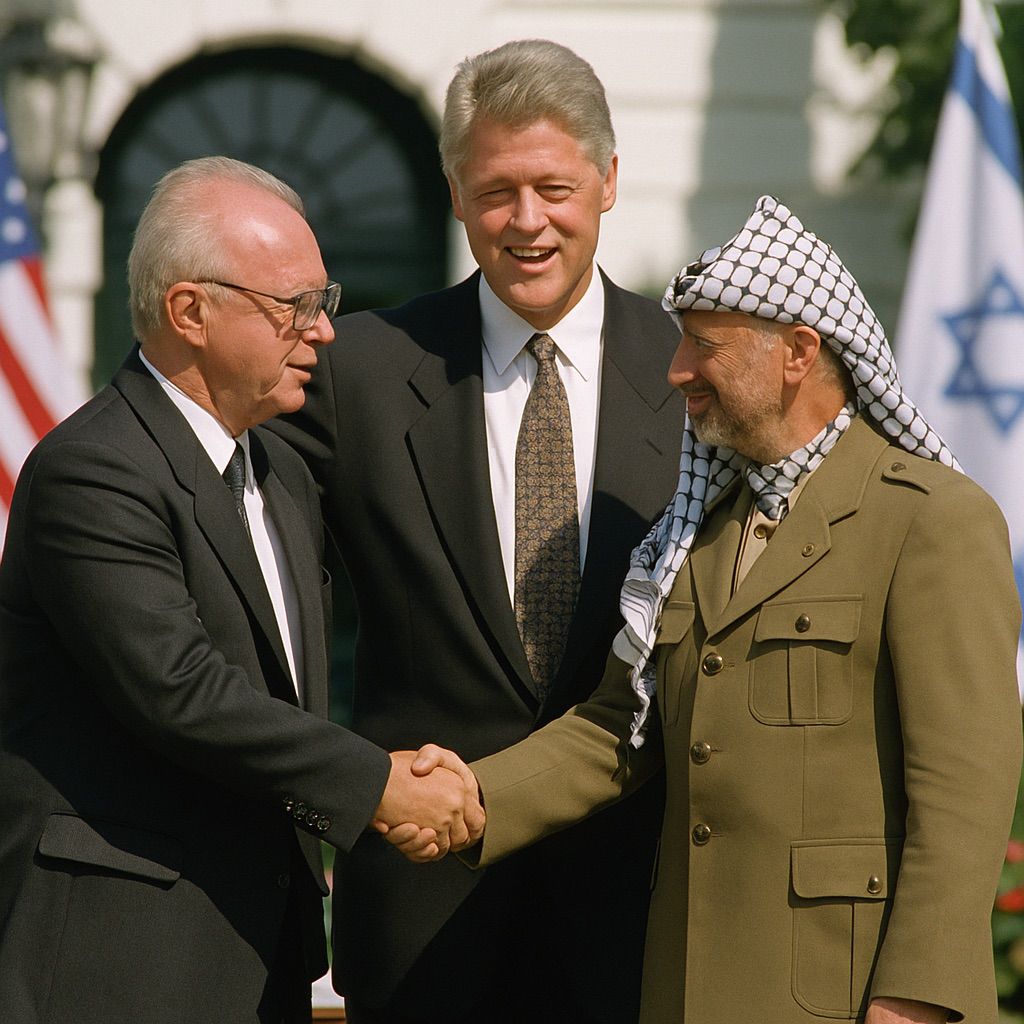
On September 13, 1993, the world stopped for a moment. Cameras from every major news network fixed their lenses on the White House lawn, where a stage had been carefully arranged, flags fluttering against the bright Washington sky. On that stage, U.S. President Bill Clinton stood between two men who had spent most of their adult lives as enemies. To his left was Yitzhak Rabin, the Prime Minister of Israel, a military man hardened by decades of war and conflict. To his right stood Yasser Arafat, the Chairman of the Palestine Liberation Organization, long branded as an adversary of Israel and reviled by many as a symbol of violence. Yet on that warm September day, the two men clasped hands — a simple gesture that carried the weight of centuries of struggle, bitterness, and bloodshed. The handshake, immortalized in photographs and broadcast worldwide, symbolized the signing of the Oslo Accords and briefly made peace between Israelis and Palestinians seem within reach. It was a moment so rare, so charged with history, that it seemed less like politics and more like theater, where hope itself was the protagonist.
The Oslo Accords were not born in grandeur. They began in secrecy, in quiet meetings in Norway where Israeli and Palestinian negotiators spoke privately, away from the glare of media and politics, in order to imagine something almost unthinkable: mutual recognition and a path to peace. For decades, relations between Israel and the Palestinians had been defined by hostility. Wars in 1948, 1967, and 1973 had left scars not only on land but on identity. Generations of Palestinians had lived in refugee camps, while generations of Israelis had grown up under the shadow of existential threats. The PLO, led by Arafat, had been seen in Israel as an irreconcilable enemy. Israel, in turn, was seen by many Palestinians as an occupying power denying them their homeland. Against this backdrop, the Oslo negotiations were astonishing not because of what they produced on paper, but because they happened at all. To talk, to sit across the table from one another, to draft letters of recognition — that itself was a revolution.
By the time the accords were brought to Washington for formal signing, anticipation had grown into something electric. The scene on the White House lawn looked like a diplomatic pageant, carefully choreographed to project optimism. Clinton, towering and beaming, placed his long arms around both Rabin and Arafat like a mediator bringing together estranged family members. Secretary of State Warren Christopher and Russian Foreign Minister Andrei Kozyrev stood by, reminding the world that peace was not only a regional matter but a global one. And then came the moment: after signing documents that recognized the PLO as Israel’s legitimate partner, and recognized Israel’s right to exist in peace, Rabin and Arafat turned toward each other. They paused, hesitated. Rabin, famously reserved and wary, seemed reluctant. But then his hand reached out, Arafat’s hand met it, and history was sealed in a photograph. For a world so accustomed to images of conflict in the Middle East, the picture of these two hands clasped together was nothing short of revolutionary.
Yet the power of that handshake lay not only in what it symbolized politically, but in what it meant emotionally. For Israelis and Palestinians alike, it represented a sliver of hope — the idea that decades of hostility might finally give way to compromise, that children might grow up without the constant echo of gunfire or the fear of bombs. For Americans, it was a rare foreign policy triumph, a chance to witness their leaders brokering peace rather than war. For the world, it was proof that even the most bitter conflicts could, at least for a moment, bend toward reconciliation. The White House lawn that day was more than a stage. It was a canvas upon which the idea of peace was painted for all humanity to see.
But peace, as history shows, is fragile. The Oslo Accords were both groundbreaking and incomplete. They outlined principles — the establishment of the Palestinian Authority, limited self-governance in parts of the West Bank and Gaza, mutual recognition — but they left many issues unresolved. Jerusalem, refugees, settlements, security arrangements — the thorniest questions were deferred. Even in that moment of celebration, critics warned that the agreements were vague, that they postponed the hardest problems, that they might collapse under the weight of reality. And indeed, as the years went by, violence, mistrust, and political shifts eroded much of the hope that had been ignited in 1993. Rabin himself, the man who shook Arafat’s hand, would be assassinated two years later by an Israeli extremist opposed to peace. Arafat would face accusations of failing to prevent violence, and the peace process would stall, then unravel. The handshake on the White House lawn remains frozen in time, not because it delivered peace, but because it symbolized how close — and how far — the world was from achieving it.
Even so, the Oslo moment remains iconic because it distilled something fundamental about human aspiration. For one afternoon, centuries of pain gave way to possibility. The handshake embodied the paradox of peace: that it is both impossibly hard and yet heartbreakingly simple. To clasp another’s hand is to acknowledge their humanity, to say, “I see you not as an enemy, but as a partner.” That simple act, performed in front of the world, was powerful enough to transcend cynicism. It reminded us that politics is not just about power and territory, but about courage — the courage to do what feels unnatural after generations of conflict, the courage to risk appearing vulnerable in front of the world.
Looking back today, three decades later, the Oslo handshake is often remembered with bittersweet emotions. It was a photograph that adorned magazine covers, textbooks, and history lessons, celebrated as a milestone of diplomacy. But it is also remembered as a moment of lost opportunity, a brief high point before disillusionment returned. Critics argue that the accords failed to address the core grievances, that they allowed both sides to claim victory without making the sacrifices necessary for real peace. Supporters counter that without Oslo, there would have been no framework for later negotiations, no precedent for recognition, no glimpse of what coexistence might look like. Either way, the image remains, lodged in the world’s memory: two hands meeting across a divide that had seemed unbridgeable.
There is a reason that people still talk about the “handshake on the White House lawn.” It was not just a diplomatic formality. It was theater, symbolism, and sincerity wrapped into one. It showed that history is not only made in battlefields and boardrooms but also in gestures that resonate across cultures. The photograph of Rabin and Arafat shaking hands became shorthand for hope itself, proof that even the deepest conflicts can, for a fleeting instant, bend toward peace. And that is why, even as the decades since Oslo have been filled with setbacks, the image continues to inspire. It is not a record of peace achieved. It is a reminder of peace imagined.
The Oslo Accords remind us that progress is rarely linear, that history is often marked by moments of possibility that are fragile and fleeting. Yet they also remind us that imagination matters. Without imagination, without the willingness to dream that enemies can one day shake hands, there is no progress at all. On September 13, 1993, the world was given a vision — incomplete, fragile, and fleeting, yes, but a vision nonetheless. And in a world too often defined by division, sometimes a vision is enough to keep hope alive.