
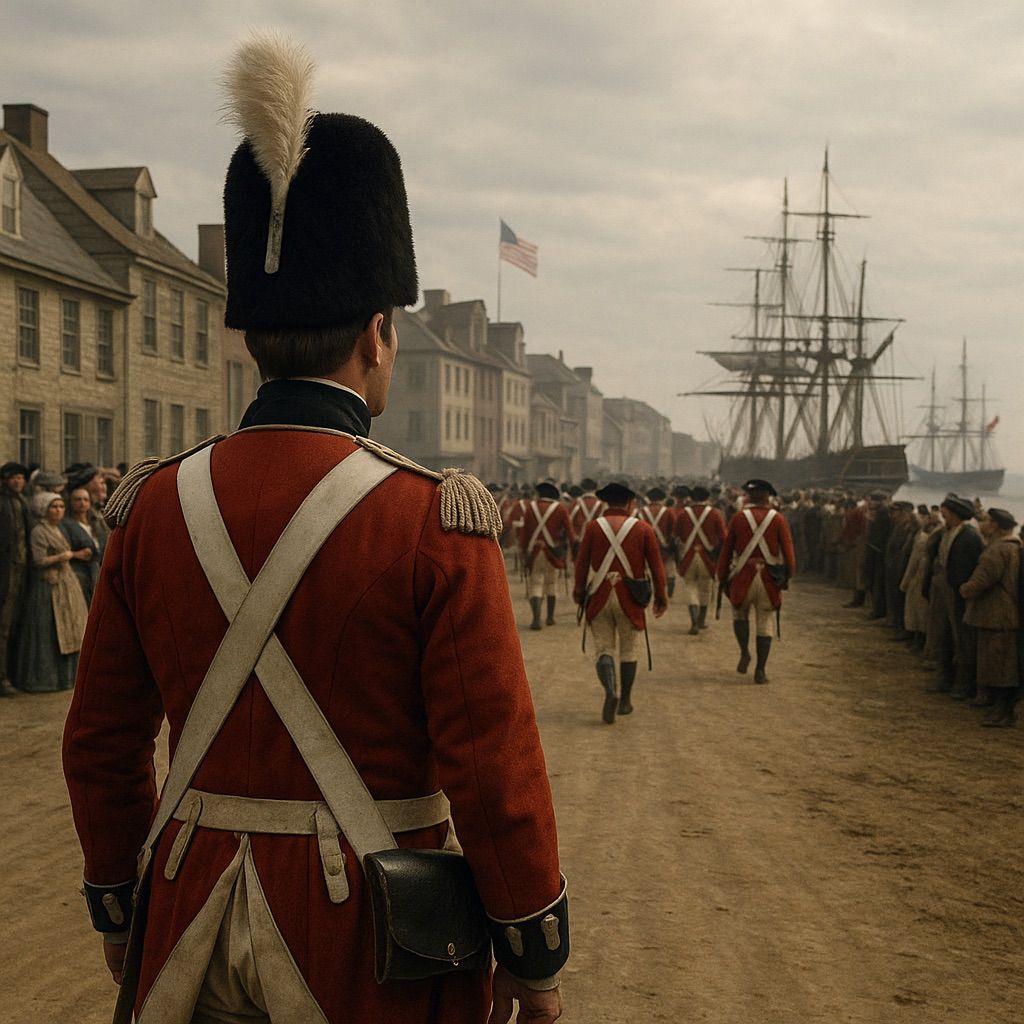
On November 25, 1783, something happened in New York City that would echo far beyond the streets, harbors, and fortifications that framed the moment. It was not a battle, nor a treaty signing, nor a soaring speech delivered from the steps of a grand building. It was, in a sense, the opposite: an ending, a departure, a quiet unraveling of what had once been one of the most powerful political and military presences on the continent. On that chilly afternoon, after years of war, occupation, fear, and uncertainty, the last British troops boarded their ships and sailed away from New York Harbor. The moment might have looked deceptively simple—troops marching, anchors lifting, sails unfurling—but beneath its surface churned a deep and unspoken recognition: the American Revolution had not only succeeded; it had become irreversible.
The British withdrawal from New York didn’t happen overnight. For most of the war, the city served as Britain’s main stronghold in North America, a fortified hub of military strategy, loyalist refuge, command operations, and political influence. The British flag had flown over New York since 1776, when General Howe’s forces overtook Washington’s Continental Army in a series of crushing defeats that forced the patriots into retreat. From that moment on, New York was more than a city—it was a symbol of British persistence, a reminder that the empire still had teeth, still had soldiers on the ground, still had a way of asserting itself despite setbacks elsewhere. Losing Boston might have been tolerable. Losing Philadelphia might have been frustrating. But New York? That would be a blow to imperial pride that few in London were willing to contemplate.
For the residents of the city, life under British occupation took on a strange dual existence. On one side were loyalists—men and women who believed the crown represented stability, prosperity, and order. On the other side were patriots—those who saw British control as a painful intrusion, a constant reminder of lost freedoms. Between them stood countless others simply trying to survive, to feed their families, to avoid drawing attention to themselves. Some residents fled. Others stayed, building lives amid the fog of war, raising children, running shops, navigating shortages, and whispering about the future in kitchens and taverns. British officers attended balls and dinners. Soldiers drilled in open squares. Loyalist merchants carried on with business. And somewhere, miles away, the Continental Army fought on, refusing to yield.
As the war dragged on, however, the British grip weakened. Cost, distance, casualties, and political fatigue in London all chipped away at morale. The surrender at Yorktown in 1781 wasn’t the official end of the war, but it signaled a shift so profound that the British government began reconsidering the entire effort. Peace negotiations eventually opened in Europe, and by 1783 the Treaty of Paris formally recognized American independence. Yet New York—still occupied, still bristling with British regiments—remained a loose thread in a tapestry that otherwise proclaimed freedom.
Preparing to evacuate an entire city wasn’t simply a matter of pulling up stakes. For the British, it meant organizing thousands of troops, supplies, wagons, artillery pieces, and tents. It meant dismantling command posts, clearing barracks, and methodically packing away the material remnants of power. It also meant deciding the fate of thousands of loyalists who feared what might happen once British protection was gone. Many had burned bridges with neighbors, declared allegiance to the crown, or fought directly against the patriots. Staying now was unthinkable. For these families, the evacuation was not a moment of closure—it was the beginning of exile. Ships filled with loyalists departed for Nova Scotia, the Caribbean, or Britain itself, carrying with them the heartbreak of displacement, the fear of the unknown, and the lingering bitterness of a war they believed had betrayed them.
By the time evacuation day arrived, an almost electric energy filled the air. New Yorkers had waited years for this moment, and though they didn’t know exactly how it would unfold, they felt the magnitude of what was coming. Crowds gathered. Children climbed onto crates and fences to gain a better view. Merchants closed their shops. Soldiers of the Continental Army, though weary, stood straighter that morning. And somewhere within the gathering excitement, anxiety lingered—would the British truly leave peacefully? Would there be last-minute violence? Would loyalists sabotage the departure? No one could be sure.
But as the morning progressed, a strange calm settled. The final red-coated regiments marched toward the waterfront, their uniforms crisp, their steps measured. They were not an army in collapse. They were professional soldiers following orders, carrying themselves with the dignity of men who knew they had fought valiantly, even if the outcome had slipped beyond their grasp. Cannon pieces were rolled into position on the ships. Crates were hoisted aboard. Officers gave final instructions. Then, slowly, the British troops boarded the vessels that would take them away from a city they had occupied for seven long years.
Perhaps the most symbolic moment of the day came as the British lowered their Union Jack from a flagpole at Fort George. Legend has it that the British had mischievously greased the pole to stop the Americans from raising their own flag. But a local young man, agile and determined, managed to climb it regardless, ripping out nails and clearing the obstruction before planting the American flag at the top. Whether the details unfolded exactly this way scarcely matters now—the moment represented something beyond logistics. It symbolized a transition, a reclaiming, a jubilant assertion of identity. With that flag unfurled in the November breeze, New York City officially became American once more.
Then, as crowds watched, the British fleet pulled away from the harbor. Some ships turned toward Canada. Others set course for the Caribbean or England. Their sails caught the wind, and the familiar red coats faded into the distance. In their wake, the harbor—once patrolled by the mightiest navy in the world—stood open and unguarded. The empire had departed. The city exhaled.
As the British ships receded, George Washington and his Continental troops entered the city in what became known as “Evacuation Day,” a celebration that continued annually for decades. Washington, who had once been forced to flee New York in humiliation, now marched in triumph. Crowds lined the streets, cheering, waving, throwing flowers. No one could deny the emotional weight of the moment. Washington’s presence signaled that the war was not just won on the battlefield but in the hearts of the people. He rode through the city not as a conqueror but as a liberator, a living symbol of perseverance, dignity, and quiet determination.
That night, Washington dined with local leaders, raising glasses to peace, unity, and the promise of a new nation. The celebrations spilled into streets and taverns. For a city that had endured occupation for so many years, the feeling of liberation was almost overwhelming. People danced. They sang. They embraced neighbors they hadn’t spoken to since the war began. They allowed themselves, perhaps for the first time, to imagine a future in which their city could flourish, not as a pawn in a geopolitical struggle, but as a cornerstone of a new republic.
The departure of the last British troops marked more than the end of a military occupation. It signaled the closing chapter of the American Revolution and the beginning of something entirely new—a shift from rebellion to nation-building. It was a moment of clarity, a collective acknowledgment that America was now responsible for its own destiny. No empire stood over it. No foreign troops lingered on its soil. Its capital, its trade, its identity, and its governance were in the hands of its own people.
Looking back now, Evacuation Day might seem overshadowed by more famous events like the signing of the Declaration of Independence or the victory at Yorktown. But in 1783, it carried a significance that every New Yorker could feel in their bones. It was proof that the war was truly over. Proof that the British acknowledged American independence not just on paper but in physical withdrawal. Proof that Washington’s perseverance had not been in vain. And proof that a city—burned, divided, occupied, and battered—could reclaim its spirit.
The city that the Continental Army entered in 1783 was not the glittering metropolis we know today. Buildings had been damaged. Some had burned. The population had shrunk. Businesses struggled. Infrastructure was weak. Yet beneath the scars lay something resilient: the will to rebuild. New York’s revival in the postwar years would be nothing short of astonishing, eventually growing into one of the most powerful and influential cities in the world. And in a way, that growth can be traced back to that single moment when British troops stepped aboard their ships and left the harbor behind.
Today, Evacuation Day is not widely celebrated. It faded over time, overshadowed by Thanksgiving, absorbed into the broader tapestry of American memory. But the significance of November 25, 1783, hasn’t vanished. It lives in the architecture of the city, in the archives of its history, and in the collective identity of a nation that was still in its infancy when the last red coat disappeared over the horizon. It remains a reminder of perseverance, of transformation, and of the quiet, powerful moments that truly define the shape of history.
The departure of the British marked an end—but it also marked a beginning. A new nation stood on the edge of possibility, free to shape its own destiny. And in that sense, the ships that left New York Harbor carried away more than soldiers. They carried away an era. What remained was something extraordinary: a chance to build a nation from the ground up, guided not by an empire across the sea but by the hopes, ambitions, and ideals of the people who called it home.